You're probably in the same spot a lot of Columbus homeowners hit after a few drives through the neighborhood. You've seen more roofs with solar. Some have the familiar raised black panels. Others look almost flush, cleaner, and more integrated. Then the questions start. Will panels hurt the roof? Are shingles better in wind and hail? If the roof needs work anyway, does it make sense to combine everything into one project?
That decision isn't just about electricity. It's a roofing decision first.
From a roof contractor's perspective, solar shingles vs solar panels comes down to how each system interacts with the part of the house that keeps water out, handles storm loads, and takes the punishment of Ohio weather year after year. Energy output matters. Payback matters. But if the roof assembly is wrong, the rest of the math gets ugly fast.
Here's the side-by-side view homeowners usually need before they ask for quotes.
| Category | Traditional Solar Panels | Solar Shingles |
|---|---|---|
| Basic design | Mounted above the roof on a rack system | Integrated into the roof surface |
| Roof relationship | Add-on to an existing or new roof | Roofing material and solar system together |
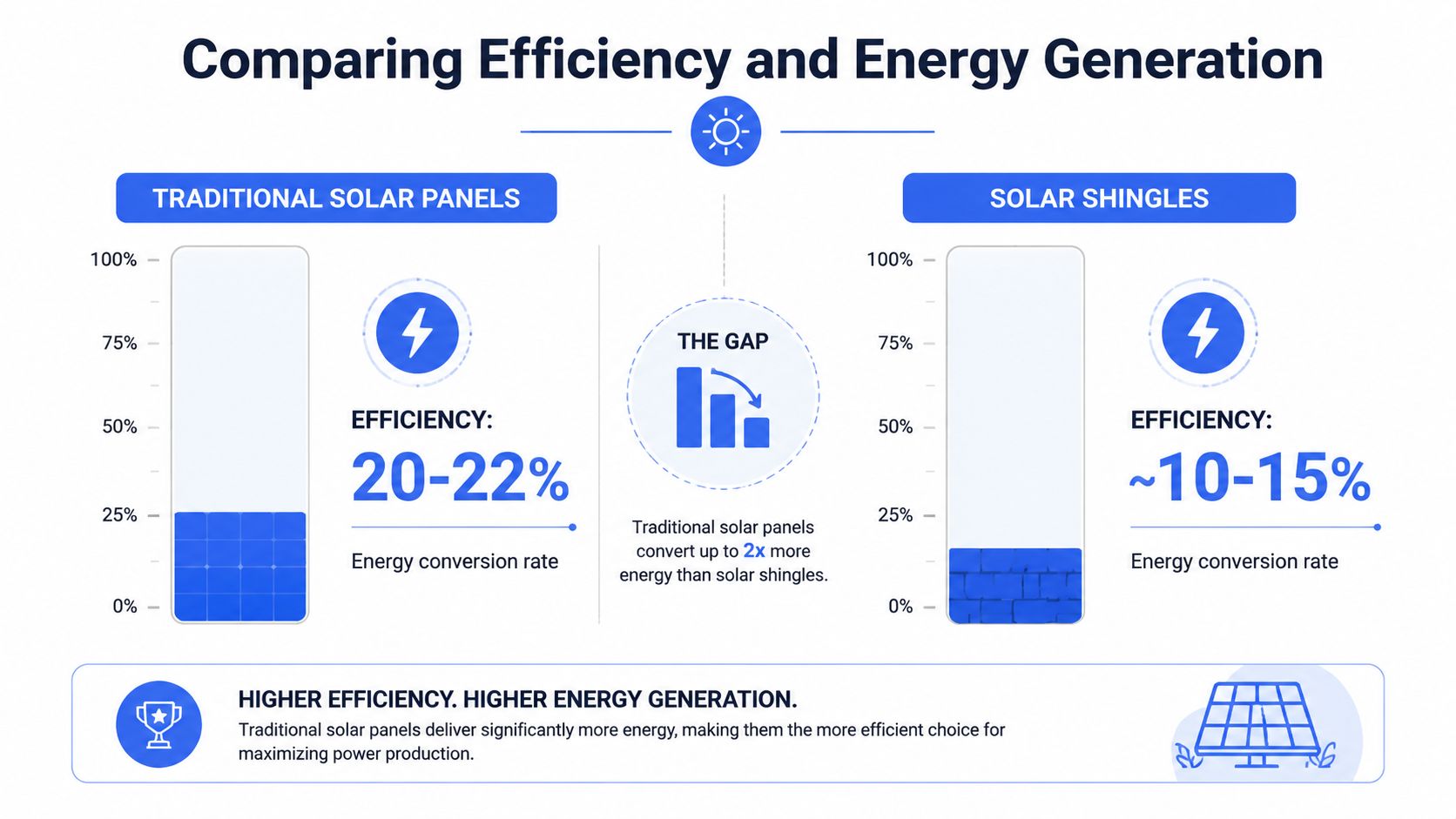
| Efficiency | 20-22%, with premium models exceeding 24% according to A1 SolarStore's comparison | Typically 14-18% according to Hixons Roofing's comparison |
| Cost range | $20,000-$30,000 according to Enphase's solar shingle analysis | $60,000-$75,000 according to Enphase's solar shingle analysis |
| Aesthetics | More visible from the street | Lower profile, more integrated look |
| Repair path | Solar components and roofing are more separable | Roofing and solar are tightly linked |
| Best fit | Homeowners prioritizing output, value, and simpler serviceability | Homeowners prioritizing appearance and planning a premium roof replacement |
Table of Contents
- Your Guide to Home Solar in Central Ohio
- Understanding the Two Paths to Solar Power
- Analyzing the Real Cost and Payback Period
- Comparing Efficiency and Energy Generation
- Roof Integration and Installation Realities
- Ohio Weather Durability Hail and Insurance
- The Verdict for Columbus Homeowners
Your Guide to Home Solar in Central Ohio
A common Columbus scenario goes like this. A homeowner starts out shopping for lower electric bills, then realizes the roof is old enough that any solar decision is tied to the next roofing decision. That's where a lot of online solar comparisons stop being useful. They talk about production and aesthetics, but they don't spend enough time on flashing details, roof age, repair access, or what happens after a hail event.
In Central Ohio, that roof-level view matters. Some homes have simple ranch layouts with clean planes that make panel layout easy. Others have hips, valleys, dormers, skylights, chimneys, and aging shingle systems that complicate every part of a solar install. If the roof is already showing wear, it makes sense to answer the roof question before the solar question. A basic first step is figuring out whether the current roof still has enough life left, which is why this guide on how to know if you need a new roof is worth reading before you compare products.
What homeowners usually miss
When considering these options, initial questions often revolve around which looks better or pays back faster. Reasonable questions. But the more practical questions are often these:
- How many roof penetrations are involved: Mounting methods, flashing quality, and installer discipline all matter.
- What happens if one component fails: A roof should stay serviceable without turning a small fix into a major tear-off.
- How the system handles Ohio storms: Wind-driven rain, hail impact, and freeze-thaw cycles test every weak point.
A solar system can be a good energy upgrade and still be the wrong roofing move for the house underneath it.
That's why the right answer isn't the same for every property. A newer roof with strong remaining life often points one way. A home headed toward a full replacement, with a homeowner who highly values curb appeal, can point another.
Understanding the Two Paths to Solar Power
The cleanest way to understand solar shingles vs solar panels is to start with how each one sits on the house.
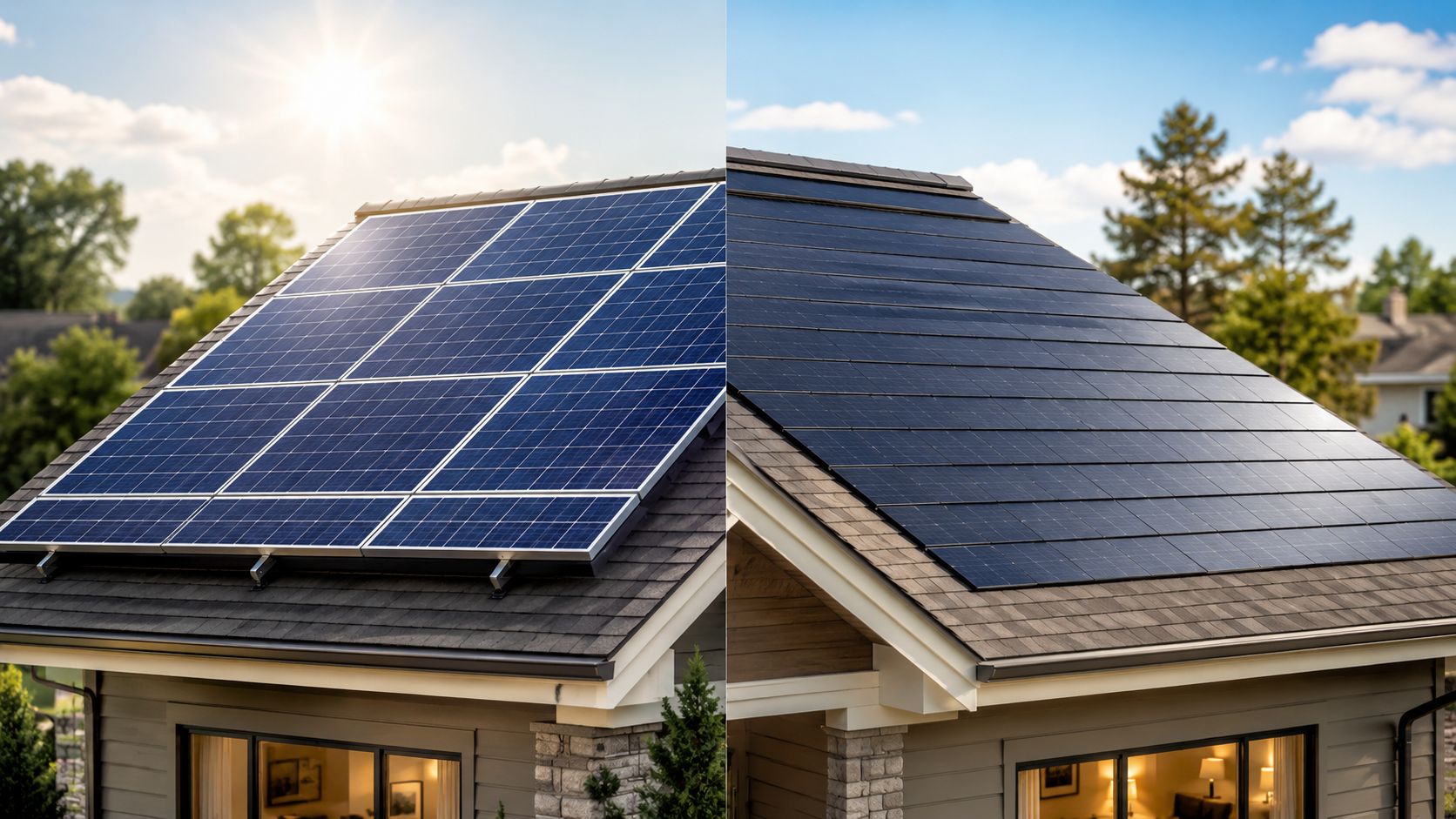
Traditional solar panels are an above-roof system. The roofing material remains the primary water-shedding layer, and the solar array gets mounted on top through a rack system designed for attachment, flashing, and drainage management. The roof still does the roofing job. The solar system rides above it.
Solar shingles are different. They're part of a building-integrated assembly. Instead of attaching a generating system over finished roofing, the generating surface becomes part of the roof covering itself. That changes installation, service, repair, and warranty questions from day one.
How traditional panels interact with the roof
With a panel system, the roofing contractor and solar installer need to respect the same basics that govern any penetration through a roof. Attachment points must land where they belong structurally. Flashing has to be correct. Water has to keep moving downhill without finding an opening.
That setup has one practical advantage. The roof system and the power-generating system are distinct enough that each can often be evaluated and serviced on its own. That doesn't remove risk, but it does keep the assembly more familiar from a roofing standpoint.
How solar shingles change the equation
Solar shingles compress two jobs into one product. They're expected to protect the house from weather while also generating power. That's appealing on the curb, especially for homeowners who dislike the look of rack-mounted panels.
If you want a visual example of that integrated approach, this overview of installing Tesla Solar Roofs for Florida properties is useful because it shows how different the planning becomes when the roof itself is the solar system.
Raised panels are an attachment strategy. Solar shingles are an assembly strategy. That difference affects everything downstream.
The practical takeaway is simple. Panels are an addition to a roof. Solar shingles are a replacement strategy that happens to generate electricity.
Analyzing the Real Cost and Payback Period
A lot of Columbus homeowners get serious about solar right after they get serious about their roof. The question usually sounds simple. Which option costs less over time? On the roof, the answer depends on more than the purchase price.
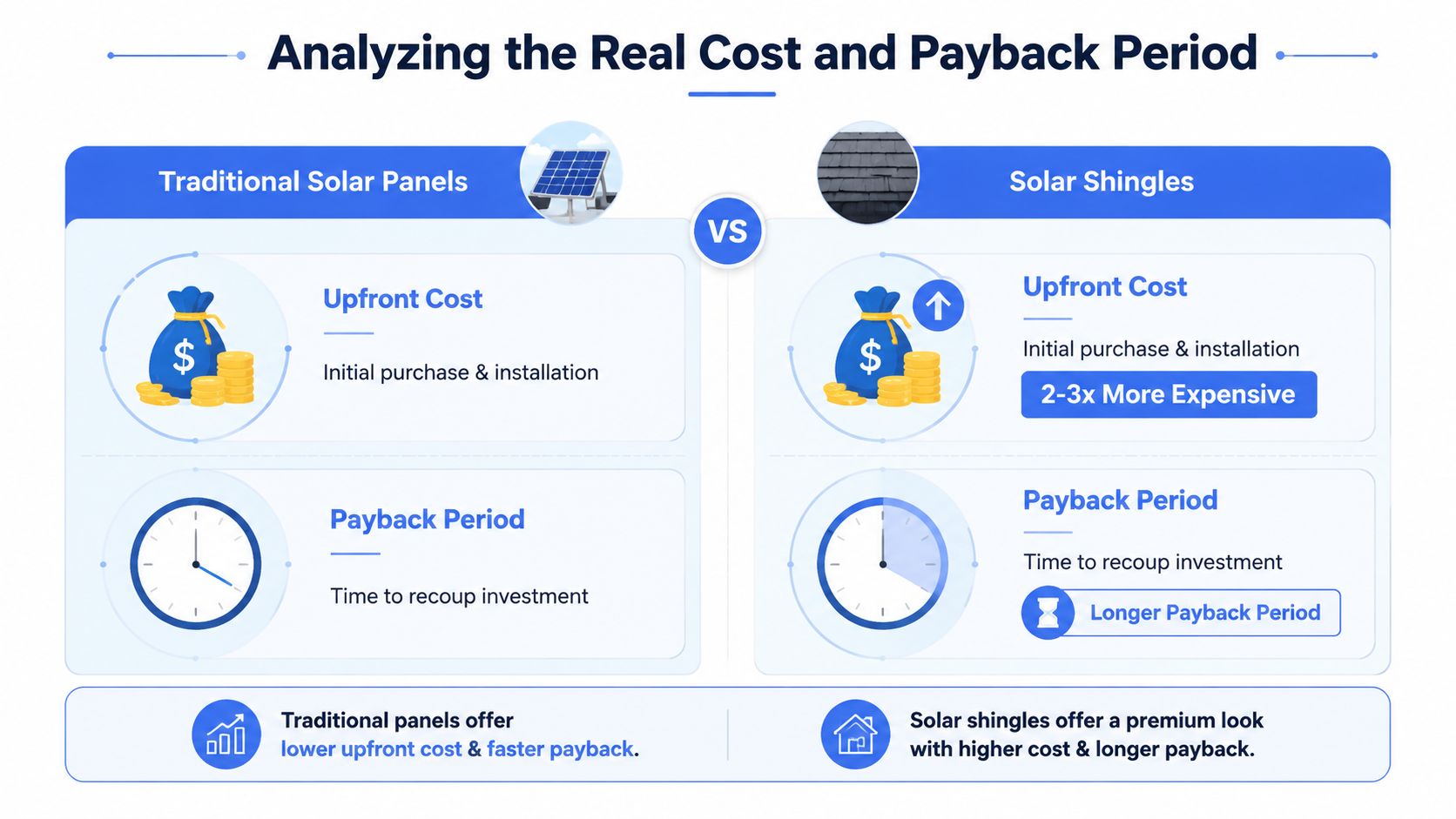
Solar shingles usually come with a much higher entry cost than a standard panel system. That gap matters because it changes monthly financing pressure, how long it takes to see meaningful savings, and how much room you have if the roof needs service before the system has paid for itself.
Why the payback discussion looks different from a roofer's side
From a roofing contractor's perspective, the actual cost is tied to the assembly, not just the equipment. Panels are typically easier to price as a separate system sitting on top of an existing roof. Solar shingles blur that line because part of what you're paying for is roofing material, part is power generation, and part is specialized installation that fewer crews are equipped to handle well.
That matters for warranty and future repair planning. If a conventional shingle roof under panels develops a problem, the roof issue and the solar issue can often be isolated more cleanly. With solar shingles, those lines are less clear. One section of roof is doing two jobs at once.
The money question changes fast when the roof is not new.
If the home already needs a full replacement, some homeowners are willing to absorb the premium for a roof-integrated product because they were already preparing for a major roofing expense. If the existing roof still has solid life left, tearing into it for solar shingles is harder to justify. In that case, traditional panels usually offer a shorter path to reasonable payback and less disruption to a roof system that is still performing.
Bottom line: A higher-end solar roof can make sense for appearance-driven projects, but it often takes more time and more favorable assumptions to justify financially.
Here's a practical way to frame the cost conversation:
| Financial question | Traditional Panels | Solar Shingles |
|---|---|---|
| Lower entry cost | Usually yes | Usually no |
| Easier to separate roof cost from solar cost | Yes | Less so |
| Better fit for budget-driven buyers | Usually yes | Rarely |
| Better fit for premium curb-appeal buyers | Sometimes | Often |
A lot of homeowners also benefit from seeing the concept explained visually before they compare bids.
Where roof age and service risk affect the numbers
Payback calculations often look neat on paper. Roof service calls do not.
In Ohio, that difference matters. Hail, wind-driven rain, and freeze-thaw movement put stress on roofs over time, and any solar system has to live through those conditions without turning a simple roof repair into a specialty project. A standard panel setup can still create complications, but the roof below it remains a familiar roofing assembly. An integrated solar shingle roof can be harder and more expensive to troubleshoot because weatherproofing and power generation are tied together in the same field of materials.
That is why I tell homeowners to price the project in two ways. First, look at install cost and estimated energy savings. Then look at what happens if you need a repair in year eight, a warranty claim in year twelve, or partial replacement work after a storm. Those are roof-level costs, and they change the payback story more than many sales proposals admit.
Comparing Efficiency and Energy Generation
A Columbus homeowner with a few shaded roof sections and a couple of vent stacks does not have unlimited room to work with. In that situation, output per usable square foot matters, and standard solar panels usually win.
As noted earlier, the efficiency gap is real. Traditional panels produce more power from the same roof area than solar shingles. That matters more on actual homes than it does on a sales sheet, because real roofs have hips, valleys, plumbing vents, chimneys, and sections that lose production from tree cover or neighboring houses.
Why the performance gap shows up in the field
Panels sit above the roof surface, so air can move underneath them and carry off heat. Solar shingles sit tight to the roof plane. They run hotter, and hotter solar products generally produce less power.
From a roofing contractor's perspective, that is not just an energy issue. It is a roof-behavior issue. Flush-mounted products keep more activity at the roof surface, where heat, fasteners, underlayment, and water management all have to keep working together year after year through Ohio summers and winter freeze-thaw cycles.
Roof layout also changes the equation fast. On a simple south-facing roof with long clean runs, either product has a fair chance to perform well for its category. On cut-up rooflines, the lower-output option gives up ground quickly because each obstruction takes away a larger share of the system's potential.
Here is the practical read:
- Limited usable roof area: Panels usually make better use of the sections worth installing on.
- Complex roof geometry: Solar shingles can run out of productive area sooner.
- Higher household demand: Panels are often the only realistic path to covering most of the load.
- Appearance-first projects: Shingles can make sense if the homeowner accepts lower production as part of the design choice.
I also look at serviceability when homeowners ask about output. A system that looks clean on day one but limits future roof access has a cost tied to that design. If you are comparing bids, this guide on how to choose a roofing contractor for solar and roof work helps sort out who is actually thinking through roof condition, flashing details, and long-term maintenance.
One other caution. Some companies present an energy comparison well but gloss over roof trade-offs because the sales process is stronger than the field execution. That gap is common in home services, and even a piece on marketing roofing company shows how easy it is for branding to outpace workmanship.
Solar shingles still have a place. Homeowners choose them for appearance, lower visual profile, and tighter roof integration. But if the question is simple roof-top production, panels usually deliver more electricity with fewer compromises in how much usable roof area you need.
Roof Integration and Installation Realities
Here, a roofing contractor tends to get more cautious than a solar salesperson.
A panel install can be done well. There are mature mounting systems, established flashing methods, and clear ways to inspect workmanship. But it still depends on installer quality. A sloppy crew can create leak paths, mis-handle penetrations, or mount over a roof that should never have been used as the base for a long-term solar investment.
Panels ask for disciplined details
When panels go on a roof, the installer has to respect the same basics that govern skylight flashing, pipe boots, and any other interruption to the roof plane. Attachment and waterproofing details can coexist with a manufacturer-backed roof system if the work is coordinated correctly and the roof itself is suitable for it.
That's why contractor selection matters so much. If you're comparing bids, this guide on how to choose a roofing contractor gives homeowners a practical checklist for separating a polished sales process from qualified roof work.
A side point that's easy to miss is that many companies look stronger online than they are in the field. If you're curious how that happens, this breakdown of marketing roofing company is a good reminder that visibility and workmanship aren't the same thing.
Solar shingles raise the stakes
With solar shingles, there's less separation between roofing material and generating equipment. If installation quality is poor, you're not just dealing with a questionable accessory mounted on top of a roof. You're dealing with the roof assembly itself.
That changes the risk profile in a few ways:
- Repair access gets more complicated: Troubleshooting may involve both roofing and electrical considerations.
- Warranty questions get more layered: Responsibility can be harder to sort out if a problem touches weatherproofing and power generation.
- Replacement planning gets narrower: Future modifications are less modular than they are with conventional panels.
A roof should be serviceable. When the roofing surface and the generating surface become one system, every future repair decision gets more specialized.
For a homeowner who values straightforward maintenance, conventional roofing plus conventional panels is usually the cleaner path. For someone committed to a premium integrated look, the installation team has to be even better because there's less margin for error.
Ohio Weather Durability Hail and Insurance
A June hailstorm hits the west side of Columbus. The next morning, the question is not just whether the solar system still produces power. The primary question is what got damaged, how easy it is to inspect, and whether the roof can be restored without a fight between trades, warranties, and insurance.
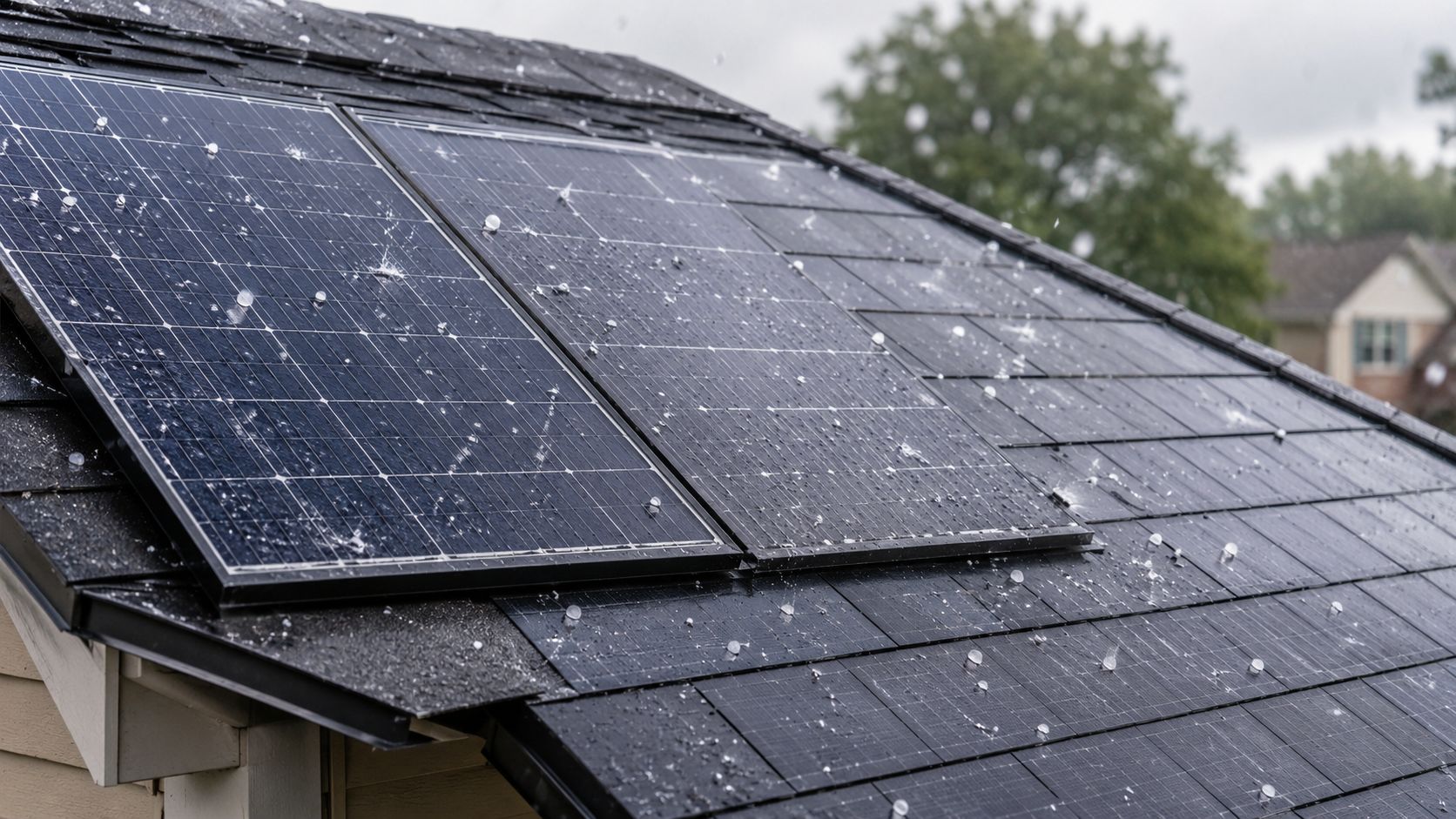
Ohio weather tests the roof system first
From a roofer's perspective, traditional panels and solar shingles do not face storm risk in the same way. Rack-mounted panels sit above the roof covering, so I can usually inspect the field shingles, flashing areas, and impact marks as separate parts of the assembly. Solar shingles blur that line. If hail strikes the power-producing surface, the roofing surface may be part of the same repair conversation.
Heat also matters here. As noted earlier, flush-mounted solar roofing tends to run hotter than raised panel systems with open airflow beneath them. In Ohio, where roofs cycle through freeze, thaw, summer heat, and hard rain, extra heat at the roof surface deserves attention because movement and aging never stop.
Hail damage is harder to sort when the roof is the solar product
After a storm, homeowners need clear answers before they call it minor damage.
- Who inspects the roof covering: A solar salesperson is not the same as an experienced storm inspector.
- Who documents impact damage: Carriers want photos, test areas, and a clear explanation of what failed.
- Who removes and reinstalls the system if roof work is needed: That step often controls the claim timeline.
- Who owns the warranty question: Roofing warranty, solar equipment warranty, and workmanship warranty can point in different directions.
That last point gets overlooked. With conventional panels, a hail claim often has cleaner separation between the roofing repair scope and the solar scope. With solar shingles, those scopes can overlap fast, especially if broken units also affect weatherproofing.
If you're dealing with a recent storm, this guide to hail damage roof issues in Columbus, Ohio helps homeowners understand what inspectors look for before the solar layer complicates the diagnosis.
Insurance questions should be asked before installation day
Homeowners should know how the carrier treats attached solar, integrated solar roofing, detach and reset labor, and partial repairs. Those details matter more after a loss than the sales presentation ever suggests. A useful starting point is Coverage Axis for solar insurance, which outlines contractor and coverage issues worth reviewing before you sign a contract.
The practical takeaway is simple. In Central Ohio, the easier a system is to inspect, isolate, and repair after hail, the lower the chance of a messy claim and a prolonged roof problem. That usually favors a conventional roof with conventional panels, especially for homeowners who care about long-term serviceability as much as solar output.
The Verdict for Columbus Homeowners
A Columbus homeowner calls after a spring hailstorm. The question is not which solar system looked better on install day. The question is which roof can be inspected, repaired, and put back into service without turning one loss into three separate problems.
For most Columbus-area homes, traditional solar panels are the better practical choice.
From a roofing contractor's standpoint, panels usually give homeowners a better balance of output, cost control, service access, and fewer complications when the roof needs repair later. They also match how many homes in Central Ohio are built and maintained. A conventional shingle roof with a properly installed rack-mounted array is easier to inspect, easier to price for future work, and easier to sort out after wind, hail, or normal roof aging.
Choose panels when function leads
Traditional panels are the better fit if these priorities sound like yours:
- You want the most energy production from the roof area available
- You care about upfront cost and a cleaner payback path
- You want a simpler repair process if the roof or solar system needs service
- Your roof is in good condition, or you're replacing it with a conventional roofing system first
That combination makes sense on Ohio roofs. It keeps the roofing assembly familiar and keeps the solar equipment more modular.
Consider shingles when appearance leads
Solar shingles can make sense for a narrower group of homeowners. They fit best when curb appeal matters most, a premium full roof replacement was already part of the plan, and the homeowner accepts higher cost and more involved repair logistics in exchange for a lower-profile look.
That is a design-first choice, not a roof-service-first choice. There is nothing wrong with that, as long as the trade-off is clear before the contract is signed.
A practical decision framework looks like this:
| If your top priority is… | Better fit |
|---|---|
| Energy production | Traditional panels |
| Faster financial logic | Traditional panels |
| Straightforward maintenance | Traditional panels |
| Minimal visual impact | Solar shingles |
| Premium integrated appearance | Solar shingles |
| Roof-first practicality in Ohio weather | Traditional panels |
For most homeowners, the winning option is the one that keeps the roof durable, inspectable, and repairable for the next 20 years, not just the one that looks cleaner in a brochure. In Central Ohio, that usually points to conventional roofing paired with conventional panels.
If your roof is part of the solar decision, HIBCO ROOF LLC can inspect the roof first and help you understand whether you're working with a good candidate for solar, a roof that should be replaced before any solar install, or storm-related damage that needs attention before you spend money on upgrades. For Columbus and Central Ohio homeowners, that roof-first approach usually leads to the better long-term decision.







Leave a Reply