A standard asphalt shingle roof replacement in the Columbus area usually falls between $8,000 and $20,000 for many homeowners. National pricing helps frame that range, with a typical 1,700-square-foot asphalt shingle roof running $6,000 to $9,000 and the average U.S. roof replacement reaching $15,000 in 2026 according to Roofing Calculator.
If you're reading this, there's a good chance you've already seen missing shingles, found a ceiling stain, or gotten a quote that made your stomach drop. Roof replacement is one of those home expenses nobody looks forward to, and the hardest part for most homeowners isn't just the price. It's not knowing what's included, what can change the cost, and whether the number in front of you is reasonable for Columbus and central Ohio.
A roof quote can look simple on the surface and still hide important details. Tear-off, disposal, underlayment, flashing, ventilation, permit costs, and damaged roof decking all matter. If those items aren't discussed clearly, it's hard to compare estimates and even harder to budget with confidence.
Table of Contents
- Understanding Your Roof Replacement Cost in 2026
- The Average New Roof Cost in Columbus Ohio
- A Breakdown of Your Roof Replacement Quote
- How Roofing Material Choice Affects Your Cost
- Factoring in Storm Damage and Insurance Claims
- Financing Your New Roof and The Estimate Process
- Your Next Step Toward a Secure and Valuable Home
Understanding Your Roof Replacement Cost in 2026
Most homeowners start with one question. How much does roof replacement cost? In Columbus, the honest answer is that most asphalt shingle projects land somewhere in the $8,000 to $20,000 range, but the final number depends on the roof itself, not just the home size.
A simple ranch with easy access, one layer of old shingles, and no damaged decking will price very differently than a steep, cut-up roof with valleys, chimney flashing, skylights, and soft wood under the shingles. That's why two neighbors with homes that look similar from the street can still get very different estimates.
The biggest mistake I see homeowners make is comparing roof quotes as if they're all pricing the same job. They often aren't. One quote may include full tear-off, new underlayment, ventilation updates, flashing replacement, cleanup, permit handling, and a contingency for wood deck repairs. Another may show a lower base price but leave important items to be added later.
Practical rule: If a quote looks unusually low, ask what happens if the crew finds bad decking, worn flashing, or ventilation problems once the old roof comes off.
Columbus homeowners also have to think about weather. Heavy rain, wind, ice, and storm damage don't care whether a roof was installed cheaply. A lower upfront price can become the expensive choice if details were skipped.
If you're still trying to decide whether you're dealing with a repair or a full replacement, this guide on how to tell if you need a new roof can help you sort out the warning signs. And if your situation involves a manufactured home with structural sagging concerns, this resource on fixing sagging mobile home roofs is worth reading before you commit to the wrong scope of work.
The Average New Roof Cost in Columbus Ohio
Columbus homeowners usually want a baseline before they call anyone. That's fair. You need a working budget, not a vague promise that someone will “take a look.”
What Columbus homeowners usually see
The clearest national benchmark for standard asphalt work comes from Housecall Pro's roofing price guide, which notes that using the 100-square-foot per square pricing model common in 2026, a small home with a 1,200 to 1,600 square foot roof typically runs $6,000 to $10,000, while a midsize home with a 1,600 to 2,400 square foot roof typically runs $9,000 to $18,000. In Columbus, many homeowners end up planning around a practical local expectation of **$8,000 to $20,000 for asphalt shingles because access, pitch, layers, and detail work often adjust the final cost.
Here's a usable budgeting table for central Ohio homeowners.
| Home Size (sq. ft.) | Approximate Roof Size (sq. ft.) | Estimated Cost Range |
|---|---|---|
| Under 1,500 | 1,200 to 1,600 | $6,000 to $10,000 |
| 1,500 to 2,500 | 1,600 to 2,400 | $9,000 to $18,000 |
| Larger or more complex homes | Above 2,400 | Often higher, depending on layout, pitch, and details |
That last row is intentionally qualitative. Once a home gets larger, steeper, or more cut-up, pricing stops behaving like a neat chart. Dormers, intersecting roof lines, chimney work, and limited access can all push the quote upward.
How the per square model works
Roofers often price by the square. One square equals 100 square feet of roof area. If your roof has 2,000 square feet of actual roofing surface, that means it’s a 20-square roof.
That doesn’t mean you can look at your home’s floor plan and estimate perfectly. Roof area is usually larger than interior square footage because of pitch, overhangs, garages, porches, and multi-level sections.
A rough estimate helps, but a field inspection matters more. Measurements need to account for:
- Pitch and walkability. A steeper roof takes more labor and more setup.
- Cut-up design. Valleys, hips, dormers, skylights, and chimneys create more waste and detail work.
- Number of layers. One existing layer is simpler than tearing off multiple layers.
- Accessory components. Flashing, drip edge, vents, pipe boots, and ridge ventilation affect the final number.
The price isn’t based on shingles alone. Roof geometry does a lot of the talking.
A Breakdown of Your Roof Replacement Quote
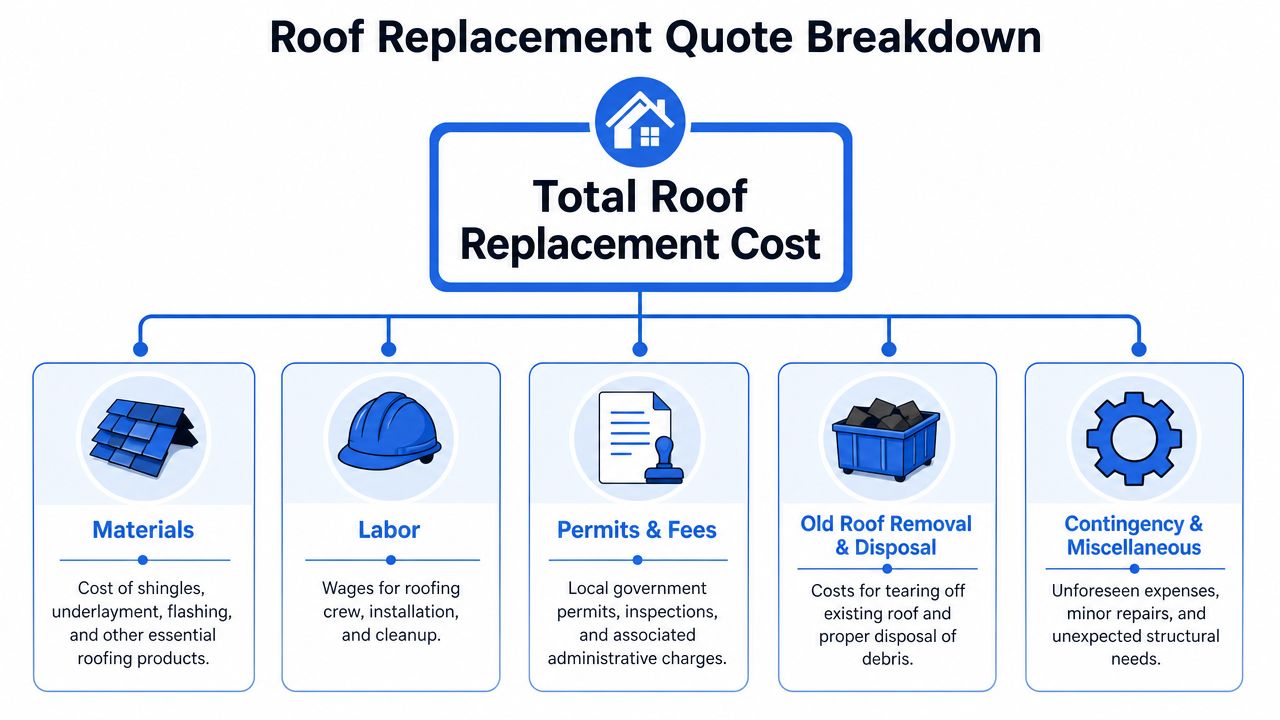
A roofing estimate should read more like an itemized repair order than a one-line lump sum. If it doesn’t, you’re being asked to trust a number without seeing what built it.
The biggest cost buckets
Labor usually takes the largest share. According to Rabbit Roofing’s U.S. roof replacement cost breakdown, labor accounts for about 60% of the final expenditure, and on a $9,000 project, roughly $5,400 goes to labor. That tracks with what homeowners often don’t see from the ground. Tear-off, deck prep, waterproofing details, shingle layout, flashing work, cleanup, and protection of landscaping all take time and skill.
Materials still matter, but “materials” doesn’t just mean shingles. A proper system usually includes underlayment, starter shingles, ridge cap, flashing, drip edge, pipe boots, ventilation components, nails, sealants, and cleanup supplies.
Then there are the hidden line items that surprise people:
- Decking replacement. If plywood or OSB is soft, rotten, or delaminated, it has to be replaced before the new roof goes on.
- Permit fees. Columbus-area jurisdictions may require permits or inspections depending on location and scope.
- Accessory repairs. Fascia, soffit edges, or trim sometimes need attention once the roof is opened up.
If your roof edge shows rot or staining, this guide from Prime Gutterworks on fascia board repair is a useful companion read because edge deterioration often shows up alongside roofing issues.
What a complete quote should show
A strong quote should answer basic questions without you having to drag each answer out of the contractor. Look for these details:
- Scope of tear-off. Does it specify full removal of existing roofing?
- System components. Are underlayment, flashing, drip edge, starter, and ridge materials listed?
- Ventilation plan. Does the quote mention intake and exhaust, or does it ignore attic airflow altogether?
- Cleanup and disposal. Is haul-away included?
- Deck repair terms. Does it explain how damaged wood will be handled if discovered?
A cheap quote often stays cheap by leaving gray areas. That may work on paper. It rarely works on install day.
Ask one direct question: “What could increase this number after the job starts?” A trustworthy roofer should answer that clearly.
How Roofing Material Choice Affects Your Cost
A Columbus homeowner can get two roof quotes for the same house and see a large price gap. In many cases, the material choice is the reason.
Asphalt shingles for practical value
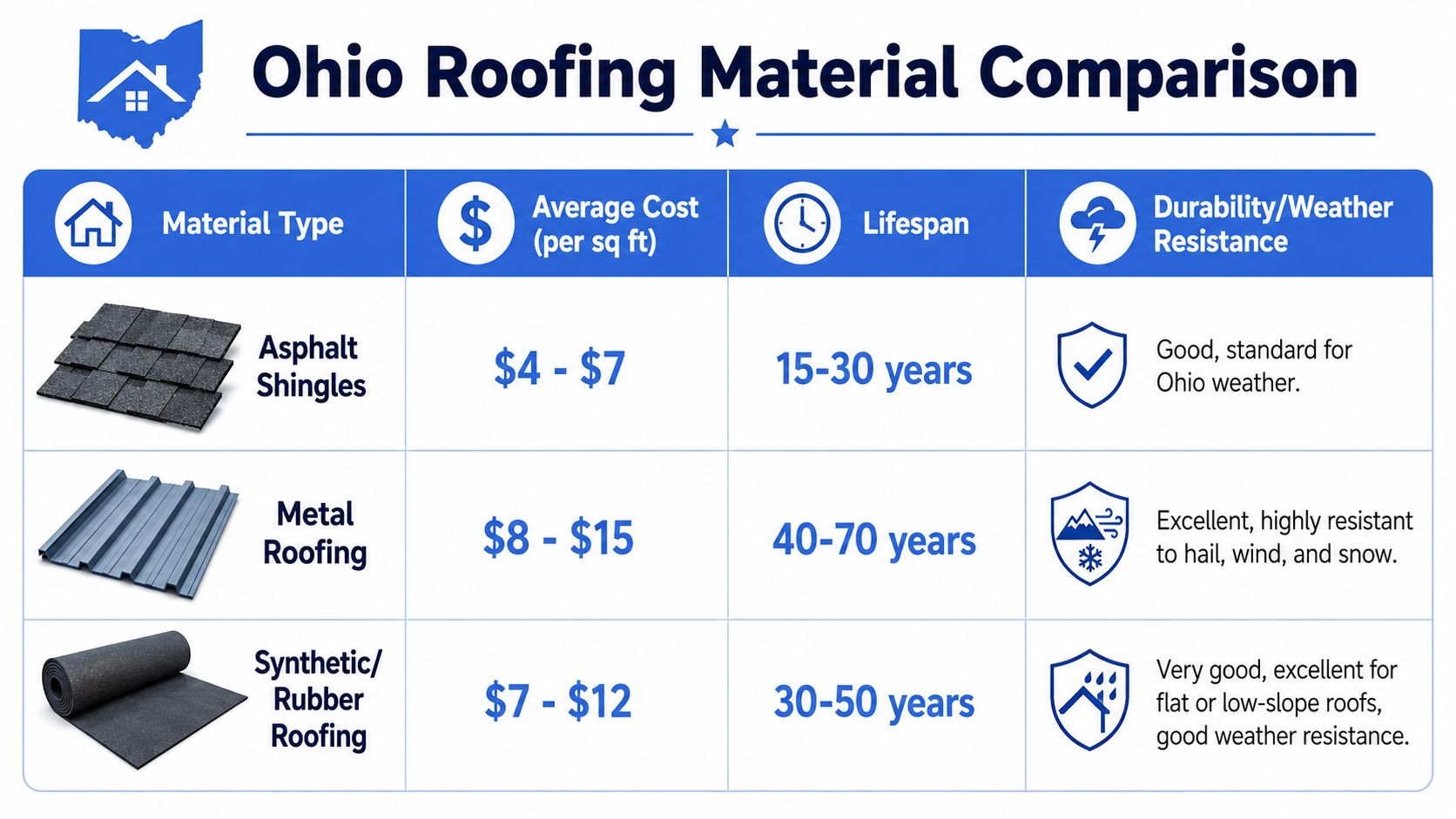
For a lot of homes in Columbus and central Ohio, asphalt shingles are still the sensible starting point. According to the 2024 Cost vs. Value Report from Remodeling, a midrange asphalt shingle roof replacement carries a much lower project cost than metal at the national level, which lines up with what homeowners here usually see on real estimates.
That lower entry price matters, especially if the roof also needs wood replacement, upgraded ventilation, or permit work. Asphalt gives homeowners more room in the budget for those job-site realities without stretching into premium-material pricing.
Architectural shingles are usually the sweet spot. They cost more than basic 3-tab shingles, but they hold up better, look better from the curb, and fit the price range of many Columbus-area replacement projects. If hail is part of your concern, it also helps to read about hail damage signs on Columbus roofs before you settle on a material.
When metal makes sense
Metal roofing changes the budget fast. HomeAdvisor’s metal roof cost guide shows a much higher installed cost range than asphalt, and that difference is real enough that material selection can shift a project from manageable to delayed.
Still, metal can be the right choice. It fits homeowners who expect to stay in the house for a long time, want a distinct look, or are willing to pay more upfront for a different maintenance and longevity profile. On the right home, it looks sharp and can make strong financial sense over a longer ownership period.
The catch is installation quality. Metal is less forgiving than asphalt around chimneys, valleys, skylights, pipe boots, and trim details. A low bid on a metal roof can turn into expensive callback work if the flashing, panel layout, or fastener placement is sloppy.
| Material | Upfront Cost | Best Fit |
|---|---|---|
| Asphalt shingles | Lower | Budget-conscious homeowners, typical residential replacement |
| Metal roofing | Higher | Long-term ownership, premium appearance, different maintenance priorities |
My practical advice is simple. If the budget is tight, choose a good asphalt system installed by a contractor with a strong track record. A properly installed shingle roof usually serves a homeowner better than a poorly installed premium roof that looked good only on paper.
Factoring in Storm Damage and Insurance Claims
In central Ohio, plenty of roof replacements don’t start with age. They start with wind, hail, or a storm that loosened shingles and opened up weak spots.
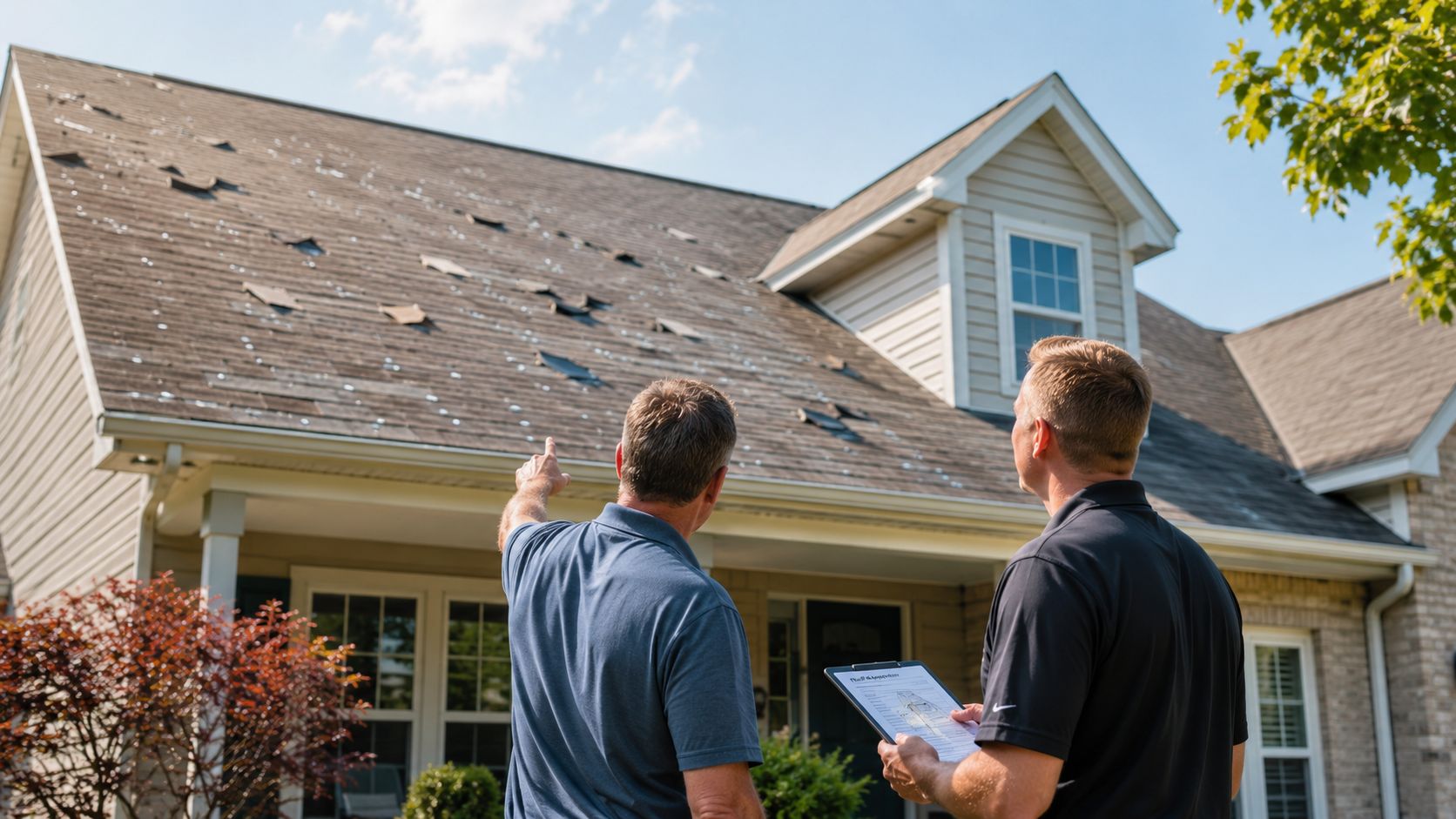
Insurance can change the out-of-pocket math dramatically, but only if the damage is documented well and the claim is handled carefully. Many homeowners wait too long, rely on a quick glance from the ground, or assume a leak is “just old age” when the roof took storm impact.
What insurance usually hinges on
Insurance coverage often turns on cause, documentation, and timing. The adjuster needs to see evidence that the roof was damaged by a covered event, not just worn out over time. That’s why inspection notes, photos, marked-up elevations, and clear descriptions matter.
This is also where complexity affects cost if insurance doesn’t cover the full scope. GAF’s roof cost guide notes that removal and disposal adds $0.40 to $2.00 per square foot, which puts a typical 1,700-square-foot roof at $665 to $3,343 for tear-off, and that steeper or more complex roofs can add $1,000 to $3,000 in extra labor and material cost. If storm damage affects a difficult roof, those added costs matter quickly.
If hail is part of your concern, this article on hail damage roof issues in Columbus, Ohio is a helpful local reference for what to look for and when to schedule an inspection.
Why documentation changes the outcome
Homeowners usually get the best result when they treat the inspection like evidence gathering, not a casual opinion. A thorough roofer should document shingle bruising, creased tabs, lifted seal strips, damaged vents, flashing impact, and related exterior signs.
A short walkthrough on the process can help:
Good claim support doesn’t mean inflating the damage. It means making sure real damage doesn’t get missed. That’s a big difference.
- Start with inspection photos. Ask for clear documentation, not just verbal comments.
- Read the scope carefully. Insurance paperwork may cover one set of items while leaving code upgrades or unrelated issues outside the claim.
- Know your deductible. That’s typically the portion you remain responsible for under your policy.
- Don’t ignore accessories. Gutters, flashing, vents, skylights, and siding may also show storm-related damage.
Financing Your New Roof and The Estimate Process
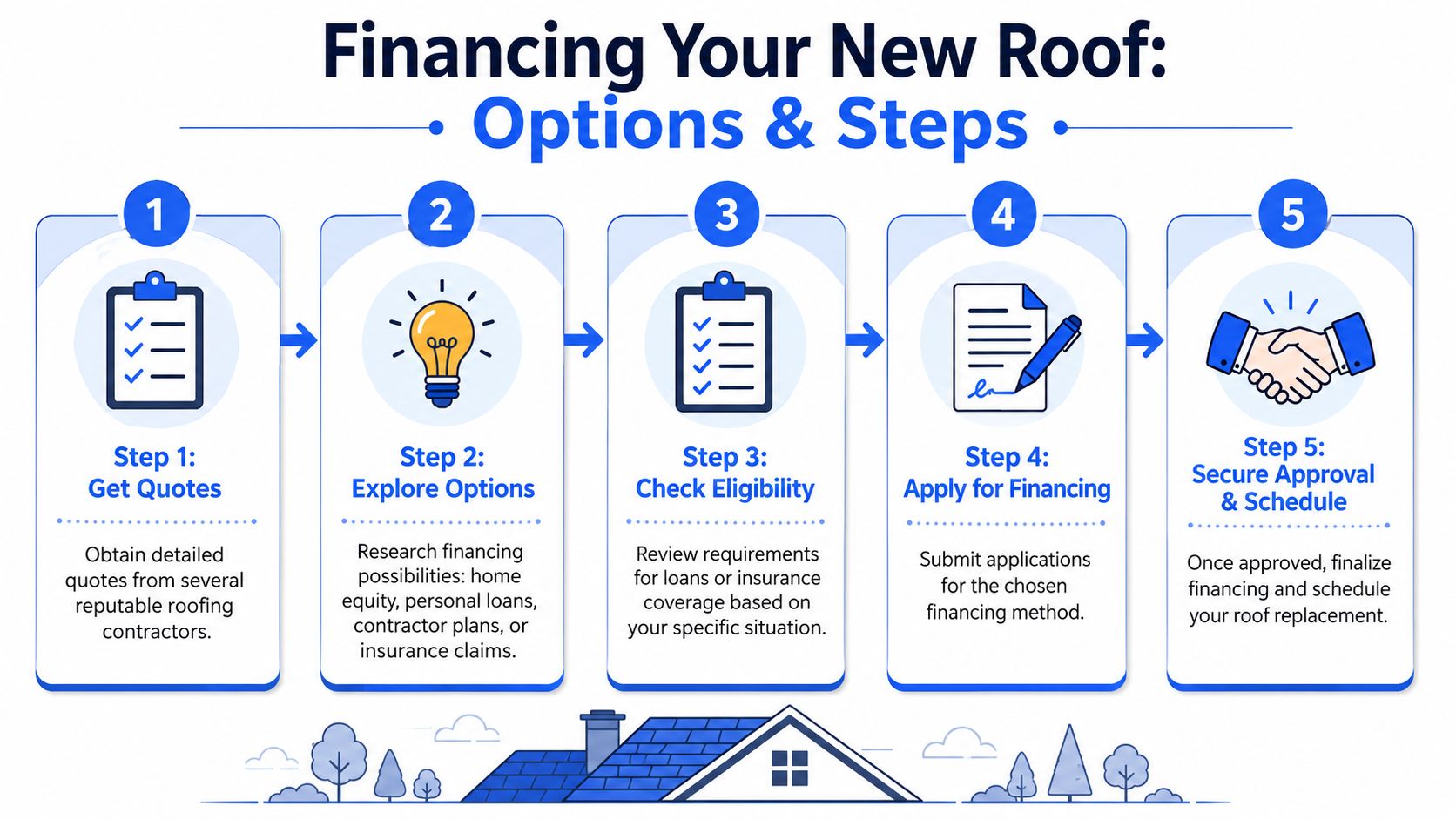
Some homeowners pay for a roof out of savings. Others use insurance proceeds, financing through a contractor program, a personal loan, or a home equity option. The right path depends on why the roof is being replaced and how fast the work needs to happen.
Common ways homeowners pay for a roof
A few options come up often:
- Insurance claim funding. This applies when storm damage is covered and the claim is approved.
- Personal financing. Some owners prefer a fixed payment option rather than a large one-time expense.
- Home equity. For homeowners with enough equity, borrowing against the home may be worth exploring. If you want a plain-language overview, this guide on unlocking home equity with FHA explains one route some borrowers consider.
- Staged exterior planning. If the roof isn’t an emergency, some people prioritize the roof first and delay gutters, siding, or skylight work until later.
The financing method should fit the problem. A storm claim is different from a planned replacement on an aging roof. A pre-listing roof for resale is different from a long-term ownership upgrade.
What a solid estimate process should look like
The estimate experience matters almost as much as the number itself. A good process should feel organized, specific, and low-pressure.
Homeowners should expect:
- Initial contact. You describe the issue, whether it’s age, leaks, visible damage, or a storm concern.
- On-site inspection. The contractor checks shingles, flashing, roof penetrations, ventilation, drainage, and any visible signs of wood damage.
- Discussion of options. Material choices, color selections, timing, and possible problem areas should be reviewed clearly.
- Written estimate. The scope should identify what is included and what could change if hidden damage is uncovered.
- Decision without pressure. You should have time to compare, ask questions, and understand warranty and payment terms.
For homeowners evaluating contractors, this guide on how to choose a roofing contractor is a smart checklist before signing anything.
A trustworthy estimate doesn’t rush you. It gives you enough detail to make a clean decision.
Your Next Step Toward a Secure and Valuable Home
Roof replacement is expensive. It also gets easier to handle once you understand what drives the price and where the surprises usually come from.
Cost matters but so does outcome
A roof isn’t just shingles nailed to plywood. It’s a weather barrier, drainage system, ventilation assembly, and resale factor sitting over everything you own. That’s why the cheapest quote can become the most expensive outcome if it skips proper flashing, ignores bad decking, or treats ventilation like an afterthought.
There is also real value in the investment itself. According to Opendoor’s analysis of roof value and resale, a new asphalt shingle roof costing $11,500 on average returns roughly $15,247 at resale, producing a 61 to 68 percent national ROI and helping homeowners recoup $6,100 to $6,800 for every $10,000 spent. That doesn’t mean every roof should be replaced for resale alone. It does mean the money isn’t disappearing into thin air.
What to do next
If you’re trying to decide what your own roof will cost, don’t stop at an online range. Use the range to set expectations, then get a real inspection and a line-by-line written estimate.
Pay attention to the parts that usually get overlooked:
- Decking condition. Rotten or soft sheathing changes the job.
- Permit and inspection handling. Someone needs to own that process.
- Flashing and ventilation details. These separate a roof that lasts from one that causes callbacks.
- Storm claim support. If weather caused the damage, documentation matters.
- Scope clarity. If a quote feels vague, it probably is.
A roof replacement shouldn’t feel like a guessing game. You need a clear number, a clear scope, and a clear explanation of what could change once the old roof is removed.
If you’re in Columbus or central Ohio, the smartest next move is simple. Get the roof inspected before the leak gets worse, before a small repair becomes interior damage, and before you’re forced to make a fast decision under pressure.
If you want a clear, no-pressure assessment of your roof, schedule a free inspection with HIBCO ROOF LLC. You’ll get a written estimate, straightforward answers about repair versus replacement, and help understanding whether your project is best handled through normal budgeting, financing, or an insurance claim.