A June thunderstorm rolls through Hilliard, and by evening you're standing beneath a ceiling stain with a coffee mug in one hand and a roofing estimate in the other. The quote gives you two choices, repair or replacement, and the contractor wants an answer before the next storm arrives. That pressure creates bad decisions.
The right answer in roof replacement vs repair isn't determined by the smaller number on the page. It depends on your roof's remaining service life, the percentage of the roof affected, the 25% reroof threshold in the International Residential Code, hail-hit density, your insurance policy, and how long you plan to own the home.
| Decision factor | Repair usually fits | Replacement usually fits |
|---|---|---|
| Roof age | Younger roof with isolated damage | Asphalt roof near or beyond its expected life |
| Damage pattern | One penetration, flashing point, or small area | Multiple slopes, widespread granule loss, or recurring leaks |
| Code impact | Work remains below the 25% reroof threshold | More than 25% of the roof is disturbed within 12 months |
| Hail evidence | Limited qualifying impacts | Hail impacts across slopes, especially at replacement-level density |
| Financial logic | Lower cost per remaining year | One project consolidates repeated repairs and resets the system |
Columbus roofs face freeze-thaw cycles, heavy rain, straight-line winds, and hail paths that can cross several neighborhoods at once. The safest choice is the one you can defend with inspection evidence, not the one that feels cheaper today.
Table of Contents
- Why This Choice Matters More Than the Quote
- Symptoms That Separate Repair From Replacement
- Repair and Replacement Side by Side
- How Code Rules and Insurance Math Force the Answer
- Real Scenarios Columbus Homeowners Actually Face
- A Practical Decision Checklist You Can Use Today
- The Most Expensive Mistake on Each Side
Why This Choice Matters More Than the Quote
The homeowner in Hilliard doesn't really have two prices to compare. She has two different five-year outcomes.
A repair may stop the visible leak while leaving brittle shingles, aging underlayment, weak flashing, or hidden decking damage in place. A replacement may solve all of those problems, but it can also waste money if the roof is relatively young and the leak comes from one failed boot or chimney detail.
That's why I start with the roof's remaining service life. Standard 3-tab asphalt shingles commonly last 15 to 20 years, while architectural asphalt shingles generally last 25 to 30 years under normal conditions, according to industry roofing lifespan guidance. A repair on a younger roof can preserve a large amount of useful life. The same repair on a roof near its design limit may only postpone replacement.
The real cost sits beyond the estimate
The 2025 Verisk U.S. Roof Report placed average U.S. residential roof repair costs at $4,699 and replacement costs at $17,631. Replacement was therefore about 3.75 times the repair cost in that market snapshot, based on the Verisk report.
Those figures don't tell you what your Columbus roof will cost, but they show the structural difference between the two decisions. Repair preserves capital when the damage is isolated. Replacement makes more sense when repeated repairs keep buying short intervals on a system that has little service life left.
Columbus weather makes delay expensive. Freeze-thaw movement can open weak flashing joints, wind can lift already-aged shingle edges, and hail can damage several slopes without creating an immediate interior stain. Waiting for a second leak often means the roof deck, insulation, drywall, or trim has already absorbed water.
Practical rule: Don't ask only, “What's cheaper today?” Ask, “How many dependable years does each option buy, and what remains vulnerable after the work?”
The defensible answer comes from three numbers homeowners rarely receive in a basic quote: remaining years, damaged roof area against the 25% code threshold, and hail impacts per 100 square feet. Once those are documented, the choice becomes much less emotional.
Symptoms That Separate Repair From Replacement
Start from the ground. You can gather useful evidence without climbing onto a Columbus roof, and you'll give the contractor better information when you call.
Use binoculars to inspect the shingle lines, valleys, roof edges, and penetrations. Look for granules collecting near downspout splash blocks, shingle edges that cup instead of lying flat, exposed nail heads on sun-facing slopes, and daylight visible through the soffit. None of these observations proves that replacement is necessary, but several together can show that the roof system is deteriorating rather than suffering from one isolated defect.
The attic often tells a different story. Take a flashlight and inspect the underside of the roof deck around chimneys, valleys, plumbing penetrations, and bathroom vents. Rusted nails, black staining, damp insulation, and daylight through the decking point to problems that may involve ventilation, flashing, underlayment, or the deck itself.
What you can see and what requires a roof inspection
You shouldn't walk a sloped roof to count damage. Soft decking can compress underfoot, and loose shingles or steep pitches create a fall risk. A contractor needs to determine how many tabs are missing on each slope, whether flashing has pulled away from a chimney or sidewall, and whether hail impacts qualify as functional damage.
| Symptom and location | Likely decision |
|---|---|
| One cracked pipe boot with otherwise sound shingles | Repair the boot and inspect nearby materials |
| A few wind-lifted shingles on a younger roof | Targeted shingle repair |
| Granules in gutters plus interior staining on an aging roof | Replacement evaluation |
| Soft decking in multiple areas | Replacement or substantial tear-off scope |
| Flashing pulled from a chimney | Repair or reflash, unless the surrounding roof is also failing |
| Hail impacts across several slopes | Documented storm-loss evaluation |
A leak near a chimney deserves special attention because the roof covering may not be the failed component. Before accepting a full replacement recommendation, review this guide to spotting roof leaks near chimneys, which helps explain why chimney flashing can send water into the house even when nearby shingles look acceptable.
For a broader interior warning-sign checklist, use these roof leak indicators while checking ceilings, attic insulation, and wall intersections.
Translate symptoms into a decision
A single cracked boot on a roof with intact shingles is a repair. Granule loss in the gutters, interior staining, curled edges, and an older shingle field point toward replacement because the damage is no longer confined to one component.
At roughly the early part of an architectural shingle roof's life, isolated storm or flashing damage often remains repairable. Near the later part of its rated service life, the same visible leak is more likely to be one symptom of broader deterioration. The inspection should answer whether water entered through one point or whether the roof has lost its ability to shed water across multiple areas.
Repair and Replacement Side by Side
Repair and replacement solve different problems. Repair restores a defined failure. Replacement removes the existing roofing system, examines the deck, and installs a new system across the roof.
The national Verisk figures give homeowners a reliable cost anchor: $4,699 for average roof repairs and $17,631 for average roof replacement in the cited U.S. snapshot. Your estimate can vary because of access, pitch, material, tear-off layers, decking, ventilation, and storm demand, but the gap remains meaningful.
Five variables that decide the call
| Variable | Repair | Replacement |
|---|---|---|
| Cost | Lower upfront capital requirement | Larger project cost, but consolidates widespread work |
| Lifespan impact | Preserves the existing roof and buys only the service life the system still has | Resets the roof system with new materials |
| Project length | Often a short visit for localized work | Requires tear-off, deck inspection, installation, and cleanup |
| Disruption | Limited ladder and material staging | Noise, debris handling, driveway use, and crew activity |
| Warranty | Usually limited workmanship coverage for the repair scope | Manufacturer material coverage plus contractor workmanship terms |
A repair is financially strong when the roof has meaningful life remaining and the contractor can isolate the failure. Replacing a sound roof because of one flashing leak is the wrong use of capital. Replacing an aging roof after repeated leak calls can be cheaper than continuing to pay for separate interventions.
Replacement also gives the crew a chance to identify hidden decking problems and rebuild vulnerable penetrations as part of one system. That doesn't mean every replacement quote is justified. Read the scope carefully, including whether the contractor plans to replace pipe boots, flashing, underlayment, ventilation components, and damaged decking.
The middle ground is sometimes a slope repair
A single-slope replacement or larger partial repair can make sense when one elevation has storm damage and the remaining slopes still have useful life. It's more substantial than replacing a few shingles but less extensive than replacing the entire roof.
Before approving an overlay or another shortcut, understand how overlaying a roof affects inspection, ventilation, future tear-off, and the ability to verify the deck. The cheapest installation method isn't automatically the lowest-cost roof over its full service life.
One point deserves emphasis: don't accept unsupported local pricing as fact. Ask each contractor to separate labor, materials, tear-off, decking allowance, ventilation, flashing, disposal, permits, and warranty terms. Then compare what each proposal fixes.
How Code Rules and Insurance Math Force the Answer
Some roof decisions are settled before price becomes the main issue. Building-code scope, hail documentation, and insurance valuation can all push a homeowner from repair toward replacement.
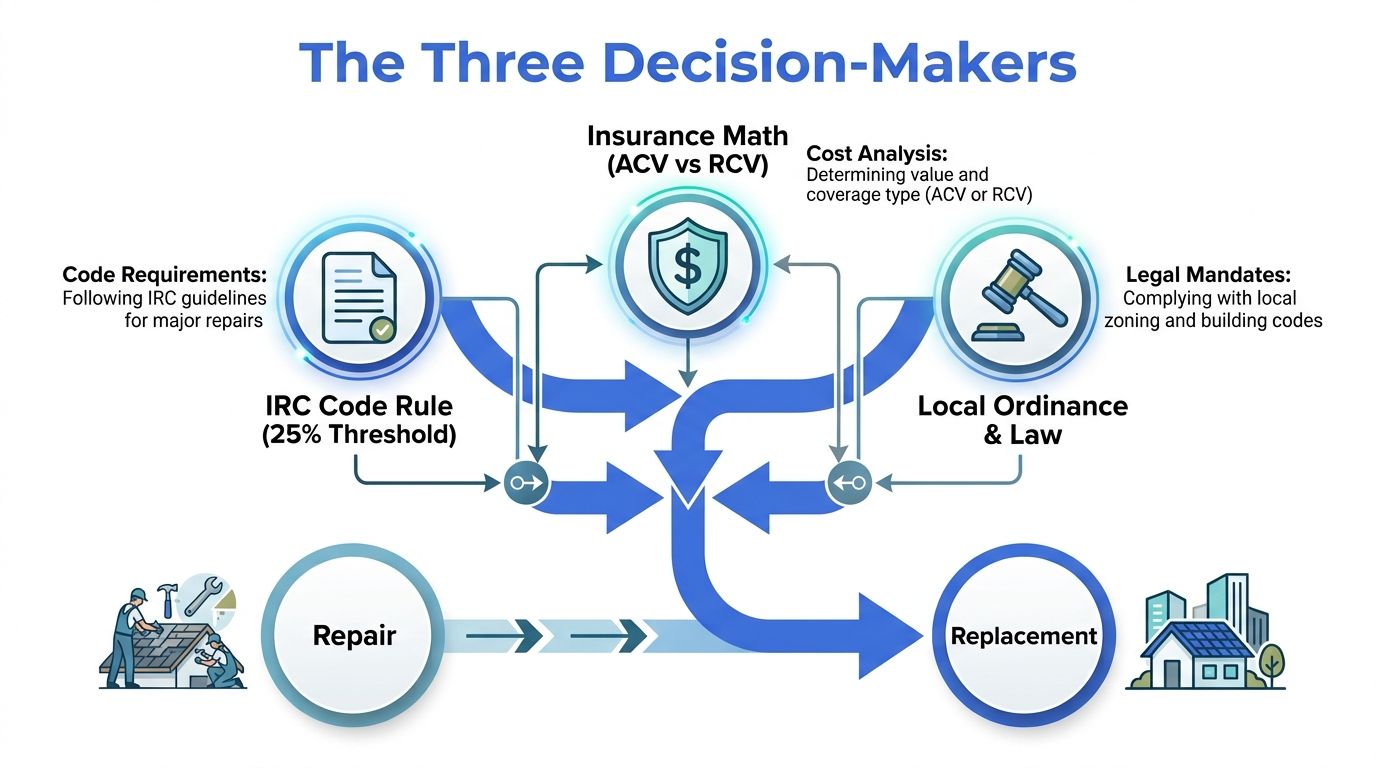
The International Residential Code uses a 25% reroof threshold. If more than 25% of the total roof area is replaced or recovered within a 12-month period, the entire roof must generally be brought into compliance with the current adopted code. Review the 25% IRC reroof rule with the contractor and confirm how the locally adopted code applies to your project.
The three decision-makers
Code scope matters when a proposed repair covers a large share of the roof. A contractor may begin with a partial repair, then discover that the planned work crosses the threshold and requires broader upgrades. Ask for the affected percentage in writing.
Hail-hit density matters because a few visible bruises don't describe the whole loss. A common field method marks a 10-by-10-foot test square, or 100 square feet, on each roof slope and counts qualifying impacts. Eight qualifying hits in that square is often treated as a replacement threshold, although the exact number varies by carrier, as described in this hail inspection guide.
Insurance math depends on the policy, not the contractor's assumption. Have the adjuster or contractor review the wind and hail deductible, roof-age provisions, exclusions, notice requirements, and whether the policy pays actual cash value or replacement cost value. A storm claim may justify replacement even when the roof still looks serviceable from the driveway, but age-related wear alone generally isn't the same as covered storm damage.
For help preparing evidence before the adjuster arrives, review this roof damage adjuster guide. Photograph each slope, close up the impact points, document collateral damage, and keep contractor reports and itemized estimates together.
Do not authorize major work before documenting suspected storm damage and checking the policy's claim requirements. Emergency protection to stop active water intrusion is different from permanently changing the roof before the carrier has a chance to inspect.
Real Scenarios Columbus Homeowners Actually Face
The same roof replacement vs repair question can produce different answers on two houses only a few streets apart. Roof age, damage distribution, insurance posture, and the homeowner's timeline change the recommendation.
| Scenario | Roof age | Key symptom | Recommended call |
|---|---|---|---|
| Single ceiling stain after a storm | 7 years | One leak with intact shingles | Repair |
| Aging 3-tab roof | 22 years | Granule loss in gutters | Replace |
| Hail event | 12 years | Eight qualifying hits per test square | Insurance-funded replacement evaluation |
| Home listing soon | 15 years | No active leaks, older roof | Strategic inspection and replacement decision |
| Rental turnover | 6 years | Tenant-caused vent boot leak | Repair |
Five Columbus calls
The young roof with one stain. A seven-year-old roof develops one ceiling stain after a June storm. The inspection finds a failed flashing boot and two damaged shingles, with no broad granule loss or deck deterioration. Repair wins because the contractor can isolate the entry point and preserve the remaining roof system.
The 22-year-old three-tab roof. Granules collect in the gutters, shingle edges are losing their shape, and more than one area shows weathering. Replacement wins. A patch may stop one leak, but it won't restore an aged shingle field.
The 12-year-old architectural roof after hail. The contractor marks a test square on each slope and records eight qualifying impacts in a 100-square-foot square. That evidence supports a serious insurance replacement evaluation, subject to the carrier's policy and threshold.
The homeowner listing in four months. The roof has no active leak, but the owner is preparing for inspection and buyer financing. The correct move is a documented condition assessment, not an automatic replacement. If the roof's remaining life creates a clear transaction problem, strategic replacement can make sense. If it remains sound, a written inspection may be the better use of capital.
The rental with a vent boot leak. A six-year-old roof leaks around a vent boot after tenant-related damage. The landlord should document the cause, replace the failed component, and inspect the surrounding shingles. Replacement would be excessive unless the inspection finds broader damage.
Storm preparation also includes practical household continuity. Columbus homeowners comparing backup-power options can use the GeneratorInstallerList Columbus page to research local generator installers, while keeping that project separate from the roof-loss documentation.
A Practical Decision Checklist You Can Use Today
Run these questions before signing a proposal. Write the answers down, attach photos, and give the same information to every contractor.
How old is the roof? Confirm the installation date if possible, then compare the material with its expected service life. A roof near the end of its rated life needs a stronger reason to justify repair.
How much of the roof is damaged? Ask the contractor to identify affected slopes and estimate the percentage of total area. If the scope approaches or exceeds the 25% threshold within 12 months, ask how current code requirements change the project.
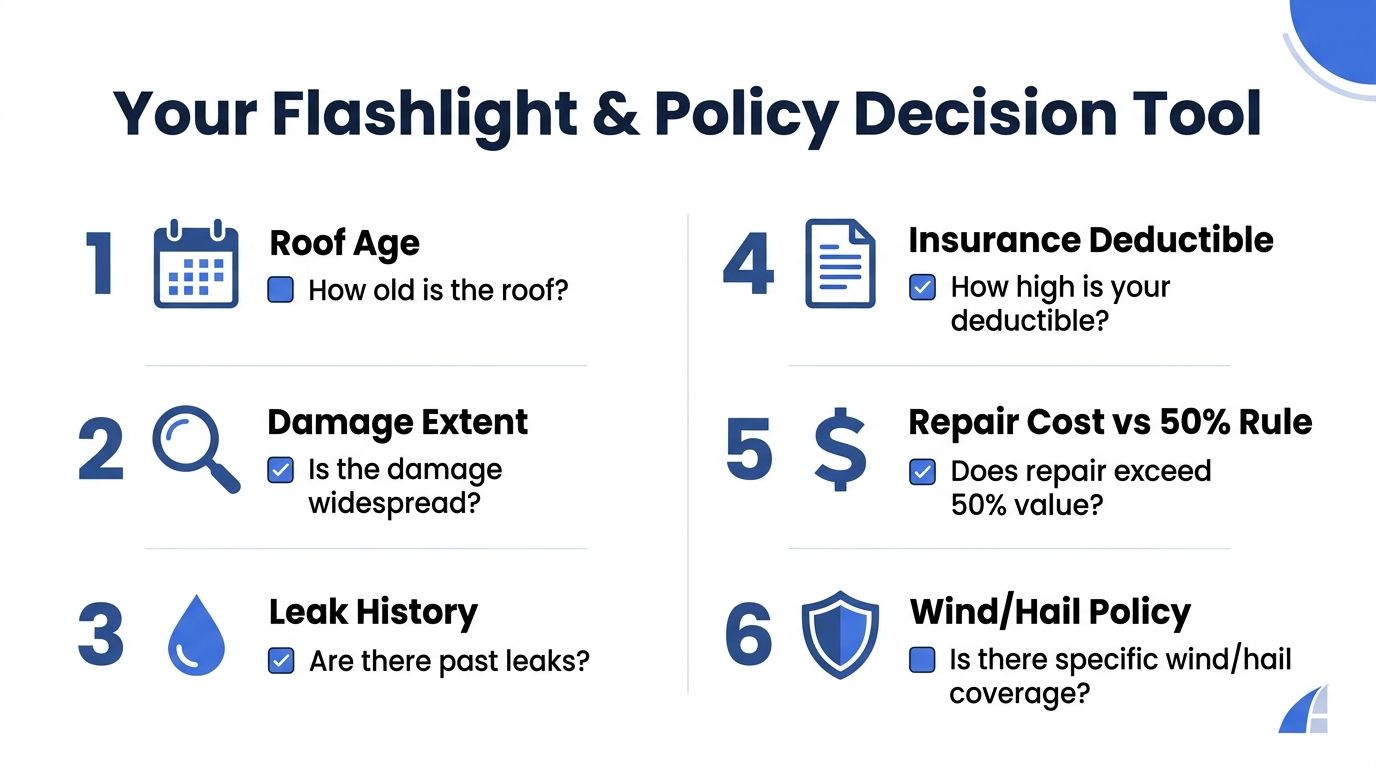
How many leaks have you addressed recently? One isolated leak favors repair. Leaks scattered across different slopes suggest a system-level problem, especially when paired with visible aging.
What does the policy cover? Check the wind and hail deductible, age provisions, exclusions, notice requirements, and ACV or RCV language. Don't assume an older roof qualifies for full replacement-cost payment.
What will you do over the next several years? Staying, selling, refinancing, and managing a rental property create different priorities. A buyer-facing roof condition may require documentation even when replacement isn't technically necessary.
Did two qualified opinions reach the same conclusion? Require photos, a written scope, and a clear explanation of why repair or replacement is recommended. For storm damage, ask whether the contractor marked test squares on every slope.
Turn answers into a direction
Repair is the clear choice when the roof is relatively young, the damage is localized, the code threshold isn't implicated, and the policy doesn't justify a broader covered-loss scope. Replacement becomes the stronger call when damage is widespread, the roof is near the end of its service life, repairs keep recurring, or the proposed work would trigger broader code compliance.
If the answers conflict, don't guess. Get a documented inspection that separates confirmed damage from deferred maintenance and identifies what remains vulnerable after a repair.
The Most Expensive Mistake on Each Side
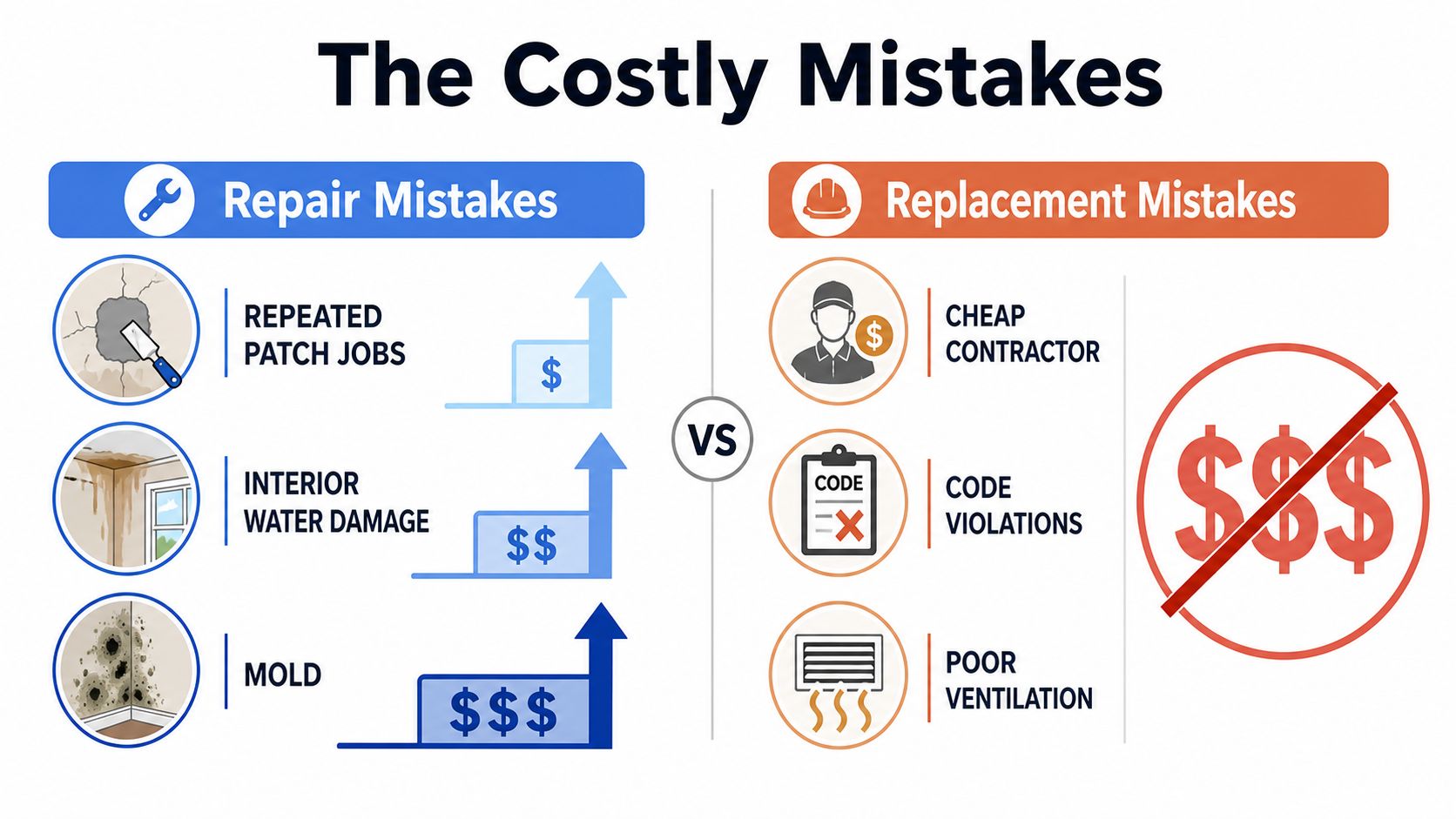
The costliest repair mistake is treating widespread hail bruising or granular loss as a small patch. The homeowner may pay for multiple service calls, interior water repairs, and another inspection, then discover that the original evidence is harder to document for insurance.
The costliest replacement mistake is tearing off a roof that has sound decking and one failed penetration. A full project can solve the wrong problem if the leak originates at a chimney, skylight, pipe boot, or sidewall flashing detail.
The repair mistake
Look at the roof as a system. If more than 25% of the surface shows functional damage, or an asphalt shingle field has passed the later part of its expected life, repair needs strong evidence to remain defensible. The question isn't whether a crew can patch it. The question is whether the patch restores dependable water-shedding performance for enough years to justify the cost.
A 22-year-old three-tab roof with widespread granule loss is not equivalent to a seven-year-old roof with two damaged shingles. The repair price may be lower in both cases, but the older roof offers much less remaining service life.
The replacement mistake
Replacement proposals should identify the actual failure. Ask whether the contractor found soft decking, multiple damaged slopes, broad hail impact, recurring leaks, or code-driven scope. If the answer is only “there's a leak,” insist on tracing the leak before approving a full tear-off.
“Don't patch what insurance will cover, and don't replace what a targeted repair can hold through several more Columbus winters.”
The right decision over a longer ownership period comes from comparing repair cost with dependable remaining years, not from comparing the two invoice totals alone. Get the inspection documented before authorizing work, especially after hail or wind.
HIBCO ROOF LLC provides free roof inspections, targeted leak repairs, storm and hail documentation, insurance claim assistance, and complete roof replacement assessments for Columbus-area homeowners. Visit HIBCO ROOF LLC to request a no-pressure written evaluation that shows whether your roof needs a repair, replacement, or a more limited scope.