Your roof is starting to look tired, but it isn't obviously failing yet. That's the exact moment Columbus homeowners get tempted by an overlay. It sounds simpler, it sounds cheaper, and if the roof only looks rough from the street, it feels like a smart way to buy time. Sometimes it is. Sometimes it's the kind of shortcut that buries a problem until the next leak shows up in a ceiling corner.
The question isn't, “Can I save money by putting new shingles over the old ones?” It's, “Is the roof even eligible for that, and will it hold up in central Ohio weather?” A roof overlay means a new asphalt shingle layer goes directly over the old layer instead of stripping everything to the deck. That can be legal and reasonable, but only when the roof has the right starting condition, the layer count is within code, and the hidden structure underneath is still sound. If those boxes aren't checked, the cheaper option turns into a delayed bill.
Table of Contents
- The Honest Decision a Homeowner Is Actually Making
- What Overlaying a Roof Actually Means
- Pros and Cons Homeowners Should Weigh Honestly
- Code, Weight, Warranty, and Insurance Implications
- The Inspection Checklist That Decides Whether an Overlay Is Even Possible
- Cost and Lifespan Compared With a Full Replacement
- Making the Right Call for Your Home
- Questions Homeowners Ask After Reading This Guide
The Honest Decision a Homeowner Is Actually Making
A homeowner in northeast Columbus called me last spring with the classic problem. The shingles were worn, a few tabs were curling, and the roof didn't look great, but there wasn't water pouring into the house. He wanted the fast answer, and the fast answer was overlay it and move on. That's what a lot of people want when they're staring at a roof they know won't last forever.
But that isn't the decision. The decision is whether you want a shorter, cheaper stopgap or a proper reset that lets someone inspect the deck, flashing, and hidden moisture conditions before they get covered again. A roof overlay is a reroofing method that puts a new asphalt shingle layer directly over the existing one, and many building-code guides limit residential asphalt roofs to two total shingle layers (NC Roofing Solution). That means overlaying a roof is often only legal when there's already one layer in place.
Practical rule: If you can't prove the roof has one clean layer and a sound deck, don't treat overlaying as your default.
That's why this guide starts with the condition of the roof, not the price tag. A roof can look “fine enough” from the driveway and still be a bad overlay candidate once a pro checks the attic, flashing, and hidden moisture profile. For a homeowner deciding whether to stay put for years or sell soon, that distinction matters more than a sales pitch about saving a little money now.
If your roof is already telling you it's worn out and you want a quick way to understand whether replacement is overdue, the visual clues in this roof warning guide are worth reading before you call for estimates.
For homeowners who are also trying to stage a house, clear the garage, or manage mess during a project, Melbourne storage tips from Safe & Sound Storage and Removals are a practical reminder that logistics matter too. Roofing is disruptive, even when it's the faster option, and planning around that disruption is part of making the right call.
What Overlaying a Roof Actually Means
Overlaying a roof means installing a new asphalt shingle layer over the old one instead of tearing the roof down to the deck first. The old shingles stay in place, the crew works over them, and the roof gets a second skin rather than a full reset. It can look fine at the end, but only if the base is already solid.
What stays and what gets changed
The old shingles stay. In many jobs, the existing underlayment also stays in place, and any flashing that can still be reused remains where it is. The new work usually includes the new shingle course and new edge metal, and fresh flashing may be installed where the roof detail demands it. The key point is simple, the old roof isn't gone, it's being buried.
That's why the layer-count rule matters so much. Many building-code guides limit residential asphalt roofs to two total shingle layers, so an overlay usually only works if the roof already has one layer (NC Roofing Solution). If there are already two layers, a full tear-off is required before new shingles can go on.
Why homeowners get tempted
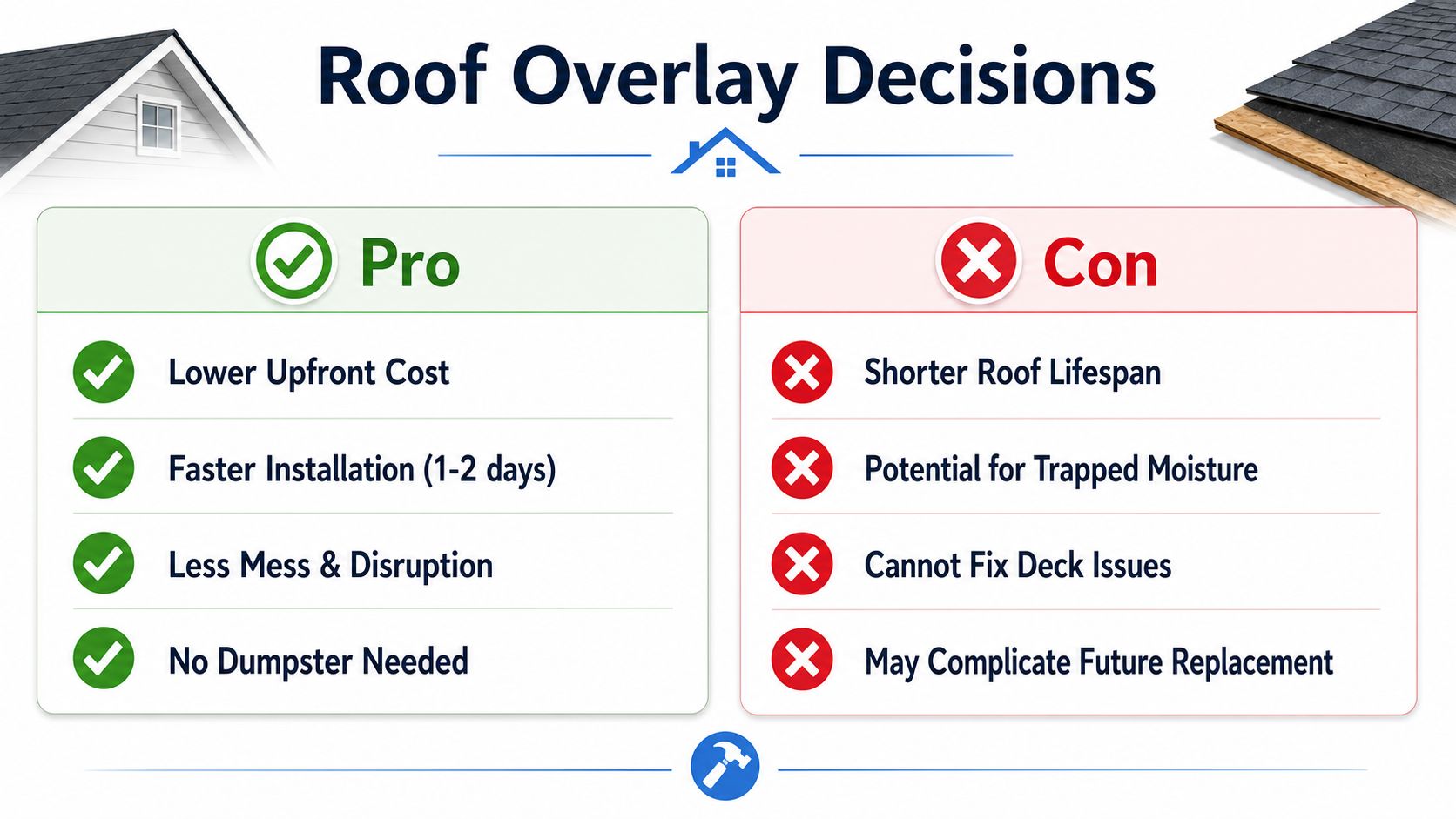
The appeal is obvious. Industry guides note that a typical single-family asphalt overlay can be done in 1 to 2 days, which cuts down on disruption (NC Roofing Solution). You're not filling the driveway with a dumpster, you're not listening to tear-off debris all day, and the roof is back under cover fast.
That speed is real. So is the limitation. An overlay is a legal second chance, not a third or fourth. If the base roof is already compromised, the new layer doesn't cure that problem. It just hides it.
Pros and Cons Homeowners Should Weigh Honestly
The case for an overlay is straightforward. It costs less up front, it finishes faster, and it creates less mess. Recent industry guides report that an overlay is typically about 25% less expensive than a full tear-off, with some estimates placing overlay costs at roughly $50 to $100 less per square foot initially (Mr. Roof). For a homeowner trying to keep cash in reserve, that matters.
It also reduces disruption. No big tear-off crew means less noise, less debris, and usually a simpler jobsite. That's why an overlay can make sense for a house that needs weather protection fast and doesn't have a hidden-deck problem. It's a reasonable bridge when the roof is eligible and the homeowner knows it's not the final answer.
The part people don't like hearing
The downside is shorter service life and less visibility into what's already wrong. The same industry guidance that highlights lower upfront cost also says overlays often last only about 15 to 16 years, compared with 20 to 30 years for a proper tear-off replacement (Mr. Roof). That's the trade. You spend less now and give up years later.
A cheap overlay is only cheap if the old roof underneath is boring, dry, and structurally sound.
A Columbus homeowner learned that lesson the hard way after choosing an overlay on a roof that looked tired but “not that bad.” Three years later, a leak around a penetration forced a tear-off sooner than expected, and the buried problems made the repair more expensive than a replacement would've been in the first place. That's the pattern I worry about, not the shingle layer itself, but the hidden defects it leaves untouched.
What really tips the scale
Use an overlay when the roof is structurally sound, you need a shorter project, and you're comfortable with a shorter horizon. Skip it when you need certainty, want a stronger long-term roof, or suspect the old system has more wrong with it than the surface reveals. The honest answer isn't that overlays are bad. It's that they're only good in a narrow lane.
Code, Weight, Warranty, and Insurance Implications
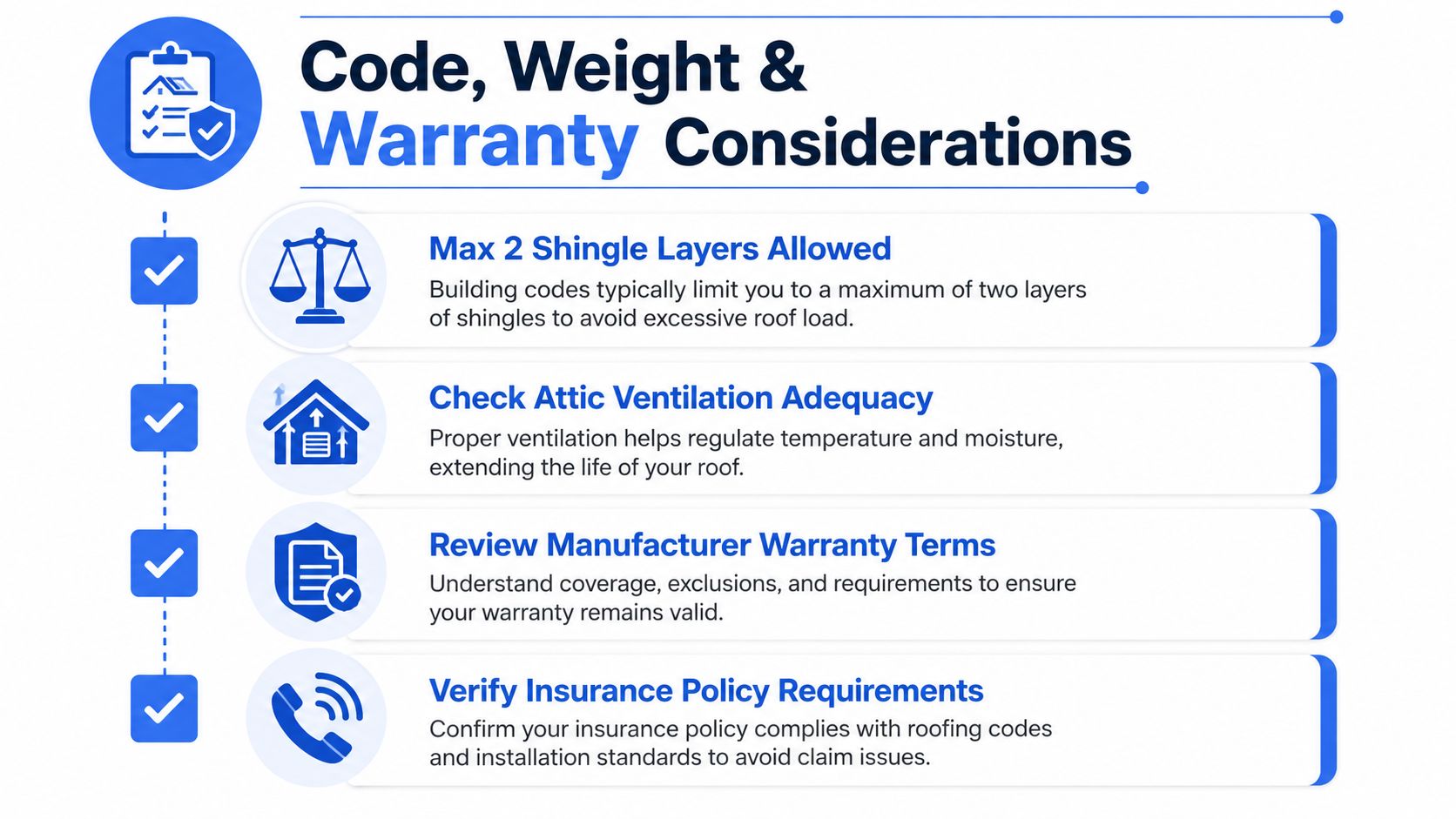
The first filter is code, not cost. For asphalt shingle roofs in the U.S. market, the practical constraint is layer count and substrate compatibility. Overlaying is only appropriate over an existing single layer of asphalt shingles, and IRC Section R908 is cited as limiting the roof to a maximum of two shingle layers total (SCGMN). If your house already has two layers, the conversation is over. Tear-off is the only option.
That rule matters in central Ohio because code compliance isn't a formality, it's the difference between a roof that passes inspection and one that becomes a problem during a sale or claim review. Some HOAs and insurers also get uneasy when a second layer is involved, because they know the roof's condition under that top layer is no longer visible. You may still be allowed to overlay, but that doesn't mean every stakeholder will love it.
Why the hidden structure matters
The deck and moisture profile decide whether the roof can safely carry another layer. Technical guidance says overlaying is generally only suitable when the existing waterproofing is dry, structurally sound, and free from significant damage, and it recommends diagnostics such as core sampling, moisture mapping, or thermographic imaging before specification (Allbase). That's the part most homeowners never see, yet it's the part that decides whether the overlay works or just conceals a problem.
Bottom line: If the deck is weak, wet, or uneven, overlaying the roof is the wrong move.
Manufacturer warranty rules are another reality check. Warranties often behave better on a clean replacement than on a re-cover, and that's no accident. The maker wants a roof installed over a proper substrate, not over a guessed-at foundation with old defects still in place. Insurance companies tend to think the same way when they review a claim or a property profile.
If you're comparing roof systems, materials, and replacement paths, a browse roof replacement materials guide can help you think through what a full replacement looks like from the materials side, not just the labor side.
The Inspection Checklist That Decides Whether an Overlay Is Even Possible
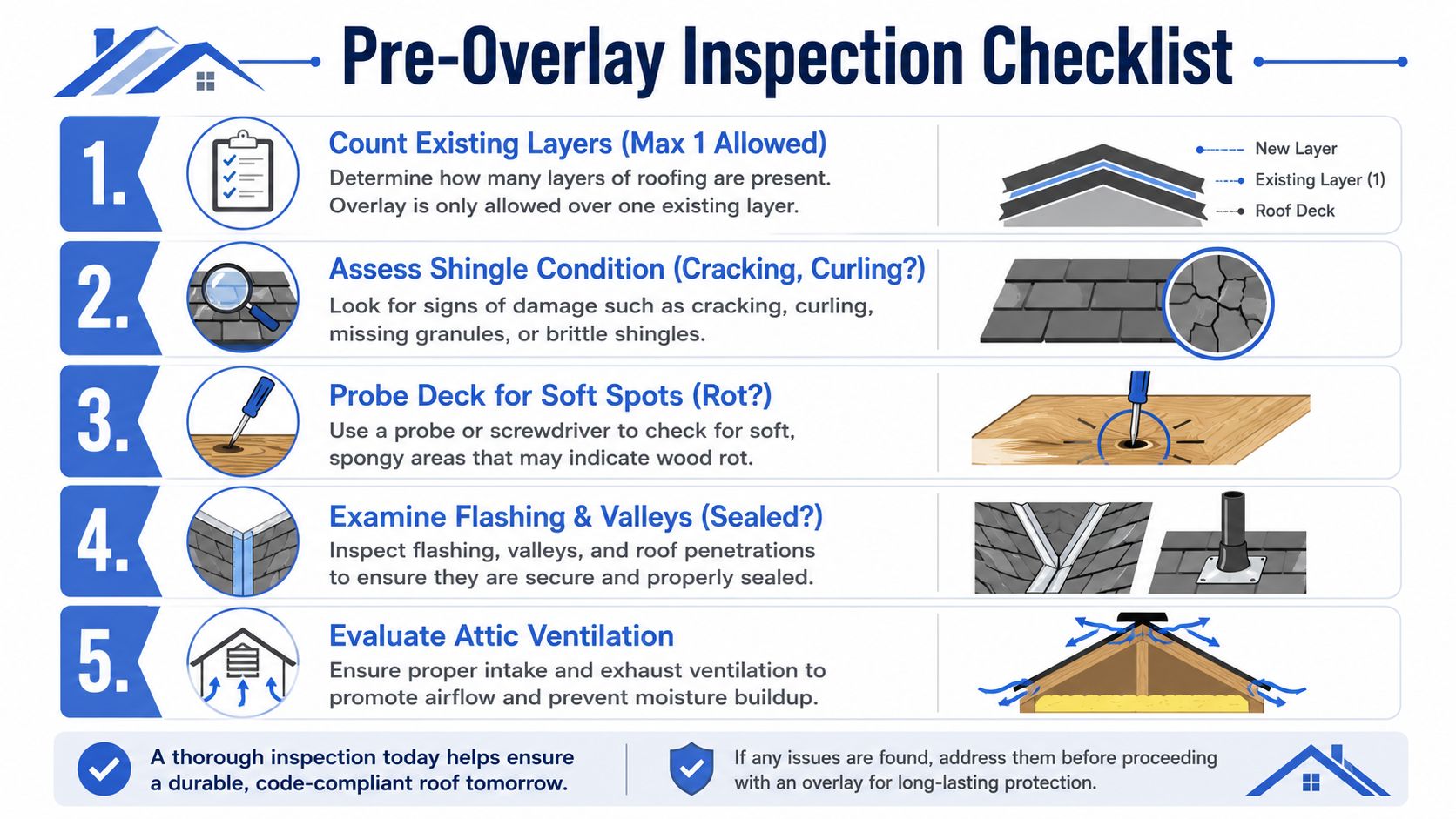
A qualified contractor should start with the simplest question first, how many layers are already there. If the answer is two, the overlay talk stops. If the answer is one, the inspection still isn't done, because the hidden condition of the deck and flashing can rule the job out just as fast as layer count.
What should be checked before anyone says yes
- Layer count: Confirm there's only one existing shingle layer, because a second layer means tear-off.
- Shingle condition: Look for widespread curling, cracking, buckling, or missing tabs.
- Deck soundness: Probe for soft spots that suggest rot or water damage.
- Flashing and valleys: Check chimneys, walls, penetrations, and valleys for failed metal or sealant.
- Attic evidence: Look for staining, mold, damp insulation, or signs of prior leaks.
- Ventilation balance: Make sure the attic can still breathe properly after another layer goes on.
The most important part is the deck. A roof can look decent on top and still be hiding rot below. That is exactly why a free inspection isn't just a sales tool, it's the only sensible way to avoid burying a problem you'll pay for later. Roofing-reference guidance says an overlay should be used only after the existing roof is checked carefully, and installers still have to manage edge shingles, metal edging, and irregularities so defects don't get trapped or turned into leak points (Roofing Canada Reference Manual).
Disqualifying signs that should end the conversation
- Two existing layers: Not eligible for another layer.
- Sagging or soft decking: Structural concern, not a cosmetic issue.
- Active leaks: The source needs exposure and repair.
- Widespread curling or buckling: The old layer is too far gone.
- Mold or water stains in the attic: Moisture has already made it through.
- Rotted decking: A buried defect will only get worse under new shingles.
For homeowners who want a clearer sense of what the deck protection layer does and why it matters, the page on roof deck protection is a useful companion read. It connects directly to the question many ask but can't see from the ground: what's happening underneath the shingles right now?
Cost and Lifespan Compared With a Full Replacement
| Factor | Roof Overlay | Full Tear-Off Replacement |
|---|---|---|
| Upfront cost | Lower, because tear-off labor and disposal are reduced | Higher, because the old roof is removed and the deck can be repaired |
| Expected lifespan | Shorter, often about 15 to 16 years (Mr. Roof) | Longer, often about 20 to 30 years (Mr. Roof) |
| Job disruption | Less mess, less noise, and usually a faster project | More debris, more activity, and a longer job |
| Hidden defects | Old problems stay buried | Deck and flashing can be inspected and repaired |
| Future replacement | Next tear-off can be more involved | Clean starting point for the next cycle |
The math is why overlays keep getting chosen. If the overlay is about 25% less expensive on day one, the savings feel immediate and real (Mr. Roof). But the roof usually gives those savings back later when the system needs to be replaced sooner and the crew has to deal with whatever the old layer was hiding.
That's the part most homeowners miss. A tear-off buys inspection, repair access, and a longer runway. A roof overlay buys time. Those aren't the same thing.
Rule of thumb: If you plan to stay in the home for the long haul, a full replacement is usually the better roofing decision. If you need a short bridge and the roof is eligible, an overlay can be acceptable.
For a pricing-oriented look at the replacement side, how much roof replacement costs gives a practical comparison point. Once you see the full-replacement side clearly, it's easier to judge whether the overlay savings are worth giving up lifespan and inspection access.
Making the Right Call for Your Home
Use four questions, and answer them sincerely. First, how many layers are already on the roof. If there are two, stop there. Second, how old and worn are the shingles, because a roof with widespread curling or buckling is usually too far gone for a cover-up. Third, what's underneath, meaning the deck, flashing, and attic condition. Fourth, how long do you plan to stay in the house.
If you're selling soon and the roof is structurally sound, an overlay may be a practical bridge. If you're staying and want the best long-term value, a tear-off usually makes more sense. If the roof has signs of moisture, sagging, or prior leak history, don't let anyone talk you into hiding the problem under another layer.
A professional inspection should verify the layer count, check the deck and flashing, review ventilation, and give you a written estimate that compares both paths clearly. That's the right way to buy a roof, apples to apples, not a price number ripped out of context. On a good inspection, you should walk away knowing whether overlaying a roof is legal, sensible, or a waste of money on your specific house.
Questions Homeowners Ask After Reading This Guide
A second layer can affect resale because inspectors notice it, and buyers often ask why a full tear-off wasn't done. Insurance carriers may also care, especially if they want proof that the roof was installed within code and on a sound substrate. If you're planning a sale, a clean replacement usually presents better than a covered-over roof.
For landlords and property owners who keep maintenance schedules tight, the landlord resources from VerticalRent are a useful reminder that roofs need documentation, not just repairs. That's true whether you own one rental or five.
How soon should you plan the next replacement after an overlay? Sooner than after a proper tear-off, because the roof is already starting from a shorter service-life position. If the house already has one layer and the deck is solid, an overlay can still be a smart move. If you're hoping it will act like a full replacement, it won't.
If you're in Columbus or anywhere in central Ohio and you're trying to decide whether your roof qualifies for an overlay or needs a full tear-off, book a free inspection with HIBCO ROOF LLC. We'll check layer count, deck condition, flashing, and ventilation, then give you a plain-English estimate that shows both options side by side so you can make the right call with no guesswork.