You step into the driveway after a storm and notice a shingle edge that wasn't sticking up yesterday. There's some gritty material beneath the downspout, too. Nothing's dripping inside, so you're left with the question homeowners often struggle to answer: is this ordinary wear, a small repair, or the beginning of something bigger?
Table of Contents
- What Most Homeowners Miss About Roof Shingle Damage
- Common Types of Shingle Damage and What Causes Them
- How Age and Weather Quietly Change Your Roof
- Judging Severity From the Ground and the Ladder
- DIY Repair Versus Calling a Professional
- Lifespan, Replacement Triggers, and Wind Ratings
- Maintenance Habits That Actually Extend Shingle Life
- Putting It Together and Common Homeowner Questions
What Most Homeowners Miss About Roof Shingle Damage
From the driveway, a roof seems straightforward. The shingles are either there or missing, flat or curled, leaking or dry. But roof shingle damage isn't always a visible, yes-or-no condition. A roof can still keep rain outside while its materials become less capable of handling another storm.
Consider a tab that remains in place but no longer bonds securely to the shingle beneath it. It may look reasonably normal on a calm afternoon. During strong winds, that loose edge presents a different problem than a securely sealed shingle beside it.
IBHS research on asphalt-shingle performance connects roof damage with age, exposure, construction practices, and storm conditions. That's why an inspection needs more than a count of missing pieces.
Read the condition, not just the appearance
A useful inspection separates what you can see from what the evidence establishes:
- Appearance: A dark patch, uneven edge, or scattered surface grit tells you where to look more closely.
- Material condition: Exposed matting, splits, and damaged tabs help establish whether the shingle itself is compromised.
- System condition: Sealing, fastening, roof edges, and transitions help explain how the roof may perform as an assembly.
A dark spot alone doesn't settle the diagnosis. Neither does a dry ceiling. The inspector needs to connect the visible mark with a physical condition and a plausible cause.
Practical rule: Treat a change in appearance as a reason to investigate, not as proof that the entire roof needs replacement.
Think of two possible inspection findings, rather than two real-world case histories. An isolated damaged shingle surrounded by sound material suggests a different repair conversation than similar-looking damage scattered across deteriorated slopes. The visible symptom may resemble the same problem, but the extent and repairability differ.
Your job isn't to diagnose every mark from the lawn. It's to recognize changes, avoid disturbing the evidence, and ask for an explanation that connects what happened, what failed, and what response fits.
Common Types of Shingle Damage and What Causes Them
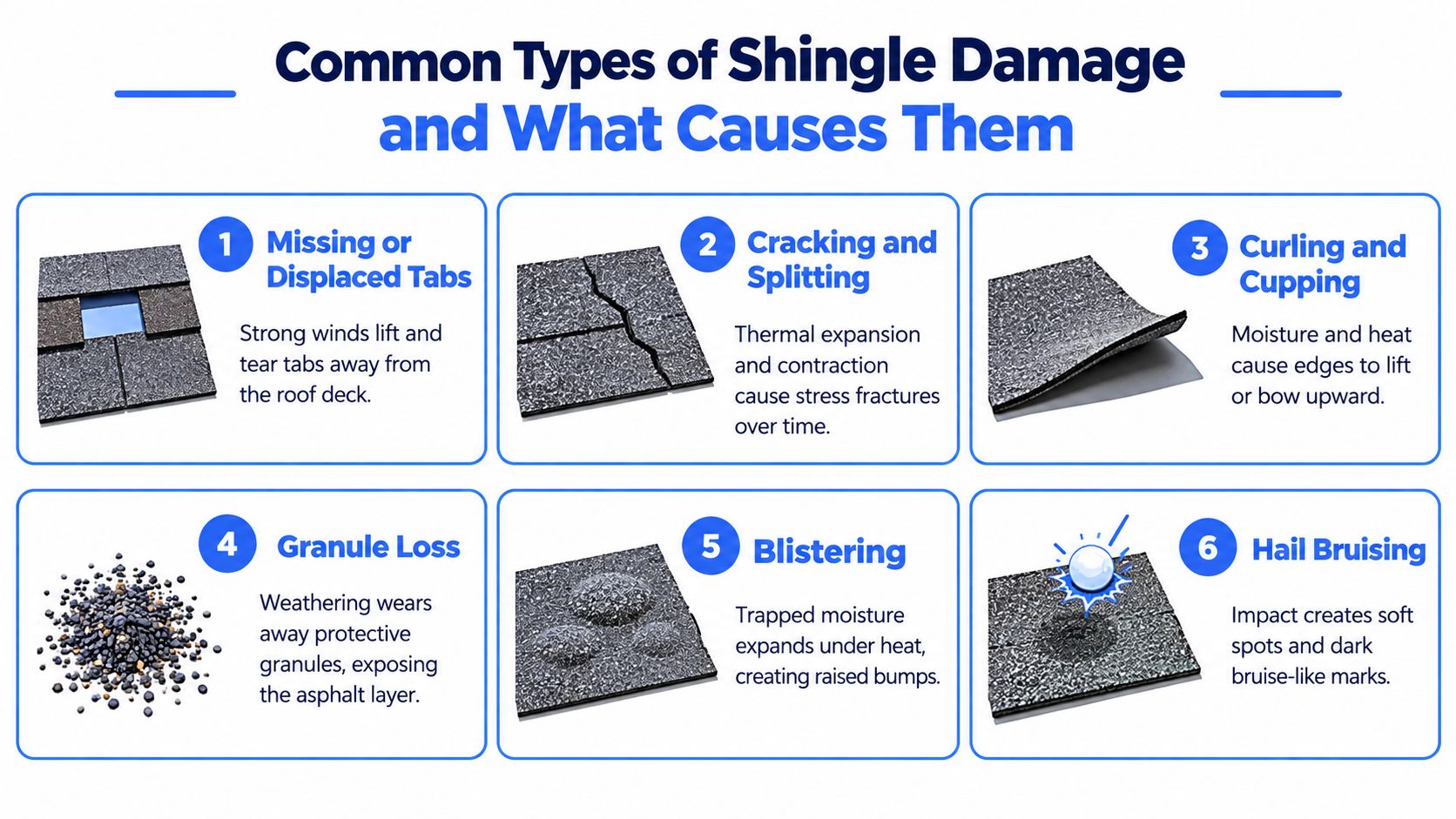
Start with the shape of the damage. A missing tab, a surface crater, and a curled edge may all look like “bad shingles,” but they don't tell the same story. Use these descriptions to guide observation, not to justify climbing onto the roof or pressing on suspect shingles.
Displacement and deformation
Missing or displaced tabs appear as gaps, crooked shingle courses, or pieces that no longer align with their neighbors. Wind may cause the final displacement, but the underlying problem can include an unsealed edge or deficient fastening.
FEMA's Hurricane Michael guidance identifies unsealed or partially unsealed shingles as recurring high-wind failure sources. An inspector should examine seal lines and nail placement, not blame the reported wind speed.
Cracking and splitting look like narrow fractures or open separations. Temperature-related expansion and contraction can contribute to stress over time, but a photograph alone won't reliably distinguish weathering from impact or handling damage.
Curling and cupping describe shingles that no longer lie flat. Edges may turn upward, or the shingle may develop a bowed profile. Heat, moisture conditions, and aging deserve investigation rather than an automatic diagnosis based on shape alone.
Surface loss and impact marks
Surface defects need closer interpretation because different causes can leave similar-looking marks:
- Granule loss: Look for bald-looking patches or a change in surface texture. Weathering and impacts can remove granules, so the location and surrounding condition matter.
- Blistering: Raised bumps or small crater-like openings may suggest heat-related expansion of trapped moisture. Don't assume every circular mark came from hail.
- Hail bruising: Impacts can leave darkened areas, displaced granules, or underlying damage. A trained evaluator may investigate localized softness, but homeowners shouldn't press, scrape, or probe shingles to test them.
The practical distinction is between a surface mark and damage through the shingle's protective layers. Ask the inspector to photograph the condition closely enough to show that distinction.
Avoid assigning a cause from one mark. A convincing diagnosis should account for the pattern across the roof, the material's condition, and other relevant observations.
How Age and Weather Quietly Change Your Roof
A roof can pass a casual look and still be weaker than it appears. The shingles may lie flat, the ceilings may stay dry, and the sealant under each tab may have lost the grip that once kept wind from lifting the edge.
The quiet change under the tabs
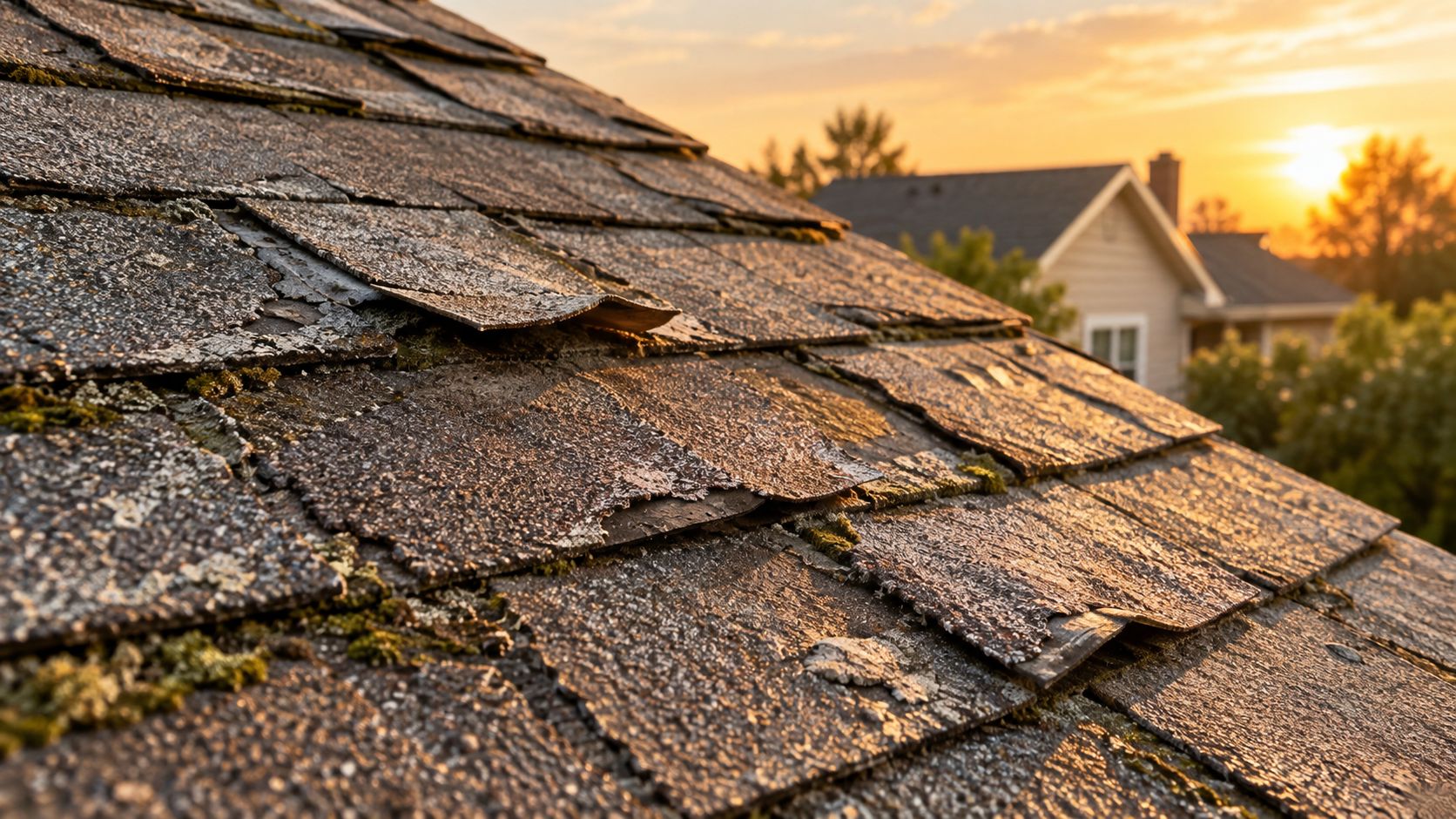
The sealant bond works like a latch. Heat, cold, sun, and time can make that latch less willing to grab, even while the shingle still looks seated from the yard. In its Roof Material Aging Farm research, launched in 2013, IBHS compared naturally weathered shingles across South Carolina, Wisconsin, and Ohio and reported that many products initially maintained or increased wind resistance, while most began losing resistance between years 5 and 10. Researchers identified deterioration of the factory-applied sealant bond as the main driver of wind vulnerability.
That is not a universal replacement birthday. Products and exposures varied too much for that. It tells an inspector where to look: remaining adhesion, brittleness, whether tabs release evenly, and whether shaded slopes aged differently from sun-exposed planes.
For a central Ohio home, ask for south- and west-facing slopes to be compared with cooler areas. Orientation is a clue. It is not a verdict by itself.
Watertight and storm-ready are related, but they are not the same condition.
Small hail fits the same pattern. A 2025 peer-reviewed study in Frontiers in Materials found that weathered shingles exposed to repeated concentrations of small hail were approximately 10 times more susceptible to subsequent severe-hail damage than new shingles, with average degradation of 47% and results reaching 67% in tested specimens. Those are experimental findings, not a formula for one home's remaining life.
Ask for the history before the label: approximate age, product, known hail or wind events, prior repairs, and matching photos across seasons. Then ask which evidence moves the recommendation toward monitor, repair, or replace. A solid answer names what was observed, not just how old the roof is.
Judging Severity From the Ground and the Ladder
After a storm, the first clue is often what is missing: a shingle tab in the yard, grit collecting at the downspout, a ceiling stain that was not there last month. Read it like a map. Isolated marks near one penetration tell a different story than the same crease repeated across a whole slope.
Use three passes before anyone talks repair scope. From the ground, compare planes under the same light and note where the pattern repeats. From the attic or upper rooms, check for fresh staining, damp sheathing, or daylight at penetrations. On a ladder only if it is dry, stable, and familiar, look at eave edges and gutters from the side; leave the field of the roof to someone trained to walk it.
Granules deserve context. A handful in a cleanout after installation is different from a steady pile season after season. For a closer read on that clue, see what roof granules in gutters can tell you. Record where the material collects and whether the amount changes instead of treating one cup as a verdict.
Then sort urgency by consequence. A close-up can look dramatic and still sit in the monitor category; a small stain can be the visible tip of a wider failure. Cosmetic: color change or shallow marks with intact edges, so document and recheck. Repairable: a torn tab or missing shingle surrounded by sound material, so schedule a focused fix. End-of-life: broad curling, exposed mat, bare patches, or repeated failures across slopes, so ask for replacement planning. Structural: sagging lines, deck movement, or a suspected opening, so keep people clear and get urgent help.
If insurance may enter the conversation, ask for the observed damage and proposed scope in writing. Audit Genius offers a way to find missed claim items while reviewing paperwork; it can support documentation, while the cause and extent still come from an on-site assessment.
A roof can shed water today and still have less reserve for the next wind event. That gap is why the questions matter: where the damage sits, how far it spreads, whether the surrounding shingles still hold, and what changed since the last photos.
DIY Repair Versus Calling a Professional
A small repair footprint doesn't necessarily mean an easy repair. Replacing a torn tab may require disturbing adjacent shingles, while reseating a lifted edge requires understanding why it lifted. Applying roofing cement beneath a flashing edge can conceal a problem if the flashing itself needs correction.
What belongs in the homeowner's hands
The most useful homeowner work usually happens without stepping onto the roof. You can photograph accessible conditions, protect belongings beneath a leak, collect maintenance records, and arrange an inspection.
VerticalRent's roof repair tips for property owners provide another planning resource for owners coordinating upkeep. Use maintenance guidance to organize responsibilities, not as permission to attempt work beyond your training.
A hands-on repair belongs in a narrow category: safe access, familiar materials, confirmed localized scope, and a manufacturer-approved method. If you can't establish those conditions, hiring a roofer is the more defensible choice.
| Homeowner task | Professional task |
|---|---|
| Record visible changes from a safe location | Determine whether shingles can be lifted and repaired without additional damage |
| Gather invoices and warranty documents | Select compatible materials and installation methods |
| Describe when water appeared indoors | Trace the entry point and inspect associated components |
Warranty and documentation questions
Don't assume that every DIY repair voids a warranty, or that every contractor repair preserves it. The actual warranty language and installation requirements control. Before authorizing work, ask which instructions apply and how the repair will be documented.
Avoid smearing sealant over visible symptoms as a substitute for diagnosis. Ask whether the repair addresses damaged material, fastening, adhesion, flashing, or another identified cause.
A contractor's inspection should go beyond your visual check by evaluating repair access, exposed matting, fastening patterns, and sealing condition where appropriate. Request photographs taken before the work changes those conditions.
For a broader scope decision, use this guide to roof replacement versus repair. The cheaper path isn't always the smallest patch; it's the work that addresses the documented defect without unnecessary replacement.
Lifespan, Replacement Triggers, and Wind Ratings
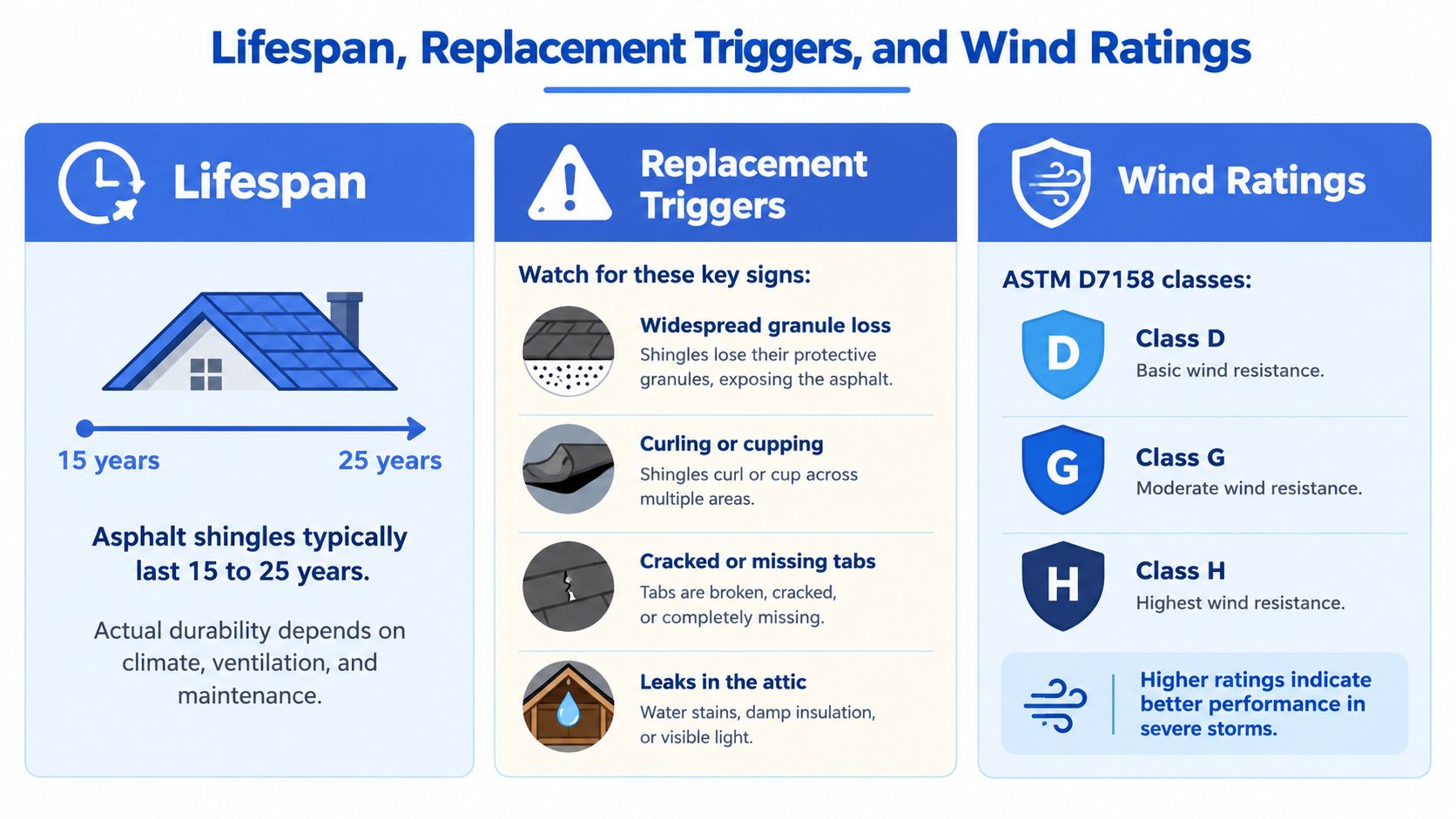
A roof can pass a leak check the week after a storm and still be a weaker roof than it was in spring. Water tightness tells you about today. Adhesion, granule coverage, and how firmly the fasteners hold tell you about the next storm. That is why the replacement decision rests on demonstrated condition; calendar age is context, not evidence.
Reading a wind rating correctly
FEMA recommends ASTM D3161 Class F or ASTM D7158 Class H shingles for improved windstorm resilience. An ASTM D7158 class describes how a shingle performs under defined testing and calculation conditions. It says nothing on its own about the roof already nailed over your deck.
The distinction matters when someone points to packaging and says the roof should have survived. Classes D, G, and H describe different levels of tested performance, and a higher class or a warranty label still leaves installation quality and present condition open to inspection.
Ask before approving replacement: What physical findings make repair unsuitable, and where are those findings documented?
Evidence that supports replacement
A public asphalt-shingle roofing specification identifies significant granule loss, exposed fibers or felt, widespread curling, splitting, and persistent unrepairable leakage at valleys, hips, or ridges as failure conditions. Read them as inspection checkpoints. Whether an insurer applies the same standard is a separate question, which is why the written record matters as much as the finding itself.
When you get the evaluation, push the findings into one of three categories. Widespread material failure means deterioration has spread beyond what a localized repair can reasonably fix. Transition failures point to valleys, ridges, hips, or the details around them that keep leaking and need their own investigation. Separate edge repairs cover items like damaged drip edge that may need correction even while the field shingles remain serviceable.
If a report cites extensive sealing problems, it should show their distribution and explain whether a manufacturer-compatible repair remains practical. A scope description that reads only "old roof" should be sent back for specifics: which slopes, which findings, and where they are documented.
Use this roof lifespan guide to frame planning questions before that conversation, then ask for a condition-based recommendation. If insurance may be involved, preserve the product information, inspection photographs, repair history, and a written explanation separating storm damage from deterioration, because replacement removes the evidence.
Maintenance Habits That Actually Extend Shingle Life
Maintenance can't restore shingles to new condition, but it can help homeowners identify correctable problems before they require broader work. Build the routine around safe observation, drainage, and appropriate professional service, rather than repeated trips onto the roof.

A seasonal rhythm for central Ohio
- Spring: After winter weather, look for displaced shingles, debris, and gutter problems. Arrange inspection of changes you couldn't safely assess during freezing conditions.
- Summer: After strong storms, compare current photographs with earlier ones. Have hanging branches evaluated for safe trimming rather than reaching over the roof yourself.
- Fall: Plan debris clearance before heavy leaf accumulation, then check again after leaf drop. Keep drainage paths visible and accessible.
- Winter: Watch from the ground for ice buildup and unusual roofline changes. Don't climb onto icy surfaces or chip at shingles to remove ice.
The purpose isn't to create a demanding inspection ritual. It's to give yourself familiar reference points so a new condition doesn't go unnoticed.
Pay for diagnosis where access or judgment matters
Gutter cleaning and gentle removal of accessible loose debris may be manageable when they don't require hazardous access. Roof-surface work, moss treatment, and sealing checks belong with someone who can follow the applicable material instructions without creating additional damage.
Ask what a maintenance visit includes. Useful deliverables include dated photographs, identified locations, a distinction between maintenance and repair needs, and a written scope for any recommended work.
For rental homes or multiple properties, Facility Management Insights' roof care checklist for facility managers can serve as an organizational reference. Keep each property's observations and work orders together so another manager can understand what was found and what was completed.
- Preserve records: Save invoices, product details, and inspection reports in the same folder.
- Track weather: Record relevant storm dates without assuming every storm caused damage.
- Close the loop: Photograph completed repairs and retain the contractor's description of the work.
Consistency matters more than aggressive cleaning. Don't scrape, pressure-wash, or coat shingles without checking the manufacturer's guidance and obtaining an appropriate professional recommendation.
Putting It Together and Common Homeowner Questions
Use a straightforward sequence: inspect safely, classify provisionally, decide with evidence, and document the outcome. Your observations help locate concerns; a qualified inspection establishes the repair scope.
Does roof age determine whether to file a hail claim?
Age matters, but it doesn't prove storm damage or establish coverage. Reporting on IBHS research found that roofs aged 11–15 years were about 4.5 times more likely to produce a hail claim than newer roofs under some storm conditions. Ask for findings that distinguish impact damage from pre-existing wear.
Will insurance pay for matching shingles across the entire roof?
Not automatically. North Carolina's insurance regulator explains that direct damage to part of a roof doesn't necessarily require payment for whole-roof replacement merely because shingles won't match. That guidance isn't an Ohio coverage determination; your policy and applicable requirements control.
What should I collect before authorizing repairs?
Preserve the evidence before materials are removed:
- Condition records: Representative exterior photographs and interior moisture observations.
- History: Roof age, prior repairs, and relevant storm timing.
- Work documents: The inspection report, written scope, estimate, and temporary-protection receipts.
Ask your insurer whether coverage is actual cash value or replacement cost. Minnesota's insurance regulator explains how depreciation and eligible later payments can differ between those coverage types. Settle the scope and payment questions before assuming a replacement will be fully reimbursed.
HIBCO ROOF LLC offers free roof inspections, shingle repairs, full replacements, and storm-damage documentation for Columbus and central Ohio homeowners. Visit HIBCO ROOF LLC to request an inspection and a written estimate based on your roof's specific needs.