
Typical asphalt shingle roofs last roughly 20 to 30 years in central Ohio conditions, depending on shingle type, attic airflow, and storm exposure. Standard 3-tab shingles often land near the shorter end, while architectural shingles commonly reach the longer end when installation and maintenance are sound.
You may be asking because the roof looks tired from the driveway, you found granules in the gutter, or a ceiling stain appeared after a summer storm. Maybe the shingles were already on the house when you bought it, and the seller's paperwork doesn't tell you whether the roof has several good years left or is approaching replacement.
A roof's calendar age helps, but it doesn't answer the question by itself. Roof life span is a condition-based planning range, shaped by material, workmanship, ventilation, weather exposure, flashing, drainage, and repairs. Central Ohio roofs deal with freeze-thaw cycling, humid summers, wind, hail, heavy rain, and occasional snow loads. Those conditions can push an otherwise ordinary asphalt roof toward either end of its expected service life.
Table of Contents
- What Roof Life Span Really Means for Central Ohio Homes
- Comparing Roofing Materials and Their Lifespans
- What Shortens or Extends a Roof Life Span
- Visible Signs Your Roof Is Nearing End of Life
- A Simple Roof Inspection Checklist for Homeowners
- Repair or Replace How to Decide
- Storm and Hail Damage in Central Ohio What Homeowners Should Do
- Your Roof Life Span Action Plan and Next Steps
What Roof Life Span Really Means for Central Ohio Homes
A homeowner in Columbus can have two roofs that look nearly identical from the street, were installed around the same time, and still have very different remaining service lives. One may have dry attic airflow, properly installed flashing, and limited storm exposure. The other may have trapped attic heat, recurring moisture, poor repairs, or hail bruising hidden among the shingle courses.
For central Ohio planning, standard asphalt shingle roofs generally fit within a 15 to 30 year working range, with 3-tab shingles commonly lasting about 15 to 20 years and architectural shingles about 25 to 30 years. These benchmarks come from roofing lifespan guidance covering asphalt materials and broader roof service expectations at HomeMatchup's roof lifespan reference. A separate regional summary reports that asphalt roofs may last about 19 to more than 20 years in northern and northeastern conditions, compared with about 14 years in warmer southwestern conditions, reinforcing why climate changes the planning range J&M Roofing's shingle lifespan guide.
Why the range matters
A warranty is a product document. Service life is what the roof delivers on the house. Manufacturers can publish longer nominal warranty language, but ventilation, installation quality, maintenance, ultraviolet exposure, wind, hail, and moisture determine whether the roof performs well in central Ohio.
Practical rule: Treat the stated life span as a planning window, then let the roof's visible and hidden condition determine the next step.
The table below gives a useful starting point. The notes are not promises. They're the questions a contractor should ask before recommending repair or replacement.
| Material | Typical Service Life | Notes for Central Ohio |
|---|---|---|
| Asphalt 3-tab shingles | 15 to 20 years | Economy option, more vulnerable to weathering and storm wear |
| Architectural asphalt shingles | 25 to 30 years | Common residential choice with a thicker, more substantial profile |
| Metal roofing | 40 to 70 years | Longer service range, but panel details, fasteners, and installation matter |
| Tile roofing | 40 to 100+ years | Durable material, but weight, breakage, and underlayment must be evaluated |
| Natural slate | 75 to 150+ years | Very long-lived when properly installed and maintained, uncommon on ordinary subdivisions |
The roof's remaining useful life should therefore be described as “serviceable with monitoring,” “repairable but aging,” or “approaching replacement,” rather than reduced to one date. Condition-based guidance emphasizes inspecting for curling, granular loss, cracking, flashing problems, and ventilation issues instead of relying on the installation date alone Canada's roof service-life guidance.
Comparing Roofing Materials and Their Lifespans
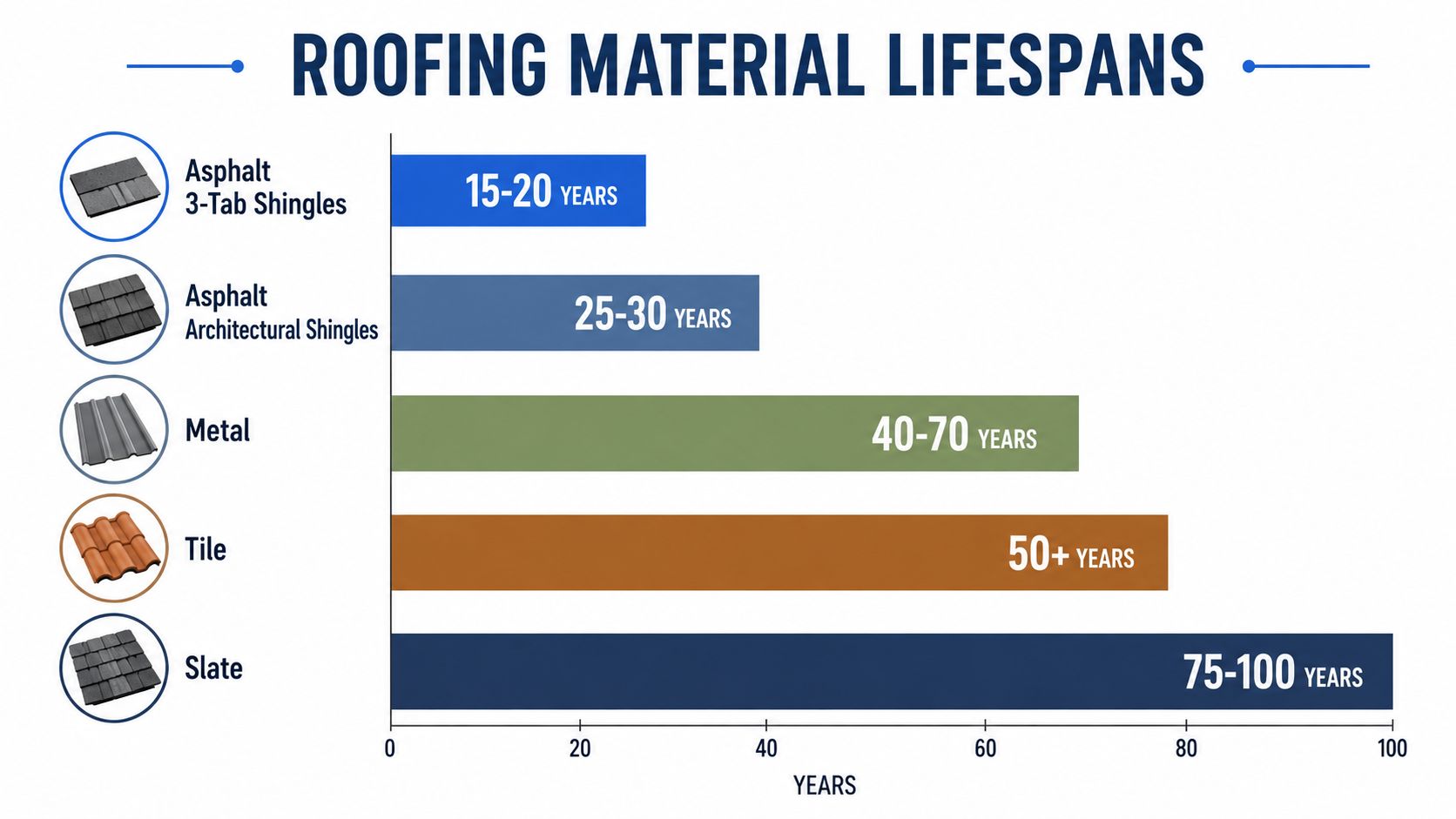
Material choice establishes the broadest difference in roof life span. Asphalt shingles remain the familiar option across central Ohio subdivisions because they balance availability, appearance, and installation practicality. Within that category, the difference between 3-tab and architectural shingles is meaningful. Published guidance commonly places 3-tab asphalt around 15 to 20 years and architectural asphalt around 25 to 30 years The Roofing Brief's material lifespan guidance.
Metal, tile, and slate can last much longer, but a longer service range doesn't automatically make them the right choice for every house. Structural capacity, roof design, repair access, neighborhood appearance, budget, and how long you plan to own the property all affect the decision.
How the materials compare
3-tab asphalt shingles offer the lowest entry point within common shingle systems, but their lighter construction leaves less room for prolonged weather exposure. They're often found on older homes and budget-conscious installations.
Architectural asphalt shingles use a dimensional profile and typically provide a longer planning range. They're common on newer central Ohio homes and are often the practical middle ground for a replacement.
Metal roofing can provide about 40 to 70 years of service, according to published material comparisons Ridgeline Roofing's roofing material lifespan guide. The trade-off is higher upfront complexity and the need for careful detailing around valleys, penetrations, chimneys, and trim. Homeowners comparing the long-term differences can review this metal roofing versus asphalt comparison.
Tile roofing can reach roughly 40 to 100+ years, but the visible tile isn't the entire roof system. Underlayment, flashing, fasteners, and supporting structure may need attention before the tile itself reaches the end of its material life.
Natural slate can last roughly 75 to 150+ years when properly installed and maintained HomeMatchup's material lifespan summary. Slate is more common on historic, custom, or architecturally distinctive homes than on typical Columbus subdivisions.
The key trade-off is lifecycle planning. A more expensive roof may outlast multiple asphalt replacement cycles, but homeowners still need to compare structural requirements, resale plans, repairability, and available installers. Choosing premium material solely because its lifespan is longer can create an impractical project if the home wasn't designed for it.
What Shortens or Extends a Roof Life Span
A roof rarely reaches the short or long end of its range because of one isolated issue. The result usually comes from several conditions working together. Asphalt shingles experience cumulative stress from ultraviolet exposure, wind, moisture, temperature changes, and thermal cycling. Guidance from the National Association of Certified Home Inspectors identifies climate stress, temperature swings, wind, and moisture as major influences on asphalt deterioration.
Central Ohio gives roofs a demanding mix. Winter freeze-thaw cycles work on cracks and weak flashing details. Summer heat and humidity affect attic conditions. Thunderstorms bring wind and hail, while leaves and branches can obstruct drainage or hold moisture against the roofing surface.
The details that change the outcome
Ventilation keeps attic heat and moisture from remaining trapped against the underside of the roof assembly. Blocked intake vents, inadequate exhaust, or insulation that covers ventilation paths can contribute to premature aging and moisture problems.
Installation quality determines whether shingles seal, fasteners land correctly, and flashing directs water where it belongs. A roof can have quality materials and still perform poorly if valleys, wall transitions, pipe boots, skylights, or chimney flashing were handled carelessly.
Maintenance isn't a substitute for a sound roof, but it can prevent small problems from becoming deck damage. Keep gutters and downspouts moving water away, remove branches and debris without walking on fragile shingles, and address loose flashing or missing shingles promptly. Homeowners who manage solar equipment in another climate may also find the broader solar panel maintenance tips for California useful for understanding why surface equipment and roof access should be handled carefully.
Storm exposure can move a roof to the short end of its range even when it still looks acceptable from the ground. Hail bruises, wind-lifted edges, and damaged seals may not create an immediate interior leak, but they can reduce the roof's ability to shed water during the next storm.
For a practical maintenance routine, use this preventive roof maintenance guide as a checklist, then have a professional evaluate anything that requires roof access. The goal isn't to force a roof to an advertised age. It's to identify the conditions that are shortening its useful service life.
Visible Signs Your Roof Is Nearing End of Life
Your roof may be aging normally, or it may be failing because of a specific defect. The difference often appears in patterns. A few isolated issues can be repairable, while widespread curling, repeated leaks, and weakened decking point toward replacement planning.
Start from the ground. Use binoculars if needed, and avoid climbing onto the roof just to confirm a concern. Asphalt shingles commonly show wear through edge curling, cupping, cracking, bald patches, and uneven surfaces. Heavy granule accumulation in gutters can indicate that the protective surface is wearing away, particularly when it appears well after the roof was installed.

What you can check safely
- Curling or cupped shingles: Raised edges and distorted tabs show that shingles are losing their intended weather seal.
- Granules in gutters: A noticeable buildup of roofing granules can signal surface wear and declining ultraviolet protection.
- Exposed nail heads: Visible or backing-out fasteners create direct water-entry points and need prompt evaluation.
- Soft or spongy decking: A springy area suggests moisture damage beneath the shingles. Don't test it by walking on the roof.
- Daylight through roof boards: Light entering around a penetration or through damaged decking deserves professional attention. Small gaps between boards in some older construction can be normal, but water staining or warped wood changes the concern.
Inside the house, look for recurring ceiling stains, damp insulation, musty odors, or fresh discoloration after rain. A stain can remain after an old repair, so the important question is whether it is active, expanding, or repeatedly returning.
Sagging is more serious than ordinary cosmetic aging. An uneven roofline can indicate compromised decking or framing, and a homeowner shouldn't climb onto or probe a sagging area. Call for an inspection and keep people away from the affected space until the condition is understood.
The installation date gives you context. The roof's condition gives you the decision. A newer roof with storm damage may need immediate repair, while an older roof with localized, stable wear may still have useful time left.
A Simple Roof Inspection Checklist for Homeowners
A safe homeowner inspection starts with observation, not roof access. Choose a clear day, stand in the yard or across the street, and use binoculars or a phone camera with a zoom lens. Look for missing shingles, lifted edges, dark or uneven areas, damaged pipe boots, visible flashing gaps, and sagging lines.
Check the exterior from safe positions
Walk the perimeter and note whether gutters are packed with leaves, pulling away from the fascia, or overflowing at corners. Confirm that downspouts discharge water away from the foundation and that water isn't staining siding below the roof edge. Trees touching the roof deserve attention because branches can scrape shingles and debris can block drainage.
Take dated photos from the same locations each time. A simple folder organized by address and season can help you compare changes without guessing whether a mark is new.
Look inside the attic
Use a flashlight and stay on the supported attic floor or walkway. Look for:
- Moisture evidence: Water stains, damp insulation, rusted fasteners, or darkened wood.
- Roof-deck condition: Warped, sagging, softened, or visibly deteriorated boards.
- Air movement: Blocked soffit vents, covered intake paths, or signs of persistent condensation.
- Storm clues: Freshly displaced debris, punctures, or water entry around penetrations.
Know what not to do
Don't walk on steep, wet, icy, or visibly damaged roofing. Don't use a ladder to reach the roof if you aren't trained and equipped to maintain three points of contact, and don't pull up shingles or disturb flashing to investigate a suspected leak.
A professional inspection can evaluate soft decking, fastener placement, concealed flashing failures, seal integrity, and storm bruising that a ground-level review can't confirm. If your observations are borderline, a free inspection gives you a condition-based assessment before a small concern becomes an interior repair.
Repair or Replace How to Decide
The repair-versus-replacement decision becomes clearer when you evaluate the whole system rather than one damaged shingle. Start with the roof's material and age, then add leak history, storm exposure, damage distribution, decking condition, and the quality of earlier repairs.
A newer roof with one isolated issue and sound surrounding shingles is often a repair candidate. A roof with recurring leaks in multiple areas, widespread curling, failed flashing throughout, or deteriorated decking deserves a replacement discussion even if one repair appears cheaper today.
Use four questions
- Is the damage localized? A small, clearly defined area may be repairable. Damage spread across slopes, ridges, valleys, and penetrations is a different problem.
- Does the roof keep leaking? Repeated repairs can indicate that the roof surface or underlying system has reached a broader failure point.
- Can replacement materials match? Color and profile matching becomes harder as products age or are discontinued. A visibly mismatched repair may also matter before a sale.
- What is your ownership plan? A homeowner preparing to sell may need a documented repair or replacement plan, while a family staying long term may prefer to solve the whole system rather than revisit the same leak.
Insurance adds another layer. Policies generally address sudden covered damage, such as hail or wind, rather than normal aging or deferred maintenance. Review the policy before assuming a claim will cover an aging roof, and document storm evidence before conditions change.
Understand the 25 percent code threshold
A widely cited re-roofing rule says that if more than 25% of the roof area is replaced or recovered within a 12-month period, the entire roof must meet current code requirements under IRC Section R908 Roofing Experts Network's explanation of the 25% rule. That threshold can turn a series of large repairs into a full compliance project, so ask the contractor how the proposed work interacts with local code.
Replacement becomes the stronger option when damage is widespread, leaks recur, decking is compromised, or the roof has reached the end of its material range. Repair remains sensible when the defect is limited, the surrounding system is healthy, and the work restores reliable water shedding.
Storm and Hail Damage in Central Ohio What Homeowners Should Do
A central Ohio storm can damage shingles without leaving an obvious hole. Hail may bruise the mat beneath the surface, and wind can lift or loosen shingles while leaving the roofline looking normal from the driveway. Later, repeated rain exposes those weakened areas.
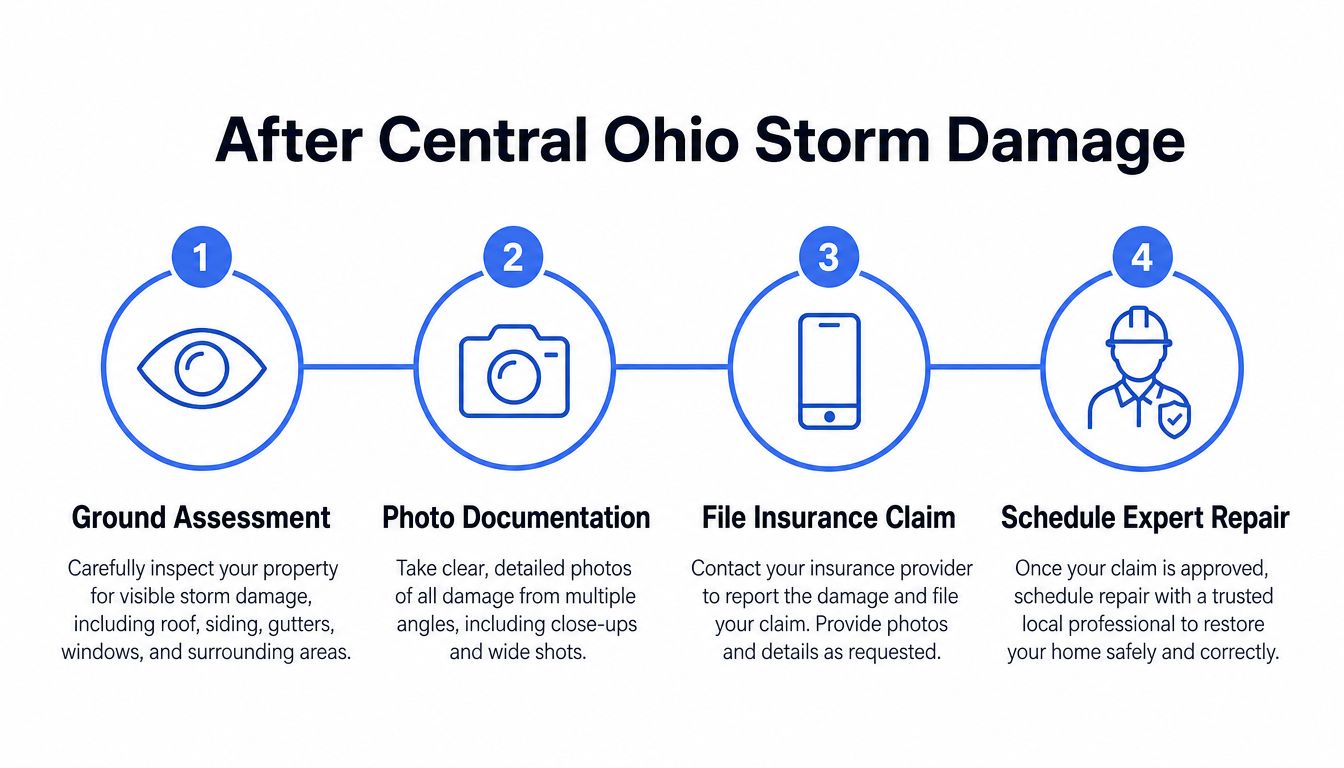
After a severe storm, begin with a ground assessment. Look for shingles in the yard, bent metal, damaged siding, dented gutters, broken branches, and fresh marks on roof slopes visible from a safe distance. Don't climb up to search for hail strikes. A roof surface can be slippery, and walking on damaged shingles may create additional problems.
Document before conditions change
Take photos and videos of the exterior, interior stains, fallen branches, damaged gutters, siding, windows, and personal property. Write down the storm date and keep repair invoices, inspection notes, and contractor photographs together. If landscaping was affected too, these tips to avoid landscaping surprises can help you separate storm cleanup decisions from roof-related work.
A contractor's assessment before calling the insurer can help you understand whether the damage appears sudden and storm-related or consistent with ordinary aging. That doesn't guarantee coverage, and it doesn't replace your adjuster's decision. It does give you a clearer record of what was observed and where.
Insurance deductibles and policy terms vary. Some policies distinguish wind and hail treatment from other covered losses, and the policy may consider depreciation depending on its coverage structure. Ask your agent specific questions before filing, especially if the evidence points only to normal wear.
For help organizing the inspection and insurance conversation, review this guide on working with a roof damage insurance adjuster. A storm inspection is especially useful when the roof appears intact but you see interior staining, displaced debris, or damage to nearby exterior components.
This video provides another visual reference for the post-storm process:
Your Roof Life Span Action Plan and Next Steps
You don't need to predict the exact day your roof will fail. You need a defensible understanding of its current condition, the risks affecting it, and the work required to keep water outside the house.
Start by recording the material and installation history if available. For common asphalt roofing, use the established 15 to 30 year planning range, then adjust your expectations for central Ohio freeze-thaw cycles, summer storms, attic airflow, workmanship, and maintenance. The roof's visible condition should carry more weight than a warranty brochure or an estimated replacement date.
Put the plan into practice
- Document the baseline: Photograph roof slopes, gutters, flashing, attic areas, and interior ceilings from safe locations.
- Watch for change: Track curling, granule loss, exposed fasteners, soft decking, stains, sagging, and daylight.
- Protect drainage: Keep gutters and downspouts clear, and address branches or debris that hold moisture against the roof.
- Respond after storms: Record damage promptly and arrange an assessment before deciding whether an insurance claim makes sense.
- Choose work based on scope: Repair isolated defects when the surrounding system is sound. Discuss replacement when damage is widespread, leaks recur, or decking and flashing have deteriorated.
A professional inspection is worthwhile when the roof is approaching its expected range, after a significant storm, when leaks return, or when you're buying, selling, or managing a property. The inspector should explain what was found, what can wait, what needs prompt attention, and how the remaining service life estimate was reached.
HIBCO ROOF LLC serves Columbus and central Ohio with free roof inspections, asphalt shingle repairs, full replacements, storm and hail assessments, gutter work, skylight services, and related exterior improvements. A written, no-pressure estimate can help you decide whether to repair now, monitor the roof, or plan a replacement before a leak forces the schedule.
Schedule a free roof inspection with HIBCO ROOF LLC to document your roof's current condition, identify storm or ventilation concerns, and get a practical repair-versus-replacement recommendation. Serving Columbus and central Ohio, HIBCO ROOF LLC can help you plan the next step before roof damage becomes an interior emergency.