

You walked downstairs after last night's rain and the same basement corner smells damp. Outside, the mulch by one downspout sits in a shallow trench, and the lowest siding course has a dark streak. The gutter above that corner was packed with wet leaves, so water sheeted over the front lip instead of going down the spout.
That is how overflowing gutters damage a house. The roof gathers rain from a wide area, and a blocked, sagging, or undersized gutter dumps it in one place. The first clues show up low: a damp block wall, a white film on the masonry, or a gully at the discharge.
You can prove whether the gutters are the source before you pay for guards, a new trough, or a foundation repair. Watch where the water appears, match it to the storm, and rule out the other usual causes. The repair should follow that evidence.
Table of Contents
- Where Overflowing Gutters Cause Damage
- How Overflow Turns Ordinary Rain Into Damage
- Foundation and Basement Damage Over Time
- How to Tell Gutters Are the Cause
- Siding, Fascia and Landscaping Damage in Practice
- Gutter Guards, Cleaning and Replacement Compared
- Confirm the Cause Before You Choose a Repair
Where Overflowing Gutters Cause Damage
Most owners meet the harm in a set order, from the soil upward. The table is the map. The notes under it say why each area is hit in that order.
| Damage Area | How Overflow Causes It | Early Sign | Typical Repair Scope |
|---|---|---|---|
| Foundation | Saturated soil and hydrostatic pressure against the wall | Hairline or stair-step cracks, bowing walls | Structural evaluation, drainage correction, sometimes wall stabilization |
| Basement moisture | Water seeps through walls and floor joints | Damp walls, musty odor, efflorescence | Regrading, sealing, dehumidification, gutter repair |
| Siding | Concentrated flow splashes back and stains the lower courses | Dark streaks, soft spots at bottom panels | Replace damaged panels, reroute discharge |
| Fascia and soffit | Water runs behind a sagging or leaking gutter | Peeling paint, soft wood, gutter pulling away | Replace rotted boards, reattach gutter, reseal joints |
| Landscaping | Discharge concentrates at one spot and erodes soil | Gullies, exposed roots, washed-out mulch | Regrade, add splash blocks or extensions |
| Roof edge | Backed-up water works under eave shingles | Curled eaves, soffit stains, ice dams in winter | Shingle and underlayment repair, ice-dam prevention |
Foundation comes first because the spilled sheet lands in the soil against the wall. Saturated soil and hydrostatic pressure push inward, which can show up as hairline cracks, stair-step cracks in block, or a wall that bows. The Wisconsin Historical Society explains that gutters are meant to keep roof water from soaking the sides of a house and to send it away from the foundation, and that water built up outside a foundation can press hard enough to bow a wall inward.
Basement moisture is that same push working through the wall and the joint at the slab. You get damp masonry, a musty odor after rain, and efflorescence, the white mineral dust left when the water dries.
Siding is next in line because the sheet hits the ground and splashes back onto the lowest panels. Dark streaks and soft spots start at the bottom course, not under the windows.
Fascia and soffit fail when a sagging gutter lets water run behind the trough. Paint peels, the board goes soft, and the hanger pulls free.
Landscaping records the discharge as a gully, bare roots, and mulch washed into the grass. That trench is often the first outdoor clue you can see without a ladder.
Roof edge trouble is the upstream version. Water that can't enter the gutter backs under the eave shingles, curls the tabs, stains the soffit, and feeds ice dams once nights freeze.
Start at the lowest mark
The earliest sign usually shows at the lowest visible point. A damp basement wall or a gully at the downspout is the place to start, then look straight up that same wall to the gutter that feeds it.
How Overflow Turns Ordinary Rain Into Damage
A roof works like a funnel. It catches rain over a wide surface and delivers it to a narrow edge.
Scale comes before the hardware. The U.S. Department of Energy's Building Science Education program notes that only a few inches of rain on a roof can generate several thousand gallons of water. Homeowners picture a bucket. The roof is delivering a small pond.
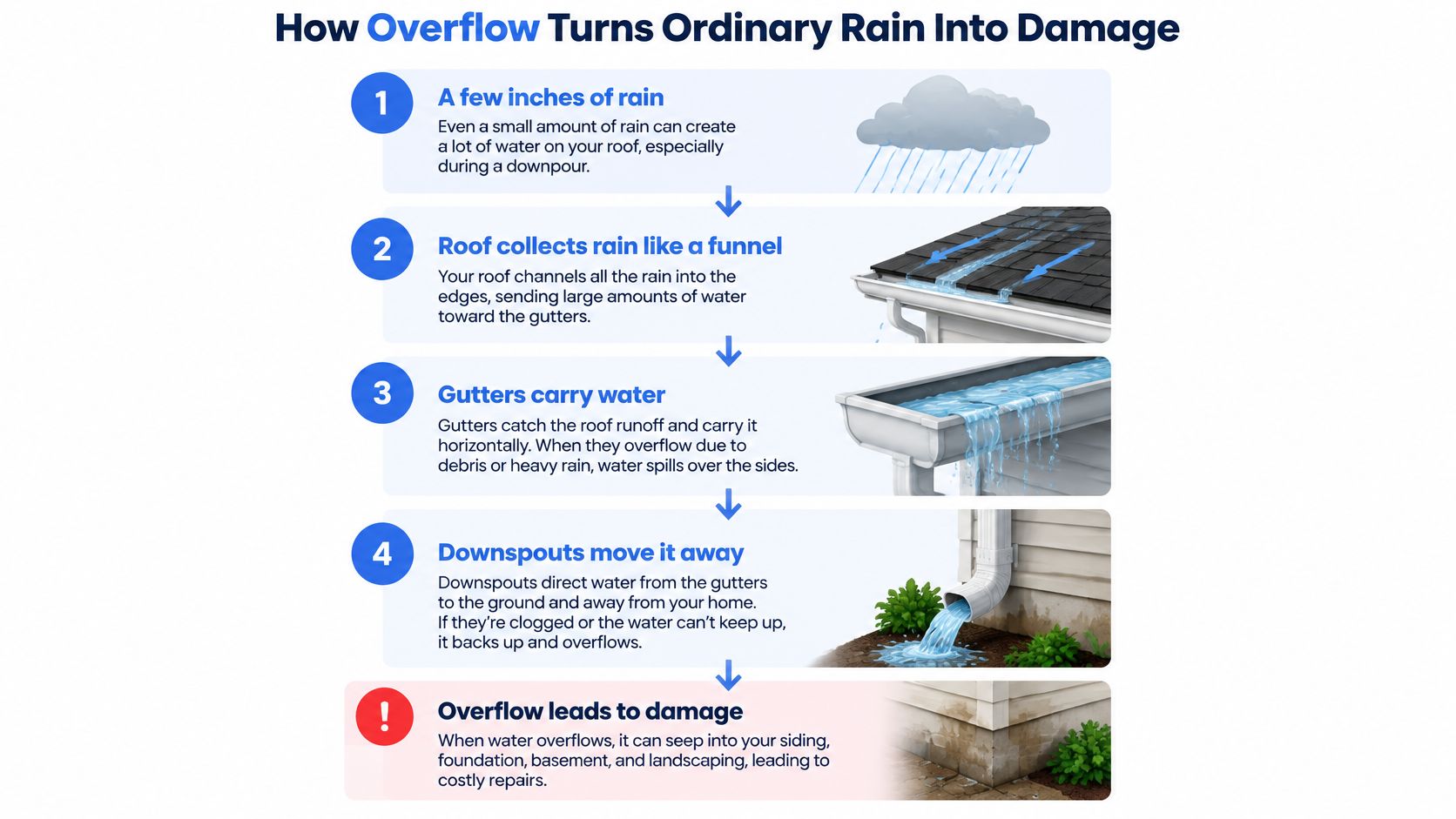
Six stages, and what usually breaks each one
- Rain hits the roof. Shingles shed it toward the eaves. Leaves and grit ride with it.
- The gutter collects it. Every section should drain toward a downspout, with no dead spot in the middle.
- Capacity drops. Leaf debris, shingle granules, a trough pitched backward, or an undersized gutter on a large roof all cut the flow.
- Water leaves at the roof edge. It falls as a sheet beside the wall instead of entering the downspout.
- Soil at the wall saturates. The same strip of ground takes the load on every storm.
- Moisture crosses the wall. Capillary action and hydrostatic pressure can move water through foundation walls into a basement or crawlspace.
That Building Science Education guidance is clear about the fix at the end of the path. Restore continuous gutter flow, confirm every section reaches a downspout, and terminate the discharge at least 5 feet from the foundation, or at least 10 feet away when you use an underground catchment. After a hard rain, check for ponding, damp masonry, efflorescence, a musty odor, and soil that has settled. Those marks mean the overflow has become a building-envelope problem, not only a dirty trough.
The gutter's job is to move water away from the house, and overflow turns the whole roof's drainage into a concentrated load at one point on the wall.
A clean lip with no downspout under it still fails. Water has to leave the property, not just leave the roof.
Foundation and Basement Damage Over Time
FEMA's basement-flood mitigation guidance treats gutters as part of keeping basements dry and foundations stable, and it warns that water damage from clogged gutters can be severe. The measures are practical: install gutters and downspouts, repair them, keep them free of debris, and extend them with rigid or flexible sections so roof runoff is carried away from the home. Downspouts should drain away from the foundation.
Damage doesn't arrive as a collapse. It climbs through stages, and the stage tells you how urgent the next step is.
Early stage
Damp patches show after storms and fade over a day or two. A musty smell hangs in the corner. On block or brick, a chalky film appears where the water dried. The wall is wet. It hasn't moved yet. This is the moment to stop the water, while sealing and drying can still be enough.
Middle stage
Hairline cracks open in the foundation wall. Mortar joints split. A stain forms where the wall meets the slab. In cold months, water sitting in those cracks freezes and widens them. You still may not need a structural brace, but painting over the crack won't hold. The water source has to stop, or the next winter makes the joint larger.
Late stage
The wall bows inward. Block shows a stair-step crack. A door sticks, and the basement floor slopes toward one side. Those signs call for a structural evaluation, not only a gutter cleaning. A new downspout won't push a bowed wall back.
Say the gutter over the northeast corner stays packed with maple leaves. After every storm that basement corner is damp, and the rest of the wall stays dry. Write down the corner, not just "basement wet." The location points back to the discharge above it.
If the soil at the footing stays wet after you've extended the spout, the buried drain may be part of the problem. Maintaining your home's perimeter drains is the next check when surface extensions aren't enough. How the gutter ties into that protection is covered in our notes on foundation protection and gutters.
Record the spot: Note the corner, the wall, and the storm. A patch that returns in the same place is more useful than a note that only says the basement got wet.
How to Tell Gutters Are the Cause
One overflowing storm rarely proves anything. Water that returns beside the same foundation area, storm after storm, is the pattern worth trusting. The repeat performance is what separates a gutter problem from a single wet week.
Building America guidance confirms that roof runoff can saturate foundation soil and contribute to interior moisture, mold, and rot. It also calls for a whole-drainage look: roof runoff, final grading, perimeter drainage, soil, and the foundation itself. In central Ohio, late-winter and early-spring rain can flood a basement because frozen ground absorbs less water. Time your notes to those storms, not to a dry Saturday.
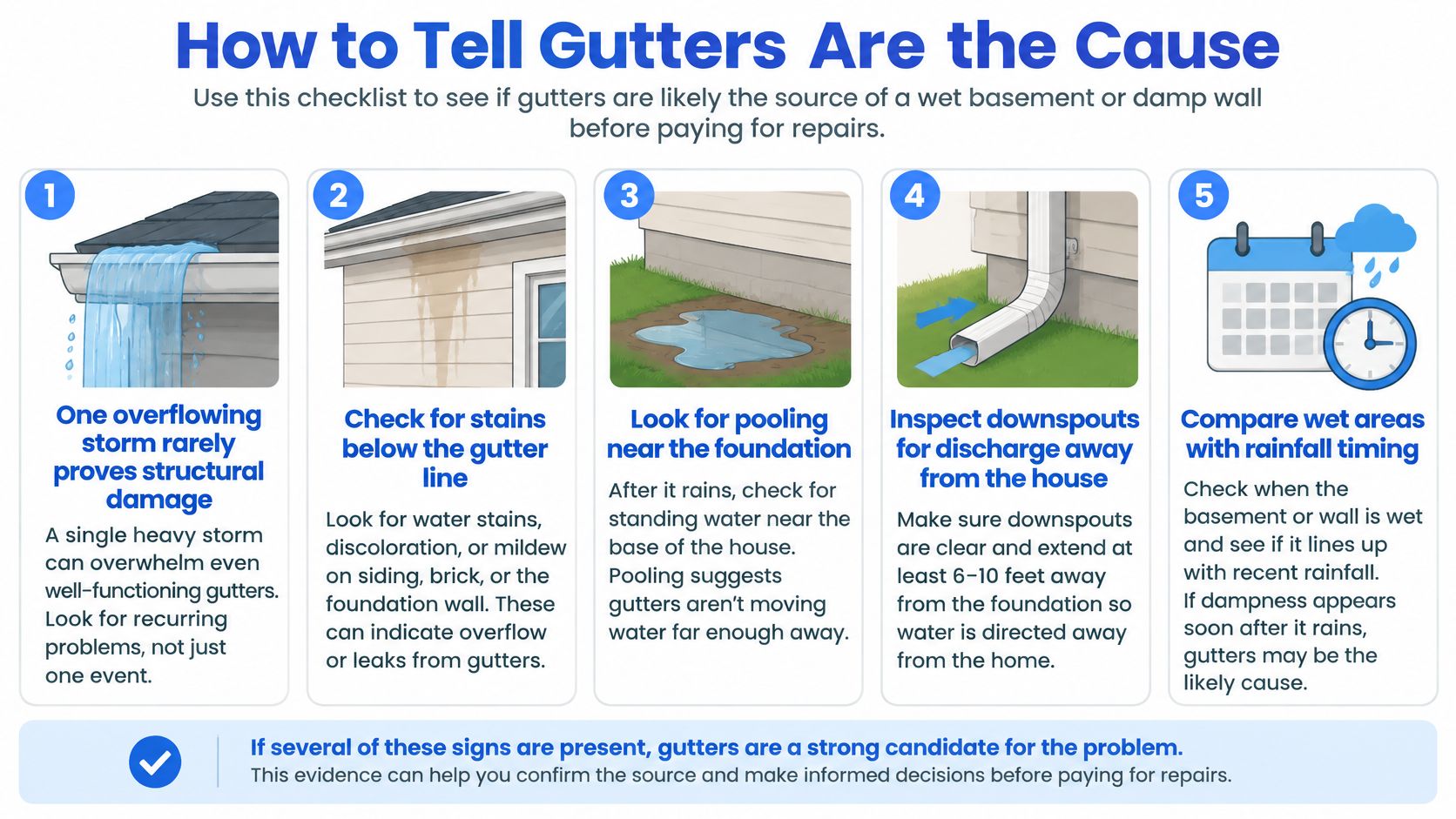
Run the test in this order
Work through the checks in sequence, so each step clears one suspect before you move to the next.
- Note exactly where water appears. A single corner, one wall, or the whole floor are different answers, and each one points to a different suspect.
- Watch the downspout during a steady rain. You want a solid stream at the bottom and no sheet of water spilling over the gutter lip.
- Check the slope of the soil. If the grade falls toward the house, even a working spout can leave a pond at the wall.
- Rule out the other sources. A plumbing leak, a flooded window well, condensation on a cold pipe or wall, groundwater, and a crack that weeps on a dry day can all mimic gutter damage.
- Photograph and date each observation. A phone picture with the storm date in the filename beats a memory from March.
Clues That Point to Gutters Versus Other Sources
| Observed clue | Points to gutters when | Points elsewhere when |
|---|---|---|
| Damp spot at one corner after storms | Gutter or downspout discharges at that corner | Window well or grade-level opening sits at that spot |
| Wet only during steady rain | Overflow reaches the wall and soaks the soil | Wet in dry weather points to plumbing or condensation |
| Whole floor wet in dry weather | Not gutters as the primary source | Plumbing leak, condensation or groundwater |
| Soil slopes toward the house | Overflow pools at the footing each time it rains | The grade is sending water to the wall, so regrading comes first |
If the wet corner lines up with a spilling gutter, and the rest of the basement stays dry except during rain, the evidence supports the gutters. If the floor is wet on a dry afternoon, or a window well stands full of leaves and water, hold off on a gutter project. Call for an inspection when cracks are widening, a wall is bowing, or you can't separate roof runoff from groundwater.
Siding, Fascia and Landscaping Damage in Practice
Say you find a gully at the downspout after a weekend storm. The mulch is gone, and a root on the foundation shrub is bare. That landscaping mark is the first thing you see, and it's the same discharge that will mark the wall.
Look up from the trench. The vinyl under that gutter has dark streaks on the lowest course, and one panel feels soft along the bottom edge. Splash from the concentrated flow hits that course first. Panels higher on the wall can look fine while the bottom one is already stained.
Then check the fascia behind a gutter that sags between hangers. Paint peels in a ribbon along the back of the trough. A screwdriver sinks into the board with little push. That's punky wood. Water ran behind the gutter, soaked the board, and the hanger is pulling out. When paint won't hold because the wood is gone, our guide to fascia board replacement covers when the board has to come off.
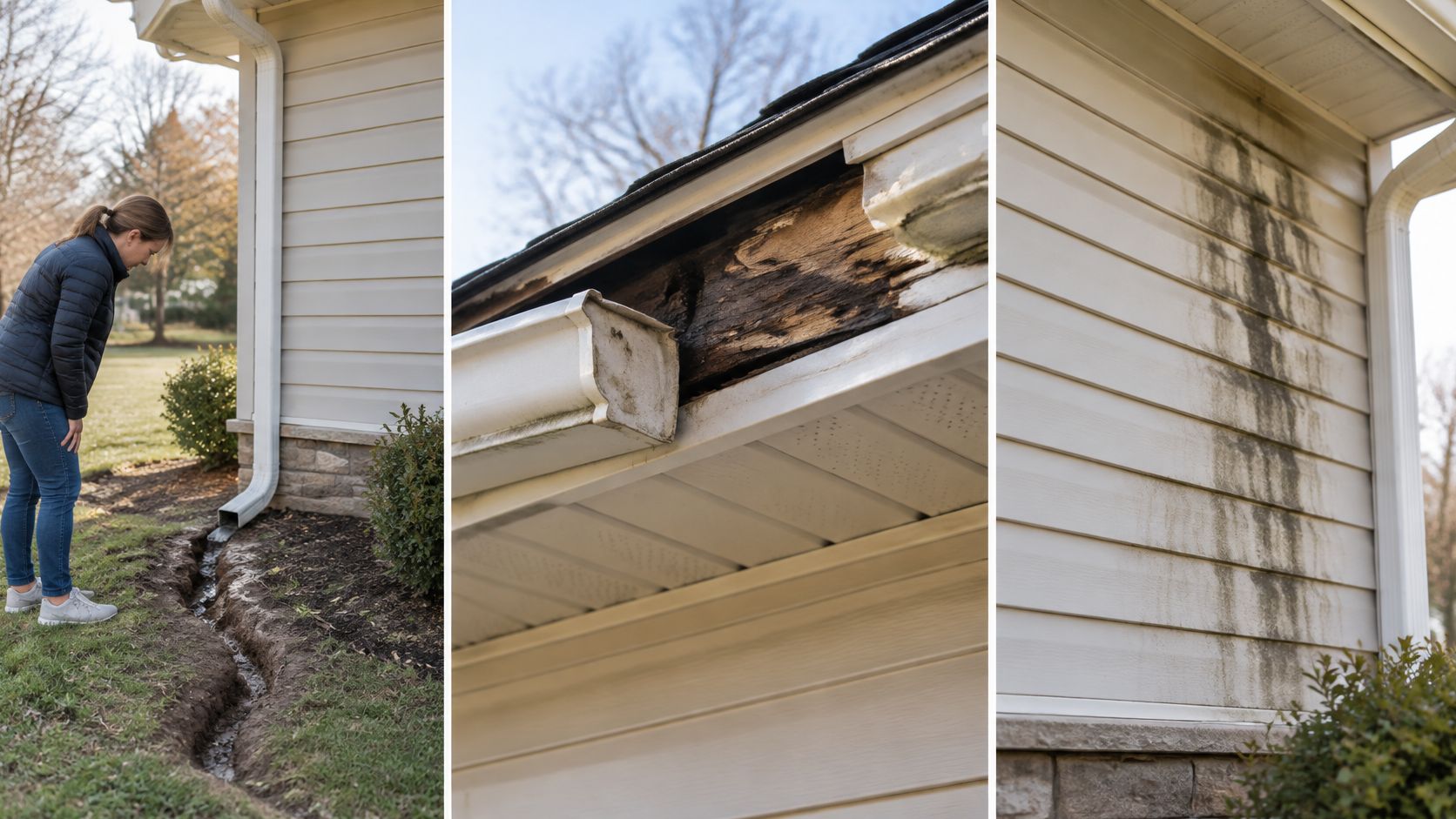
FEMA advises keeping gutters and downspouts free of leaves, sediment, and roof-shingle granules, because blockages keep water from draining away and can saturate the ground around the house. At the discharge, that flow can erode soil, expose or undermine a foundation edge, and stain or rot siding. FEMA recommends elbows, drain sleeves, and splash blocks to spread it. USDA guidance warns that runoff erosion and lingering moisture can damage foundations and contribute to unhealthy mold, and that undersized or clogged gutters overflow more often.
What a twice-a-year check covers
Do the walk at least twice a year, especially before rainy seasons and after autumn leaf fall.
- Fasteners: A hanger that's pulled out lets the gutter sag and spill behind the fascia.
- Pitch: Water should move toward the downspout, not sit in a belly in the middle of the run.
- Seams and spout size: An open joint, or a downspout that's too small for the roof, overflows even when the trough looks empty.
- The last few feet: Any extension has to land on stable ground that slopes away from the home, not into a footing-drain connection.
The stained panel is the result. The repair starts at the discharge point that carved the gully.
Gutter Guards, Cleaning and Replacement Compared
The rain test already named the failure. Read the options by that failure, not by price.
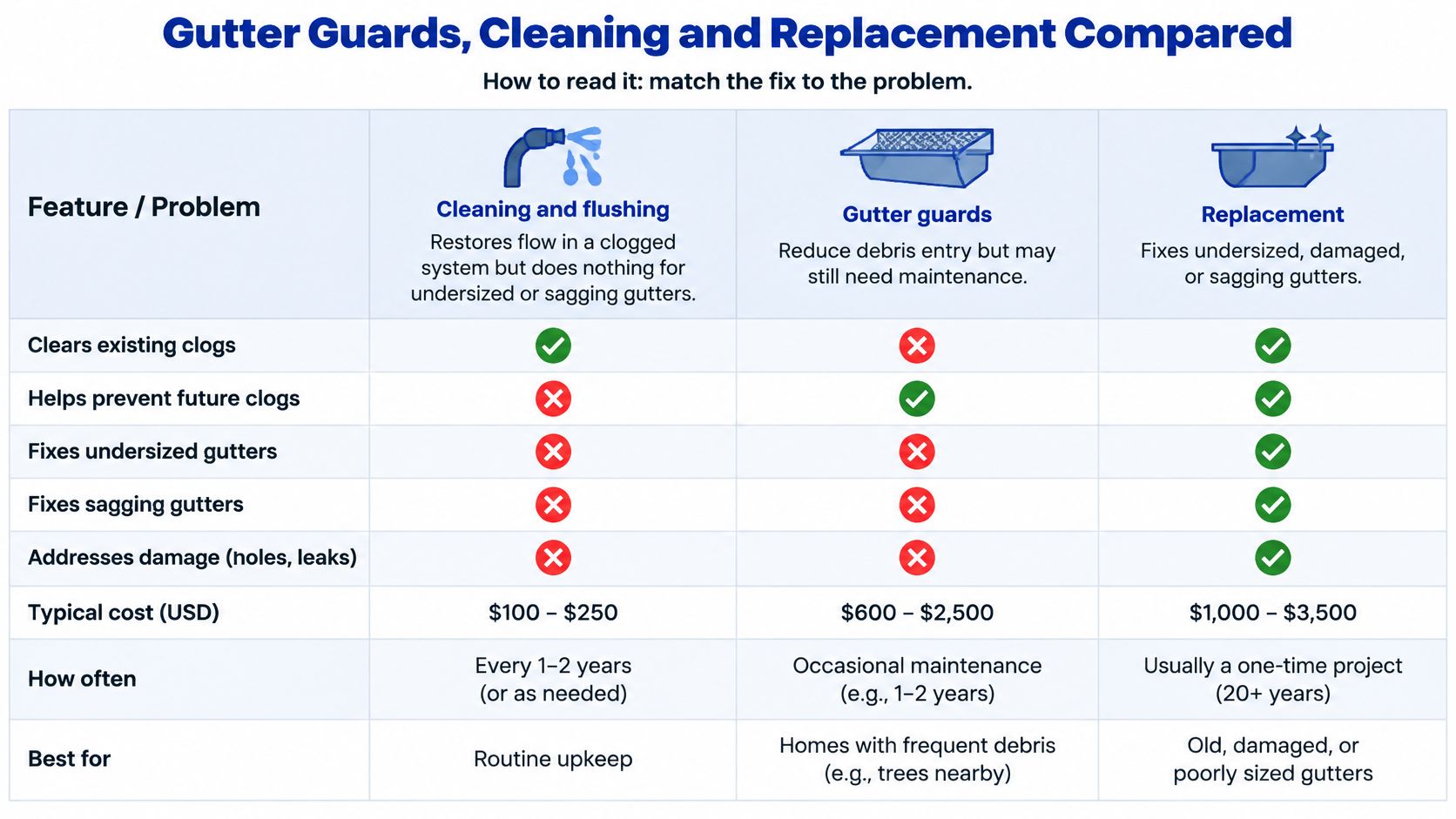
| Fix | What It Stops | Main Limit | Best Fit |
|---|---|---|---|
| Cleaning and flushing | Clogs from leaves and shingle granules | Does not fix undersized or sagging gutters | Sound gutters that clog from debris |
| Downspout extensions and splash blocks | Discharge landing next to the foundation | Needs stable ground that slopes away from the house | Downspouts that dump at the wall |
| Gutter guards | Debris buildup between cleanings | Cannot fix backward pitch or undersized channels | Heavy tree cover and frequent clogs |
| Larger gutters or added downspouts | Overflow from undersized capacity | Higher material and labor cost | Large roof areas and heavy rain |
| Seamless replacement and re-pitching | Sagging, separated seams and wrong slope | Full replacement cost | Failing or leaking systems |
| Regrading the soil | Water pooling at the foundation | Requires grading work and a drainage check | Flat lots or soil sloping toward the house |
When the trough itself is fine
Cleaning and flushing brings back flow in a clogged system. It won't enlarge a small gutter or lift a sag. Put it on the calendar before the wet months and again after the leaves drop. A practical walkthrough of preventing gutter overflow after spring storms is worth reading before you set a ladder on wet ground.
Downspout extensions and splash blocks solve a spout that dumps at the foundation. They fail if the ground slopes back toward the wall, because the water returns.
Gutter guards, whether mesh, foam, or a reverse-curve cover, slow the debris. They still need a periodic look, and they can't correct a gutter pitched the wrong way. If you're deciding between a screen and an open trough, our look at whether gutter guards really work spells out the checks that remain.
When you need a different gutter or a different grade
Larger gutters or extra downspouts fix overflow that happens on a clean system, which is a capacity problem on a big roof in a hard rain.
Full replacement and re-pitching are for sagging runs, open seams, and the wrong slope. Flushing a split joint only resets the leak until the next storm.
Regrading is the answer when soil slopes toward the house and water sits at the footing no matter how far the spout reaches.
Guards cut how often you clean. They don't end the job. Let the cause you proved in the rain pick the row, not the lowest bid.
Confirm the Cause Before You Choose a Repair
A repair picked before the cause is clear is how homeowners pay twice: once for a guard on a backward pitch, then again for the wall that kept getting wet. Read the water like a trail. The place it appears tells you which part of the runoff path failed.
- Photograph and date the stains, soft wood, soil gully, and the discharge point itself.
- Log the storms. Note which rain produced water, and whether it showed at one corner, one wall, or across the basement floor.
- Match each wet spot to the rain test. A spill over the lip points to clog, sag, or capacity. A dry downspout during the same storm points back to blockage. Water only where the spout lands points to extension or grade. A stain far from the discharge point needs a wider look at roof edge, flashing, or foundation.
- Read the homeowners policy for water damage and any deadline to report it. Keep the dated photos and storm log together; that record is what a claim or a contractor's diagnosis rests on.
- Book an inspection when the notes point past the gutters, or when you see bowing, stair-step cracks, or a sloping floor. Ask for the visit to separate cleaning, extensions, regrading, gutter replacement, and a foundation evaluation.
HIBCO ROOF LLC begins with a thorough roof inspection and says plainly whether a repair or replacement is the better long-term choice. Every homeowner receives a free inspection and a no-obligation estimate. Call or text 614-810-0050 and ask that the discharge point be written into the notes.
This week, walk the perimeter during the next storm. Log every wet spot: corner, wall, time, and whether the gutter above it was spilling.
If the storm log points to a spilling gutter, a sagging fascia, or a spout that dumps at the wall, HIBCO ROOF LLC can inspect the roof edge and drainage together and explain which option holds up. The company serves Columbus and central Ohio with free, no-obligation inspections and gutter work. Visit HIBCO ROOF LLC to schedule that look before the next heavy rain.