

After a hard spring storm, the first clue is rarely a flooded basement. More often it's a hairline stair-step crack, a damp line on the block wall, or soil washed bare beneath a downspout that used to look fine. In Columbus, I've seen that pattern enough times to know the problem usually started long before the crack showed up, with roof water landing too close to the foundation and staying there.
That's why foundation protection gutters matter as a complete drainage system, not just a strip of metal on the roof edge. Gutters catch runoff, downspouts move it away, grading keeps it moving after it hits the ground, and overflow planning keeps the system working when rain gets intense. When any one of those parts is weak, the foundation usually becomes the pressure point.
Table of Contents
- How Gutters Protect Your Foundation
- Gutter Sizing and Installation Requirements
- Downspout Routing and Discharge Distance
- Grading and Surface Protection Strategies
- When Gutter Guards Are Not Enough
- Warning Signs of Gutter and Foundation Problems
- Maintenance Schedule for Columbus Area Homes
How Gutters Protect Your Foundation
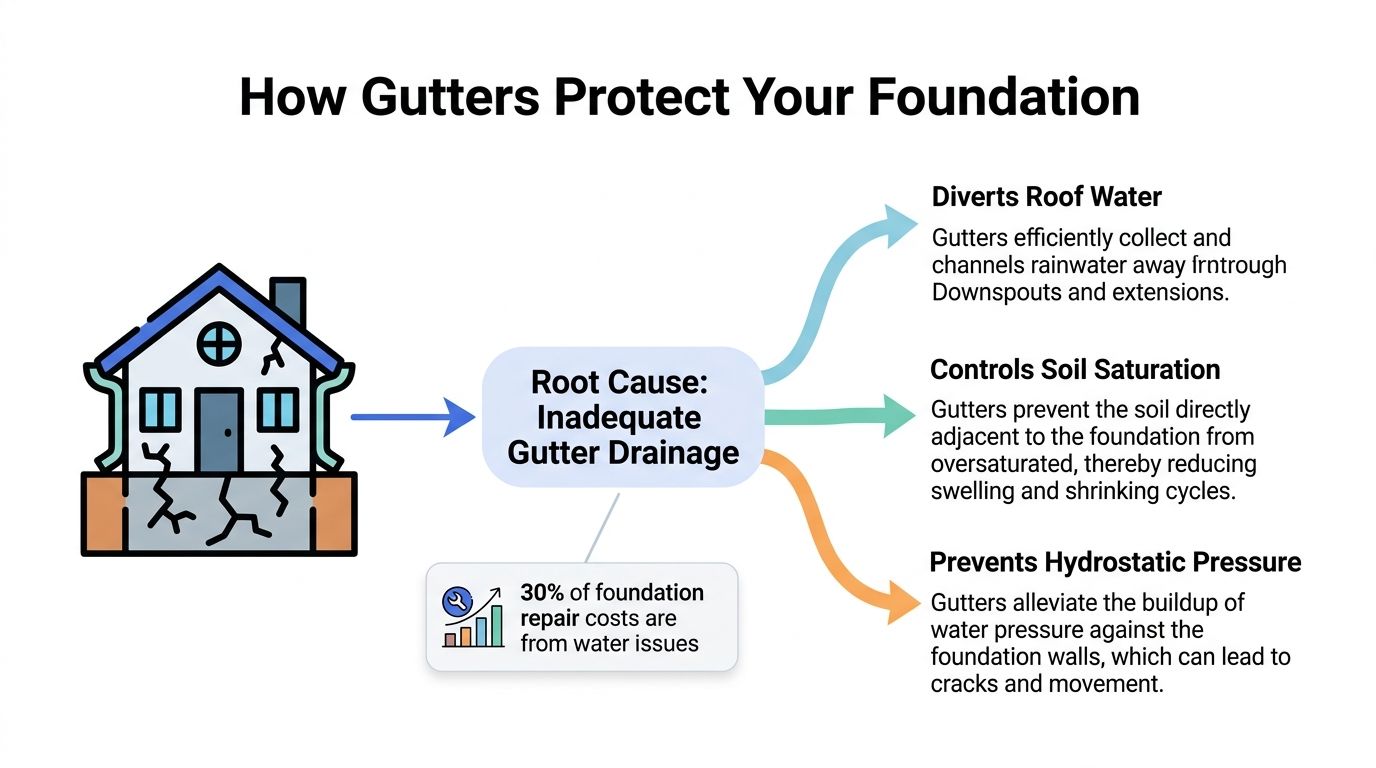
A homeowner in Columbus often notices the damage after the storm, not during it. The basement wall starts showing a stair-step crack, maybe there's a damp smell near the sump, and the downspout on that side is spilling right beside the house. That's usually where the trail begins, because roof runoff that should have left the lot instead soaked the backfill zone next to the footing.
The logic is straightforward. Gutters intercept roof water, downspouts carry it down, and the ground surface finishes the job by moving it away from the structure. That layered defense matters in central Ohio because clay-heavy soils hold moisture and push back against basement walls as they swell. Once that soil stays wet, the wall sees more pressure, not less.
Why the roof edge is only the first step
A gutter system can capture water and still fail the house if discharge stays too close to the foundation. That's why the best installations don't stop at the fascia line, they end where the water can't easily migrate back. Building-science guidance says discharge should be routed to sloping grade farther than 5 feet from the foundation, or to an underground catchment system farther than 10 feet away and not tied into the foundation drain system, which is the right way to think about the whole assembly (Building Science Education, PNNL guidance on gutters and downspouts).
That same layered mindset is why I don't talk about gutters as a cosmetic upgrade. In the field, they're part of a water-management chain that includes the roof, the gutter profile, the downspout path, and the final grade. Break the chain at any point, and water finds the weakest spot.
For homeowners comparing options, a solid starting point is preventing foundation problems from gutters, because it reinforces a simple truth: the foundation doesn't care how pretty the gutter looks if the runoff still ends up beside the house. If you're also planning debris control, the system should be matched with the right leaf-guard approach, not treated as a standalone fix, which is why many homeowners also review leaf guard gutter systems.
Gutter Sizing and Installation Requirements
Sizing is where a lot of systems go wrong. A gutter can be clean, new, and expensive, and still fail if it's too small for the roof it serves or pitched so poorly that water pools in the trough. In Columbus and the surrounding area, I usually push homeowners toward 6-inch K-style gutters when the roof area and storm exposure call for more capacity, because undersized systems are the ones that overflow first.
What to verify before installation
A solid installation starts with the roof catchment area, then matches the gutter and downspout layout to the water load. The pitch matters too. A common rule is 1/4 inch of drop per 10 feet of run toward the downspout, so a 40-foot run should fall about 1 inch total to keep water moving (gutter pitch guidance). If the slope is flatter than that, standing water sits in the trough and the system becomes heavier, dirtier, and more failure-prone.
Hanger spacing matters just as much. I don't like hangers farther apart than 24 inches, especially here where winter ice and trapped water can pull a weak run loose. Fascia condition matters too, because fastening new metal to rotted wood only hides the problem until the first heavy storm or freeze-thaw cycle.
Practical rule: an oversized gutter with correct pitch beats a premium gutter that's too small or too flat.
Simple sizing checklist
- Measure the roof section the gutter serves, not the whole house.
- Check the fascia for rot, softness, or pulled fasteners before installation.
- Confirm pitch with a level, not by eye.
- Match downspouts to the roof load and the discharge plan.
- Leave room for overflow so water doesn't pour over the back edge during heavy rain.
| Roof Catchment Area (sq ft) | Recommended Gutter Size | Downspout Size | Max Downspout Spacing |
|---|---|---|---|
| Small roof section | 5-inch or 6-inch K-style, depending on layout | Standard downspout | Shorter runs |
| Medium roof section | 6-inch K-style | Larger downspout | Closer spacing |
| Large or steep roof section | 6-inch K-style or larger where needed | Larger downspout | Tighter spacing |
If you want a clean installation process to compare against what's on your house now, the details in seamless gutter installation are worth reviewing before anyone starts hanging metal. Sections help reduce leak points, but they still need the right pitch, spacing, and discharge plan to protect the foundation.
Downspout Routing and Discharge Distance
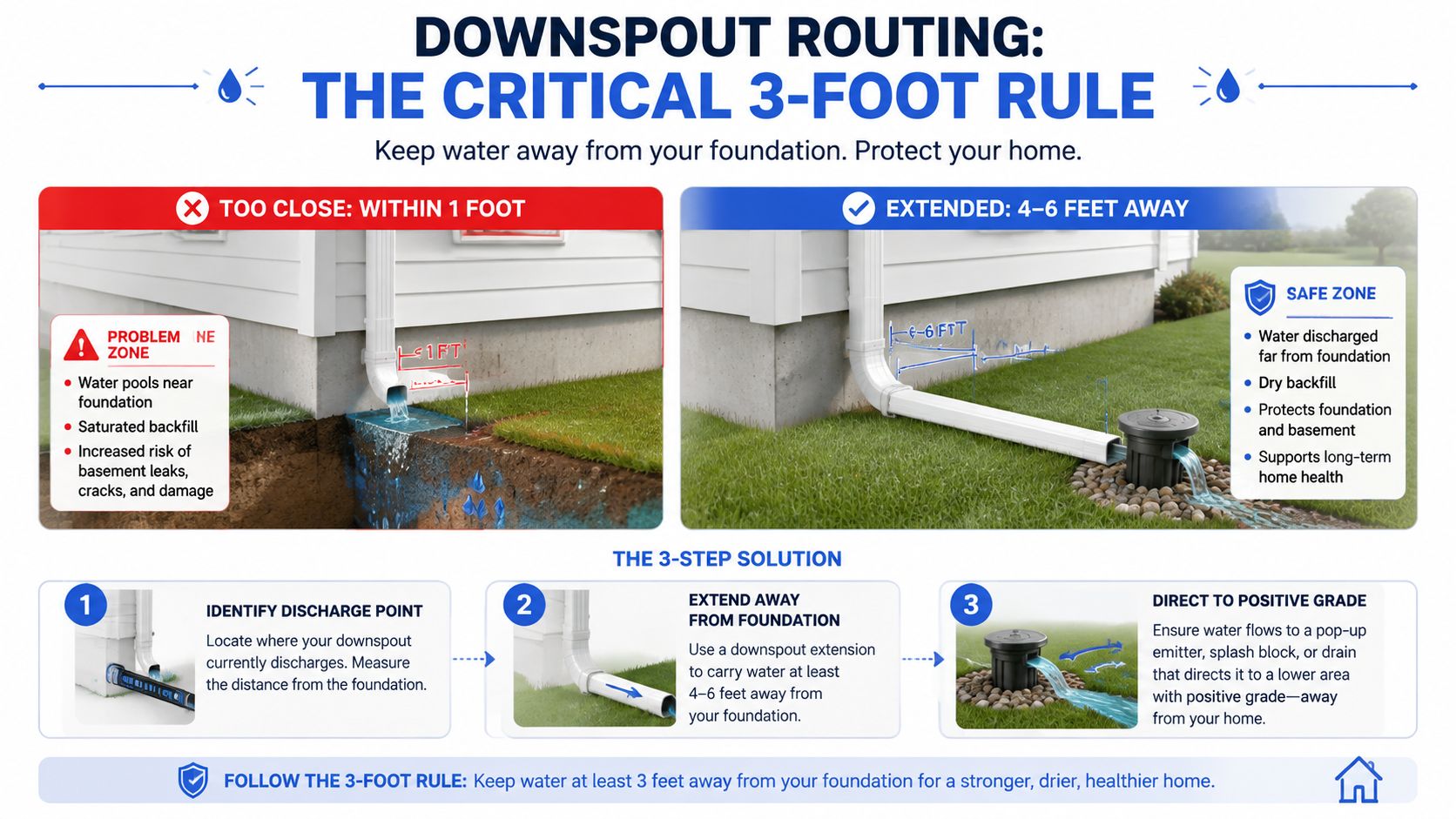
Downspouts get ignored because they look finished once the elbow is on. That's a mistake. The job starts after the water leaves the pipe, because discharge too close to the foundation saturates the soil beside the wall, and that loose backfill behaves like a sponge.
I see homeowners spend money on new gutters, then dump every downspout into the same corner where the patio slopes back toward the house. That setup moves the problem from the roofline to the footing. On Columbus properties with clay soil, that moisture doesn't disappear quickly, it lingers and pushes water pressure against the wall.
Where the water needs to end up
Downspouts should move runoff to a termination point that clears the foundation zone. Building guidance says runoff should go at least 4 to 6 feet from the house, and often 5 to 10 feet where the lot is flat or drains slowly (drainage guidance). Another building-science source says sloped leaders should discharge at least 10 feet from the foundation wall (structural foundation drainage guidance). That's the standard I trust when I'm looking at a problem property.
For most Columbus homes, buried solid pipe with a cleanout point is the most reliable long-term choice. Corrugated tubing is faster to install but tends to sag and trap debris. Splash blocks can help in a pinch, but they're weak when the ground slopes the wrong way or when the soil stays soft after repeated storms.
If you're planning the route, the practical questions are simple.
- Where does the water land now?
- Can it reach the foundation again by flowing across grade?
- Does the outlet terminate on positive slope or into a depression?
- Is there a real destination, or just a temporary patch?
For a straightforward planning reference, planning downspout drainage lays out the same basic principle in plain language, every downspout needs a deliberate ending point, not just an elbow and hope.
Grading and Surface Protection Strategies
A gutter can discharge correctly while the foundation still gets wet. I see this after Columbus storms when settlement or landscaping has reversed the yard's slope. Water leaves the downspout, crosses the surface, and returns to the foundation wall. Gutters, outlet routing, grading, and overflow control must work as one water-management system.
What the ground should do
Site-drainage guidance tied to the International Residential Code calls for the ground to slope away from the foundation at least 6 inches over the first 10 feet, about a 5% slope (grading guidance). On older Columbus homes, that grade often disappears through settlement, landscaping, patio additions, or accumulated mulch. The result is negative grade, which directs roof runoff back toward the house.
I check the area with a straightedge and level, then follow the surface during a hard rain. A shallow but consistent fall may be restored with compacted soil and careful shaping. If the yard slopes toward the wall, adding loose dirt rarely lasts. The correction may require rebuilding the grade, intercepting water with a swale or drain, and protecting the discharge path so runoff does not erode the repair.
Surface protection that helps
Mulch placed against the foundation can retain moisture and hide settlement. Keep the foundation edge defined, with a surface that resists erosion and gives water a visible route away from the structure. Concrete aprons, French drains, and swales each fit different site conditions. A drain helps collect water, while a swale uses grade to carry it across the lot. Neither works well if its outlet ends in a low spot.
For areas where gutters release water near the house, Fairfax County recommends a foundation-line band of 10 to 12 inches of bluestone or pea gravel, 3 to 4 inches thick over fabric, with 4 to 5 inch plastic edging to limit erosion (Fairfax County drainage guide). That surface does not replace proper grading or a suitable discharge point. It protects the soil at a vulnerable location and makes overflow easier to identify.
Foundation water management fails when one layer handles runoff but the next layer sends it back toward the wall.
When Gutter Guards Are Not Enough
Gutter guards help with debris, but they don't create capacity. That's the part marketing glosses over. A clean system that's too small still overflows, and during intense rain, the water doesn't care whether a mesh screen is installed.
Recent climate guidance has started to treat overflow as part of the design, not an accident. The Maine climate white paper recommends considering additional leaders and gutter overflow, and obstructed downpipes can force water to spray over the gutter when discharge is blocked (Maine climate white paper). That lines up with what I see after big summer storms, when the issue isn't leaf load alone, it's volume.
Where guards help and where they don't
Mesh can reduce routine cleaning, but it won't fix undersized gutters, poor pitch, or weak downspout routing. Fine debris still gets through some systems, and winter ice can still form where drainage is slow. Even a good guard can narrow flow enough that a steep roof sheds faster than the system can carry water away during a hard burst.
That's why overflow design matters. Secondary outlets, oversized runs, and deliberate overflow points are part of a system that protects the siding and the foundation when rain beats the gutter capacity. If the overflow ends up cascading down the wall or dumping beside the footing, the guard only made the problem look cleaner.
The practical decision is simple. If your gutters are already small or poorly routed, capacity upgrades come before guard add-ons. If debris is the main issue and the rest of the system is sound, guards can make sense as one part of the solution.
Warning Signs of Gutter and Foundation Problems
Foundation trouble rarely starts with a dramatic failure. After a storm, the early clues usually appear as changed soil, stained siding, or water that keeps collecting beside one part of the house. Inspect the exterior and interior together, because the visible damage often sits at the end of a longer drainage problem.
What to look for outside
Walk the perimeter after rainfall, paying close attention to each downspout outlet.
- Erosion channels: a trench below one outlet shows concentrated discharge.
- Siding stains or algae: dark streaks beneath seams can indicate overflow or leaking joints.
- Washed-out mulch: bare soil beside the wall means runoff is reaching the foundation area.
- Sagging gutters: dips between hangers hold water and reduce the system's carrying capacity.
- Separated joints or pulled fasteners: these allow leaks and can worsen as the gutter fills.
Also check whether the downspout outlet, extension, and surrounding grade direct water away from the house. A sound gutter can still create foundation trouble if discharge ends beside the footing or if the soil has settled toward the wall.
What to check inside
In the basement or crawlspace, look for efflorescence, horizontal cracking, persistent musty odors, and doors or windows that stick during wet seasons. A crack wider than 1/8 inch, a wall bowing more than 2 inches, or standing water appearing within 24 hours of rainfall calls for diagnostic evaluation rather than routine cleaning.
Overflow needs correction through cleaning, resizing, or improvements to the gutter system, as noted in the Fairfax County drainage guide. In practice, the symptom may come from several connected failures: a blocked outlet, insufficient capacity, poor routing, or grading that sends overflow back toward the foundation. Trace the entire path before choosing a repair.
Practical rule: if soil below one downspout looks different after every storm, treat that area as a warning. The next repair may involve the outlet, the grade, or the foundation itself.
Maintenance Schedule for Columbus Area Homes
Columbus homes face freeze-thaw cycles, leaf drop, spring debris, and summer storms. A single annual inspection often misses problems, especially on lots with mature trees. Set a seasonal schedule that checks the complete water path, from roof edge to downspout outlet and surrounding grade.
Seasonal rhythm that works here
Spring cleaning belongs after the main debris period, when maple helicopters and oak catkins have stopped filling the troughs. Inspect seams, hangers, and outlets for damage left by winter. Summer is the right time to confirm that lawn work has not moved extensions or redirected discharge toward the foundation.
Fall commonly requires two cleanings, one after early leaf drop and another after the final heavy drop. Tree-heavy lots may need closer observation between visits. Before sustained freezing, confirm that every gutter run and downspout drains fully. Standing water can freeze, stress joints, and reduce capacity during the next storm. This winter gutter maintenance guide provides a useful cold-weather checklist.
| Season | Timing | Primary Tasks | Columbus-Specific Notes |
|---|---|---|---|
| Spring | After late debris drop | Clean gutters, inspect seams, check hangers | Look for freeze-thaw damage |
| Summer | Mid-season check | Verify extensions and discharge points | Mowers can shift outlets |
| Fall | Mid-October and late November | Clean twice and inspect for clogs | Tree-heavy lots need closer checks |
| Winter | Before sustained freezing | Confirm complete drainage | Ice can stress the system |
Photograph each downspout outlet during seasonal checks. Compare the soil, mulch, and splash pattern over time. Persistent erosion, a wet strip, or soil settling near the wall may show that the outlet, grade, or overflow plan needs correction. Cleaning alone cannot solve a discharge route that ends beside the footing.
If overflow continues, inspect the entire system before replacing one component. Capacity, outlet blockage, extension placement, grading, and overflow control must work together during heavy Columbus rain.
HIBCO ROOF LLC can inspect gutter performance, downspout routing, and grading, then identify the parts requiring attention. Visit HIBCO ROOF LLC to ask about gutter repairs, replacement, and drainage setup for Columbus weather.