Skylight flashing repair usually costs $150 to $800, with most standard jobs landing around $300 to $450. That national average is useful, but it’s also a wide range, and the actual price depends on the roof, the skylight, the leak path, and how much surrounding roofing has to be disturbed to fix it correctly.
If you’re reading this, there’s a good chance you’ve already seen the warning signs. Maybe there’s a brown water mark on the drywall below the skylight. Maybe the leak only shows up during wind-driven rain. Maybe someone already tried caulk, and it helped for a while, then the drip came back. That’s common with skylight leaks in Columbus. A lot of homeowners think the glass is bad when the problem lies with the metal flashing system around the unit.
A proper flashing repair isn’t just smearing sealant around the frame. It usually means lifting shingles, checking the underlayment, replacing or reworking the metal pieces that direct water away from the skylight, and then tying everything back together so water sheds the way it should. That’s where the cost comes from, and that’s why the lowest quote isn’t always the cheapest outcome.
Table of Contents
- Understanding Skylight Flashing and Why It Fails
- Primary Factors That Determine Skylight Repair Costs
- The Hidden Dangers and High Costs of DIY Repairs
- Should You Repair or Replace Your Skylight
- Skylight Flashing Repair Costs in Columbus Ohio
- Get a Free Flashing Inspection from HIBCO ROOF
- Frequently Asked Questions About Skylight Repair
Understanding Skylight Flashing and Why It Fails
Skylight flashing is the metal system that seals the joint where the skylight meets the roof. The simplest way to think about it is the rain guard over a jacket zipper. The zipper closes the opening, but the flap over it is what keeps water from getting in. On a roof, shingles and underlayment do part of the job, but flashing is what handles the vulnerable seam.
That seam is where many skylight leaks start. Water doesn’t need a big opening. It only needs one bad overlap, one lifted corner, one rusted section, or one installer shortcut to get under the roofing and into the house.
Why flashing fails first
Skylights interrupt the roof plane. That alone makes them more demanding than a normal field of shingles. The roof has to move water around an opening, not just down a slope.
Common causes include:
- Poor original installation: If the apron, step flashing, or saddle pieces weren’t woven correctly into the roofing, the system may leak long before the skylight itself wears out.
- Storm damage: Wind can lift surrounding shingles. Hail can dent metal. Debris can loosen edges or break old sealant.
- Age and UV exposure: Sealants dry out. Metal expands and contracts. Roofing materials around the skylight get brittle over time.
- Previous patch jobs: Caulk over failed flashing often hides the issue instead of fixing it.
Practical rule: If a skylight only leaks during certain storms, the problem is often in how water is being redirected around the opening, not in the glass itself.
A homeowner can usually spot the symptom, but not the path water is taking. That’s why leaks around roof penetrations need proper diagnosis. If you’re trying to sort out whether the stain you’re seeing points to flashing trouble, this guide on signs of a roof leak gives a useful starting point.
Why sealant alone usually doesn’t hold
Sealant has a place in roofing work, but it doesn’t replace a flashing system. If the metal pieces are lapped wrong, punctured, loose, or trapped under damaged shingles, the leak path stays active.
For homeowners trying to stay ahead of these problems, routine exterior checks matter. General expert Arizona home maintenance tips are a good reminder that small roof and envelope issues get expensive when they sit too long, even if the climate there is different from Central Ohio.
Primary Factors That Determine Skylight Repair Costs
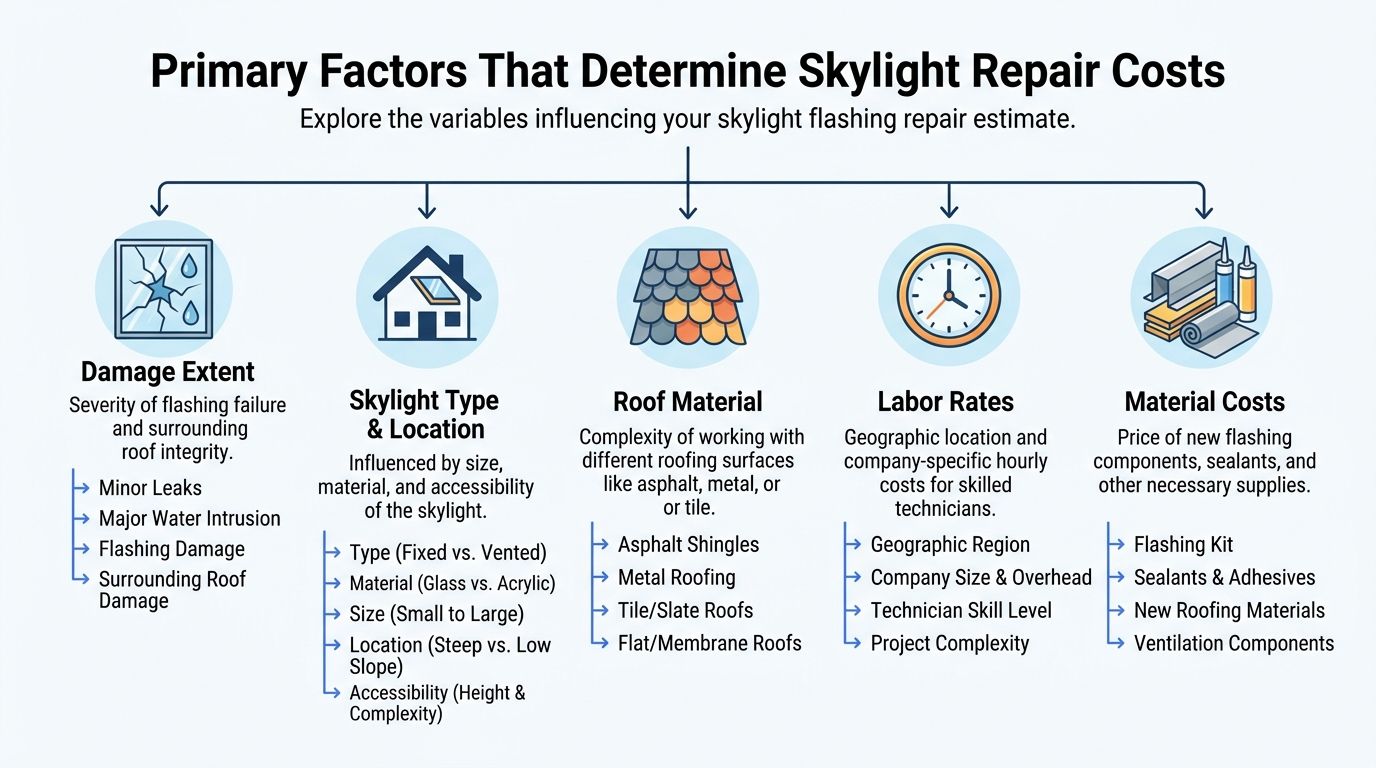
A homeowner might hear one price for a simple fix and another for a full re-flash and wonder why the gap is so wide. The answer is labor scope. According to HomeGuide, skylight flashing repair costs between $150 and $500 for localized fixes, rising to $300 to $800 when re-flashing requires integrating new apron, step, and saddle pieces with underlayment re-weaving; this range reflects standard labor rates of $30 to $80 per hour and a work scope of 1 to 4 hours (HomeGuide skylight repair cost data).
What the base repair range actually covers
At the low end, the job may involve a small, accessible leak where the surrounding shingles are still in decent shape. At the higher end, the roofer may need to remove and reinstall roofing around the skylight, replace multiple flashing components, and rework the water-shedding layers below the shingles.
That difference matters because homeowners often compare estimates without comparing scope. One bid may be for spot sealing. Another may include tear-back, new metal, underlayment tie-in, and final water testing.
A repair quote only makes sense if you know whether it covers a patch, a partial rework, or a full flashing rebuild around the skylight.
The variables that move the price up or down
Here’s what usually drives the final invoice:
| Factor | How it affects cost | What to ask |
|---|---|---|
| Damage extent | A small leak at one edge costs less than widespread failure with rotten decking or soaked roofing layers. | Is this a localized repair or full re-flashing? |
| Skylight type and location | A basic fixed skylight on a simple roof is easier than a larger unit high on a steep roof. | How much roof area has to be opened up? |
| Roof material | Asphalt shingles are usually simpler to lift and re-integrate than tile or metal systems. | Will existing roofing be reused or replaced around the unit? |
| Access and safety setup | Two-story homes, steep pitches, and limited access increase labor time. | Does the estimate include setup and protection work? |
| Material scope | New flashing pieces, sealants, and underlayment add cost when the repair goes beyond surface work. | Are all metal components being replaced or only selected pieces? |
A good estimate should also reflect local labor conditions, crew setup, and whether the skylight sits in an easy work zone or a tricky roof section. For homeowners trying to lower long-term ownership costs, this property maintenance cost reduction guide has a practical mindset: minor issues are cheaper when they’re handled before they spread into surrounding materials.
The Hidden Dangers and High Costs of DIY Repairs
A skylight leak makes people want to act fast. That part makes sense. The risky part is assuming flashing repair is a tube-of-sealant job.
Most failed DIY skylight repairs have the same pattern. The visible gap gets sealed. The underlying water path stays open underneath the shingles or underlayment. Then the leak comes back, usually after the next hard rain, and by then the roof is harder and more expensive to fix.
Why skylight flashing is harder than it looks
Flashing repair means working in layers. The shingles have to come apart without being torn up. The metal pieces have to overlap in the correct sequence. The water barrier below has to tie back together so runoff moves around the skylight and back onto the roof surface.
Mistakes usually happen in places homeowners can’t see once the job is closed up:
- Shingles get damaged during removal
- Fasteners go in the wrong place
- Flashing pieces overlap incorrectly
- Sealant gets used as the main defense instead of the backup
- The curb-to-roof junction isn’t sealed into the surrounding system
If water has already reached insulation or interior finishes, the roofing mistake can turn into a restoration issue. That’s why guidance like AMPM Restoration’s insights is worth reading. Once moisture spreads beyond the entry point, the repair gets bigger than the roof opening itself.
What a failed repair turns into
There’s a direct financial reason not to gamble here. A source cited in the verified data states that when flashing repair is done after a roof system has already been fully replaced, or as a standalone emergency call, total costs can escalate to $3,000 to $5,000 because of crew mobilization, overhead, and the need to remove and replace surrounding roofing to integrate new flashing. That premium is 6 to 8 times higher than handling the work during original installation or re-roofing (video reference on skylight flashing cost escalation).
That doesn’t mean every bad patch turns into a major bill. It means the downside is real. Once water gets under a finished roof system, the repair often stops being “fix the skylight” and becomes “open the area back up and rebuild the tie-in.”
Should You Repair or Replace Your Skylight
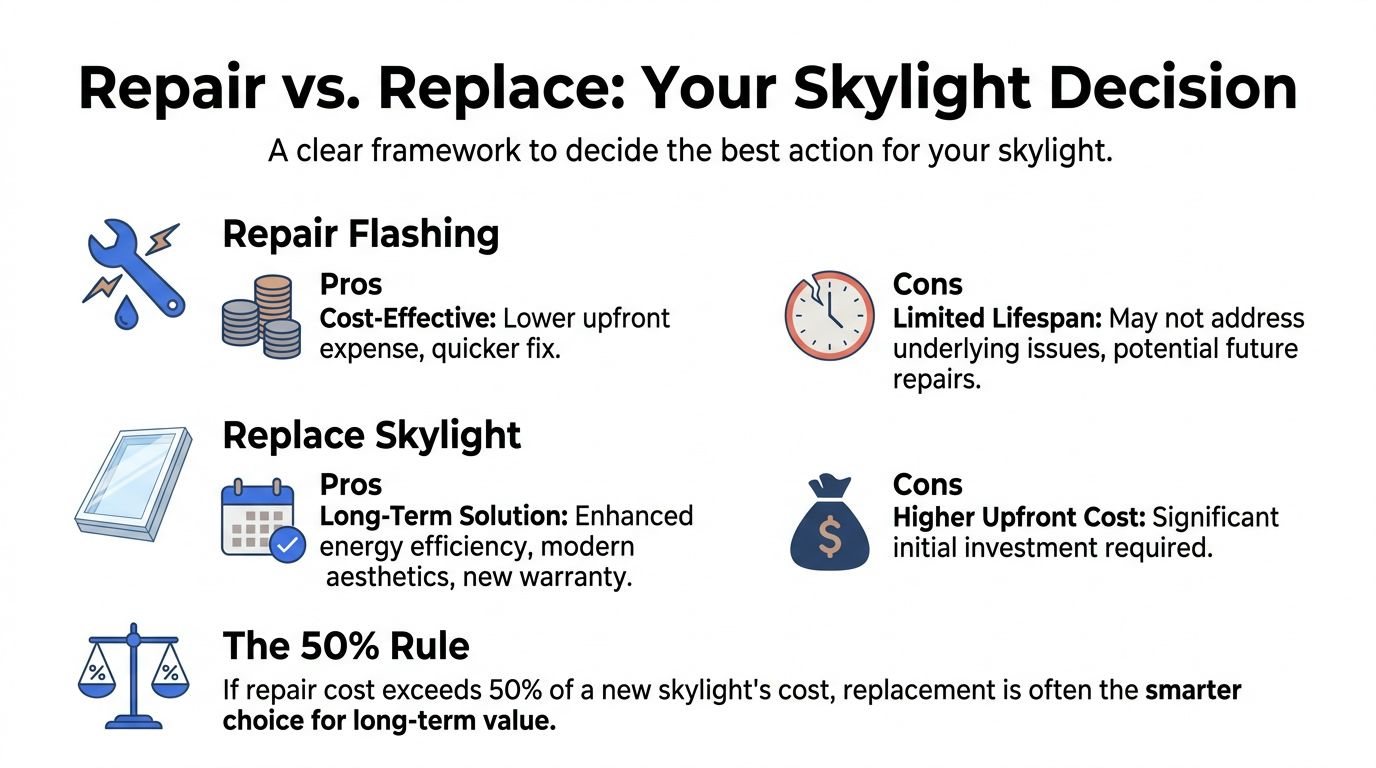
The repair-versus-replace decision isn’t emotional. It’s mostly math, age, and condition. If the skylight unit is still in good shape and the leak is limited to the flashing, repair can make sense. If the unit is old, fogged, cracked, drafty, or showing seal failure, a flashing repair can become money spent on the wrong problem.
When a repair still makes financial sense
A targeted repair is usually worth considering when:
- The skylight is relatively newer: The frame, glass, and seals are still performing well.
- The leak source is clearly in the flashing: The roofer can trace water entry to the roof-side integration, not the skylight body.
- The surrounding roof is serviceable: The shingles around the opening can be lifted and reinstalled without creating a second problem.
A lot of homeowners just need a clean answer on whether they’re repairing a roof detail or buying time on a failing unit. This article on whether you need new skylights can help frame that decision.
When replacement is the smarter move
The common benchmark is the 50% rule. Angi states that homeowners should replace the entire skylight if the repair cost exceeds 50% of the replacement price, and full replacement ranges from $1,200 to $3,500 depending on skylight type and installation complexity (Angi skylight repair guidance).
That rule works because a bigger repair bill on an older skylight often buys only temporary relief. You still have an aging unit with older seals, older glass, and no reset on service life.
This short video gives another practical look at the decision:
For homeowners comparing options in Columbus, one available route is a full skylight replacement using a factory flashing kit and integrated sealing system, such as the skylight replacement service offered by HIBCO ROOF LLC. That approach fits situations where the leak isn’t just a flashing detail anymore and the unit itself is part of the risk.
Skylight Flashing Repair Costs in Columbus Ohio
National averages are helpful, but Columbus homeowners want local numbers that match local conditions. The national reference point still matters. Naples Roofing reports that skylight flashing repair generally falls between $150 and $800 nationally, with most homeowners spending about $300 to $450 for standard jobs, and fixed skylight flashing repairs commonly landing between $272 and $343 (national skylight flashing repair cost reference).
In Central Ohio, actual estimates often land above the lowest national examples once roof access, weather exposure, and surrounding roofing integration are factored in.
What Columbus homeowners usually run into
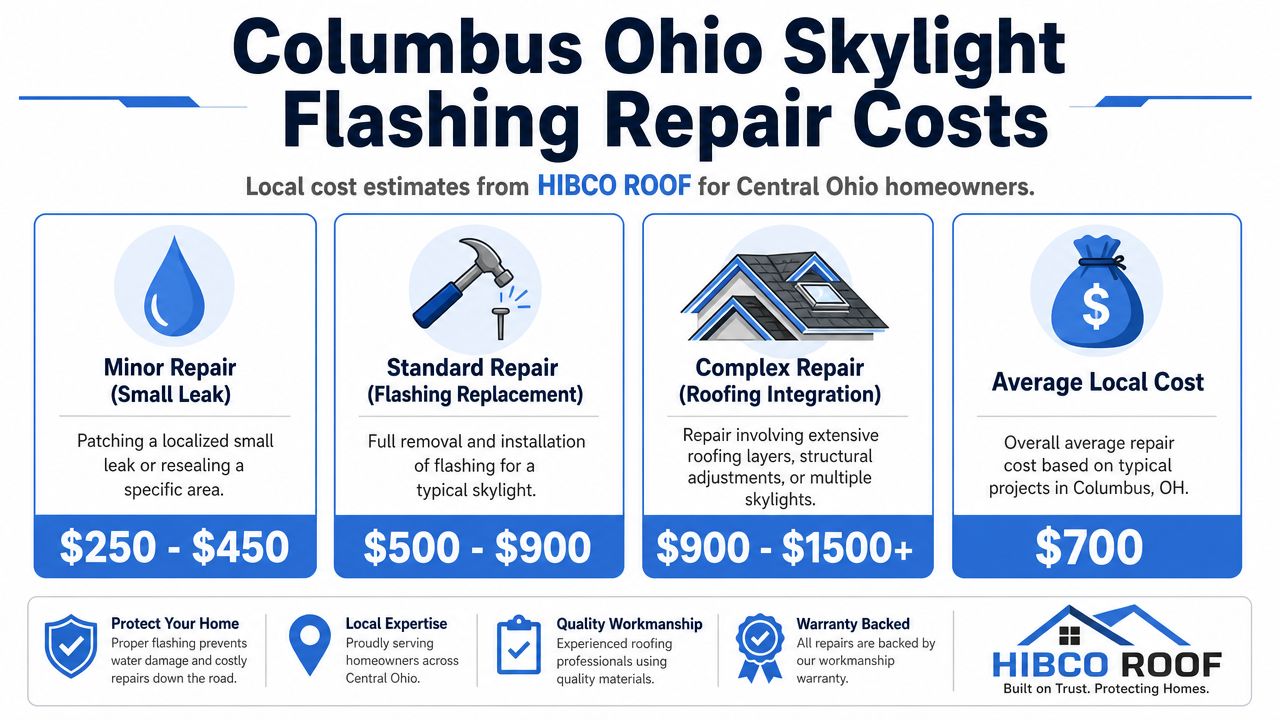
These local figures are practical planning numbers for common service scenarios in the Columbus market:
- Minor repair for a small leak: $250 to $450
- Standard flashing replacement on a typical skylight: $500 to $900
- Complex repair involving roofing integration or multiple layers: $900 to $1500+
- Average local cost: $700
Those numbers are more useful than a broad national range because they reflect the kinds of homes seen across Columbus suburbs and surrounding communities. A one-story ranch with straightforward asphalt shingles is often simpler than a taller home with steeper access and more cut-up roof sections.
How local conditions affect pricing
Central Ohio roofs deal with freeze-thaw movement, heavy rain, wind-driven storms, and winter conditions that expose weak flashing details fast. That doesn’t automatically mean a more expensive repair, but it does mean shortcuts tend to fail here.
A few local cost drivers show up over and over:
| Local condition | Why it matters |
|---|---|
| Steeper roof lines | Crews need more setup, more time, and more careful tear-back around the skylight |
| Two-story access | Labor gets less efficient when staging and material handling take longer |
| Older shingles around the skylight | Brittle shingles can break during removal and may need replacement in the repair area |
| Previous patch attempts | Old tar and sealant make diagnosis and clean integration harder |
If you own a home in Dublin, Westerville, Grove City, Hilliard, or Worthington, expect the quote to reflect the roof in front of the contractor, not a generic online calculator. That’s the only way a skylight flashing repair cost estimate becomes useful.
Get a Free Flashing Inspection from HIBCO ROOF
When a skylight leaks, the first priority is finding the water entry point without guessing. A proper inspection answers three questions: is the leak in the flashing, is the skylight unit itself failing, and how much roofing has to be opened to make a durable repair.

What happens during the inspection
A solid roof inspection should be direct and documented. The technician checks the skylight perimeter, the surrounding shingles, visible metal flashing, and the nearby roof surface for signs of failed water shedding. Interior evidence matters too, because ceiling stains often show where water ended up, not where it got in.
Here’s what homeowners should expect from the process:
Initial review of the leak history
You explain when the leak happens, whether it’s tied to heavy rain, wind, snow melt, or repeated storms.Exterior roof assessment
The inspector looks for lifted shingles, exposed fasteners, deteriorated sealant, metal separation, and signs the flashing was installed incorrectly.Photo documentation
Clear photos help show whether the problem is isolated or tied to wider roof wear.Written repair recommendation
You get a plain estimate that separates repair from replacement if both are realistic options.
The right inspection should reduce uncertainty, not add sales pressure.
What you receive after the visit
Homeowners usually want a straight answer more than a long pitch. Is this a flashing issue that can be repaired? Is replacement the safer move? Is there interior damage that should be addressed after the roof work?
If you want that kind of no-pressure starting point, schedule one of the company’s free roof inspections in Columbus. That gives you a documented look at the skylight area before you decide whether to authorize a repair.
Frequently Asked Questions About Skylight Repair
A few questions come up on almost every skylight leak call. Here are the answers homeowners usually need before they decide what to do.
Will insurance pay for skylight flashing repair
Sometimes, but it depends on the cause. If a storm damaged the roof or flashing, there may be coverage. If the issue comes from wear, aging sealant, or old installation defects, many policies treat that as maintenance. The best approach is to document the condition and ask your roofer to separate storm-related findings from age-related wear.
How do you tell flashing failure from a bad skylight seal
The leak pattern usually gives clues. Flashing leaks often show up during wind-driven rain or after heavy runoff moves across the roof. Seal failure in the skylight itself may show as condensation between panes, chronic fogging, drafts, or water issues that don’t match exterior rain direction.
A roofer should inspect both the roof-side integration and the skylight body before recommending work. Guessing is what leads to repeat repairs.
Can older skylights still be repaired
Sometimes they can, but age matters. SunSquare Skylights’ 2026 price guide states that full skylight replacement averages $2,000 to $5,300+ while minor repairs, including flashing, range from $150 to $800, and units older than 10 years are often more economical to replace because of degraded seals or outdated efficiency (SunSquare skylight repair and replacement guide).
That doesn’t mean every older skylight must be replaced. It means the repair should be judged against the age and condition of the whole unit, not just the metal around it.
How long does a professional flashing repair last
There isn’t one fixed answer because lifespan depends on roof condition, skylight age, workmanship, and whether the leak was isolated to flashing alone. A properly integrated repair lasts much longer than a surface patch. If the surrounding shingles are brittle or the skylight itself is near the end of its life, even good flashing work won’t solve every future problem.
Can flashing be repaired on an out-of-production skylight
Often yes, if the skylight frame is still sound and a roofer can fabricate or adapt compatible flashing details. The challenge is that older units may not justify custom repair work if the frame, seals, or glazing are already declining. In those cases, replacement is often the cleaner long-term answer.
If you’ve got an active skylight leak or you’re trying to compare repair versus replacement, HIBCO ROOF LLC can inspect the skylight, document the flashing condition, and give you a written estimate for the work that fits the problem.







Leave a Reply