A roof leak repair in 2026 typically costs $400 to $1,900, with a national average of about $1,150 based on the verified pricing cited in this guide. The problem is that this usually covers the roof repair itself, not the ceiling damage, mold cleanup, insulation problems, or decking issues that can show up if the leak keeps working its way through your home.
If you're reading this with a bucket on the floor, a brown ceiling stain spreading, or water showing up after the last storm rolled through Columbus, you're probably not thinking about roofing theory. You're thinking, "How bad is this going to get, and what is it going to cost me?" That's the right question.
Most homeowners search for roof leak repair cost expecting one clean number. Real life doesn't work that way. A small pipe boot repair is one type of job. A skylight leak with soaked decking is a different job. A storm hit on an older roof can push you into a repair-versus-replacement decision fast.
The part many people miss is the total cost of the leak. The patch is only the first number. The bigger financial risk is delay.
Table of Contents
- That Drip Is a Warning Sign What a Roof Leak Really Costs
- Breaking Down the Numbers Typical Roof Leak Repair Costs
- Why Prices Vary The Top 5 Factors Driving Repair Costs
- DIY vs Pro When a Repair Becomes a Replacement
- Handling Insurance Claims for Storm and Hail Damage
- What to Expect During a Professional Roof Inspection
- Get a Clear and Honest Estimate for Your Columbus Roof
That Drip Is a Warning Sign What a Roof Leak Really Costs
A leak usually starts the same way. You notice a stain that wasn't there last week. Then you hear a drip in the attic or see water tracking down drywall near a vent, chimney, or skylight. At that moment, the central question is how much to stop it.
For the roof repair alone, national 2026 pricing puts the average around $1,150, with most jobs falling between $400 and $1,900 based on damage severity, roofing material, and location, according to roof leak repair pricing data from Cobex Construction Group.
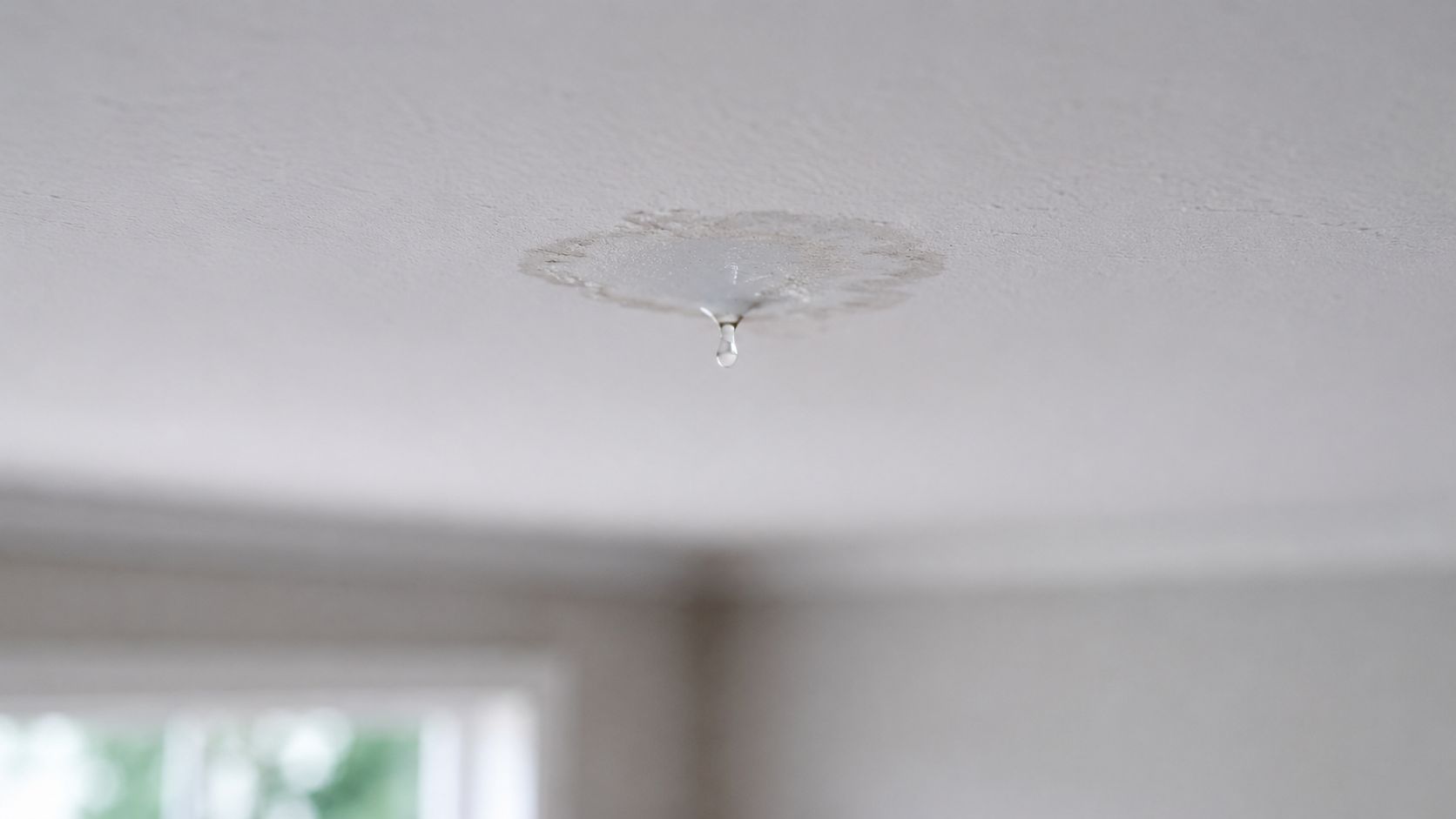
That number helps, but it doesn't tell the whole story. A leak is rarely just a shingle problem once water gets inside. It can affect insulation, drywall, trim, attic ventilation, roof decking, and in some cases framing around the damaged area.
What drives panic costs
Homeowners often lose money in two ways:
- They patch the symptom: Someone seals the visible spot, but nobody tracks the actual entry point.
- They wait too long: Water keeps moving while they compare quotes or hope the leak won't come back.
- They focus only on the roof line item: Interior damage ends up costing almost as much, or more, than the roofing work.
- They treat every leak like a small repair: Some leaks are warning signs that the roof system is near the end of what patching can realistically accomplish.
Practical rule: The fastest way to control roof leak repair cost is to stop the leak early and find the real source, not just the wet spot inside.
A worried homeowner doesn't need a sales pitch. They need a clear diagnosis, a realistic price range, and an honest answer about whether the roof needs a repair, a larger corrective job, or a replacement decision. That's where the rest of this gets more useful.
Breaking Down the Numbers Typical Roof Leak Repair Costs
Roof leak pricing gets expensive fast when the wet spot on the ceiling is not directly below the failure. I see that all the time in Columbus. Water can enter at a chimney, travel along decking or framing, and show up ten feet away. That is why one homeowner gets a few-hundred-dollar repair and another gets a much larger estimate for what looked like the same problem.
A current pricing guide from A1 Roof Pro puts many professional roof leak repairs in the $350 to $1,500 range, with more involved repairs, such as flashing failures, skylight leaks, valley leaks, or hidden water damage, reaching $1,500 to $3,000 or more. Those numbers track with what homeowners usually see when the repair stays localized and the roof structure underneath is still sound.
What a basic repair usually includes
A basic roof leak repair usually covers the roofing work needed to stop water entry at the source. That can mean replacing damaged shingles, a pipe boot, step flashing, counterflashing, sealant at a detail that failed, or a vent component that has cracked or loosened.
It often does not include the inside repairs homeowners expect. Drywall, insulation, paint, trim, and mold cleanup are usually separate costs.
For asphalt roofs, earlier cost data already cited in this article shows repairs are often priced by the affected area and the type of detail being rebuilt, with small patch work staying on the lower end when access is simple and decking is still solid.
If the leak showed up after a hailstorm, review practical insurance claim advice for hail damage before you approve repairs or talk with your carrier. Photos, date stamps, and a clean inspection record can make a real difference.
2026 Estimated Roof Leak Repair Costs by Source
| Leak Source | Typical Cost Range |
|---|---|
| Pipe boot or vent pipe | $150 to $500 |
| Cracked or missing shingles | $200 to $500 |
| Flashing repair | $200 to $600 |
| Chimney re-flashing | $400 to $1,200 |
| Skylight leak | $300 to $800 |
| Roof valley leak | $500 to $1,500 |
| Flat or low-slope leak repair | $300 to $1,000 |
| Small TPO or EPDM patch | $300 to $500 |
| Seam re-welding on flat roofing | $200 to $400 |
Those ranges are useful for budgeting, but they are not the decision by themselves.
A $500 patch can be a smart repair on a newer roof with one isolated failure. The same $500 patch on an older storm-worn roof may just buy a little time. In Central Ohio, that matters because wind-driven rain, hail, and freeze-thaw cycles expose weak areas quickly. Once repair costs start stacking up across multiple sections, the 25% rule becomes practical. If the damaged portion is approaching a quarter of the roof system, replacement is often the better financial call than repeating patch jobs.
Material matters too
Repair pricing also changes with the roof covering because labor, matching, and repair risk are different on each system.
- Asphalt shingles: $150 to $1,000
- Tile roofing: $400 to $1,600
- Metal roofing: $400 to $1,700
- Slate roofing: $400 to $1,800
Asphalt is usually the most forgiving to repair. Metal, tile, and slate often take more time, more care, and harder-to-match materials. A small leak on those systems can still turn into a higher bill because the work has to be done without creating a new problem next to the repair.
One more cost homeowners miss is delay. A leak that could have stayed a flashing repair can turn into decking replacement, insulation removal, and ceiling work after a few more storms. That is usually the hidden penalty that makes a quick repair the cheaper choice.
Why Prices Vary The Top 5 Factors Driving Repair Costs
Homeowners usually look at two estimates and assume one contractor is overpriced. Sometimes the difference is that one person priced a patch and the other priced the actual fix.
The roof itself changes the price
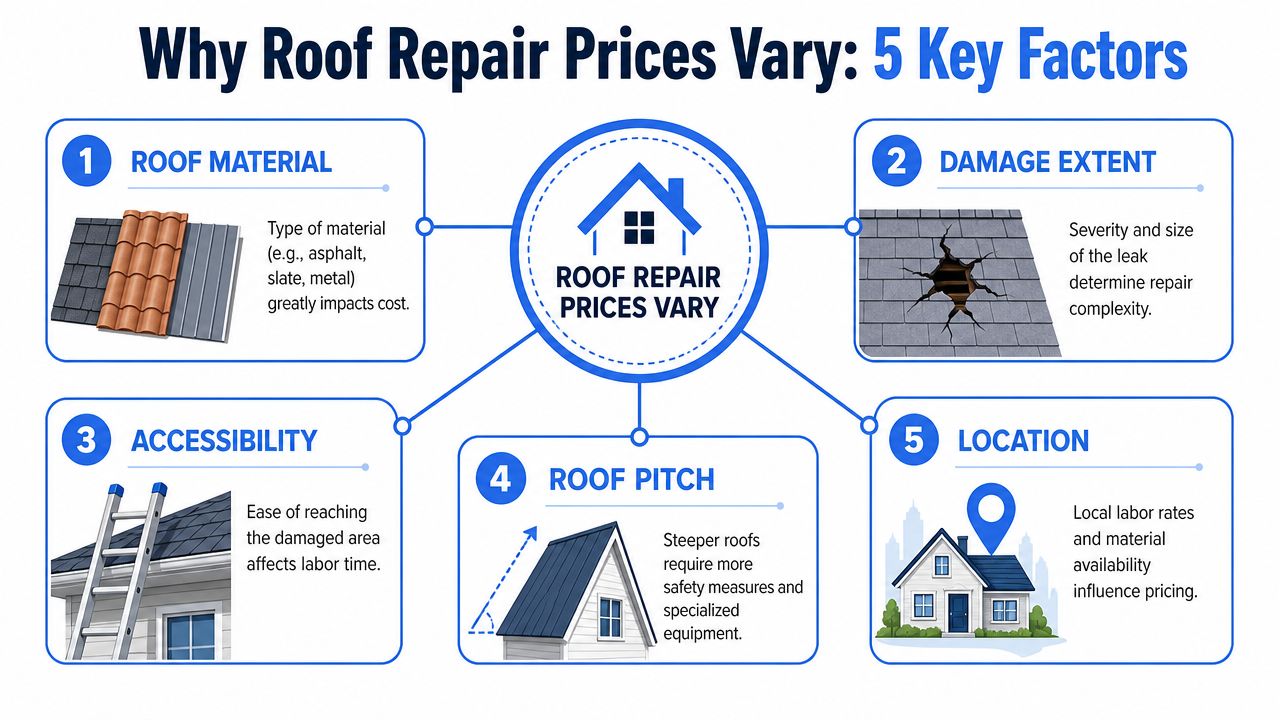
Five things push roof leak repair cost up or down more than anything else:
Roofing material
Asphalt shingle repairs are usually more straightforward than slate, metal, or tile. Matching pieces, fastening methods, and repair sequencing all change with the roof type.Extent of damage
A visible leak might come from one failed flashing detail, or it might be the first sign that water has reached the underlayment and decking. If the deck is soft, the job expands quickly.Accessibility
A leak on a low, open roof section is easier to service than one above a sunroom, over landscaping, or near a steep second-story edge.Roof pitch
Steeper roofs slow the crew down and increase the safety setup. That affects labor even when the repair area is small.Local labor and job conditions
Material availability, scheduling pressure after storms, and how much tear-off is needed all affect the final number.
A verified 2026 cost summary from ConsumerAffairs roof leak repair pricing places typical repairs at $360 to $1,550, notes labor at $35 to $90 per hour, underlayment replacement at $2 to $4 per square foot, and decking repair at $3 to $7 per square foot.
Delay is often the most expensive choice
The hidden cost doesn't always show up on the same day as the leak. It shows up after water sits in drywall, insulation, and wood.
Verified data on the cost of diagnostic delay shows that while many roof repairs fall in the $300 to $1,550 range, waiting 2 to 3 days can trigger $500 to $2,000 in ceiling damage and $500 to $1,500 in mold removal, turning a $750 repair into a $3,000+ total loss, according to The Style Saloniste analysis of delay costs.
That is why the lowest quote isn't always the cheapest outcome. If someone offers a quick caulk fix without checking the attic, flashing, and substrate, you're not comparing equal work.
What usually works and what doesn't
- What works: Tracing the leak from inside and outside, checking penetrations, and opening suspect areas when the evidence points below the surface.
- What doesn't: Smearing sealant around everything visible and calling it repaired.
- What works: Fixing the failure point and any soaked material directly tied to it.
- What doesn't: Ignoring interior signs because the roof surface "looks mostly okay."
Water doesn't care where the ceiling stain shows up. It follows framing, seams, and gravity until it finds a place to appear.
DIY vs Pro When a Repair Becomes a Replacement
A small ceiling stain can make a leak look manageable. Then a roofer gets on the roof, checks the attic, and finds brittle shingles, failed flashing, and soft decking around the entry point. That is the moment the question changes from "Can this be patched?" to "Does it still make financial sense to patch it?"
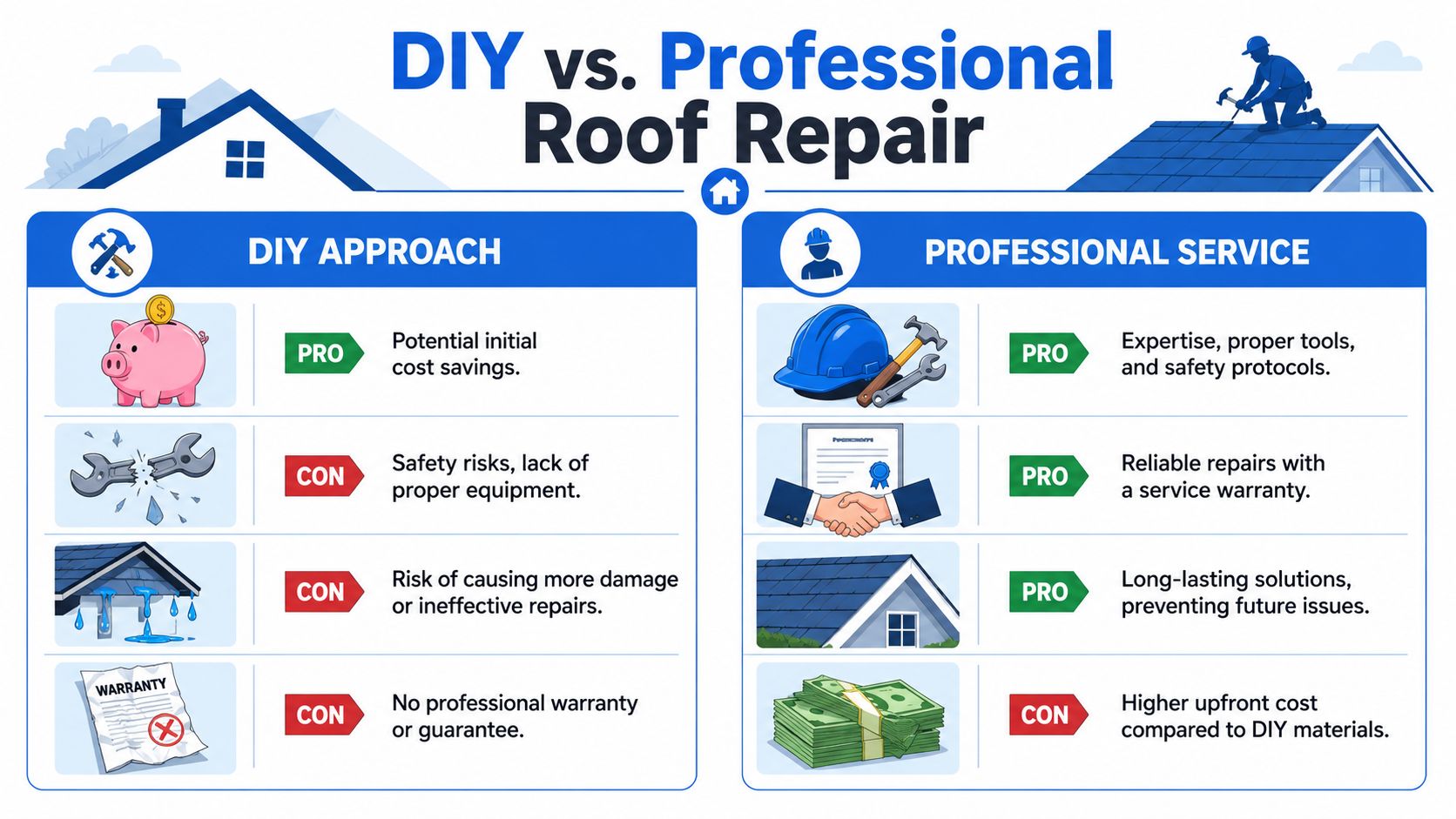
DIY has a place, but it is limited. Put a bucket under an active drip. Move furniture. Tarp a damaged area from the ground if you can do it safely after a storm. Those are temporary protective steps. Finding the failure point and fixing it correctly usually takes roof access, attic inspection, and the judgment to tell old wear from isolated damage.
Around Columbus, I see the same mistake over and over. A homeowner seals the spot where water shows up, but the leak started higher up the roof or around a penetration. Water travels. By the time it stains drywall, the source can be several feet away.
A professional repair earns its cost in a few specific ways:
- Accurate diagnosis: The inspection checks flashing, pipe boots, valleys, exposed fasteners, shingle condition, attic moisture, and the roof deck.
- Correct repair method: Different leak points need different fixes. A bad pipe boot, lifted flashing, and wind-damaged shingles are not the same repair.
- Clear accountability: A written scope and warranty give you something to hold onto if the leak returns.
- Honest replacement advice: A good roofer should tell you when a repair buys real time and when it is only delaying a larger bill.
If your estimate is starting to climb, it helps to compare it against a full replacement. This guide to roof replacement cost in Columbus gives homeowners a useful baseline for that decision.
The 25% rule that helps you decide
The most practical checkpoint is the 25% rule. As noted earlier, if a repair is going to cost more than about a quarter of what a full replacement would cost, replacement is often the smarter financial move, especially on an older roof or one with repeated storm exposure.
That rule matters in Central Ohio. We get wind, hail, freeze-thaw cycles, and heavy rain. On a roof that has already been patched a few times, another repair can turn into expensive delay instead of real value. You pay for labor and materials now, then still face replacement sooner than expected.
That does not mean every larger repair should become a full reroof. A newer roof with one damaged area may still be a solid repair candidate. The condition of the surrounding shingles, the state of the decking, and the roof's repair history matter more than one number by itself.
A practical way to judge the next step
Ask these questions before approving the work:
- Is the leak tied to one failed component, or is the roof showing wear in several areas?
- Will this repair likely hold through future storm seasons, or is it a short extension on a worn-out system?
- If you spend this money now, are you reducing future cost, or stacking another bill on top of an approaching replacement?
HIBCO ROOF LLC is one local company homeowners use for inspection, leak diagnosis, repair, and replacement comparison. The part that matters is not the sales pitch. It is getting a written scope that shows whether you are paying for a durable repair or putting money into a roof that is already at the end of its useful life.
If a major repair only buys a little time on a worn roof, replacement is often the lower total cost.
Handling Insurance Claims for Storm and Hail Damage
Around Columbus, plenty of leaks don't come from simple age. They show up after wind lifts shingles, hail bruises the roof surface, or flashing gets loosened during a storm.
When that happens, the insurance process can either help or create more stress. The difference usually comes down to documentation and timing.
What to do before you file
Start with evidence. Take photos of the interior stain, active dripping, wet insulation if visible, and any exterior damage you can safely document from the ground. Don't climb the roof if conditions are slick or the slope is steep.
Then get a contractor assessment before you start arguing with your insurer about what happened. A clear inspection record helps establish whether the leak came from storm damage, wear, a failed component, or a mix of issues. For Columbus homeowners, this overview of hail damage roof concerns in Columbus, Ohio is a useful starting point when the leak followed severe weather.
Why asphalt shingle damage needs careful documentation
Asphalt shingles are the most common residential roofing material in this market, and verified 2026 pricing shows average repair costs ranging from $360 to $1,750, with most homeowners spending about $960. Minor repairs can be as low as $130, while extensive damage can reach $5,800 or more, according to Angi's asphalt shingle roof repair cost guide.
That spread is exactly why photos and written notes matter. One claim may involve a few replaceable shingles. Another may involve broader slope damage, compromised seal strips, or collateral damage around vents and flashing.
Keep the process simple
- Document first: Interior stains, attic signs, and exterior storm evidence all matter.
- Read your deductible: Wind and hail deductibles can affect whether filing makes financial sense.
- Get a written inspection summary: You need more than a verbal opinion.
- Match the scope to the claim: If the carrier is paying for storm-created damage, the repair scope should reflect that damage clearly.
A contractor can't decide your claim, but a thorough roof assessment gives you something concrete to work from.
What to Expect During a Professional Roof Inspection
A proper inspection shouldn't feel rushed or vague. If someone glances from the driveway and gives you a number, that's not a real diagnosis.
A roofer should work the problem from the inside out. That's how you separate a ceiling symptom from the actual roof failure.
Inside first then outside
The first stop is often the attic or upper interior, if access allows. The inspector looks for stained decking, damp insulation, nail rust, darkened wood, and the direction water traveled. Those clues help narrow down whether the issue started at a penetration, a valley, a flashing line, or a field shingle problem.
Outside, the inspection should include shingles, ridge areas, exposed transitions, pipe boots, vent flashing, chimney details, skylight edges, gutters, and the surrounding roof plane. The goal isn't only to find the obvious break. It's to find everything connected to it.
For homeowners who want to understand how inspection-focused contractors present roofing visuals and documentation, Paletz Roofing and Inspections offers a useful example of how inspection branding and reporting are framed online.
What a written estimate should tell you
A useful estimate should answer basic questions in plain language:
- Where is the leak source most likely located
- What materials need to be repaired or replaced
- Whether decking or underlayment concerns are suspected
- What is included, and what is not included
- Whether emergency protection is temporary or permanent
If you want a clearer idea of what a leak-focused inspection service looks for, roof leak detection service details can help you compare scope and expectations before you book an appointment.
A good inspection doesn't just tell you the price. It tells you why the price is what it is.
Get a Clear and Honest Estimate for Your Columbus Roof
A leak estimate should help you make a money decision, not just schedule a repair. In Columbus, that matters because one small stain can point to a simple flashing fix, or to storm damage that has already spread into decking, insulation, and drywall.
The right estimate should answer one bigger question homeowners often miss. Is this roof still a good candidate for repair, or are you about to spend patch money on a system that is close to replacement anyway? That is where the 25% rule helps. If a large share of the roof is worn, brittle, storm-hit, or has leaks in multiple areas, a replacement can be the less expensive choice over the next few years than repeated service calls and interior repairs.

Homeowners usually feel some relief once the options are laid out clearly. A good estimate separates the job into practical categories: a contained repair, a repair with hidden risk, or a roof that has reached the point where replacement is the smarter use of your money. That hidden risk matters. Waiting can turn a modest roof repair into rotten wood, stained ceilings, mold cleanup, and higher labor because the crew has to open up more of the system to fix it correctly.
That is also why the cheapest number on paper is not always the lowest total cost.
A contractor should be willing to explain the trade-offs in plain language. If the leak is isolated and the surrounding shingles still have life left, a targeted repair often makes sense. If the roof has storm wear across multiple slopes, granule loss, aging pipe boots, and soft decking near the leak, another patch may only delay a larger bill.
HIBCO ROOF LLC is a licensed and insured residential roofing contractor serving Columbus and Central Ohio, and the company offers free written estimates, storm damage assessment, leak diagnosis, repairs, and full replacements. It is also listed as an Owens Corning Preferred Roofing Contractor. For a worried homeowner, that means you can get a documented opinion before authorizing work.
This short video gives more context on roofing service expectations and project communication:
If water is showing up after storms, the best next step is to get the roof inspected before the next round of rain adds cost you could have avoided.
If you need a clear next step, contact HIBCO ROOF LLC for a free, no-pressure written estimate in Columbus and Central Ohio. A proper inspection can tell you whether you are looking at a straightforward repair, damage that has spread farther than it appears, or a replacement decision that saves money over the long run.








Leave a Reply