After a severe storm, many homeowners stand in the driveway staring at loose granules, dented gutters, or a ceiling stain and wonder whether to call the insurer or a roofer first. That decision matters. A roof inspection for an insurance claim isn't just a search for visible damage. It should answer the harder question: is this a repairable, covered loss, or an aging roof that needs maintenance or replacement regardless of the storm?
The distinction affects your claim, your out-of-pocket cost, and the evidence you'll need. A professional inspection can document the roof's condition before a claim is filed, identify urgent temporary repairs, and give you a realistic basis for deciding whether pursuing coverage makes sense.
Table of Contents
- Why Your First Call Should Be a Roofing Contractor
- What Professional Inspectors Actually Look For
- The Repair vs. Replace Decision That Changes Everything
- Building a Claim Packet That Gets Approved
- Understanding ACV vs. RCV Policy Coverage
- Working with Adjusters and Avoiding Claim Denials
Why Your First Call Should Be a Roofing Contractor
The phone usually rings in the same order after a storm. A homeowner sees a leak, searches for the insurance number, and reports damage before anyone has established what happened. That instinct is understandable, but it can create a problem if the roof has only ordinary aging, isolated maintenance issues, or damage that falls below the policy's practical benefit.
A roofing contractor should inspect the property first and give you an honest condition assessment. If the inspection finds no covered storm damage, you may avoid opening a claim that has little chance of producing a useful payment. If the roof does have functional damage, you'll have dated photos, a written scope, and a clearer explanation ready before the adjuster visits. Guidance on pre-claim inspections also emphasizes that an unnecessary or denied claim can remain part of your insurance history and may affect future costs, so the first call deserves care.
Start with the roof, not the paperwork
A professional inspection should separate three questions:
- Did a documented storm occur? Verify the suspected date against local event records rather than relying only on memory.
- What damage exists? Look for wind displacement, hail impacts, fractures, punctures, damaged soft metals, and related moisture entry.
- Does the damage justify a claim? Compare the likely repair or replacement scope with the policy terms, deductible, roof condition, and likely payment basis.
Your wind or hail deductible is especially important. A roof may need work, but filing may not be financially sensible if the covered scope is close to the amount you'd have to pay yourself. A contractor can't determine your coverage, but can help establish the probable work before you make that decision.
Practical rule: A roofer should provide roofing facts, not promise an insurance outcome. The policy, cause of loss, documented condition, and repair scope control the claim.
Consider two common outcomes. In one, a contractor finds bruised shingles across multiple slopes, damaged gutters, and interior moisture evidence that aligns with a verified storm. Filing is reasonable because the evidence connects the event to functional damage. In another, the roof has brittle shingles, old flashing, and no storm-consistent impacts. Paying for maintenance or a targeted repair may be smarter than opening a claim built on weak evidence.
Homeowners also benefit from choosing a contractor who communicates reliably, especially when inspections, adjuster appointments, estimates, and emergency repairs must be coordinated. Roofing companies evaluating their own customer communications may find roofing business phone answering useful for handling calls without losing urgent inspection requests. For homeowners, the more important test is whether the contractor explains findings clearly and provides a written record.
Before scheduling anyone, review how to choose a roofing contractor and look for licensing, insurance, clear estimates, and a willingness to tell you when a claim isn't warranted.
What Professional Inspectors Actually Look For
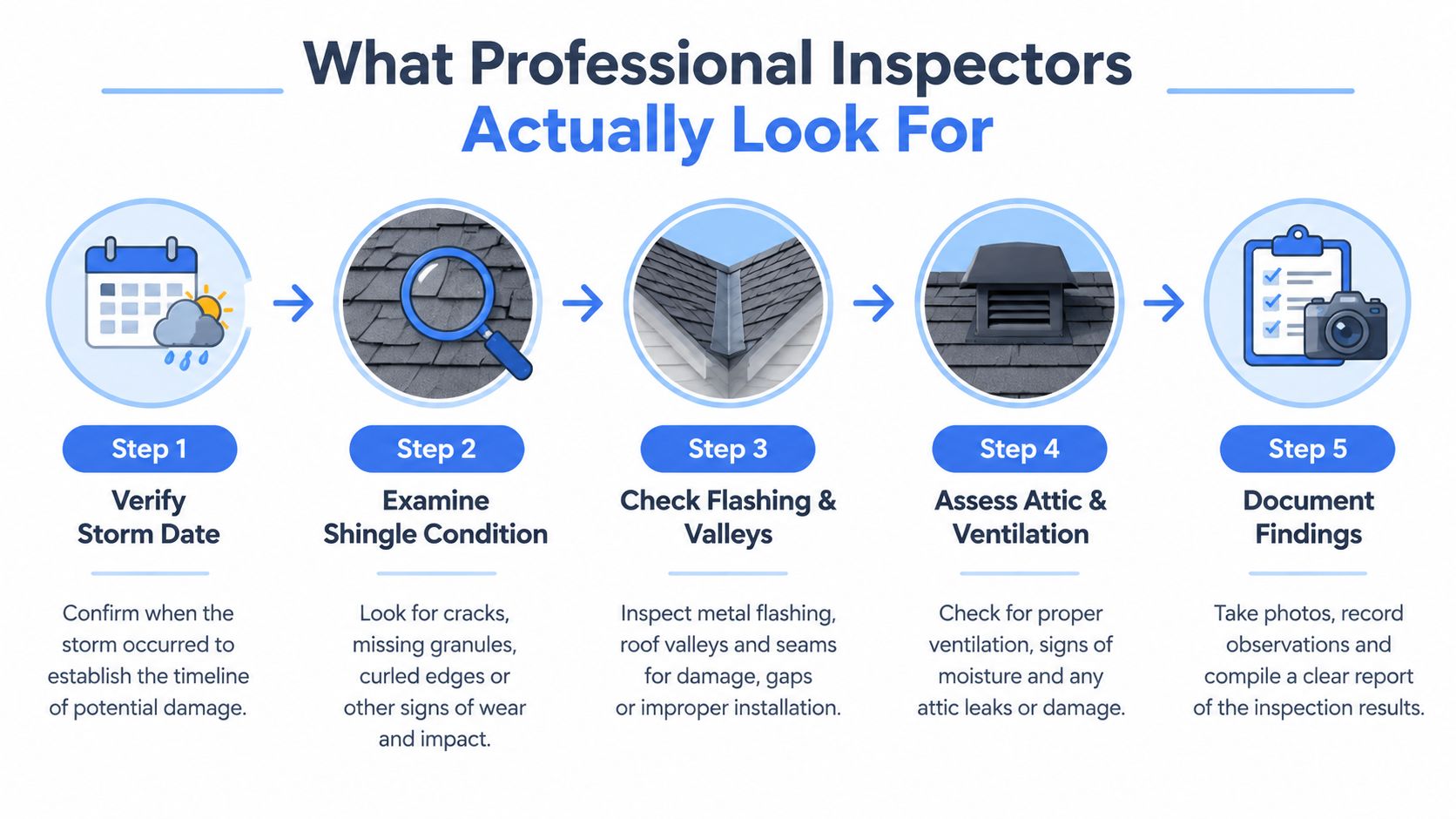
A credible inspection follows a sequence. The contractor doesn't begin by counting every mark on the roof. First, the inspector establishes whether the reported event is plausible, then checks collateral evidence, examines each roof slope, and records findings in a way another professional can evaluate.
Verify the event and inspect from the ground
The first step is storm verification. Official records can help establish the date, time, location, measurable hail size or wind speed, and reports from spotters or affected areas through NOAA's Storm Events Database. The inspector then walks the property at ground level, looking at gutters, downspouts, HVAC equipment, fascia, siding, screens, and other soft metals or adjacent surfaces.
Ground-level evidence matters because it can support the storm narrative before anyone climbs the roof. Dents on a metal component aren't automatically proof of roof damage, but they can justify a closer examination of the slopes.
Use test squares and classify the impacts
On the roof, the inspector examines each slope rather than sampling only the easiest or most visible area. Test squares create a repeatable method. For asphalt shingles, a commonly cited evaluation benchmark is 8 functional impacts per 100 square feet, with the findings supported by photographs and slope labels. That benchmark appears in guidance on hail-damage roof assessment, but it isn't a substitute for policy language or professional judgment.
The inspector classifies what each impact did to the shingle:
- Bruising: A depressed area may indicate damage beneath the surface and should be documented carefully.
- Fractures: Cracks or breaks can compromise the shingle's ability to perform.
- Punctures: A penetration is more direct evidence of physical damage and potential water entry.
The count alone doesn't decide coverage. The inspector must distinguish functional damage from cosmetic marks, manufacturing defects, foot traffic, blistering, granule loss from age, and pre-existing deterioration.
Record the complete roof system
A useful report identifies every slope, includes overview and close-up photographs, and provides a written scope of recommended work. It should also address roof age, material type, weather conditions, flashing, penetrations, vents, valleys, and whether the observed condition is storm-caused, cosmetic, functional, or pre-existing.
That level of detail gives the adjuster something concrete to review. A photo without a slope label or explanation may show a mark, but it doesn't establish its cause, significance, or relationship to the proposed repair.
The Repair vs. Replace Decision That Changes Everything
Most homeowners ask whether the roof is damaged. The more useful question is whether the damage can be repaired without leaving the roof unable to perform properly, and whether the policy supports replacement of the affected system. Repairability and replacement eligibility aren't the same thing.
Repairability depends on the material, location, age, matching availability, installation method, and extent of damage. Replacement eligibility depends on the policy, the covered cause, the documented scope, and the insurer's interpretation of what is necessary to restore the property.
Roof condition changes the analysis
An older roof can have genuine storm damage, but an insurer may separate that damage from deterioration that existed before the event. The inspection report should therefore identify the roof's baseline condition instead of treating every defect as storm-related.
The current cost environment makes the decision more consequential. Verisk's 2025 U.S. Roof Report found that average residential replacement costs reached $17,631 in 2025, up 33% from the prior four-year average, while average repair costs reached $4,699, up 25%. Those figures are reported by Insurance Business, and they show why a homeowner shouldn't assume that a small-looking defect has a small financial consequence.
Verisk also reported that roofs in moderate-to-poor condition experience about 60% higher loss costs, and that 38% of U.S. residential homes fell into that condition in 2025, as covered by the same source. That doesn't mean an insurer must replace an aging roof after any storm. It does mean roof condition deserves explicit attention when evaluating whether the event caused a repairable loss or exposed a broader maintenance deficiency.
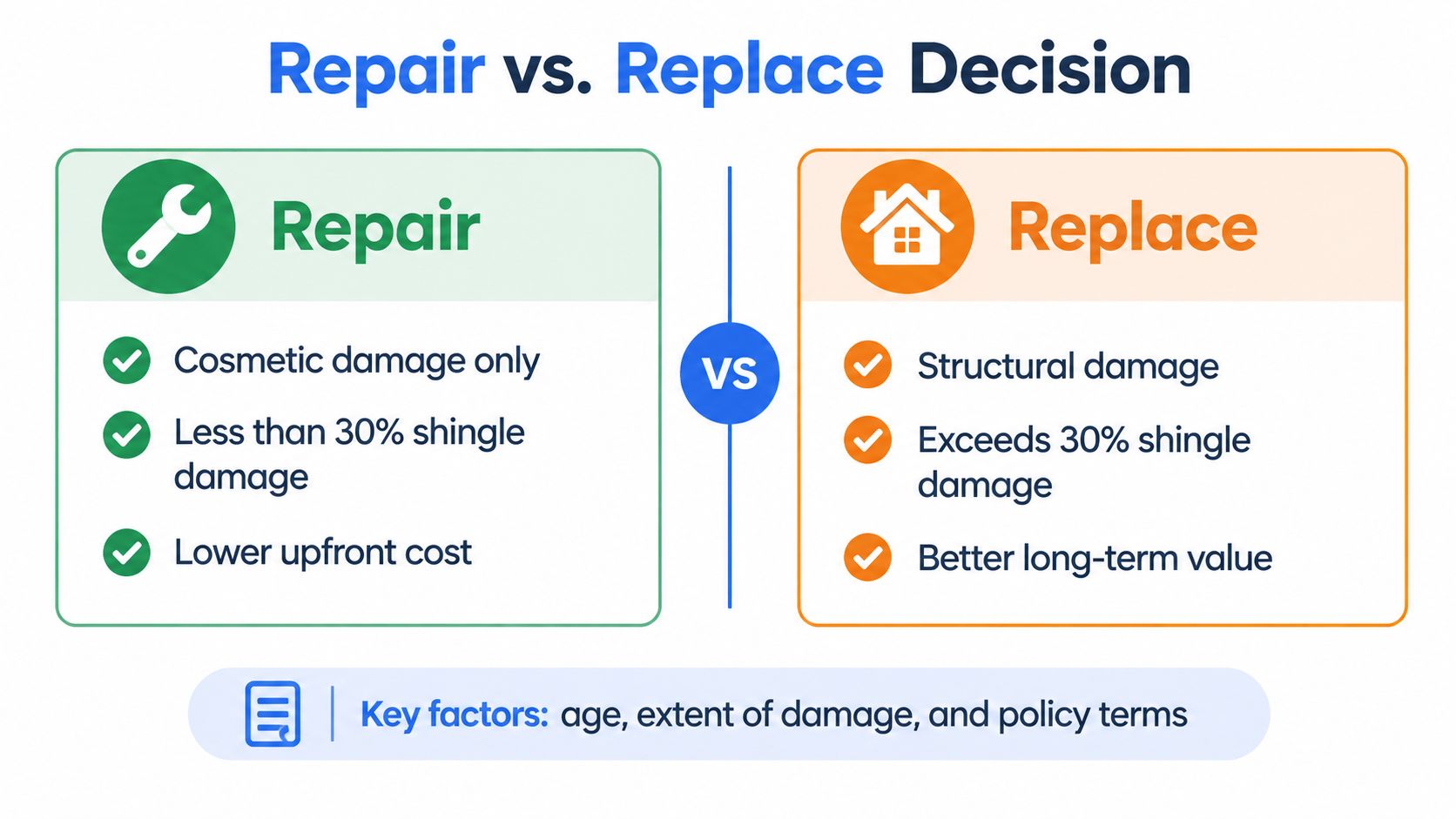
Use a decision matrix, not a sales pitch
| Inspection finding | Likely practical direction | What must be documented |
|---|---|---|
| Isolated functional damage with sound surrounding materials | Targeted repair may be reasonable | Exact slope, affected components, matching materials, and repair method |
| Damage across multiple slopes with related collateral evidence | Replacement may deserve review | Damage pattern, test-square findings, roof condition, and full scope |
| Widespread age-related deterioration without storm-consistent impacts | Maintenance or owner-funded replacement | Roof age, wear, flashing condition, and absence of functional storm damage |
| Storm damage combined with pre-existing weakness | Split the causes carefully | Which conditions came from the event and which existed beforehand |
The “repair” side of the decision isn't automatically cheaper in the long run. A patch that can't be integrated with brittle or discontinued materials may fail to restore the roof properly. Conversely, a contractor who recommends full replacement without documenting why repair won't work is asking the claim to carry a maintenance burden.
If you're planning other exterior work at the same time, a structured home remodeling checklist for 2026 can help you separate insurance-funded work from elective improvements. Keep those scopes distinct. Insurers generally evaluate covered restoration, not unrelated upgrades.
Building a Claim Packet That Gets Approved
A strong claim packet tells one consistent story. The storm record establishes the event, exterior photographs show the damage, interior evidence demonstrates consequences, and the professional report explains what must be repaired. Cost records then connect the condition to a reasonable scope.
Organize the material before the adjuster arrives. Scattered phone photos and verbal descriptions force the reviewer to reconstruct the claim, and gaps invite questions about cause, timing, and extent.
Create a chronological evidence file
Start with the storm date and time, local weather documentation, and any official event record that applies to your area. NOAA data can provide a useful verification source, as described earlier. Add pre-storm maintenance records if you have them, because they help establish the roof's condition before the reported loss.
For photographs, use clear folders. A practical arrangement is:
- Ground Level Ancillary: Gutters, downspouts, HVAC equipment, siding, fascia, screens, and other collateral surfaces.
- Roof Overview: Each slope, roof plane, ridge, valleys, penetrations, vents, flashing, and visible debris.
- Test Square Close-Ups: Detailed images of individual bruises, fractures, punctures, lifted shingles, and granule loss.
- Interior Moisture Evidence: Ceiling stains, wall marks, damp insulation, attic entry points, and areas affected by active leaks.
- Temporary Repairs: Tarping, sealant, emergency plumbing, drying, or other actions taken to prevent additional damage.
Timestamped photos and videos are particularly useful for hail documentation, including images of a 10×10 foot test square and ground-level collateral damage. The recommended folder structure is also described in this hail-damage documentation guide.
Make the report answer the hard questions
The report should explicitly separate storm damage from wear and tear. It should note:
- Roof identity: Age, material, roof design, and slope labels.
- Weather context: Conditions at the time of inspection and the reported storm event.
- Component condition: Shingles, flashing, valleys, vents, pipe penetrations, gutters, and related surfaces.
- Damage classification: Functional storm damage, cosmetic damage, pre-existing deterioration, or maintenance deficiency.
- Scope: Repair or replacement recommendations, required materials, and affected areas.
- Moisture findings: Interior stains, attic evidence, active leaks, and likely entry points.
The NRCA industry guidance emphasizes the importance of distinguishing storm-caused damage from wear and tear and making the inspection report specific about roof age, materials, flashing, penetrations, weather, and functional versus cosmetic conditions.
Preserve every cost record
Include an itemized repair estimate, not just a single replacement figure. The estimate should identify labor, materials, affected roof areas, related components, and temporary protection. Keep receipts for emergency work, since a temporary repair may prevent additional interior damage while the claim is reviewed.
A useful packet contains the storm record, dated exterior and interior evidence, the inspection report, a damage diagram, itemized estimates, and receipts. This claim documentation checklist lays out those records in practical terms.
Understanding ACV vs. RCV Policy Coverage
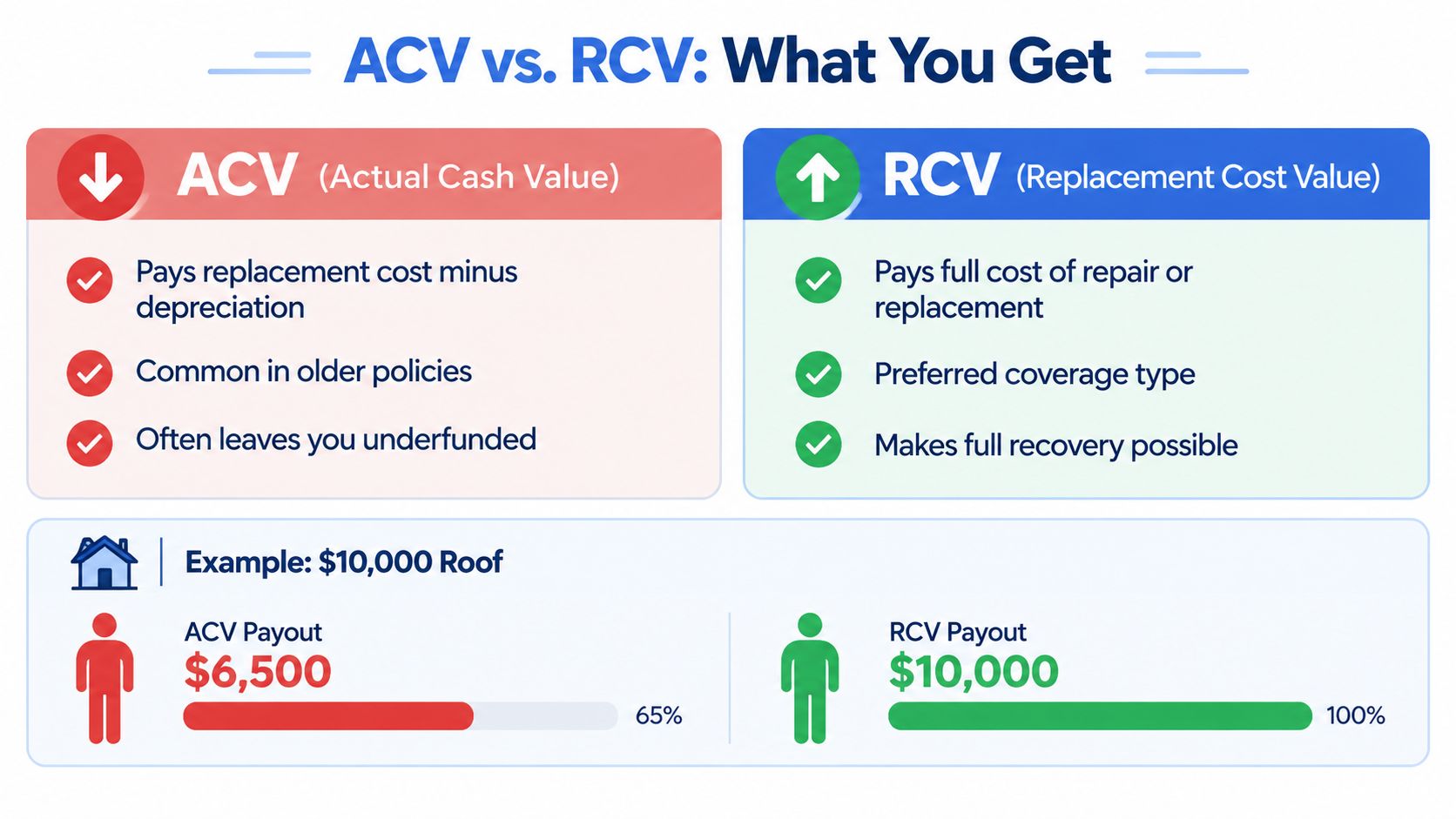
Two homeowners with similar roofs and similar storm damage can receive very different payments because their policies calculate loss differently. Before deciding whether replacement is financially realistic, find out whether the roof is covered on an Actual Cash Value, or ACV, basis, or a Replacement Cost Value, or RCV, basis.
Your declarations page, endorsements, and policy conditions should identify the applicable basis. If the wording is unclear, ask the insurer to explain how roof depreciation is calculated and whether recoverable depreciation applies after completed work.
ACV pays for today's depreciated value
Under an ACV approach, the insurer calculates replacement cost and subtracts accumulated depreciation. The payment is therefore tied to the roof's current value rather than the full cost of installing a new roof. This explanation of ACV roof coverage describes ACV as replacement cost minus depreciation.
That distinction can leave a homeowner underfunded. If the roof needs full replacement, the contractor still has to install the complete system, but the initial insurance payment may cover only the depreciated portion, less the deductible. The homeowner must then fund the difference unless another policy provision, negotiation, or coverage feature changes the result.
RCV can support full restoration
RCV coverage generally pays the cost to repair or replace covered damage, subject to the policy's terms and deductible. The same source describes RCV as paying full replacement cost minus only the deductible, although policy conditions can govern how and when withheld depreciation is released.
| Coverage basis | Basic calculation | Main homeowner concern |
|---|---|---|
| ACV | Replacement cost minus accumulated depreciation | The payment may not cover the work required |
| RCV | Full replacement cost minus the deductible, subject to policy conditions | Documentation and completion requirements still matter |
Neither policy type turns maintenance into a covered loss. ACV and RCV determine how a covered loss is valued, not whether the storm caused the damage in the first place.
If the insurer approves damage on an ACV basis, ask for the calculation in writing. Confirm the roof's age used for depreciation, the replacement-cost estimate, the deductible, and whether the policy allows any additional payment after repairs. For a more detailed policy comparison, review Actual Cash Value vs. Replacement Cost for a roof.
Working with Adjusters and Avoiding Claim Denials
The adjuster meeting works best when everyone focuses on evidence instead of performance. A contractor can attend when useful, explain roofing components, point out documented damage, and compare the proposed scope with the work required. But the roofer isn't your attorney or public adjuster, and having a contractor on the roof doesn't create coverage.
The policyholder controls the claim. You decide whether to file, what information to submit, and which contractor to hire. Your roofer's role is to explain the roof accurately, identify storm damage versus age-related deterioration, and flag legitimate omissions in the estimate.
Keep the conversation precise
Bring the report, labeled photographs, storm records, interior evidence, and itemized estimate. Ask the adjuster to identify which findings are accepted, which are disputed, and whether the disagreement concerns cause, scope, policy language, or depreciation.
Avoid altering the roof or creating damage. A claim must reflect the property's actual condition, and suspicious marks can undermine otherwise legitimate evidence. Don't let a contractor promise approval, pressure you to sign an assignment you don't understand, or describe themselves as your legal representative.
If the claim is denied, request the written reason and the specific policy language used. Then compare the denial with the inspection report, photographs, and estimate. A qualified roofer can provide a supplemental technical explanation, while a licensed public adjuster or attorney may be appropriate for coverage disputes beyond roofing expertise. This guide to working with a roof damage insurance adjuster can help you prepare for that review.
HIBCO ROOF LLC provides roof inspections, storm-damage documentation, repair and replacement estimates, and insurance claim assistance for homeowners in Columbus and central Ohio. Visit HIBCO ROOF LLC to request an inspection and discuss whether your roof appears repairable, replacement-eligible, or better handled as an owner-funded maintenance project.