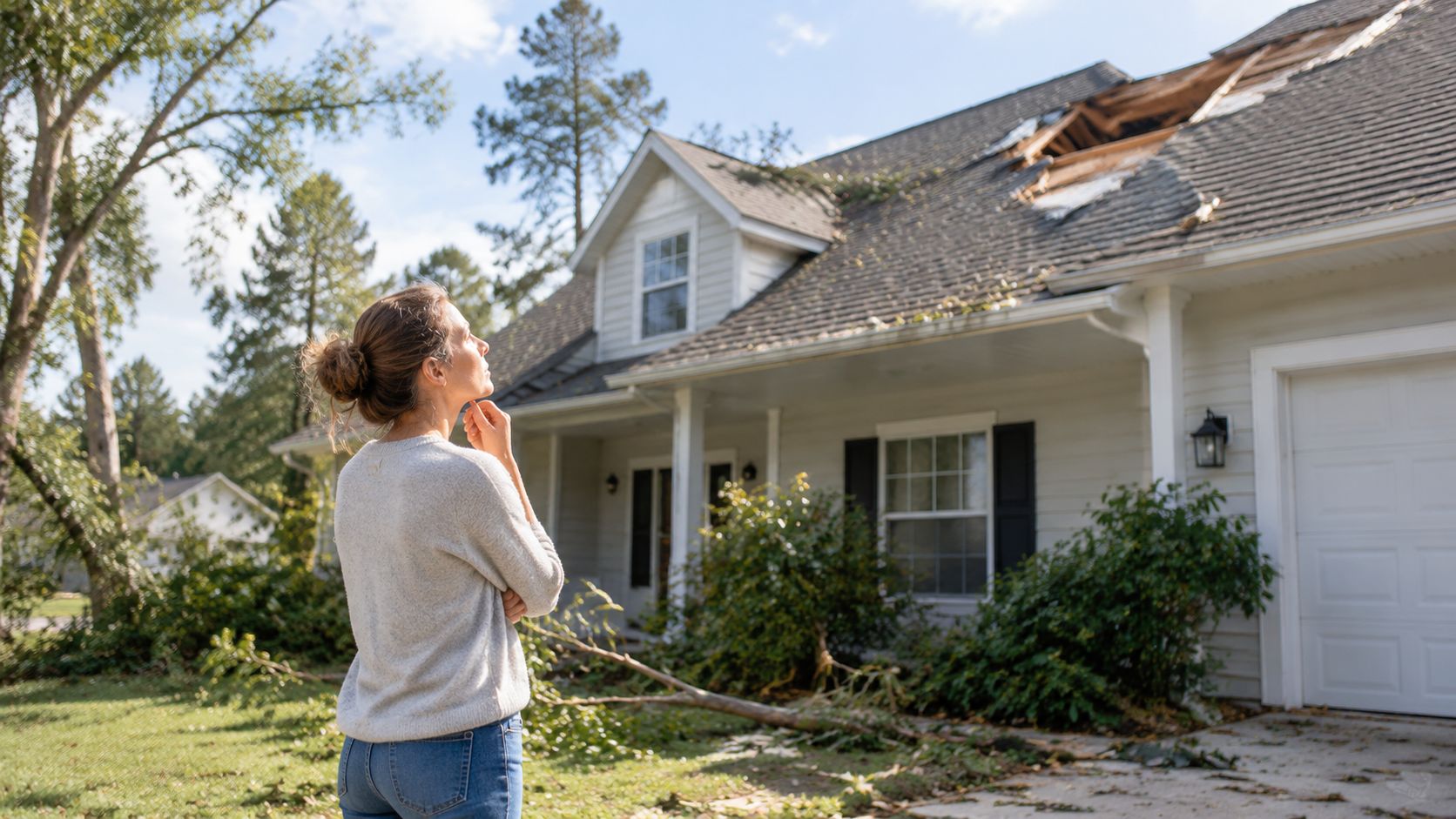
A storm has just moved through, and you've found shingles in the yard, water around a ceiling fixture, or a tree limb across the roof. The insurance adjuster asks whether your policy settles the roof at actual cash value or replacement cost value, and the answer may determine whether your insurer funds most of the work or leaves you covering a large gap.
The difference isn't a technical footnote. It affects the first payment, the final settlement, your repair schedule, and, under the 2026 lending-rule change, how an ACV roof policy may fit into a purchase, refinance, or sale. This guide breaks down the calculations and the practical decisions behind actual cash value vs replacement cost roof coverage, so you can read your policy and claim estimate with fewer surprises.
Table of Contents
- Your Roof Is Damaged What Happens Next
- Understanding the Core Concepts ACV and RCV
- How Insurers Calculate Your Roof Payout
- The Financial Impact for Homeowners in Practice
- Choosing the Right Roof Coverage for Your Situation
- How a Professional Contractor Can Help Your Claim
Your Roof Is Damaged What Happens Next
After a covered storm loss, your first job isn't choosing between a contractor and an adjuster. It's finding out exactly how the policy values the damaged roof. A homeowner with an older roof may hear that the replacement estimate is approved, then discover the check is based on the roof's depreciated value instead.
The National Association of Insurance Commissioners explains that ACV pays the depreciated cost to repair or replace damaged property. Under that method, the insurer reduces the roof payment for age and condition. Replacement cost coverage is designed to pay the current repair or replacement cost after the deductible, subject to the policy's terms. You can review the NAIC explanation of ACV and replacement cost coverage for the underlying distinction.
That's why a roof inspection should document more than visible holes. The report should identify the roof's apparent age, material, damaged areas, related flashing or ventilation issues, interior water damage, and temporary measures already taken. A contractor's scope should also be compared with the adjuster's estimate, line by line, rather than judged only by the total.
Start with the policy, not the payout
Look for the loss-settlement language, roof-surface endorsements, deductible, and any condition requiring repairs before withheld depreciation is released. If you're dealing with hail or wind damage, keep photographs, invoices, inspection reports, and correspondence together. HIBCO's hail damage roof insurance claim guidance is one practical reference for organizing that process.
Practical rule: Never assume an approved replacement estimate means the insurer will immediately pay the full replacement price.
An ACV settlement may arrive as one lower payment. An RCV claim may begin with an ACV-based payment, then release recoverable depreciation after the work is completed and documented. Understanding that sequence before signing a contract helps you avoid committing to a roof replacement without knowing how you'll cover the initial shortfall.
Understanding the Core Concepts ACV and RCV
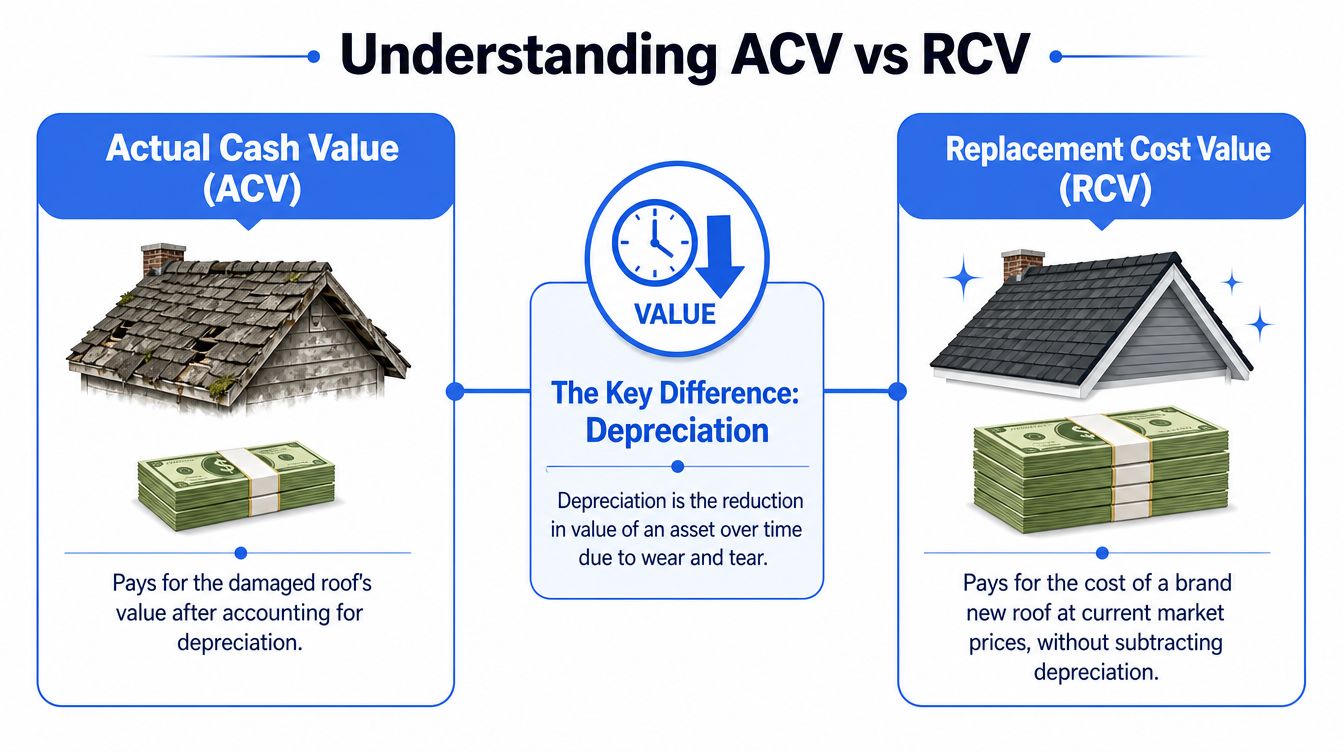
The simplest way to understand ACV and RCV is to focus on one word, depreciation. A roof loses value as it ages and experiences wear. ACV reflects that reduced value at the time of the covered loss, while RCV is intended to fund a new roof made with materials of like kind and quality, without subtracting age-related depreciation.
ACV treats age as part of the value
Think of a car. The amount needed to buy a new equivalent car isn't normally the same as the value of the used car sitting in your driveway. ACV applies a similar principle to a roof. The insurer starts with the cost to repair or replace the damaged property, then subtracts an amount representing age and wear.
The Robertson Ryan guide to replacement cost and actual cash value describes the distinction directly. If a roof originally cost $15,000 and has depreciated by $5,000, an ACV settlement would be about $10,000 before the deductible, while RCV would target the full replacement cost, subject to the deductible and policy conditions.
That doesn't mean ACV pays for a roof that looks exactly as it did before the storm. It means the settlement reflects the roof's remaining value rather than the price of installing brand-new materials.
RCV aims at current replacement
Replacement cost coverage removes depreciation from the final replacement calculation. The policy generally pays the current cost to replace the damaged roof with a new equivalent roof, subject to the deductible, limits, exclusions, and required claim procedures.
RCV often involves two stages. The insurer issues an initial payment based on the actual cash value, then releases the recoverable depreciation after the homeowner completes the approved repairs and submits acceptable documentation. The policyholder still needs to understand deadlines and documentation requirements because “recoverable” doesn't mean the money arrives automatically.
What both methods still require
Neither method makes every roof problem payable. Coverage depends on the cause of loss, policy language, exclusions, deductible, and the scope of damage. Neither method should be confused with the home's market value. These are settlement approaches for covered property damage, not a valuation of what the entire home would sell for.
Before authorizing work, ask the carrier or insurance professional:
- Settlement basis: Is the roof covered at ACV, RCV, or under a roof-specific endorsement?
- Depreciation: Is it recoverable, nonrecoverable, or already included in the first payment?
- Documentation: What invoices, completion evidence, photographs, or forms are required?
- Deductible: Which deductible applies to this loss, and when is it applied?
How Insurers Calculate Your Roof Payout
A numerical example makes the difference easier to see. Assume the damaged roof is 10 years old, the expected service life is 25 years, and the current replacement estimate is $20,000. Travelers gives an example in which a 25-year composition shingle roof may depreciate at 4% per year. Under that framework, a 10-year-old roof is treated as 40% depreciated, producing $8,000 in depreciation on a $20,000 estimate before the deductible. See Travelers' explanation of depreciation calculations.
The ACV calculation
The calculation starts with the replacement estimate and subtracts depreciation:
- Replacement estimate: $20,000
- Depreciation: $8,000
- ACV before deductible: $12,000
- Deductible: applied according to the policy
The resulting ACV payment is therefore lower than the cost of installing the new roof. The homeowner supplies the difference between the approved replacement cost and the insurance payment, along with the deductible and any work outside the covered scope.
A separate published example uses a flat $500 per year wear-and-tear assumption. Over 5 years, depreciation would total $2,500, and a separate $1,000 deductible would further reduce the payment. The exact calculation depends on the carrier's method, roof material, policy language, and claim facts. Don't treat a sample formula as a promise about your own settlement.
The RCV calculation
Under an RCV policy, the insurer doesn't subtract depreciation from the final replacement-cost amount when the policy conditions are met. The process often works in two payments:
- Initial payment: The carrier issues an amount based on the ACV calculation, after applying the deductible and other approved adjustments.
- Recoverable depreciation: After the roof is repaired or replaced, the homeowner submits the required completion documents and receives eligible withheld depreciation.
For the example above, the initial payment could reflect the $12,000 ACV figure before the deductible, while the recoverable depreciation would correspond to the $8,000 withheld amount, assuming the work satisfies the policy and the final approved scope remains unchanged. The homeowner still pays the deductible, and the insurer won't necessarily pay upgrades, code items, or unrelated deterioration unless the policy covers them.
ACV vs. RCV Payout Comparison
| Factor | Actual Cash Value (ACV) Policy | Replacement Cost Value (RCV) Policy |
|---|---|---|
| Valuation | Replacement cost minus depreciation | Current replacement cost without subtracting depreciation, subject to policy terms |
| Age impact | Older roofs generally produce a lower settlement | Age doesn't reduce the eligible final replacement-cost amount in the same way |
| Payment structure | Commonly one lower payment | Often an initial ACV payment plus recoverable depreciation |
| Documentation | Supports the claimed damage and approved scope | Supports the damage, scope, completed work, and recovery of withheld depreciation |
| Homeowner exposure | Greater responsibility for the depreciated portion and deductible | Usually limited more closely to the deductible and noncovered work, if all conditions are met |
The paperwork matters as much as the arithmetic. A clear process for collecting estimates, adjuster notes, photographs, invoices, and completion evidence can prevent avoidable delays. For broader context on how documentation and claim workflows are handled, Matil's overview of insurance claims processing is a useful resource.
If the estimates don't match, request a written explanation of each difference. A contractor who meets the adjuster at the property can identify missing accessories, flashing, ventilation components, or related damage before the scope becomes final. Homeowners can also review HIBCO's guide to working with a roof damage insurance adjuster for practical claim-preparation steps.
The Financial Impact for Homeowners in Practice
An ACV policy can leave a homeowner responsible for a sizable part of the replacement bill, while RCV generally shifts more of that covered cost to the insurer. ACV usually costs less upfront but transfers more replacement risk to the homeowner. RCV usually costs more upfront but provides stronger protection against the cost of installing a new roof after a covered loss.
The gap grows as the roof ages. In the example above, depreciation created an $8,000 difference before the deductible on a $20,000 replacement estimate. With ACV coverage, the homeowner needs access to that money or must delay, finance, or reduce the project.
Lower premiums can hide a larger future bill
An ACV policy may fit someone who values lower ongoing premiums and has enough savings to handle a reduced claim payment. It may also seem practical when a roof is already old and the carrier offers limited coverage choices. The premium saving does not remove the replacement obligation. It determines who carries that risk.
The Tennessee Department of Commerce states the formula plainly: ACV equals replacement cost minus depreciation, while replacement cost coverage pays what the damaged structure costs in current dollars without accounting for age-related wear. The Tennessee insurance consumer guidance can help you confirm the terminology in your policy.
After a storm, an ACV settlement can create pressure while you are arranging temporary protection, interior repairs, contractor scheduling, and mortgage payments. The reduced roof payment arrives during the same period when other expenses may be increasing.
RCV improves predictability, not every outcome
RCV does not mean the carrier pays every invoice a contractor submits. The insurer still reviews the cause of loss, repair scope, materials, coverage limits, exclusions, deductible, and policy conditions. You may also owe for upgrades, elective changes, uncovered damage, or work beyond the approved estimate.
RCV provides a more predictable route to restoring a covered roof when you follow the policy requirements. Texas Department of Insurance guidance describes the common payment structure as an initial ACV payment, followed by recoverable depreciation after repairs are completed and documented. Review the Texas guidance on replacement cost and actual cash value policies before treating the second payment as automatic.
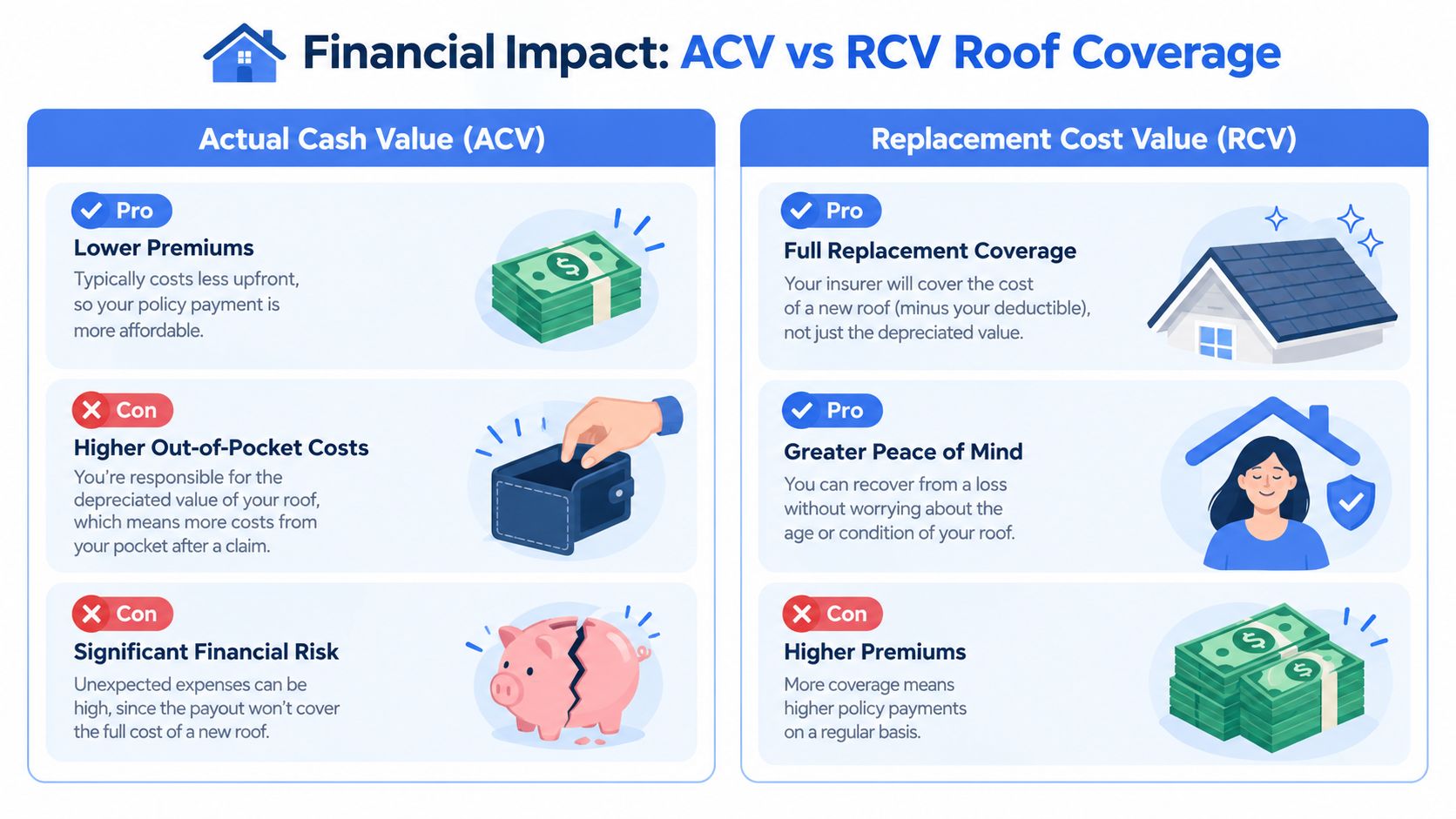
Budget test: If an ACV settlement would force you to borrow money or postpone essential repairs, the lower premium may not be worth the exposure.
The financing consequences also matter. Under the 2026 Fannie Mae and Freddie Mac rule change, ACV roof coverage can affect how buyers, sellers, and lenders evaluate a home. A roof with limited settlement protection may create a financing question, a negotiation point, or an added cash requirement during a sale or refinance.
Review the policy before renewal, not after the storm. Confirm how the roof is settled, whether depreciation is recoverable, what deductible applies, and whether a roof endorsement changes the general dwelling coverage language. Ask for unclear answers in writing.
Choosing the Right Roof Coverage for Your Situation
A homeowner with an aging roof, limited savings, and an ACV policy can face a large out-of-pocket bill after a covered loss. For most owner-occupied homes, RCV is the safer default when it is available and affordable. The decision should account for the roof's age, your cash reserves, the property's use, and whether you plan to keep, sell, or refinance it.

When ACV may be workable
ACV can suit a homeowner who understands the exposure and has a realistic way to pay the depreciated portion. A rental property owner trying to control premiums may accept that trade-off. An owner with a newer roof and less accumulated depreciation may also face less financial pressure than someone with an older roof and little cash available.
Treat that choice as a documented decision. Ask the insurer how roof age and condition affect eligibility, whether the settlement applies only to the roof surface, and whether other components receive different valuation. Request unclear answers in writing.
The 2026 mortgage change
The 2026 Fannie Mae and Freddie Mac rule change affects how insurance and lending interact. ACV roof coverage may be accepted for qualifying single-family homes and condominiums backed by these housing-finance enterprises, subject to their requirements and the individual lender's review. The rule change therefore matters during a purchase or refinance, not only after storm damage.
Acceptance does not make ACV financially equivalent to RCV. It may remove an automatic financing obstacle in a qualifying transaction, while leaving the homeowner responsible for the gap between the roof's depreciated value and its replacement cost. That exposure can affect cash planning, buyer and seller negotiations, repair choices, and a lender's review of property condition.
For a buyer, an ACV policy can mean a home remains financeable while still requiring more personal cash after a loss. For a seller, the roof settlement basis can become a negotiation issue. Share the declarations page and roof endorsement with the lender early, and obtain a roof inspection before listing when the coverage limitation could affect the transaction.
For buyers and sellers: “Allowed by the lender” does not mean “fully funded after a loss.” Verify the roof settlement basis before making an offer, listing a property, or budgeting for ownership.
Review the policy before renewal. Confirm how the roof is settled, whether depreciation is recoverable, what deductible applies, and whether a roof endorsement changes the dwelling coverage language. Homeowners reviewing endorsements can also consult guidance on streamlining policy endorsement processes, then ask the insurer to explain how any endorsement changes roof valuation.
How a Professional Contractor Can Help Your Claim
A contractor can't change an ACV policy into RCV, but a qualified contractor can help establish the damage and replacement scope that the policy will evaluate. The strongest claims begin with evidence collected before repairs obscure the original condition.
Build the file before the work starts
A thorough inspection should record the roof surface, flashings, penetrations, ventilation components, gutters, skylights, and interior signs of water intrusion. Photographs should show both close details and wider roof elevations. The written report should distinguish storm-created damage from maintenance issues and explain why the proposed repair or replacement is appropriate.
Ask the contractor to provide:
- A detailed estimate: Labor, materials, tear-off, disposal, accessories, and applicable scope items should be identifiable.
- Condition records: Roof age, material, prior repairs, and visible preexisting conditions should be stated carefully.
- Adjuster coordination: An on-site meeting can help both parties inspect the same areas and address missed damage.
- Completion documents: In an RCV claim, invoices, photographs, permits when applicable, and completion confirmation may support recovery of withheld depreciation.
HIBCO ROOF LLC provides inspections, storm-damage documentation, repairs, full roof replacements, and insurance claim assistance for homeowners in Columbus and central Ohio. Homeowners who want a broader overview of contractor risk and coverage can also review this complete guide for roofing businesses.
Use the guide to choosing a roofing contractor before signing an agreement. Confirm licensing and insurance, request a written scope, understand payment terms, and make sure the contractor knows whether your claim is ACV or RCV. Don't authorize work based only on a verbal promise that the insurer will pay the difference.
HIBCO ROOF LLC offers roof inspections, storm and hail damage documentation, repairs, full replacements, and claim assistance for homeowners in Columbus and central Ohio. Visit HIBCO ROOF LLC to request a free estimate and discuss your roof's ACV or RCV settlement before you commit to repairs.