
Neither system is universally better. LeafGuard is usually the stronger choice when existing gutters need replacement and large leaves dominate the yard, while LeafFilter is usually better when current gutters are sound and the home faces fine debris such as pine needles, shingle grit, and pollen.
That distinction matters after a Columbus storm. A summer downpour can expose an undersized or sagging gutter quickly, while fall leaves can cover the roofline and hide a developing blockage until water spills over the fascia. Homeowners often start by asking which product filters more debris, but the more important question is whether the gutter system underneath is worth keeping.
Table of Contents
- Understanding the Real Leaf Guard vs Leaf Filter Decision
- How LeafGuard and LeafFilter Systems Actually Work
- Performance Comparison for Columbus Debris and Rain
- Cost, Installation Scope, and What the Quotes Usually Include
- When to Choose LeafGuard Versus LeafFilter in Central Ohio
- Durability, Maintenance Reality, and Warranty Expectations
- FAQ About Gutter Protection Choices for Columbus Homes
Understanding the Real Leaf Guard vs Leaf Filter Decision
Central Ohio homes see a changing debris mix. Mature trees can drop broad leaves in the fall, while roof wear contributes shingle grit and fine particles that collect with pollen and dirt. A homeowner may clean the gutters before winter, then find overflow again after a series of heavy storms because the original problem wasn't debris alone. It may have been poor pitch, loose hangers, damaged fascia, undersized gutters, or downspouts that can't move water efficiently.
The LeafGuard versus LeafFilter decision is really two decisions:
- Should the existing gutter system remain?
- If it remains, what type of protection matches the debris around the home?
LeafGuard is an all-in-one reverse-curve gutter replacement. LeafFilter is a micro-mesh protection system installed over existing gutters. That installation difference affects the project scope before debris performance even enters the conversation.
A sound, properly sized gutter can often serve as the base for an add-on guard. A gutter with cracks, separation, major sagging, or weak attachment points may need repair or replacement before any cover or filter can work reliably. Manufacturer installation guidance for a leaf-filter-style cover specifically directs installers to clean the gutters first, repair damaged or loose sections, and overlap guard pieces to form a continuous barrier, as shown in this installation guide for a 5-inch aluminum gutter cover.
Practical rule: Don't place a premium protection system over a gutter that already fails as a water-collection system.
A 2025 homeowner survey illustrates why protection remains attractive. Before installation, 58% of homeowners cleaned their gutters at least twice a year, but afterward 41% cleaned only annually and nearly 17% reported no gutter cleaning at all, according to This Old House's gutter-guard survey. The same survey found leaves were the most common debris problem at 86%, followed by dirt or dust at 62%, insect debris at 53%, pine needles at 33%, and pollen at 31%. Those results support a lower-maintenance goal, but they don't make any system maintenance-free or suitable for every gutter condition.
How LeafGuard and LeafFilter Systems Actually Work
The simplest way to understand the products is to follow the water.
LeafGuard replaces the gutter. Its reverse-curve profile creates a curved surface over the trough. Rainwater follows the curve through surface tension and gravity, enters the channel, and larger debris is directed over the front edge. Because the gutter and cover are integrated, the installer removes the existing gutter rather than attaching a protective layer to it. This can make sense when the old system is damaged, poorly sized, or no longer securely attached to the fascia.
LeafFilter keeps the gutter and adds a barrier. It uses a fine stainless steel micro-mesh installed over the existing trough. Rainwater moves across the mesh and passes through the small openings, while leaves and other debris remain on top. LeafFilter describes this arrangement in its explanation of how debris behaves on the micro-mesh.
The structural difference affects the inspection. With LeafGuard, the contractor is evaluating a replacement project, including the fascia and the layout for new gutter runs. With LeafFilter, the contractor must determine whether the existing gutters are straight, sound, correctly pitched, and capable of accepting the mounting system. The roof edge, corners, miters, and downspout connections all need attention.
Independent guidance describes the broader categories clearly. Leaf guards generally cover the gutter trough and divert debris using gravity, wind, or a shed-style surface, while leaf filters use a finer mesh to sift water through before debris reaches the downspout, as explained in this comparison of leaf guards and leaf filters.
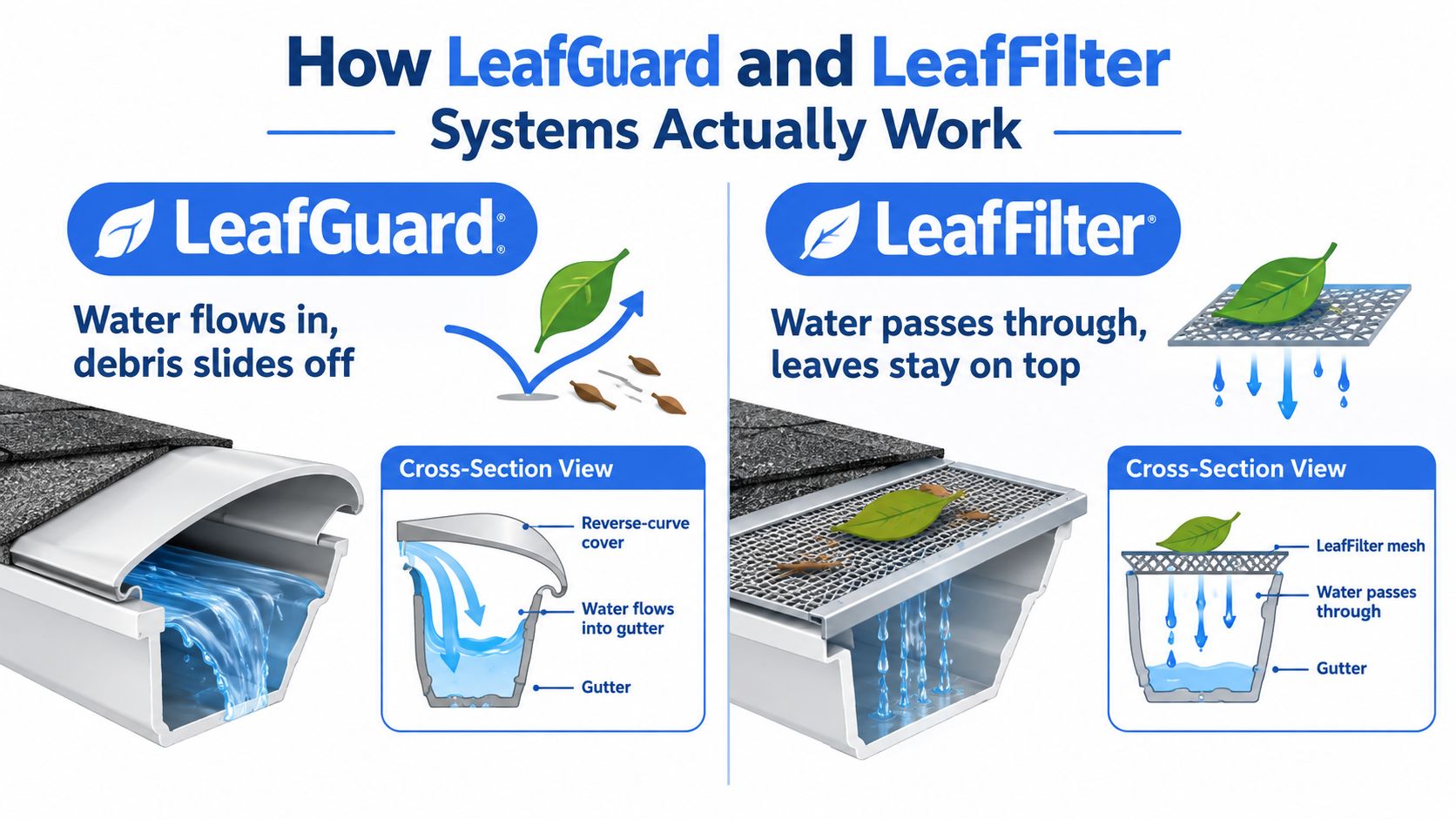
For a broader look at reverse-curve systems and their installation format, see our guide to leaf guard gutter systems. The key point is simple: LeafGuard changes the collection system, while LeafFilter changes how water enters the collection system.
Performance Comparison for Columbus Debris and Rain
For mixed Columbus debris, micro-mesh generally has the technical advantage. Fine openings can stop material that a solid reverse-curve cover may allow to enter through its front opening or collect along the water path. That difference matters in neighborhoods with conifers, aging shingles, and heavy pollen.
Hands-on testing by This Old House found that LeafFilter blocked 100% of pine needles and that the micro-mesh prevented over 90% of the tested debris types, including leaves, shingle grit, and pine needles, according to its LeafFilter versus LeafGuard comparison. That result doesn't mean every installation will perform identically. Pitch, roof runoff, gutter alignment, nearby trees, and downspout capacity still influence what happens during a storm.
A separate independent test summary reported that stainless steel micro-mesh blocked 99.5% of debris and could handle rainfall rates above 6 inches per hour, as described in testing of multiple gutter-guard types. Those findings help explain why micro-mesh is often selected for heavy rain and small debris, but they shouldn't be treated as a guarantee for every roof.
Matching the guard to the debris
LeafGuard's reverse curve is well suited to broad leaves that can slide over the surface. It becomes less compelling when the debris is thin, light, or particulate. Pine needles, pollen, and shingle grit can follow water movement differently from a large maple leaf, and some may collect at the entry point.
LeafFilter's mesh handles a wider debris spectrum, particularly when the homeowner's main concern is fine material. The trade-off is that the material stays on top of the mesh. If roof runoff carries dust, granules, or pollen onto the surface, the system may need inspection and rinsing even when the gutter trough itself remains clear.
Higher filtration efficiency and lower maintenance aren't the same thing.
Consumer Reports reached a similar practical conclusion during 16 months of outdoor testing in 2010. Its coverage found that some products performed much better than others, while low-priced screens sometimes compared favorably with more expensive systems. It also reported that no system was completely maintenance-free, as detailed in Consumer Reports' gutter-guard testing coverage.
Cost, Installation Scope, and What the Quotes Usually Include
Price comparisons become unreliable when one quote covers an add-on and another includes a new gutter system. LeafFilter is commonly installed over existing gutters, while LeafGuard replaces those gutters as part of the product. The project may also include fascia work, downspout changes, corner transitions, cleanup, and access costs.
Recent pricing coverage illustrates the problem. One 2026 survey cited average installed costs of about $41.72 per linear foot for LeafFilter and $39.59 for LeafGuard, while other 2026 coverage reported approximately $22.66 per foot for LeafFilter and $21.67 per foot for LeafGuard, as summarized in LeafFilter's comparison of LeafGuard. These figures shouldn't be treated as universal Columbus prices. They show why homeowners need to ask what the contractor included in the scope.
What may be bundled into the number
A LeafGuard estimate may include removal of old gutters, fabrication and installation of the replacement system, new hangers, downspout work, and repairs discovered at the fascia. A LeafFilter estimate may include cleaning, minor reinforcement, guard installation, and adjustments around corners or roof sections. If the existing gutter needs substantial repair, the add-on quote can change before installation begins.
Use the same questions for every contractor:
- Linear footage: Is the quote based on the measured gutter length, and does it include every roof section?
- Gutter condition: Who pays for repairs to loose, cracked, or sagging gutters?
- Fascia and hangers: Are damaged boards or weak attachment points included, excluded, or priced separately?
- Downspouts: Does the scope address blocked, undersized, or poorly positioned downspouts?
- Removal: If replacement is involved, is disposal of the old gutter system included?
- Warranty: What does the warranty cover, and who performs service if the system overflows?
A lower price may represent a smaller scope rather than a better deal. The quote might exclude fascia repair, cleaning, downspout adjustments, or the replacement work needed to create a stable base.
For more context on how gutter replacement scope affects a project estimate, review this gutter replacement cost guide. The right comparison isn't LeafFilter's price against LeafGuard's price in isolation. It's the total cost of achieving a reliable gutter system, including the work each home needs.
When to Choose LeafGuard Versus LeafFilter in Central Ohio
Three common Columbus-area situations make the decision clearer.
The gutters are failing and broad leaves dominate
A homeowner with old, separated, undersized, or badly sagging gutters shouldn't begin with a filter comparison. The first need is a dependable replacement system. If the yard is surrounded by mature trees that drop large leaves, LeafGuard's reverse-curve replacement may fit the project because it combines the new gutter and protective profile in one installation.
That choice still requires a close look at roof runoff and downspout placement. A new gutter won't solve overflow caused by poor drainage design, and a replacement system can't compensate for damaged fascia that remains unaddressed.
The gutters are sound but fine debris keeps returning
Another homeowner may have straight, secure gutters that collect water properly but sit beneath pine trees or a roof that sheds granules. In that case, preserving the existing gutter and adding micro-mesh protection is usually the more logical path. LeafFilter's tested performance with pine needles and mixed fine debris makes it the stronger technical match for this environment.
The installer still needs to clean and inspect the trough before covering it. A mesh barrier can reduce debris entry, but it can't correct a gutter that lacks pitch or a downspout that already backs up.
The homeowner wants less ladder work but accepts periodic upkeep
Some homeowners mainly want to reduce climbing and repeated seasonal cleaning. Either system may reduce the amount of debris inside the gutter, but neither should be sold as a reason to ignore the roof edge completely. Reverse-curve systems can need clearing where leaves collect, while mesh systems can need rinsing when fine material accumulates on top.
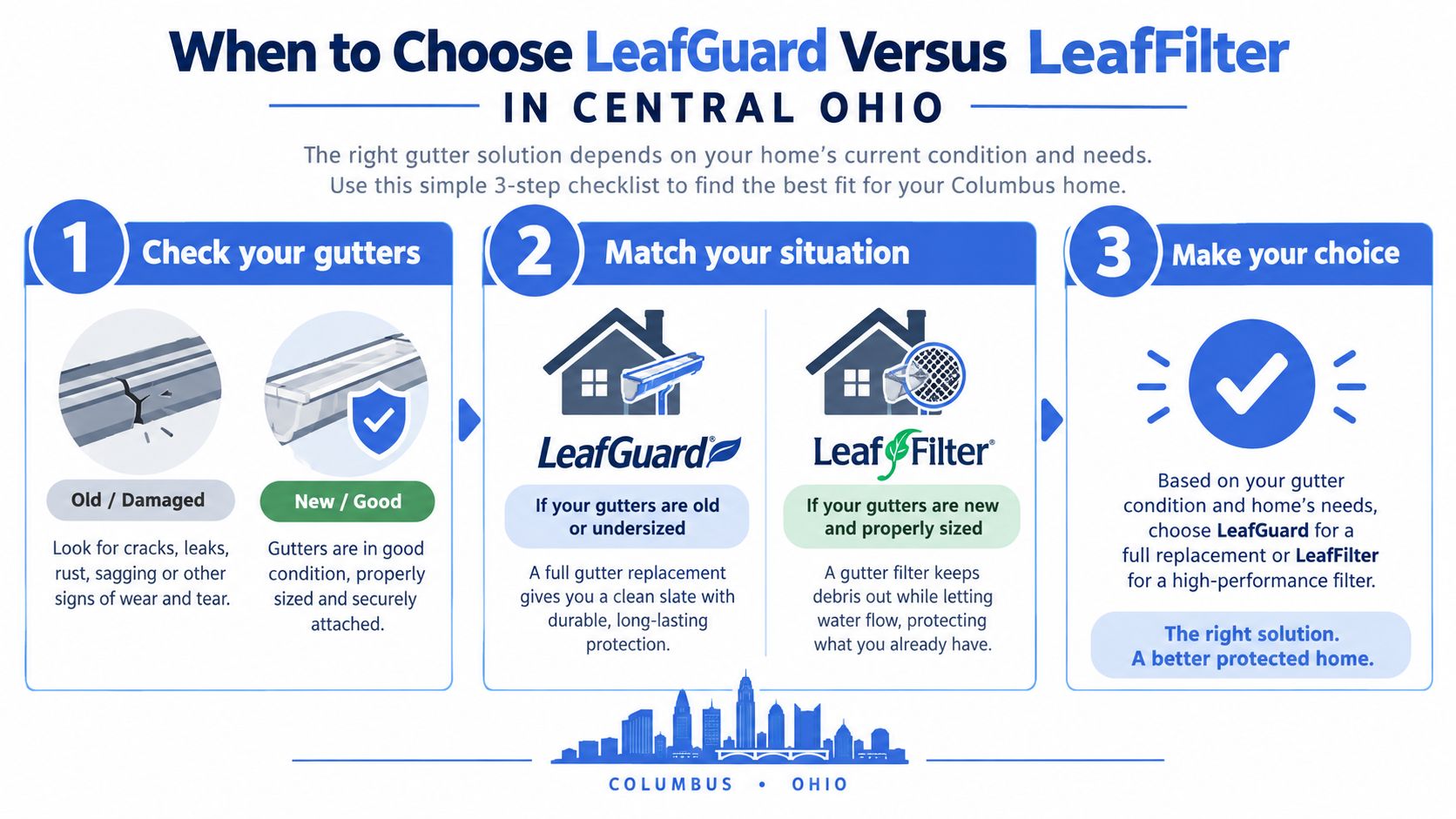
Decision point: Choose the system that matches both the gutter's condition and the debris that actually lands on the roof.
A home with good gutters and fine debris usually points toward LeafFilter. A home needing full replacement, with large leaf fall as the dominant issue, may point toward LeafGuard. A roof with mixed conditions deserves an inspection before a product recommendation.
Durability, Maintenance Reality, and Warranty Expectations
No protection system is install-and-forget. The gutter trough may stay cleaner, but the roof edge still collects material, and water still needs a clear path through the system. The 2010 outdoor testing cited earlier found meaningful performance differences between products and also concluded that no system eliminated maintenance entirely.
LeafGuard's open-front reverse-curve approach has a practical strength with large leaves. Debris can slide over the hood instead of entering the gutter. Its weakness appears with fine material, which can reach the entry point or settle where the water travels. LeafFilter's micro-mesh blocks smaller debris more effectively, but that same fine surface can collect pollen, roof grit, and dust. Proper pitch and access for rinsing become important.
Maintenance expectations
Plan on visual checks after major storms and during heavy leaf fall. Look for debris sitting across the surface, water spilling at corners, staining below the front edge, and downspouts that discharge weakly. A system that looks clean from the ground can still have a problem at a valley, miter, or downspout transition.
LeafFilter's warranty language emphasizes no-clog protection for the life of the home and states that the company may repair or refund the system if it overflows or causes interior water damage, according to LeafFilter's review and warranty discussion. Read the exclusions and service process before treating that promise as automatic protection. Ask whether the warranty applies to installation defects, existing gutter failures, fascia damage, storm damage, or conditions caused by nearby trees.
For a practical discussion of reverse-curve ownership considerations, see these reviews of Leaf Guard gutters. The best recommendation path remains straightforward: select LeafGuard when replacement is justified and large leaves are the dominant concern, and select LeafFilter when sound gutters need stronger protection from fine debris. In both cases, require a written maintenance and warranty explanation.
FAQ About Gutter Protection Choices for Columbus Homes
Do gutter guards eliminate cleaning completely?
No. They can reduce how often the gutter trough needs cleaning, but debris can still accumulate on top of a cover or mesh. Check the roof edge after major storms, during fall leaf drop, and whenever overflow returns. The 2025 survey cited earlier supports a meaningful maintenance reduction, not a promise of zero maintenance.
How do I decide whether to keep the existing gutters?
Keep them when they are secure, properly pitched, appropriately sized, and free from damage that would undermine the guard installation. Replacement makes more sense when the gutters are cracked, sagging, separating, undersized, or attached to deteriorated fascia. LeafFilter is an add-on system, while LeafGuard is a replacement system, so the inspection should come before the brand decision.
Do heavy Midwest rains favor one system?
Rain intensity makes installation quality critical. The guard needs proper pitch, continuous attachment, clear corners, and downspouts that can carry the collected water. Micro-mesh has strong results in independent heavy-rain testing, but no product can overcome poor drainage design. Ask the contractor to evaluate roof valleys, downspout capacity, and discharge points rather than discussing the guard alone.
If you're comparing options for a Columbus-area home, HIBCO ROOF LLC provides gutter inspections, gutter installation and replacement, and leaf guard protection installation as part of its residential exterior services. Visit HIBCO ROOF LLC to request a free, no-pressure estimate that separates gutter repairs, replacement needs, and protection costs.