

You planned to spend Saturday watching the Buckeyes, not standing on a ladder with wet leaves in your hands. Then a fall storm rolls through Columbus, water pours over one corner of the gutter, and you find yourself looking at stained siding, soggy mulch, or a downspout that barely drains. That cycle is familiar across central Ohio, especially on homes surrounded by mature oak, maple, and pine trees.
Leaf guard gutter systems can reduce the amount of debris that enters the gutter channel, but they aren't a magic shield against every drainage problem. The right system can lower cleaning demands and help control overflow. The wrong system, or a poorly fitted one, can collect debris on top, restrict water during a hard storm, and create a new maintenance problem.
Table of Contents
- What Leaf Guard Gutter Systems Actually Do
- Types of Leaf Guard Systems and How They Work
- Benefits and Honest Drawbacks of Leaf Guards
- Cost Ranges and Return on Investment
- Installation Process and What to Expect
- The Maintenance Reality After Installation
- Signs You Need Leaf Guards Versus Simple Cleaning
- Questions to Ask Your Gutter Contractor
What Leaf Guard Gutter Systems Actually Do
A gutter guard is installed over or inside a rain gutter. Its job is simple in principle: keep leaves, needles, seeds, shingle grit, and other debris out while allowing rainwater to reach the downspout. The challenge is that water and debris behave differently. Water needs an open path with enough capacity during a heavy downpour, while the guard needs openings or a shape that rejects unwanted material.
A Columbus homeowner with a large maple near the roof may find that a basic screen stops broad leaves but lets small seeds and pollen through. Another homeowner under pine trees may have a different problem, because narrow needles can slip through larger openings or collect across the guard surface. A system that works acceptably on a relatively open lot may struggle on a heavily wooded property.
The basic design tradeoff
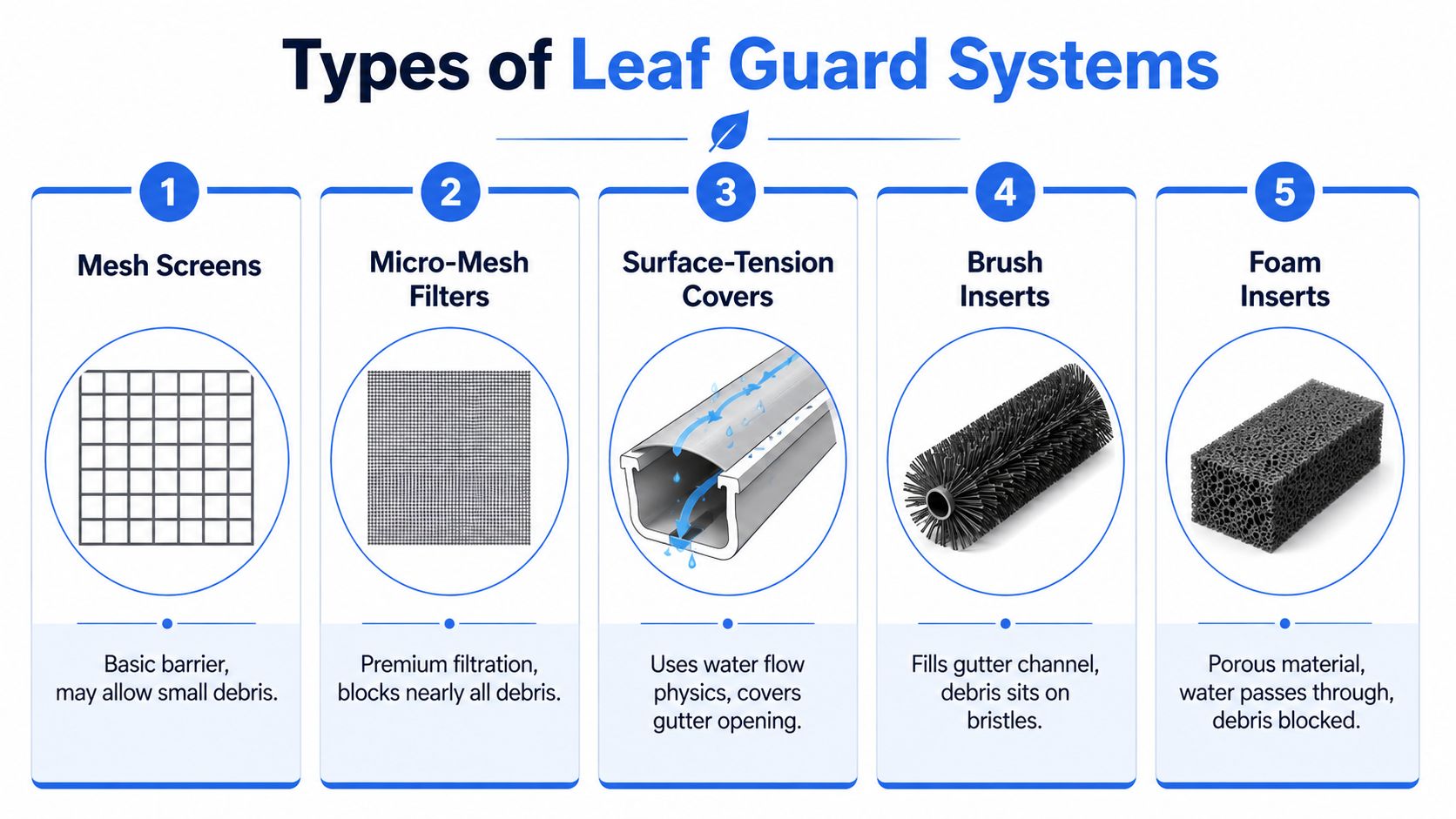
Guards generally use one of three approaches. A screen or mesh creates a physical barrier over the gutter opening. A micro-mesh filter uses much finer openings, often described as 50 to 280 microns, to allow water through while excluding fine debris such as pine needles, shingle grit, and seed matter, as described by the National Eavestrough Authority's explanation of gutter protection. A surface-tension cover uses a curved hood to direct water around its edge and into the gutter while leaves slide away.
Brush and foam products sit inside the gutter rather than covering it completely. They can reduce the amount of material that reaches the bottom of the channel, but debris may remain on the bristles or porous surface and still require attention.
Practical rule: A guard doesn't remove the need to understand your roof drainage. It changes where debris collects and how water enters the gutter.
A mature product category deserves a measured evaluation. The first U.S. patent for a gutter or gutter cover was reportedly issued to J.M. Hess on October 26, 1880, and development expanded from early screens to solid-top covers in the late 1800s, early 1900s, and mid-1900s, according to this history of gutter guards. That history shows the problem is longstanding, but it also explains why today's systems differ so much in geometry, filtration, attachment, and water-flow behavior.
Types of Leaf Guard Systems and How They Work
A Columbus home beneath mature oaks, pines, or maples needs a different guard than a property with only light tree cover. Spring pollen, seed matter, roof grit, and wet leaves all behave differently. Roof pitch, gutter condition, downspout layout, and local rainfall also affect whether a system keeps working after installation.
Mesh screens
Basic mesh screens block larger leaves and twigs while leaving the gutter opening visible. They suit homes with moderate debris and homeowners who accept occasional brushing. Small maple seeds, pine needles, pollen, and roof grit can pass through the openings or collect across the surface.
Metal mesh usually holds its shape better than thin plastic, but attachment quality matters more than the material alone. A loose edge can lift, sag, or leave a gap where debris enters. Mesh is practical for broad fall leaves, but less effective when fine debris is the main problem.
Micro-mesh filters
Micro-mesh has much smaller openings and filters finer material, making it a common choice beneath pine trees or mixed tree cover. Performance depends on the product and installation, as shown in this micro-mesh gutter guard comparison.
A fine filter still needs attention. Pollen and wet organic matter can coat the top, reducing the area available for water to enter. Installation angle, surface buildup, gutter pitch, and downspout capacity determine how the system performs during real Columbus storms. Homeowners should plan for inspection and occasional surface cleaning rather than assume the filter is maintenance-free.
Surface-tension covers
Curved covers guide rain along the hood and over its edge into the gutter while leaves slide or fall away. They can work well where broad leaves dominate. Poorly matched designs may struggle during intense rainfall if water reaches the edge faster than it can turn into the channel. Roof pitch and the cover's position relative to the gutter both deserve review before installation.
Brush and foam inserts
Brush inserts sit inside the gutter, allowing water to move around their bristles while leaves remain above them. They install easily, but pine needles and small debris can lodge between the bristles and require removal.
Foam inserts use a porous block to admit water while stopping larger debris. They are less noticeable from the ground, yet the foam can hold organic matter and needs direct inspection. In shaded areas, trapped moisture and decomposing material may make cleaning more involved than expected.
The right choice depends on the debris reaching the roof, not just the product category. Before adding protection, inspect the roof edge, gutter slope, and downspout route. Homeowners comparing gutter work with broader drainage or roof repair options in Cincinnati can use the same principle: roof condition and water management must be evaluated together.
Benefits and Honest Drawbacks of Leaf Guards
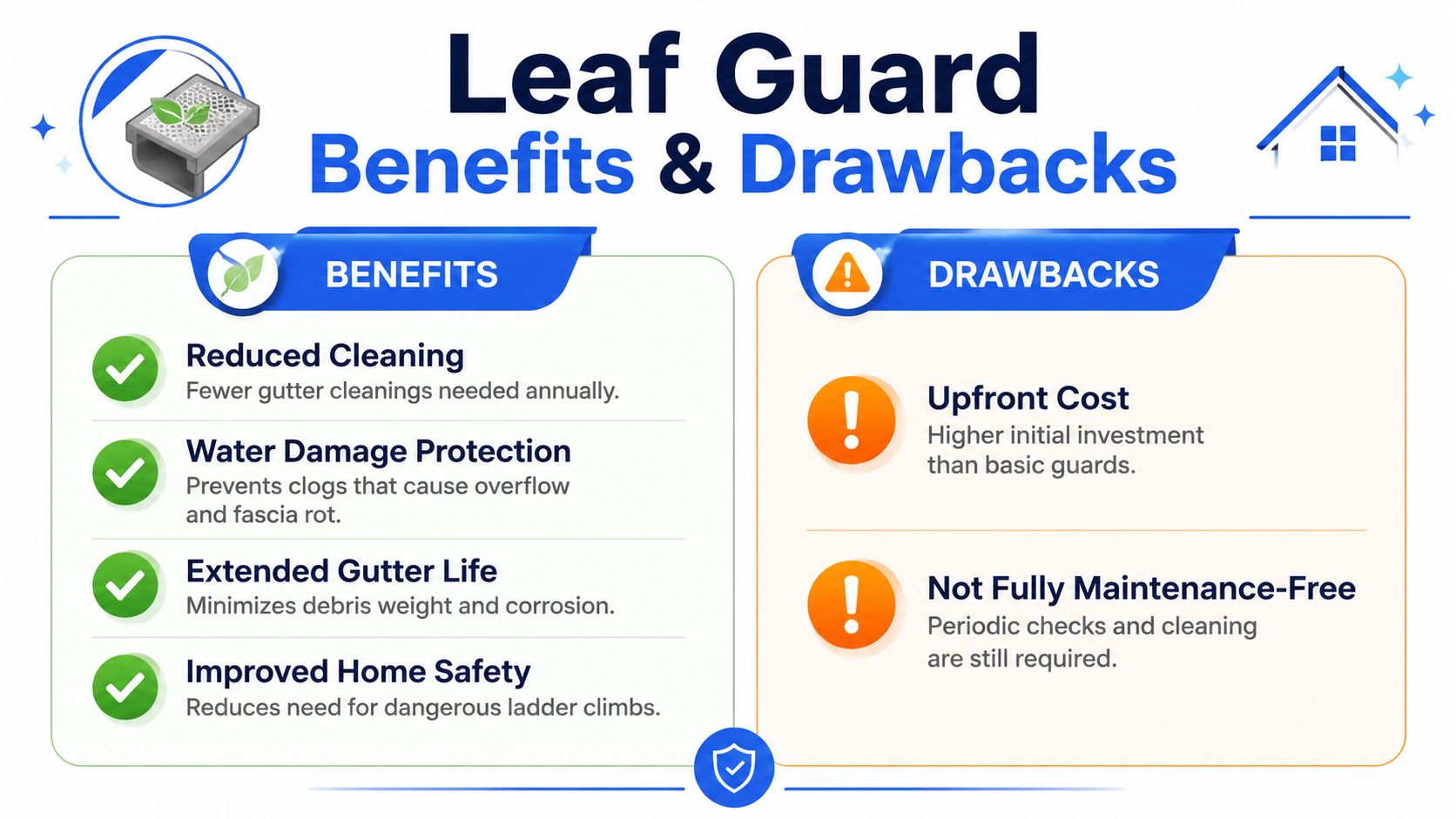
The clearest benefit is reduced debris entering the gutter channel. That can mean fewer full cleanouts, less ladder work, and a lower chance that a blockage will send water over the fascia during a storm. Guards also help keep heavy, wet organic material from sitting in the gutter and contributing to corrosion or sagging.
A protected gutter system can support the rest of the home's drainage path. Water reaches the downspout more consistently, which helps move runoff away from siding, trim, landscaping, and the foundation. It won't correct a badly pitched gutter, a disconnected downspout, or grading that directs water toward the house.
Where the tradeoff appears
A guard must reject debris without choking the water path. BRE testing reported that some gutter accessories installed inside the gutter reduced rainwater flow by 50% to 80%. In that testing, a rigid flat mesh guard reduced flow from a 120 l/m baseline to 98 l/m, while a brush-style guard reduced it to 60 l/m. A mesh product with no measurable impact maintained the full baseline, according to this review of gutter guard performance and hydraulic capacity.
The practical lesson is more important than the product category. A guard with a large obstruction, clogged surface, or poor slope can contribute to overflow during peak rainfall. Water flow depends on the geometry of the guard, the open area, the gutter condition, and the downspout route.
What buyers still give up
The drawbacks are straightforward:
- Upfront investment: A professionally fitted system costs more than a basic loose screen.
- Surface buildup: Leaves may stay out of the channel but collect on top of the guard.
- Installation sensitivity: Poor attachment or an incorrect angle can reduce performance.
- Continuing inspections: Storms, pollen, ice, and roof debris still deserve attention.
- Limited problem-solving: Guards won't repair undersized gutters, failing fascia, or blocked underground discharge lines.
The right goal is less maintenance and more predictable drainage, not a promise that the roofline will never need inspection.
Cost Ranges and Return on Investment
A truthful Columbus estimate starts with the existing gutter system, not a price per foot pulled from an advertisement. Material costs vary by design, but the final project also reflects labor, access, roof pitch, corners, downspout transitions, gutter repairs, and whether the existing system should be replaced before protection is added.
The table below is a planning framework, not a quoted Columbus price. Exact pricing depends on site conditions and the selected product.
| System Type | Material Cost per Foot | Installed Cost per Foot | Typical Home Total |
|---|---|---|---|
| Basic mesh screen | Varies by product | Varies by access and labor | Varies by home size |
| Micro-mesh filter | Higher than basic screen | Higher due to fitting and attachment | Varies by roof complexity |
| Surface-tension cover | Varies by hood design | Varies by gutter condition | Varies by layout |
| Brush insert | Usually lower material complexity | Varies by cleaning and fitting needs | Varies by gutter length |
| Foam insert | Varies by porous material | Varies by installation method | Varies by home size |
For background on how gutter replacement pricing can affect a combined project, review this gutter replacement cost guide. It helps separate the cost of new drainage hardware from the cost of adding protection.
How to evaluate the return
Start by listing what you currently spend or risk:
- Cleaning: Record how often you hire a professional or pay for equipment and time.
- Repairs: Note overflow-related fascia, siding, landscaping, or foundation drainage work.
- Replacement timing: Consider whether debris weight and corrosion are shortening gutter life.
- Safety: Assign value to avoiding repeated ladder work, especially on steep or multi-story areas.
- Ownership horizon: A system makes more financial sense when you expect to remain in the home long enough to benefit from reduced upkeep.
Don't claim the guards will automatically pay for themselves. If your property has minimal tree cover and cleaning is easy, routine service may be the more economical choice. If the home sits under mature trees, has recurring overflow, or requires difficult ladder access, the upgrade can make stronger financial sense even without a precise payback calculation.
Financing or pre-qualification may help homeowners combine gutter work with a larger exterior project, but the decision should still start with drainage needs, not the monthly payment.
Installation Process and What to Expect
Professional installation begins with an inspection, not a product pitch. The contractor should examine gutter slope, fasteners, seams, fascia, downspout outlets, roof edges, and signs of overflow. If the gutter is already sagging or corroded, adding a cover won't restore its shape.

The work sequence
Initial inspection identifies the actual drainage problem. The installer should look at roof runoff concentration, valley discharge, downspout placement, and areas where water has already overflowed.
Measurement and fitting follow. Guards need to match the gutter profile, roof edge, corners, inside angles, and outlet areas. A universal piece forced into an inconsistent gutter rarely performs like a system fitted to the property.
Attachment must hold the guard securely without damaging roofing materials or creating an unintended path for water. The correct method depends on the product and roof-gutter relationship. Homeowners should ask how the installer protects shingles, flashing, and the roof warranty.
Water testing gives the crew an opportunity to check flow at problem areas. The test should include valleys and downspouts, not only a convenient straight run.
Final cleanup and walkthrough should cover debris removal, visible fasteners, downspout discharge, warranty documents, and realistic maintenance. The homeowner needs to know where debris may collect and what inspections remain.
The installation time depends on home size, access, gutter condition, and repairs required. Prepare by clearing patio furniture and fragile items near the work zone, keeping vehicles away from access areas, and securing pets indoors. For related drainage work, review this seamless gutter installation resource before comparing replacement and guard options.
The Maintenance Reality After Installation
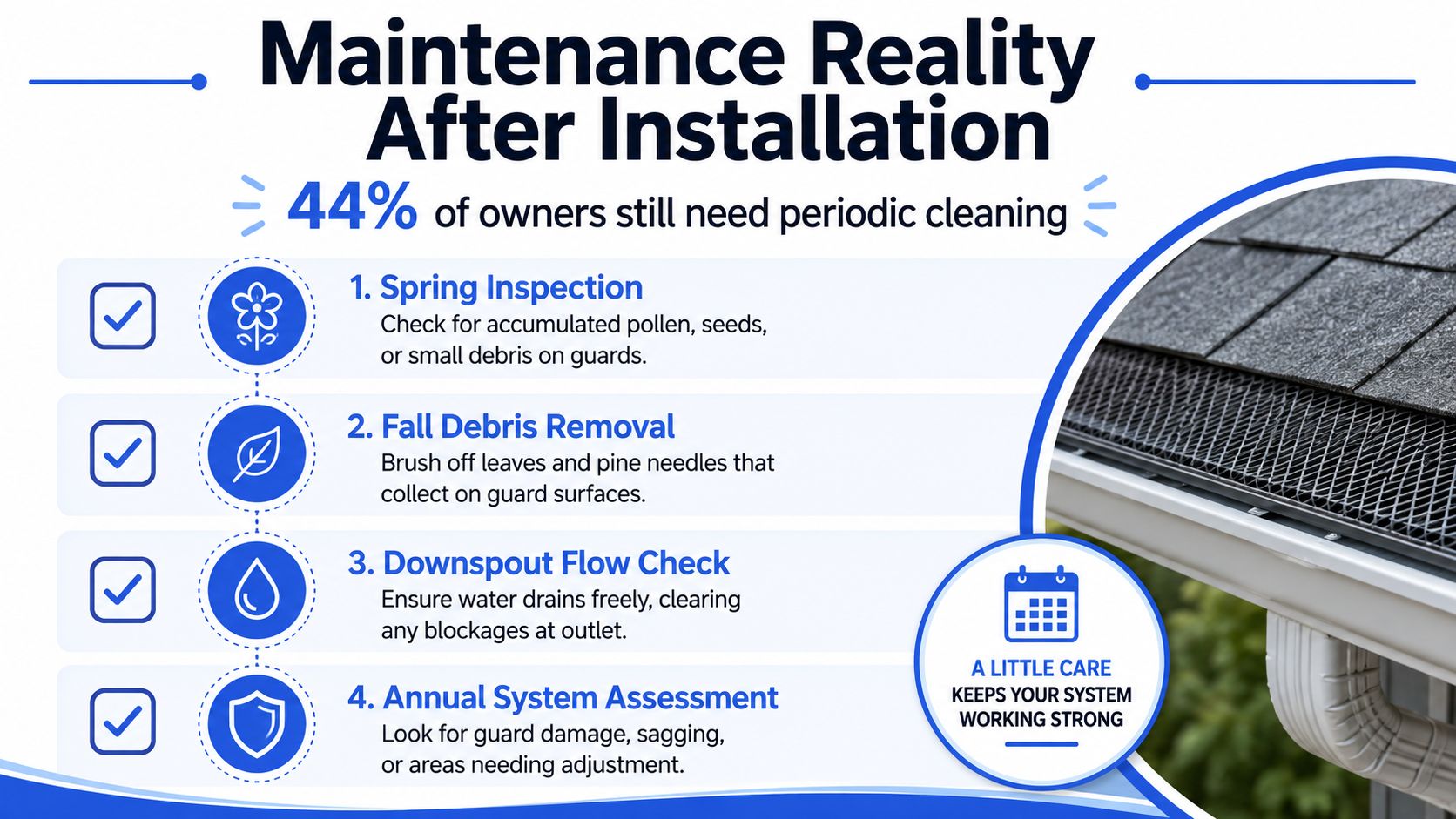
The phrase “maintenance-free” creates the wrong expectation for many homeowners. A guard can keep debris out of the gutter channel while leaves, pollen, seed pods, and roof grit remain on the exposed surface. If that layer becomes thick or wet, water may have difficulty reaching the openings.
A 2025 homeowner survey found that 44% of guard users still needed to clean their gutters after installation, while 41% of guard owners cleaned them at least once per year, according to this survey of gutter guard maintenance. Those figures don't mean every system needs the same service. They do show why a homeowner should plan for inspection rather than accept a one-and-done promise.
A central Ohio upkeep pattern
Columbus homes experience different debris loads across the year:
- Spring: Check for pollen, seed pods, small branches, and residue left by winter storms.
- Summer: Inspect after strong thunderstorms, especially where wind pushes leaves and roof debris across the guard.
- Fall: Brush leaves and pine needles from the top surface during peak leaf drop instead of waiting for a saturated layer to form.
- Winter: Watch for ice, snow movement, and damage from freeze-thaw conditions. Don't chip aggressively at a guard or gutter, because sharp tools can deform the system.
A seasonal inspection should include the downspout outlet and the point where water leaves the downspout. A clean guard won't help if the outlet is blocked or the discharge sends water back toward the foundation.
The best maintenance plan is based on your trees and roof, not on the product brochure.
Some high-quality micro-mesh systems are reported to reduce routine service to around every 18 to 24 months, but that is a reported range, not a guarantee for every Columbus property, as described in the micro-mesh performance guide. Heavy tree cover, storm debris, roof granules, and ice exposure can shorten the interval.
Signs You Need Leaf Guards Versus Simple Cleaning
A Columbus home under mature trees can need gutter cleaning again soon after service. If overflow keeps staining siding, washing soil toward the foundation, or forcing repeated service calls, leaf guards deserve consideration. Their value is reducing recurring debris entry, not eliminating every inspection.
Access and safety also matter. Steep roofs, multiple levels, limited mobility, or poor ladder positions can make routine cleaning an unreasonable task. Rental owners and property managers may prefer a more predictable exterior maintenance plan, even though the system still needs periodic attention.
Choose cleaning when the situation is simple
Cleaning may be the better choice when:
- Tree exposure is limited: An open lot produces little roof debris.
- The gutters are accessible: A single-story run can be checked safely.
- The system is sound: Gutters have proper slope, secure fasteners, and clear downspouts.
- Overflow is isolated: One blockage or downspout problem explains the incident.
- You may sell soon: A larger upgrade may not provide enough time to return its value through lower upkeep.
A single clogged outlet after a storm does not automatically justify guards. Clear the blockage, inspect the slope, and watch whether the problem returns during Columbus's heavier leaf and storm seasons.
Choose guards when the burden is recurring
Leaf guards fit homes where cleaning is frequent, hazardous, or costly, particularly after overflow has caused visible damage. They also suit homeowners who plan to stay and want fewer seasonal chores, while accepting that brushing, inspections, and downspout checks remain part of ownership.
Do not cover failing gutters. Repair or replace damaged sections first, confirm that downspouts can carry roof runoff, and check whether valleys concentrate water beyond a standard cover's capacity. Oak leaves, maple seeds, pine needles, roof grit, and storm debris can each affect performance differently. The selected design should match those conditions and the property's drainage pattern, not just the product description.
Questions to Ask Your Gutter Contractor
A capable contractor should explain the system in terms you can verify. Ask these questions before signing:
- Which guard types do you install? The answer should include practical differences between screen, micro-mesh, surface-tension, brush, and foam designs.
- What debris is common on my property? The contractor should address oak leaves, maple seeds, pine needles, pollen, and roof grit rather than give a generic recommendation.
- Are my existing gutters sound? Ask whether sagging, corrosion, loose fasteners, bad slope, or damaged fascia must be corrected first.
- How will you check water capacity? A serious evaluation includes roof valleys, downspout outlets, concentrated runoff, and heavy-rain behavior.
- What maintenance remains? Get a clear explanation of surface brushing, rinsing, seasonal inspection, and downspout checks.
- What does the warranty cover? Distinguish product defects, installation problems, clog service, and exclusions for storm or ice damage.
- Can you provide references from similar homes? Look for projects with comparable tree cover, roof complexity, and gutter layout.
- Are you licensed and insured? Request documentation before work begins.
- Will I receive a written estimate? The document should identify materials, labor, repairs, removal, cleanup, and payment terms.
Be cautious when a salesperson promises that you will never inspect the system, dismisses overflow concerns, or recommends a product without examining the gutters. A low bid can also conceal necessary repairs, limited warranty coverage, or an installation method that doesn't suit the roof edge.
For a broader contractor-vetting checklist, use this guide on how to choose a roofing contractor. HIBCO ROOF LLC provides roof inspections, gutter installation and replacement, leaf guard protection, storm assessments, and written estimates for Columbus-area homeowners, so you can ask for the gutter condition and maintenance expectations to be documented before authorizing work.
Before you commit: Ask the contractor to show you where debris will collect, how water enters the gutter, and what you should inspect after a major storm.
HIBCO ROOF LLC can inspect your existing gutters, evaluate roof runoff, and recommend leaf guard protection or gutter replacement based on your home's condition and central Ohio debris exposure. Visit HIBCO ROOF LLC to request a free estimate and discuss a practical maintenance plan for your property.