
A spring storm can leave a Columbus homeowner staring at a wet foundation wall, a sagging gutter, or a strip of fascia that's pulling away from the roofline. The first question is usually simple, even if the answer isn't. What does gutter replacement cost, really?
The confusion starts because most quotes only show part of the job. One contractor may price a straightforward swap, while another includes removal, disposal, downspouts, and any repair at the roof edge before new gutters go on. National pricing reflects that spread, with full replacement often landing in the low-thousands rather than the hundreds, and the final bill rising with house size, material choice, and access conditions. For homeowners who are already budgeting a roof or exterior project, gutters belong in the same planning bucket as other envelope work, not as a quick patch.
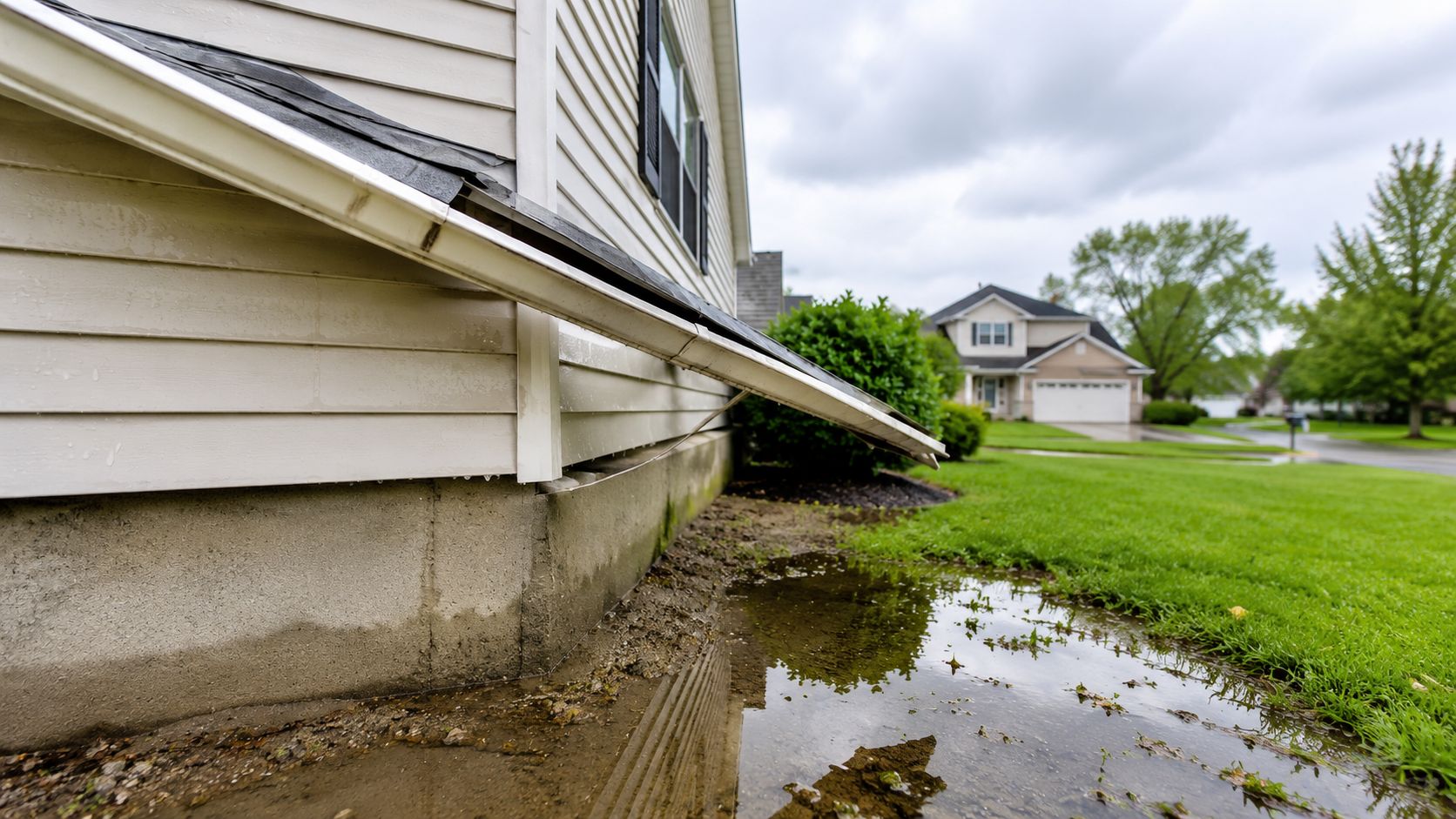
Columbus homes deal with the same basic forces as the rest of central Ohio, but freeze-thaw swings and storm seasons make weak gutters fail faster. A homeowner comparing quotes can use winter gutter maintenance as a reminder that small drainage problems often become bigger roof-edge repairs when they're ignored. For a broader view, drainage planning also ties into projects like drainage tile pricing from Modern Yard Landscapes, because roof runoff and yard runoff usually affect the same foundation.
Table of Contents
- Introduction: When Gutters Fail, Cost Questions Follow
- The True Cost of Gutter Replacement in the US and Columbus
- Factors That Drive Your Gutter Replacement Cost Up or Down
- Columbus and Central Ohio Local Pricing Context
- Insurance Claims, Financing, and Hidden Costs to Watch For
- Timeline and What to Expect from a Professional Estimate
- Conclusion: Invest in Quality and Protect Your Home
Introduction: When Gutters Fail, Cost Questions Follow
A homeowner on the west side of Columbus might notice water pooling where it shouldn't after a hard rain, then walk the perimeter and find a gutter hanging low at one corner. That's usually when the questions start. Do the gutters need repair, or is full replacement the smarter move?
The answer depends on what failed. If the metal is separated, crushed, rusted through, or pulling away because the fascia is soft, a simple patch doesn't solve the problem. A replacement quote may cover new runs, new hangers, new downspouts, and haul-away, and those items change the total much more than many homeowners expect.
A cheap gutter price can be expensive if the installer ignores the roof edge, because the leak path doesn't stop at the gutter itself.
The practical way to think about it is this. Gutters are part of the water-management system around the house, not a stand-alone accessory. If water is already reaching the foundation or rotting the roof edge, the bill is for stopping that damage and rebuilding the system correctly.
For that reason, homeowners should read a quote the way they'd read a roof proposal. Look for scope, not just the headline number. A fair estimate explains what's being removed, what's being replaced, and what may have to be repaired once the old materials come off.
The True Cost of Gutter Replacement in the US and Columbus
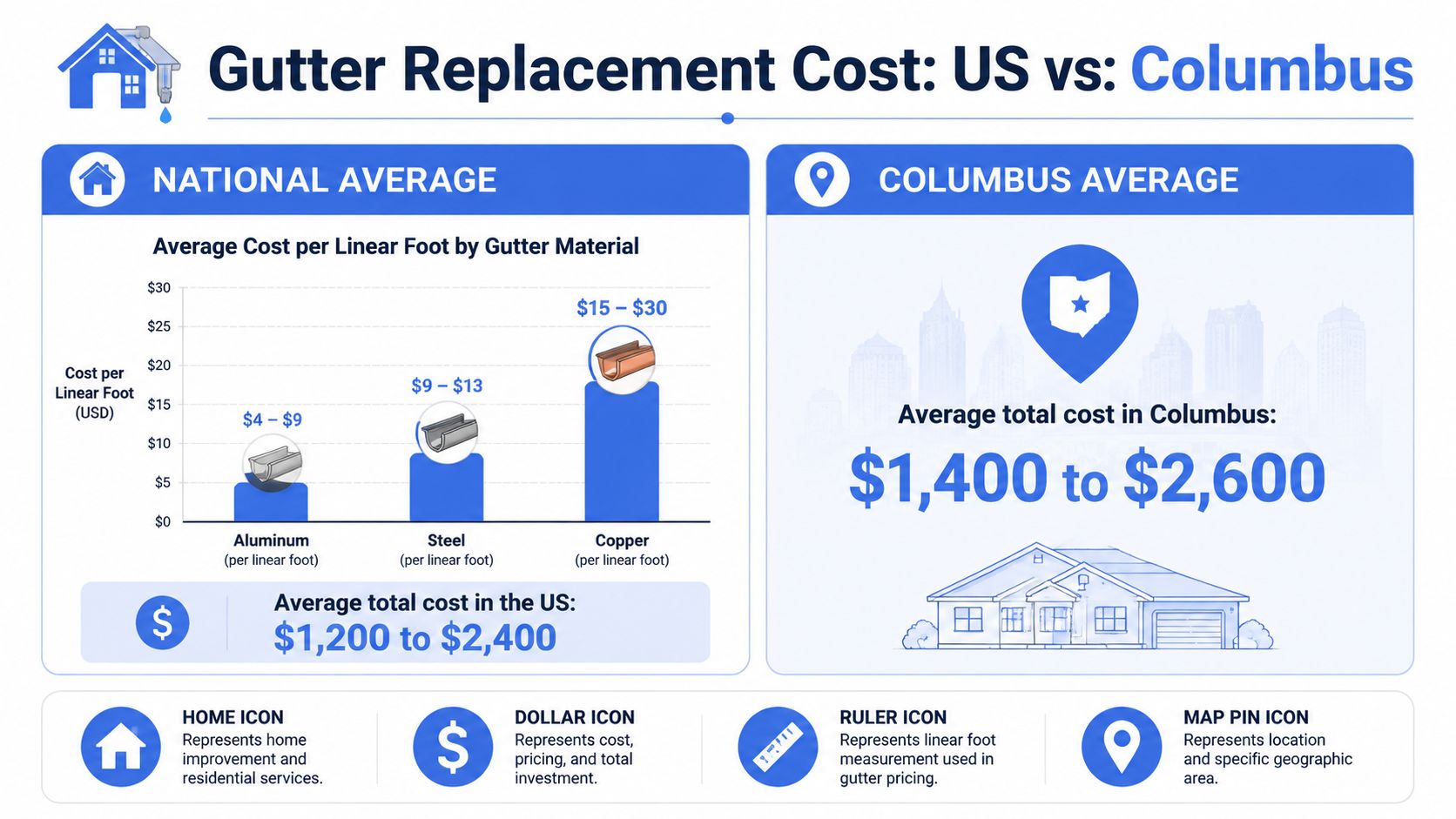
A gutter replacement quote often looks simple on paper, then the extras start showing up. National pricing for a gutter replacement cost estimate varies more than most homeowners realize. One 2026 benchmark from Modernize puts typical replacement around $4,000, with a usual range of $2,800 to $5,200 for a mid-range single-family project, while NerdWallet gives a broader $2,000 to $6,000 range and notes that large, custom, multi-level homes can reach $10,000. Those same sources also tie price to linear footage, with NerdWallet citing $4 to $40 per linear foot and Modernize emphasizing that labor, complexity, and total length drive the final bill. Modernize's 2026 gutter cost calculator is useful because it reflects the reality most homeowners run into, the project is often a meaningful exterior expense, not a minor maintenance line item.
Why the same house can produce very different quotes
The spread comes from what the quote covers. HomeAdvisor's 2025 pricing data shows a lower average replacement range of $629 to $1,734, with a typical spend of $1,181, while HomeGuide reports a 2026 national average of $12 to $25 per linear foot, or about $2,200 to $5,000 total for an average home, and says full replacement averages $2,200 to $5,000 overall. HomeAdvisor's gutter installation pricing and HomeGuide's gutter installation cost guide do not conflict so much as they measure different scopes.
For Columbus homeowners, that means two honest bids can still look far apart. One may assume a clean swap with easy access, while the other may include teardown, debris hauling, and roof-edge repairs once the old gutters come off. A contractor who prices the work properly also has to account for drainage sizing for building maintenance so the replacement system moves water where the home needs it.
The linear-foot model is the real pricing engine
Most replacement jobs are priced by installed linear foot because that is how contractors measure labor and material. The roof perimeter, number of corners, downspout layout, and disposal work all affect the total. For a homeowner, the useful comparison is not just the final number, it is the installed price per foot and what that price includes.
Ask whether the quote is for material only, installed price, or full replacement with removal and disposal. Those are not the same project.
The hidden costs are usually at the roof edge. If the fascia is soft, if old fasteners leave damage behind, or if the drip edge needs attention, the price rises fast even when the gutter itself is straightforward. Homeowners who want a longer-lasting system should also compare seamless gutter installation options instead of looking only at the lowest bid, because fewer joints often mean fewer leak points and fewer service calls later.
A low quote can leave out removal, disposal, or the repairs that show up once the old metal is off. A higher quote can be the better value if it covers the full scope and uses materials that hold up longer. The comparison is same scope versus same scope.
Factors That Drive Your Gutter Replacement Cost Up or Down
A homeowner often gets the first quote and assumes the job is just about feet of metal on the roof edge. The actual bill usually starts changing once crews measure the roofline, check access, and look for damage left behind by the old system. Material choice still drives a large part of the total, but removal, disposal, and roof-edge repairs can matter just as much by the time the work is finished. HomeGuide's seamless gutter cost guide shows how wide the price spread can be when the material and scope change.
Material, style, and lifespan all move together
A comparison table helps more than a long list of adjectives because the trade-offs are straightforward.
| Material | Cost per Linear Foot | Lifespan | Best For |
|---|---|---|---|
| Seamless aluminum | $7 to $15 | Long service life for most homes | Budget-conscious homeowners who still want a durable system |
| Copper | $25 to $50 | 50 to 100 years | Premium projects, curb appeal, and long-term durability |
That spread explains why two homes with similar gutter length can still land in very different budget brackets. A crew may recommend a higher-grade system when the homeowner wants fewer service calls, better appearance, or longer service life, even if the initial quote is harder to absorb. A lower quote can make sense for a short-term fix, but it can also mean more upkeep and earlier replacement.
Continuous systems also change the value equation. They usually cost more at the start, yet fewer joints mean fewer places for leaks, sealant failures, and callbacks. If the goal is to spend less over the full life of the system, the cheapest per-foot number is not always the best deal.
Home shape, access, and add-ons matter just as much
House layout can push the price up quickly. Steep pitches, multiple stories, tight side yards, and hard-to-reach rear elevations all add setup time and safety work, and that labor shows up in the estimate. Homeowners comparing scope should also review fascia board replacement because soft fascia often turns a simple gutter job into a roof-edge repair project.
Drainage planning affects cost too. Homes with complex rooflines, long runs, or several downspout paths need more careful layout so water moves where it should, and that is where drainage sizing for building maintenance becomes part of the estimate instead of an afterthought. The wrong size or outlet count can leave a new system struggling in heavy rain, which defeats the point of paying for replacement in the first place.
Add-ons change the bill in practical ways. Leaf guards, longer downspouts, splash blocks, and finish upgrades all add material and labor, and each one should be listed clearly in the quote. If the estimate includes them, the price may rise now but reduce maintenance work later.
The cheapest gutter job is usually the one that does not need to be reopened a year later.
The fairest comparison is same scope against same scope. Ask what the quote includes for removal, disposal, corner work, downspouts, cleanup, and any hidden repairs at the roof edge, then judge the installed price from there.
Columbus and Central Ohio Local Pricing Context
A Columbus homeowner comparing gutter quotes can see two numbers that look close on paper and still end up with very different final bills. Local pricing tends to follow national trends, but central Ohio weather, scheduling pressure after storms, and the condition of the roof edge all affect what a contractor really has to price in. Labor is competitive here, yet after heavy rain or hail, crews often get backed up with emergency calls, and that pushes out lead times and limits room for discount pricing.
Weather and material selection influence the recommendation
Ohio's freeze-thaw cycle is hard on seams, fasteners, and the roof edge itself. Materials that hold up through temperature swings usually make more sense than a choice based only on the lowest sticker price. That is why local contractors often recommend systems that stay stable through seasonal changes instead of the lightest possible option.
Material availability is usually steady, but special-order colors and custom finishes can still slow a project down. If a homeowner wants a specific match for trim or siding, the quote may include lead time and extra handling. Those are normal costs when they come from a real supply or fabrication step, not padding.
The linear-foot model drives pricing
The linear-foot model is useful because it reflects what most homeowners experience, but it is not the whole bill. A low per-foot number can still leave out tear-off, disposal, corner work, downspouts, hangers, cleanup, and hidden repairs at the roof edge. That is where the final cost moves away from the headline rate and into the installed price that matters.
Columbus homes are not uniform, so bids are not uniform either. One contractor may assume the fascia is sound and the old gutters come off cleanly. Another may spot hidden rot, disposal needs, or access issues before the work starts, and that changes the quote in a fair way.
That is why local estimates matter more than generic national averages. A solid bid should show how many feet are being replaced, what metal is going up, and whether the price includes downspouts, hangers, and tear-off. If the number is vague, the scope usually is too.
For homeowners trying to compare apples to apples, the most useful question is direct. What part of this quote is actual replacement, and what part is contingency for conditions found on site? That answer tells you more than the total alone. It also shows whether the contractor has priced the actual job, or only the visible part of it.
Insurance Claims, Financing, and Hidden Costs to Watch For
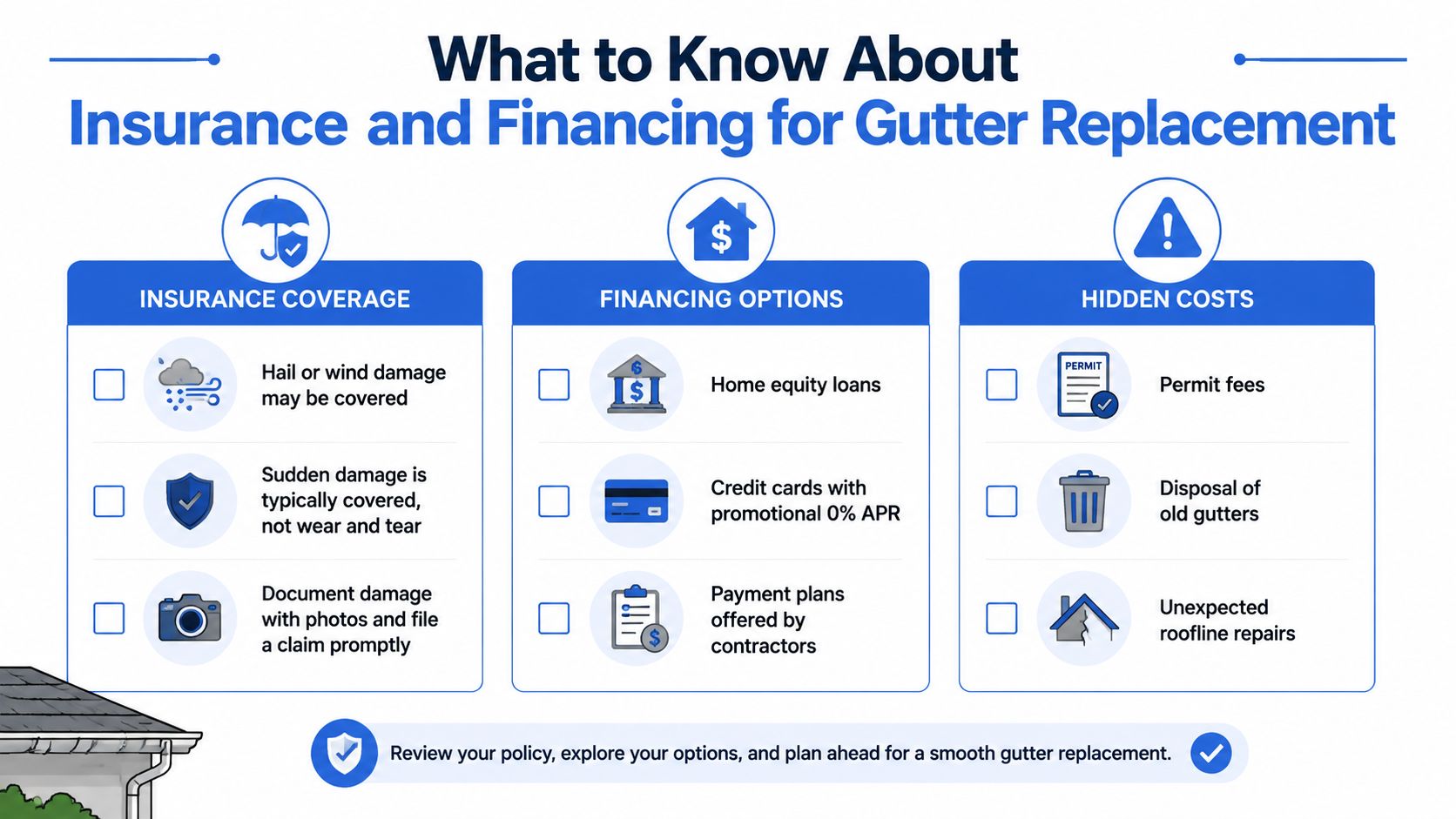
Storm-damaged gutters may qualify for an insurance claim if the damage came from a sudden wind or hail event. Wear and tear is a different situation, and most policies do not treat gradual deterioration the same way as sudden damage. Before filing, homeowners should document the problem with clear photos, check the deductible, and confirm whether the claim is worth pursuing.
Financing can make a higher-quality system more realistic
A lot of homeowners do not want to pay the full amount up front, and that is a common constraint. Contractors may offer payment plans, and some homeowners use home equity loans or promotional credit options to spread the expense over time. If you want a broader lending resource for remodeling budgets, renovation financing for self-employed can be a useful starting point for understanding how project financing gets structured.
Borrowing should support the right scope, not force a cheap shortcut. A well-built gutter system that lasts longer and leaks less often can be the better financial decision over the life of the home, especially when the first quote leaves out the work that usually shows up later.
Hidden costs are where estimates drift upward
Two items show up often in real projects. Removal and disposal can add $0.65 to $0.85 per linear foot on top of installation, and once the old gutters come down, rot at the fascia or soffit may become visible. Bob Vila's custom-formed gutter cost guide is useful here because it separates the price to install from the price to deal with what is already failing behind it.
If a contractor will not explain tear-off, disposal, or roof-edge repair in writing, the quote is not complete.
That kind of surprise is common when the mounting surface is soft or damaged. A gutter replacement can turn into a small exterior-envelope repair job, and the right response is clear scope, not guesswork. Roof-edge repairs are often what keep the new system from failing early, so they belong in the conversation before work begins.
A quote should also make material trade-offs clear. Custom-formed aluminum usually costs less up front than heavier options, while premium materials can make sense when the homeowner wants fewer replacements over time or wants to match the rest of the exterior more closely.
| Material | Typical use case | Cost trade-off |
|---|---|---|
| Aluminum | Most common choice for many homes | Lower upfront cost, moderate lifespan |
| Custom-formed aluminum | Homes that need a better fit and cleaner appearance | More fabrication work, better finish consistency |
| Copper | High-end roofs and long-term durability | Highest upfront cost, strongest long-term value |
Insurance and financing often overlap when the damage is real but the cash flow is tight. In those cases, it helps to know whether the roof-edge work is covered, whether the deductible has already been met, and whether the remaining balance can be handled with savings, payment plans, or another source of funding. The infographic below summarizes coverage, financing, and cost factors homeowners usually have to sort through before choosing a repair path.
Timeline and What to Expect from a Professional Estimate
A professional estimate should start with a real inspection, not a quick glance from the driveway. The contractor should check the gutters, downspouts, fascia, soffits, and the roof edge, then measure the linear footage that needs replacement. If the estimate skips those details, it's incomplete.
What a good estimate includes
The written quote should separate material, labor, removal, and any possible additional work. It should also state whether cleanup and haul-away are included, because those items affect the true final number. A homeowner who only sees one lump sum has no way to know where the money is going.
During the appointment, ask about material warranties, workmanship warranties, and whether the company is licensed and insured. Ask how they handle debris, what happens if hidden damage appears after teardown, and whether the quote covers the downspouts and accessories that keep the system functional. A contractor who answers those questions plainly is usually easier to work with on the job itself.
How long the work usually takes
For an average home, the process commonly takes one to three days depending on complexity and weather. Simple rooflines move faster. Multi-story homes, steep pitches, or hidden repairs take longer because crews need more setup and more caution around the roof edge.
One practical sign of a professional operation is how they talk about scope before they start. A clear estimator does not promise a perfect number without seeing the house. They explain the variables, then put the actual work in writing so the homeowner can compare bids fairly.
If you want the estimate to be useful later, keep it specific. A good document should tell you what gets replaced, what gets removed, and what conditions could change the price. That is the difference between a quote that helps you budget and a quote that creates a dispute later.
Conclusion: Invest in Quality and Protect Your Home
Gutter replacement is one of those projects where the cheapest number can be the most expensive outcome. In central Ohio, the risk isn't just a higher invoice, it's a system that leaks, sags, or fails to manage water before it reaches the fascia or foundation. That's why the smartest homeowners focus on the full scope, not just the headline price.
The best estimates explain the installed foot price, the tear-off cost, and any repair work that may show up after removal. They also make the material trade-off plain. Aluminum keeps budgets in check, while copper and other premium systems make more sense when longevity, appearance, and lower maintenance matter more than the lowest initial spend.
In Columbus, that long view matters. Freeze-thaw cycles, storm seasons, and older roof edges can turn a rushed gutter job into a repeat problem. A careful replacement protects the exterior envelope and reduces the odds that you'll be dealing with the same leak path again.
HIBCO ROOF LLC provides free, no-pressure estimates for Columbus-area homeowners who want a clear breakdown of gutter replacement cost, labor, removal, and any roof-edge repairs that may be needed. If your gutters are pulling away, overflowing, or leaving water where it shouldn't be, visit HIBCO ROOF LLC and request an estimate that shows the full scope before you commit.