A cold draft at the couch, soft wood at one sill, fog between the panes: that is usually when Columbus homeowners start collecting window quotes. Then the bids arrive and look nothing alike. One contractor prices a quick insert that keeps the existing frame. Another prices a full-frame job that pulls trim, opens the rough opening, and repairs what the old unit hid.
Those are different scopes, so treat them as different jobs. The useful question is which intervention solves the problem in front of you. Pay for rotten framing to be removed when it is rotten. Skip full demolition when the existing frame is square, dry, and worth keeping.
A good Columbus-area quote shows that logic line by line.
Table of Contents
- What Homeowners Actually Pay for Window Frame Replacement
- How a Replacement Quote Is Actually Built
- Choosing the Right Scope for Your Windows
- Frame Materials and What They Really Cost
- Energy Ratings, Climate, and Real Payback
- Getting an Accurate Quote You Can Actually Compare
- Financing, Credits, and Timing the Project
What Homeowners Actually Pay for Window Frame Replacement
Start by separating the window unit from the installation scope. Typical total replacement costs run about $300–$2,100 per window, with an average near $850, but a retrofit insert and a full-frame installation don't involve the same work. The labor benchmark is about $100–$300 per window for retrofit installations and $150–$800 for full-frame installations, where crews remove the frame and work on the rough opening (HomeAdvisor's window replacement cost guide).
That range is broad because the scope can change the price dramatically. A Minnesota state energy-program analysis compared new windows at approximately $30–$90 per square foot with retrofit technologies at about $3–$7 per square foot, illustrating why replacing the entire assembly can cost far more than upgrading within an existing frame (Minnesota Commerce energy-program analysis). Those figures aren't a Columbus quote, but they make the core point: price the work being done, not just the glass.
Put the project total in context
For a hypothetical ten-window job, multiplying the national average of about $850 per window gives a rough baseline of $8,500. That's arithmetic based on a national average, not a Columbus estimate. Actual bids move up or down with window size, material, access, removal, trim, and whether the rough openings need repair. Consumer Reports gives a broader national range of $300–$3,000 per window and notes that location, size, materials, style, and installation position affect the final price (Consumer Reports' replacement-window buying guide).
A larger opening, custom unit, or full-frame installation can move the total up. A sound existing frame may allow an insert retrofit that avoids some demolition and finish work. Don't treat the lowest per-window figure as a bargain until you know what it excludes.
Practical rule: Compare the same scope across bids. A cheaper insert quote isn't a fair comparison to a full-frame quote that includes removal, flashing, and opening repairs.
How a Replacement Quote Is Actually Built
A useful quote breaks the price into work you can point to. Ask the estimator to distinguish the window unit, labor, removal and disposal, rough-opening repairs, flashing and air sealing, trim, permits, and finish work. If the proposal gives one lump sum, you can't tell whether the crew has included the repairs your home needs.
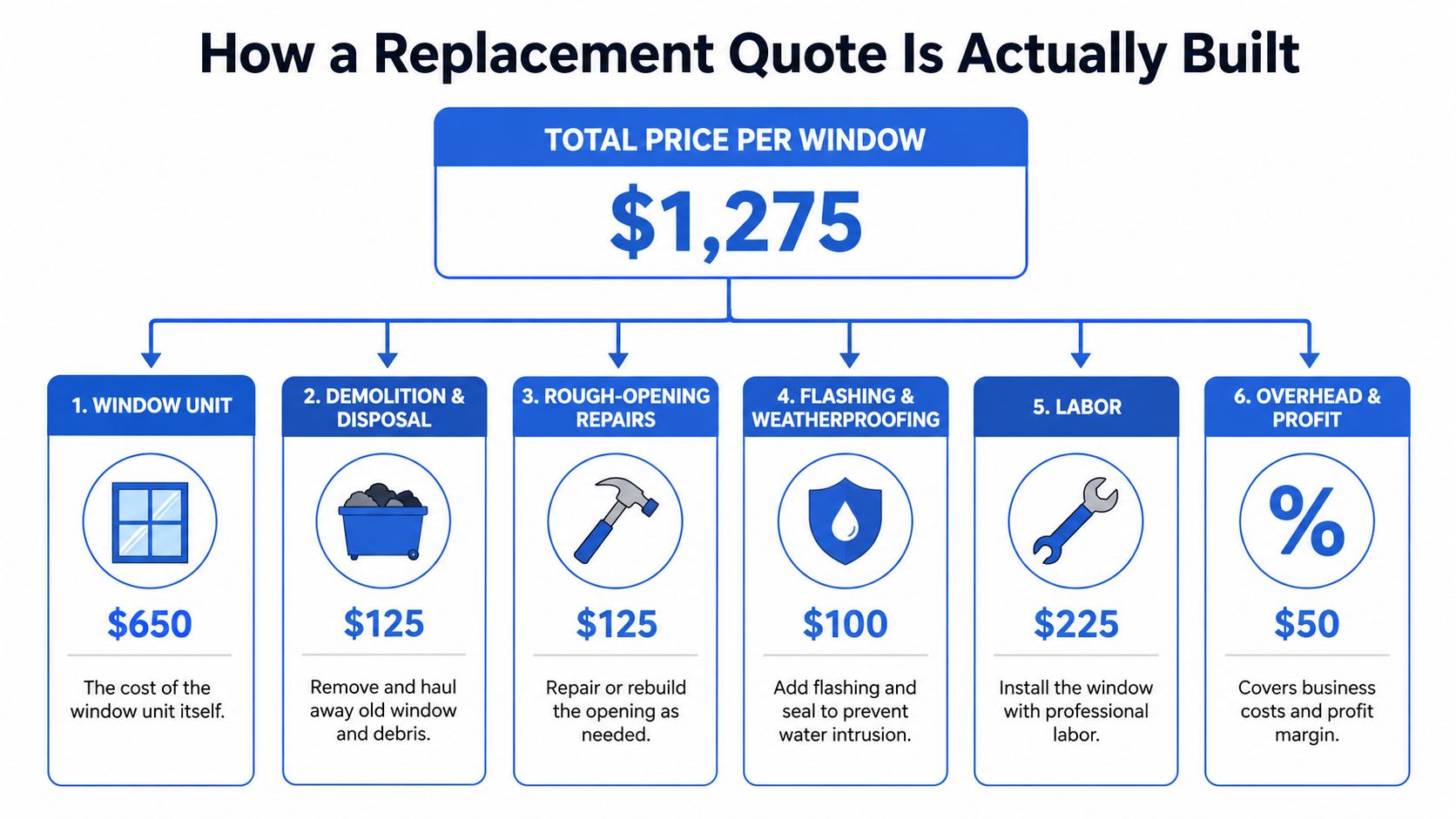
The unit is only one part of the job. Its cost depends on the opening, material, and chosen assembly. For a full-frame installation, the crew must also remove the old unit, manage disposal, and expose the rough opening. If the sill or jamb is deteriorated, the contractor may need to correct it before installing the replacement. That work is a legitimate reason a quote may rise after inspection, but it should be described rather than buried in a vague allowance.
Follow the installation line by line
Flashing and air sealing protect the opening where the new window meets the wall. The quote should state what weatherproofing work is included, not just say "install window." Proper installation matters: ENERGY STAR guidance emphasizes evaluating the whole-window performance alongside installation quality, since the rated product alone doesn't fix poor sealing or an unsound opening (ENERGY STAR guidance on windows and storm windows).
Then check the interior and exterior trim. Reusing sound trim can limit finish costs; replacing damaged or mismatched trim adds materials and labor. Ask whether painting, caulking, siding adjustments, and cleanup are part of the price. Permit requirements can vary by project and local rules, so ask the contractor whether any permit is needed and who handles it.
A low sticker price can turn expensive when disposal, trim, or opening repairs show up as additions. A higher bid can be the better value if it includes the work needed to stop water or air leaks at the frame.
Choosing the Right Scope for Your Windows
Choose the least expensive intervention that solves the actual problem, not automatically the cheapest price per opening. If the sash sticks but the surrounding frame is sound, targeted repair may be enough. If the window operates but leaks air, weatherstripping or a storm-window upgrade may address the complaint without removing the assembly. Where a frame is warped, leaking, or deteriorated, preserving it with an insert can leave the underlying issue in place.
Older homes deserve a careful inspection before anyone recommends replacement. Historic wood windows may be repairable, and retrofit strategies can improve comfort without removing the original frame. The National Trust for Historic Preservation's analysis discusses ways to improve older windows and cautions against assuming full replacement is always the most cost-effective approach (National Trust analysis of window retrofit strategies).
Match the symptom to the work
| Option | Typical use | Disruption | Best fit |
|---|---|---|---|
| Sash repair | A damaged or poorly operating sash, with a sound frame | Low | The frame is intact and the problem is limited to the moving part |
| Insert retrofit | Replacing the operable unit inside an existing frame | Lower than full-frame work | The existing frame is square, sound, and not leaking |
| Full-frame replacement | Removing the window and frame to expose the rough opening | Higher | Rot, warping, water intrusion, or persistent leakage calls for opening repairs |
| Storm-window retrofit | Adding a secondary layer over an existing window | Usually limited | The original assembly is worth retaining and the goal is added protection or comfort |
Don't ask only whether a window is “old.” Ask what has failed, where water or air is getting through, and whether the frame is still suitable to support a new unit. For a draft around an otherwise sound frame, start with the seal and weatherstripping. This guide to resealing windows can help you understand that narrower repair before committing to a replacement.
Frame Materials and What They Really Cost
Ask an estimator for the price of a "vinyl window" and you'll get a number. Ask what that vinyl unit includes and you'll get the truth. Material is one line on the quote, and in central Ohio it's rarely the line that decides whether the job succeeds.
The replacement-window benchmarks cited earlier put typical unit ranges at $100–$900 for vinyl, $150–$1,300 for wood, $75–$400 for aluminum, $300–$1,200 for composite, and $500–$1,500 for fiberglass. Treat those as catalog figures, not installed Columbus pricing. Your quote folds material into the glass package, labor, flashing, and trim.
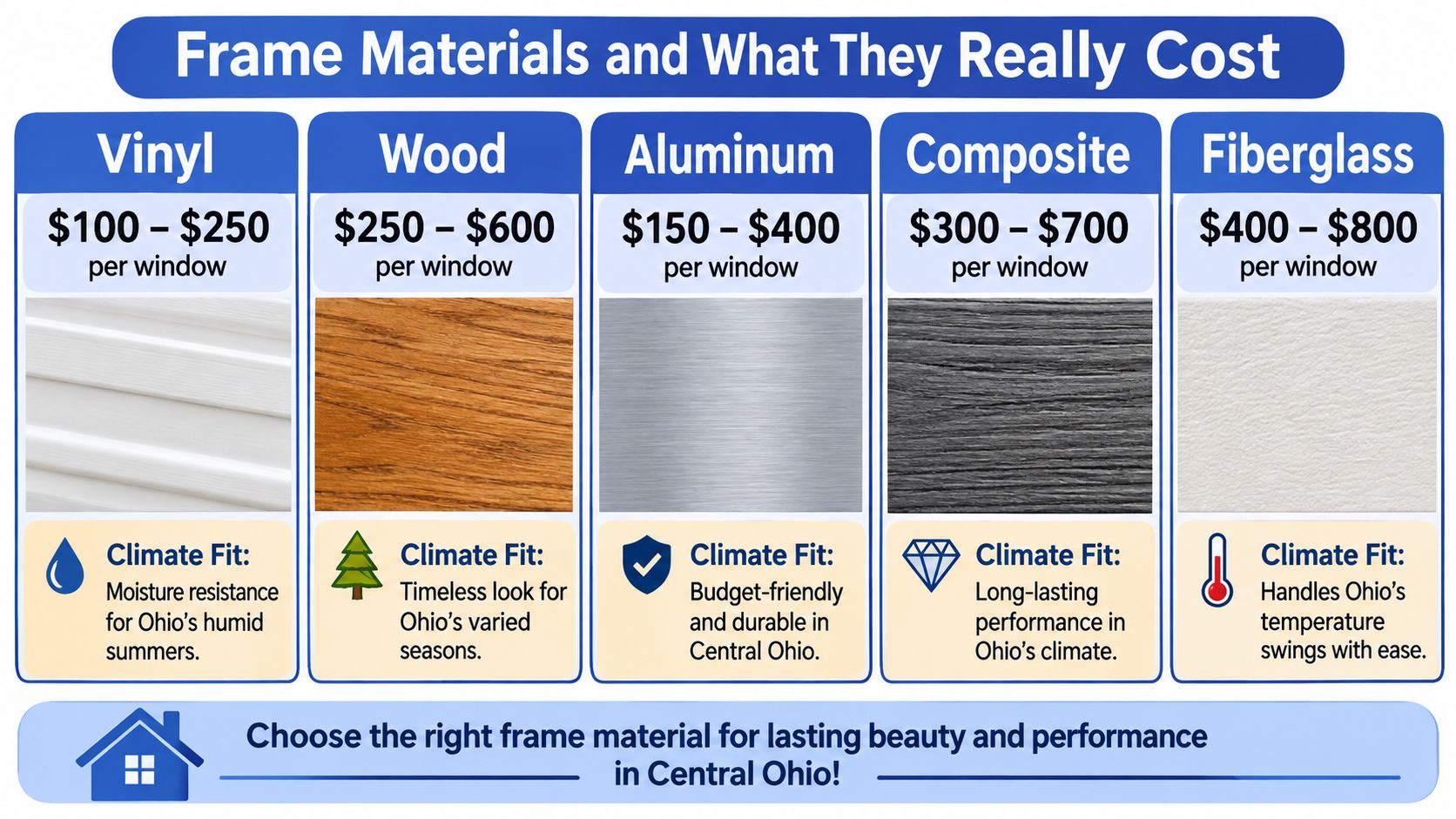
Here's how I'd read each material on a quote:
- Vinyl: the budget workhorse. Lowest listed range, minimal upkeep, and the sensible default for most replacements around Columbus.
- Wood: the looks-first option. You pay more and you sign up for maintenance. If the house is historic or appearance is driving the project, it's justified; otherwise you're buying upkeep more than performance.
- Aluminum: the cheapest listed entry point, though the frame price alone says nothing about how the assembly insulates. Ask about thermal breaks before a low number sways you.
- Composite: priced above basic vinyl. Worth it when you want durability and a wood-like look without refinishing.
- Fiberglass: the highest listed starting and top-end prices. It has to earn that premium through the whole unit's performance, not the material name.
Compare the assembly, not a material name
The frame is one part of a unit sitting inside a wall opening. When a quote lands, ask what glazing, spacer, air sealing, flashing, and trim are included in that material line. A cheap frame set into a rotted rough opening solves nothing, and a premium frame over sloppy flashing fails the same way. Match the spend to the actual failure.
If insulation is your priority, compare the full double-pane package rather than shopping frame material in isolation. This overview of what double-paned windows include gives you the vocabulary for that conversation with an estimator. Pick a material you can maintain and an assembly that fits the house. Pay extra only when the upcharge ties to a specific condition, appearance requirement, or performance gain.
Energy Ratings, Climate, and Real Payback
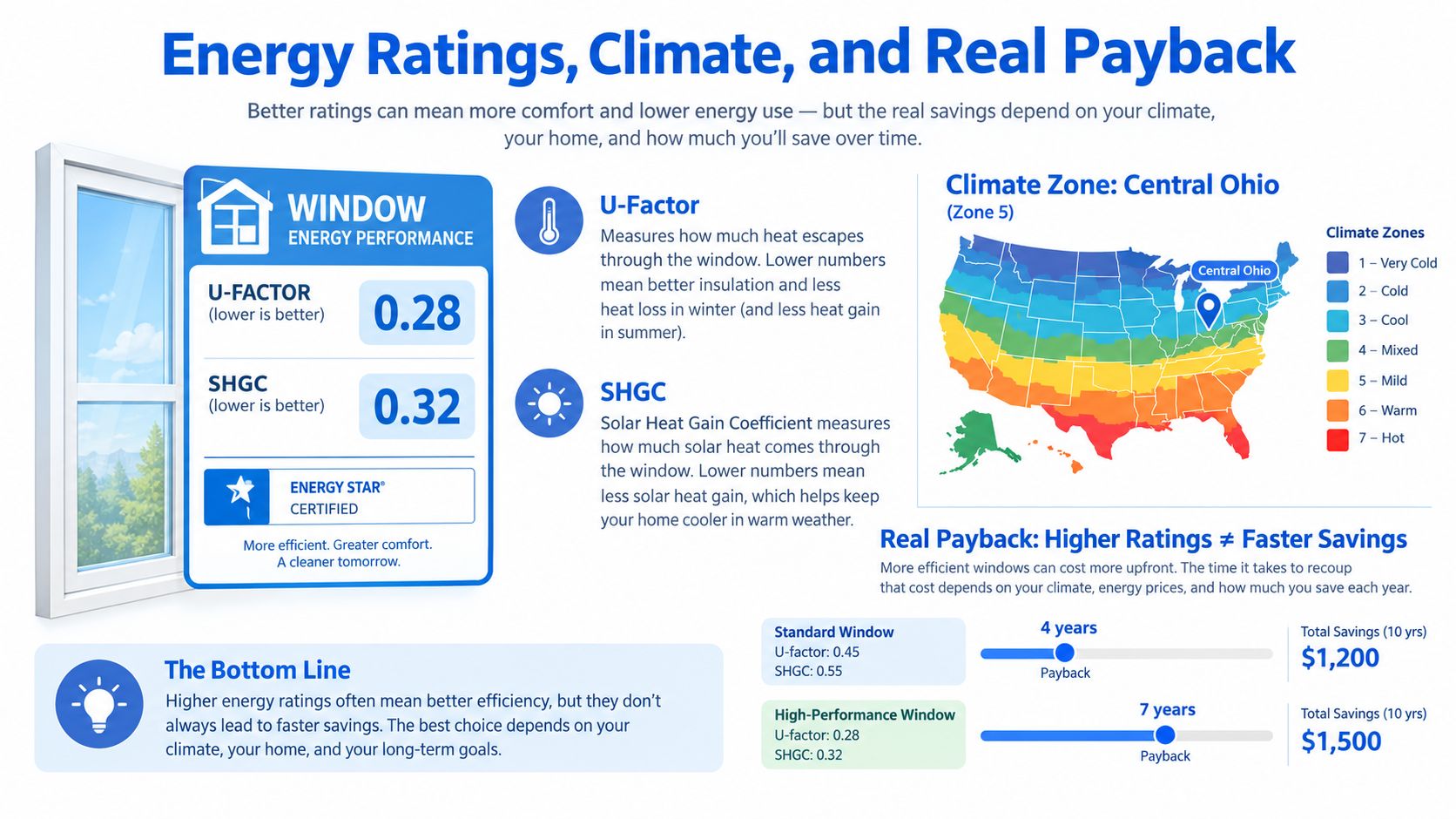
Two homes on the same Columbus street can get identical quotes and see wildly different payback. The difference is what is already in the walls. ENERGY STAR estimates that replacing single-pane windows with certified models saves about $125–$340 a year and can cut household heating and cooling costs by up to 13% nationwide, while replacing clear double-pane windows delivers smaller savings of about $20–$70 annually (ENERGY STAR window cost and energy savings guidance). Same project, same price, completely different payback schedule. Treat the high end of those estimates as a ceiling, not an average.
Read the label for your climate
U-factor measures how well the whole window resists heat transfer, and lower is better. For a heating-dominated market like central Ohio, ask for a unit certified for the Northern climate zone and insist on the whole-window U-factor, not the center-of-glass figure. Center-of-glass numbers always read better than the assembly you are buying, and estimators know it.
SHGC, the solar heat gain coefficient, controls how much solar warmth passes through the glass. A lower SHGC reduces summer cooling load, but it also blocks free winter sun you would otherwise collect. South- and west-facing glass drives most of the cooling penalty in this climate, so matching the rating to each elevation beats grabbing the lowest number on the shelf.
Here is the honest version of the payback talk. If you already have clear double-pane windows, energy savings alone will rarely carry a full-frame project. Buy it because the seals failed, the frames are rotting, rooms stay drafty, or maintenance has become a burden. For the broader picture on what buyers pay for, this look at whether new windows raise resale value covers what the market rewards.
Getting an Accurate Quote You Can Actually Compare
Invite each estimator to price the same work. Show them the problem, identify which windows are affected, and ask for a written scope that spells out the proposed installation method. Then use the same questions with every contractor.
- What stays and what goes? Confirm whether the bid covers a sash, an insert, or full-frame removal.
- Who handles disposal? Make sure removal and cleanup aren't an unpriced extra.
- What happens if the opening is damaged? Ask how repairs are documented and approved before added work starts.
- What flashing and air sealing are included? Get the method and coverage described in writing.
- What finish work is part of the price? Clarify trim, caulking, paint, and siding repairs.
- Who performs the installation? Ask who supervises the crew and what workmanship coverage applies.
Compare scope before totals
A bid that includes full-frame removal, opening repair, and finish work shouldn't be compared as if it were an insert-only price. Put the quotes side by side and match each line item. If one contractor leaves a repair as an undefined allowance, ask for the conditions that trigger it and how you'll approve the change.
For a Columbus-area written estimate, ask the contractor to identify the unit, labor, disposal, flashing, opening repairs, and trim separately. That gives you a clearer basis for weighing proposals than a single total or a verbal promise.
Financing, Credits, and Timing the Project
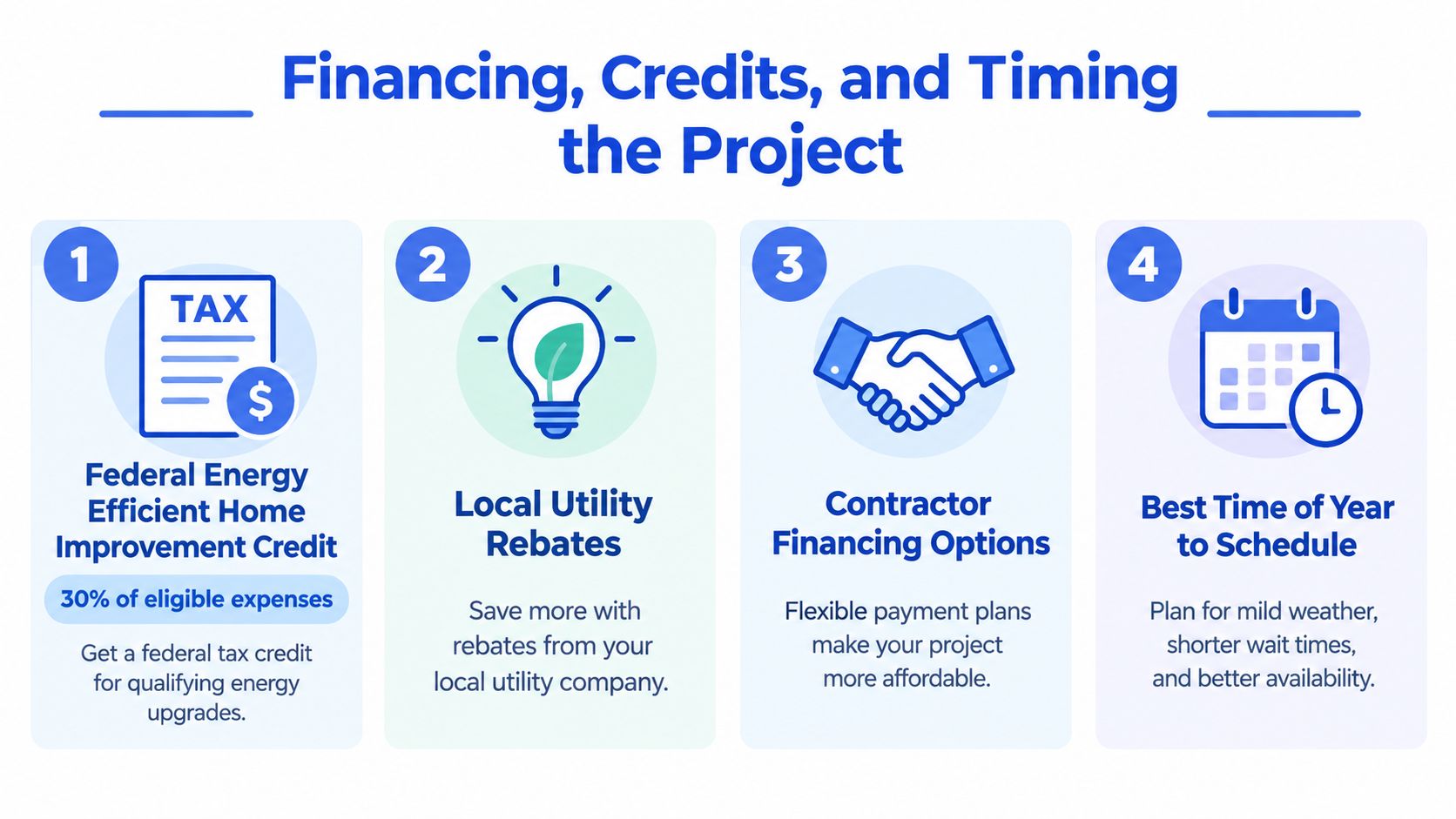
Start with the federal tax credit, but verify that the product and installation qualify before you count the savings. IRS guidance for qualifying improvements made from 2023 through 2025 describes a credit generally equal to 30% of eligible expenses, subject to a $1,200 annual overall limit for applicable energy-efficient property and home improvements. Exterior windows and skylights share a $600 combined limit; qualifying windows must meet the applicable ENERGY STAR Most Efficient certification requirement, and installation labor for building-envelope components doesn't qualify (IRS Energy Efficient Home Improvement Credit guidance). The IRS also says the improvement must be installed during the tax year claimed, not merely purchased. Keep product certification and an itemized invoice, and check the current rules before filing because eligibility and effective dates can change.
Keep the funding plan grounded
Ask whether your contractor offers financing pre-qualification, and compare the terms with other funding options before signing. A financing offer can spread payments, but it doesn't make an overpriced or incomplete scope a good deal. Ask about timing too. If storm damage or an insurance restoration is part of the project, coordinate documentation and covered work before agreeing to pay for overlapping repairs yourself. For general context on how replacement-cost coverage is approached in claims, consult North Carolina public adjuster advice.
Seasonal scheduling may give you more flexibility, but don't delay a repair that's allowing water into the home just to chase a possible discount. Likewise, resale value belongs in the decision, but it shouldn't be treated as a guaranteed refund. The Department of Energy's consumer guide estimates homeowners recoup about 78% of the cost on average when the home is sold, while also noting that energy savings vary by location and the window being replaced (Department of Energy window savings guide). Base the choice on condition, scope, and your plans for the home.
HIBCO ROOF LLC offers window replacement services and free estimates for homeowners in Columbus and central Ohio. Get a written estimate that separates the window unit from installation and opening repairs by visiting HIBCO ROOF LLC.