

You notice it on a cold Columbus morning before you notice anything else. The heat is running, the room feels fine in the middle, and yet the wall of windows still gives off that chilly edge that makes you keep your hand in your pocket longer than you want to. That's usually when homeowners start wondering whether windows double paned really make a difference, or whether the problem is something else in the house envelope.
The short answer is that a double-pane window is more than two sheets of glass. It's a sealed, manufactured assembly that affects comfort, noise, moisture, and heat flow along the perimeter of your home, which is why it matters in every season, not just winter. In a place like Columbus, where January cold, summer humidity, and older housing stock all put pressure on exterior components, the window choice is part of the whole building shell, not a standalone upgrade.
Table of Contents
- What a Double Paned Window Actually Is
- How the Sealed Cavity and Gas Fill Work
- Energy and Comfort Performance Compared to Single Pane
- Benefits Beyond Lower Energy Bills
- Common Problems and How Long These Windows Last
- Repair vs Replacement and What Each Costs
- Columbus and Central Ohio Considerations and When to Call a Contractor
- Key Takeaways and Common Questions
What a Double Paned Window Actually Is
A homeowner usually sees the symptom first, not the product. The glass feels cold, the window area seems drafty, and a January freeze makes the whole opening feel like part of the outdoors. That's where the idea of double paned windows starts to make sense, because the upgrade isn't just “more glass,” it's a sealed unit that slows heat transfer much better than a single sheet can.
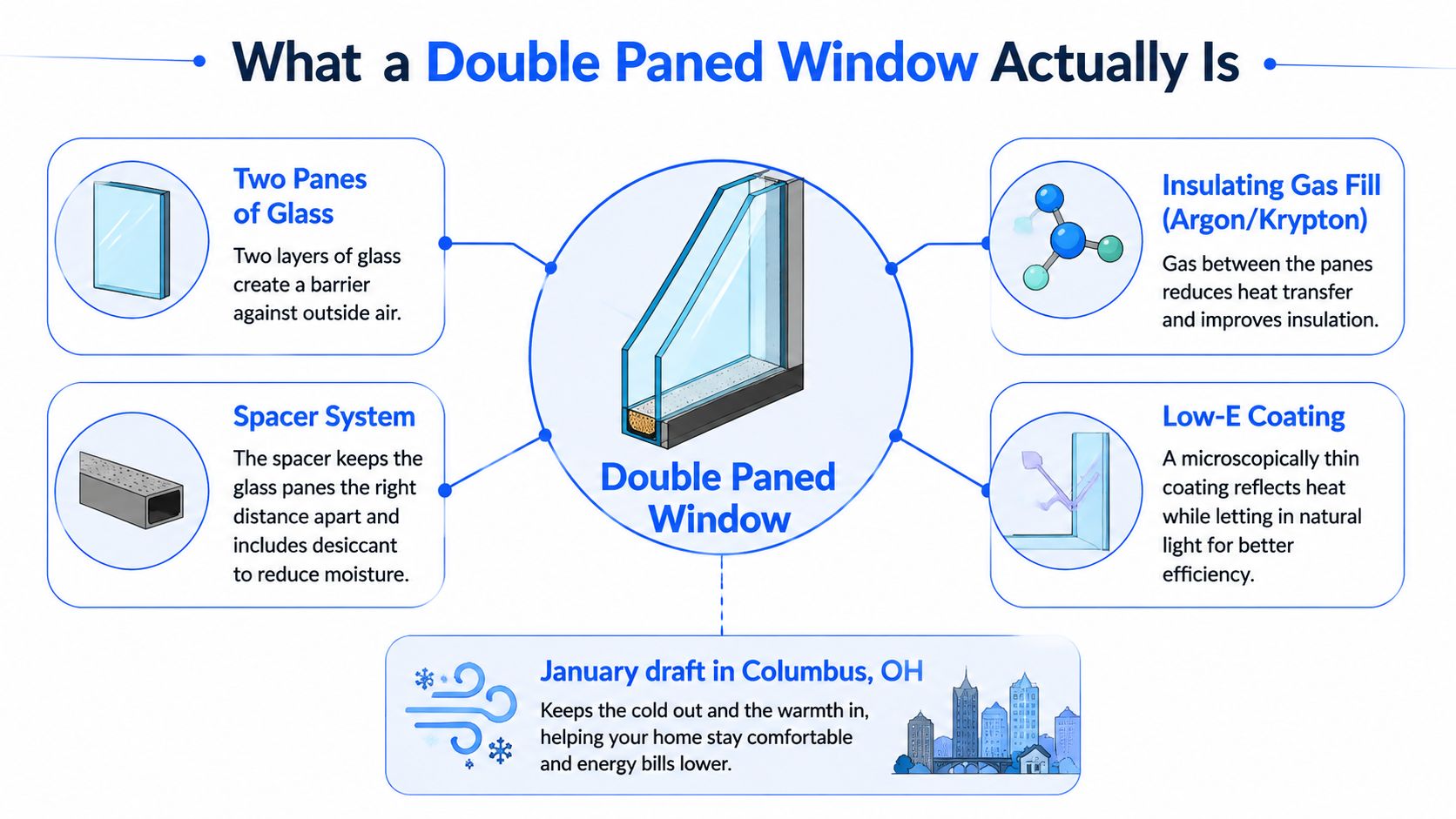
A double-pane window is an insulated glass unit, often shortened to IGU, made from two parallel panes of glass separated by a sealed cavity. That cavity is typically about 1/2 inch to 3/4 inch wide, and it's filled with dry air or an inert gas such as argon or krypton (DG Floors). The spacer keeps the panes apart, and it also carries desiccant to absorb leftover moisture so the unit stays clear and stable.
Practical rule: two panes alone don't guarantee good performance. The spacer, gas fill, coatings, and seal quality do a lot of the work.
That's why the term insulated glass unit matters. It tells you you're dealing with a factory-built assembly, not two loose sheets of glass sitting in a frame. The modern standard is built around that sealed cavity, and by the mid-2010s it had become common enough that about 68.5 million U.S. homes had double-pane windows, while 1.2 million had triple-pane units and 48.5 million were still on single-pane glass (DWM Magazine, citing U.S. Energy Information Administration RECS data).
Triple-pane windows add another layer, while low-e upgrades change how the glass handles heat and sunlight. The basic idea is simple, though. A double-pane unit creates a thermal buffer, and that buffer is what gives the rest of the system its value.
How the Sealed Cavity and Gas Fill Work
Think of the sealed cavity like the air space in a thermos. The two glass panes are only part of the story, because the gap between them is what slows heat moving in and out of the house. Without that gap, the window behaves much more like a single conductive surface.
A double-pane insulated glass unit is built from two parallel panes of glass separated by a sealed cavity typically about 1/2 inch to 3/4 inch wide, filled with dry air or an inert gas such as argon or krypton, and held apart by a spacer containing desiccant to absorb residual moisture (DG Floors). That spacer is doing quiet but important work. It sets the gap, helps manage moisture, and supports the seal system that keeps the unit from fogging up from the inside.
The seal package matters just as much as the gas. Industry descriptions consistently point to a primary polyisobutylene seal and a secondary structural seal as the layers that limit gas loss and condensation risk (DG Floors). If those seals fail, the window loses the insulated character that made it valuable in the first place.
A double-pane window is a sealed system, not a pair of panes. Once the cavity is compromised, performance starts to slide.
That is also why argon comes up so often in window conversations. It's the most common fill because it strikes a practical balance between performance and cost, and the gas-filled space and spacer system are the defining structural difference between single- and double-pane windows (Pella). In other words, the insulation is not magic glass. It's the whole assembly working together.
Energy and Comfort Performance Compared to Single Pane
A lot of homeowners hear “double pane” and assume all units perform about the same. They don't. The glass package, coatings, and gas fill can move a window from modest improvement to noticeably better thermal control, which is why the details matter when you're comparing quotes or deciding whether a replacement is worth it.
The simplest way to read performance is to look at R-value and U-factor. A single-pane window sits around R-0.85, while a standard air-filled double-pane unit ranges from R-2.1 to R-3.6. Add low-e coating and argon fill, and the value climbs to roughly R-3.8, with U-factor dropping from 0.49 for clear double pane to about 0.27 with low-e and argon (Inman).
Double Pane Window Performance Compared to Single Pane
| Glazing Type | U-Factor | R-Value | Typical Use |
|---|---|---|---|
| Single pane | Not provided in the verified data | R-0.85 | Older windows, weakest thermal performance |
| Standard air-filled double pane | 0.49 for clear double pane | R-2.1 to R-3.6 | Basic upgrade from single pane |
| Double pane with low-e and argon | 0.27 | About R-3.8 | Better efficiency and comfort control |
The Whole Building Design Guide gives another useful comparison. A standard clear double-pane insulated glass unit has a U-factor of 0.48 and SHGC of 0.70, while a soft-coat low-e double pane with argon fill improves to U-factor 0.26 and SHGC 0.57 (Whole Building Design Guide). That means the glass can cut heat flow and reduce solar gain at the same time, which matters on sunny west-facing walls in summer and on cold glass surfaces in winter.
If you're making the room more comfortable, don't ignore the rest of the opening. Homeowners who are upgrading windows often pair the work with interior treatments, and buying tips for thermal blinds can help fill in the comfort gap around especially exposed rooms. The key is to treat the window as one part of the thermal system, not the only part.
Benefits Beyond Lower Energy Bills
The utility bill is only one reason people replace old glass. The more immediate reward is often how the room feels. A good double-pane unit changes the edge of the room, the noise level near the street, and the way sunlight behaves on a bright afternoon.
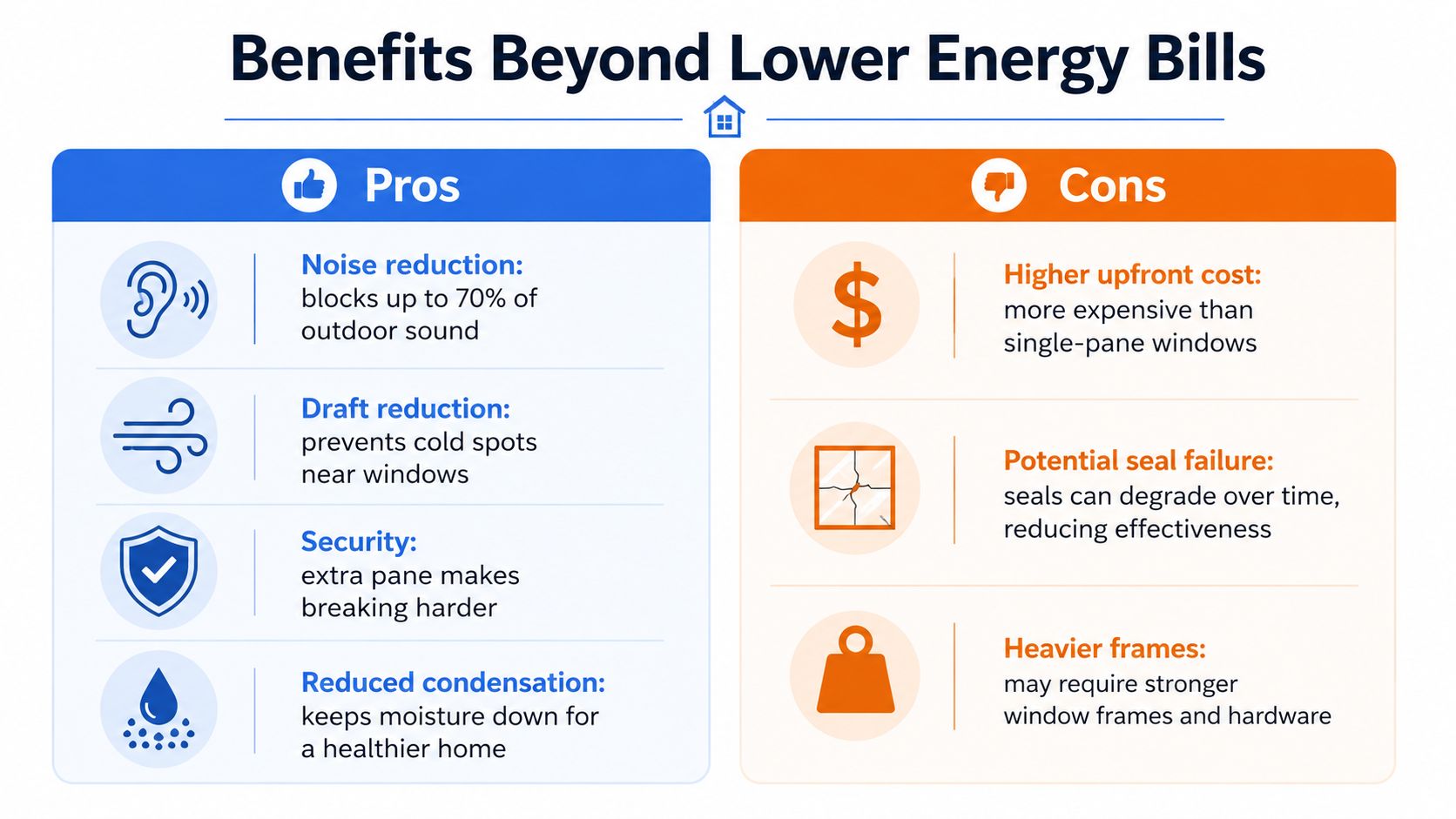
The U-factor and SHGC figures help explain that comfort shift. A clear double-pane unit at U-factor 0.48 and SHGC 0.70 admits and transfers more heat than a soft-coat low-e double pane with argon, which improves to U-factor 0.26 and SHGC 0.57 (Whole Building Design Guide). On a Columbus home with a west-facing room, that can mean less harsh afternoon sun on the inside surface, and less of that chilly-radiation feeling next to the glass in winter.
Noise is another everyday reason homeowners notice the difference. The sealed cavity and second pane add a layer between outside sound and the room, so traffic, lawn equipment, and neighborhood noise usually feel less sharp. That's especially useful on lots near busier roads, where the window opening is part of your comfort whether you're working, sleeping, or just trying to hear the TV.
One useful way to judge window value is by where you feel it, not just what you pay. The room near the window should feel less harsh, less draft-prone, and less exposed to temperature swings.
The visual side matters too. Modern coatings can reduce glare and help control solar gain, while the improved seal system reduces the odds of seeing moisture behavior at the glass edge. If you're also thinking about broader exterior updates, exterior home improvements often get planned together because the window choice affects the whole envelope. That's usually the smartest way to think about it, as a home system instead of separate projects.
Common Problems and How Long These Windows Last
A homeowner calls after noticing a cloudy patch between the panes. The glass doesn't wipe clean, the fog doesn't move, and the problem gets worse after a weather change. That's the moment seal failure becomes more likely than a simple cleaning issue.
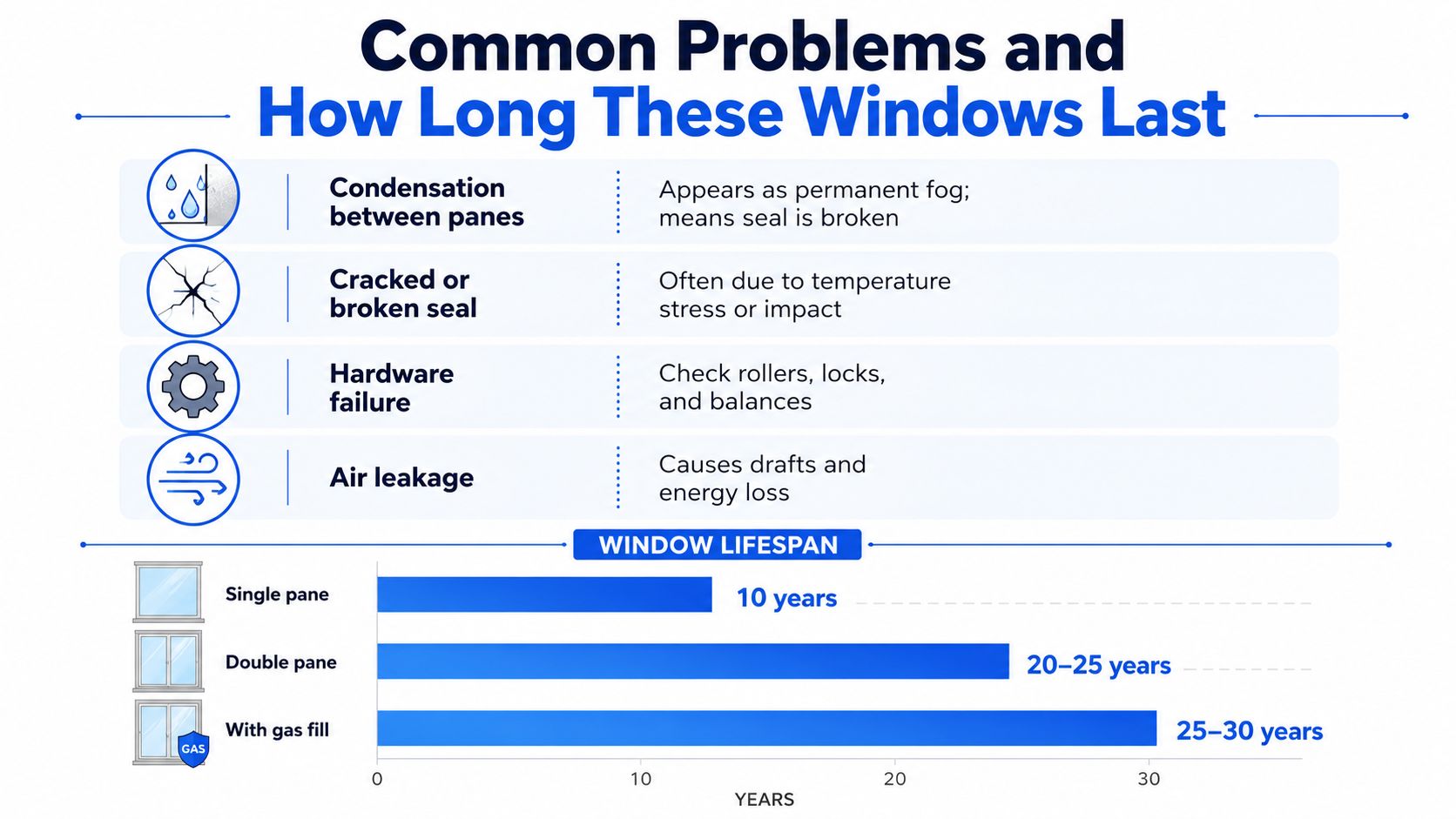
The first commercially available double-glazed product reached the North American market in 1938, was withdrawn the next year because of seal failures, and was reintroduced in 1946 (Gerretsen history of window technology). That history still matters today because the central engineering challenge hasn't changed much. If the seal fails, the unit stops behaving like an insulated glass system.
What to watch for
- Condensation between panes. If the fog is trapped inside the unit, that usually points to a broken seal rather than room humidity.
- Drafts at the edges. Air leakage around the sash or frame can feel like a failed window even when the glass itself is intact.
- Spacer separation. If the edge construction looks distorted or loose, the unit may be losing integrity.
- Persistent haze that won't clean off. That often means moisture or contamination inside the insulated cavity.
A second issue is that the problem can start small and spread into the whole assembly. Once gas loss begins, the insulating value drops, and the homeowner often feels it as a colder perimeter in winter or a warmer room in summer. A repair checklist matters, but so does recognizing when the sealed unit itself is the part that has failed.
For odd residue on the surface, especially after painting or renovation work, glass paint removal tips can help sort out whether you're dealing with a surface issue or a true inter-pane failure. That distinction saves a lot of confusion before anyone orders replacement parts.
Repair vs Replacement and What Each Costs
The right answer usually comes down to the condition of the sealed unit, the frame, and the opening around it. If the problem is limited and the sash or frame are still sound, replacing the insulated glass unit may be enough. If the frame is failing, water has been involved, or the unit is old enough that multiple parts are wearing out, full replacement usually makes more sense.
Double-glazed replacement isn't a field-fit job in the casual sense. Published performance data show that a standard air gap is commonly 15 to 18 mm with overall double-glazed assembly thickness around 23 to 26 mm when 4 mm panes are used, which is why replacement units must be ordered to the exact original dimensions rather than field-fitted (Soundproof Windows). That's a big reason a contractor will measure carefully before quoting the work.
A simple decision framework
- Choose repair or IGU swap when the frame is solid, the seal has failed, and the rest of the window still operates normally.
- Choose full replacement when the frame is deteriorated, the hardware is worn out, or the unit's size and condition make a replacement sash a cleaner fix.
- Review the whole exterior scope when you already plan siding, roofing, or trim work, because the window project may fit better into a larger envelope repair.
For homeowners who also deal with painted trim or vinyl-window prep, Toronto vinyl window paint tips offer a useful reminder that surface condition and finish compatibility matter before any new work begins. That same logic applies here. The cheapest option is not always the right one if it leaves the frame, seal, or surrounding trim in poor shape.
Practical rule: compare quotes for the same scope, not just the lowest per-window number. Ask whether the estimate covers the glass only, the sash, or the full frame.
If you want a broader view of how replacement projects are typically approached, window replacement guidance is worth reading before you make a final decision. The biggest mistake is treating all failed windows as interchangeable when the frame, opening, and surrounding exterior may be telling a different story.
Columbus and Central Ohio Considerations and When to Call a Contractor
Columbus weather is hard on exterior systems because it changes your windows' job throughout the year. Freeze-thaw cycles can expose weak seals and old caulking, summer humidity makes moisture problems easier to spot, and older housing stock often means you're dealing with more than one aging component at the same time. That's why a window issue here is often also a siding, trim, or flashing conversation.
If you're seeing fog between panes, edge drafts, or recurring condensation that doesn't match the rest of the house, it's time to bring in a licensed exterior contractor. A good one will look at the window, but also at the surrounding envelope, including gutters, siding, roof flashing, dormers, and skylights. That broader review is useful because problems travel across building materials before homeowners notice them.
In a lot of central Ohio homes, the window isn't the only weak point. It's often the easiest place to see that the envelope needs attention.
If the estimate process feels rushed or the contractor only talks about one opening at a time, keep asking questions. You want someone who can tell you whether the issue is isolated or part of a larger exterior failure pattern, and who can explain the difference between repair and replacement without pressure.
Key Takeaways and Common Questions
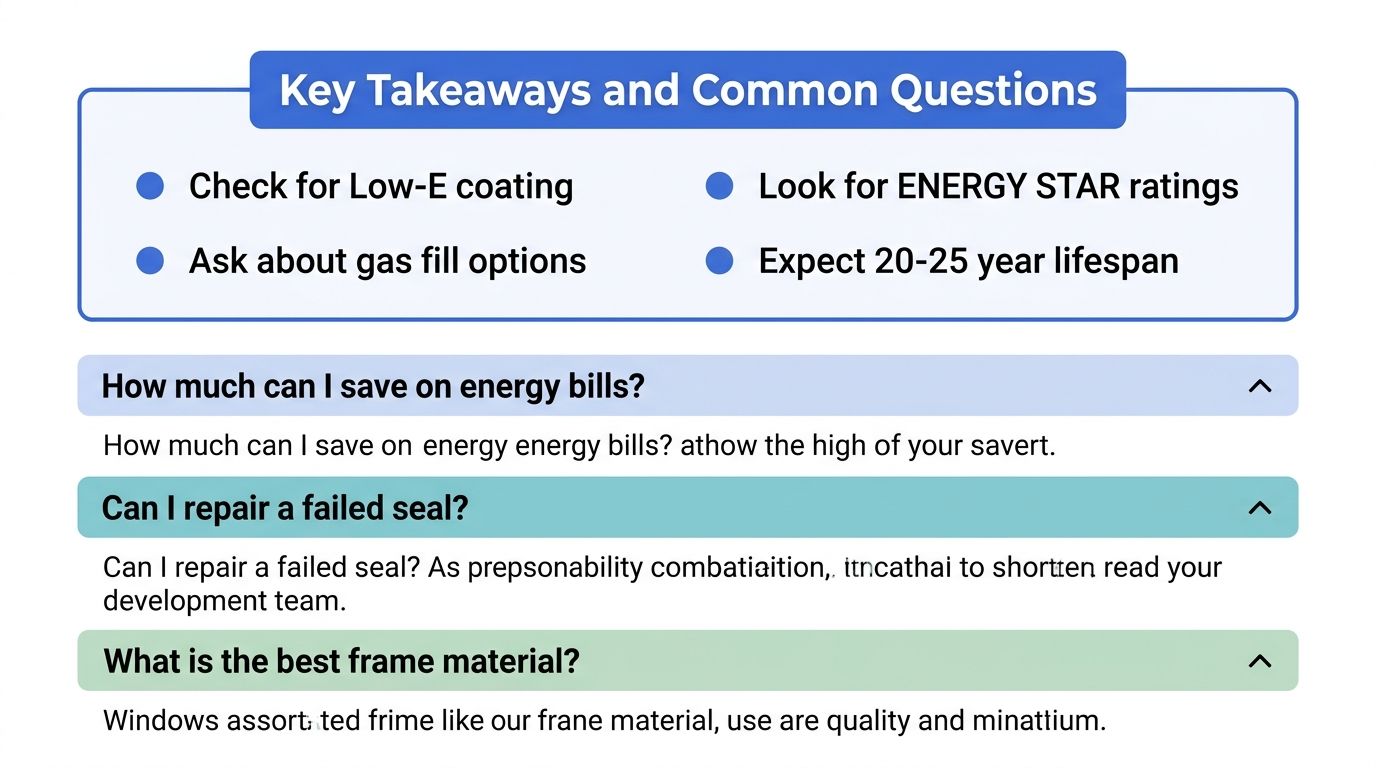
Double-pane windows are sealed insulated glass units, not just two panes of glass. Their performance depends on the cavity, spacer, gas fill, and coatings, and the most important warning sign is fog or failure between the panes. If you're comparing options, ask about low-e glass, argon fill, and whether the frame still deserves to stay.
FAQ
Can a failed seal be fixed? Sometimes the glass unit can be replaced, but a failed seal usually means the insulated unit itself has lost performance.
Are all double-pane windows the same? No, coatings, gas fill, and spacer quality make a real difference.
What should I ask first? Ask whether the problem is in the glass, the sash, or the frame.
If your windows are fogging, drafty, or just not performing the way they should, HIBCO ROOF LLC can inspect the exterior as a whole, not just the obvious symptom. Their team handles roofing, gutters, siding, skylights, and window-related exterior work across Columbus and central Ohio, so you can get one clear estimate and a practical next step. Visit HIBCO ROOF LLC to request a free estimate and talk through the best fix for your home.