
Ask ten contractors whether to buy 5-inch or 6-inch gutters and most will hand you the same line: 5-inch for a normal house, 6-inch if you've had overflow. It sounds safe. It's also how a lot of Columbus homes end up with a bigger trough bolted to the same undersized downspouts, still spilling water over the edge in the first hard July storm.
Size isn't a house-wide label you pick once. It's a per-run answer, decided by how much roof drains into one length of channel, how fast that water arrives, and how quickly the outlet can get rid of it. A 6-inch gutter is a bigger pipe. It is not a repair for a clogged elbow, a back-pitched section, or a 2 x 3 downspout that can't keep up.
This comparison of 5 inch vs 6 inch gutters works the way an estimator works, run by run, with the published capacity numbers on the table and their limits stated plainly next to them.
Table of Contents
- 5 Inch vs 6 Inch Gutters Side by Side
- How Much Water Each Size Actually Carries
- How to Size Each Gutter Run on Your Roof
- Choosing the Size by Roof Shape and Tree Cover
- Look, Fit and Cost of Each Size
- Why 6-Inch Gutters Still Overflow
- Confirm Your Choice and Order Both Sizes
5 Inch vs 6 Inch Gutters Side by Side
A 6-inch K-style gutter holds about 67% more water per linear foot than a 5-inch gutter. A separate plumbing-code sizing table shows a 54% increase in drainage area at the same rainfall rate. Those figures use different methods, so treat each as a comparison within its own basis.
| Measure | 5-inch | 6-inch |
|---|---|---|
| Storage per linear foot (K-style profile) | 1.2 gallons | 2.0 gallons |
| Roof area per run at 4 inches per hour (UPC sizing table) | 625 sq ft | 960 sq ft |
| Rated flow, semicircular at 1/8 inch per foot | 74 gpm | 110 gpm |
| Drainage area in Ace Handyman Services' separate estimate | About 6,500 sq ft | About 9,200 sq ft |
The storage figures come from a published gutter sizing guide, which lists 1.2 gallons per linear foot for a 5-inch K-style profile and 2.0 gallons for a 6-inch. The UPC-based flow ratings are from a comparison of International Plumbing Code Table 1106.6: for semicircular gutters at a 1/8-inch-per-foot slope, the listed rates are 74 and 110 gallons per minute. The profiles and measurement methods differ, so these values show relative comparisons, not interchangeable performance guarantees.
Ace Handyman Services gives a separate estimate of about 6,500 square feet of roof drainage for 5-inch K-style gutters and about 9,200 square feet for 6-inch gutters in its gutter cost guide. That estimate uses a different basis from the UPC table and should not be combined with its drainage-area figures.
For a real roof, compare each run's projected area with the relevant sizing table, then account for its outlet and slope. The 6-inch trough offers more capacity where a run needs it; it cannot make an undersized outlet or poor slope drain faster.
How Much Water Each Size Actually Carries
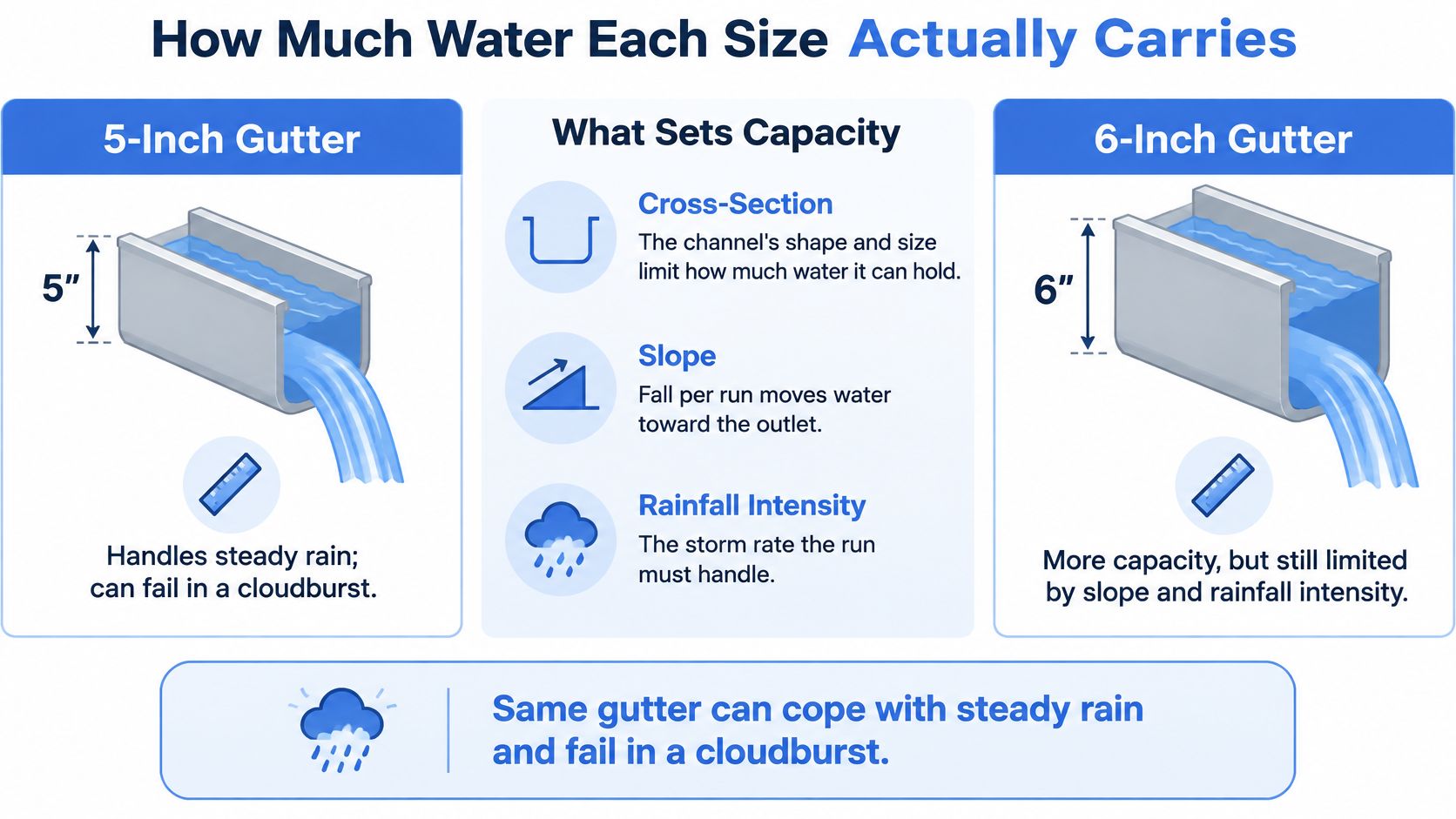
Capacity is set on each run by three things, the channel's cross-section, the fall along that run, and the rainfall intensity the run has to survive. Change the storm and the answer changes for the exact same gutter.
A sizing table adapted from the 1997 Uniform Plumbing Code, reproduced by Harvesting Rainwater, puts hard numbers on that. At a rainfall intensity of 4 inches per hour, a 5-inch gutter serves a maximum catchment of 625 square feet against 960 square feet for a 6-inch. That's 335 square feet more, or roughly 54%.
| Rainfall rate | 5-inch (sq ft) | 6-inch (sq ft) |
|---|---|---|
| 2 inches per hour | 1,250 | 1,920 |
| 4 inches per hour | 625 | 960 |
| 6 inches per hour | 416 | 640 |
The progression is the interesting part. Push the storm to 6 inches per hour and the same gutters drop to 416 and 640 square feet, still about 54% apart but now serving two thirds less roof than they did at 2 inches per hour. The percentage gap between sizes stays stable. The absolute capacity collapses.
Why intensity matters more than annual rainfall
Central Ohio doesn't overflow gutters because of yearly totals. It overflows them because a summer cell drops an inch in fifteen minutes on a roof that was sized for a gentler rate. That's why the sizing question is never "how much rain do we get here" but "how hard does it come down when it matters."
The 54% gain also belongs to one run, not the whole house. A 6-inch gutter on the front elevation of a two-story colonial does nothing for a rear run that's already at its limit. And the same table's own caveat is worth repeating: a bigger trough doesn't solve an undersized downspout or a run with poor slope. The collection and discharge route has to be sized as one piece.
The takeaway: judge a gutter against the design storm, not the average rain.
How to Size Each Gutter Run on Your Roof
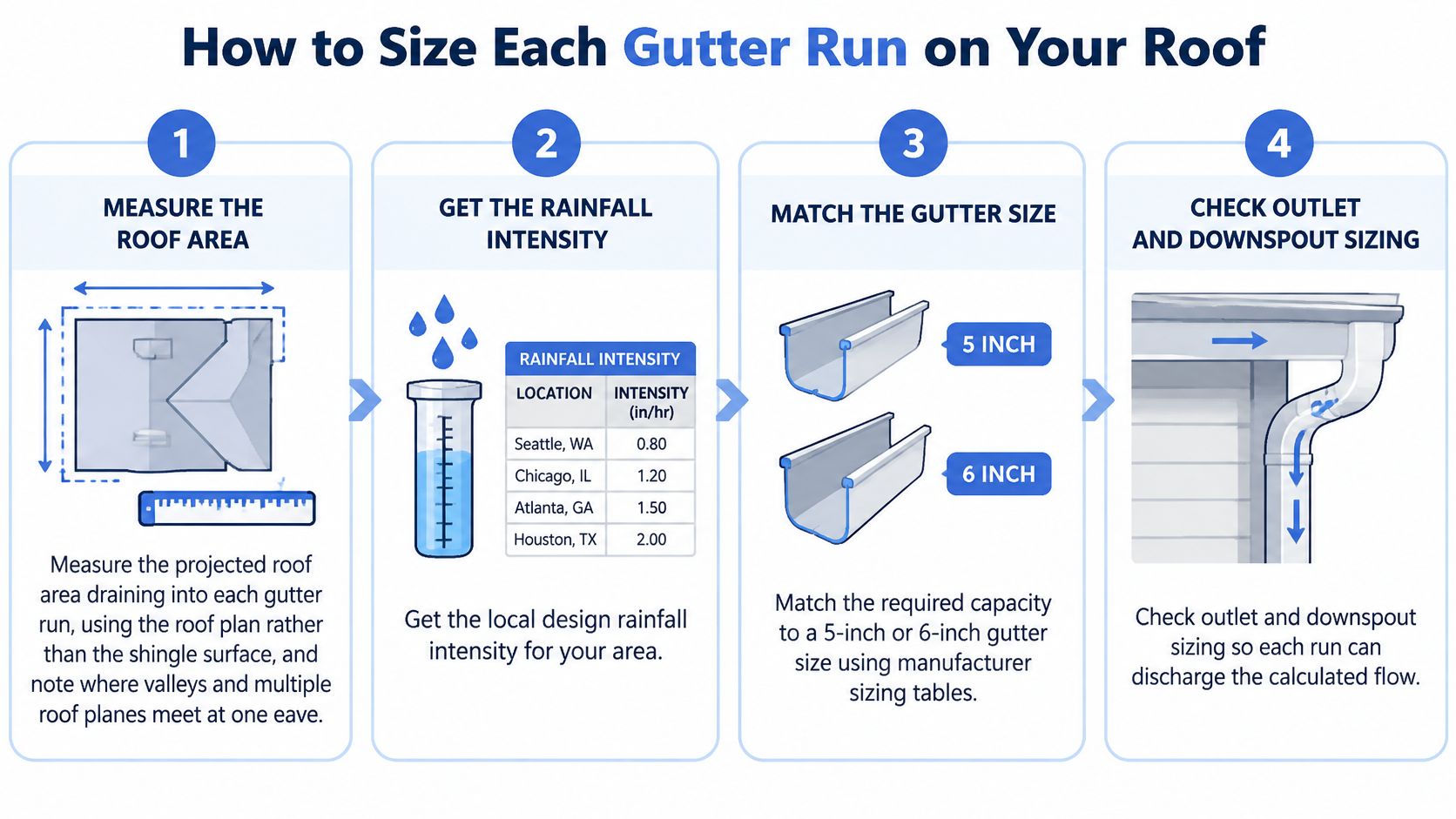
A roof can need 6-inch gutters on one side and 5-inch gutters on another. Size each run according to the roof area feeding it, then check whether its outlets and slope can carry that flow. The technical gutter sizing reference describes a calculation based on projected roof area and short-duration rainfall.
Measure the projected roof area feeding each run. Use the roof's horizontal footprint, not the sloped shingle surface. The projected area is the basis for gutter sizing, so measuring the slope can overstate the amount draining to the run.
Get the local design rainfall intensity. Ask your building authority for the short-duration storm figure used for drainage design. The sizing reference uses the most intense five-minute rainfall expected over a ten-year recurrence period; an hourly average may understate the demand during a cloudburst.
Scale capacity to rainfall intensity. At one inch of rain per hour, planning values are about 5,520 square feet for a 5-inch K-style gutter and 7,960 square feet for a 6-inch gutter. At four inches per hour, those values fall to about 1,380 and 1,990 square feet, respectively.
Account for slope. A continuous fall of 1/8 inch per foot can increase stated watershed capacity by about 40%. Check the full run with a level: a flat or back-pitched section can hold water instead of moving it toward the outlet.
Check each run's downspouts and discharge point. The outlet limits how quickly water leaves the trough. Adding another downspout divides the area each outlet must serve, but the discharged water also needs a suitable route away from the house. See guidance on gutter discharge and foundation protection.
Compare the calculated area with the capacity for each size. Upsize only the runs that exceed the relevant planning value, and make sure the outlets can handle the flow.
Record the decision run by run. List each run, its projected roof area, downspout count, and selected gutter size. That makes clear why one elevation may need 6-inch gutters while another does not.
These are planning benchmarks, not guarantees. Profile shape, hanger spacing, debris, outlet size, downspout count, roof pitch, and local design criteria all affect performance.
Decision rule: At four inches of rain per hour, a run above about 1,380 square feet exceeds the stated 5-inch planning value. A 6-inch gutter has a higher planning value, about 1,990 square feet, but it still depends on adequate slope, outlets, and downspouts.
The final check is the full drainage path: each run must move peak flow to outlets that can carry it, without water spilling behind the fascia.
Choosing the Size by Roof Shape and Tree Cover
A house does not need one gutter size everywhere. A valley that concentrates runoff may call for a larger channel on one run, while a single roof plane draining to another eave may not. Roof shape and tree cover help identify where drainage demands differ.
| Situation | Lean toward | Why |
|---|---|---|
| Single roof plane, each run under about 1,300 sq ft at 4 inches per hour | 5-inch | The planning estimate may fit the run's load |
| Steep roof or several planes draining into one eave | 6-inch on that run | Concentrated flow can exceed a 5-inch planning estimate |
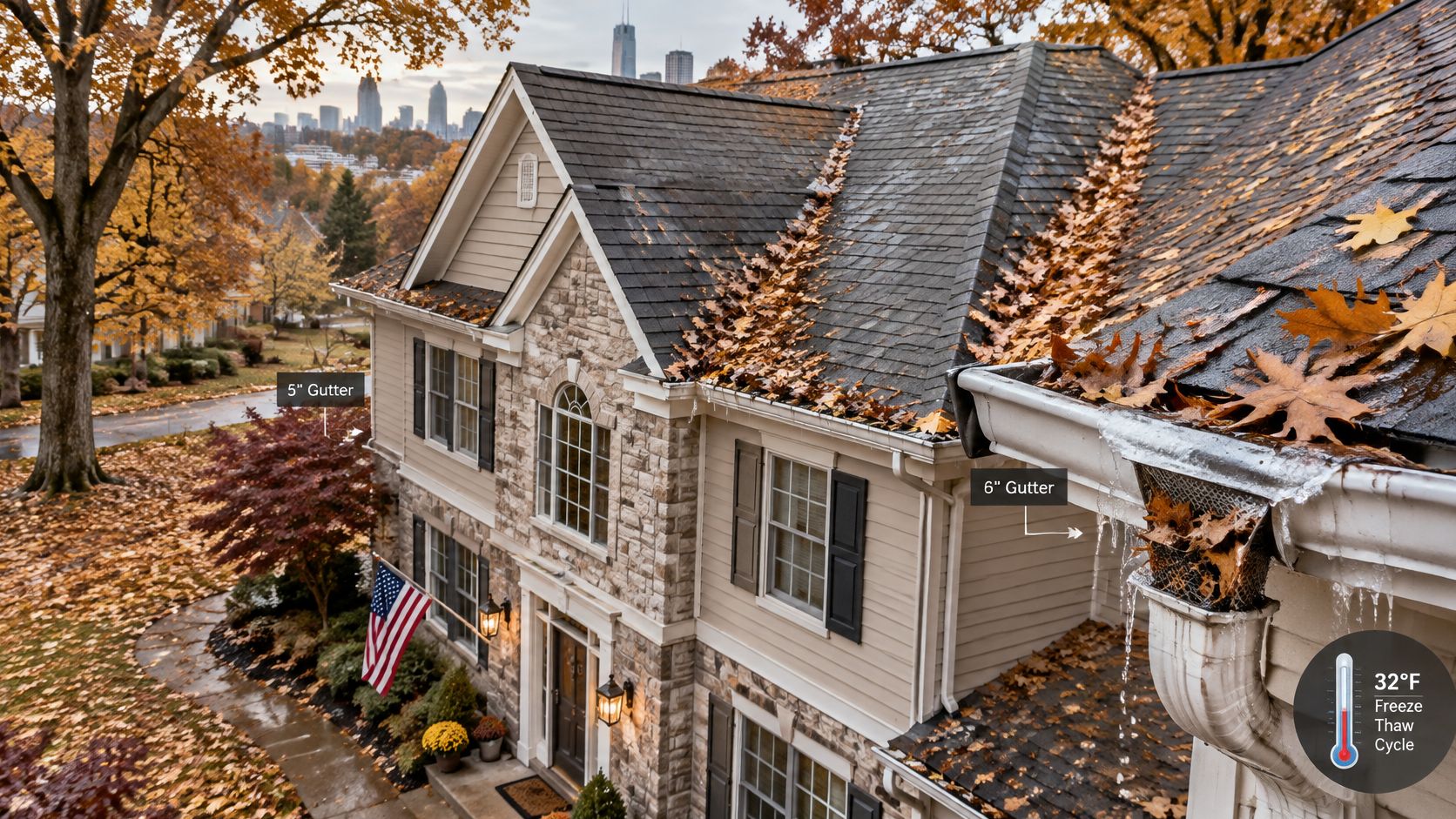
| Heavy tree cover and frequent leaf fall | Either size, with guards and cleaning | Debris can reduce drainage in either size |
| Long run with only one downspout | 6-inch, or add a downspout | A larger trough does not increase the outlet's capacity |
Roof pitch affects how quickly runoff reaches the gutter. A steep roof can send water to the eave faster than a shallow roof with the same area, increasing the peak flow the channel must handle. Valleys also matter: when several planes direct water to one short section, that point faces a greater load than a run collecting from one plane.
Tree cover changes maintenance needs, not just gutter width. Guards and regular cleaning help keep leaves and seed pods from obstructing the channel. A larger gutter can still overflow if debris blocks its outlet, or if the run's slope fails to carry water toward the downspout.
Trees close to the house can also affect where downspouts discharge. Keep discharge points clear of root zones, and consider the risks of trees near foundations when choosing where water should flow.
A mixed system can match different runs to different demands. For example, a front eave receiving runoff from a valley may warrant 6-inch gutters, while side elevations collecting water from single roof planes may suit 5-inch. The choice should follow each run's roof area and drainage path, rather than the house's overall appearance.
Size each run for its own roof shape and flow, then check that the outlet and slope can carry the water away.
Look, Fit and Cost of Each Size
The most common mistake with a larger gutter isn't the trough, it's what hangs under it. A 6-inch channel feeding a 2 x 3 downspout is a funnel with a narrow neck, and the extra capacity you paid for backs up at the outlet. Match the discharge hardware to the trough before you compare prices.
| Component | 5-inch | 6-inch |
|---|---|---|
| Common downspout size | 2 x 3 inch | 3 x 4 inch |
| Hangers and fascia | Standard hangers and fascia | Heavier-duty hangers and deeper fascia |
| Visual proportion | Lower profile for smaller eaves | Bolder line for tall or multi-story walls |
| Material cost per linear foot | Lower | Higher, exact price varies by quote |
Appearance is the part homeowners raise first, and it's fair to address directly. The 6-inch line fills the fascia and reads as proportionate on tall two-story walls and wide eaves, where a 5-inch can look undersized for the roof above it. On a compact single-story ranch with narrow trim, the wider profile looks heavy and slightly commercial, and the 3 x 4 downspouts are more visible on the wall than the gutter is at the eave.
Cost runs in the same direction, with a caveat. Six-inch carries more material and more labor per linear foot, but on some roofs fewer runs or fewer downspout penetrations offset part of the difference. The only fair comparison is both sizes priced on the same layout, with the same downspout count and the same hanger spacing.
Continuous construction changes the calculation more than the size label does. Continuous gutters and downspouts are professionally installed and designed for superior drainage and long-term performance, and a roll-formed run built to the exact roofline has joints only at corners and outlets instead of every ten feet. A run that isn't leaking at a joint mid-panel performs better regardless of which profile you pick.
Confirm downspout dimensions against the manufacturer's profile specification before ordering. The sizes above are common industry options, not a fixed standard.
If budget is the deciding factor, what gutters cost per foot walks through how material, linear footage, and downspout count stack up, which is where a fair comparison starts.
Why 6-Inch Gutters Still Overflow
A 6-inch gutter can overflow even when its trough is large enough. The cause may be a blocked outlet, poor slope, or a downspout that cannot carry water away fast enough. Gutter size is a run-by-run decision, and upgrading the trough alone does not fix those restrictions.
Annual rainfall averages do not show how a gutter handles a short, intense storm. The comparison table's planning figure for a 5-inch run is about 1,380 square feet at 4 inches of rain per hour. At higher rainfall intensity, that run's capacity drops. A larger trough may provide more room, but the outlet and downspout still have to move the water.
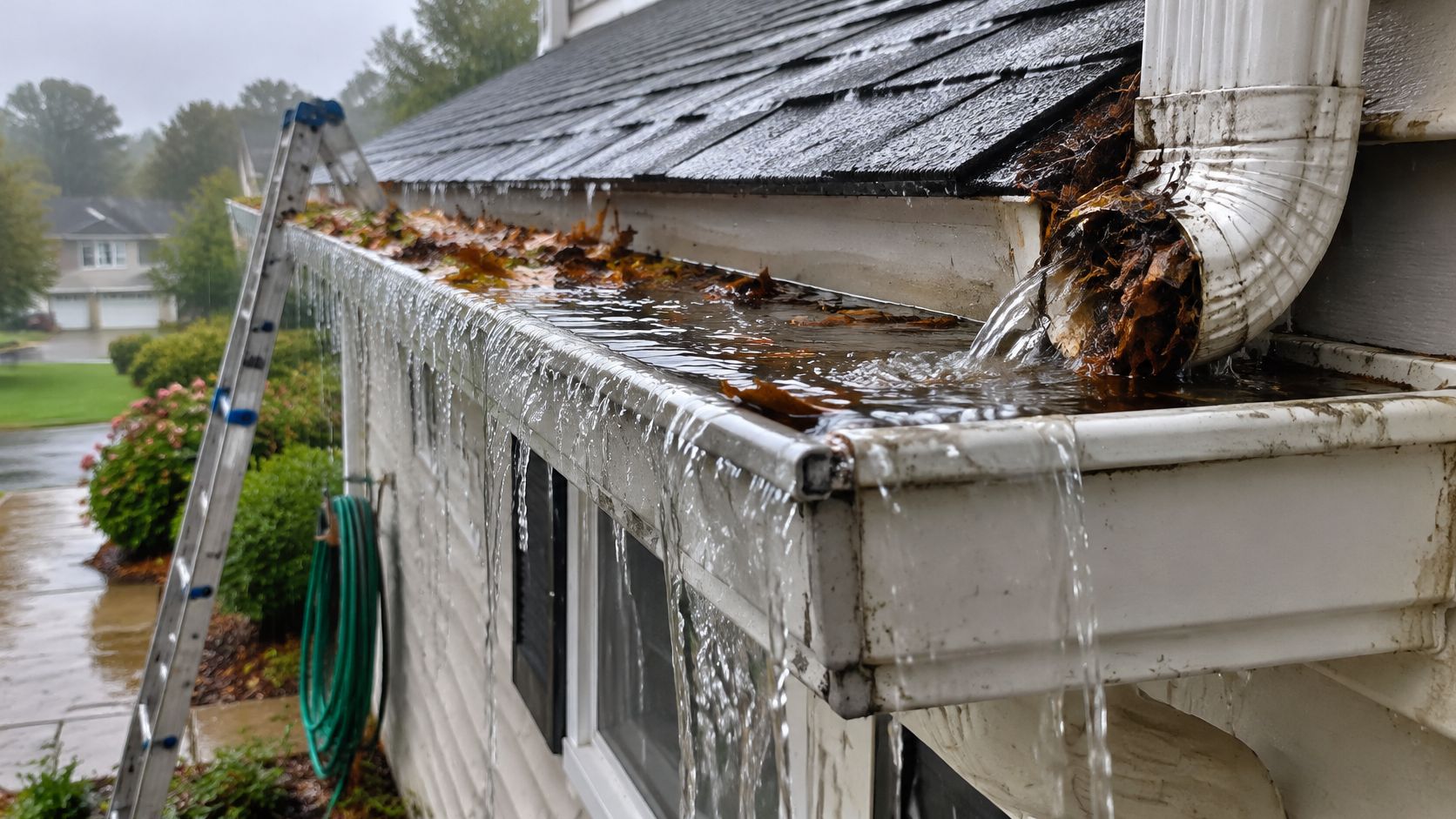
Check the likely restrictions before replacing a run:
- A clogged outlet or elbow: Water backs up through the channel. Clearing the blockage may restore drainage.
- A flat or back-pitched section: Water pools at a low point and can spill over. The gutter needs a continuous fall toward its outlet.
- Concentrated flow from a roof valley: A heavy stream can overwhelm one section. A diverter can spread that flow across more of the gutter.
- A guard covered with debris: Accumulated leaves or other debris can restrict water entry. The guard needs to suit the debris around the home.
- An undersized downspout: The trough may collect water faster than the downspout can discharge it. A correctly sized outlet or additional downspout may address the bottleneck.
- Ice blocking the channel: A gutter cannot drain while ice obstructs it. Keeping debris out helps avoid one source of blockage, but does not prevent freezing.
The useful question is where the restriction occurs. If water spills near an outlet, a larger trough may leave the problem untouched. For more on diagnosing these causes, read about why gutters overflow in heavy rain. Where downspouts discharge also matters: homeowners can browse monsoon drainage fixes for ideas about handling water in the yard.
A bigger trough cannot compensate for a blocked outlet.
When the gutter is clear but still overflows during a storm, check how quickly water can leave the run. Outlet capacity and the trough's slope can limit drainage regardless of whether the gutter is 5 or 6 inches.
Confirm Your Choice and Order Both Sizes
Choose by roof run, not by the house as a whole. Before approving an order, check that the proposed size fits the fascia and hangers and that the outlets and downspouts can carry the water each run receives.
- Match the components: Confirm fascia depth, hanger fit, outlet size, and downspout size for each run. A larger trough cannot make up for an outlet that restricts flow.
- Compare complete layouts: Ask for 5-inch and 6-inch options using the same downspout count and hanger spacing. That makes the size comparison meaningful.
- Check the measurements on site: A free inspection can assess the roof planes feeding each run and help confirm the proposed layout.
The same sizing questions apply in other regions. For example, gutter solutions for Martin County homes address gutter options for a different local market.
A good contractor should explain whether repair or replacement better fits the condition of your roof, without pressure. HIBCO ROOF says it will recommend repair when that is sufficient and explain when replacement may be the better long-term investment. Call or text HIBCO Roofing at 614-810-0050 to schedule a free inspection.
HIBCO ROOF LLC installs gutters and guards in Columbus and central Ohio. An inspection can help compare 5-inch and 6-inch gutters on the same layout. If your gutters spill during heavy rain, mention it when scheduling, since that helps focus the assessment. Visit HIBCO ROOF LLC to schedule a free inspection.