

Most homes pay about $6 to $16 per linear foot installed, with a national average around $8 to $12 per foot. Aluminum commonly runs $6 to $15 per foot, while copper is much higher at roughly $20 to $40 per foot.
You may be standing in your Columbus driveway with a tape measure in hand, counting roofline sections and trying to understand why one contractor's “per-foot” quote is far above another's. The confusion usually starts because per-foot pricing is a building block, not the final project total. Materials, labor, roof height, corners, downspouts, fascia repairs, removal, and gutter guards can all change the number.
Table of Contents
- Why Gutter Pricing Confuses Columbus Homeowners
- How Per Foot Gutter Pricing Works
- Material Choices That Change Your Per Foot Cost
- Labor and Home Factors That Raise or Lower the Rate
- What Your Per Foot Quote Often Leaves Out
- Columbus Sample Estimates You Can Use to Budget
- Choosing the Right Gutters and Next Steps for Your Home
Why Gutter Pricing Confuses Columbus Homeowners
A Columbus homeowner might measure roughly the same roofline as a neighbor and still receive a very different gutter estimate. One house may have a simple, single-story ranch roof with clear ladder access. The other may have two stories, steep slopes, dormers, landscaping around the foundation, and old gutters that need to be removed before installation begins.
Both estimates may list a price per linear foot. They aren't necessarily pricing the same work.
The current benchmark for most homes is $6 to $16 per linear foot installed, with many projects falling near $8 to $12 per foot. This 2026 gutter installation pricing benchmark also places aluminum around $6 to $15 per foot installed and copper around $20 to $40 per foot. Those are useful starting points, but they don't tell you whether the quote includes downspouts, old-gutter disposal, fascia repairs, or guards.
The same footage can hide different work
Think of linear footage like the size of a room in a flooring quote. A contractor may price flooring by the square foot, but the final bill can still change because of stairs, subfloor repairs, difficult cuts, or removal of the existing material. Gutter work follows the same pattern.
A straight roof edge is relatively simple. A roofline with several inside corners, outside corners, valleys, and downspout transitions takes more layout and fitting. A two-story installation also requires more careful access planning than a one-story job.
Practical rule: Don't compare the per-foot number until you know whether both contractors included the same material, profile, downspouts, removal, and repair work.
Water control also depends on what happens after the downspout. If runoff collects beside the foundation, the gutter itself may be only part of the problem. Homeowners who are already dealing with grading or concentrated runoff can review this design-build drainage advice for broader ways to direct water away from the house.
This guide gives you a practical way to read the quote. First, identify the footage. Then separate the material and installation rate from the items priced outside that rate. Finally, use the home's height, roof shape, and drainage needs to judge whether the total makes sense.
How Per Foot Gutter Pricing Works
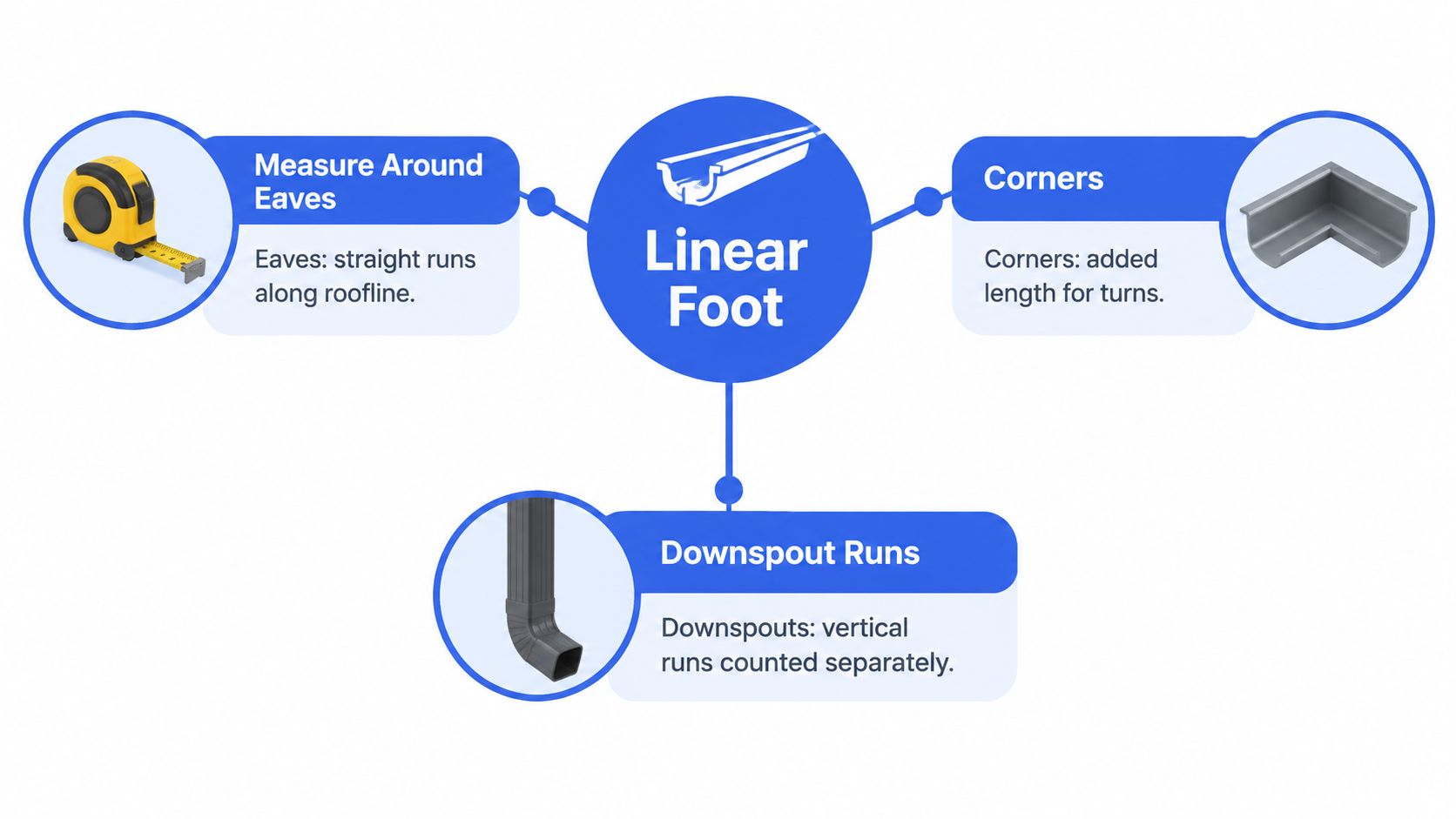
A linear foot is one foot of gutter measured along the roof edge. The idea is similar to pricing baseboard by length: the contractor measures the run, then applies a rate for the gutter material and installation. That number is only the starting point for the installed total.
Begin with the horizontal roof edges where water leaves the roof. Add each eave run to find the total footage. Corners require additional forming or joining, while downspouts add vertical sections and connection work. Whether those pieces are included depends on the estimate.
Read the quote from the top down
A clear estimate should identify these items:
- Total linear footage: The combined length of gutter runs around the eaves.
- Gutter material and profile: The material, size, and style, such as aluminum, vinyl, steel, or copper.
- Installed rate: Whether the per-foot price includes both material and standard installation labor.
- Separate work: Downspouts, elbows, extensions, removal, fascia repair, and guards.
“Per foot” does not automatically cover every part of the drainage system. One Columbus contractor may include standard downspouts in a package, while another may price them separately because their number, length, and routing vary by house.
Why a small rate change matters
A difference of $2 to $5 per foot can materially change the total on a typical single-family home, as shown by this 2026 per-foot gutter cost benchmark. For a home with 160 linear feet, that difference applies across the complete roofline. A small-looking gap on the rate becomes a larger gap in the final estimate.
Compare the scope before choosing the lowest number. A lower rate may reflect sectional material, fewer included components, or work priced separately. A higher rate may include custom fabrication, more difficult access, or a larger gutter profile.
For more detail on how continuous systems are formed and installed, read a step-by-step guide to seamless gutter installation. The practical question is simple: what exactly does the stated rate buy?
Material Choices That Change Your Per Foot Cost
Material creates one of the clearest differences between gutter quotes. Raw-material price, fabrication, weight, corrosion resistance, and the appearance you want all affect the installed rate.
The following ranges come from the material-based gutter installation cost guide. They describe installed pricing, not material-only pricing.
Gutter Material Cost per Linear Foot Installed
| Material | Installed Cost per Foot | Best For |
|---|---|---|
| Vinyl | $5 to $10 | Budget-conscious projects and simple rooflines |
| Aluminum | $6 to $12 | Most residential homes and balanced value |
| Steel | $9 to $18 | Homeowners prioritizing strength |
| Copper | $20 to $40+ | Historic, distinctive, or high-end homes |
| Seamless gutters | $8 to $28 | Custom-fitted systems with fewer joints |
Vinyl sits near the lower end because it's inexpensive and relatively light. It can make sense when upfront cost is the main concern, but homeowners should think carefully about how the material will handle local weather and future replacement needs.
Aluminum is the common middle ground. It resists rust, weighs less than steel, can be formed into runs, and is available in finishes that coordinate with trim and siding. That combination makes it a practical choice for many Columbus exteriors.
Steel costs more because it offers greater rigidity and strength. It may suit a property where physical durability matters, but the quote should identify the steel type and protective finish. A contractor should also explain how the system will be protected from corrosion if the coating becomes damaged.
Copper occupies a different category. At about $20 to $40 per foot, it can cost more than three times the lower end of common aluminum pricing, depending on the installation. The premium usually reflects both the material and the specialized handling required. Copper is often chosen because its appearance becomes part of the home's architectural character, not because it is the budget option.
Seamless versus sectional
Sectional gutters arrive in pre-cut pieces that are joined during installation. Gutters that are formed to the needed length on site reduce the number of joints along long runs. That fabrication and installation process can place such systems in a higher price range.
The right comparison isn't aluminum against copper or vinyl against steel. Ask whether you're comparing sectional aluminum to aluminum, because the installation method changes the quote even when the base metal is the same.
Labor and Home Factors That Raise or Lower the Rate
A contractor doesn't install a price per foot in the abstract. The crew installs gutters on a specific house, at a specific height, with a specific roof shape and working area. Those conditions determine how much time, equipment, and fitting the job requires.
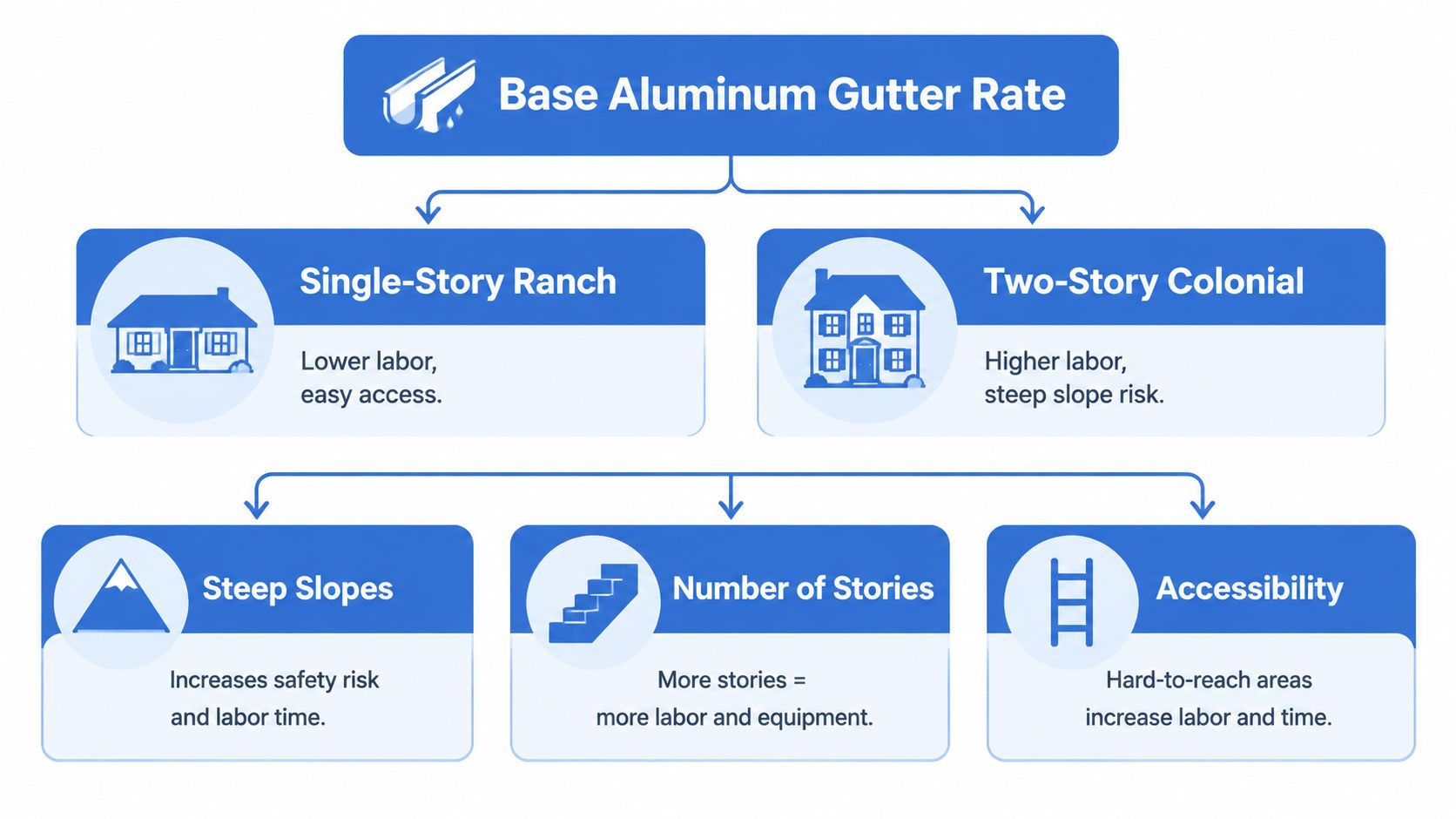
A single-story ranch usually gives the crew direct access to long, straight roof edges. A two-story colonial may involve taller ladders, more setup, steeper slopes, and more difficult transitions. The gutter material may be identical, but the labor burden isn't.
Roof shape and access
Straight runs are easier to measure and install than rooflines broken up by dormers, bump-outs, valleys, and multiple corners. Every transition requires planning so water continues toward the correct outlet instead of pooling or spilling over.
Access can raise the rate even when the roofline is short. Fences, decks, dense landscaping, uneven ground, and limited space beside the house can slow ladder placement and material handling. A contractor should inspect these conditions before giving a firm number.
Fascia condition and old gutters
Gutters attach to the fascia or to a related support system along the roof edge. If the wood behind the existing gutter is soft or damaged, the crew may need to repair it before securing the new system. A new gutter can't perform properly if its mounting surface won't hold the hangers.
Old gutter removal is another common difference between quotes. One estimate may assume a clean installation on an exposed fascia. Another may include removing and hauling away the existing system. Ask directly whether removal and disposal are included.
Profile size
Gutter size affects both material volume and flow capacity. Standard aluminum K-style systems with a 5-inch profile are often priced around $8 to $14 per linear foot, while 6-inch profiles commonly add about $1 to $3 per foot, moving the range toward $10 to $15 per foot, according to this gutter installation cost calculator.
A larger profile can make sense for a steep roof, a large catchment area, or a property exposed to heavier rainfall. It isn't automatically necessary for every Columbus home. The installer should explain the reason for recommending the larger size instead of treating it as an unexplained upgrade.
Ask before approving an add-on: “What condition on my roof or drainage layout makes the larger profile necessary?”
What Your Per Foot Quote Often Leaves Out
The headline rate usually describes the main gutter runs. Your actual total depends on the pieces that collect, redirect, support, repair, and discharge the water.
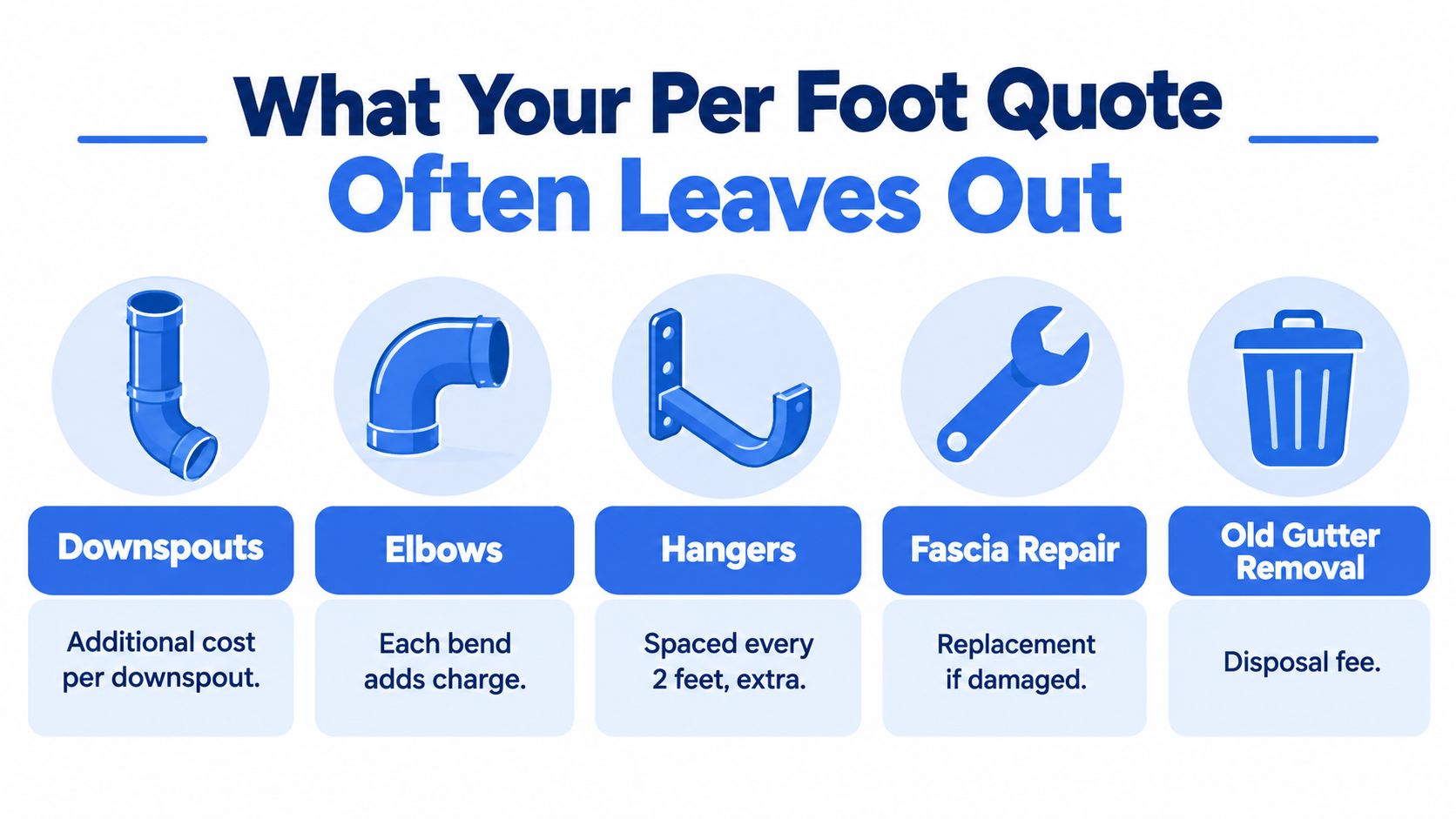
A useful quote audit starts with the basic question: does the per-foot rate cover only the horizontal gutter, or does it include the complete drainage system? Downspouts, elbows, extensions, hangers, and outlet connections may be listed separately.
The line items to inspect
- Downspouts: Confirm how many are included, where they'll be placed, and whether extensions are part of the scope.
- Elbows and transitions: Each bend or offset takes additional fitting and installation work.
- Hangers and fasteners: The crew needs enough support for the gutter profile and roofline conditions.
- Fascia repair: Damaged wood may need replacement before the new gutter can be installed securely.
- Old gutter removal: Ask whether the existing system will be removed, hauled away, and disposed of.
- Gutter guards: Leaf protection is usually an add-on rather than part of the base gutter rate.
This leaf guard gutter systems guide is useful when you're comparing protection options alongside a replacement. Guards can reduce debris entering the gutter, but they don't make the rest of the system unnecessary. The roofline still needs correct slope, secure attachment, suitable downspout capacity, and a safe discharge point.
Guards can change the budget
One 2026 pricing calculator places a full-perimeter gutter guard system at about $1,000 to $1,800, depending on the property and system selected. That gutter installation cost reference shows why per-foot pricing alone can give an incomplete picture.
Don't compare one quote with guards against another quote without guards and call them equivalent. Ask for an itemized version that separates the base gutters, downspouts, repairs, removal, and leaf protection. That format lets you see whether a higher total reflects a better scope or a higher rate.
Columbus Sample Estimates You Can Use to Budget
The easiest way to make per-foot pricing useful is to multiply the measured footage by the installed rate, then add items that the contractor prices separately. The examples below are budgeting illustrations based on the verified installed ranges, not fixed Columbus quotes.
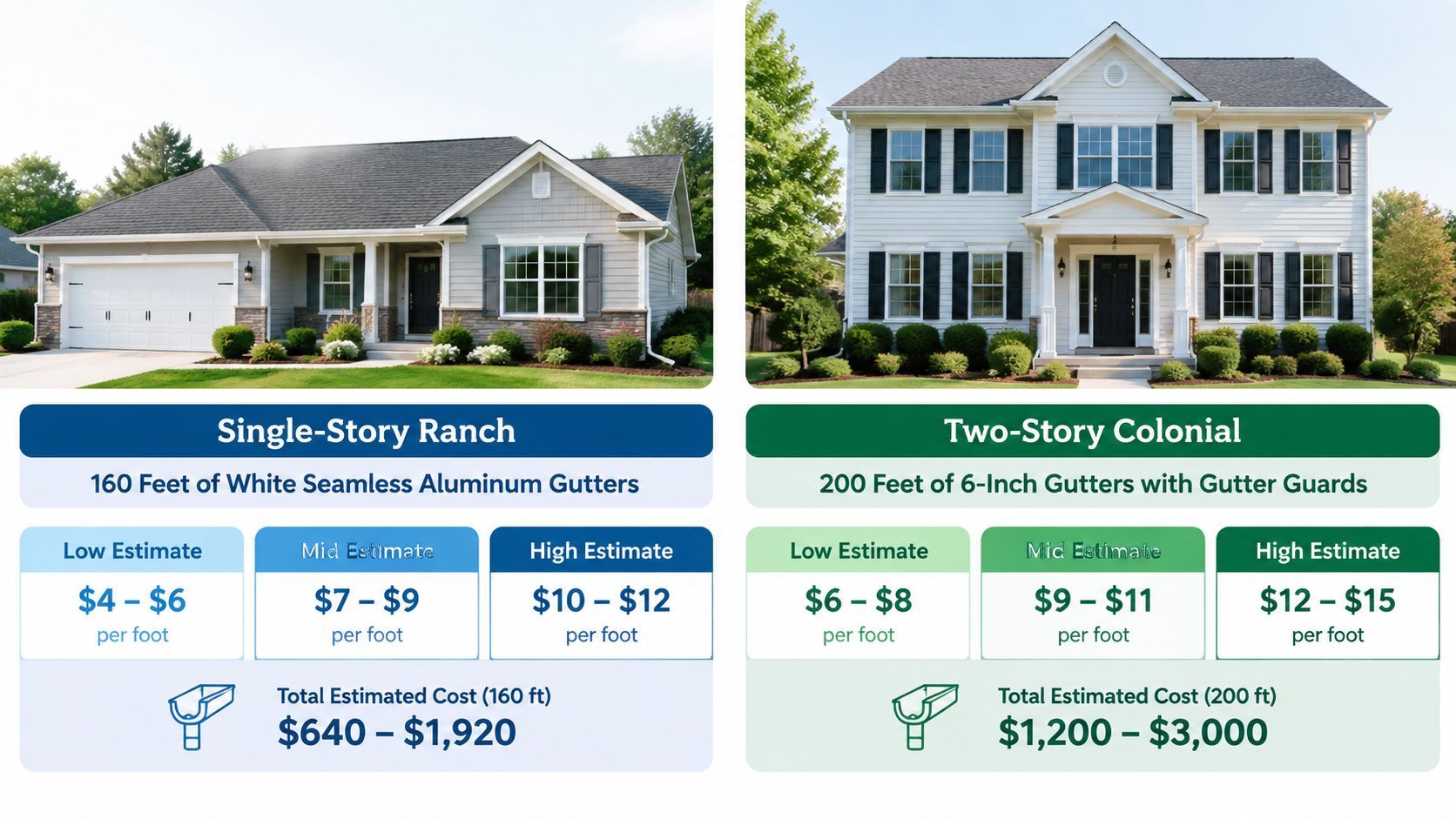
Example one, a 160-foot ranch
Start with a straightforward single-story ranch that needs 160 linear feet of aluminum gutter. Using the benchmark range of $6 to $15 per foot for aluminum, the gutter portion would calculate as follows:
- Lower material and installation range: 160 × $6 = $960
- Middle planning point: 160 × $10 = $1,600
- Higher aluminum range: 160 × $15 = $2,400
Those figures represent the main aluminum work. The written estimate still needs to show downspouts, elbows, removal, fascia repairs, and any guards. If the home has clear access and a simple roofline, the quote may stay closer to the lower or middle portion of the range. More corners or repair work can move it higher.
Example two, a 200-foot two-story home
Now consider a 200-foot two-story home that needs a 6-inch aluminum profile and gutter guards. The 6-inch profile commonly falls around $10 to $15 per foot installed, based on the gutter installation cost calculator.
- Lower 6-inch base range: 200 × $10 = $2,000
- Upper 6-inch base range: 200 × $15 = $3,000
- Guard allowance: add about $1,000 to $1,800 for a full perimeter system, based on the 2026 gutter guard pricing reference
That produces a base-plus-guard planning range of $3,000 to $4,800, before any separately priced fascia repair, old-gutter removal, or unusual downspout routing. A two-story layout, steep roof, heavy tree cover, or large roof catchment area may justify the larger profile and additional protection.
For more context on the complete replacement process, review this guide to gutter replacement cost. Then use your measured footage and an itemized estimate to replace these examples with your home's actual scope.
Choosing the Right Gutters and Next Steps for Your Home
The lowest per-foot number isn't automatically the best value. A gutter system must fit the roof's water volume, attach securely to sound fascia, and discharge water far enough from the foundation to protect the exterior.
For many Columbus homeowners, aluminum is a sensible starting point because it balances material cost, corrosion resistance, appearance, and custom fitting. A larger profile can be appropriate when the roof collects substantial water or the existing system overflows. Gutter guards deserve consideration when tree debris makes cleaning a recurring burden, but they should be priced as a separate part of the overall drainage plan.
Use this short checklist before signing:
- Measure or verify the roofline footage.
- Confirm the material, profile, and installation method.
- Count the downspouts and identify their discharge points.
- Ask whether removal and fascia inspection are included.
- Request separate pricing for guards and other add-ons.
- Compare written scopes, not just headline rates.
HIBCO ROOF LLC provides gutter installation and replacement, leaf guard systems, roof inspections, and related exterior work for Columbus and central Ohio homeowners. A free written estimate can help you determine whether repair, phased replacement, or a complete system makes more sense for the condition of your roof edge and fascia.
For a practical per-foot estimate that reflects your actual roofline, downspouts, access, and fascia condition, visit HIBCO ROOF LLC to request a free estimate. Their Columbus-area team can inspect the existing system, explain the scope in plain language, and provide pricing before you authorize the work.