

Installed gutters on a typical Columbus home usually land around $6 to $20 per linear foot for aluminum, with copper at $30 to $50 per linear foot. For many residential jobs, that puts the project in a realistic range before you even start comparing profiles, downspouts, and labor details.
If water is spilling over your fascia during a hard summer rain, you're not looking at a cosmetic issue. You're looking at a drainage system that's failing at the joints, the slope, or both, and that's exactly where a one-piece gutter system earns its keep.
Table of Contents
- What Seamless Gutters Actually Solve for Columbus Homeowners
- How Seamless Gutters Are Built On-Site
- Choosing the Right Size, Material, and Profile
- What the Installation Day Actually Looks Like
- Maintenance, Leaf Guards, and Longevity
- Storm Damage and the Insurance Claim Path
- How to Choose a Qualified Columbus Installer
- Questions Columbus Homeowners Ask Before Booking the Job
What Seamless Gutters Actually Solve for Columbus Homeowners
A Columbus homeowner usually starts caring about gutters the moment a summer downpour pushes water over the edge and stains the fascia. That's when a gutter installation starts making sense, not as an upgrade for its own sake, but as a fix for a system that's leaking at its weakest points.

The installed price is the first thing people ask about, and it should be. Aluminum gutters typically run about $6 to $20 per linear foot, while copper runs about $30 to $50 per linear foot (marketintelo.com). That's a real range, but it's still a manageable residential project for a lot of homes, not some luxury-only exterior package.
Why the industry moved away from sectional runs
The market shifted because 75% of gutter installations in the United States now consist of continuous-run systems, and one industry report values the global market for these systems at $1.8 billion in 2025 with a projected 4.8% CAGR to $2.7 billion by 2034 (horchroofing.com). That didn't happen because homeowners fell in love with a term. It happened because custom-fabricated runs reduce the mid-span joints where sectional systems commonly fail.
Sectional gutters can work, but every splice is a maintenance point. In central Ohio, that matters because freeze-thaw cycles, spring storms, and leaf buildup all punish weak connections. A properly installed continuous run doesn't eliminate every leak path, but it removes one of the biggest ones.
Practical rule: buy the gutter system that solves the failure you actually have. If your old gutters leak at the joints and sag between hangers, a seamless run with correct pitch and fastening is the right fix.
For winter prep around the home, a separate gutter maintenance routine still matters, especially before freeze-up, and you can read more in HIBCO's winter gutter maintenance guide.
How Seamless Gutters Are Built On-Site
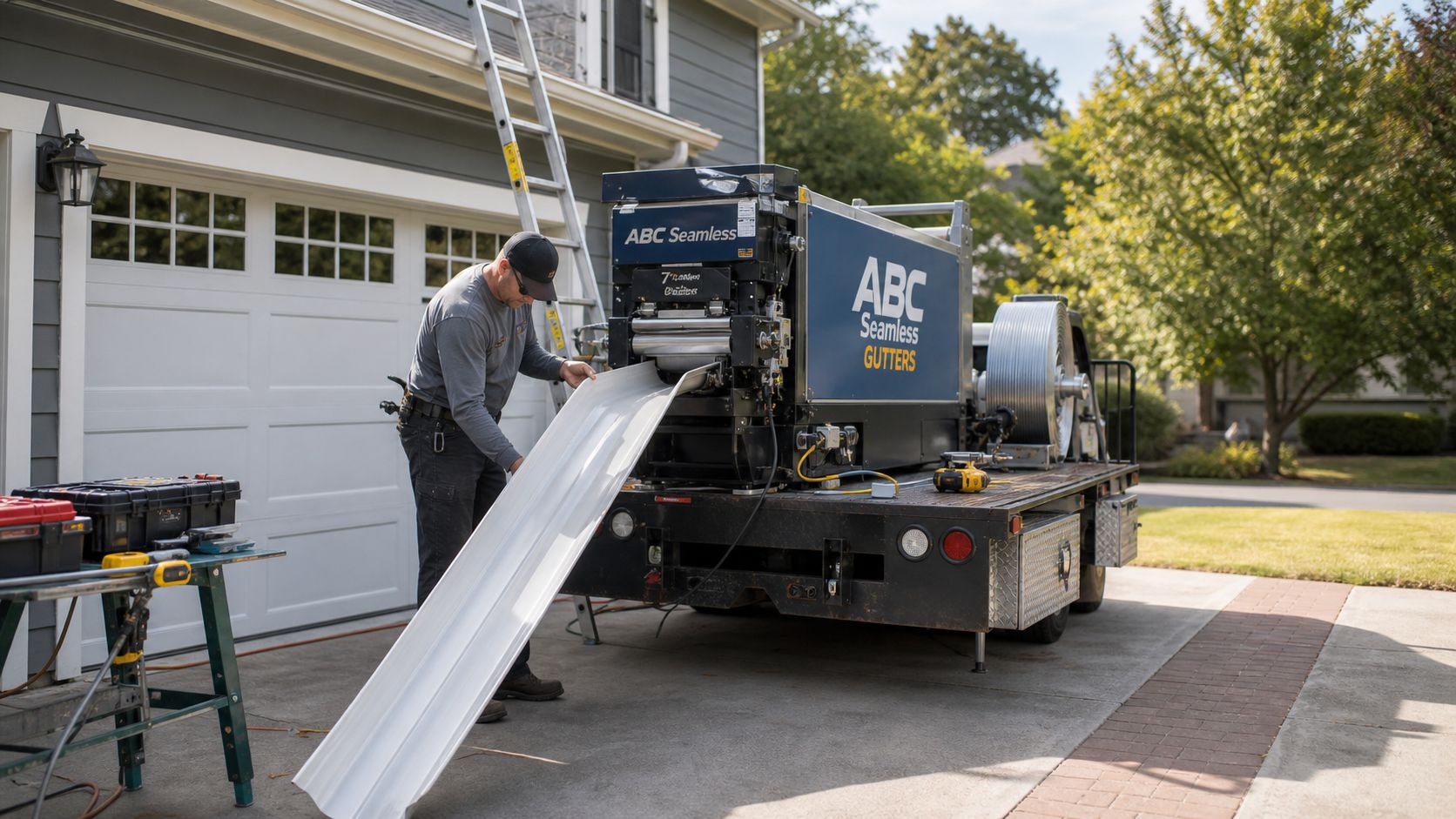
Gutters are fabricated on-site, not pre-cut in a warehouse. Crews bring coil stock, feed it through a truck- or trailer-mounted forming machine, and roll out a continuous metal run that matches the roofline exactly.
That's why installation day looks more technical than a simple parts swap. The crew measures the fascia, confirms corner locations, and forms one long piece from span to span so there are no mid-span horizontal joints to seal later. It's a bit like a tailor cutting a suit in your living room, except the “suit” is a water-management system and the stakes are your fascia, siding, and foundation.
What “seamless” does and doesn't mean
The word gets oversold online. A gutter system means the horizontal trough is one continuous piece, so you've removed the long joints that love to leak. It does not mean the whole system has zero joints.
Corners, end caps, and downspout outlets still exist, and those points can still leak if the install is sloppy or the fascia is compromised. That's why good crews still check alignment, seal the ends carefully, and fasten everything before water ever hits it.
A smart homeowner should expect precision, not magic. Continuous gutters are custom-made to fit the house, but the system still depends on the installer's work at the transition points. If you understand that distinction before the estimate, you'll judge the quote more accurately and avoid buying hype instead of performance.
Choosing the Right Size, Material, and Profile
A gutter system should match the roof, not just the trim color. On a lot of Columbus homes, a 5-inch K-style gutter is the standard fit, but a 6-inch K-style system is the better call when the roof is large, steep, or sends a heavy volume of runoff into one stretch of the run.
Downspout sizing is where weak proposals fall apart. A 2×3-inch downspout is typically paired with about 600 square feet of roofing, while a 3×4-inch downspout is used for about 1,200 square feet (seamlessgutters.com). If the quote only talks about the gutter body and ignores outlet capacity, the system can look fine from the curb and still choke at the drain points.
Material choices that make sense
Aluminum is the default for a reason. It balances weight, price, and appearance without creating a lot of headaches on a typical residential install. Premium aluminum often uses 3105-H24 alloy at around .032 inch thickness (seamlessgutters.com), which is a better fit than bargain material when the run has to hold its line through snow load, ladder bumps, and seasonal movement.
Copper sits in a different category. It is the upscale choice, and homeowners usually pick it for appearance or the long-term look of the patina, not because it is the economical option.
| Seamless Gutter Material and Sizing Comparison | |||
|---|---|---|---|
| Material | Typical Gauge | Profile Sizes | Approx. Installed Cost per Linear Foot |
| Aluminum | Around .032 inch for premium systems | 5-inch, 6-inch | $6 to $20 (marketintelo.com) |
| Copper | Varies by system design | 5-inch, 6-inch | $30 to $50 (marketintelo.com) |
| Premium aluminum spec | 3105-H24, about .032 inch | 5-inch, 6-inch | Mid-range residential pricing |
If you have big roof planes, do not let anyone sell you a smaller system just because it looks cleaner on paper. Capacity beats appearance once a storm starts moving water.
The fit between the drip edge and the gutter matters just as much as the gutter size itself. A clean reference on that spacing is HIBCO's note on drip edge and gutter spacing.
What the Installation Day Actually Looks Like
A good install day starts on the ground, not on a ladder. The crew should walk the perimeter, inspect the fascia, mark the gutter line, and confirm where each downspout needs to discharge before any old metal comes off.
If the home already has sectional gutters, removal happens first. Then the crew forms the new run on-site, feeds the coil through the machine, and sets the hangers along the fascia with tighter spacing at ends, corners, and outlets. The point is simple, the gutter has to hold its line under water weight and storm runoff, not just sit there looking straight (thegutterguy.com).
Slope is the part homeowners should watch closely
A gutter should never look dead flat, but it should also not look crooked from the street. The usual setup keeps a steady pitch of about 1/4 inch per 25 feet, or about 1 inch per 40 feet, so water keeps moving without making the run look off-level.
Installers should check that pitch with a level, then run water through the system before they leave. If water sits in the trough or backs up at the outlet, the pitch or outlet placement is wrong and needs to be fixed on the spot. That is the difference between a clean install and a callback.
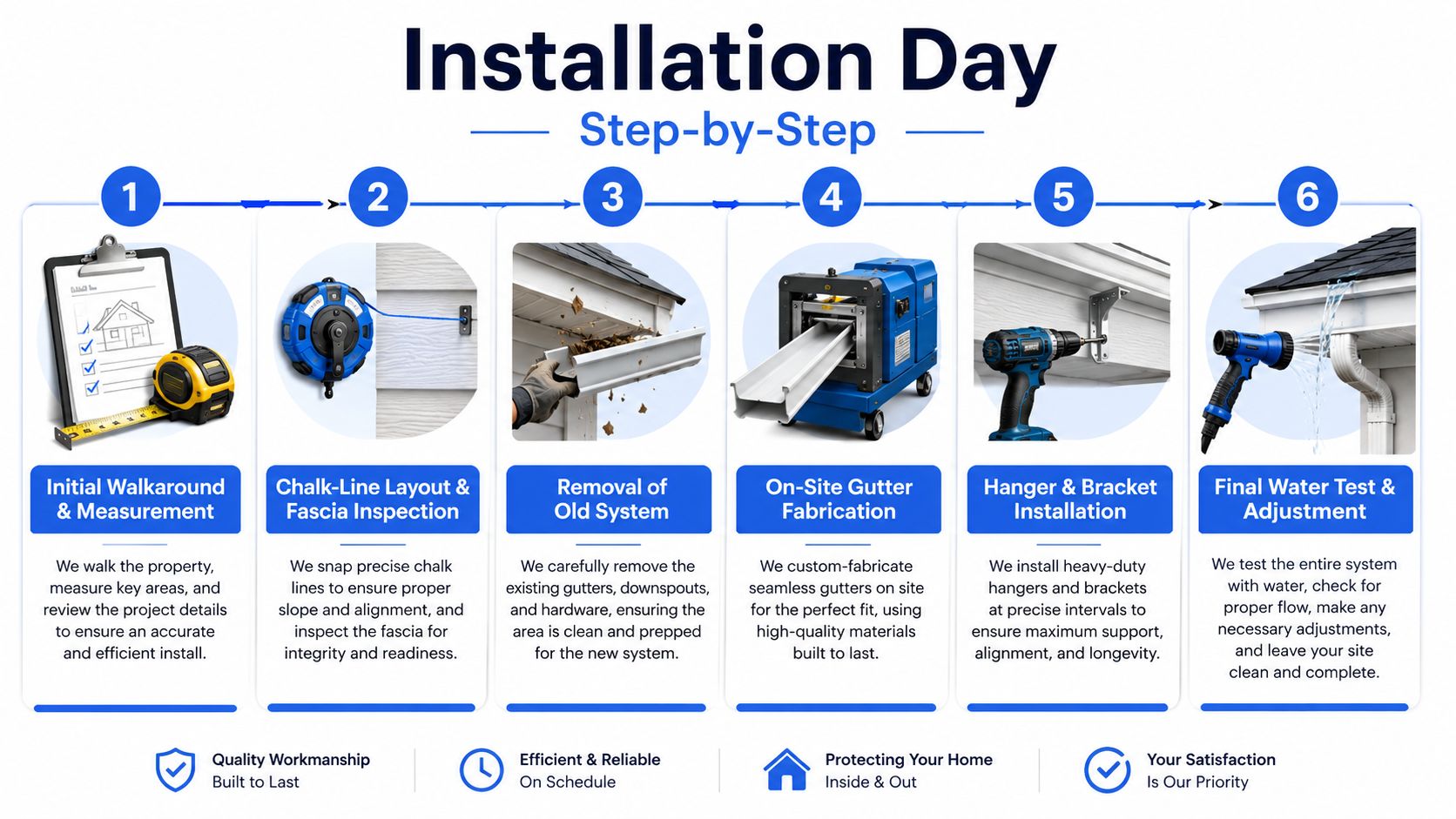
For most single-family homes, the work usually takes 1 to 2 days. Bigger rooflines, rotten fascia, or awkward multi-story access can stretch that out, and that is normal. What you do not want is a crew that rushes past those problems and leaves you with a gutter system that looks finished but moves water badly.
If you are comparing options, a quick look at reviews of leaf guard gutters helps you decide whether guards should be part of the install or a later add-on.
Maintenance, Leaf Guards, and Longevity
A continuous system still needs attention after the truck leaves. The body of the gutter is cleaner than a sectional setup, but the weak points are still the corners, end caps, and downspout connections.
Gutters reduce one category of failure; they don't erase maintenance. If a crew left a bad corner seal or the fascia has hidden rot, water will still find a way out, even with a continuous horizontal run (englertinc.com).
My take on leaf guards in central Ohio
I'd rather see a homeowner use a good guard than ignore the system and hope a few cleanouts a year will stay enough. Columbus neighborhoods dump maple, oak, and pine debris into gutters constantly, and the right guard can cut down on that burden.
That said, no guard is universal. Screen, foam, reverse-curve, and micro-mesh products all have trade-offs, and the wrong match can cause overflow or create a cleaning problem in a different place. Guards reduce maintenance, they don't eliminate it.
A simple routine still wins:
- Check After Big Storms: Look for debris at visible outlets and confirm the downspouts still discharge away from the foundation.
- Watch the Corners: Stand back and look for drips, staining, or overflow at turns and end points.
- Keep Extensions Clear: If a downspout extension got kicked loose, water will pool right where you don't want it.
If you're weighing guards against more frequent cleaning, this review of leaf guard gutters is worth a look before you sign anything.
Storm Damage and the Insurance Claim Path
Central Ohio weather can distort gutters fast. Wind can bend runs, hail can dent soft aluminum, and displaced hangers can change the pitch just enough to create chronic overflow after one storm.
The signs are usually visible if you know what to look for. Dented downspouts, bent gutter lines, cracked connections, and brackets pulled away from the fascia point to impact or movement, not normal wear.

What to document first
Take photos and video before you touch anything major. If water is actively entering the house, use temporary mitigation so the problem does not get worse, then have a contractor assess the damage before you call the insurer.
That order matters. You want a clean record of what the storm did, what was already present, and what needs repair now. If you want a plain explanation of the claim process, Treecorp Solutions' insurance claim guide lays out how homeowners usually organize documentation.
Claims work better when the paperwork matches the actual damage path. The report should show whether the problem starts at the roof edge, a corner, a downspout outlet, or a fascia section that failed under load. HIBCO ROOF LLC handles storm and hail damage assessment as part of a broader exterior review, which is the right approach. Gutters, roofing, siding, and flashing all affect the same water path, so the report should be written that way.
How to Choose a Qualified Columbus Installer
Start with the contractor, not the gutter profile. A qualified installer should be licensed and insured in Ohio, give you a written estimate, and break out material and labor so you can see exactly what you're buying.
Ask how they build the system around your house. If they cannot explain hanger spacing, downspout sizing, fascia condition, and slope in plain language, they are quoting a metal trough, not a drainage system that can handle Columbus weather.
What a good estimate should show
- Line-item pricing: Material, labor, and any teardown or disposal charges should be clear.
- Project scope: You should know whether the job includes new outlets, downspouts, or related fascia repairs.
- Documentation: Photos, measurements, and a written description of the work keep everyone honest.
You should also see pricing that makes sense for the scope. Consumer pricing guides show installed gutter costs in a wide range, with material and labor shifting based on the size of the home, the profile, and how much prep the crew has to do. That matters because a quote that looks cheap can leave out the parts that make the system work, especially if the contractor is ignoring outlet placement or trying to reuse damaged components (angi.com).
Good contractor behavior is easy to spot. The crew shows up with the materials listed on the estimate, documents the work, respects the slope you discussed, and leaves the site clean. That is the baseline.
For a plain-English reference on contractor diligence and insurance expectations, essential policies for contractors is worth comparing against any local bidder. HIBCO ROOF LLC also offers free written estimates, uses manufacturer-backed materials, and completes many replacements in a single day with documented cleanup, which are the same signals I'd expect from any Columbus installer.
Questions Columbus Homeowners Ask Before Booking the Job
A straight gutter replacement on a typical Columbus home should move fast. If the roof edge and fascia are sound, the job usually stays in the short range, and a contractor should not make it sound more complicated than it is. If someone says they can hang new gutters over a tired sectional run, be careful. Bad anchor points, weak slope, and old outlet locations usually carry right into the new system.
Ask about slope first. That is the part that makes or breaks the job. A good installer should tell you how the run will pitch on your roof length, where each downspout will discharge, and whether the outlet size and placement match the roof area feeding that section. If those details are vague, the quote is weak.
The gutter system has to work with the roof, not fight it. If you are replacing the roof at the same time, line up the flashing and drip edge with the gutter work so the edge detail is clean and water has a clear path off the house. Doing the gutter job after the roof is finished is the cleaner sequence. Forcing both trades to improvise around each other usually creates avoidable problems.
Get the estimate in writing, know your rough roof perimeter, and point out every place where water has overflowed, stained siding, or backed up at a downspout. That gives the contractor a real starting point instead of a guess. It also helps them size the system correctly, which matters more than whether the gutters are labeled sectional or without joints.
A good Columbus contractor should be able to walk you through the plan quickly, explain the trade-offs, and show you where the system will need the most support. If the answers stay clear, the job is probably in good hands.
If your gutters are overflowing, dented, or just outdated, HIBCO ROOF LLC can inspect the system, explain the fix, and give you a free written estimate for the work. Visit HIBCO ROOF LLC to schedule a look at your home and get a straight answer on gutter installation, storm damage, or a full exterior replacement plan.