A spring storm rolls through Columbus, and the next morning you notice water spilling over the gutter near the front porch. One section has pulled slightly away from the fascia, another shows a dark line at the joint, and the basement wall has a damp spot that wasn't there last season. You need a practical answer, not a sales pitch: should you repair the sectional gutters, or replace them with continuous gutters while the roof is being evaluated?
The answer depends on more than appearance. Seamless vs sectional gutters is a decision about leak points, sealant maintenance, Ohio's freeze-thaw cycles, repair logistics, and how long the roof and gutter system need to serve the same house. The most important question is often overlooked: will you stay long enough for the higher initial cost of seamless gutters to pay back?
Table of Contents
- The Gutter Decision That Saves You Money
- Understanding Seamless and Sectional Gutter Systems
- Cost Durability and Maintenance Comparison
- How Ohio Weather Affects Gutter Performance
- When Each Gutter Type Makes Sense
- Making the Right Choice for Your Home
- Next Steps for Columbus Homeowners
The Gutter Decision That Saves You Money
A leaking joint can send water behind the gutter before an interior leak appears. Fascia, soffit, siding, and even the foundation may take on moisture while the visible problem still looks minor. That makes the gutter choice a maintenance and timing decision, not just an appearance decision.
Construction drives much of the long-term cost. Continuous-run gutters are formed in long runs, so joints occur mainly at corners and downspout outlets. Sectional gutters connect shorter pieces with connectors and sealant, leaving more locations that can loosen, crack, or separate as Ohio temperatures shift. An industry breakdown of gutter construction differences and pricing premiums reports that continuous-run systems can have about 70% to 80% fewer potential leak points than sectional gutters. The same market summary places the continuous-run premium at 10% to 15% upfront, or roughly $10 to $15 per linear foot.
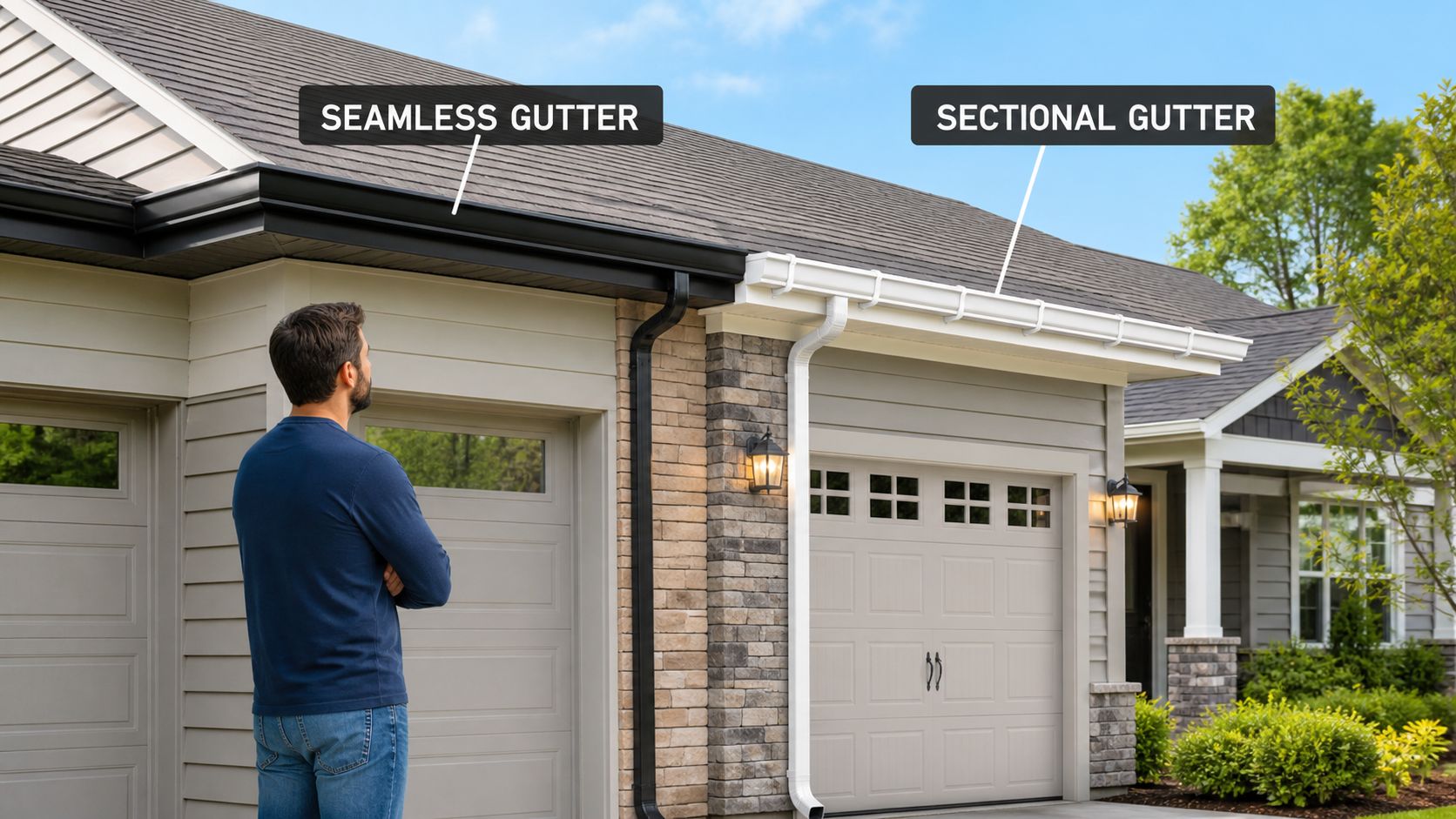
The hidden cost is timing
Roof age and ownership plans can change the better-value option. If you expect to sell after a short remaining stay and the roof is already older, paying for gutters designed to serve well beyond that timeline may not make financial sense. A sectional system can fit when the existing roof, available budget, and sale plans all point toward a shorter-term repair.
Long-term ownership changes the calculation. Replacing the roof and gutters together can reduce the chance of paying for separate exterior work while you remain in the home. The useful comparison is upfront cost, maintenance tolerance, roof life, and expected time in the property, not the installation invoice alone.
Practical rule: Match gutter investment to the roof's remaining service life and your ownership horizon, not to the lowest estimate on the page.
Columbus weather makes that timing more significant. Rain, summer heat, winter contraction, ice, and repeated freeze-thaw movement all stress gutter joints. Continuous gutters still need clear downspouts, correct pitch, secure hangers, and sound corner seals. They do, however, remove most mid-run connections from the failure equation, which can reduce the number of joints requiring inspection and resealing during the roof's remaining service life.
Understanding Seamless and Sectional Gutter Systems
Continuous gutters are custom-formed on-site from a continuous coil of metal. A contractor measures each roof edge, feeds the coil through a portable roll-forming machine, and cuts the run to fit the home. Properly installed, the principal seams occur at corners and downspout outlets, with expansion planning used where long runs require it.
Sectional gutters arrive as pre-cut pieces, commonly 10-foot or 12-foot lengths, that installers connect along the roofline with joining hardware and sealant. Gutter system construction overview This design makes sectional material widely accessible and can allow a capable homeowner to handle small projects without specialized fabrication equipment.
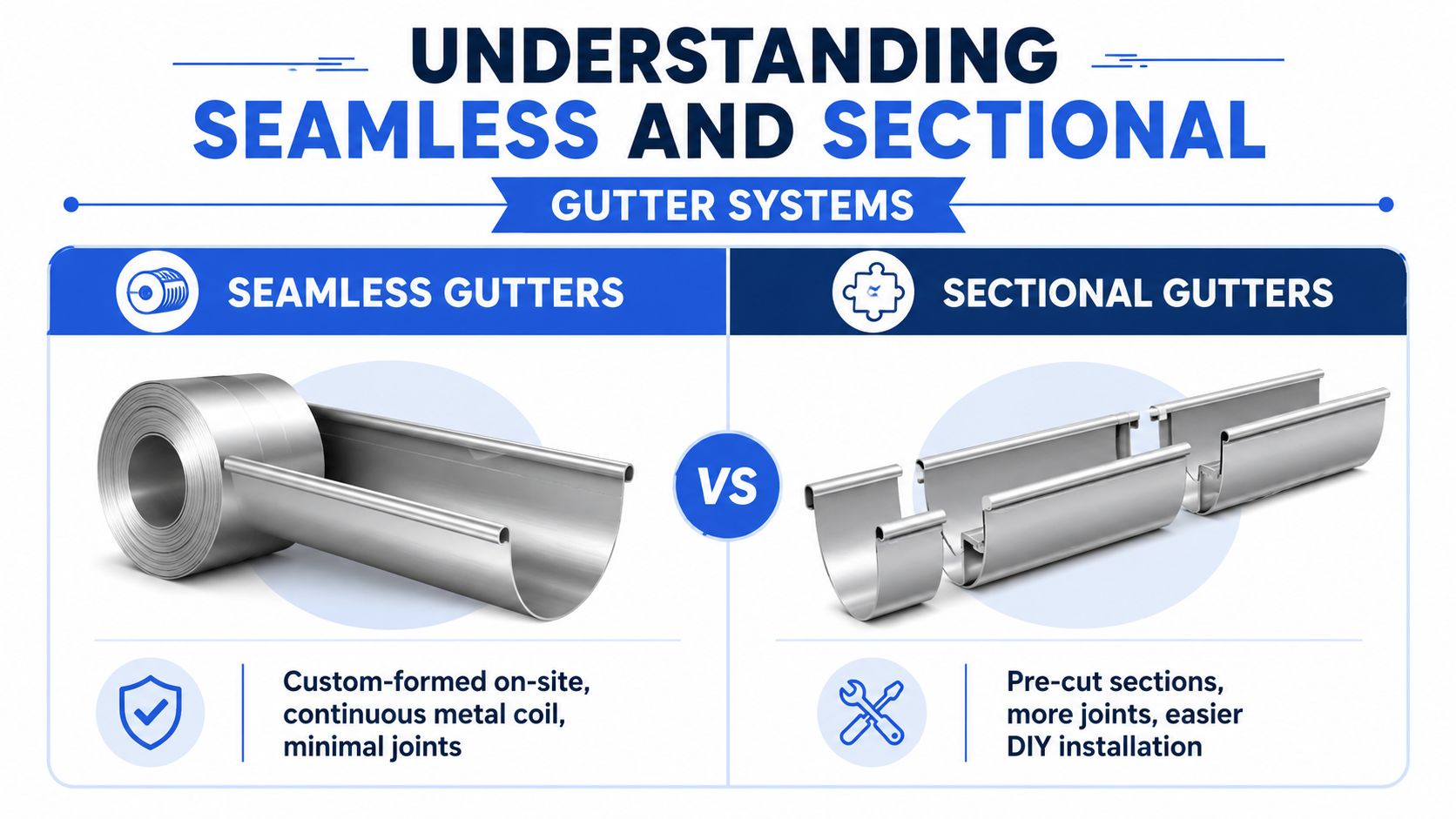
How the two systems are built
The continuous-forming process lets the installer create a run that follows the measured roof edge instead of assembling many short pieces. That reduces mid-span joints and gives the finished installation a cleaner visual line. It also means the contractor must bring the forming equipment, make accurate measurements, and handle fabrication on site.
Sectional systems trade that custom production for accessibility. A homeowner can purchase standard pieces, cut them as needed, and connect them with sealant and fasteners. The same convenience creates a maintenance obligation because every splice becomes another connection exposed to water, temperature changes, and movement.
Material choice matters within both categories. Aluminum is the dominant gutter material, accounting for 48.7% of total volume and 42.3% of revenue in the cited market data, while such gutters were reported to command 38.5% of the gutters market in 2025. The same source projects a 5.2% CAGR from 2026 through 2034, indicating continued market demand, not a guarantee that every home needs such installation. Gutters market material and segment data
Aluminum is popular because it combines corrosion resistance with a finished appearance and practical forming characteristics. Steel and copper remain options for specific design or durability goals, but the correct choice still depends on roof drainage, attachment conditions, exposure, and budget.
For homeowners reviewing installation details, HIBCO's seamless gutter installation guide explains the on-site fabrication approach and the role of continuous runs.
Cost Durability and Maintenance Comparison
The initial estimate favors sectional gutters, but the lifetime equation can favor alternatives when the home will be occupied for years and the owner wants fewer seam-related repairs. The available comparison data places systems without seams at 10% to 15% more upfront, with a typical cited range of $10 to $15 per linear foot. Gutter industry pricing and leak-point comparison
| Criteria | Seamless Gutters | Sectional Gutters |
|---|---|---|
| Construction | Custom-formed continuous runs | Pre-cut pieces joined on site |
| Potential leak points | Fewer intermediate joints | Multiple connector and sealant joints |
| Upfront cost | Higher, commonly about $10 to $15 per linear foot | Lower starting cost |
| Maintenance focus | Corners, outlets, pitch, hangers, and debris | All of the above, plus recurring seam inspection |
| Repair logistics | May require matching and on-site fabrication | Individual sections are generally easier to replace |
| DIY suitability | Usually requires professional equipment | More accessible for small projects |
Where the premium can pay back
The strongest financial argument for seamless gutters is not that they never fail. They still need cleaning, correctly placed downspouts, sound hangers, and attention at corners and outlets. Their advantage is that they remove most field joints, which are common locations for sealant breakdown and water escape.
Industry guides commonly estimate that continuous gutters can last roughly 5 to 10 years longer than sectional systems and can reduce seam-related maintenance. Ownership-horizon and gutter durability discussion That doesn't establish a universal payback period. A homeowner who moves soon may never recover the premium through avoided maintenance, while a long-term owner may value fewer repairs more than the lowest installation price.
Sectional gutters can still work well when installed with proper slope, secure hangers, sealed connections, and accessible downspouts. The weakness is cumulative. Each joint adds another place to inspect, and a missed leak can damage the wood behind the gutter before the failure becomes visible from the ground.
A roof project complicates the decision further. If shingles, flashing, or decking also need attention, the gutter choice should be evaluated as part of the home's exterior system. A resource covering the homeowners roof financial choice can help frame the larger repair-versus-replacement decision, while HIBCO's gutter replacement cost guide provides a separate starting point for discussing project scope with a contractor.
Repairs are part of the calculation
Sectional gutters have a practical advantage after localized damage. If a ladder, branch, or hail event damages one piece, replacing a short section may be straightforward, and standard material can be easier to source.
Systems without joints require more specialized matching and may need on-site fabrication for a clean repair. That inconvenience is real, but it should be weighed against the lower number of original joints and the possibility of avoiding repeated seam resealing across the entire roof edge.
How Ohio Weather Affects Gutter Performance
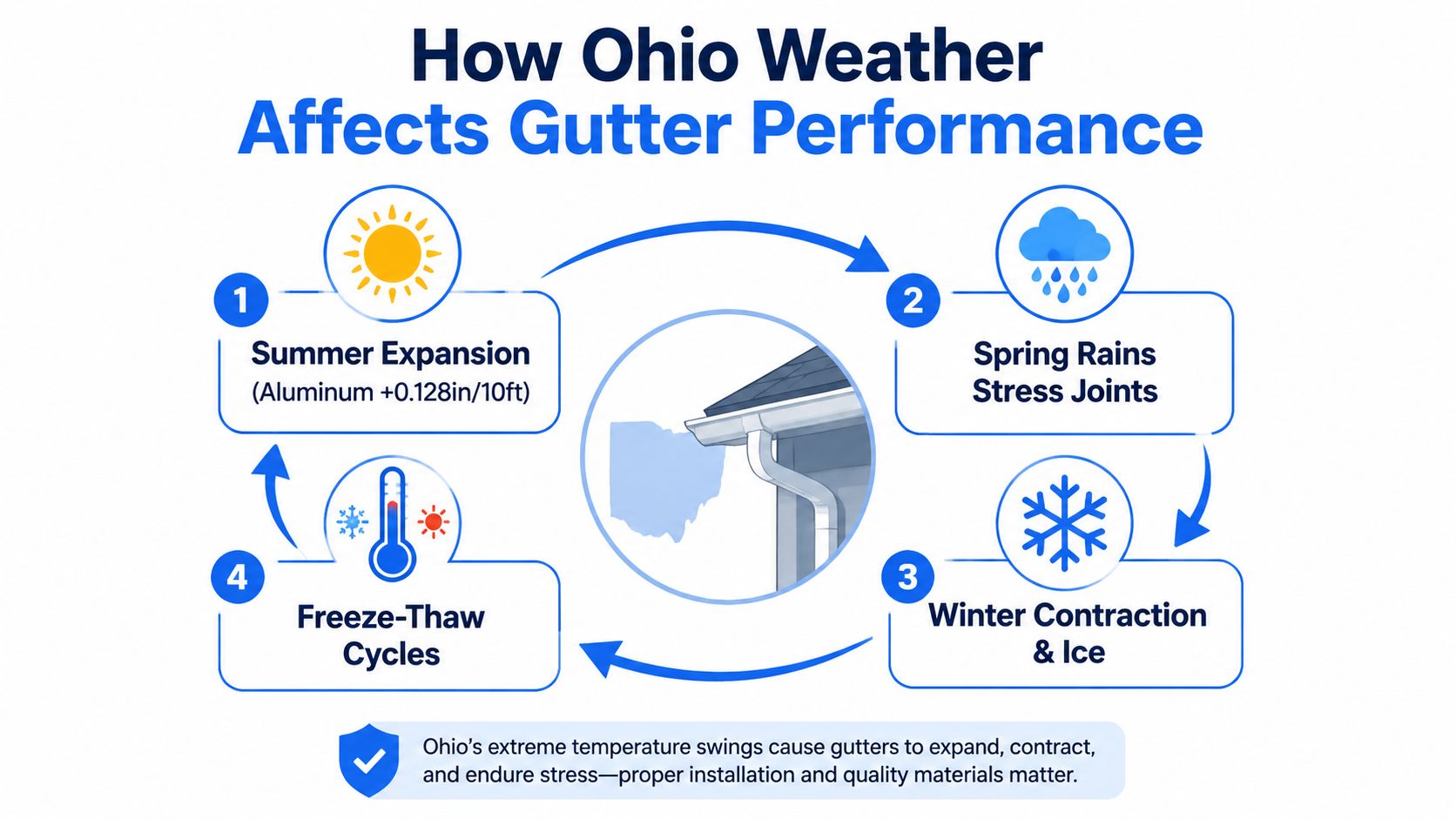
Central Ohio weather tests the connections in a gutter system repeatedly. Summer heat expands metal, autumn rain fills the drainage path, winter cold contracts the material, and freeze-thaw cycles place repeated stress on sealants and fasteners. A gutter that looks sound in mild weather can reveal its weak points after several seasonal changes.
For aluminum, guidance identifies movement of about 0.128 inches per 10 feet for a 100°F temperature change. Comparable figures in the same installation guidance are 0.080 inches for steel and 0.113 inches for copper over 10 feet under the same temperature change. Thermal movement guidance for gutter installation
Continuous does not mean unlimited
A continuous run still moves. Long metal runs need expansion relief, and multiple references place the practical limit for continuous runs at roughly 40 to 50 feet without an expansion joint. Copper guidance also cites about 1.1 inches of movement per 100 feet for every 100°F change, which illustrates why installers must plan for movement rather than completely eliminate every joint. Thermal movement and gutter guard guidance
The difference is where the movement is managed. In a sectional system, each splice must tolerate movement, weather exposure, and sealant aging. In a one-piece system, the installer shifts that concern toward end caps, corners, outlets, and properly designed expansion points. Fewer joints don't remove thermal stress, but they reduce the number of intermediate locations where stress can open a seam or separate sealant.
Freeze-thaw exposes weak workmanship
Ohio's cold-weather problem isn't only low temperature. Water enters small gaps, freezes, expands, and then melts. Repeated cycles can widen a weak connection, especially where a gutter already lacks support or holds standing water.
A sectional system can perform acceptably when joints are carefully sealed and the gutter has correct pitch. It becomes less forgiving when multiple connectors sit on a long roof edge and the installation has inconsistent support. Gutters fabricated on site offer a stronger starting point for this climate, but they still need sound fastening, appropriate drainage capacity, and regular cleaning.
For seasonal upkeep, HIBCO's winter gutter maintenance guidance is a useful checklist before cold weather turns a small drainage issue into an ice-related repair.
When Each Gutter Type Makes Sense
A new Columbus-area home with a recently installed roof is the clearest continuous-gutter scenario. The owner is already investing in a long-term exterior system, and continuous runs fit the home's roof geometry without adding a series of mid-run connections. The higher starting price is easier to justify when the roof and gutters are intended to work together for many years.
A different decision applies to an older home with aging shingles. If the owner expects to list the property soon, replacing every exterior component with the longest-lasting option may not produce the best financial return. Sectional gutters can provide a functional, lower-cost drainage solution, particularly when the existing roof has limited remaining life and the owner needs to control immediate spending.

Three homes, three reasonable answers
New construction: Installers can coordinate gutter pitch, downspout placement, fascia attachment, and roof drainage from the beginning. One-piece gutters usually fit this situation because the owner isn't trying to preserve a short-term patch on an already aging exterior.
Older primary residence: Start with the roof assessment. If the shingles, flashing, or decking need replacement soon, coordinate the gutter decision with that work. A sectional repair or replacement may be appropriate if the homeowner is selling or expects another major exterior project shortly.
Rental property: A property manager may prioritize predictable cash flow and localized repair access. Sectional gutters can make sense where a damaged piece needs quick replacement and the ownership strategy doesn't justify paying more for a lower-maintenance system. The manager still needs to watch for hidden fascia damage and recurring leaks.
Resale and inspection risk
Sellers often focus on curb appeal, but a gutter that leaks onto the fascia can create an inspection concern. A clean installation may present better visually, while a well-repaired sectional system can also function properly if the joints, pitch, hangers, and downspouts are in good condition.
Climate stress adds nuance. Recent guidance notes that sectional systems may experience sealant-joint failures within roughly 5 to 10 years in harsh conditions, while those without sections still require resealing at corners and outlets and aren't leak-proof forever. Climate stress, repairs, and gutter service-life considerations
The repair question matters for property managers and homeowners alike. A branch impact may favor the replaceable-piece convenience of sectional gutters. A long, leak-prone roof edge may favor continuous construction because it removes many recurring joint problems before they start.
Making the Right Choice for Your Home
Before deciding, answer three questions: How much useful life remains on the roof? How long do you expect to stay? How often are you willing to inspect and reseal joints? These answers matter more than a simple preference for one gutter style.
Use this scoring check during the estimate:
- Roof timing: If roofing work may happen soon, avoid installing a system that could be removed or adjusted during that project.
- Ownership timeline: A longer stay gives a lower-maintenance installation more time to justify its higher upfront cost. A shorter hold period may favor a practical repair or replacement that meets current drainage needs.
- Maintenance tolerance: Count the work involved in checking seams, watching for leaks, clearing debris, and repairing loose sections. An inexpensive system can cost more in attention when access is difficult.
- Damage pattern: Repeated leaks along a long roof edge point toward reducing the number of joints. One damaged area may make replaceable sections useful.
- Roof-edge condition: Sagging gutters, soft fascia, poor pitch, or overflowing downspouts should be corrected as part of the drainage plan, not hidden by new material.
Give each category a simple low, medium, or high rating, then compare the result with the estimate. A high roof-timing risk and short ownership period usually call for controlled spending. A sound roof, long stay, and low maintenance tolerance support paying for a system with fewer seam-related service points. The durability comparison above explains the expected service-life difference between the two systems.
Ohio's freeze-thaw cycles make this review more practical. Water can enter weak joints, freeze, expand, and leave sealant or fittings more vulnerable through repeated temperature changes. Good pitch, secure hangers, sealed corners, and properly placed downspouts still matter regardless of the gutter type.
Ask the contractor to put the recommendation in writing. The scope should identify fascia repairs, roof-edge coordination, corners, outlets, downspout changes, and the maintenance you will still need after installation. The right choice fits the home's drainage demands, the roof's remaining service life, and your willingness to pay for repairs or upkeep.
Next Steps for Columbus Homeowners
A gutter decision should match your time in the home and the roof's remaining life. Replacing long runs with a lower-seam system may make sense for a long stay, but it can be poor timing if the roof will soon require replacement. Ohio's freeze-thaw cycles also make weak joints, loose fittings, and poor drainage more expensive to ignore.
Use these questions during the estimate:
- Roof timing: How much useful roof life remains, and should roofing and gutter work be scheduled together?
- Stay length: Will the gutter system likely serve the property for as long as you expect to own it?
- Material selection: Which metal and profile suit the home's drainage needs, appearance, and exposure?
- Movement planning: Where will long runs allow for expansion, and how will corners and outlets be sealed?
- Drainage layout: Are downspouts positioned to move water away from the foundation instead of releasing it beside the wall?
- Protection options: Would leaf guards reduce debris at this property, or make cleaning and maintenance more difficult?
- Warranty terms: Which coverage comes from the manufacturer, and what covers installation workmanship?
- Written scope: Does the estimate list removal, fascia repairs, disposal, new outlets, downspout changes, and cleanup?
Check that the contractor is licensed and insured, uses manufacturer-backed materials, and documents the installation plan. Compare estimates by seam count, attachment method, roof coordination, repair policy, and the maintenance you will still handle, not by price alone.
If the roof is nearing replacement, coordinate the projects so flashing, fascia, and gutter placement are addressed together. If the roof is sound and you plan to stay, a properly installed system with fewer service points may justify its higher initial cost. A shorter ownership period may favor a targeted repair or controlled replacement, provided the drainage problem is resolved.
HIBCO ROOF LLC provides free inspections, written estimates, roof repairs and replacements, continuous gutter installation, and leaf guard options for Columbus and central Ohio homeowners. Visit HIBCO ROOF LLC to request an assessment based on gutter condition, roof life, drainage layout, and plans for the property.