A small brown mark has appeared on the ceiling after a night of heavy rain. You climb into the attic, find damp insulation near a roof penetration, and start wondering whether a contractor can patch the problem or whether the whole roof needs to come off. That decision feels urgent because water rarely waits for a convenient time.
Can a roof be repaired instead of replaced? Often, yes. A repair makes sense when the failure is confined to a specific area and the surrounding roofing system remains sound. Replacement becomes the better answer when the roof has widespread deterioration, recurring leaks, damaged decking, or too little useful life left to justify another patch. The visible leak is only the starting point. The question is whether the roof assembly around it can continue shedding water reliably.
Table of Contents
- The Repair vs Replace Dilemma for Columbus Homeowners
- Key Factors That Determine If Your Roof Can Be Repaired
- When a Full Roof Replacement Is the Only Smart Choice
- Comparing the Costs and Timelines of Repair vs Replacement
- Navigating Insurance Claims and Manufacturer Warranties
- Your Roof Repair vs Replacement Decision Checklist
- Next Steps for Central Ohio Homeowners
The Repair vs Replace Dilemma for Columbus Homeowners
A Columbus homeowner may see one missing shingle after a summer storm and assume the solution is simple. Another homeowner may see the same kind of ceiling stain after several seasons of wind, rain, and winter freeze-thaw cycles. The symptoms look similar from inside the house, but the correct roofing decisions can be completely different.
The first homeowner may need a targeted repair. A roofer might replace damaged shingles, correct a flashing failure, or reseal a pipe boot. The second may have a roof that has lost protective granules across several slopes, absorbed moisture around the decking, and developed more than one leak path. A patch could stop the current drip while leaving the larger failure untouched.
Localized damage versus systemic failure
A localized defect has a defined source. It may involve one penetration, a short flashing run, a small group of missing shingles, or a limited storm-damaged area. If the underlayment, roof deck, and adjacent shingles remain in good condition, a properly integrated repair can restore the water-shedding surface without disturbing the rest of the roof. Technical guidance on when isolated roofing defects are repairable explains why details such as flashings and penetrations often become failure points before the main shingle field does.
A systemic failure is different. It affects the roof as a whole or appears in multiple locations. Repeated leaks, widespread curling, brittle shingles, heavy granule loss, soft decking, or damage across multiple slopes suggest that the roof is no longer failing in one isolated spot. In that situation, repair is an intervention, not a reset button.
Practical rule: A repair should solve a defined problem, not merely make the roof look better for a short time.
Central Ohio weather adds pressure to borderline roofs. Summer hail and wind can damage shingles and flashing, while winter moisture and repeated freezing and thawing can widen cracks or expose weak details. Those conditions don't automatically require replacement, but they make a careful inspection more important than a quick visual estimate from the driveway.
The economics also explain why homeowners consider repair first. A major U.S. roof market benchmark reported average 2025 roof replacement costs of $17,631 and average repair costs of $4,699, with repair averaging about 27% of replacement cost. The same report found that 38% of U.S. residential homes had moderate to poor roof condition in 2025, which indicates how common this decision has become for aging properties. The State of America's Roofs report from Verisk provides the underlying benchmark.
The important distinction is not just cheap versus expensive. It is limited failure versus aging system. A well-scoped repair can protect a sound roof and preserve useful service life. A poorly chosen repair can leave hidden moisture, create a recurring leak, and delay a replacement until the damage is more expensive to correct.
Key Factors That Determine If Your Roof Can Be Repaired
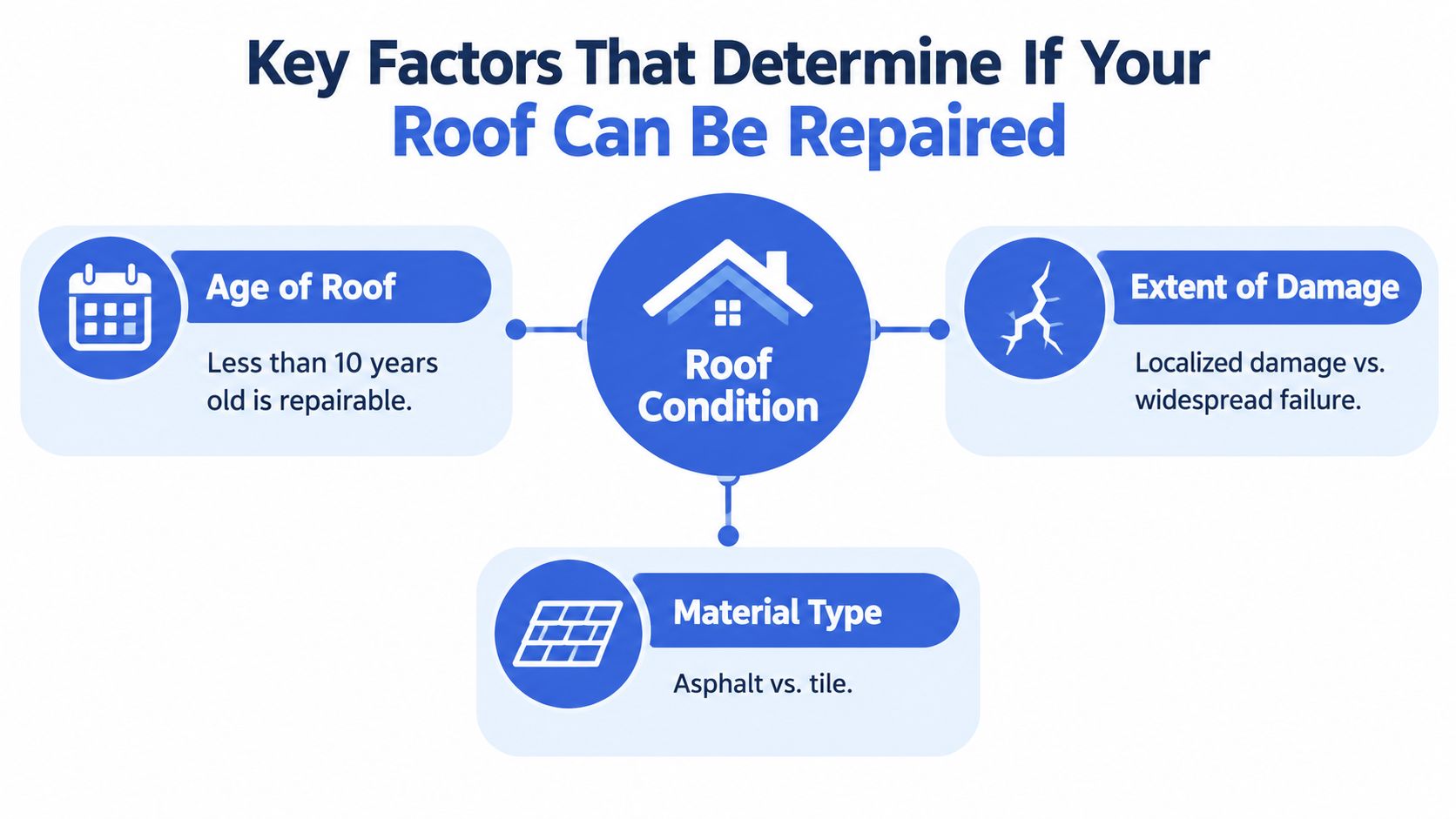
A professional assessment should answer three questions: How much life remains, how much of the roof is affected, and what condition is hidden below the shingles? The roof may be repairable when all three answers are favorable. A contractor who only counts missing shingles hasn't finished the evaluation.
Start with remaining service life
Age doesn't determine the answer by itself, but it sets the financial context. One commonly used framework favors repair when a roof is under about 60% of its expected material lifespan and the damage is localized. Replacement becomes more likely once the roof has passed about 80% of expected life or a repair exceeds 30% of replacement cost. RoofVista's lifespan and repair-versus-replacement guidance outlines those thresholds.
Material matters because different shingles age at different rates. Three-tab asphalt shingles commonly last about 15 to 20 years, while architectural asphalt shingles commonly last about 25 to 30 years, according to the same guidance. That means a 12-year-old three-tab roof deserves a different assessment from a 12-year-old architectural roof, even if both have one missing shingle.
A roof under about 15 years old with isolated damage and sound structure is commonly considered repair-friendly, while a roof in the last quarter of its rated life deserves much more scrutiny before repair money is committed. Repair-versus-replacement decision guidance from RealCostIQ uses age, damage extent, structural condition, and repair cost together rather than treating any single factor as decisive.
Examine the damage pattern
The next question is whether a competent roofer can isolate the failure. Repair is generally defensible when the issue involves:
- Missing or damaged shingles: A limited group can often be replaced if nearby shingles are flexible and the underlayment remains intact.
- Flashing failure: A chimney, wall intersection, skylight, or plumbing penetration may need new flashing rather than a new roof.
- One leak path: A single, traceable entry point is different from stains appearing in several rooms or roof sections.
- One affected slope: A partial repair may work when the other slopes are still performing well and the damaged area can be properly tied into the existing system.
A repair becomes less convincing when the roof shows widespread granule loss, curling, brittleness, repeated leaks, or damage across several slopes. The roof deck also matters. Shingles can be replaced over a compromised deck, but that doesn't restore the structural surface beneath them.
Inspect the assembly, not just the shingle
A roof is a layered system. The inspection should include the shingles, underlayment, flashing, penetrations, ventilation, and decking. Soft or discolored wood, damp insulation, staining around rafters, or evidence of long-term moisture can turn a surface repair into a deeper repair or replacement project.
Homeowners who want a broader understanding of what inspectors examine can review this guide on what to expect during a home inspection. It won't replace a dedicated roofing inspection, but it helps explain why visible conditions and concealed conditions both matter.
Ask for evidence: Request photographs of the damaged area, the underside of the decking when accessible, the flashing details, and any moisture-related findings. A written explanation should connect each recommended task to a specific condition.
A repair works best when the roof is relatively young, the damage isn't recurring, and the surrounding materials can accept a properly matched repair. If the roof is old and brittle, removing adjacent shingles can cause additional damage during the repair itself. That practical limitation often changes the estimate from “replace a few shingles” to “replace a larger section,” which is why age and material type belong in the same conversation as the leak.
When a Full Roof Replacement Is the Only Smart Choice
Patching an old roof can feel financially responsible because the immediate invoice is smaller. That logic fails when the patch addresses only the symptom and the roof has already entered a pattern of recurring failure.
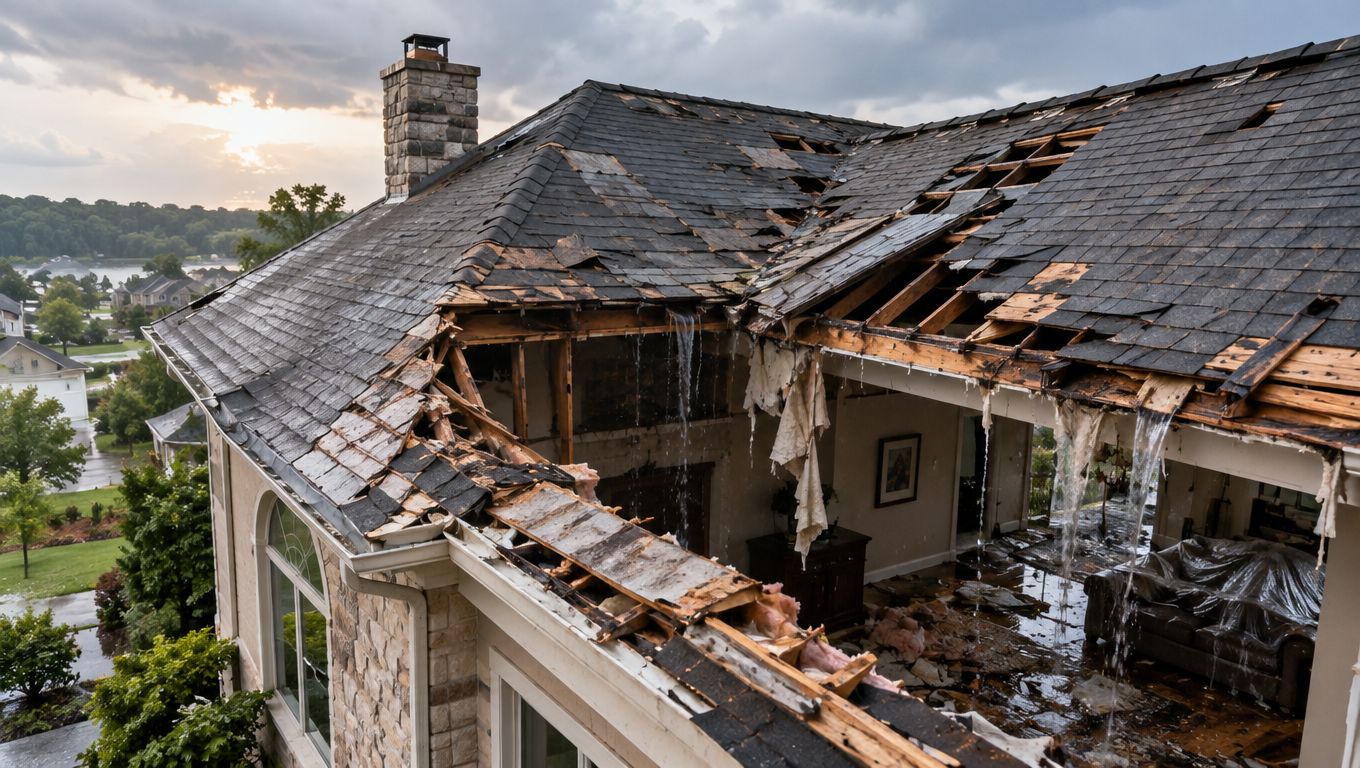
A full replacement becomes the stronger option when the damage is widespread, several slopes are involved, leaks keep returning, or the decking has deteriorated. Industry guidance commonly points toward replacement when repair costs rise above roughly 20% to 25% of replacement cost, especially when the roof is in the last third of its expected service life. Modernize's repair-versus-replacement guidance describes how age, repeated failures, and the extent of deterioration change the calculation.
The warning signs that patching won't solve
Look beyond the current drip. A replacement deserves serious consideration when you find:
- Multiple active leaks: Water entering through separate areas usually indicates more than one isolated defect.
- Widespread granule loss: Granules protect asphalt shingles from weather exposure. Loss across the roof field signals general aging, not one damaged spot.
- Soft or rotted decking: The roof can't perform reliably if the structural surface beneath it has lost strength.
- Repeated repair history: A roof that needs another patch shortly after previous work may be reaching the point where repairs no longer restore dependable performance.
- Damage across multiple slopes: Storm damage in several roof sections is harder to isolate and more likely to expose broader wear.
Interior damage raises the stakes. A recurring leak can affect insulation, drywall, trim, electrical components, and framing. Mold remediation may become necessary when moisture remains concealed, and those costs are separate from the roofing invoice. Delaying a replacement can also force an emergency project during bad weather, when the homeowner has less time to compare scopes and materials.
A roof overlay or second layer may appear to avoid tear-off, but it can hide the deck and make future diagnosis more difficult. Before considering that approach, review the technical discussion of overlaying a roof and the conditions that affect it. The installation method, existing layers, ventilation, local requirements, and condition of the roof beneath all need to be evaluated.
Why repeated repairs lose value
A repair buys useful life only if the rest of the system can support that life. On an older asphalt roof, one repaired leak may be followed by failures at another flashing, ridge, valley, or shingle field. The homeowner then pays for multiple visits, interior repairs, and emergency protection without removing the underlying age problem.
The decision is especially difficult after hail or wind damage. The visible impact may be limited, but a close inspection can reveal loosened tabs, bruised shingles, damaged flashing, or moisture below the surface. A repair is reasonable when the deck is dry and the damage is strictly localized. Replacement is more sensible when storm damage combines with an aged roof or a recurring leak.
The expensive mistake isn't always choosing replacement. Sometimes it's paying for several repairs on a roof that had already reached the point where a replacement was the lower-cost path.
Comparing the Costs and Timelines of Repair vs Replacement
Repair usually wins on upfront cost, while replacement can win on cost per remaining year of service. A homeowner who compares only the first invoice may choose a repair that looks inexpensive but provides little dependable life. A homeowner who compares the condition of the roof, the expected service life, and the full scope of work can make a more rational choice.
A widely used industry heuristic says replacement deserves priority when a repair exceeds 30% of the cost of a full replacement. Certaroof's explanation of the 30% rule presents that threshold as a practical investment test, not an automatic law. The roof's age, material, damage pattern, and hidden conditions still matter.
Repair vs Replacement Quick Comparison
| Factor | Targeted Repair | Full Replacement |
|---|---|---|
| Best fit | A localized leak, flashing failure, or limited storm damage on a sound roof | Widespread deterioration, recurring leaks, compromised decking, or an end-of-life roof |
| Upfront commitment | Lower initial cost because only a defined area is addressed | Higher initial cost because the existing roofing system is removed and rebuilt |
| Scope | Shingles, flashing, sealants, pipe boots, or a small section | Tear-off, deck inspection, underlayment, flashing, ventilation details, and new shingles |
| Timeline | Often a short visit when the source is accessible and materials are available | A coordinated project that may be completed quickly, with many replacements finished in a single day according to HIBCO's documented project information |
| Long-term risk | The rest of an aging roof remains in place | The roof system starts a new service cycle, subject to material, installation, and maintenance conditions |
| Financial question | Does the repair preserve enough useful life to justify its cost? | Does the larger investment remove recurring failures and future emergency work? |
A repair can be completed in hours when the source is clear, the roof is safe to access, and replacement materials are available. A replacement takes more planning because the crew must protect landscaping and property, remove existing materials, inspect the deck, install the new system, and clean the site. For a closer look at the line items that can affect replacement pricing, homeowners can review this guide to roof replacement cost per square.
Think in remaining life, not just invoice size
Suppose a repair costs close to the 30% threshold on a roof already near the end of its expected life. The repair may stop today's leak, but another failure could require more spending soon. Replacement costs more at the beginning, yet it may eliminate several related expenses, including repeated service calls, interior restoration, and temporary water protection.
A written estimate should separate the immediate repair from possible concealed work. Ask whether the price includes replacing damaged decking, correcting flashing, improving ventilation, removing multiple layers, and disposing of old materials. A low repair estimate that excludes those conditions isn't a true comparison with a complete replacement proposal.
The best choice also depends on whether the roof will remain your responsibility for years or whether you're preparing to sell. A roof that is acceptable for short-term stabilization may not be a sound long-term investment for a homeowner planning to stay in the property. Your contractor should explain both paths without treating the least expensive initial option as automatically best.
Navigating Insurance Claims and Manufacturer Warranties
Insurance and warranties can change the repair-versus-replace decision, but neither one guarantees payment for an aging roof. Homeowners need to separate sudden storm damage from wear and tear, then document the condition before authorizing substantial work.
Start by photographing the exterior, interior stains, attic conditions, fallen branches, loose shingles, and visible impact marks. If active water is entering the home, arrange temporary protection that prevents further damage without concealing the original condition. Then review the policy and notify the carrier before approving major repairs.
Build a defensible claim file
An adjuster may authorize a partial repair, one-slope replacement, or full replacement depending on the documented damage and the policy language. The deciding issue is usually whether the proposed scope fully restores the roof after a covered event, not whether the homeowner prefers a new roof.
A contractor's inspection report should identify:
- The suspected cause: Wind, hail, fallen debris, flashing failure, age, or another condition.
- The affected locations: Specific slopes, penetrations, valleys, ridges, and interior areas.
- The visible and concealed findings: Shingle damage, underlayment concerns, decking moisture, and attic evidence.
- The proposed scope: Emergency protection, targeted repair, partial replacement, or complete replacement.
- The supporting records: Dated photographs, measurements, material information, and invoices.
For a plain-language overview of the process, homeowners can read how roof insurance claims work. Policy terms vary, so the carrier's written determination controls coverage. Don't assume that a storm automatically means the insurer will pay for age-related deterioration.
Protect the manufacturer's warranty
A manufacturer warranty generally depends on the roofing system being installed according to the manufacturer's requirements. An improper repair, incompatible material, poor flashing detail, or unapproved installation can create a warranty dispute later. Mixing different shingle batches or colors may also create a visible mismatch and complicate the appearance of a repaired section.
Ask the contractor to identify the shingle manufacturer, product line, underlayment, flashing materials, ventilation components, and workmanship coverage. If matching shingles are discontinued, the contractor and insurer should discuss what can realistically be repaired and how the proposed materials will integrate with the existing roof.
Don't sign a repair authorization that leaves the cause, materials, and warranty responsibilities vague. The written scope should state what the contractor will remove, what will remain, how the new work will tie into existing roofing, and who handles follow-up if the same leak returns.
Your Roof Repair vs Replacement Decision Checklist
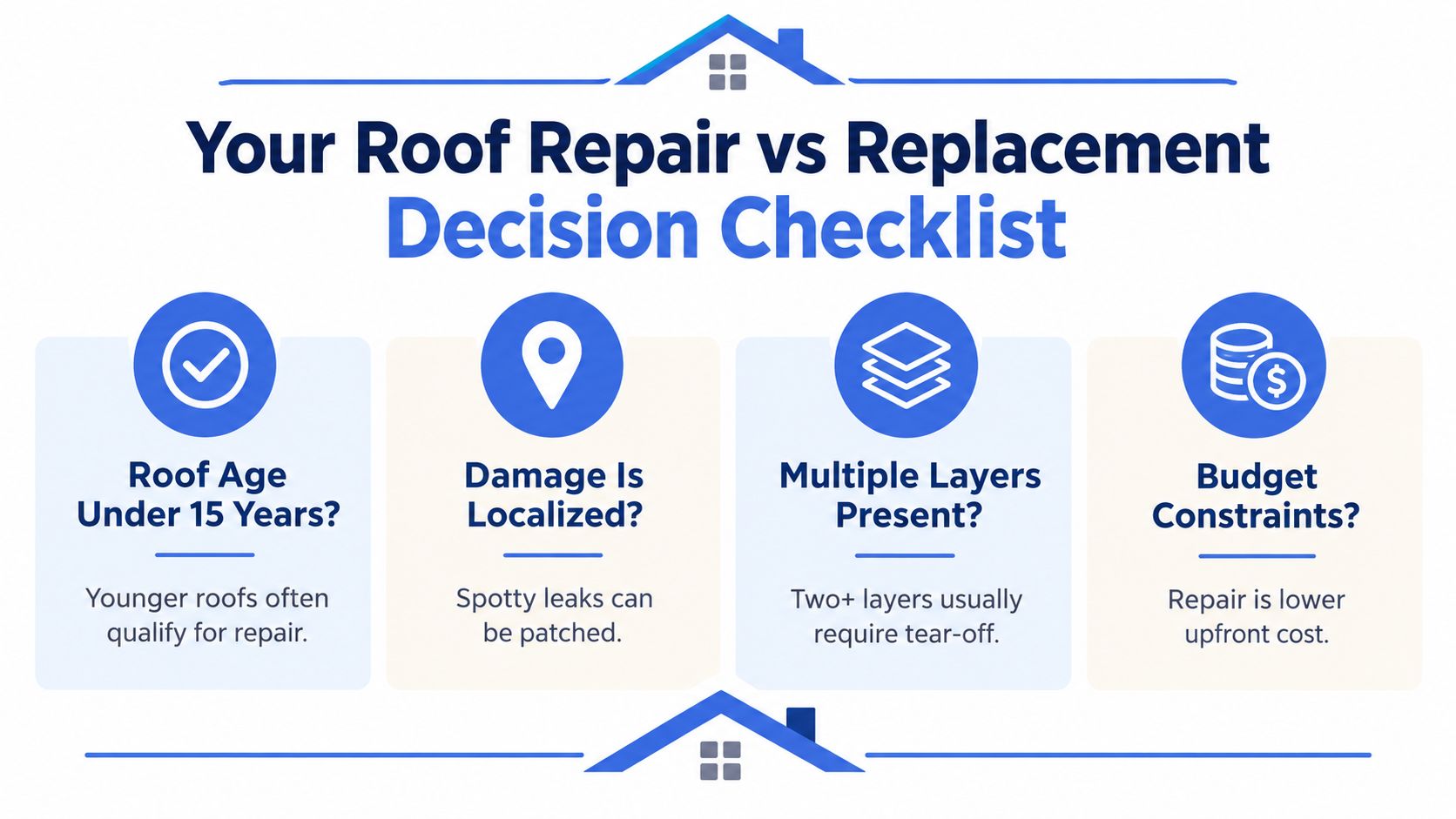
Use the inspection as a decision meeting, not just a price-shopping exercise. A reliable recommendation should connect the roof's age, damage pattern, hidden structure, insurance position, and estimated cost. If one of those pieces is missing, the conclusion may be premature.
Ask these questions on the roof
How old is the roofing material? Confirm whether the roof uses three-tab or architectural asphalt shingles, and ask how its age compares with the material's expected service life. Roof service-life guidance commonly places three-tab shingles around 15 to 20 years and architectural shingles around 25 to 30 years. Paletz Roofing's material-age guidance provides those commonly used ranges.
Is the damage localized? Ask whether the problem is confined to one penetration, one slope, or a defined group of shingles. Damage across multiple slopes, recurring leaks, and widespread deterioration point away from a simple patch. Owl Roofing's decision guidance uses the extent of affected shingles and the presence of multiple slopes or decking rot as key decision factors.
What does the deck look like? Have the contractor check for soft spots, rot, staining, and evidence of long-term moisture. Shingles cannot compensate for a roof deck that has lost structural integrity.
What condition are the shingles in? Look for curling, brittleness, cracked surfaces, exposed fiberglass, and granule loss in gutters. One damaged shingle isn't equivalent to a roof field that has deteriorated across several slopes.
Has the leak returned after prior work? A recurring leak may indicate that the original source was misidentified or that nearby components are also failing. Ask for the previous repair records and compare them with the current findings.
Check the money and paperwork
Write down the full replacement estimate before judging a repair quote. Then apply the 30% comparison rule as a screening tool, while remembering that it isn't a substitute for evaluating age and hidden damage. If the repair approaches that threshold on an old roof, ask the contractor to price both a targeted repair and a complete system replacement.
Confirm whether the roof has multiple existing layers. Multiple layers can restrict inspection access and may require tear-off before the contractor can verify the decking and install the new system correctly. Also ask whether the proposed repair includes matching materials, flashing integration, disposal, interior protection, and a workmanship warranty.
Before approving work, you should be able to answer three questions: What failed, why will this scope correct it, and what condition remains after the repair?
Finally, review your insurance policy and gather previous invoices, warranty documents, inspection reports, and storm photographs. If the contractor recommends replacement, ask whether the recommendation is based on covered damage, age-related deterioration, structural condition, or a combination. That distinction helps you avoid both an unnecessary claim and an under-scoped repair.
Next Steps for Central Ohio Homeowners
Start with a thorough roof inspection rather than choosing a repair based on a ceiling stain or a contractor's quick estimate. The inspection should trace the leak, examine shingles and flashing, check accessible decking and attic conditions, and evaluate ventilation. It should also identify whether storm or hail damage is separate from ordinary aging.
Ask for a written report with photographs and two clearly separated options when both are reasonable. The repair scope should identify the exact area, materials, flashing work, expected limitations, and warranty. The replacement scope should explain tear-off, deck repairs, underlayment, ventilation, flashing, shingle products, cleanup, and the expected schedule.
Before work begins, take these steps:
- Review your policy: Confirm deductibles, exclusions, claim timing, and whether the policy distinguishes actual cash value from replacement cost.
- Collect warranty records: Find the original invoice, shingle product information, installation paperwork, and any prior repair receipts.
- Document the condition: Photograph interior stains, attic moisture, exterior damage, gutters, and surrounding property conditions.
- Compare complete scopes: Don't compare a limited repair price with a replacement estimate that includes every required component.
- Confirm credentials: Verify that the contractor is licensed and insured, and ask who will perform the work and manage the project.
- Get the timeline in writing: Include material ordering, weather contingencies, daily protection, cleanup, and final inspection.
A repair is the right answer when it restores a sound roof. Replacement is the right answer when the roof's age, structure, and damage pattern make another patch a short-lived purchase. A careful inspection gives you the information needed to tell the difference before water damage turns a manageable project into an emergency.
HIBCO ROOF LLC provides Columbus and central Ohio homeowners with roof inspections, leak diagnosis, storm damage documentation, targeted repairs, and full roof replacements, along with free written estimates. Visit HIBCO ROOF LLC to request an inspection and discuss whether repairing the existing system or replacing it offers the sounder long-term value.