Approximately $23,107 is a realistic Columbus average for full siding replacement, with typical projects ranging from $19,759 to $26,833. Installed pricing can span $2.80 to $21 per square foot, and that measurement refers to exterior wall area, not the home's interior floor area.
You may be looking at cracked panels after a storm, faded siding before listing your home, or water stains around a window. Three contractors arrive, take three different approaches, and leave you with quotes that seem impossible to compare. One estimate may look like a bargain, while another appears wildly inflated.
The difference usually isn't a mistake in arithmetic. It comes from what each contractor measured, what each quote includes, and what the crew expects to find underneath the existing siding. A low bid that omits tear-off, flashing, trim, or sheathing repairs isn't cheaper in any useful sense. It's incomplete.
Table of Contents
- How Much Does Siding Cost to Replace in Columbus
- Material Costs Vinyl vs Fiber Cement Breakdown
- Labor and Hidden Costs in Siding Quotes
- Why the Cheapest Bid Is Often the Most Expensive
- When Insulated Siding Actually Makes Financial Sense
- Budgeting and Financing Your Siding Project
How Much Does Siding Cost to Replace in Columbus
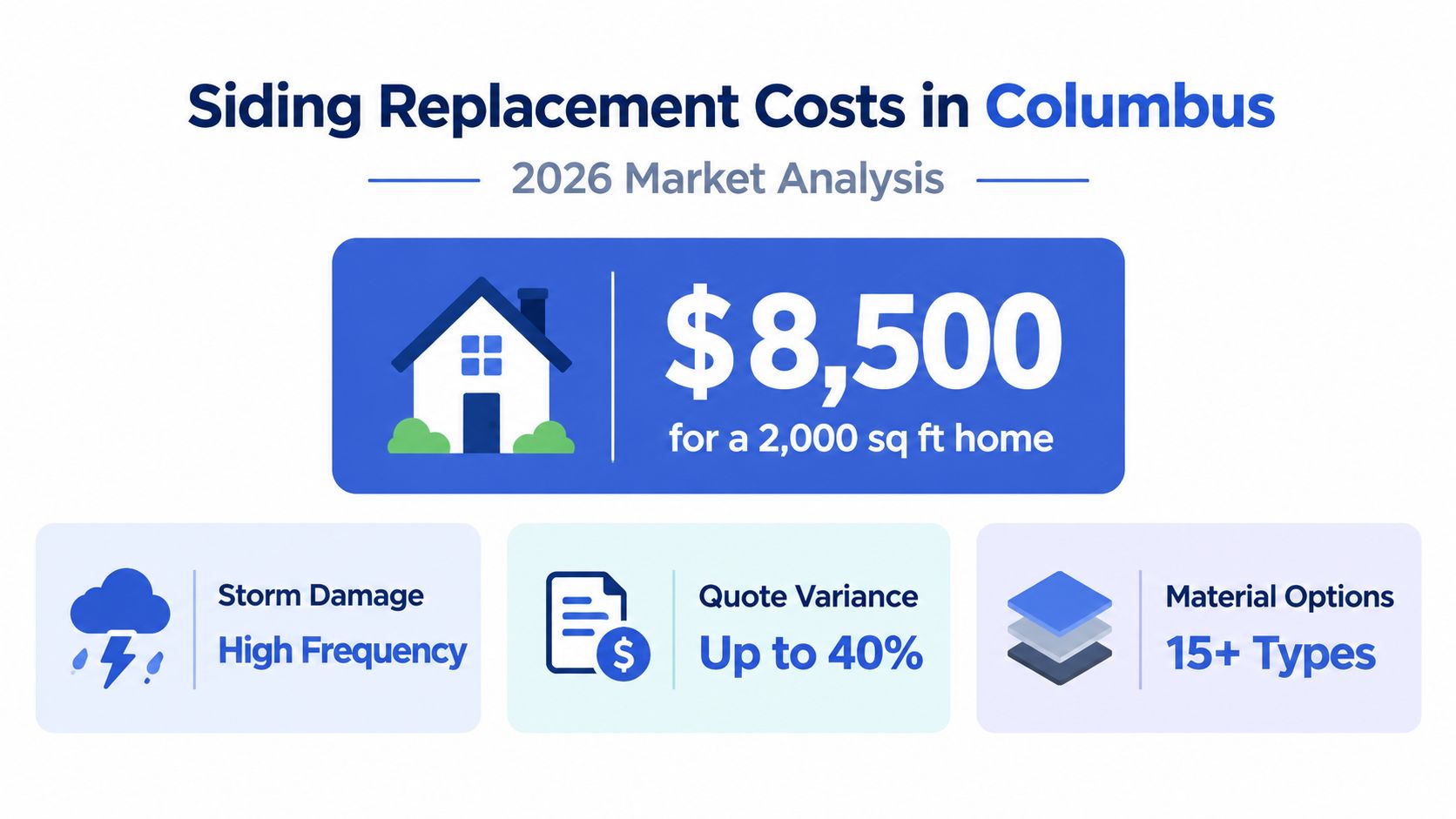
A Columbus homeowner might receive one quote near the lower end of the market and another that approaches the cost of a major exterior remodel. The local average of approximately $23,107, with typical projects between $19,759 and $26,833, provides a useful starting point, but it isn't a guaranteed price for any particular house. Those Columbus figures come from a local cost survey that also reports installed ranges from $2.80 to $21 per square foot, depending heavily on material and project conditions. Columbus siding replacement cost data explains why economical vinyl and premium materials such as brick or specialty siding occupy completely different price categories.
The most common pricing mistake is using the home's listing square footage as if it were the siding quantity. It isn't. Siding covers walls, including gables, bump-outs, dormers, and upper stories. A two-story colonial and a single-story ranch can have the same interior floor area while requiring very different amounts of exterior cladding.
A practical estimate starts with the following measurements:
- Wall surfaces: The contractor should calculate the exterior areas that will receive siding.
- Openings: Windows and doors reduce siding coverage, but they also add trim and detailing labor.
- Complexity: Corners, gables, dormers, multiple stories, and difficult access increase installation time.
- Existing conditions: Old siding, damaged sheathing, and moisture around openings can change the work after removal.
For reference, the same Columbus source places an approximately 1,800-square-foot home across a potential total of roughly $5,040 to $37,800, and a 2,000-square-foot project at approximately $5,600 to $42,000 when applying the broad material range. Those endpoints represent materially different specifications, not a typical like-for-like bid. The relevant figure for your house is the measured siding area multiplied by a clearly defined installed price, followed by separately stated preparation and repair costs.
Practical rule: Don't compare a quote based on living space with one based on measured wall coverage. Ask both contractors to show the siding area they used.
Homeowners who want a broader way to evaluate exterior contractors can also review the Roofing Siding Contractors resource, particularly when comparing the inspection and estimating process rather than just the advertised price.
Material Costs Vinyl vs Fiber Cement Breakdown
Material choice establishes the starting point, but installation conditions determine where a product lands within its range. Vinyl commonly costs about $3 to $12 per square foot installed, while fiber cement typically lands near $7 to $18 per square foot installed. The vinyl range is documented in vinyl siding installation cost guidance, and the fiber-cement range reflects both material and labor pricing in fiber cement siding cost data.
| Siding Material | Installed Cost Per Sq Ft | Best For |
|---|---|---|
| Vinyl | $3 to $12 | Lower upfront cost, straightforward elevations, and homeowners who want broad style availability |
| Fiber cement | $7 to $18 | A heavier, more labor-intensive cladding system where the homeowner values its appearance and construction characteristics |
Vinyl sits at the lower end when the project has accessible walls, simple profiles, limited trim, and uncomplicated removal. A higher-end profile, insulated backing, numerous corners, or difficult upper-story access can move the installed price upward. For 1,500 square feet of covered wall area, the vinyl range corresponds to approximately $4,500 to $18,000 before unusual structural repairs or project-specific additions, based on the same installed pricing source.
Fiber cement costs more for a technical reason, not because the product is marketed as premium. Crews must handle heavier planks or panels, make controlled cuts, fasten them correctly, treat joints, and maintain proper clearances from roofs and grade. Window, door, corner, and roofline details demand careful layout. Poor handling can damage the product or create water-management problems at the transitions.
For 1,500 square feet of siding area, fiber cement at $7 to $18 per square foot installed implies approximately $10,500 to $27,000 before unusual structural repairs, premium detailing, or concealed substrate work. That range is tied to the siding area, not the home's interior size.
What the material comparison leaves out
A material table can't tell you whether the installer will replace damaged sheathing, add a weather-resistive barrier, or rebuild window flashing. Those decisions affect the performance of either product. Fiber cement installed over a poorly prepared wall is not a durable upgrade, and inexpensive vinyl won't perform well if the crew ignores water intrusion behind the old cladding.
The vinyl siding replacement cost guide can help you frame the material discussion, but your written estimate still needs to identify the exact product line, profile, color, accessories, trim package, and installation scope. Don't accept “vinyl siding” or “fiber cement” as a complete specification.
Labor and Hidden Costs in Siding Quotes
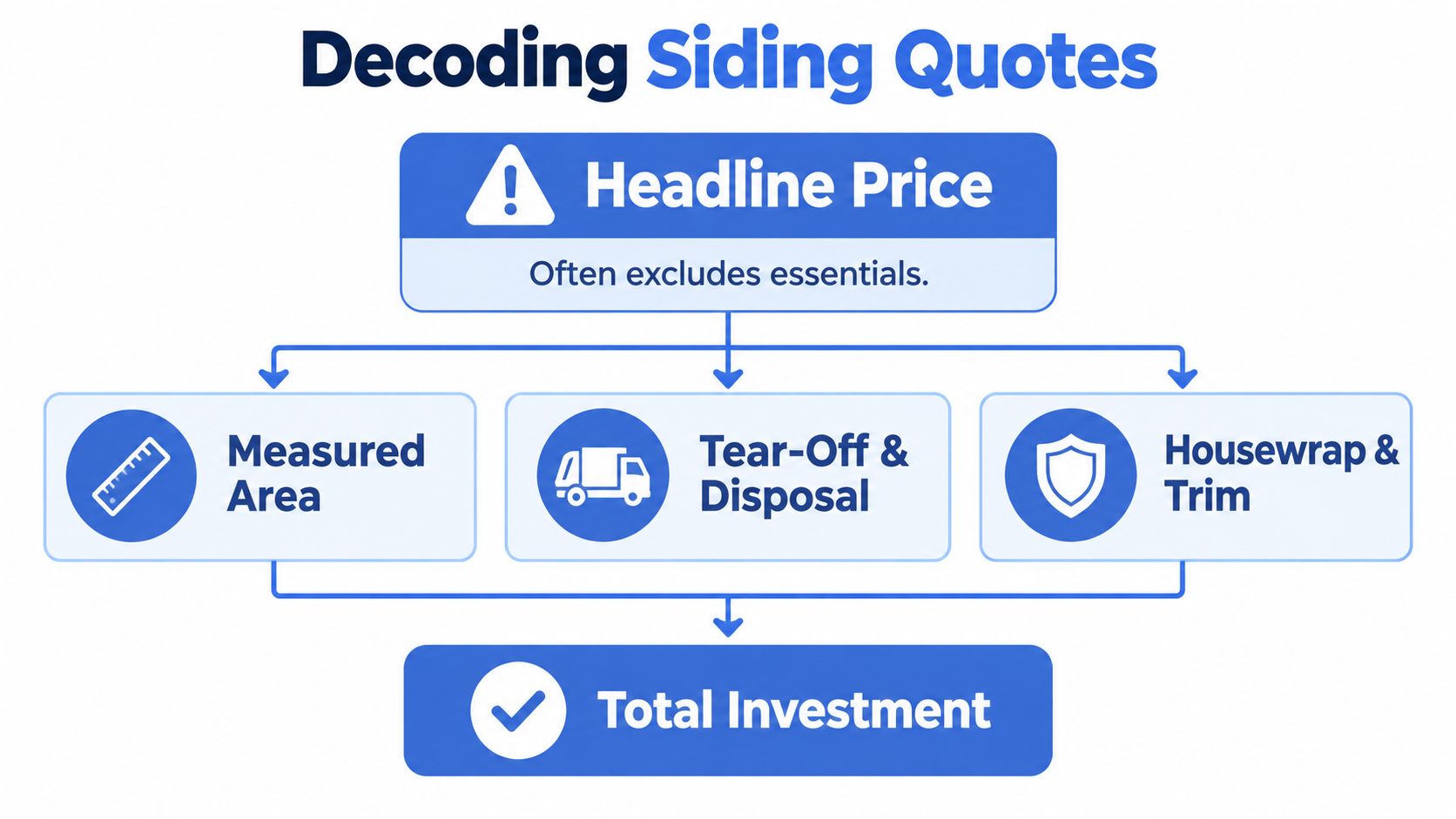
A siding quote should read like a scope of work, not a single attractive number. If the estimate only says “replace siding” followed by a total, you can't tell whether the contractor measured the walls correctly or just multiplied an assumed area by a low unit price.
The most useful estimates separate the following:
- Measured siding area: The quantity should be based on exterior wall coverage, with openings and waste handled transparently.
- Tear-off and disposal: The quote should state how many layers will be removed and how debris will be handled.
- Water protection: Housewrap, flashing, kick-out details, and window and door transitions deserve specific descriptions.
- Exterior finish pieces: Trim, soffits, fascia-related details, corner posts, starter strips, and channels can materially affect the completed appearance.
- Wall preparation: Damaged sheathing, framing corrections, insulation, and substrate repairs should be allowances or separately priced work.
- Project administration: Permits, taxes, access equipment, and height-related labor should not appear as surprises after work begins.
Removal alone can add $1 to $3 per square foot in many Columbus projects, while heavy wood or metal siding may cost approximately $4 to $5 per square foot to remove, according to the local siding cost information cited earlier. A separate cost analysis reports existing siding removal at $6,594 to $23,190 for many projects, showing how much the tear-off decision can change the final bill. Detailed siding replacement scope and removal costs provides the source for those removal figures.
Why labor varies so sharply
Crew time changes with wall height, layout, product, and access. A simple ranch with broad, unobstructed walls allows installers to move quickly. A two-story home with dormers, narrow side yards, multiple roof intersections, and several layers of old siding requires more setup, cutting, protection, and detail work.
Fiber cement adds another layer of labor because installers need controlled cuts, careful fastening, and precise joint treatment. Vinyl installs differently, but it still requires correct expansion clearances, starter courses, trim channels, and detailing around penetrations.
A quote that leaves out housewrap or flashing may not be intentionally deceptive. It may reflect a contractor's assumption that the existing assembly is sound, or it may be a low-bid strategy. Either way, the homeowner carries the risk unless the scope identifies who pays when the wall is opened.
A quote without measured area and preparation details is like a car repair estimate that lists parts but omits labor, disposal, and the condition of the parts underneath.
Before signing, compare estimates line by line. The siding installation cost per square foot breakdown is useful for understanding unit pricing, but no per-square-foot figure replaces an on-site inspection of the wall assembly.
Why the Cheapest Bid Is Often the Most Expensive
A low bid feels reassuring until the crew removes the first section of siding. Then the contractor discovers an additional layer, soft sheathing, missing flashing, or moisture around a window. If the original estimate didn't explain how those conditions would be handled, the homeowner is forced to approve change orders under pressure.
Published estimates show why headline comparisons fail. One 2026 cost analysis places a typical 2,000-square-foot replacement at $8,500 to $20,000, while another reports an average of $14,500. These figures come from published siding replacement cost comparisons, but they aren't bids for your house. The gap exists because scope, material, access, tear-off, and wall condition can differ substantially.
In central Ohio, older homes may contain multiple siding layers or damaged sheathing. Moisture around windows can remain hidden until the surrounding trim and cladding come off. A contractor who prices only the visible finish may produce a lower initial number while leaving the most consequential work undefined.
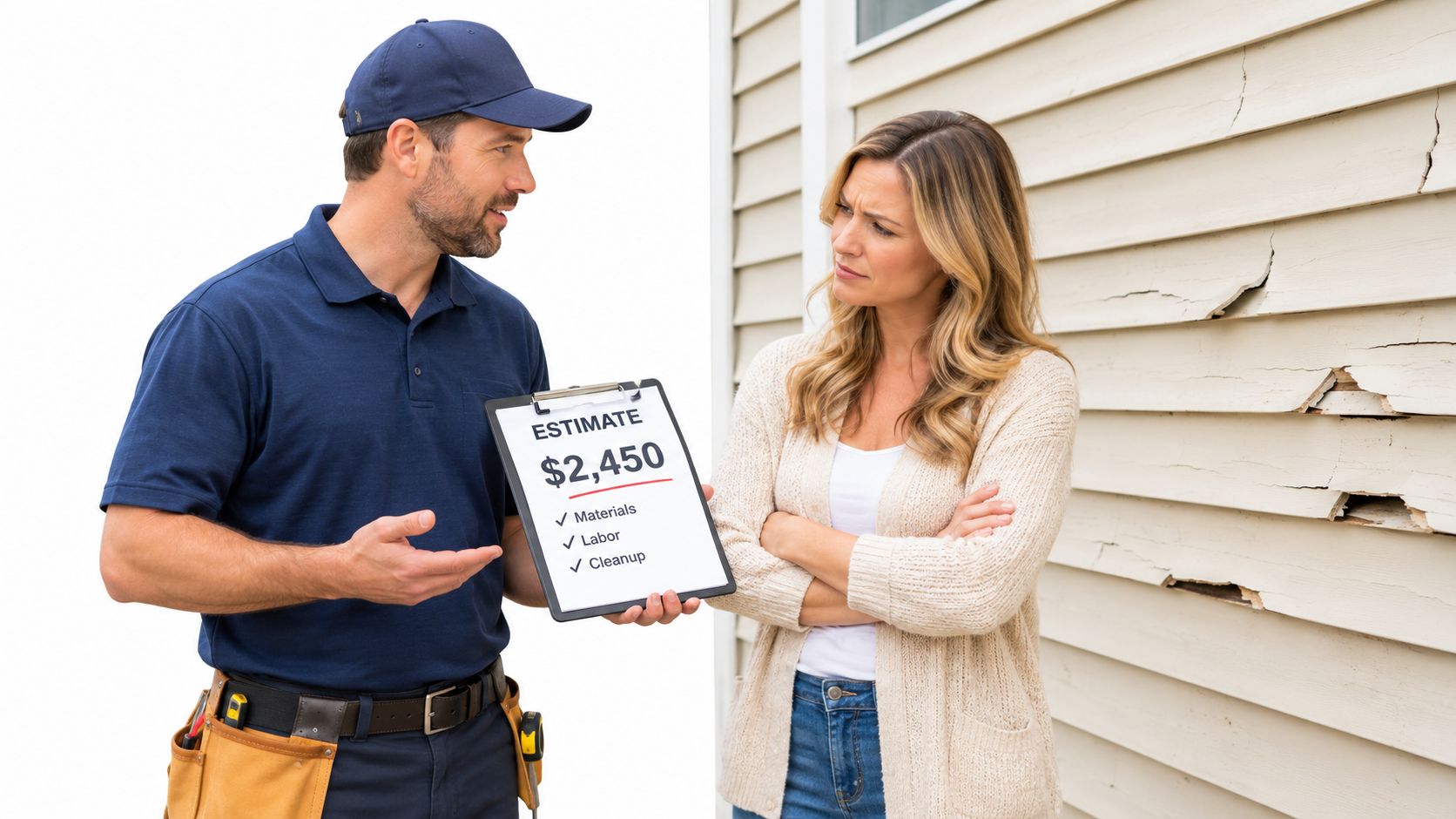
Compare scope before price
Use the bid itself to identify risk. A thorough estimate should answer these questions in writing:
- Does the price include one layer of removal, or every layer discovered?
- Does the crew install housewrap and specify the flashing approach?
- Are sheathing repairs included, excluded, or handled under a defined allowance?
- Does the price cover window, door, corner, soffit, and gable detailing?
- Are permits, disposal, access equipment, and cleanup included?
- What conditions allow the contractor to issue a change order?
The cheapest bid becomes especially dangerous when it omits water-management details. New siding can hide a problem for a while, but it can't compensate for failed flashing or wet substrate. A complete scope may cost more at the start and still represent the lower-cost project because it reduces the chance of paying twice for access, removal, and repairs.
The right question isn't “Who has the lowest price?” Ask, “Which contractor has priced the same finished exterior?” If the answer is unclear, the estimates aren't ready for comparison.
When Insulated Siding Actually Makes Financial Sense
Insulated siding can improve comfort, but it isn't an automatic financial win. An Ohio-focused estimate places insulation-board installation at $0.50 to $2.00 per square foot and cites potential heating reductions of 10% to 20%, while other guidance says the benefit is strongest in homes with poor existing insulation. Those figures and the limitations around payback are discussed in insulated siding maintenance and cost analysis.
The problem is that siding insulation addresses only part of the building envelope. It won't substitute for attic insulation, air sealing, efficient windows, or correction of bulk-water intrusion. If warm air escapes through the attic or bypasses around penetrations, adding foam behind siding may not deliver the result implied by a generic “energy efficient” label.
Diagnose the wall before choosing the upgrade
Ask the contractor to document the proposed assembly rather than just recommending insulated panels. The conversation should cover:
- Added R-value: What thermal resistance does the new insulation provide?
- Continuous insulation: Is the plan a continuous exterior layer, foam-backed siding, or another approach?
- Existing wall condition: What insulation is already present, and are there voids or compression?
- Air leakage: Would attic work or targeted air sealing address a larger source of discomfort?
- Water management: How will the crew flash windows, doors, roof intersections, and penetrations?
- Payback: What is the simple payback based on the added cost, rather than a generic savings promise?
Savings depend on fuel prices, wall area, exposure, and the existing R-value. A wind-exposed house with weak wall insulation may benefit more than a well-sealed home whose main losses occur through the attic. The only responsible comparison separates the upfront premium, expected maintenance, durability, comfort, and potential energy benefit.
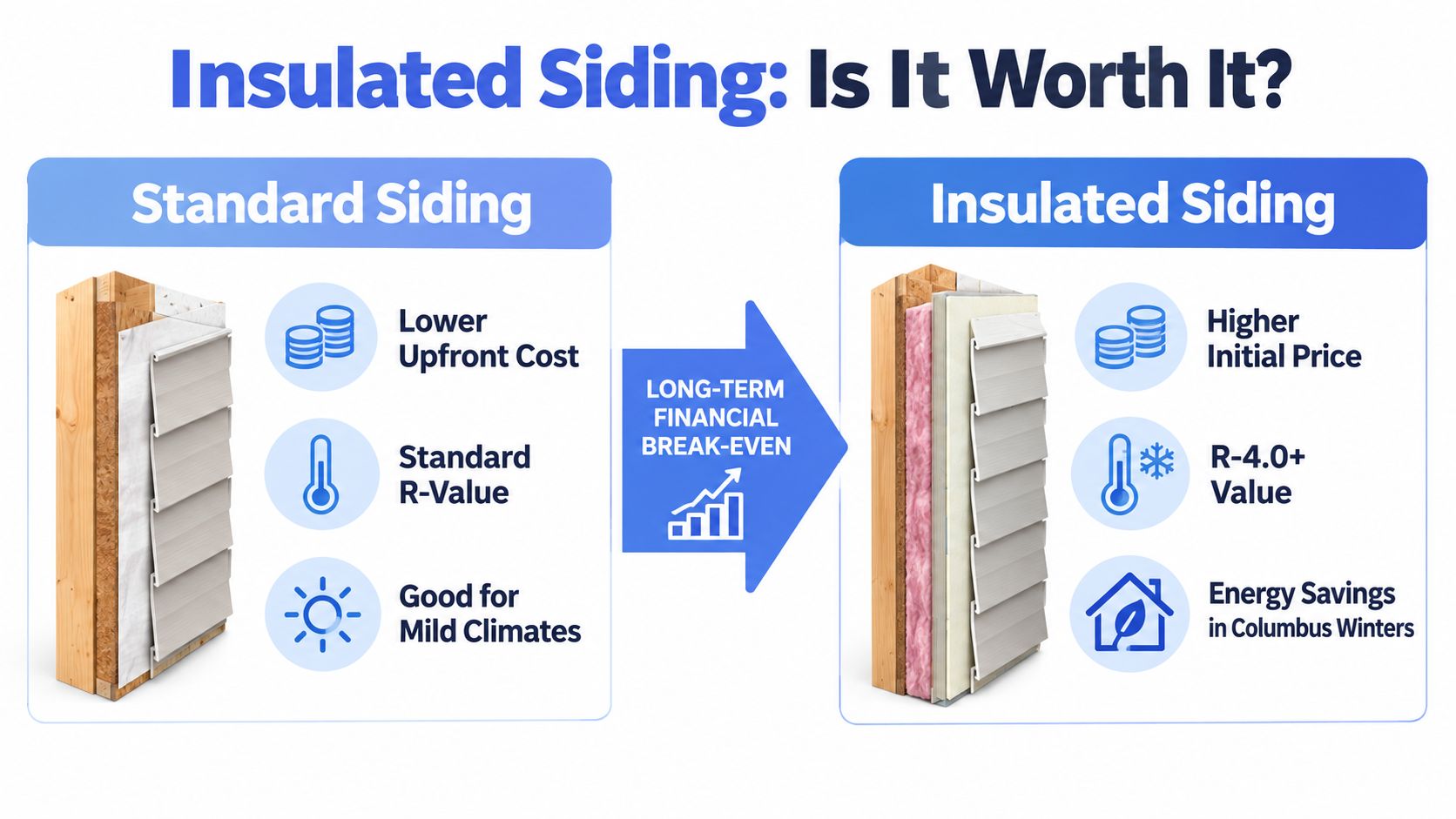
For many Columbus homes, standard siding combined with targeted air sealing or attic work may be the financially stronger plan. Insulated siding can still make sense when the wall assembly needs improvement and the added cost is clearly documented. The decision should follow a diagnosis, not a sales label.
Budgeting and Financing Your Siding Project
A sound siding budget begins with four variables: measured wall area, material selection, removal complexity, and scope completeness. Interior floor area can help describe the house, but it shouldn't be the basis for the siding quantity. Your estimate should show the wall measurement and identify what happens when the crew finds damaged substrate.
Request a written quote that separates siding, trim, soffits, flashing, tear-off, disposal, housewrap, repairs, permits, insulation, taxes, and access-related labor. Then ask the contractor to explain which items are fixed, which are allowances, and which conditions could create a change order.
A short pre-signing checklist can prevent most unpleasant surprises:
- Measurement: Is siding coverage calculated independently from interior floor space?
- Removal: Are tear-off and disposal included for the actual number of layers?
- Water management: Are housewrap, flashing, and window and door transitions specified?
- Substrate: Are sheathing and moisture repairs priced separately or covered by a clear allowance?
- Payment: Are financing terms, pre-qualification requirements, and the total repayment obligation stated plainly?
Licensed contractors may offer financing pre-qualification, but compare the terms with the same care you apply to the construction scope. A practical financial literacy guide can help you review borrowing decisions, monthly obligations, and the difference between an affordable payment and an affordable project.
HIBCO ROOF LLC serves Columbus and central Ohio with siding replacement, including vinyl options, free written estimates, and financing pre-qualification options. Homeowners evaluating siding alongside gutters, windows, or other exterior home improvements should make sure the contractor coordinates those scopes instead of treating each wall component as an isolated repair.
The goal isn't the lowest bid. It's the most complete scope at a price you can understand, with enough detail to protect the wall assembly and prevent avoidable change orders.
If your Columbus home needs new siding, HIBCO ROOF LLC can inspect the exterior, measure the actual siding area, and prepare a free written estimate that separates replacement, tear-off, trim, and potential substrate work. Request an estimate and financing pre-qualification review before you compare bids, so you know exactly what each contractor is proposing.