A lot of Columbus homeowners start this process the same way. A stain shows up on a ceiling after a hard rain. A few shingles blow into the yard. Or a home inspector says the roof is at the end of its life, and suddenly a project you hoped to put off becomes urgent.
That's when the confusion starts. One contractor says you need a full replacement. Another says it can be repaired. One quote looks suspiciously low. Another is packed with roofing terms most homeowners never use. If you're trying to figure out how to choose a roofing contractor without getting cornered into a bad decision, the best move is to slow the process down and verify everything.
Before anyone climbs on your roof, it helps to understand what you're looking at. If you're still not sure whether the problem is age, storm damage, or a repair issue, this guide on how to tell if you need a new roof is a good starting point. If you want a broader property-condition perspective before replacing anything, an expert roof survey guide can also help you understand what a proper assessment should include.
Table of Contents
- Your Guide to a Stress-Free Roof Replacement
- The Pre-Hire Checklist What to Verify Before You Call
- Decoding the Estimate How to Compare Apples to Apples
- Spotting Red Flags Before You Sign the Contract
- Beyond the Contract What to Expect During Installation
- Your Columbus Ohio Roofing Contractor Checklist
Your Guide to a Stress-Free Roof Replacement
A roof replacement feels expensive because it is expensive, but the part that causes the most trouble usually isn't the shingles. It's the hiring mistake. Homeowners get into trouble when they rush after a leak, trust a polished sales pitch, or compare prices without comparing what's being installed.
In Columbus, the most common bad outcome isn't a dramatic collapse. It's a roof that looks fine from the street and starts showing problems later. Flashing details were skipped. The wrong underlayment was used. The permit was never pulled. The crew changed halfway through the job, and nobody owned the result.
That's why the best hiring process is simple, but not casual. Check credentials. Verify permits. Read proposals line by line. Ask who is supervising your project. Ask what materials are being used on every layer, not just the visible shingle.
Practical rule: A roofing estimate should lower your stress, not raise it. If the company makes the job feel more confusing, that usually gets worse after you sign.
The good contractors don't need to force urgency. They answer direct questions, provide paperwork, and explain trade-offs clearly. If one option costs more because it uses a complete roofing system instead of builder-grade accessories, they should be able to show you exactly where that value is.
A skeptical homeowner is usually a smart homeowner. That's especially true if you've never replaced a roof before and don't know which details matter. This guide is built around the questions that effectively protect your house, your budget, and your safety.
The Pre-Hire Checklist What to Verify Before You Call
The smartest time to screen a roofing contractor is before the estimate is scheduled. Once a salesperson is in your driveway, many homeowners feel pressure to keep moving forward. It's better to narrow the field first.
Start with documents, not promises
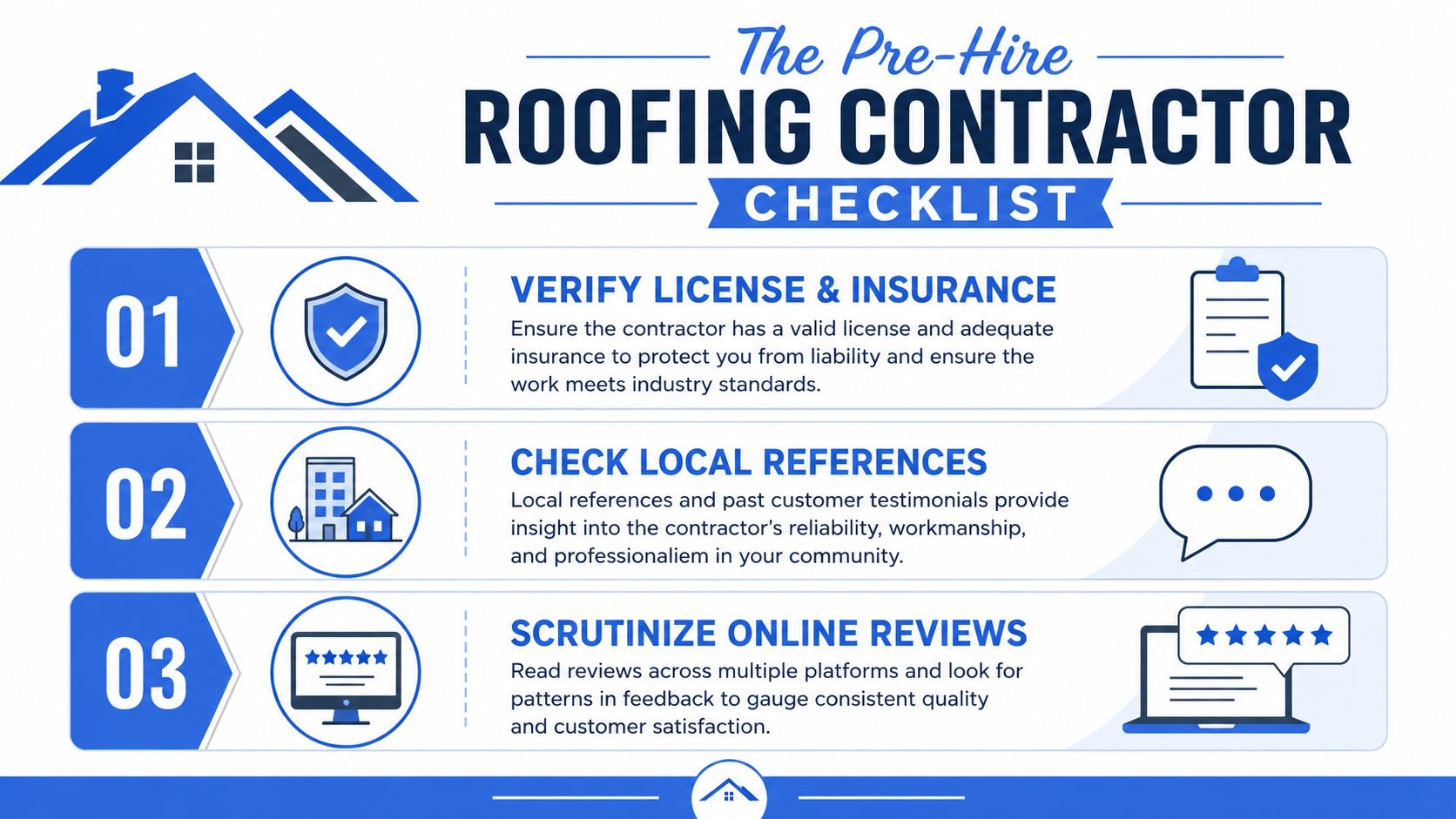
The first three questions are essential in Columbus.
- Are you licensed, bonded, and insured? If the answer is vague, move on.
- Will you pull the required permits? If they expect you to handle permits for their roofing work, that's a problem.
- Can you show me the exact paperwork? Verbal answers don't protect your house.
A critical step is to demand a copy of the actual license document and a Certificate of Insurance, then independently call the insurance carrier to confirm the policy is active. That same guidance notes that contractors with hundreds of reviews averaging 4.5 stars on platforms like Google Business or the BBB are statistically more reliable than companies with only a few perfect scores, because consistency tells you more than a tiny sample does.
Bonding and insurance aren't just paperwork for the office file. If a worker gets hurt on your property or the contractor damages part of the home, those documents affect whether you're protected or exposed.
A proper permit matters too. Municipal permit requirements exist for a reason. They help screen out unqualified operators and create a record that the work was supposed to meet local standards.
Check whether the company is built for local accountability
Online reviews matter, but local proof matters more. Ask for recent Columbus-area references. Ask whether the jobs were completed on time, whether the site was cleaned properly, and whether the homeowner would hire the company again.
You should also look at how the company presents itself locally.
| What to verify | Why it matters |
|---|---|
| Permanent business presence | Fly-by-night operators are harder to reach after the job |
| Local references | Columbus homeowners can tell you how the company handled real issues |
| Written inspection process | Organized companies document what they find and what they recommend |
| Manufacturer certification | Third-party vetting adds another layer of confidence |
Manufacturer credentials can be useful here. For example, Owens Corning Preferred status isn't something a contractor invents for a brochure. A contractor must be invited into that program, and Owens Corning verifies that the contractor holds required licenses, maintains proper insurance, is financially stable, and has an excellent reputation. That doesn't replace your own due diligence, but it does give homeowners a meaningful signal.
If you want to understand what a careful inspection process should look like before you hire anyone, NW Claims Management's roof inspection advice is a useful outside reference. And if you want a local starting point for getting eyes on the roof without committing to work, a free roof inspection in Columbus can help you separate urgent issues from sales pressure.
Ask one blunt question early: “If I call your insurance carrier today, will they confirm active coverage?” A legitimate contractor won't flinch.
Decoding the Estimate How to Compare Apples to Apples
Most homeowners think they're comparing roofing bids by looking at the bottom line. They aren't. They're usually comparing different scopes, different material quality, and different levels of accountability.
What a real estimate should spell out
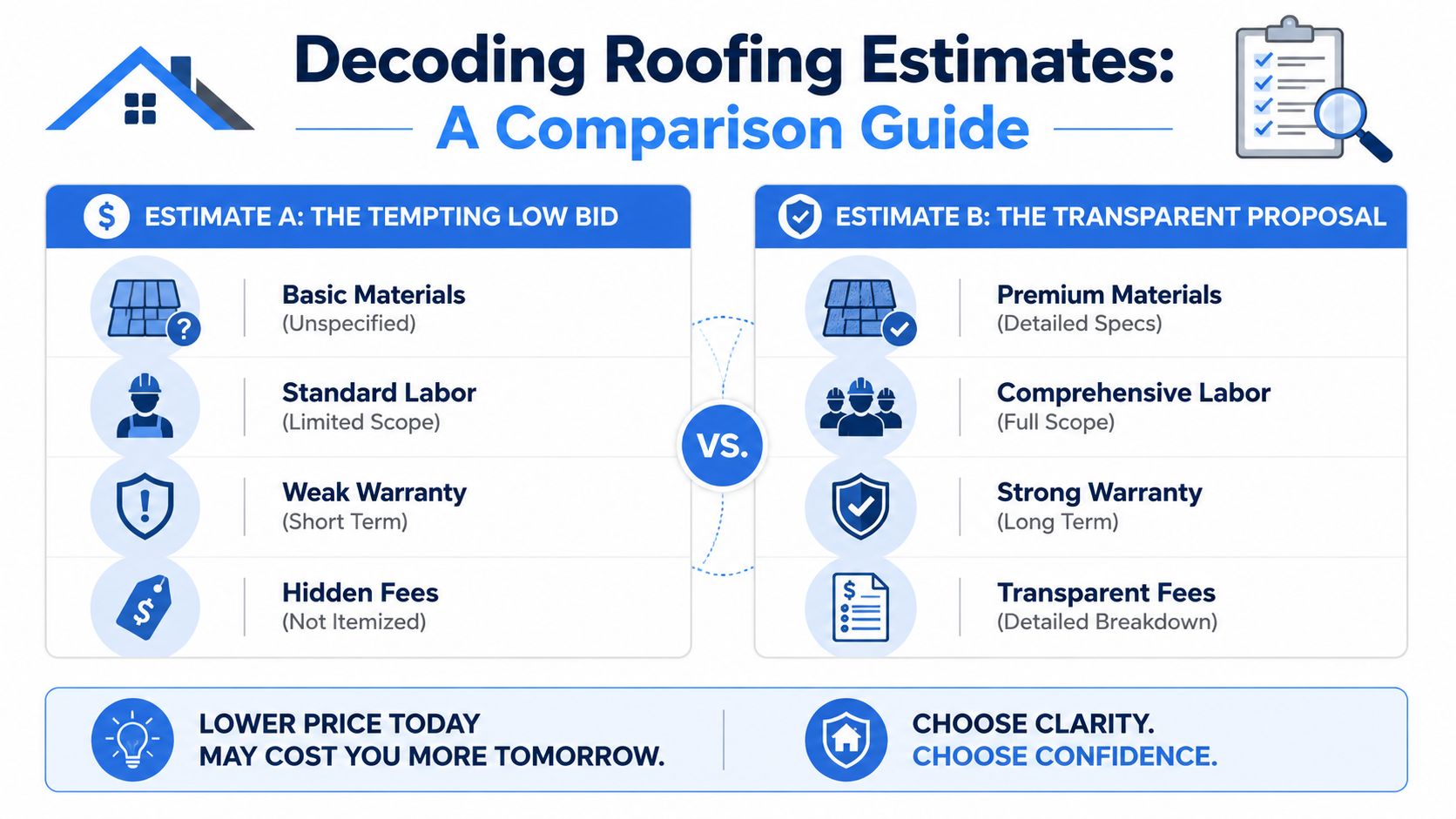
According to the NRCA, homeowners should insist on a written proposal that includes complete descriptions of work, specifications, and payment procedures, and they should keep “healthy skepticism about the lowest bid” because if it “sounds too good to be true, it probably is”. The NRCA explains that low bids often connect to hidden fees or inferior materials in its guidance on selecting a roofing contractor.
That advice lines up with what experienced roofers see every week. A vague estimate gives the contractor room to substitute materials, shrink the scope, or add charges later. A detailed estimate limits those games.
A written proposal should clearly identify:
- Scope of tear-off: One layer or multiple layers, plus disposal.
- Decking procedure: What happens if rotten wood is found.
- Underlayment and leak barrier: Brand and type, not just “felt” or “synthetic.”
- Flashing details: Valleys, walls, chimneys, skylights, vents.
- Ventilation components: Intake and exhaust details where applicable.
- Cleanup expectations: Dumpster handling, debris removal, nail sweep.
- Payment schedule: When money is due and what triggers each payment.
The shingle is not the whole roof
Here's a mistake homeowners make all the time. They hear a strong shingle brand in the sales pitch and assume the whole system is high quality.
It often isn't.
Many contractors advertise a recognizable shingle, then save money on the parts you don't notice from the street. That can mean generic starter, cheaper underlayment, lower-grade ice and water protection, or accessory components that don't match the manufacturer's full system. Some manufacturers also limit warranty coverage depending on the other components used in the roof assembly.
That's why material disclosure matters. A company that names every component is easier to trust than one that only names the shingle.
A short video can help you think through that side-by-side comparison process:
Compare bids side by side
Use a simple worksheet. Put each estimate in its own column and compare details line by line.
Don't ask, “Which quote is cheapest?” Ask, “Which proposal is complete, specific, and built to hold up?”
A practical comparison table might look like this:
| Item | Estimate A | Estimate B |
|---|---|---|
| Shingle brand named | Yes | Yes |
| Underlayment brand named | No | Yes |
| Ice and water protection specified | Vague | Clear |
| Flashing replacement described | Minimal | Detailed |
| Warranty language | General | Written and specific |
| Permit responsibility | Unclear | Contractor states they handle it |
When homeowners ask what often seals the deal for a careful buyer, it usually isn't one flashy feature. It's a combination of full material disclosure, professional behavior, and confidence that the contractor isn't hiding behind broad language.
Spotting Red Flags Before You Sign the Contract
Some contractors should be eliminated before the estimate ends. The hard part is that many of them sound polished. They know how to create urgency, keep the conversation moving, and make a weak contract sound normal.
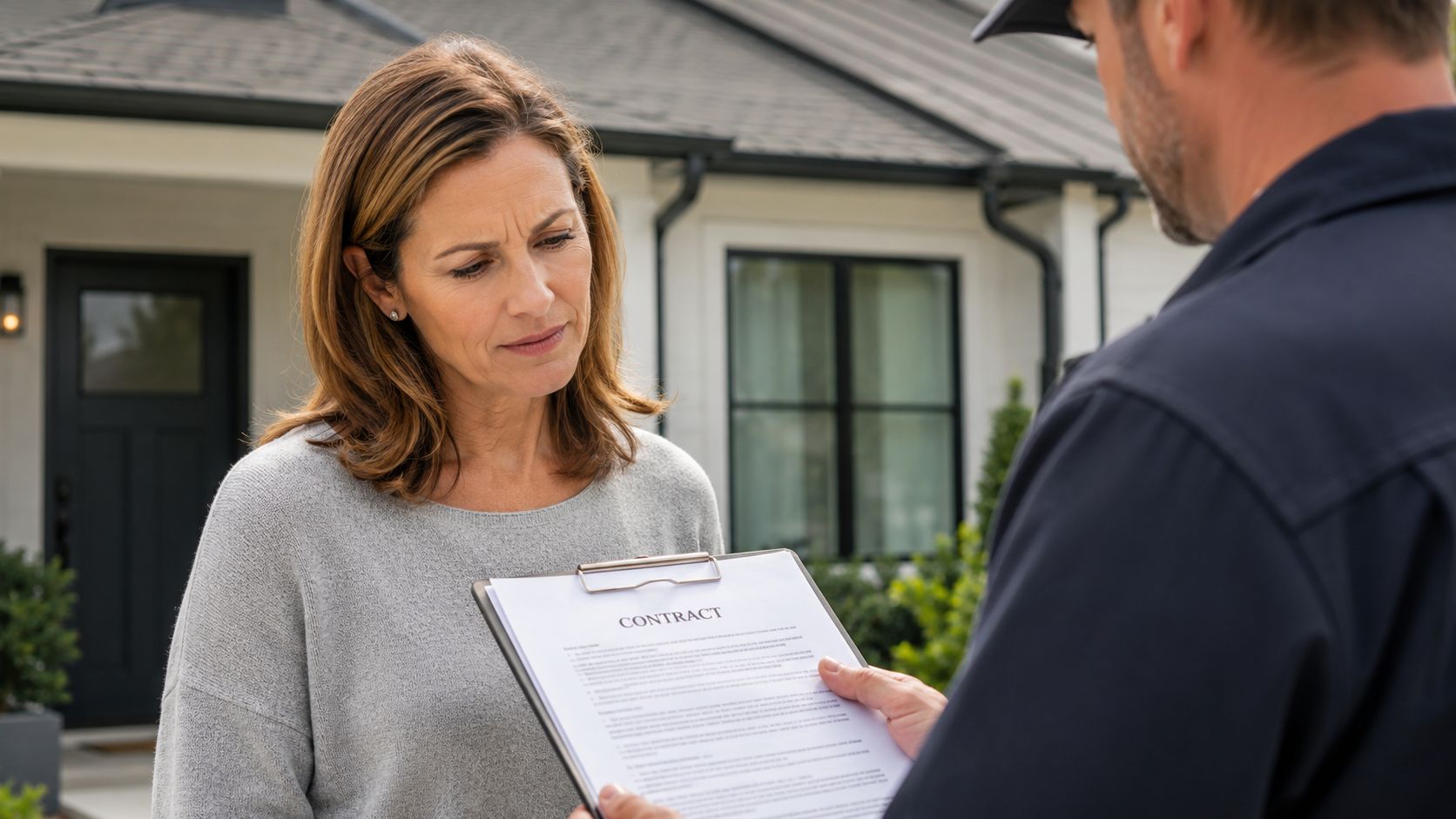
Warning signs that should stop the conversation
Start with behavior. If someone shows up after a storm and pushes for a same-day signature, that's not customer service. That's pressure. Columbus homeowners should be especially careful with storm chasers who don't have a stable local labor base or long-term local accountability.
Watch for these common red flags:
- Same-day pressure: “This price only works if you sign now.”
- No local footprint: No established office, no local references, no clear community presence.
- Loose talk about permits: “You probably don't need one” or “You can pull it.”
- Reluctance to show insurance documents: They talk around the question instead of answering it.
- Verbal-only promises: They say the paperwork will be cleaned up later.
A professional roofer understands that homeowners need time to review a contract. If the contractor acts offended by questions, take that as useful information.
Proposal language that should make you nervous
The contract itself tells you how the job is likely to go. Weak paperwork usually leads to weak accountability.
Look closely for phrases like these:
- “Replace roof as needed” instead of a defined scope.
- “Standard materials” with no brand names or product details.
- “Repairs extra” without explaining how hidden damage is documented and approved.
- “Warranty included” with no separate explanation of labor and manufacturer coverage.
- Missing supervisor details so nobody is clearly accountable on site.
One of the biggest proposal red flags is selective specificity. The shingle may be named in bold print, while more than a dozen other materials are left generic. That's where profit-padding often happens. A roof replacement is a system, not a shingle purchase.
If the proposal is vague before you sign, expect disputes after work starts.
Another warning sign is a contractor who sells image instead of process. Nice brochures don't matter if the contract doesn't identify materials, supervision, cleanup, and payment terms.
Homeowners also tend to trust friendliness too quickly. Good manners are welcome, but they don't replace documentation. The safest decision is usually the contractor whose paperwork stays clear when you start asking harder questions.
Beyond the Contract What to Expect During Installation
A contract can look excellent on paper and still produce a frustrating job if the installation process is sloppy. The crew, the supervision, and the day-to-day professionalism matter just as much as the estimate.
Ask who is in charge on your property
One question gets overlooked far too often: Who is supervising this job from start to finish? Homeowners should ask for the supervisor's name, how large the crew will be, and whether the same workers are expected to stay on site through the project.
This matters even more because a 2024 NRCA survey shows 85% of roofing contractors struggle to hire skilled labor, which affects project timelines and quality. In practical terms, that means workforce stability and project supervision continuity are not minor details. They are core hiring questions.
A good answer sounds concrete. You should hear who the point of contact is, how updates will be delivered, and what happens if weather or decking repairs change the schedule. A weak answer sounds like this: “Our office will keep you posted.”
Professional crews act like professionals
Homeowners know within the first hour whether the crew is organized. Materials should arrive in a controlled way. Tear-off should follow a plan. Landscaping and driveway areas should be protected. Workers should act like they're on someone else's property, because they are.
The most appreciated job-site habits are simple:
- Clear communication: Someone explains when the crew starts, what happens that day, and when they expect to finish.
- Respectful conduct: No chaotic behavior, no blasting music, no unnecessary disruption.
- Clean work zones: Debris is managed during the job, not just at the end.
- Final cleanup: The property is checked carefully, including for stray nails and leftover scraps.
Homeowners consistently respond well to professionalism they can see. They notice when the crew keeps a clean site. They notice when the workers aren't loud and careless. They notice when the contractor explains what materials are being installed instead of treating the whole process like a mystery.
A good roof replacement should feel controlled, not chaotic.
The day of installation should confirm your decision, not make you wonder if you hired the wrong company.
If you get the sense that different crews are rotating through, nobody is introducing themselves, and the supervisor is hard to find, speak up immediately. Problems are easiest to correct while the work is still underway.
Your Columbus Ohio Roofing Contractor Checklist
By this point, the goal isn't to become a roofer. It's to become hard to fool. Homeowners who know what to verify usually make better choices, even if they've never hired for a roof replacement before.
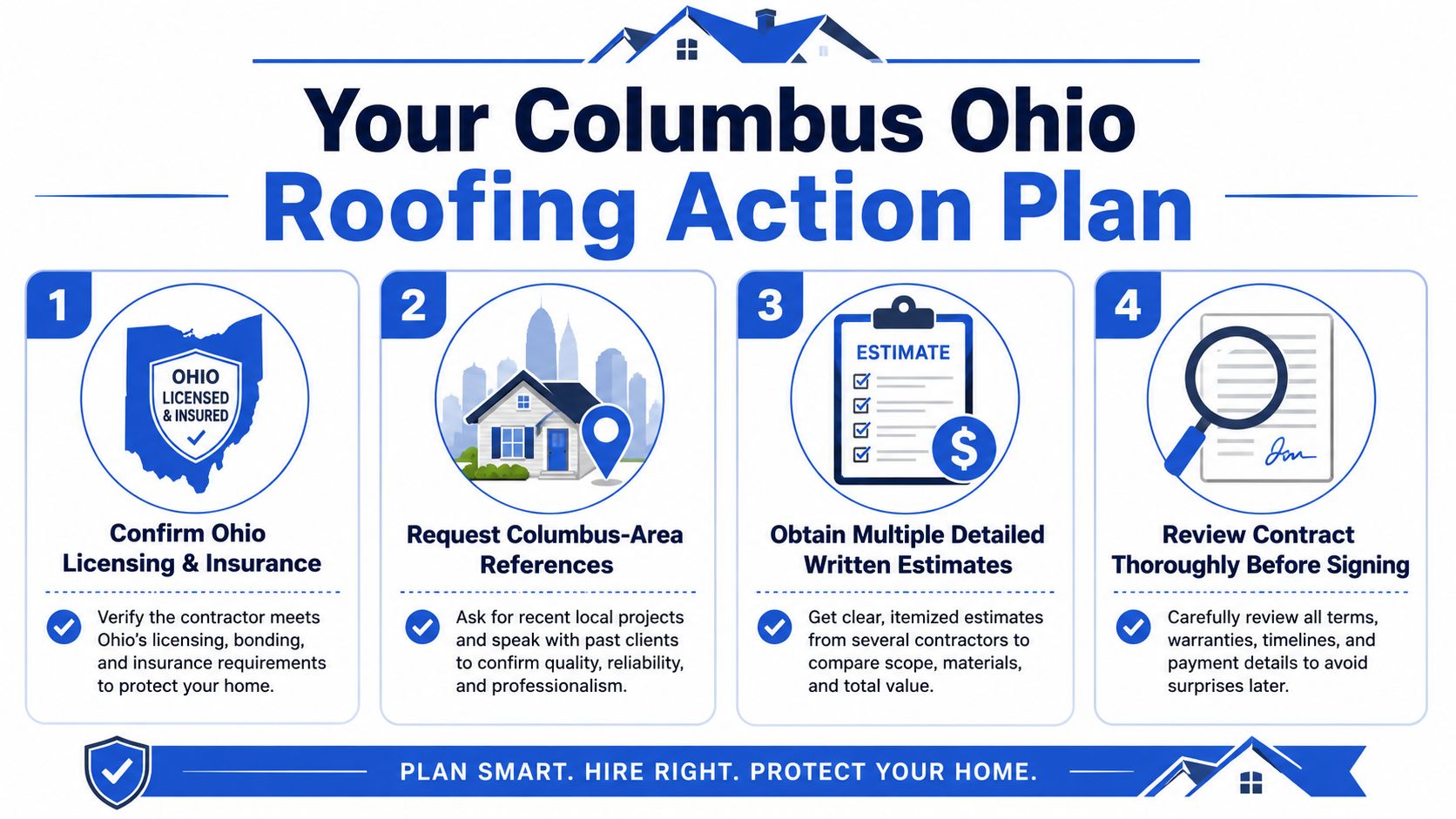
The short list to use before you hire
Keep this checklist handy when you're deciding how to choose a roofing contractor in Columbus:
- Verify paperwork first: Get the license document, bonding information if applicable, and Certificate of Insurance. Confirm that coverage is active.
- Ask who handles permits: The contractor should be prepared to acquire the proper permits required by the municipality.
- Require a detailed written estimate: You want descriptions of work, specifications, payment procedures, and clear material disclosure.
- Check local reputation: Look for Columbus-area references and review patterns, not just star ratings in isolation.
- Ask about the full roof system: Shingles matter, but so do underlayment, leak barriers, flashing components, starter materials, and fastening methods.
- Identify the on-site supervisor: Know who is accountable once the crew arrives.
- Review cleanup expectations: Make sure final debris removal is part of the agreement, not an assumption.
- Read the contract slowly: If language is broad, ask for revisions before signing.
Why verified credentials matter in Columbus
Manufacturer vetting can provide extra peace of mind when you're narrowing the field. For homeowners comparing local options, it helps to understand what Owens Corning Preferred contractor status in Columbus is meant to signal. A designation like that doesn't replace your own review of insurance, proposal quality, and supervision. It does show that the contractor has already been examined on the same basic issues homeowners should care about.
There's also a practical local point here. Columbus weather puts pressure on roofing systems through wind, heavy rain, freeze-thaw cycles, and storm events. That's why system-wide material quality matters more than a one-line promise about “premium shingles.” A roof only performs as well as its weakest component.
The homeowners who feel best after the job usually choose based on trust earned through specifics. They know what materials are being used. They know who is responsible on site. They know the contractor can be found after the work is done.
That's how to choose a roofing contractor. Pick the company that stays transparent when the questions get detailed.
If you want a no-pressure assessment from a licensed and insured local team, HIBCO ROOF LLC helps Columbus-area homeowners with inspections, repairs, roof replacements, storm damage evaluations, and exterior work. If you need clear answers, a written estimate, and a contractor who explains the full roofing system instead of just the shingle, they're a solid place to start.






Leave a Reply