
A lot of Columbus homeowners only think about roof and gutter cleaning when they hear it. Heavy rain starts pounding the shingles, the downspouts can’t keep up, and water begins pouring over the front gutter instead of through it. That moment usually feels like an annoying maintenance issue. In reality, it can become a roofing issue, a foundation issue, and now, in some cases, an insurance issue.
That last part catches people off guard. If a storm damages your home, the condition of your drainage system can affect how the claim is reviewed. Roof and gutter cleaning services aren’t just about keeping leaves out of troughs anymore. They’re part of documenting that you maintained the home the way a carrier expects when weather turns ugly.
Table of Contents
- Your First Line of Defense Against Columbus Storms
- Beyond Clogs The Hidden Risks of Neglected Gutters
- Seven Telltale Signs Your Home Is Calling for Help
- DIY Dangers vs Professional Peace of Mind
- The Professional Process What a Quality Cleaning Involves
- How Often and How Much Gutter Cleaning in Columbus
- Hiring a Pro Your Checklist for Central Ohio
Your First Line of Defense Against Columbus Storms
A common Central Ohio scenario goes like this. The sky turns dark in the afternoon, wind starts pushing rain sideways, and within minutes the gutters are spilling like waterfalls over the edge. You look up and see sheets of water dumping beside the foundation, staining siding, splashing mulch onto brick, and soaking the area around the basement wall.
Most homeowners stop at the visible problem. The gutter is clogged, so the gutter needs cleaning. That’s true, but it’s only part of the story.
Storm response now starts before the storm arrives. If your roofline, gutters, and downspouts weren’t maintained, that can become part of the conversation when a claim is reviewed after wind or water damage. A Q1 2025 Insurance Information Institute analysis found that 42% of denied storm claims in the Midwest included untreated gutter overflow as a root cause, with insurers citing negligent home maintenance as a primary exclusion.
Practical rule: If water management failed before the storm, the storm may not be treated as the only cause of damage.
That’s why cleaning matters as risk management, not just upkeep. A documented service visit shows that someone checked the roof edge, removed obstructions, restored flow, and looked for developing trouble spots before the next weather event hit.
For homeowners dealing with active leaks, missing shingles, or wind-driven rain after severe weather, it also helps to understand how drainage problems connect to larger storm damage repair concerns in Columbus. Overflowing gutters rarely stay “just a gutter problem” for long.
Beyond Clogs The Hidden Risks of Neglected Gutters
Gutters fail in ways homeowners do not always see from the yard. By the time water shows up in a basement corner or paint starts peeling at the eaves, the drainage problem has usually been building for a while.
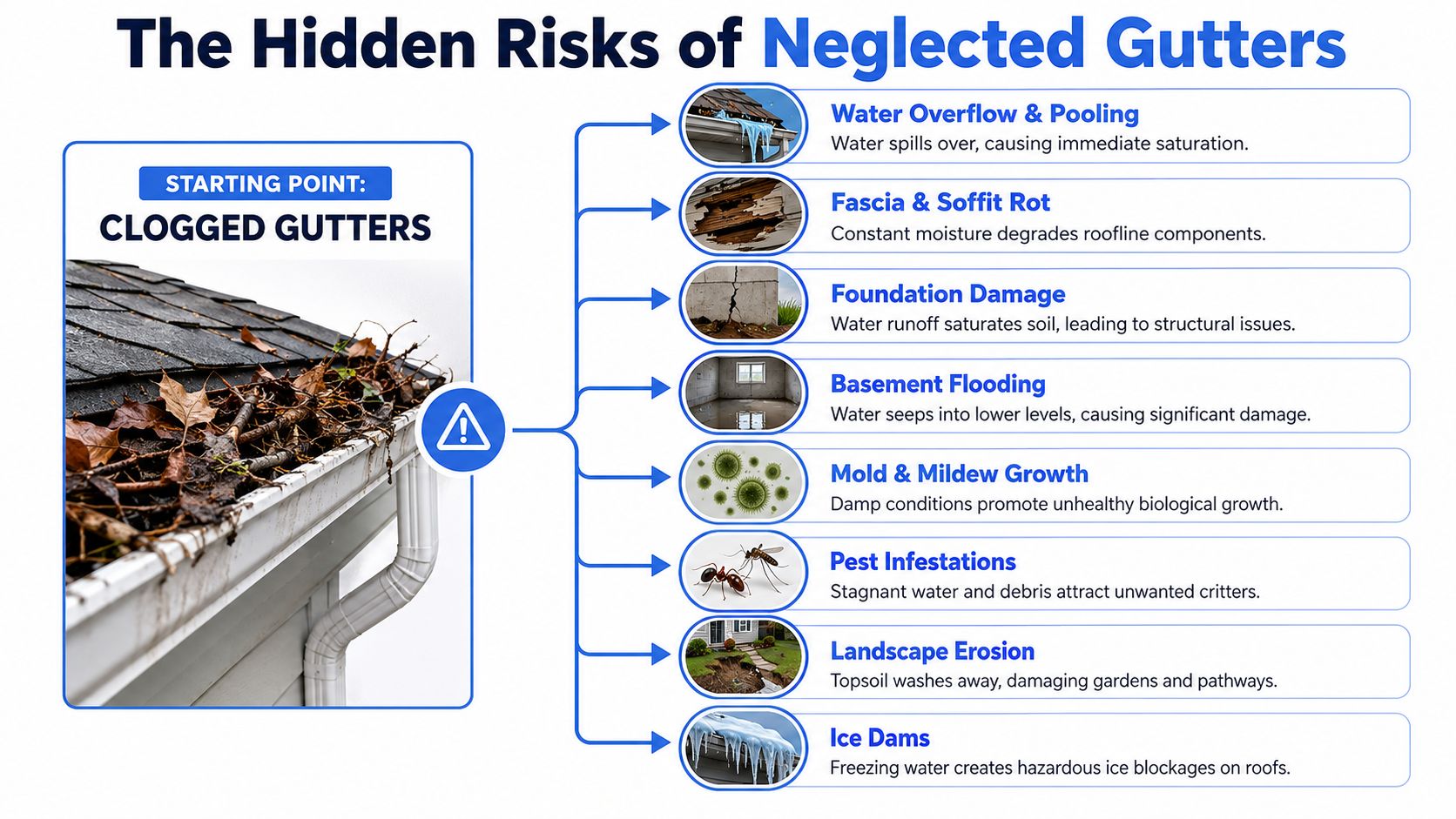
A working gutter system has one job. Catch roof runoff, carry it to the downspouts, and discharge it away from the house. Once leaves, maple helicopters, shingle grit, and roof sludge start restricting that path, water spills where the house was never designed to handle it. Homeowners who need repairs beyond basic cleaning often end up dealing with damaged fascia, loose fasteners, and sections that need gutter repair or replacement in Columbus because the blockage was left in place too long.
What overflow actually does to a house
Overflow changes the direction of water at the roof edge. Instead of dropping into the trough and out through the downspout, it runs behind the gutter, soaks the fascia, and keeps soffits damp. I see this often on homes where the gutter itself is still attached, but the wood behind it has already started to soften. From the ground, the clues are usually subtle at first. Blistered paint, dark staining, and slight waviness along the trim.
The trouble does not stop at the eaves.
Water dumped beside the house saturates soil near the foundation, splashes dirt onto siding and brick, and collects in low spots that stay wet long after the storm passes. In Columbus, that repeated saturation is a real risk factor for basement seepage, settlement concerns, and winter icing near walkways and entries.
Why this gets expensive fast
The cost difference is usually obvious in the field. Cleaning a gutter system is routine maintenance. Repairing rotted trim, replacing wet insulation, addressing stained ceilings, or tracking down moisture that has worked into the wall assembly is not.
Insurance is part of that equation now. After a storm, carriers increasingly look at whether the home was maintained before the loss. If clogged gutters contributed to the damage path, that can complicate a claim that the homeowner assumed would be straightforward. A documented cleaning or inspection helps show that water management was not ignored.
One blocked run can also create several repair tickets at once. I have seen the same neglected gutter lead to fascia rot, mulch washout, foundation splashback, and interior moisture signs in a single season.
Water follows the easiest path available. Good gutter maintenance controls that path before it reaches wood, insulation, or the foundation.
Columbus weather adds a winter layer of risk
Central Ohio puts gutters through more than fall leaf drop. Debris holds moisture in the trough, and once temperatures swing below freezing, that trapped water turns to ice. The gutter gets heavier, joints get stressed, and meltwater loses its exit route.
That is when roof-edge problems start to multiply. Water can back up near the eave, refreeze, and work its way under the first courses of shingles. Homeowners often blame the roof first, but the drainage failure is part of the story.
What neglected gutters tend to attract
Wet debris also creates the kind of environment pests use. Mosquitoes need standing water. Birds use packed organic material for nesting. Insects are drawn to damp buildup along the roofline, especially where overflow has already softened wood.
A clean gutter system will not solve every exterior issue, but it removes one of the most common starting points for moisture damage, pest activity, and claim problems after severe weather.
Seven Telltale Signs Your Home Is Calling for Help
You don’t need to climb a ladder to spot early warning signs. A good ground-level walk around the house after rain, or even on a dry day, can tell you a lot. If you see any of the conditions below, the home is asking for roof and gutter cleaning services, and possibly a closer inspection.
Signs you can spot from the yard
Water pouring over the gutter edge during rain. This usually means the trough is full, the downspout is blocked, or the system can’t move water fast enough because debris has narrowed the channel. Overflow at one corner often points to a clog farther downstream.
Dark streaks or dirty stripes on siding. Water should enter the gutter and leave through the downspout. If it’s running over the face or behind the gutter, siding ends up carrying that stain pattern.
Mud splatter around the foundation. That splash mark tells you roof runoff is landing where it shouldn’t. Over time, repeated saturation near the base of the house raises the risk of seepage and settlement-related concerns.
Plants growing in the gutters. Once seeds settle into wet debris, a gutter can start acting like a planter. By that point, this isn’t light maintenance. It’s a drainage failure that’s been building for a while.
Signs at the roofline and drainage points
Take a slow look up at the eaves and corners.
- Sagging gutter sections often mean trapped debris and standing water have added too much weight, or hangers have loosened.
- Bird or pest activity near the roof edge can signal nesting material and moisture in the gutter channel.
- Granules near downspout outlets may indicate shingle wear. Granule loss doesn’t automatically mean the roof is failing, but it does mean someone should look closer at roof condition and runoff patterns.
For homeowners comparing repair, replacement, and drainage upgrades, a good starting point is reviewing gutter system options for Columbus homes.
If one section is overflowing, assume the rest of the system needs inspection too. Gutters fail in chains, not in isolation.
What these signs usually mean
A few signs point to cleaning only. Others suggest the house needs more than a debris removal visit.
| Sign | What it often means |
|---|---|
| Overflow in rain | Trough clog, blocked downspout, or poor flow |
| Sagging section | Excess weight, loose hangers, or standing water |
| Staining on fascia or siding | Water running over or behind the gutter |
| Granules at outlets | Roof surface wear worth inspecting |
| Persistent wet area by foundation | Drainage discharge too close to home |
The key is timing. Homeowners get into trouble when they wait for interior signs like ceiling stains or basement water. By then, the exterior warning signs have usually been there for months.
DIY Dangers vs Professional Peace of Mind
Many homeowners can handle basic exterior maintenance, and on a single-story home with safe access, light debris, and stable footing, DIY might seem reasonable. But the risk calculation changes fast once the roof gets steeper, the home gets taller, or the gutter layout gets more complex.
That’s especially true in older Columbus neighborhoods with mature trees, second-story eaves, and uneven ground around the perimeter.
Where DIY goes wrong
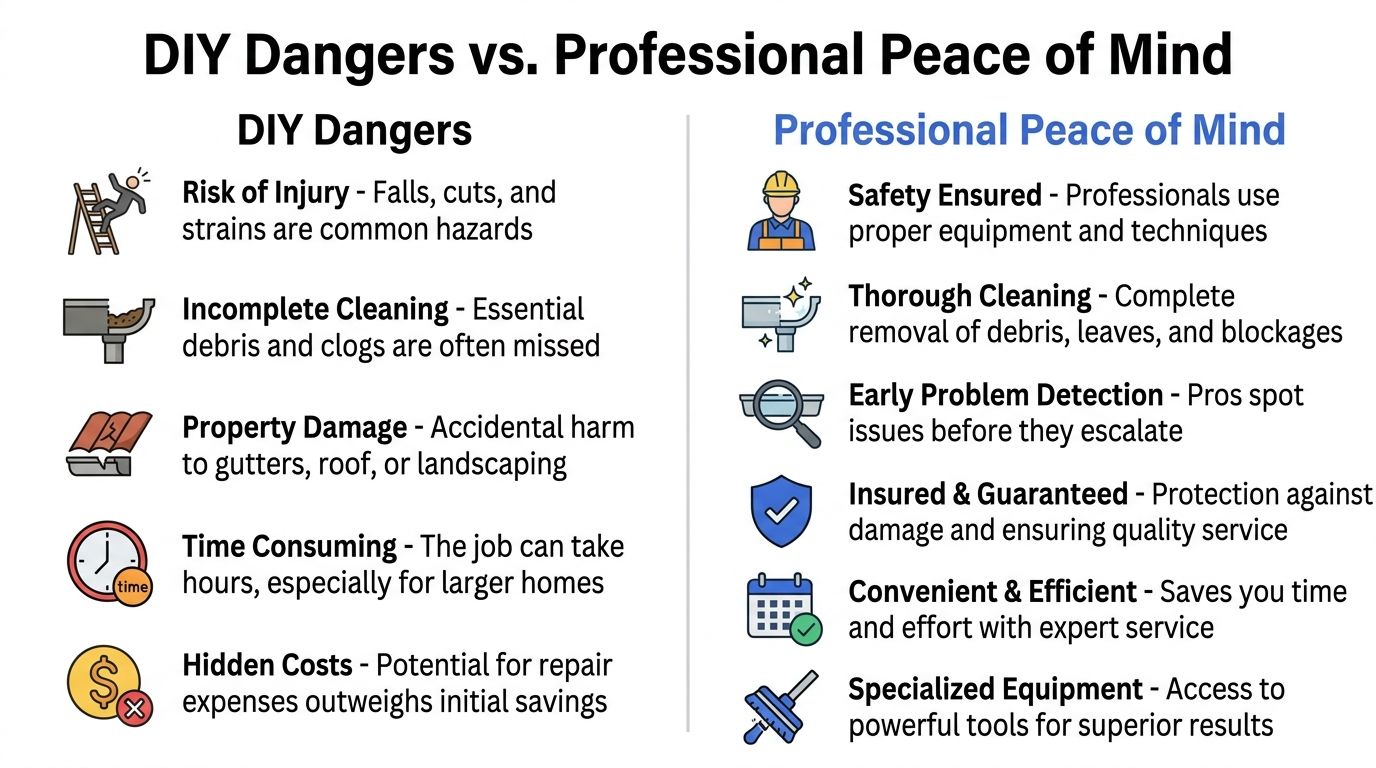
The danger usually starts before the first handful of debris comes out. Ladder angle is off. Ground isn’t level. The homeowner overreaches instead of climbing down and moving the ladder. Or they step onto a roof that’s steeper and slicker than it looked from the yard.
That matters because many people underestimate what “too steep” feels like once they’re on the roof. A roof with significant pitch changes the job from basic cleaning to fall-protection work.
What homeowners often miss in a DIY clean
A lot of DIY cleanings turn into scoop-and-go jobs. Leaves come out, but the work stops there. The downspout doesn’t get pressure-flushed. The elbow clog doesn’t get augered. The standing water that reveals poor slope doesn’t get diagnosed. The hidden issue remains in place, and the homeowner thinks the system is clean because the top looks better.
A partial cleaning can be misleading. The gutter appears open from above while the actual blockage is packed at an elbow transition or lower in the downspout run.
This short video gives useful context on the practical difference between doing the job yourself and bringing in a trained crew.
What professionals bring that DIY usually doesn’t
A professional service should bring more than a ladder and a leaf scoop. It should bring a safe access plan, the right tools, and clear accountability.
Here’s the side-by-side reality:
- Access and safety. Pros use proper ladders, stabilizers, tie-offs, and roof-access judgment. On steep or high sections, that alone changes the risk profile.
- Better blockage removal. Stubborn clogs often need water flushing, augers, or plumber’s snakes at elbows and turns.
- Damage spotting. An experienced crew notices loose brackets, rusting seams, sagging runs, and discharge problems while cleaning.
- Cleanup standards. A real service removes debris from walkways, beds, and hardscape instead of leaving the mess below.
The cheapest gutter cleaning is the one that doesn’t put you in the emergency room and doesn’t leave the actual clog behind.
The decision most homeowners should make
If the house is more than one story, the roof is steep, the rear elevation is hard to access, or you’ve had overflow despite prior cleaning, professional help is the smarter choice. Not because every homeowner lacks the skill, but because roof and gutter cleaning services become a safety job and a diagnostic job long before they look like one.
The Professional Process What a Quality Cleaning Involves
A quality gutter cleaning has to answer two questions at the same time. Will the system carry water off the house during the next hard Columbus rain, and is there any condition here that could create a bigger problem later?
That matters more now than many homeowners realize. After wind and hail events, insurers often look closely at maintenance history when they review water-related damage claims. A documented cleaning that notes overflow points, loose sections, and drainage problems can help show the system was being maintained instead of ignored.
The sequence that separates a real service from a quick cleanup
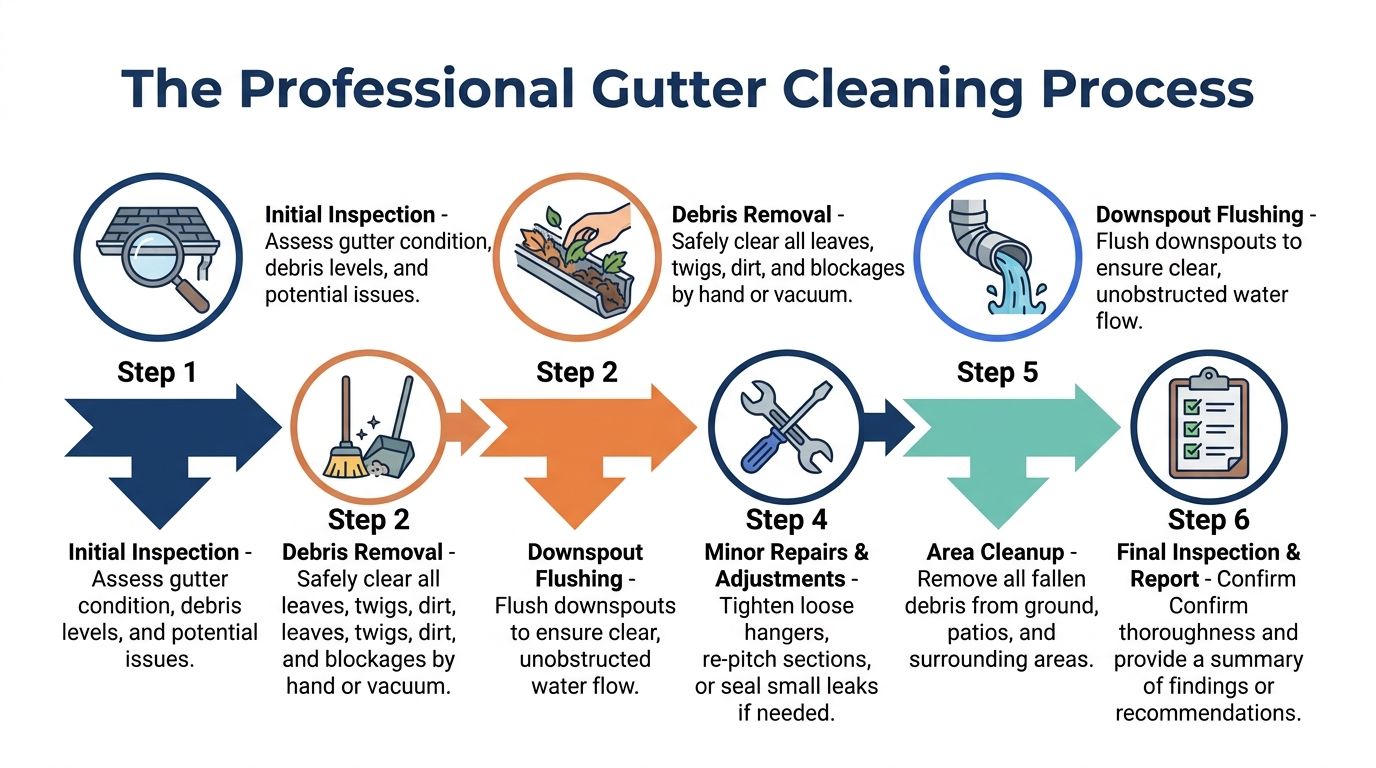
At HIBCO, we treat cleaning as a defined field process, not a leaf-removal stop. The order matters because each step checks a different failure point in the drainage system.
Initial condition check
The crew starts by looking for packed debris, standing water, loose hangers, separated joints, roof-edge wear, and sections where runoff may be overshooting the gutter.Removal of debris from gutter runs and problem roof edges
Leaves, sticks, shingle granules, and sludge are removed in a way that fits the condition of the system. Light buildup can be cleared quickly. Compacted material at outlets and low spots takes slower hand work to avoid bending the trough or damaging seams.Downspout flow test
The system is flushed to confirm water reaches the discharge point. Hidden clogs are revealed by this flush, especially in underground drains and at the first elbow.Obstruction clearing at elbows and outlets
This is one of the most important parts of the job. A gutter can look clean from above and still fail in a storm if the outlet or bend is choked with wet debris.Pitch and attachment review
If water still sits in the channel after cleaning, debris was only part of the problem. The crew should check for reverse pitch, sagging spans, loose fasteners, or a section that has pulled away from the fascia.Site cleanup and documentation
Debris should be removed from beds, walks, patios, and driveways. The homeowner should also get a clear summary of what was found.
Why those middle steps matter
The misses usually happen at the outlet, the elbow, or the low section that has started to sag. Those are the spots that cause repeat overflow onto fascia boards, siding, and foundation beds even after a surface cleanup.
A clean-looking gutter is not the same as a working gutter.
That distinction matters for risk management. If a crew leaves without confirming drainage and noting defects, the homeowner is left with no real proof that the system was functioning before the next storm. For Columbus homes that see heavy spring rain, summer downpours, and winter freeze-thaw cycles, that gap can become expensive fast.
What homeowners should expect before the crew leaves
A professional service should leave behind three things.
- Clear drainage
- A clean property
- A written note of defects or concerns
That final piece gets overlooked. Homeowners should know whether the system has seam failure, loose brackets, poor slope, splash-back at discharge, or sections that may need repair soon. If repeated clogging is tied to tree cover, the right long-term fix may be leaf guard protection for heavy debris areas, not more frequent scooping alone.
Cleaning and repair are different scopes of work. A trustworthy contractor says so plainly. If the gutters are clean but the system still has alignment or fastening problems, that should be documented and explained in plain language, not blurred into a generic “everything looks fine.”
How Often and How Much Gutter Cleaning in Columbus
A common Columbus call goes like this. A homeowner waits until water spills over the front gutter during a hard storm, then asks if one cleaning a year should be enough. Sometimes it is. On many Central Ohio homes, it is not.
The right schedule depends on tree cover, roof pitch, gutter length, and how the system handled the last heavy rain. Cost follows the same pattern. A one-story ranch with open access is a different job than a two-story home with steep rear elevations and gutters packed with wet maple leaves.
For pricing, national home service guides give homeowners a reasonable baseline. Angi reports that professional gutter cleaning commonly falls within a broad national range based on home size and access, with higher pricing for taller homes and tougher setups such as roofline obstructions or heavy debris removal (Angi gutter cleaning cost guide). In Columbus, expect estimates to reflect labor time, ladder risk, downspout flushing, and whether the crew is also clearing roof-edge buildup.
Frequency should be set by what drops on the house and what drains through the system. Home maintenance guidance from the University of Nebraska Lincoln Extension advises cleaning at least twice a year, typically in spring and fall, with more frequent attention where overhanging trees increase debris load (University of Nebraska Lincoln Extension home maintenance guidance).
That lines up with what works in Columbus.
- Twice a year fits many homes with moderate tree cover. Late spring and late fall are the usual service windows.
- Three times a year is common for homes under mature maples, oaks, or sycamores, especially where seed drop and leaf volume are heavy.
- More frequent service may be needed for pine-heavy lots, valleys that collect roof grit, or sections that clog at the same downspout every storm season.
A fixed calendar does not solve every problem. Some homes need a rain-performance check more than another routine scoop-out.
This matters for more than housekeeping. After hail, wind, or heavy rain events, insurance carriers often look closely at maintenance history when they review water-related claims. If gutters were overdue, packed solid, or known to overflow, that can complicate the conversation. Homeowners are often surprised by that. Cleanings that are documented, with dates and notes on condition, help show the home was being maintained before the loss.
A practical Columbus schedule looks like this:
- Late spring to clear pollen strings, seed pods, blossoms, and asphalt granules washed down from the roof
- Late fall after the bulk of leaf drop
- One extra visit for houses with heavy canopy cover, pine needles, or a history of overflow in one trouble area
If a home seems to need cleaning every month or two, the issue is usually not frequency alone. I would start looking for poor pitch, undersized gutters, crushed downspouts, or a guard product that is letting fine debris pack in tight. That is a repair or design conversation, not just a cleaning invoice.
Hiring a Pro Your Checklist for Central Ohio
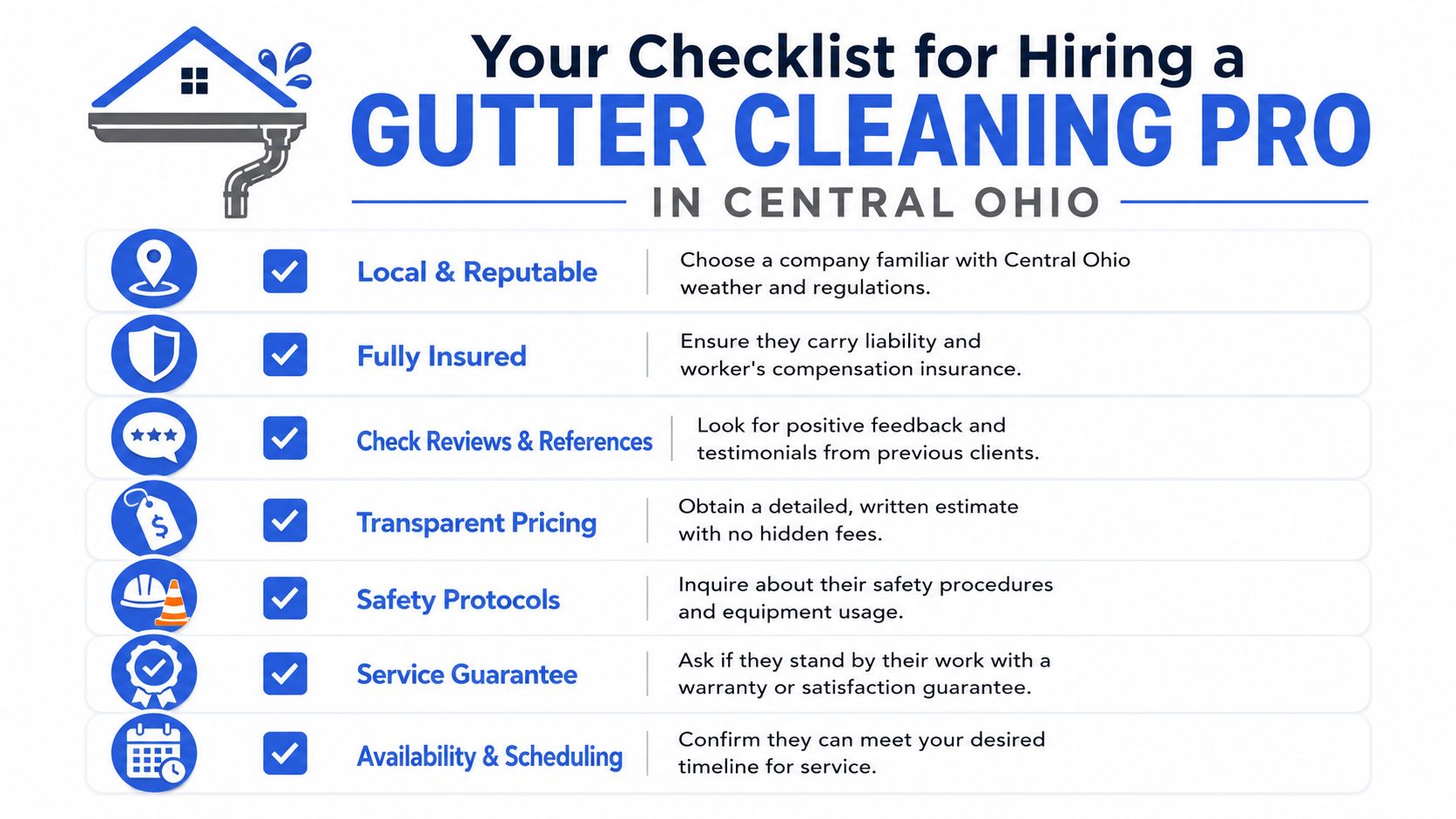
Hiring the right company comes down to standards, not promises. Plenty of crews can remove leaves. Fewer can show that they work safely, document what they found, and stand behind the result.
Questions worth asking before you book
Use this checklist when you call any contractor:
- Insurance first. Ask for proof of coverage. According to professional standards for gutter cleaning providers, reputable companies should carry dual insurance coverage and should offer a 30 to 90 day return-free guarantee if gutters clog after service.
- Scope in writing. The estimate should state whether the service includes clearing gutters, flushing downpipes or downspouts, debris disposal, and minor adjustments or reporting.
- Safety approach. Ask how they access steep sections, second-story lines, and rear elevations. If the answer sounds casual, keep looking.
- Cleanup expectations. Confirm they remove debris from the ground instead of leaving it in beds or on concrete.
- Inspection notes. Ask whether they report loose brackets, rust, failed seals, pest signs, or sagging sections.
What separates a dependable local contractor
The best companies are specific. They tell you what they’ll do, what they won’t do, and what they found after the work is complete. They don’t blur the line between cleaning, repair, and replacement.
Good contractors don’t just clear debris. They reduce uncertainty.
That matters in Central Ohio, where storms, freeze-thaw cycles, and mature tree cover put steady pressure on roof drainage systems. Don’t hire the cheapest name on a list and assume the job is handled. Hire the company that treats roof and gutter cleaning services as home protection work.
If you want a local team to inspect your roofline, clear problem areas, and help protect your home before the next storm, contact HIBCO ROOF LLC. They serve Columbus and Central Ohio with licensed and insured roofing and exterior work, including gutter solutions, storm damage support, and free written estimates.
Created with Outrank tool