If you're replacing a roof in Columbus, you're probably already feeling the tension between two very different kinds of decisions. One is immediate: what can I afford right now? The other is longer term: what will I wish I had chosen after the next hailstorm, the next ice buildup, or the next summer of high attic heat?
That's where most homeowners get stuck on metal roofing vs asphalt. Both can be the right answer. Both can also be the wrong answer if they're matched to the wrong house, the wrong budget, or the wrong installer. In Central Ohio, roofing decisions don't happen in a vacuum. Wind-driven rain, heavy snow, freeze-thaw cycles, hail, and hot humid summers all expose shortcuts fast.
The generic version of this debate usually stops at “metal lasts longer” and “asphalt costs less.” That's true, but it's incomplete. The bigger questions are the ones people often don't hear until after the contract is signed. Can a metal roof really go over old shingles? Are all metal roofs equally strong in hail? Does the lower upfront price of asphalt still look cheaper after a few decades in the same house?
Table of Contents
- Choosing the Right Roof for Your Columbus Home
- Metal vs Asphalt At a Glance Comparison
- Upfront Cost vs Lifetime Value in Central Ohio
- Durability and Performance in Ohio Weather
- Energy Efficiency ROI and Resale Value
- Aesthetics Maintenance and Installation Realities
- Your Decision Checklist Which Roof is Right for You
Choosing the Right Roof for Your Columbus Home
A roof replacement is a big purchase, but it doesn't have to be a confusing one. For most homeowners, the main consideration is narrowing the choice to the material that fits how long you plan to stay, how much storm exposure your property gets, and how much upfront cost you're comfortable carrying.
In Columbus, both asphalt shingles and metal roofing are legitimate residential options. Asphalt remains common because it's familiar, widely available, and easier on the initial budget. Metal keeps gaining traction because homeowners want a roof that holds up better over time and asks less from them once it's installed.
The local piece matters. A roof in Central Ohio has to deal with more than age alone.
- Summer storms: Wind and hail are what often force roofing decisions faster than expected.
- Winter weight: Snow and ice put stress on weak details, especially around valleys, eaves, and flashing.
- Temperature swings: Freeze-thaw cycles expose installation mistakes that might stay hidden in milder climates.
A smart comparison starts with the house in front of you, not with a generic national ranking. A ranch in an exposed subdivision, a two-story home with complex valleys, and a rental property where budget controls every decision may all land on different answers.
Practical rule: Pick the roof system that matches your time horizon. If you're solving for the next few years, asphalt often makes sense. If you're solving for decades, metal deserves serious attention.
Another thing worth saying plainly: product category is only part of the outcome. Installation quality, flashing details, deck condition, ventilation, and whether the old roof is torn off properly all matter just as much as whether the final surface is steel or shingle.
Metal vs Asphalt At a Glance Comparison
A lot of Columbus homeowners start here. They want the fast read before they sort through bids, product lines, and sales talk. At the highest level, asphalt usually wins the first-price conversation. Metal usually wins the long-horizon conversation.
That summary is useful, but Ohio weather exposes the gaps in oversimplified charts. Metal over old shingles is not the same as a full tear-off metal install. And a standing seam roof does not take hail the same way a stamped metal shingle roof does.
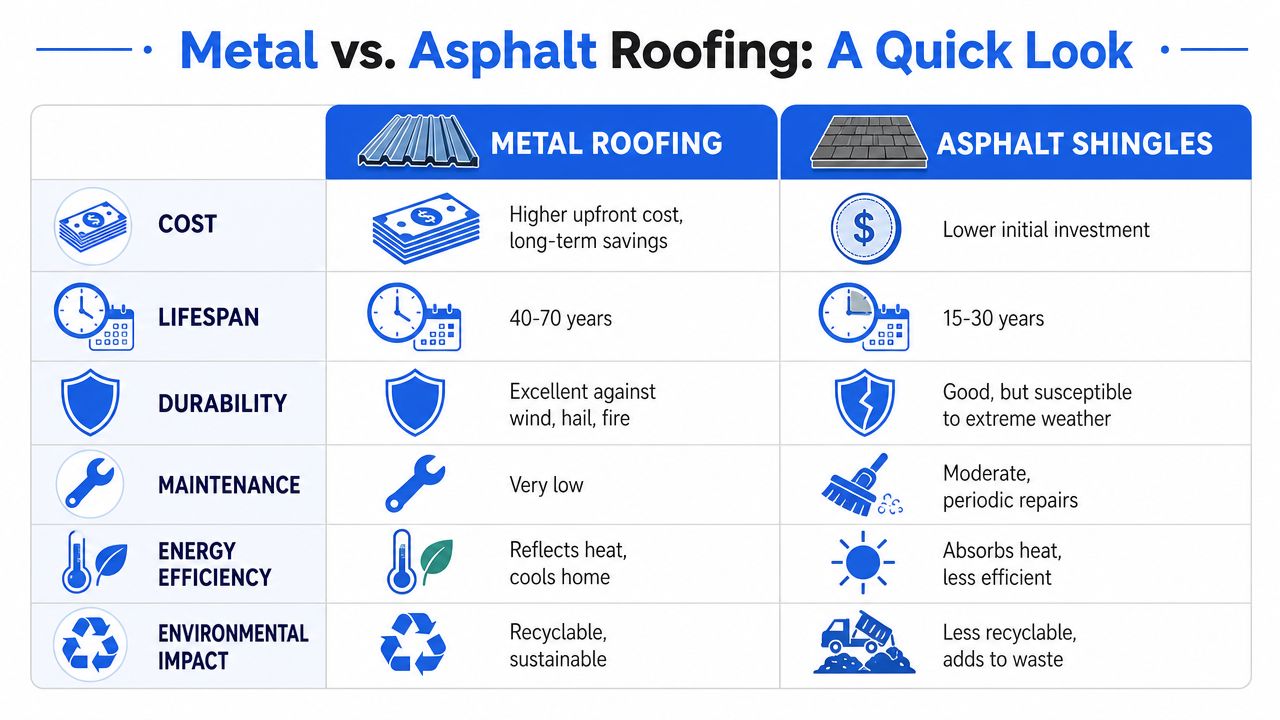
Metal Roof vs Asphalt Shingles Key Differences
| Feature | Asphalt Shingles | Metal Roofing |
|---|---|---|
| Lifespan | Commonly lasts a couple of decades with normal wear and storm exposure | Often lasts several decades longer, depending on panel type, coating, and installation quality |
| Upfront cost | Lower initial cost | Higher initial cost |
| Lifetime cost | Often rises with future tear-offs, repairs, and earlier replacement cycles | Often delivers better long-term value if the home will keep the roof long enough |
| Wind and hail performance | Familiar and repairable, but more likely to lose granules, crease, or age faster after repeated storms | Usually stronger in wind, but hail resistance depends heavily on profile, gauge, and substrate |
| Energy behavior | Absorbs more solar heat | Can reflect more solar heat with the right finish |
| Fire resistance | Lower fire resistance than metal systems | Non-combustible surface material |
If you are trying to compare proposals, it helps to pair this chart with a local roof replacement cost breakdown for Columbus-area homes, because material choice is only one part of the number.
What this table tends to miss
The first missed detail is hail.
Homeowners often hear “metal is tougher” and stop there. In practice, hail performance depends on which metal roof you mean. Standing seam panels can resist puncture well but still show cosmetic denting. Metal shingles and stone-coated systems can behave differently because the profile, panel support, and surface finish all matter. Asphalt shingles can also come through smaller storms fine, then lose years of life after repeated granule loss that is not obvious from the ground.
The second missed detail is the install method.
A metal roof installed over existing asphalt shingles can look attractive on paper because it cuts tear-off cost. On some homes, that approach creates avoidable problems. It can hide rotten decking, make flashing details harder to correct, trap uneven surfaces under the new roof, and complicate future leak diagnosis. In Central Ohio, where freeze-thaw cycles expose weak details fast, those shortcuts matter.
The third missed detail is scope.
Two quotes can both say “metal roof” and cover very different work. One may include full tear-off, deck repair allowance, high-temp underlayment, new ventilation details, and proper trim replacement. Another may price the surface only. Same material category. Very different result.
A good proposal explains the assembly, not just the top layer.
Upfront Cost vs Lifetime Value in Central Ohio
A Columbus homeowner gets two bids for the same house. One is low enough to feel manageable today. The other is a tougher number to swallow, but it may be the last full roof replacement for a long time. That is the central decision.
Asphalt usually wins on upfront price. Metal usually wins on replacement frequency. The mistake is treating that as the whole calculation, especially in Ohio, where weather, labor, tear-off, and repair timing all affect what the roof costs you over the years.
What lifetime value means in the real world
Lifetime value is not just material lifespan. It is how many times you pay for tear-off, dump fees, underlayment, flashings, labor, and the disruption of another roofing project at your house.
That is why a cheaper proposal can still cost more over time.
On a long ownership timeline, asphalt often means you are signing up for another full replacement sooner. Metal can reduce that cycle, but only if the system is installed right and the quote includes the parts that matter, not just the visible panels.
A few cost drivers tend to get missed:
- Repeat tear-offs: Every future replacement brings labor, disposal, and scheduling costs back into the picture.
- Interim repairs: Older shingle roofs are more likely to need patchwork before replacement.
- Market timing: If a roof ages out after a storm-heavy season or during a price spike, you lose the ability to choose the timing.
- Hidden scope gaps: A low number on paper may leave out deck repair, ventilation updates, flashing replacement, or better underlayment.
I see homeowners focus on the roof covering and miss the assembly. That is where bids separate fast.
Why this matters more in Central Ohio
Central Ohio roofs deal with heat, cold, wind, snow, and freeze-thaw swings in the same year. Those conditions shorten the life of average work and expose shortcuts. A roof that has to be replaced earlier than expected is not just a product problem. It is a money problem.
Ice at the eaves is part of that equation too. If you are comparing total ownership cost, attic performance and ventilation belong in the conversation because they affect moisture risk and winter wear. This guide on preventing roof ice dams is worth reviewing alongside roofing bids.
When asphalt is still the smart choice
Asphalt still makes sense for plenty of Columbus homes.
It is often the right fit if you plan to move within several years, if cash flow matters more than long-term payback, or if the house itself does not justify the premium for metal. A good architectural shingle roof, installed well, can be the practical choice.
Metal makes more financial sense when you expect to stay put, want fewer replacement cycles, and are willing to pay more now for that longer horizon. Even then, the details matter. A metal roof installed over existing shingles may lower the first invoice, but that shortcut can change the value equation if it hides deck problems or leaves uneven surfaces underneath.
For homeowners comparing proposals, this breakdown of roof replacement cost in Central Ohio helps frame the numbers correctly. Material is only one line item.
The better question is simple. What will this roof cost during the years you plan to own the house?
Durability and Performance in Ohio Weather
Ohio weather is where the conversation gets real. A roof in Columbus has to survive summer wind events, hail, winter snow loads, ice at the eaves, and the wear that comes from repeated freezing and thawing. Product brochures make everything sound durable. Storm seasons sort out what holds up.
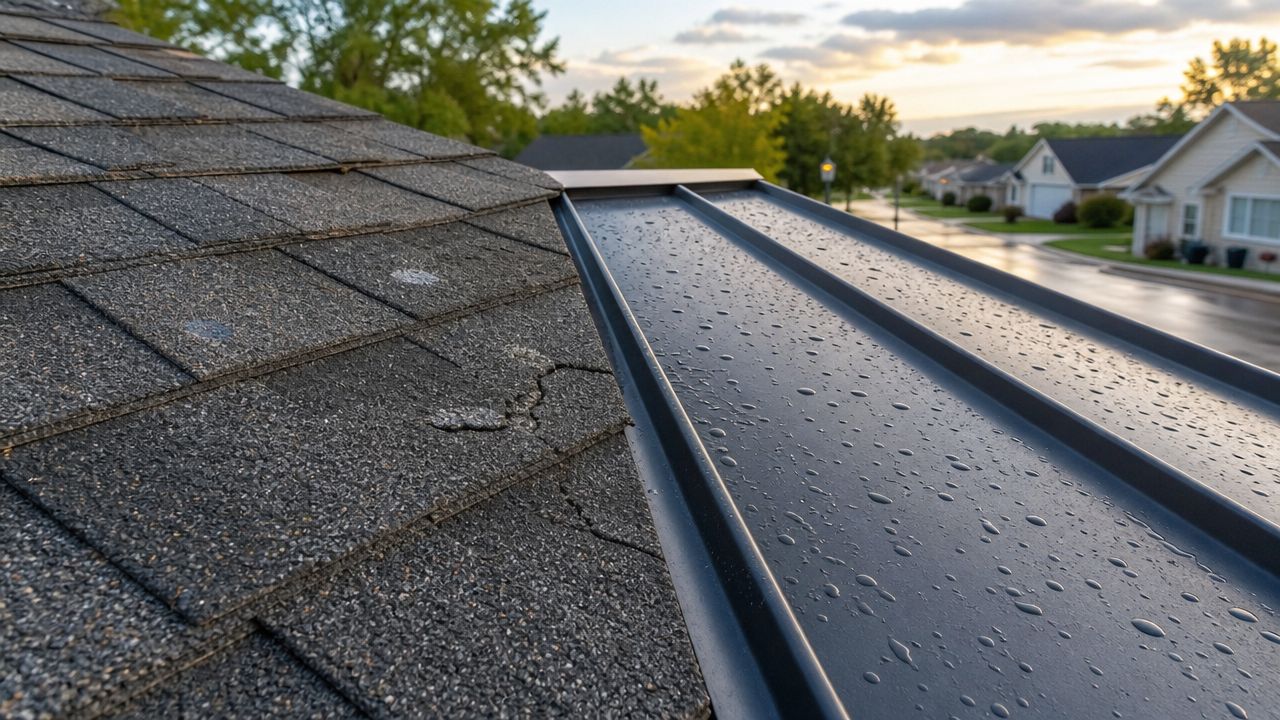
What Ohio weather actually tests
Durability here isn't one category. It's a stack of different stresses.
According to this guide to metal roofing versus asphalt in storm-prone regions, metal roofing systems demonstrate a service life of 40 to 70+ years, while asphalt shingles typically expire between 15 and 30 years. The same source notes metal's resistance to fire, hail impact, corrosion, and wind up to 130 MPH, and it specifically points to stronger performance in heavy snow and high winds for homeowners in places like Ohio.
That matches what matters locally:
- Wind: Loose edges, weak fastening, and aging shingles get exposed fast.
- Snow: Roof geometry and drainage details matter, especially in valleys and at transitions.
- Ice: Ventilation and insulation affect performance just as much as the top layer. Homeowners dealing with winter edge buildup should understand the basics of preventing roof ice dams because no roof covering solves poor heat management by itself.
For some homes, a premium shingle system is still enough. If your house already has that traditional look and you're weighing whether an upgraded laminated product fits better than metal, it helps to understand how architectural shingles differ from basic options.
The hail question most articles oversimplify
This is one of the most misunderstood parts of metal roofing vs asphalt. People hear “metal” and assume “hail proof.” That's too broad to be useful.
Standing seam metal is generally the stronger performer. Metal shingles can still be durable, but they're not automatically equal to standing seam in a hail event. A 2025 Build Show analysis by Matt Risinger stated that metal shingles are about 80% to 90% as hail-resistant as standing seam metal, which is a meaningful difference for homeowners in hail-prone parts of Ohio, as discussed in that Build Show analysis.
If hail resistance is your top priority, don't stop at “metal.” Ask which metal profile you're actually buying.
That distinction matters even more when insurance claims are involved. Cosmetic denting, functional damage, and long-term water-shedding performance are not all the same thing. A homeowner choosing between standing seam and a stamped metal shingle should expect a direct conversation about those differences, not a blanket promise that every metal roof behaves alike.
Energy Efficiency ROI and Resale Value
A July afternoon in Columbus will expose the weak points in a roof fast. The upstairs bedrooms get stuffy, the bonus room over the garage runs hotter than the rest of the house, and the AC keeps cycling. Homeowners usually blame the insulation first, but roof material plays a real part in what that upper floor feels like.
Where the energy difference shows up
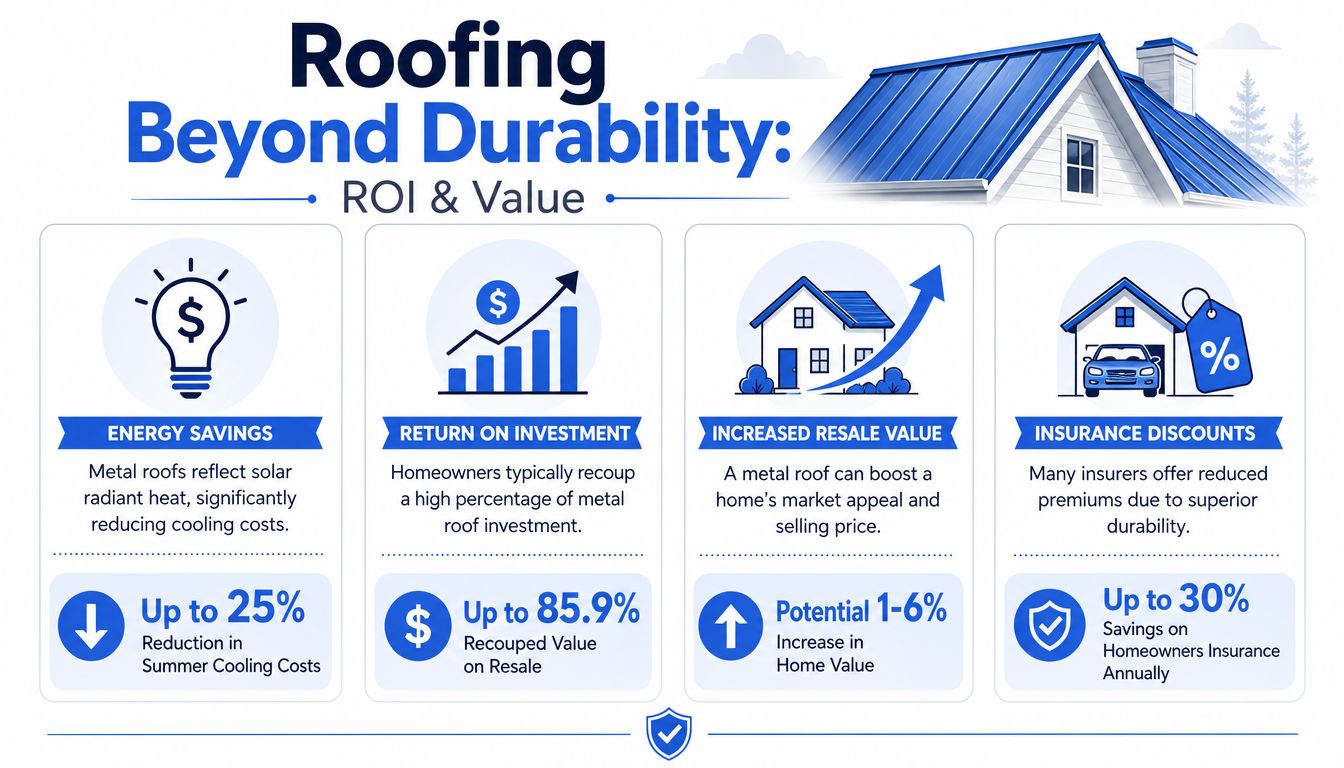
Metal has an advantage in summer because it reflects more heat than many dark asphalt shingle roofs. In real houses, that can mean a cooler attic, less heat radiating into second-floor rooms, and less strain on the cooling system during hot Ohio stretches.
The catch is simple. A roof does not fix bad attic insulation, poor ventilation, leaky ductwork, or old windows. I tell homeowners to treat roofing efficiency as part of the system, not the whole system. If the attic is under-insulated, a metal roof helps, but it will not erase the rest of the problem.
Heat also wears asphalt in a way homeowners can see over time. Curling, granule loss, fading, and early brittleness tend to show up faster on roof planes that bake all afternoon. If you want the practical version of that problem, this breakdown of what heat does to asphalt roof shingles is worth reading.
Energy savings also depend on which metal roof you are talking about. Profile, color, coating, and how the system is installed all matter. That same real-world distinction matters throughout this guide. Just like standing seam and metal shingles do not perform the same in hail, they are not always equal in long-term efficiency or buyer perception either.
How ROI works in the field
Most Columbus homeowners do not get a clean, spreadsheet-perfect return. They get a mix of benefits. Lower cooling demand in summer. Fewer worries about replacing the roof again in 15 to 20 years. Better odds that a buyer sees the roof as an upgrade instead of a looming expense.
That resale piece is real, but it varies house by house. A well-chosen metal roof tends to help more on homes where buyers already expect higher-end materials, cleaner detailing, and longer-term durability. On a modest home in a neighborhood dominated by asphalt, the premium may be smaller even if the roof itself is excellent.
Buyer perception matters more than people think. A new asphalt roof tells buyers the house has been maintained. A quality metal roof often tells them the owner spent more to reduce future hassle. Those are different signals.
As noted earlier from Buckeye Metal Roofing, resale gains and cost recovery can be favorable for metal in the right situation. The practical takeaway is simpler. If you plan to stay for a long time, the return often shows up first in comfort, lower maintenance pressure, and fewer replacement cycles. If you may sell in a few years, metal can still help, but only if the roof style fits the house and the installation looks clean.
One more caution here. Maintenance affects resale too. A roof that is stained, poorly washed, or damaged by aggressive cleaning loses some of the visual and financial benefit, regardless of material. Homeowners comparing upkeep should review Water Works Power Washing roof cleaning advice before treating either roof type like a pressure-washing project.
In Central Ohio, the best ROI usually comes from matching the roof to the house, the budget, and how long you plan to own it.
Aesthetics Maintenance and Installation Realities
A lot of people still picture metal roofing as something you'd only see on a barn, a pole building, or a stark modern home. That's outdated. Residential metal now comes in profiles and colors that fit everything from clean contemporary lines to more traditional homes. Asphalt, of course, still offers the familiar neighborhood look that many homeowners prefer.
Style isn't the limiting factor anymore
The visual choice today is usually less about whether a roof can look good and more about what kind of statement you want the roof to make. Standing seam gives a crisp, architectural appearance. Metal shingles soften that look and can fit homes where exposed panel lines would feel too commercial. Asphalt stays popular because it blends in easily and works with almost any siding package.
This is also where samples, digital previews, and actual neighborhood context matter more than internet photos.
On maintenance, the trade-off is more practical than dramatic. Metal usually asks for less routine attention. Asphalt is easier to patch in some situations, but it's also more likely to need periodic repair as it ages. Either way, homeowners should be careful with cleaning methods. If you're evaluating maintenance habits, this piece on Water Works Power Washing roof cleaning advice is a useful reminder that aggressive cleaning can create roof damage instead of preventing it.
Why metal over shingles is usually a bad shortcut
This is the part that gets glossed over too often in sales conversations. You'll sometimes hear that installing metal directly over existing asphalt shingles saves money because it avoids tear-off. On paper, that sounds efficient. In the field, it often creates risk.
According to Roof Maxx's discussion of metal roofs over asphalt shingles, this practice is frequently unsafe and often violates local building codes in storm-prone regions like Ohio. More important, it prevents inspection of the roof deck, which is critical after hail damage.
That's not a small technicality. Hidden deck rot, soft spots, old flashing failures, and trapped moisture don't disappear because new metal goes on top. They stay buried.
A proper tear-off allows a contractor to check the substrate, repair damaged decking, and build the new system on a sound base. Skipping that step can leave the homeowner paying for a premium roof installed over unknown problems.
- Missed deck damage: You can't fix what you don't uncover.
- Moisture risk: Old layers can trap conditions that shorten system performance.
- Claim complications: Storm-related hidden damage may become harder to document later.
Don't let “save on tear-off” talk you into hiding the most important part of the roof.
That's especially true in Central Ohio, where hail and wind claims are common enough that underlying conditions matter. A new roof should solve problems, not cover them.
Your Decision Checklist Which Roof is Right for You
The best choice usually becomes clear when you stop asking which material is “better” in the abstract and start asking which one fits your house, budget, and plans.
Choose asphalt shingles if most of these sound like you:
- You need the lower upfront path: The project has to work within a tighter immediate budget.
- You may move sooner rather than later: A shorter ownership window often makes the initial savings more important.
- You want the most familiar neighborhood look: Shingles fit almost anywhere without drawing attention.
- Your priority is functional replacement now: You need a dependable roof without stretching into a premium system.
Choose metal roofing if these sound more like your situation:
- You plan to stay in the home long term: Longer ownership gives metal more time to prove its value.
- Storm durability is high on your list: Wind, hail exposure, and snow performance matter to you.
- You want lower maintenance over time: You'd rather pay more once than deal with more recurring roofing decisions.
- You care about efficiency and resale appeal: Reflectivity and stronger buyer perception add to the equation.
If you're deciding between metal types, narrow it one step further:
- Standing seam is often the stronger choice if hail performance and long-term durability are your top concerns.
- Metal shingles may fit better if you want the benefits of metal with a more traditional look.
- Asphalt architectural shingles remain a solid middle path when you want improved appearance and performance without moving into metal pricing.
A final gut-check helps. Ask yourself which regret would bother you more. Paying more upfront than you wanted, or replacing and repairing sooner than you hoped?
For many Columbus homeowners, that's the question that settles the metal roofing vs asphalt decision better than any brochure ever will.
If you want a roof recommendation based on your actual home, not a generic sales pitch, HIBCO ROOF LLC offers free inspections, written estimates, and practical guidance for homeowners across Columbus and Central Ohio. If you're dealing with storm damage, an aging roof, or you're stuck choosing between asphalt and metal, they can inspect the roof, explain what they found, and help you price the right scope without pressure.