You're probably looking at a roofing estimate right now, seeing a line for roof deck protection, and wondering whether it's a real part of the roof or just another add-on. That reaction is normal. Most homeowners know shingles, gutters, maybe flashing. Fewer know what sits underneath the shingles and ultimately determines whether the whole system holds up or starts leaking.
The short answer is simple. Roof deck protection is the waterproofing layer installed between your roofing material and the wood deck underneath. It protects the structural part of the roof from water intrusion, and it matters enough that the market for it is projected to grow at about 6% CAGR over the next five years as more of the industry treats it as a core part of roof longevity, not an optional upgrade (market outlook for roof deck protection).
For homes in Central Ohio, that hidden layer matters even more than many people realize. A roof here doesn't just deal with rain. It deals with wind-driven storms, freeze-thaw cycles, humid summers, and the awkward low-slope roof sections that show up over porches, dormers, and additions. Those are the areas where generic advice often falls apart.
Table of Contents
- Your Roof's Unseen Shield
- What Is the Roof Deck and Why Protect It
- The Key Elements of Roof Deck Protection
- Getting the Installation Right
- Protecting Your Roof in Central Ohio's Climate
- When Your Roof Deck Needs Attention
- HIBCO ROOF Your Expert in Columbus Roof Protection
Your Roof's Unseen Shield
A homeowner usually learns about roof deck protection at the worst possible time. The shingles are aging, a stain appears on a bedroom ceiling, or an insurance claim turns into a longer conversation than expected. Then a quote shows up with line items that sound technical, and the value isn't obvious.
That's where confusion starts. People see shingles as the roof because shingles are visible. Roofers know better. The visible layer sheds most of the weather, but the backup water barrier under it is what protects the wood deck when wind pushes rain under a course, when ice backs water up, or when a detail around a vent gets stressed over time.
Practical rule: If the layer beneath the shingles fails, the deck starts taking the hit, and repairs get more expensive fast.
Roof deck protection isn't one universal roll used the same way on every house. It's a group of materials and details chosen for slope, layout, climate, and vulnerability points. On one roof, a synthetic underlayment may be the right field material. On another, a low-slope transition may need a fully adhered membrane because standard coverage won't stay watertight there.
Homeowners don't need to memorize every product name. They do need to know this. The hidden layer under the shingles protects the part of the house that gives the entire roof its structure. If that layer is chosen poorly or installed carelessly, the roof can look fine from the street while trouble is developing underneath.
What Is the Roof Deck and Why Protect It
The roof deck is the wooden surface attached to the rafters or trusses. Shingles, underlayment, and other roofing components all rely on it. If you want a simple analogy, think of it as the roof's subfloor. It's the structural base that everything else fastens to.
That base has to meet real structural standards. For framing spaced 16 inches on-center, code requires a minimum sheathing thickness of 7/16-inch for OSB or 15/32-inch for plywood under IRC Table R503.2.1(1) (roof sheathing code overview). That requirement tells you something important. The deck isn't trim work. It's a load-bearing part of the house.
What the deck actually does
The deck supports:
- Roofing materials like shingles and flashing
- Weather loads such as snow and driven rain
- Worker movement during installation and repair
- Fastener holding power so the outer roof system stays attached properly
If the deck is soft, delaminated, rotted, or swollen, even good shingles won't perform the way they should. Nails don't hold as well. The surface telegraphs irregularities. Leak risk goes up because the whole assembly loses stability.
What damages it
Water is the main enemy, but not always in the obvious way. Sometimes it comes from a direct roof leak. Sometimes it enters at a valley, wall intersection, or low-slope tie-in. Sometimes attic moisture contributes from below. Once the deck stays wet long enough, you start seeing rot, mold, staining, and eventually structural weakness.
A lot of homeowners focus only on shingle color and replacement price, which is understandable. Budget matters. If you're trying to think through replacement scope and what drives a quote, this Homeowner's guide to Marietta roof costs gives a useful breakdown of how roof complexity and hidden conditions can affect pricing.
Protecting the deck protects more than lumber. It protects the fastening surface, the roof shape, the attic below, and the money you just spent on the new roof.
Here's the practical takeaway in plain terms:
| Roof component | What happens if it gets neglected |
|---|---|
| Shingles | Surface wear and visible weathering |
| Flashing | Localized leaks at edges and penetrations |
| Roof deck | Structural damage that can spread under large sections |
That's why roof deck protection deserves attention before a single shingle goes back on.
The Key Elements of Roof Deck Protection
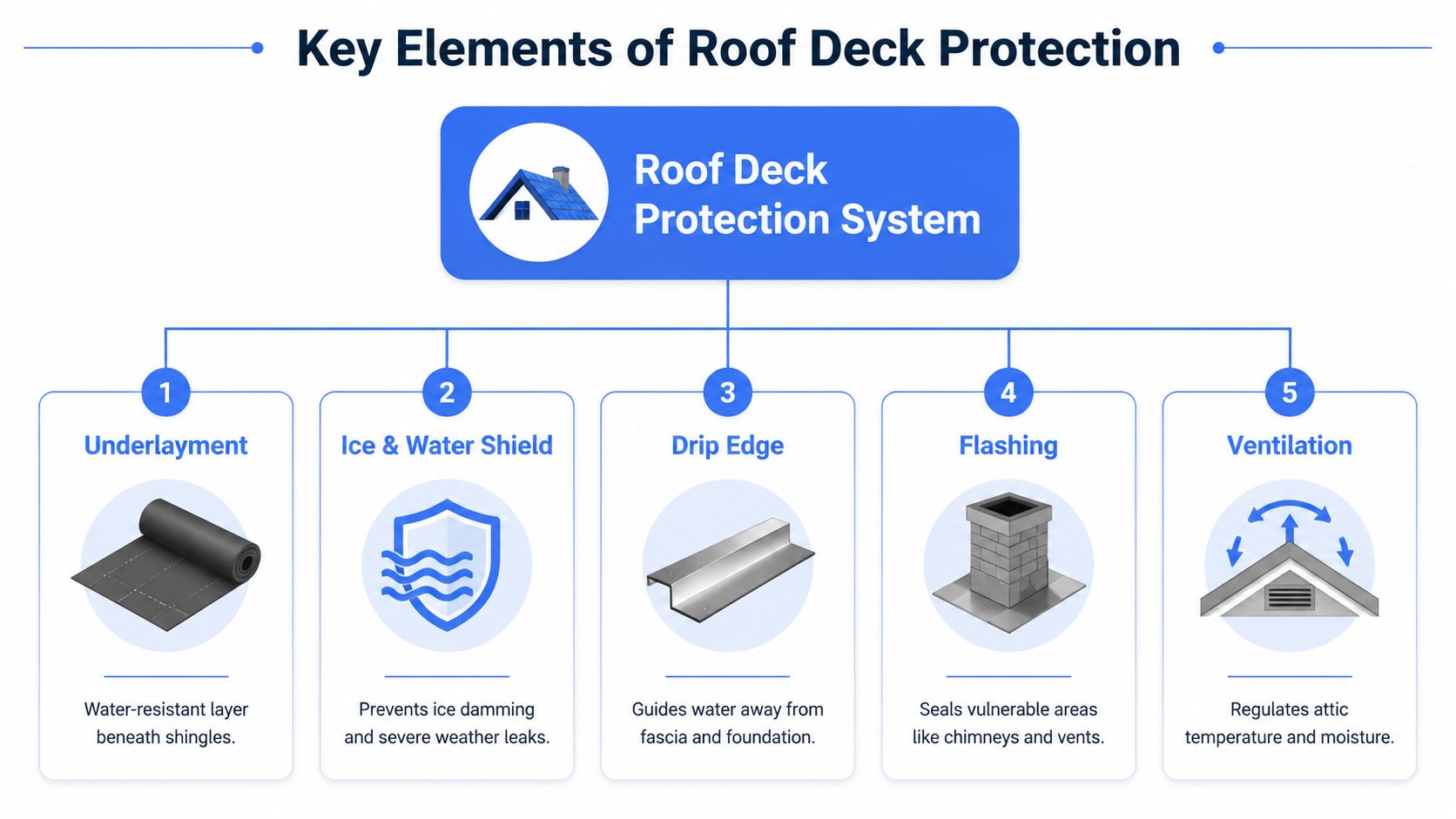
A lot of estimates make roof deck protection sound like one product. It isn't. It's a layered system, and each part has a different job.
Underlayment does the broad coverage work
Underlayment is the full-coverage sheet installed over the deck and beneath the finished roofing material. In most residential steep-slope work, this is the main secondary water barrier across the field of the roof.
The old conversation used to be felt versus felt. Today, the comparison is often synthetic underlayment versus organic felt. Modern synthetic products have significantly higher tear resistance and don't absorb moisture when wet, while conventional organic felt can absorb water, wrinkle, and contribute to roof rot (synthetic vs felt underlayments).
That difference matters on active jobsites. If weather changes during installation, a material that resists tearing and doesn't drink in water gives the deck a better chance of staying protected until the finished roof is on.
Ice and water shield handles the danger zones
Not every area of a roof faces the same level of risk. Eaves, valleys, wall intersections, skylights, plumbing penetrations, and other transitions take more abuse than open field areas. That's where self-adhered membranes, often called ice and water shield, earn their keep.
This material is used where water tends to back up, linger, or push sideways. It also helps around places where fasteners and cut edges create more opportunities for trouble. On Ohio homes, these zones deserve close attention because winter conditions and storm-driven rain expose every shortcut.
A good roofer doesn't just throw the same material everywhere and hope for the best. The layout should reflect where the roof is most vulnerable.
Flashing drip edge and ventilation complete the system
Flashing and drip edge are metal details, but they're part of roof deck protection because they control where water goes. Drip edge pushes runoff away from the roof edge and helps protect fascia and edge decking. Flashing seals joints around chimneys, vents, sidewalls, and other interruptions where shingles alone can't do the job.
Ventilation matters for a different reason. It helps manage heat and moisture moving through the attic assembly. Without proper airflow, the underside of the deck can stay damp longer than it should, and that creates conditions roofing materials can't solve from above alone.
For homeowners who want a practical maintenance mindset after installation, this guide on residential roof care is useful because it focuses on regular observation and upkeep rather than waiting for obvious failure.
A simple way to think about the system is this:
- Underlayment covers the broad surface.
- Ice and water shield protects high-risk sections.
- Flashing seals interruptions and directional joints.
- Drip edge controls runoff at the perimeter.
- Ventilation helps prevent moisture problems from inside the house.
Miss one of those, or install one of them poorly, and the deck can still end up exposed.
Getting the Installation Right
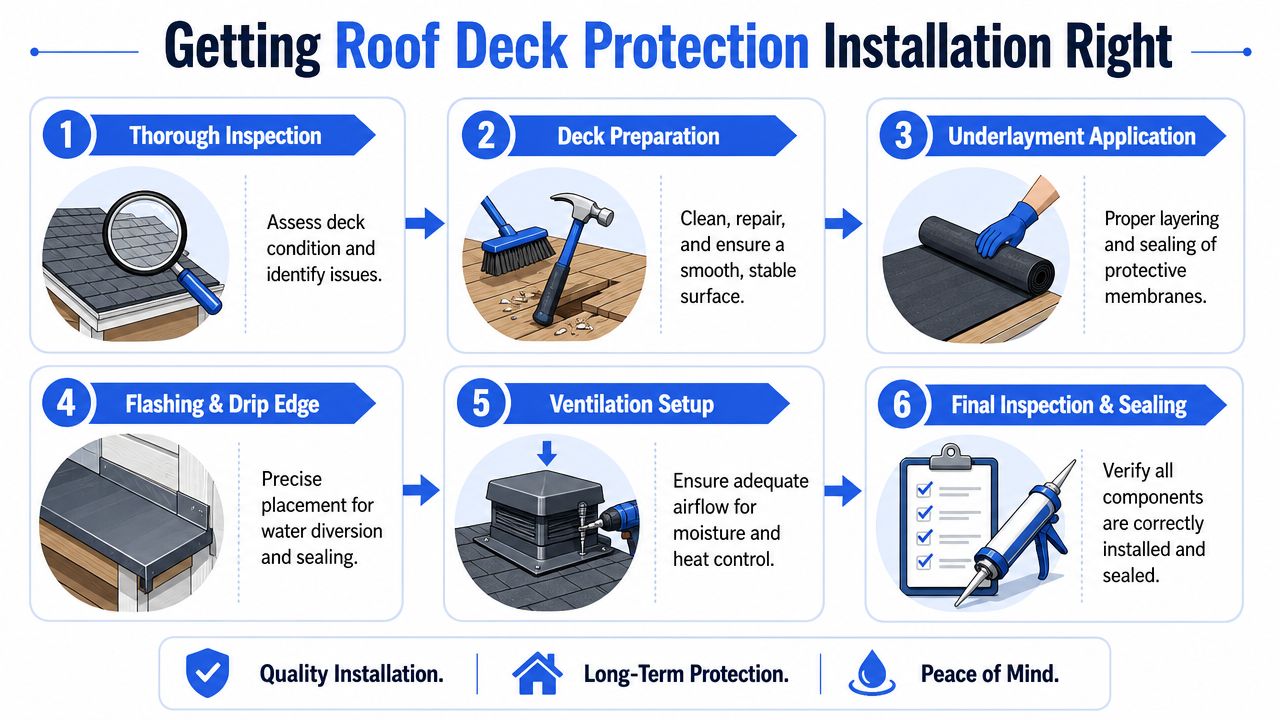
Good materials don't rescue sloppy installation. That's where many roofing problems start. A roof can look neat from the driveway and still be vulnerable because the water-shedding sequence underneath was handled incorrectly.
Early in the job, the crew should inspect the deck, replace compromised sections, and prep a clean, stable surface before any protective layer goes on.
Slope changes the installation rules
The biggest mistake I see in homeowner conversations is treating every roof plane the same. They aren't the same. Low-slope roof applications from 2:12 to less than 4:12 require double-coverage installation of synthetic underlayment, and the fastening must use plastic 1-inch head cap nails instead of staples to reduce leak risk (CertainTeed DiamondDeck technical specifications).
That detail matters because low-slope sections shed water more slowly. When water lingers longer, the roof needs more overlap and more reliable fastening. Staples are a bad shortcut here. They don't provide the same hold or sealing performance as proper cap fasteners.
On a low-slope section, fastener choice isn't a small detail. It changes how well the underlayment stays in place and how reliably it sheds water.
If you're comparing bids, ask how the contractor handles slope transitions and underlayment fastening. If you want a framework for evaluating crews before signing, this guide on how to choose a roofing contractor helps homeowners ask better questions.
Details that separate solid work from callbacks
Installation quality shows up in the details homeowners rarely see once the roof is finished:
- Correct overlaps: Courses need to lap in a way that sheds water naturally downhill.
- Clean transitions: Valleys, walls, vents, and skylights need deliberate sequencing, not patchwork.
- No staple shortcuts: Especially on vulnerable sections, staples can become failure points.
- Tight edge work: Drip edge and flashing should direct water out and away, not trap it.
A short visual helps if you want to see the sequence in action.
The homeowner's role isn't to supervise every fastener. It's to understand enough to tell the difference between a roofing system and a pile of materials.
Protecting Your Roof in Central Ohio's Climate
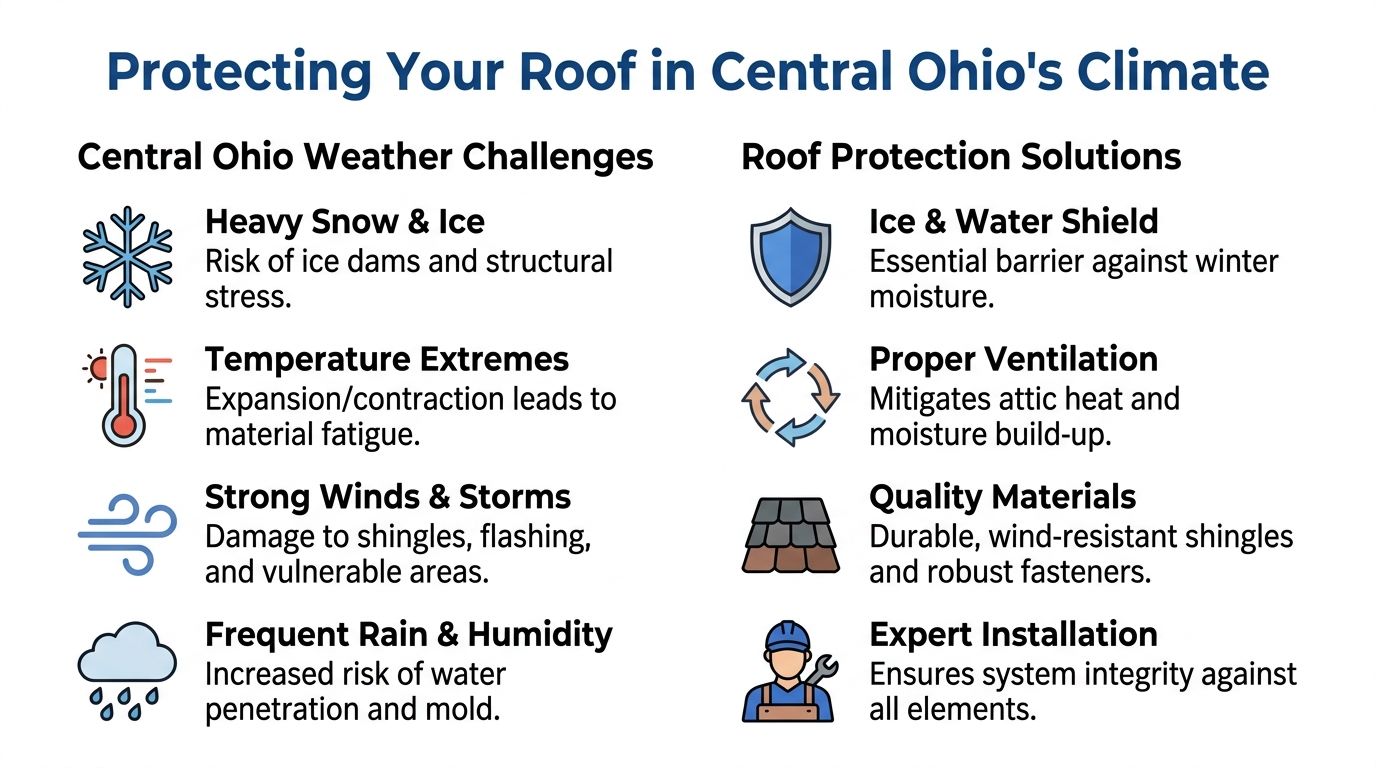
Columbus-area roofs take a beating in ways generic roofing articles barely acknowledge. Rain rarely falls straight down in a neat demonstration. Wind pushes it sideways. Winter creates freeze-thaw cycles that stress edges and transitions. Summer heat bakes materials, then a storm rolls through and tests every exposed detail.
That local weather reality is why roof deck protection can't be picked on autopilot.
Ohio roofs fail at transitions first
The most overlooked issue on Ohio homes is the low-slope section that doesn't look dramatic from the street. It might be over a porch, where a dormer ties in, or where an addition meets the main structure. Homeowners often assume the same underlayment approach used on a steeper section is fine there too.
It often isn't.
A significant share of residential roof leaks begins at low-slope transitions due to underlayment misapplication, and many guides miss the distinction that while synthetic underlayment works on steeper slopes, low-slope roofs from 2:12 to 4:12 need a fully adhered membrane to be watertight (underlayment guidance for slope-specific use).
That's the part many roof bids never explain clearly. A roof can have both steep-slope and low-slope behavior on the same house. Treating those sections identically is how callbacks and interior stains start.
What good protection looks like here
A well-protected Central Ohio roof usually has a few things in common:
| Roof condition | What works better | What often fails |
|---|---|---|
| Steeper main roof planes | Properly installed synthetic underlayment | Generic material choice with weak detailing |
| Low-slope tie-ins and porch roofs | Fully adhered membrane where needed | Standard synthetic used as if slope doesn't matter |
| Storm-exposed edges and penetrations | Tight flashing, edge metal, and sealing | Piece-by-piece patching that ignores water path |
Heat also plays a role. Repeated expansion and contraction can stress shingles and details over time, especially on sun-beaten sections. If you want to understand that side of roof wear, this article on what heat does to asphalt roof shingles is worth reading.
A roof in Central Ohio doesn't need the fanciest product on the shelf. It needs the right material in the right place for the slope and exposure it actually has.
That's why the low-slope conversation matters so much. It's not trivia. It's where many preventable leaks start.
When Your Roof Deck Needs Attention
Most homeowners won't see the roof deck directly, but they can still catch warning signs before damage spreads. The key is to pay attention to changes in shape, moisture, and recurring leak behavior instead of waiting for a major failure.
Signs you can spot from inside and outside
Start with what the house is already telling you.
- Interior stains: Brown spots on ceilings or upper walls often mean water is getting past the roof assembly.
- A wavy or sagging roofline: That can point to deck deterioration or structural movement.
- Recurring leak spots: If the same area keeps leaking after surface repairs, the issue may be deeper.
- Musty attic smell or visible darkening: Moisture problems often show up underneath before they become obvious outside.
Wildlife can also complicate the picture. If an attic opening or roof edge has been disturbed, animals may create entry points or worsen existing weak spots. In cases like that, homeowners sometimes need help from specialists such as Vanish Canada raccoon removal before roofing repairs can fully address the damage path.
What a roofer looks for that you can't see from the lawn
A proper inspection goes beyond the shingles. Failure analysis in roofing has shown that assessing the underside of the roof deck for signs of water intrusion is a critical proactive step, both to prevent future failures and to keep the structure safe for workers during the project (professional guidance on roof deck assessment).
That means checking the attic side of the deck, not just the top surface. A trained roofer looks for staining, softness, delamination, old leak paths, and signs that water has traveled from somewhere other than the visible problem area.
If you're already seeing symptoms and want to understand the next step, a dedicated roof leak detection service can help isolate whether the issue is flashing, underlayment, a transition detail, or deck-related damage.
A homeowner doesn't need to diagnose everything. But catching the signals early can keep a repair from turning into a full deck replacement.
HIBCO ROOF Your Expert in Columbus Roof Protection
For homeowners in Columbus, roof deck protection isn't just about buying better materials. It's about having the whole roof evaluated as a system so the hidden failures get addressed before new shingles cover them up.

HIBCO ROOF LLC serves Central Ohio with inspections, repairs, and full roof replacements that account for the deck underneath, the underlayment above it, and the vulnerable transition areas that often cause trouble on local homes. That matters because roof problems rarely stay isolated to one visible component. A leak at a valley, low-slope section, skylight, or wall intersection can involve hidden deck damage by the time the stain appears indoors.
The company's approach fits the way a roof should be handled. Inspect the structure. Identify active and hidden water paths. Replace or repair what's compromised. Install a coordinated roofing system with manufacturer-backed materials and documented practices. That's especially important for storm-related work, where surface damage is only part of the story and homeowners need clear documentation for claim support.
HIBCO ROOF LLC is also an Owens Corning Preferred Roofing Contractor, which gives homeowners another layer of confidence when they're comparing contractors. Add in free, no-pressure written estimates, licensed and insured service, and communication that walks through the estimate line by line, and the process becomes easier to trust.
If your estimate includes roof deck protection and you're not sure whether it's necessary, that's the right time to ask questions. A good contractor should be able to explain where the roof needs standard underlayment, where it needs a stronger membrane, what the deck condition is, and why each line item is there.
If you want a clear explanation of your roof's condition and a no-pressure plan for protecting it properly, contact HIBCO ROOF LLC. They provide free estimates for Columbus-area homeowners and can walk you through deck condition, slope-specific protection, leak risks, and full replacement options in plain language.