A siding square equals 100 square feet, and installed vinyl siding typically runs $732 to $1,251 per square in 2026, with labor and trim often pushing projects toward the higher end. For a Columbus homeowner, that makes the siding installation cost per square a useful starting point, but not a complete project budget.
You're probably looking at a contractor's estimate and wondering why one proposal feels manageable while another climbs sharply. The difference may not be the panel itself. Tear-off, wall preparation, trim, access, insulation, disposal, and the material's maintenance demands can all change what you'll spend now and what you'll spend over the years.
Table of Contents
- What a Siding Square Actually Means
- Breaking Down the Cost Per Square
- Material Options and Their Price Ranges
- Why the Cheapest Quote May Cost More Over Time
- How to Measure Your Home for Siding
- Questions to Ask Before Signing a Siding Contract
What a Siding Square Actually Means
Most homeowners measure a house in square feet. Siding contractors usually price the wall area in squares, with one siding square equal to 100 square feet of material. If the measured exterior wall area is 2,400 square feet, the basic quantity is 24 squares before accounting for waste, cuts, gables, and project-specific ordering practices.
The unit is practical because siding arrives, gets estimated, and gets installed across broad wall surfaces. A contractor can discuss the material quantity, labor, accessories, and installation scope using the same unit instead of handling long strings of square-foot figures. Roofing uses a similar system, so homeowners comparing exterior projects may find the concept familiar. HIBCO's explanation of roof replacement cost per square uses that same measurement logic.
How contractors turn walls into squares
The calculation follows a straightforward sequence:
- Measure the length and height of each exterior wall.
- Multiply length by height to find each wall's gross area.
- Measure major windows and doors and subtract their area.
- Add the remaining wall areas together.
- Divide the result by 100 to convert square feet into siding squares.
The contractor may also account for gable ends and other angled sections separately. A two-story elevation, dormer, enclosed porch, or tight side-yard access can require more labor even when the total wall area seems modest.

Why the number on the quote may differ
The square count on a proposal isn't always identical to your rough measurement. Contractors must plan for cuts, corners, starter strips, window details, and damaged or unusable pieces. They may also separate the siding field area from trim, soffits, fascia, insulation, and removal work.
Practical rule: Compare the measured wall area and the listed scope before comparing the final price. A lower square count can make a quote look cheaper without making it more complete.
A widely cited 2026 benchmark places national installed vinyl siding at $7.32 to $12.51 per square foot, or approximately $732 to $1,251 per 100-square-foot square (Homewyse's vinyl siding installation estimate). That range illustrates why the siding installation cost per square can move substantially once labor, trim, region, and removal are included.
Breaking Down the Cost Per Square
A per-square price is a package of work, not just the price of vinyl panels. The contractor is pricing a wall system, the people installing it, the details that keep water out, and the cleanup required after the old cladding comes off.
Independent 2026 guides place the broader installed siding market around $3 to $18 per square foot, with vinyl commonly near the lower end at approximately $3 to $7 per square foot installed (SimplyWise's siding cost guide). Another contractor pricing benchmark places average installed vinyl work around $1,200 per square, with labor commonly representing 40% to 45% of the installed price (HomeGuide's vinyl siding cost data).
The main line items
Material includes the siding panels, starter strips, corner posts, utility trim, J-channel, soffit-related pieces, and other manufacturer components. A basic quote may cover only the visible siding field, while a complete proposal identifies the accessory package separately.
Labor covers layout, cutting, fastening, flashing integration, detail work around openings, and installation at height. Labor alone can range from approximately $2 to $12 per square foot, depending on region, access, siding type, and job difficulty (HOVER's house siding cost guide).
Tear-off and disposal matter on replacement projects. Removing old siding exposes the wall, but it also creates labor, hauling, and disposal responsibilities. If the existing material is left in place, the contractor should explain whether the project is an overlay and how that affects wall inspection and detailing.
Preparation and accessories may include housewrap, flashing, sheathing repairs, insulation upgrades, trim replacement, vents, and permit-related work. These are often where a supposedly inexpensive bid becomes less comparable.
| Component | Low Range | High Range |
|---|---|---|
| Vinyl siding material | $3 per sq. ft. | $7 per sq. ft. |
| Installed vinyl reference | $7.32 per sq. ft. | $12.51 per sq. ft. |
| Labor alone | $2 per sq. ft. | $12 per sq. ft. |
| Broader installed siding market | $3 per sq. ft. | $18 per sq. ft. |
The ranges in this table come from the cited 2026 pricing guides, but they aren't a promise that each component will appear as a separate allowance. Some contractors bundle labor and material into one square price. A useful guide to house cladding expenses can help homeowners think through material, preparation, and installation scope before they compare bids.
What a complete quote should reveal
Ask whether the price includes complete tear-off, disposal, wall inspection, housewrap, flashing, trim, soffits, fascia, vents, insulation, and cleanup. If the contractor lists an allowance for hidden damage, ask how approval works if the crew finds deteriorated sheathing.
A quote isn't necessarily overpriced because it includes more line items. It may be more honest about the work required to install siding correctly over an older exterior.
Material Options and Their Price Ranges
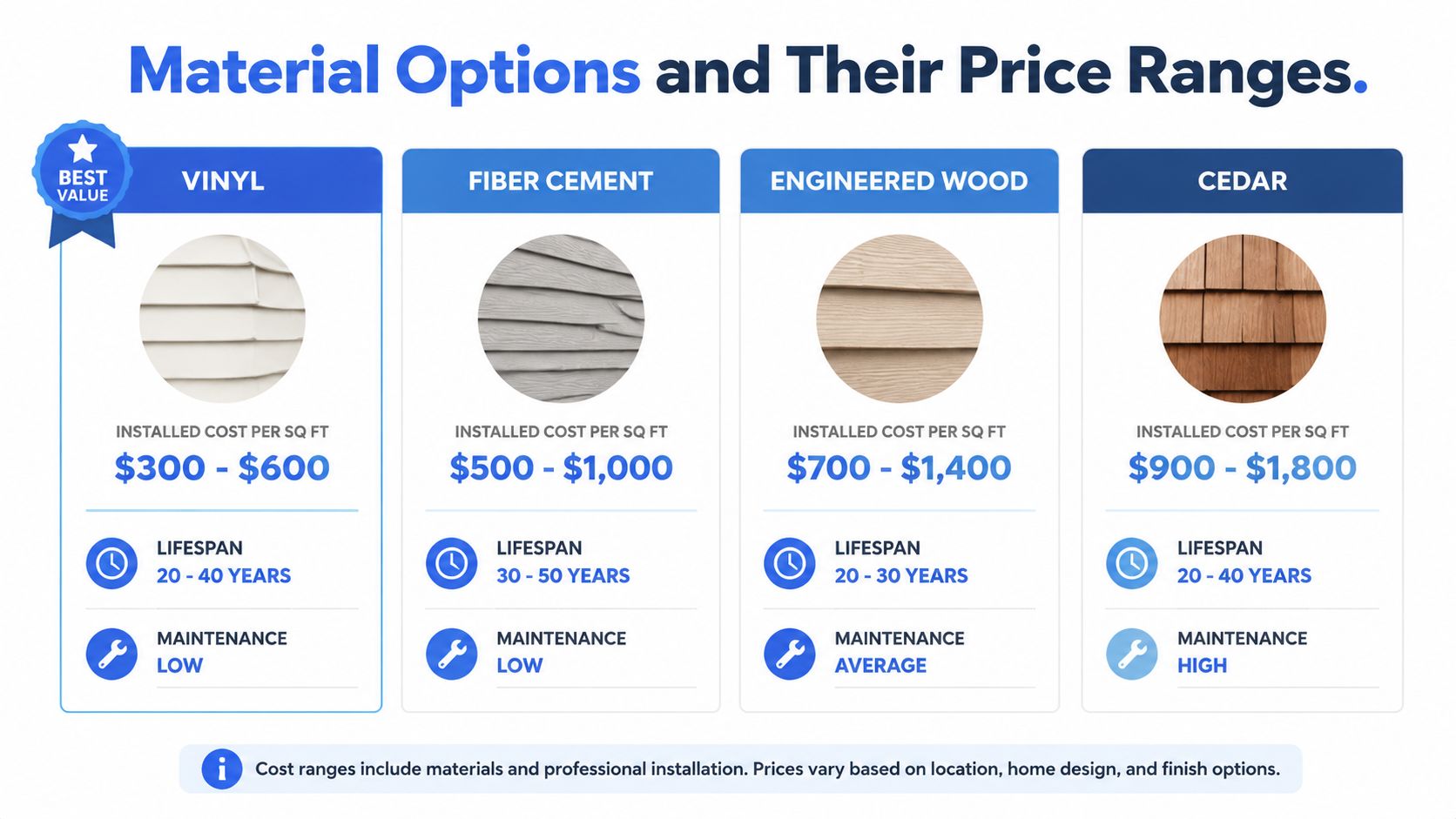
Vinyl usually wins the initial-price comparison, but the right cladding depends on how you use the house, how much maintenance you're willing to perform, and which exterior risks matter most. Columbus homes include newer construction, older wood-frame properties, additions, porches, and elevations with details that can make installation more demanding than a simple wall calculation suggests.
The 2026 installed ranges below provide a budgeting framework. They aren't interchangeable bids because each material carries different handling, finishing, and maintenance requirements.
| Material | Typical installed range | Ownership profile |
|---|---|---|
| Vinyl | $4 to $12 per sq. ft. | Low upkeep and broad style selection |
| Fiber cement | $7 to $14 per sq. ft. | Rigid, paintable, and more labor-intensive |
| Engineered wood | $5 to $10 per sq. ft. | Wood appearance with lower upkeep than traditional wood |
| Cedar and other wood products | Higher than the ranges above | Natural appearance with greater maintenance demands |
These material ranges are supported by EZ Estimation's siding installation cost guide. A separate 2026 comparison places vinyl around $4 to $12 per square foot installed, fiber cement around $5 to $15, and engineered wood around $5 to $10, while cedar and stone veneer can rise substantially higher (Pipelineon's siding installation cost discussion).
Vinyl
Vinyl is often the practical choice for homeowners who want a clean exterior upgrade without a repainting routine. It comes in multiple profiles and colors, and its lighter weight can make installation more straightforward than heavier alternatives. The trade-off is that damaged panels may need replacement rather than touch-up, and fastening details matter because the material expands and contracts with temperature.
For Columbus homeowners, insulated vinyl may deserve a separate quote when comfort and wall flatness matter. It won't correct every air-sealing or insulation problem, so treat it as one part of the exterior system rather than a substitute for broader energy work. HIBCO's vinyl siding replacement cost guide offers another reference point for evaluating that option.
Fiber cement
Fiber cement costs more because it is heavier and typically demands more cutting, handling, fastening, and finishing attention. It suits homeowners who want a more rigid, painted-wood appearance or who place a high priority on fire performance. The ownership trade-off is a repainting and touch-up cycle that vinyl generally avoids.
Engineered wood and cedar
Engineered wood sits between vinyl and premium wood in both appearance and cost. It can provide a wood-like design with less maintenance than traditional cedar, though the installation and finish specifications still deserve close review.
Cedar offers natural character that manufactured products don't fully reproduce. It also asks more from the owner, including attention to moisture, coatings, pests, and surface condition. For a deeper explanation of cladding replacement essentials, review the practical considerations around removing and rebuilding an exterior cladding system.
Why the Cheapest Quote May Cost More Over Time
The lowest siding installation cost per square isn't automatically the lowest ownership cost. A cheap bid may be sensible if it includes the same preparation, trim, flashing, cleanup, and warranty terms as a higher bid. It becomes risky when the price difference comes from omitted work or from choosing a material whose maintenance pattern doesn't fit your household.
Total cost of ownership includes the original installation, cleaning, repainting, repairs, replacement panels, and eventual replacement cycle. It also includes the consequences of poor water management. Siding itself isn't the entire weather barrier, so the quote should address the layers and transitions behind it.
The 15-year question
Consider two hypothetical ownership paths without treating either as a guaranteed result. A budget vinyl project may require less maintenance, but a homeowner could still face panel replacement after impact, color limitations when matching older panels, or a full replacement sooner than expected if the installation or wall system was poor. A higher-priced fiber cement or engineered wood project may demand more upfront investment and periodic finish work, yet its appearance, rigidity, or repair strategy may better suit the property.
That doesn't make fiber cement or engineered wood automatically cheaper over 15 years. It means the owner should compare the likely maintenance burden against the initial price, not assume that the lowest invoice wins.
The material label matters less than the complete installation scope and the maintenance routine you're prepared to follow.
Where low bids create trouble
A bid can look attractive because it excludes tear-off, assumes no sheathing repairs, uses a minimal trim package, or leaves insulation and flashing undefined. Those omissions may surface as change orders or as performance problems after the crew has finished.
Use this decision test:
- Choose value vinyl when low upkeep and controlled initial cost matter most.
- Price fiber cement seriously when fire performance, rigid detailing, and a painted appearance justify ongoing finish care.
- Consider engineered wood when you want a wood-inspired exterior with a different maintenance balance.
- Treat cedar as a design commitment, not a cheaper alternative to manufactured siding.
The smartest quote is the one that matches your ownership plan and clearly states what happens behind the visible panels.
How to Measure Your Home for Siding
A homeowner can create a useful rough square count before meeting a contractor. It won't replace a professional takeoff, especially on a multi-story home or a property with many gables, but it can help you identify a quote that seems disconnected from the building.
Start with a notebook, tape measure, calculator, and a simple sketch of each elevation. Measure each wall's length and height, then multiply those figures to get gross wall area. Record the elevations separately instead of trying to measure the entire house in one calculation.
Work elevation by elevation
For a rectangular wall, multiply length by height. For a triangular gable, multiply the base by the triangle's height and divide by two. Add bump-outs, porch walls, and enclosed additions as separate shapes so you don't lose track of the calculation.
Next, measure windows and doors. Record their width and height, multiply each opening, and subtract the combined area from the gross wall total. Small openings and cutting waste still affect material ordering, so don't assume every square foot you subtract disappears from the contractor's material plan.

Convert the result into squares
Once you have the adjusted wall area, divide it by 100. That gives your rough siding-square count because one square represents 100 square feet. Keep your worksheet and ask the contractor to explain any major difference between your estimate and the measured quantity in the proposal.
Use these field checks:
- Measure tall elevations safely: Don't climb ladders just to obtain a rough budget number. Estimate from accessible points or let the contractor perform the high measurements.
- Separate complex sections: Dormers, bay windows, steep rooflines, and enclosed porches often require more detail work than their area suggests.
- Ask about waste and accessories: Your wall-area calculation doesn't include every trim component or installation material.
- Keep photos with the sketch: Photos help explain why a wall measurement includes a recessed section, transition, or difficult access point.
Your goal isn't to out-measure the contractor. It's to understand the unit being priced and to recognize whether the proposal describes the same exterior you're looking at.
Questions to Ask Before Signing a Siding Contract
A siding contract should let you understand what the crew will remove, what they'll install, and what happens if the wall underneath isn't in the condition everyone expected. If the proposal only names a product and a total price, you don't yet have enough information to compare it properly.
Bring the estimate to the meeting and mark each answer directly on the document. For insurance-related work, homeowners may also benefit from reviewing these tips from Restore Heroes so they understand the difference between covered damage, maintenance, exclusions, and documentation.
Scope and wall preparation
Ask these questions first:
- Is complete tear-off included? Confirm how many existing layers the crew will remove, how disposal is handled, and whether the price changes if concealed material is found.
- What happens behind the siding? Ask whether housewrap, flashing, wall repairs, and moisture-damaged sheathing are included, excluded, or covered through an allowance.
- Are trim, soffits, and fascia detailed? The contract should identify window and door trim, corners, gables, vents, soffits, fascia, and any replacement pieces.
- Which insulation options are available? Ask whether the proposal includes standard siding, insulated vinyl, or another wall upgrade, and request the cost difference in writing.
An allowance isn't a blank check. It should explain the assumed quantity, the unit used for extra work, who approves changes, and how payment is calculated.
Product, warranty, and scheduling
Request the exact manufacturer, profile, color, grade, and accessory package. Warranty language should identify what the manufacturer covers, what the installer covers, how long each obligation lasts, and which installation conditions could void coverage.
Also ask:
- What is the payment schedule?
- What is the expected start window?
- How will weather delays be handled?
- Who protects landscaping, windows, and exterior fixtures?
- Who removes debris at the end of each workday and at final completion?
- How will change orders be documented and approved?
Before signing, compare at least two complete scopes rather than comparing only the final totals. Homeowners in Columbus and central Ohio can review vinyl siding replacement near me as they evaluate local project options and contractor discussions.
A written estimate from HIBCO ROOF LLC can address siding replacement alongside related roof, gutter, window, and exterior conditions, with free estimates available for area homeowners. Visit HIBCO ROOF LLC to request an evaluation, compare the siding installation cost per square with the full project scope, and discuss the right material and preparation plan for your Columbus home.