Roof replacement cost per square in Columbus typically runs from $400 to $1,100 installed, which is $4 to $11 per square foot, and most asphalt shingle jobs land around $300 to $600 per square before premium upgrades or a tough tear-off changes the math. That's why one neighbor gets a quote that feels manageable, while another gets a number that makes them stare at the kitchen table in silence.
Most homeowners don't get confused because the roofing math is hard. They get confused because contractors speak in squares, line items, and system parts, while homeowners are trying to answer a much simpler question, “What's this roof going to cost me, and what am I paying for?”
Table of Contents
- What a Roofing Square Actually Means
- Every Cost Component Hidden Inside the Per-Square Price
- Columbus Price Ranges by Roofing Material
- How to Calculate Your Own Roof Replacement Budget
- Hidden Costs and Quote Traps to Watch For
- Insurance Claims and Financing Options for Columbus Homeowners
What a Roofing Square Actually Means
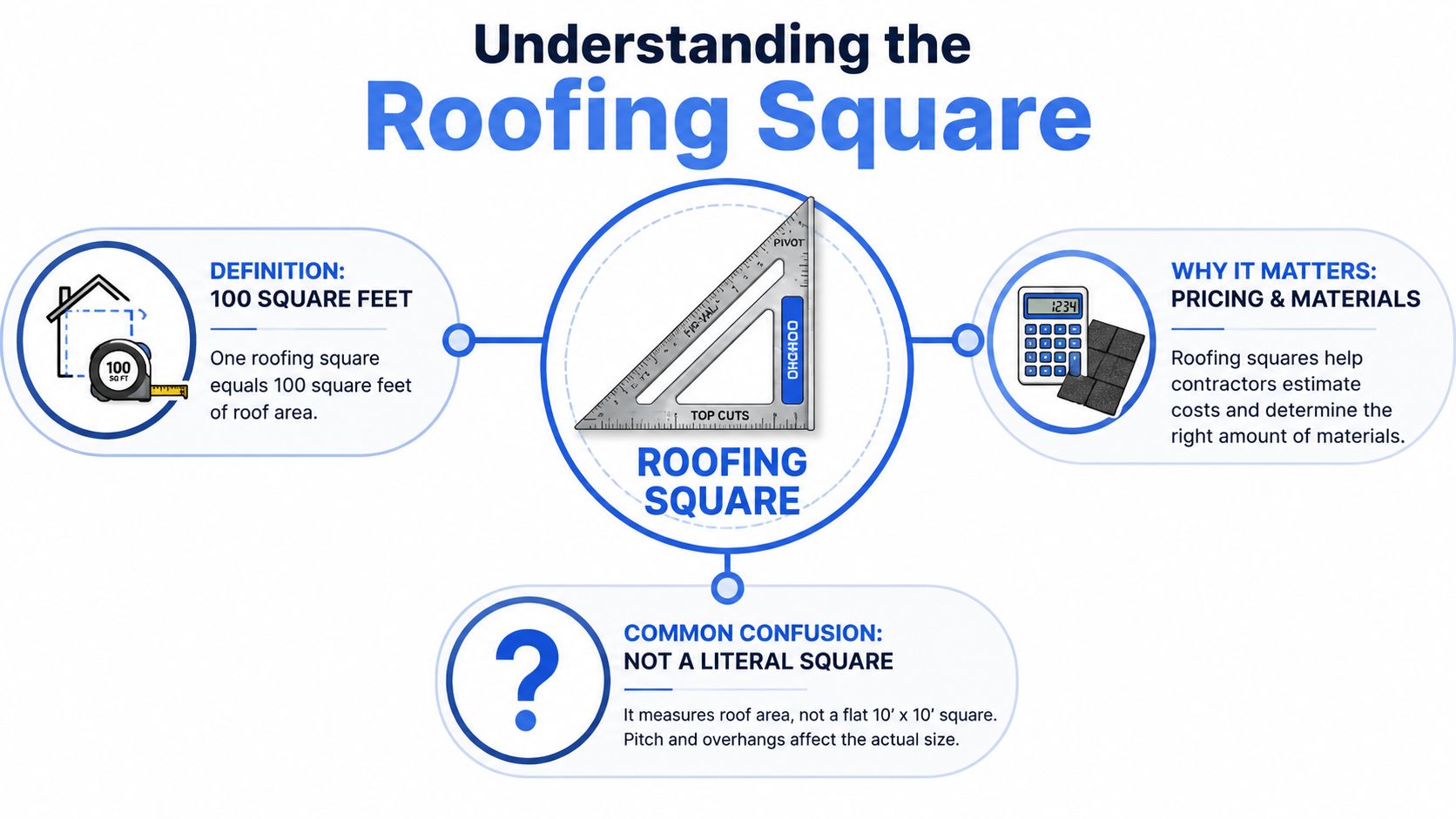
You're holding a bid that says 24 squares, and the number feels abstract because nobody talks that way outside the roofing trade. A roofing square is 100 square feet of roof area, and contractors use it because it makes estimating faster and keeps material counts tied to labor in a consistent way.
Why contractors talk in squares
A bid by the square is easier to compare across homes because roof jobs aren't just about surface area. The same footprint can become a very different roof once pitch, valleys, dormers, hips, and waste are factored in.
Practical rule: If you know your roof area in square feet, divide by 100 to get the rough square count. A 2,000-square-foot roof surface is about 20 squares.
That's the number homeowners need to recognize when they compare quotes. A roofer quoting 20 squares isn't saying the home is 20 square feet, they're saying the roof surface being replaced works out to about 2,000 square feet.
The reason this matters is simple. Footprint and actual roof area are not the same thing. A two-story home can have a smaller footprint than a ranch, but a steeper pitch can push the roof area higher than you'd expect.
If you want a simple reference point, a homeowner-friendly explanation of roof pricing per square is also available in this roof pricing by square guide, which is useful when you're trying to compare contractor language to real-world totals.
How to do the mental math
Start with the roof area, not the house footprint. Then divide by 100, because one square equals 100 square feet.
If a roof surface is roughly 2,200 square feet, that's about 22 squares. If slope and complexity push the actual surface closer to 2,500 square feet, you're near 25 squares.
That's also why two homes with the same size footprint can get very different bids. One may be a straightforward gable roof. The other may be loaded with valleys, ridges, skylights, and angles that demand more labor and more material waste.
A Columbus homeowner doesn't need to become a roofer to follow the estimate. You just need the language. Once you know what a square is, the rest of the quote starts making sense.
Every Cost Component Hidden Inside the Per-Square Price
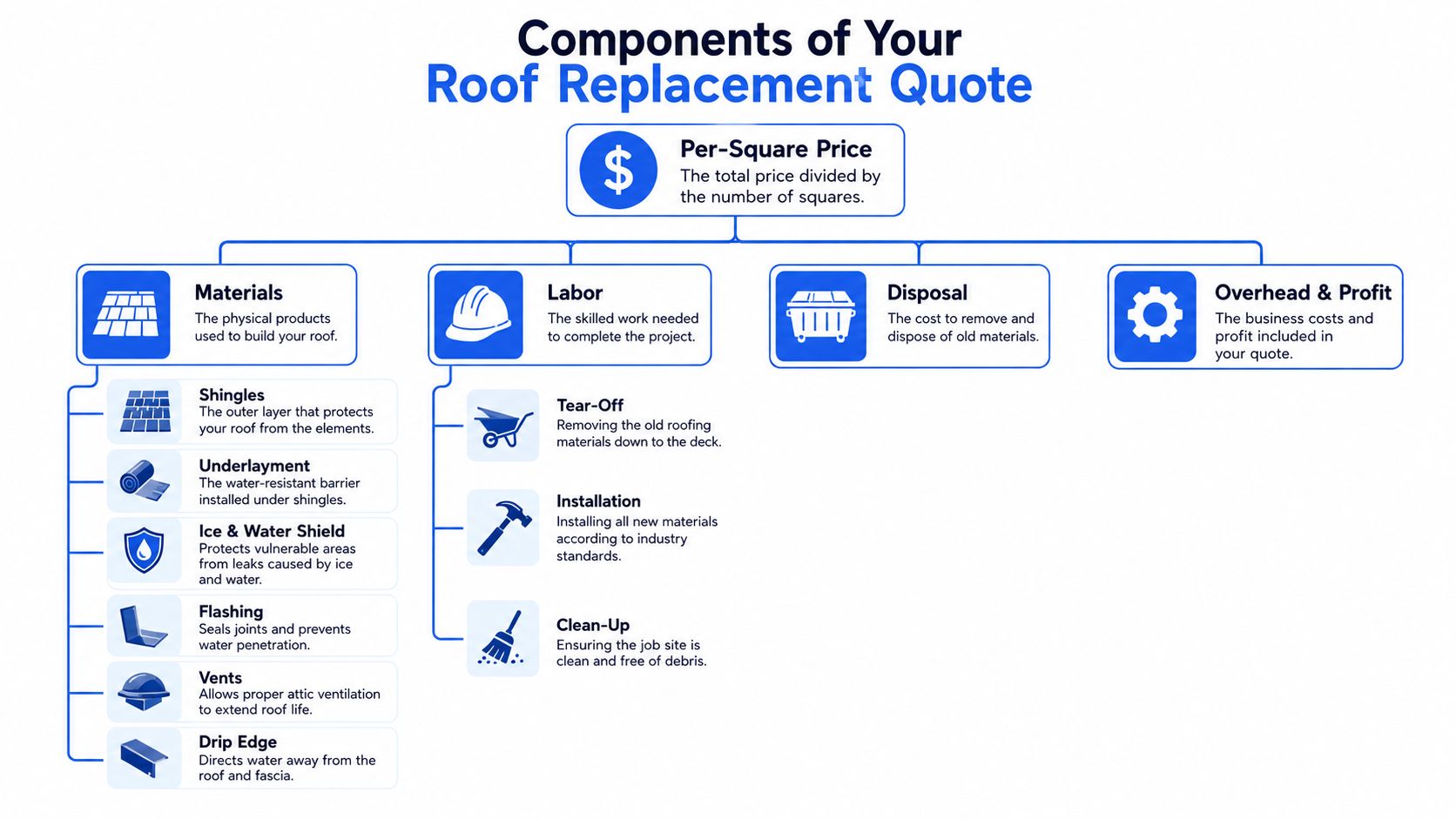
A per-square price is never just shingles. It's a bundled system cost including layers, labor, removal, and the details that keep the roof from leaking later.
What gets rolled into the quote
The visible part is the shingle package, but the hidden structure behind the number matters just as much. Underlayment, starter strips, ridge cap, flashing, and ventilation all help the roof perform as a system, not just as a cover.
A lower quote can look attractive if it trims those pieces, but that's often a false economy. The roof may be sealed on day one and still fail early if flashing details or ventilation are weak.
Here's the part homeowners usually miss. The cost of the square includes the labor to tear off the old roof, get the debris off the property, install the new materials, and handle the details around chimneys, pipes, and valleys. That's why two quotes with the same shingle brand can land in very different places.
The quote should show the real work
A good estimate usually separates these parts:
- Materials: shingles, underlayment, starter, ridge cap, flashing, vents, drip edge.
- Labor: tear-off, installation, clean-up.
- Disposal: hauling away old shingles and waste.
- Overhead and profit: the business side of the job, which covers staffing, insurance, scheduling, and administration.
The technical reason costs move is simple. A square on a steep roof takes more time than a square on a low-slope one. A roof with multiple penetrations takes longer to flash correctly. A job with damaged decking takes more carpentry before the roofing even starts.
A homeowner who understands that structure can audit an estimate faster. If the quote is vague about flashing or underlayment, that's a warning sign. If the price is higher because the contractor is including proper tear-off, disposal, and system components, that can be money well spent.
What to ask: “Does this price include tear-off, disposal, underlayment, flashing, and ventilation, or am I going to see those added later?”
For Columbus homeowners who want a second example of how contractors break down replacement pricing, this asphalt shingle replacement cost guide is a helpful point of comparison.
Columbus Price Ranges by Roofing Material
Material choice is where the numbers start separating fast. Asphalt shingles stay near the bottom of the installed range, while metal, tile, and specialty products climb quickly because the material itself costs more and the labor usually gets more demanding too.
Columbus Roof Replacement Cost Per Square by Material
| Material | Cost Per Square Installed | Typical Lifespan | Best For |
|---|---|---|---|
| 3-tab asphalt shingles | About $300 to $600 | About 15 to 30 years | Budget-focused replacements where simple pricing matters |
| Architectural asphalt shingles | About $375 to $850 | About 15 to 30 years | Most common residential choice when homeowners want a balance of cost and durability |
| Metal roofing | About $783 to $883 for one pricing reference, and broader guides show higher installed ranges depending on scope | Longer-lasting than asphalt | Homeowners planning to stay put longer and wanting a premium system |
| Tile roofing | About $877 to $1,251 for one pricing reference, with broader guides showing still higher installed ranges in some projects | Longer-lasting than asphalt | Homes suited to heavier premium systems and more specialized labor |
| Copper | About $2,325 to $4,065 | Premium, specialty lifespan | High-end projects where appearance and longevity matter more than upfront cost |
The baseline for roof replacement cost per square stays grounded in the broader installed range of $400 to $1,100 per square from consumer pricing guides, while asphalt shingles commonly sit lower and premium systems climb well above that benchmark. Those numbers line up with the national installed range of $4 to $11 per square foot, or $400 to $1,100 per square (NerdWallet roof replacement cost guide).
Asphalt still dominates a lot of Columbus work because the upfront cost is manageable and the lifecycle is familiar. Broad pricing data puts asphalt shingles around $3 to $6 per square foot installed, or about $300 to $600 per square for a standard job, and the material commonly lasts 15 to 30 years (Thumbtack roof replacement cost). That's why most homeowners still compare premium systems against asphalt first.
Trade-off that matters: The cheapest roof isn't always the least expensive over time. A lower upfront bid helps today, but durability and maintenance risk shape the real cost of ownership.
For most Columbus homes, the choice comes down to the roof's age, the owner's timeline, and how much complexity sits on the roofline. If you're comparing standard asphalt to a premium system, the right question isn't only “What's the square price?” It's “How long do I need this roof to hold up, and what am I giving up to save money now?”
How to Calculate Your Own Roof Replacement Budget
A homeowner can get surprisingly close to a real budget before a contractor ever climbs the ladder. The key is to estimate roof squares first, then apply a realistic installed rate and add the items that usually come with a full replacement.
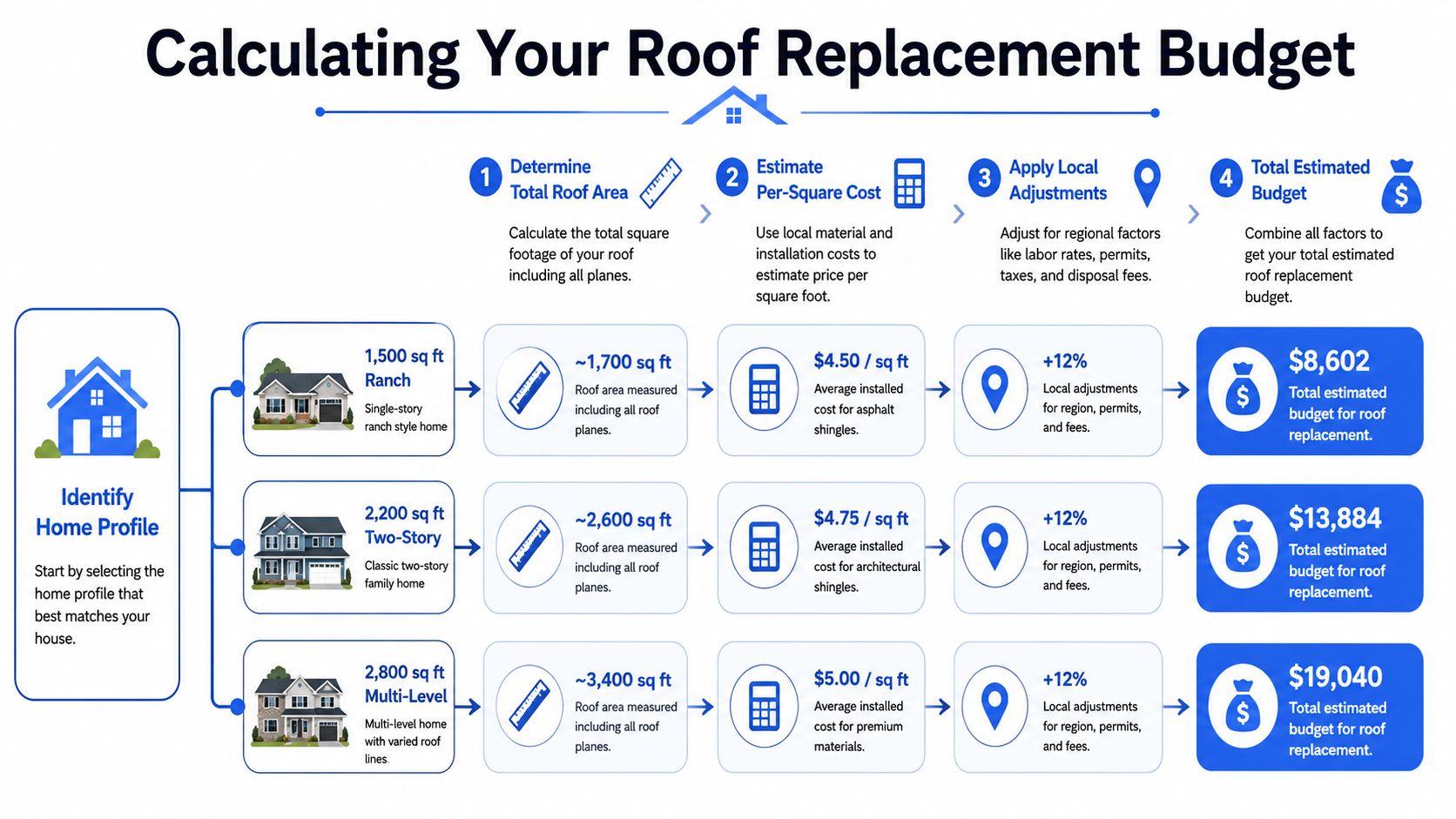
Start with the roof profile
A 1,500-square-foot ranch usually has a simpler roofline than a larger two-story home, but the roof surface can still be meaningfully larger than the living area once slope is added. A 2,200-square-foot two-story often has less footprint than a ranch of the same living space, yet the actual roof shape may be more complicated. A 3,000-square-foot home with complex rooflines usually carries the most labor and waste.
A practical estimating approach is to think in ranges instead of pretending every roof is identical. Then multiply the estimated square count by the installed price per square for the material you want.
For homeowners who like to budget in writing, a simple planning worksheet pairs well with the Peaceful Mindful Pocket LLC budget guide, especially when you're trying to keep a roof project from crowding out other household priorities.
A simple homeowner worksheet
Use this sequence:
- Estimate roof squares. Divide roof area by 100.
- Choose the material. Asphalt, metal, tile, or another system.
- Apply the installed rate. Use a real per-square figure, not material-only pricing.
- Add tear-off and disposal. Full replacements almost always include this work.
- Check for complexity. Steep pitch, multiple penetrations, or second-story access push the total upward.
A Columbus homeowner using this approach can ballpark a ranch, two-story, or multi-level project without pretending the estimate is final. The final quote will still depend on deck condition, ventilation, and the exact roof layout, but the worksheet keeps you grounded.
A useful rule of thumb from the national pricing references is that a mid-range roof on a typical home can move materially if the job includes steep-slope access, penetrations, or code-driven replacement of waterproofing components (HomeAdvisor roof installation cost guide). That's why the budget should always leave room for more than just shingles.
Hidden Costs and Quote Traps to Watch For
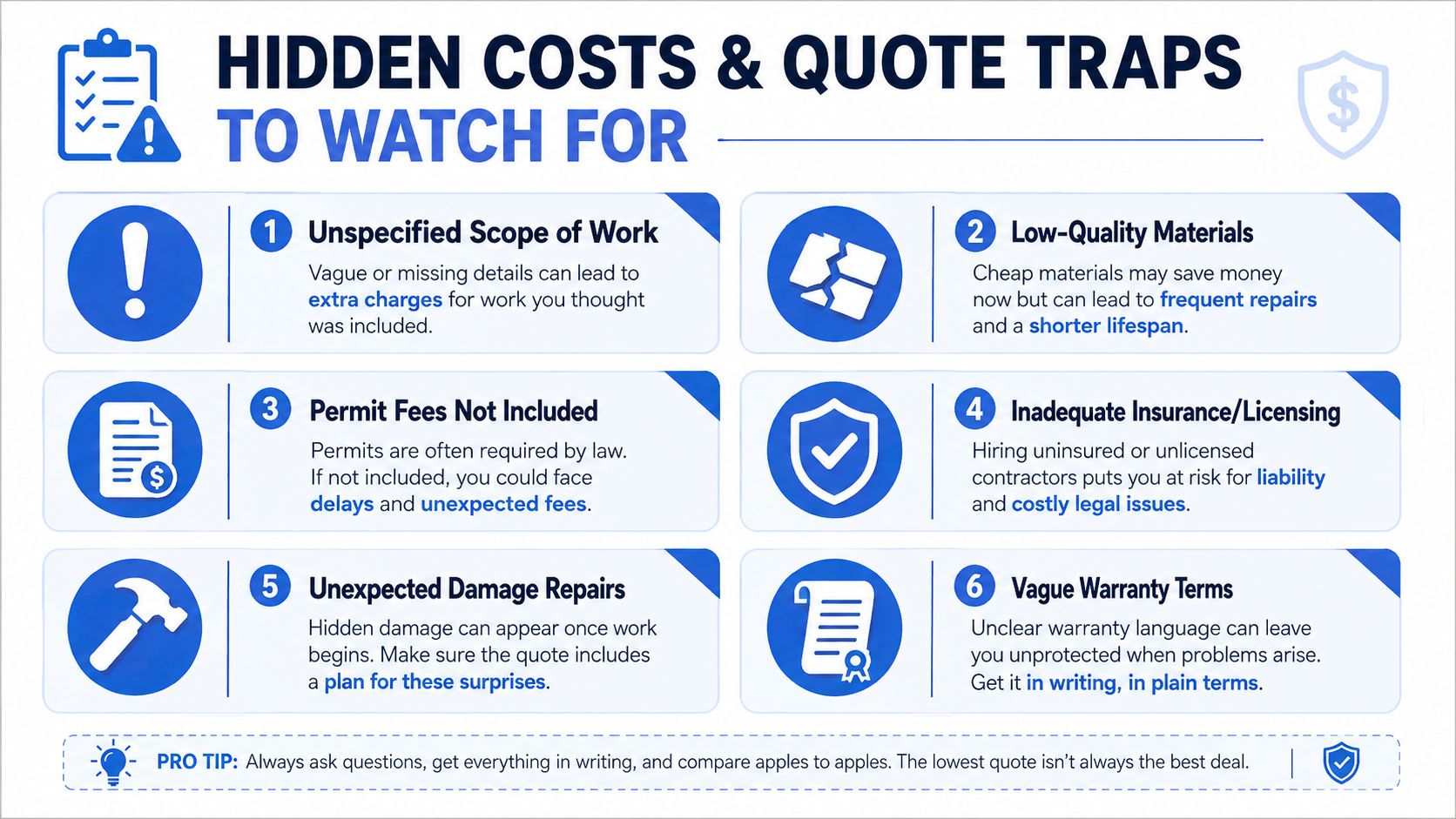
Cheap quotes can look clean on paper and still blow up later. The usual problem isn't mystery math, it's missing scope.
The add-ons that are real
Some extras are legitimate because they're tied to what the crew finds after tear-off. Rotted decking, extra layers of old shingles, upgraded ventilation, and better flashing details all take time and materials.
That doesn't mean every surprise is a scam. It means the estimate should spell out how those items will be billed before the crew arrives. If the contractor can't explain the pricing trigger, that's a problem.
A detailed estimate should answer a few plain questions:
- What counts as extra decking repair? Ask whether it's billed by sheet, by area, or by damage found.
- How many layers are included? One layer is different from multiple layers.
- What ventilation work is included? Some jobs need changes to satisfy manufacturer requirements.
- Are permits and disposal included? If not, you may be getting a headline number, not a real total.
- What warranty terms apply? Vague warranty language is where homeowners get burned later.
The red flags
A price that comes in far below the others can mean something was left out. That might be flashing, tear-off, disposal, or code compliance. It can also mean the contractor plans to add charges later once the roof is open.
A good quote reads like a scope document, not a guess.
Homeowners should also be cautious when a bid avoids specifics on materials. If the estimate doesn't say what shingle line, what underlayment, or what flashing method is being used, you can't compare it fairly against another proposal.
For a practical checklist on choosing the right contractor before the first nail comes off the roof, this roofing contractor selection guide is worth a look. The main goal is simple, get the scope clear before the contract is signed.
Insurance Claims and Financing Options for Columbus Homeowners
Storm damage changes the conversation fast. Once hail or wind enters the picture, the issue isn't just roof replacement cost per square, it's how much of the job your policy may cover and how quickly the paperwork moves.
Insurance and payment timing
If a roof is damaged by a covered event, the insurer typically looks at the loss, then applies the policy terms and deductible. The homeowner still has to document the damage well, because adjusters need proof that the roof was affected by a specific event rather than normal wear.
That's where homeowners get into trouble. If you wait too long, the roof may deteriorate further and the claim becomes harder to support. If you file too early without documentation, the insurer may not have enough evidence to treat it as a covered loss.
Financing can help bridge the gap when you need the roof replaced before the claim settles or when you're paying out of pocket. Many homeowners also compare contractor financing to broader budgeting tools, and a Saleswise kitchen remodel financing guide is a useful example of how financing terms can affect monthly planning even when the project isn't a kitchen.
What to do before the adjuster arrives
A local inspection gives you a starting point, and a written estimate gives you a document to compare against the insurer's numbers. That matters when the roof is old, damage is scattered, or the replacement includes system components that aren't obvious from the ground.
For Columbus homeowners, the cleanest path is usually to document the roof first, then decide whether to file, finance, or pay cash based on the actual scope. That keeps the project tied to facts instead of pressure.
If your roof is aging, leaking, or showing storm damage, HIBCO ROOF LLC can inspect it, document what's happening, and give you a written estimate you can use. Visit HIBCO ROOF LLC to schedule a free roof inspection and get a clear, line-by-line replacement quote before you commit to a contractor.