
Yes. A new roof raises home value, and it rarely raises it by the amount on the invoice. The 2025 Cost vs. Value Report puts the Columbus benchmark for a standard asphalt-shingle replacement at $29,253 in project cost against about $20,252 in resale value, a 69.2% recovery. Plan on getting back roughly two-thirds of what you spend.
Nationally the same model prices a defined asphalt job at $31,871 and estimates $21,501 back, or about 67.5% to 68%, according to the 2025 Cost vs. Value report. Older estimates ran higher. A 2019 national survey put cost recovery near 107 percent, though that figure came out of a different housing market and should not set a seller's expectations today.
Three separate questions sit inside does a new roof increase home value. What the appraisal adds. What share of the cost comes back at closing. And what deal friction disappears once the roof stops being a problem. A worn roof can threaten financing, draw an inspector's attention, or just look tired from the driveway, and clearing that has value the recovery percentage never captures.
Sellers who get this right stop treating the roof as an investment with a payout and start treating it as a condition problem with a price. Sometimes paying that price is the right move. Sometimes a repair, a documented inspection, and an accurate list price beat a tear-off.
Table of Contents
- What a New Roof Returns at Resale
- Buyer Appeal Versus Appraised Value
- Materials and Markets That Move the Number
- Insurance Claims and Seller Disclosure
- How Sellers Present a New Roof
- Repair, Replace, or List As-Is Before Selling
What a New Roof Returns at Resale
Three benchmark rows cover almost every central Ohio seller. Find the one closest to your house before you read anything else.
| Benchmark | Project cost | Estimated resale value | Cost recovery |
|---|---|---|---|
| 2025 national asphalt shingle | $31,871 | $21,501 | about 67.5 to 68% |
| 2025 regional asphalt shingle | $29,253 | $20,252 | 69.2% |
| 2025 lower regional asphalt figure | $26,705 | $18,960 | 71.0% |
The middle row comes from the 2025 Cost vs. Value Report, which prices a regional asphalt-shingle replacement at $29,253 and puts resale value near $20,252, a 69.2% recovery. The same report lists a lower regional job at $26,705, returning an estimated $18,960, or 71.0%. Read the three rows together: a new roof does lift market value, and the resale contribution lands below the installed cost every time.
What the modeled job actually includes
The benchmark is one defined scope, not an average of whatever contractors bid that season. Tear the existing roofing off to bare wood sheathing, install 30 squares of fiberglass asphalt shingles carrying at least a 25-year warranty, add new felt or synthetic underlayment, galvanized drip edge, and aluminum flashing on a rectangular hip roof. That is the job behind every percentage in the table.
That spec is what makes the numbers usable. If your quote covers 22 squares of architectural shingles on a simple gable, the modeled cost overstates your job. If it includes two layers of tear-off, three sheets of decking, and four valleys, it understates the work. Before you treat any row as your planning range, check the square count, the tear-off depth, and whether flashing and ventilation sit on their own line items. A bid well above the benchmark usually reflects size, decking repair, or roof complexity, not a different value effect.
Why the percentage moves year to year
These are survey-based projections from real estate professionals. They are not a record of closed-sale premiums, and they are not an appraisal formula. They also drift. A 2019 national survey estimate put roof replacement recovery at 107%, a figure produced by a tight market and a cheaper job. The 2024 edition of the same project dropped national asphalt recovery to 56.9%, on a $30,680 average cost and $17,461 of resale value, per the 2024 Cost vs. Value Report. One category of work, three snapshots, and a spread wide enough to change the advice you would give a seller in each year.
That swing is the useful part. The metric measures what real estate people believe a buyer will pay for a roof, and that belief tracks the market they are selling in. Your roof's actual effect runs through your shingles' condition, your street, and the comparables your appraiser pulls.
Practical rule: use the table to judge whether a replacement lands in the right neighborhood of financial sense, then let an inspection decide whether it is needed at all. Nobody should spend $29,000 chasing a number a survey produced.
The rows also assume a house that needs a roof. On a home with twelve useful years left in the shingles, the same invoice buys far less appeal and almost no appraisal movement. And cost recovery is not profit. The recovered share is what a buyer effectively pays for the work; the rest shows up as concessions you never had to make, which is real money even though no line on the closing statement says roof.
Buyer Appeal Versus Appraised Value
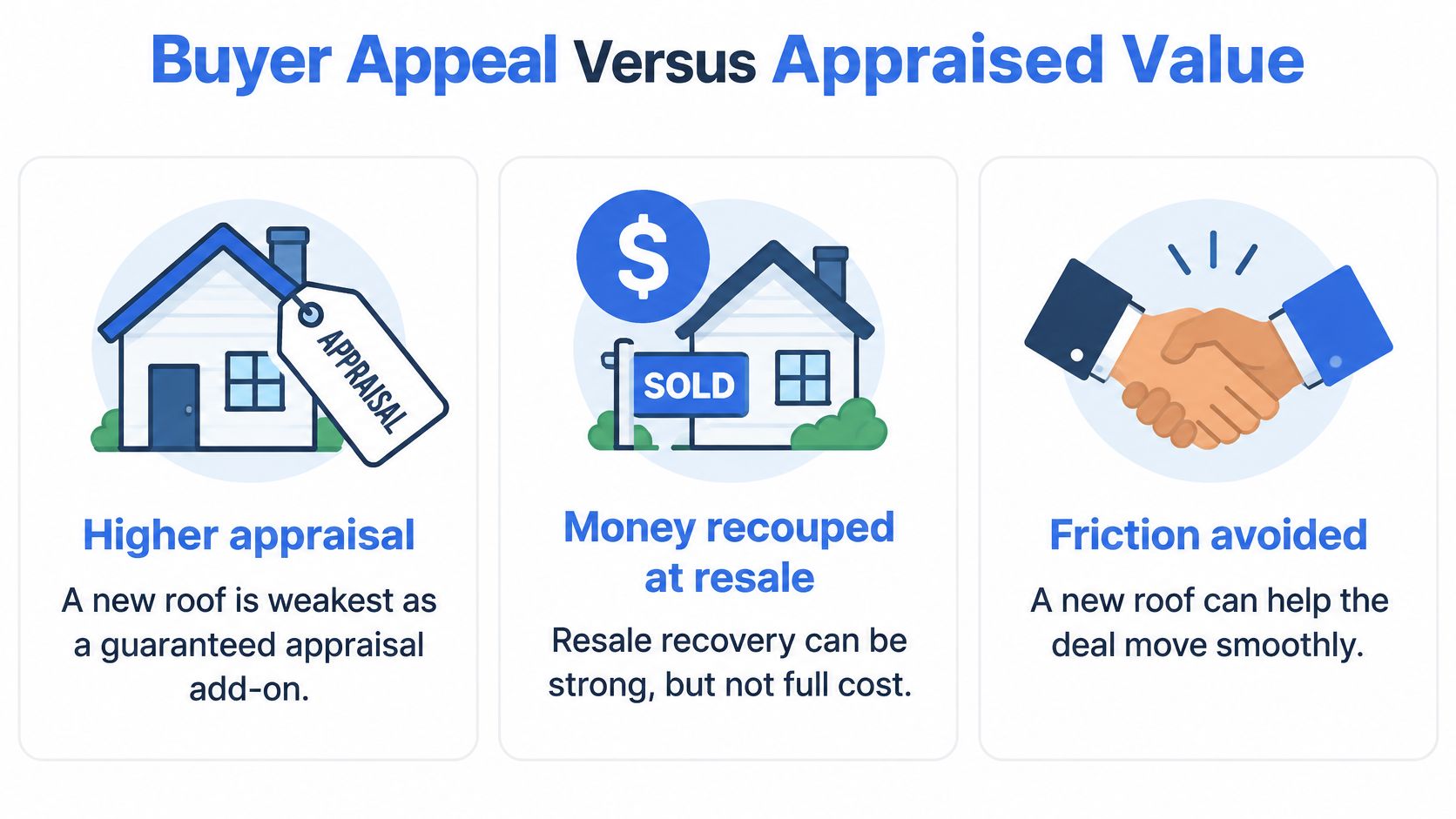
Most sellers put three different results in one bucket. A higher appraisal, cash recovered at resale, and a deal that doesn't stall are not the same outcome, and a new roof behaves differently in each.
The professionals who answer the National Association of REALTORS® surveys treat roofing as a listing decision more than a valuation one. In its 2025 Remodeling Impact findings, 37% of REALTORS® recommended installing a new roof before listing, third behind painting the entire home at 50% and painting one interior room at 41%. New roofing also carried one of the strongest demand signals among exterior projects, with 43% of REALTORS® reporting increased buyer demand for it over the preceding two years.
The buyer side explains the recommendation. A 2024 Zillow report cited in that same coverage found 72% of buyers considered a watertight roof very important, while only 15% of sellers had repaired or replaced their roof before listing. That gap is the opportunity. Most listings compete with an older roof, so a home with a documented newer one stands out without needing an inflated price.
Why the appraisal doesn't copy the invoice
An appraiser values your house against the sales around it. A $29,000 roof doesn't get tacked onto a comparable price from a house that sold with twelve-year-old shingles; the appraiser adjusts for condition within a range the comparables support. That's the weakest of the three channels, and it's the one sellers most expect to be automatic.
A tired roof behaves like bald tires on a used car. Nobody pays extra for a new stereo, but everybody deducts for tires they'll have to replace in the first month.
The logic runs the other way on a sound roof. If your shingles have clear years left and no interior staining, the appraisal treats the roof as ordinary maintenance and the replacement invoice buys you almost nothing in that column. It may still buy a smoother negotiation, but don't spend the money expecting the appraisal to move.
What buyers actually object to
Buyers read roof condition as a signal about the rest of the house. Granule loss in the gutters, curled tabs, or a ceiling stain tells them the seller defers maintenance, and they price that suspicion broadly rather than measuring the actual repair.
Judge your roof by the objection it would create at inspection, not by the hope that the appraiser copies the contractor's bill. If an inspector would write "roof at end of service life" and your buyer would ask for a credit, you have a roof problem worth pricing. If the inspector would shrug, you have a perception problem, and a documented inspection is far cheaper than a tear-off.
Materials and Markets That Move the Number
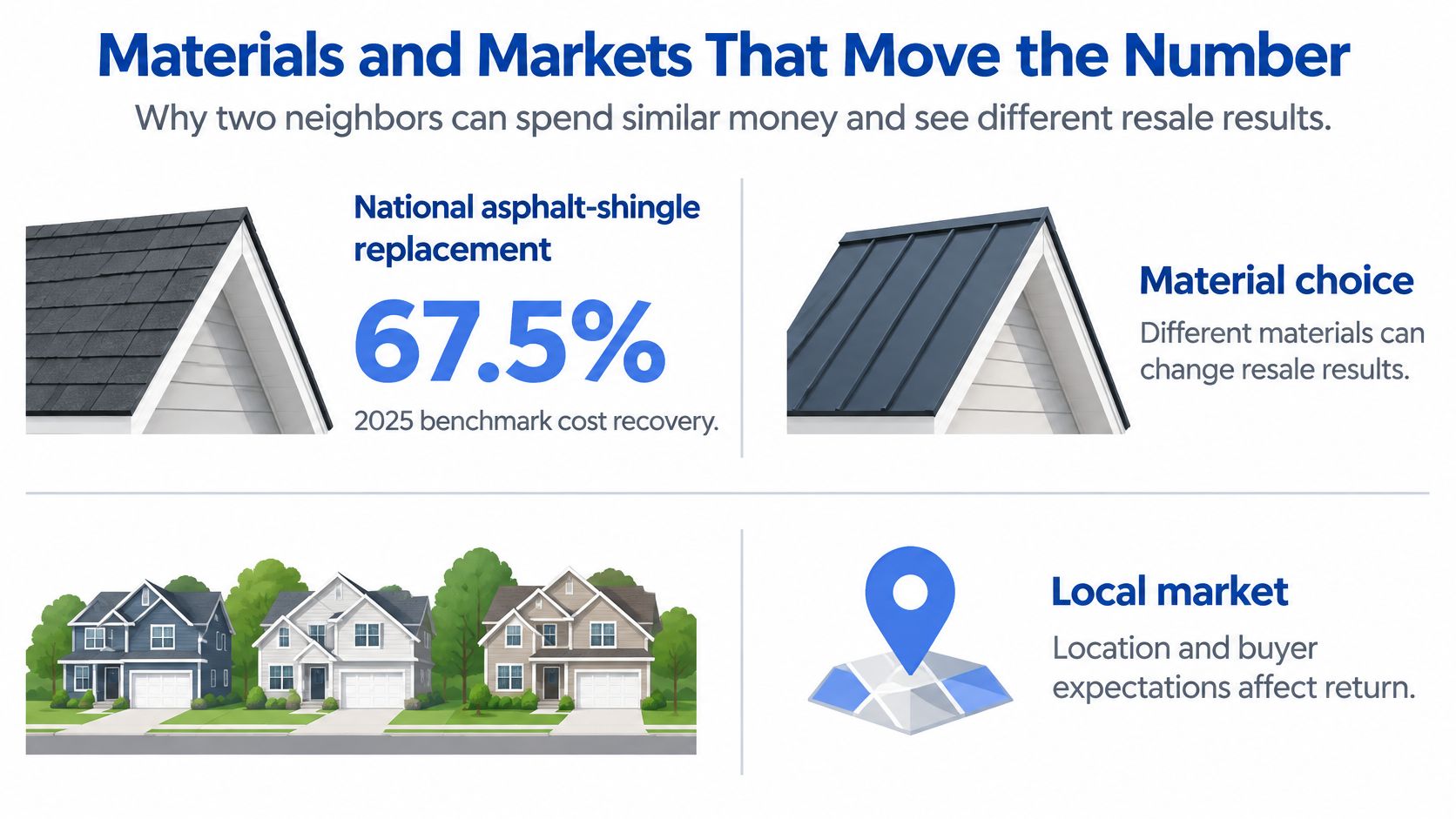
Two neighbors replace roofs the same month, spend within a few thousand dollars of each other, and see different results at closing. Material choice and the neighborhood price band explain most of the gap.
| Material | Estimated cost recovery | Value pattern | Best fit |
|---|---|---|---|
| Asphalt shingles | 69.2% in the Columbus benchmark; about 67.5% nationally | Strong share of a moderate project cost | Typical central Ohio comparable sales |
| Metal roofing | about 50.1% national | Lower recovery on a costlier project | Homes whose nearby sales already support the premium |
The 2025 benchmark priced a substantially more expensive metal-roof project at about 50.1% cost recovery nationally, as reported in this analysis of roof condition and transaction economics. Extra construction cost does not convert one for one into resale value. A lower percentage on a larger invoice can still return comparable dollars at closing, which is why the recovery rate alone doesn't settle the material choice.
Where the premium stops paying
Metal, slate, and designer shingles aren't bad roofs. They're roofs whose price only comes back on a house priced where buyers already expect them. On a street of 1970s ranches with three-tab asphalt, a standing seam metal roof can make your home the most expensive per square foot on the block, and the appraiser caps the adjustment no matter what the invoice says.
If you're weighing the two systems on lifespan and maintenance rather than resale, this metal roofing vs asphalt comparison covers both.
The levers besides material
Roof condition moves marketability and transaction economics independently of the roof's direct contributory value, and that's where most of your real risk sits. A roof near the end of its useful life creates an information and financing problem. Inspectors may find active leaks, damaged flashing, deteriorated decking, or limited remaining service life, and buyers respond by discounting their offers, requesting credits, or requiring replacement before closing.
The rest of the list, in the order it usually bites:
- Remaining service life. A 22-year-old architectural roof shedding granules is a known future bill the buyer will want discounted.
- Active leaks or soft decking. Water in the attic turns a roofing question into a structural one.
- Street-facing curb appeal. When the roof is visible from the road, faded shingles drag down the whole exterior.
- Complexity. Valleys, dormers, steep pitch, and chimneys raise labor, which raises cost without raising value proportionally.
- Storm history. A recent hail event in the neighborhood shapes what buyers assume about insurance and future claims.
- Price band. The same roof returns more on a house with room in the budget than at the very top of the local market.
Neighborhood fit: upgrade the material only when nearby sales already support it. Otherwise put the money into a complete asphalt system with proper ventilation, flashing, and underlayment, not shingles alone.
Insurance Claims and Seller Disclosure
A roof you paid for and a roof your insurer paid for are different stories to the next buyer, even when both are three years old and watertight. The physical product is identical. The paper trail isn't. That difference is the part sellers forget when they hear that a new roof helps value.
Insurers look at the property, the roof's age, and the claims filed on the address. A buyer's carrier can decline coverage or price the policy higher because of what it sees there. Replacing a worn roof removes that objection. A large hail claim can still follow the address and complicate the next owner's policy, which is why so many deals stumble at the insurance binder rather than at the inspection.
Paid replacement versus claim-funded replacement
Both solve the condition problem. Only one is clean on paper.
A retail replacement comes with a paid invoice, a workmanship warranty, and no loss history attached to the roof beyond the work itself. A claim-funded replacement comes with an adjuster's approved scope, a deductible you paid, and a claim recorded against the property. Neither is a defect, and neither should be hidden. Sellers get into trouble by describing the second as though it were the first.
We document storm damage, meet with adjusters, and guide homeowners through the claim process, so the file usually exists before the house is listed. If your roof went on after a storm and you can't locate the approved scope or the photos, request the claim file from your carrier before you list, and read how insurance claims work from first notice to the adjuster's scope before you hand anything to a buyer.
What to gather before the first showing
- Dates. The storm, the claim filing, the installation, and the deductible you paid out of pocket.
- Scope. What the insurer approved versus what was installed, including decking and flashing.
- Photos. Before and after, from the street and at the penetrations.
- Permits. Whatever your city required at the time of the work.
- Warranty. Whether it transfers to a buyer, and for how many years.
Ohio sellers are expected to disclose known defects, leaks, and significant repairs. Hoping a buyer won't ask is a closing risk, not a pricing strategy. Say plainly whether the whole system was replaced or a section was patched, because a patch won't necessarily change how a carrier views the house. If water is active right now, fix the source before listing so the negotiation concerns a finished repair instead of an unknown deck.
Call your insurer before you set a price and ask two direct questions: how a new roof will be treated on this property, and how the existing claim history will affect a buyer's policy. Price the house after you have that answer.
How Sellers Present a New Roof
A new roof is worth more when a buyer can verify it without taking your word for it. Turn it into a packet an agent can hand over and an inspector can read in two minutes.
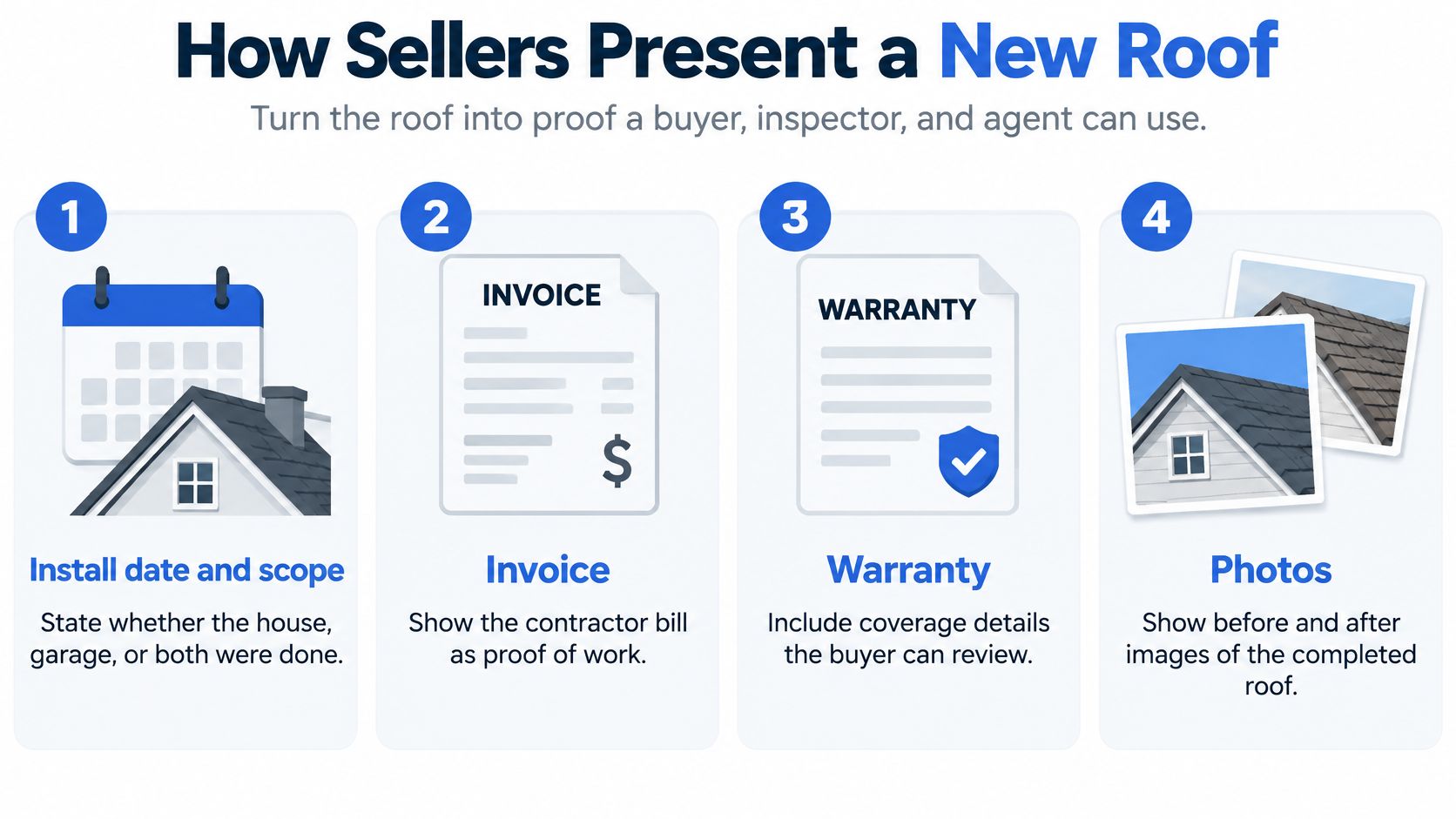
Paperwork is what ties the three numbers together. The appraiser sees a dated, code-compliant installation. The buyer's agent sees warranty coverage that survives the sale. The inspector sees line items instead of a shrug. Buyers trust a new roof more when the installation and the warranty can be verified with documents, and a seller who produces them answers the skepticism that usually gets priced into the offer.
The packet, in order
- Install date and scope. State whether the house, the garage, or both were done, with the month and year.
- The invoice. It should list tear-off, underlayment, flashing, ventilation, and any decking repair. A shingle brand name alone proves nothing.
- Warranties. Manufacturer coverage and workmanship coverage, the years on each, and whether they transfer to a second owner.
- Photos. Four to six shots: two from the street, plus valleys, chimney flashing, and any penetrated boot or vent.
- A one-line listing remark. Something like "architectural asphalt roof replaced in 2024 with transferable manufacturer warranty."
No dollar figure belongs in that remark. You're stating a fact, not asserting a premium, and an agent who writes "adds $20,000 in value" hands a buyer something to test and disprove.
Partial roofs and honest edges
If you replaced the back slope after a wind event and the front is original, say so in the first line of the disclosure. Buyers forgive a partial replacement. They don't forgive learning at inspection that "new roof" meant one side of the ridge.
Where to put the year: in the caption of your first exterior photo. Buyers scroll photos before they read remarks, and roof age is the question that decides whether they keep scrolling.
Hand the packet out at showings and attach the same documents to your disclosure. If you bought the house with a newer roof and have no paperwork, pull the permit record from your city, ask the previous owner, and get an inspection that names the installation's condition. A verified roof recovers more of its cost because it shortens the inspection conversation. An unverified one gets treated like an old roof with new shingles on it.
Repair, Replace, or List As-Is Before Selling
The claim that every new roof pays for itself traces back to a single old survey. The National Association of REALTORS® and the National Association of the Remodeling Industry reported in their 2019 Remodeling Impact Survey that homeowners were estimated to recover 107% of project cost on new roofing, the strongest exterior project studied, alongside vinyl windows, fiber-cement siding, and wood windows. That's a 2019 survey estimate, not a forecast about your house in the current market.
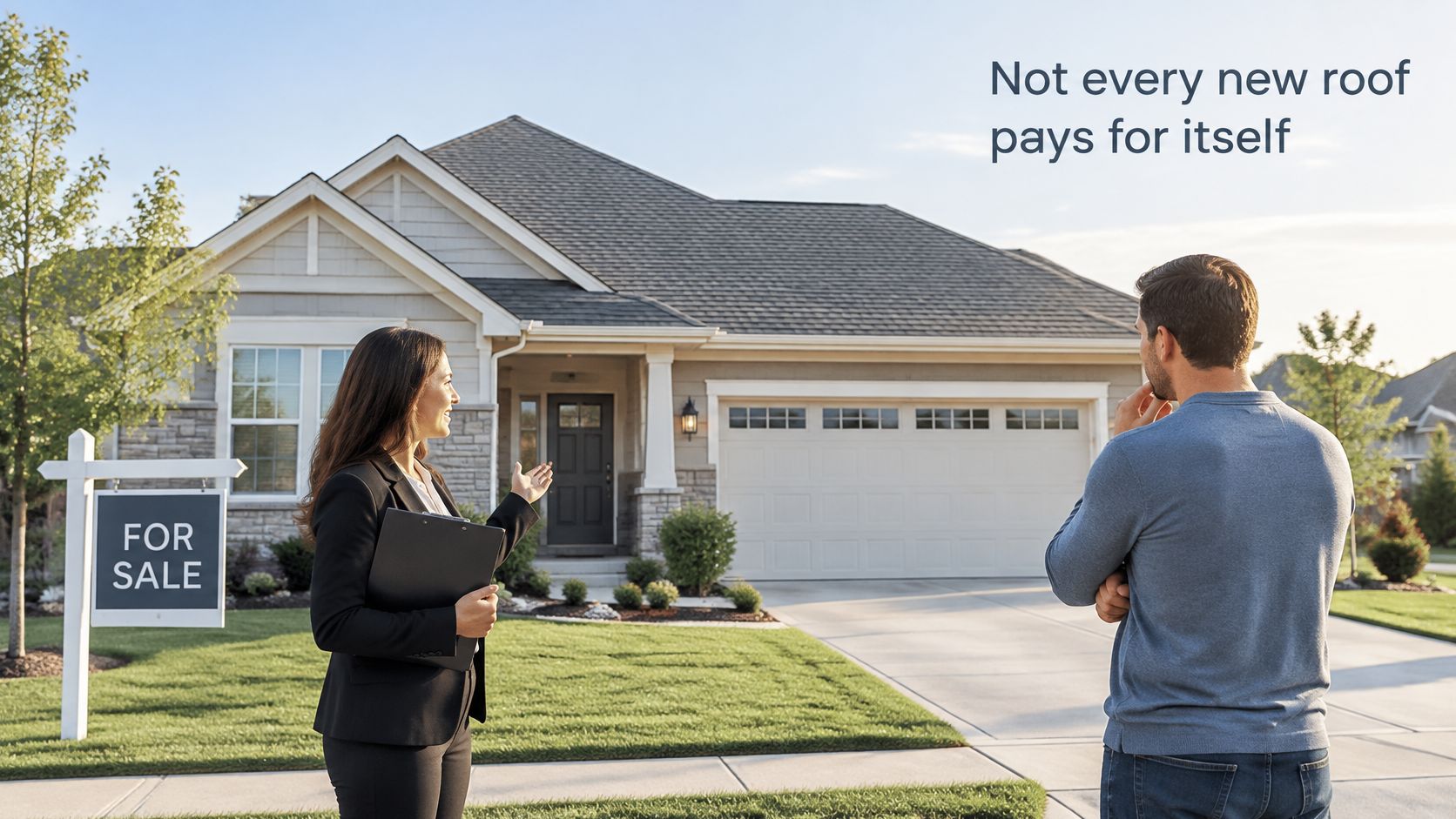
Retire two myths before you choose a branch. The appraiser doesn't add your contractor's invoice, and a roof with sound years left doesn't need replacing to protect resale.
Then decide.
- Replace when the roof is near end of life, or when it's likely to hurt insurability, financing, inspection results, or showings.
- Repair when the problem is limited, such as flashing, pipe boots, or a small shingle area, and the rest of the system has clear service life.
- List as-is with documentation when the roof is sound and the inspection will back you up.
Use cost recovery as a screen, not a verdict. Compare the replacement quote against the buyer credits, delays, and lost offers you'd face by leaving it, and remember the benchmark models a 30-square job on a simple hip roof.
Every homeowner gets a free roof inspection and a no-obligation estimate. If a roof can be repaired, we say so; if replacement is the better long-term investment, we explain why, without pressure. Our Owens Corning Preferred Contractor installations meet the standards that help homeowners qualify for enhanced warranty protection. For the decision itself, this roof replacement vs repair guide walks through it.
If the roof is the open question on your listing, HIBCO ROOF LLC starts with a free inspection and a written, no-obligation estimate, so you know before you set a price whether you're facing a repair, a replacement, or nothing at all. We work on Columbus and central Ohio homes, document storm damage for insurance, and install complete roofing systems rather than shingles over whatever is underneath. Visit HIBCO ROOF LLC to book an inspection and settle the roof question before your first showing.