
You come home after a central Ohio storm and find scattered shingles in the yard, a dented downspout, and water staining near an upstairs ceiling. Your first instinct is to call the nearest roofer and get the damage fixed before the next rain. That instinct can create problems if nobody documents the original condition or if you sign paperwork before you understand who controls the claim.
The right way to get help with insurance is to treat the first days as a documentation race, not a repair race. Your contractor can inspect, photograph, measure, and prepare a repair scope. Your insurer decides coverage under the policy. You decide who receives information, what you sign, and whether the proposed settlement matches the damage.
Table of Contents
- The First Hours After a Storm Hits Central Ohio
- Notifying Your Insurer and Opening the Claim File
- Who Actually Has Authority Over the Claim
- Documenting Storm and Hail Damage the Right Way
- Avoiding the Pitfalls That Quietly Shrink a Settlement
- Escalating When the Insurer Stalls, Underpays, or Denies
The First Hours After a Storm Hits Central Ohio
A homeowner in Westerville recently described the familiar sequence after a hard hailstorm: shingles were scattered along the driveway, the aluminum downspout was dented, and a bedroom ceiling showed a faint brown mark. By evening, several contractors had offered to “handle the insurance” if the homeowner signed an agreement immediately.
That is exactly when homeowners lose control. The first mistake is authorizing permanent repairs before the insurer or its adjuster has had a reasonable opportunity to inspect the original condition. The second is allowing a contractor to submit or interpret the claim without the homeowner retaining copies of the policy, photographs, estimates, and every communication.
Prompt action still matters. The National Association of Insurance Commissioners homeowners guide says homeowners should notify the agent or company as soon as possible, check the policy's reporting provisions, and maintain a complete claim file. Policies may require notice within a specified timeframe, so don't assume a general deadline applies to every loss.
Practical rule: Stop additional damage, preserve the evidence, and keep authority over every submission.
Your contractor should help create evidence, not make promises about coverage. If a roof opening is allowing water inside, temporary mitigation may be necessary. Cover the opening, save receipts, photograph the condition before and after the temporary work, and avoid permanent replacement until inspection is reasonably possible.
A 72-hour snapshot
| Timeframe | Action | Why It Matters |
|---|---|---|
| Immediately | Photograph the property from a safe location, prevent additional damage, and contact the insurer or agent | Establishes the original condition and starts the claim process |
| First day | Save the policy, declarations page, claim number, receipts, videos, and correspondence | Keeps important evidence out of scattered email threads |
| Before inspection | Obtain a written contractor scope and ask what documentation the insurer requires | Helps compare observed damage with the adjuster's later scope |
| Before signing | Verify the contractor's identity and insurance, then review every agreement | Prevents rushed assignments, releases, or unclear authorizations |
Fast communication matters in claims and in service businesses generally. The discussion of how fast follow-up converts leads is useful context for understanding why prompt responses shape outcomes, but speed shouldn't replace careful documentation.
For a Columbus homeowner, keep the claim in your hands from the start. A written record also makes later help more effective, whether you contact a public adjuster, an attorney, or the HIBCO guide to insurance claim recovery support.
Notifying Your Insurer and Opening the Claim File
Call the insurer or your agent as soon as you can describe the loss safely. Give the facts only. Say what you saw, avoid guessing about coverage, and do not repeat a contractor's opinion that the insurer “has to pay.”
Use a simple call script:
- Give the property address and the date of the storm or event.
- Describe visible damage, such as missing shingles, dents, broken screens, or interior staining.
- Ask for the claim number and the adjuster's name and contact information once assigned.
- Ask which temporary repairs are allowed or expected.
- Ask where to send photographs, receipts, estimates, and videos.
- Ask for the coverage position, denial, or partial-payment explanation in writing.
Keep a clean record of every call, text, email, and letter. The Ohio Department of Insurance and a guide to how insurance claims work both point homeowners toward the same habit, document who you spoke with, what they said, and when they said it. Store that in one place, either a binder or a well-labeled digital folder.
Build one claim file
Your file should hold:
- Policy records: The policy, declarations page, endorsements, deductibles, and renewal documents.
- Damage evidence: Original-resolution photographs and videos taken before emergency work, plus a dated inventory.
- Financial records: Mitigation invoices, repair estimates, receipts, and proof of payment.
- Communication history: Emails, letters, text messages, call notes, inspection dates, and promised follow-ups.
- Insurer documents: The claim number, adjuster correspondence, scope of loss, payment explanation, denial letter, or reservation of rights letter.
Photograph the roof, gutters, siding, windows, doors, attic, ceilings, walls, and affected belongings when it is safe to do so. Keep damaged materials available for inspection where practical. The NAIC consumer guidance on documenting damage and temporary repairs is clear on the homeowner's job here, document the damage, keep receipts, and separate emergency mitigation from permanent repairs.
If an adjuster questions the timing of temporary repairs, answer plainly: you took only the steps needed to stop more water intrusion and protect the property, and you kept the original damage documented before that work began. That keeps the file credible and keeps the conversation focused on the loss, not on a contractor's sales pitch.
Who Actually Has Authority Over the Claim
Homeowners often treat everyone at the property as if they have the same authority. They don't. A contractor, public adjuster, and attorney perform different jobs, and confusing those jobs can leave you with a thin file and an agreement you didn't understand.
The contractor assesses construction conditions. A competent roofer can identify bruised shingles, measure roof planes, inspect flashing, document damaged gutters, and prepare a repair scope. The contractor can explain what work may be needed and provide an estimate. The contractor cannot decide whether the policy covers the loss or promise that the insurer will pay.
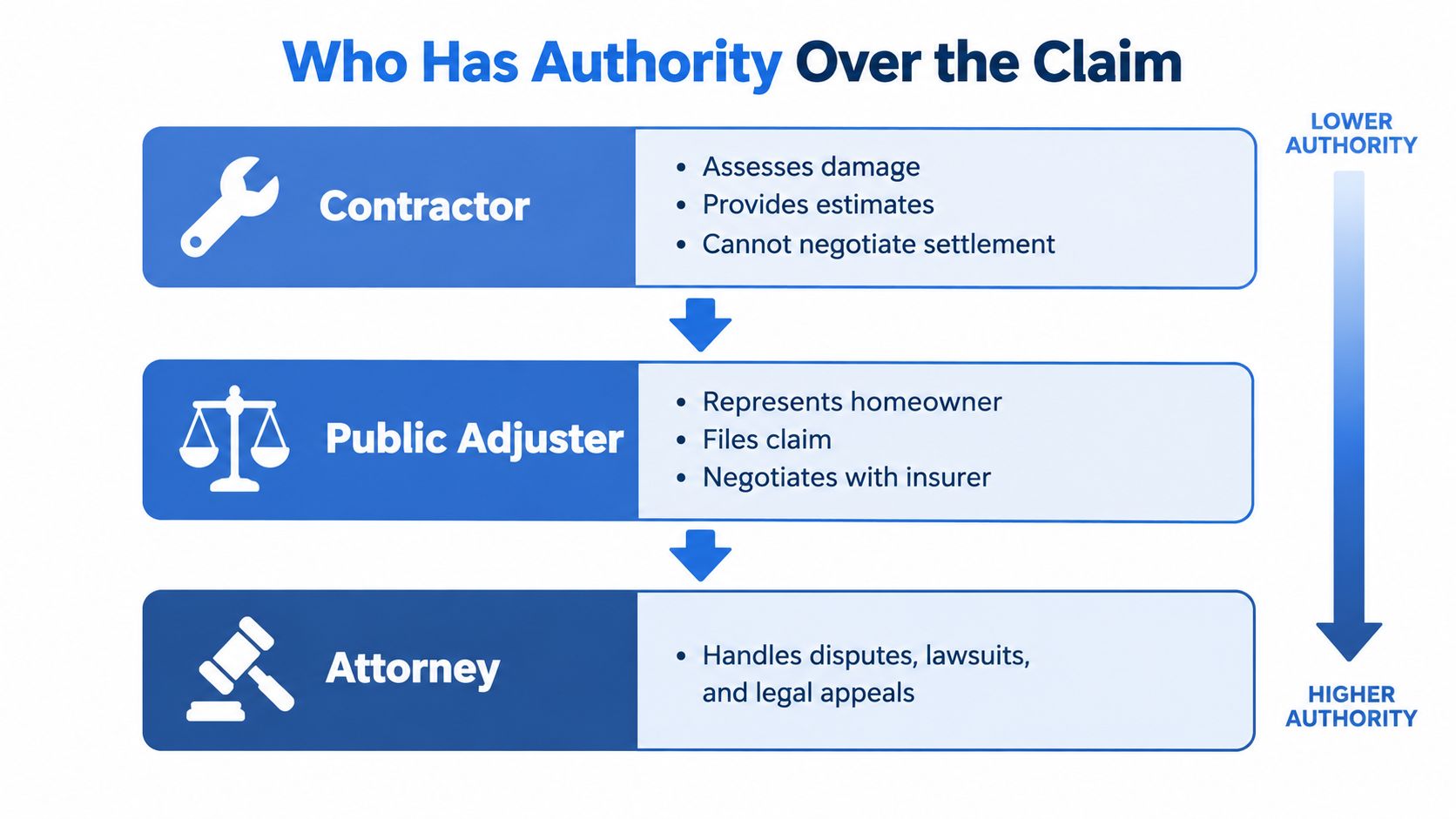
A licensed public adjuster represents the homeowner in the claim process, subject to applicable Ohio requirements. That professional may prepare and negotiate the claim, organize supporting evidence, and challenge the insurer's scope. Review the fee agreement carefully before hiring one, and confirm exactly what authority you're granting.
An attorney becomes appropriate when policy language is disputed, a denial raises a legal issue, deadlines are approaching, or litigation is realistic. An attorney can advise on legal rights, contractual duties, releases, and formal proceedings. Don't hire a lawyer merely because a contractor uses legal-sounding language to sell a project.
Match the helper to the decision
| Decision | Person who can help | Person who decides |
|---|---|---|
| What construction damage exists | Contractor or qualified inspector | Homeowner uses the evidence to pursue the claim |
| How to present and negotiate a claim | Public adjuster, if hired | Homeowner retains authority under the agreement |
| Whether disputed policy language creates a legal case | Attorney | Insurer initially applies the policy, with legal remedies available |
| Whether the policy pays a loss | Insurer under the policy | Insurer's claims process and applicable legal procedures |
Ohio insurance guidance makes the central boundary clear. A contractor can support documentation, but coverage determinations belong to the insurer under the policy. A strong claim file gives the homeowner an advantage regardless of which professional is involved. For a practical look at the inspection relationship, see this resource about a roof damage insurance adjuster.
Documenting Storm and Hail Damage the Right Way
A contractor's inspection should give you organized evidence, not a coverage decision. A generic estimate that says “replace roof due to hail” carries little weight. Require a file that connects each condition to a photograph, measurement, location, and explanation of how the storm may have caused it.
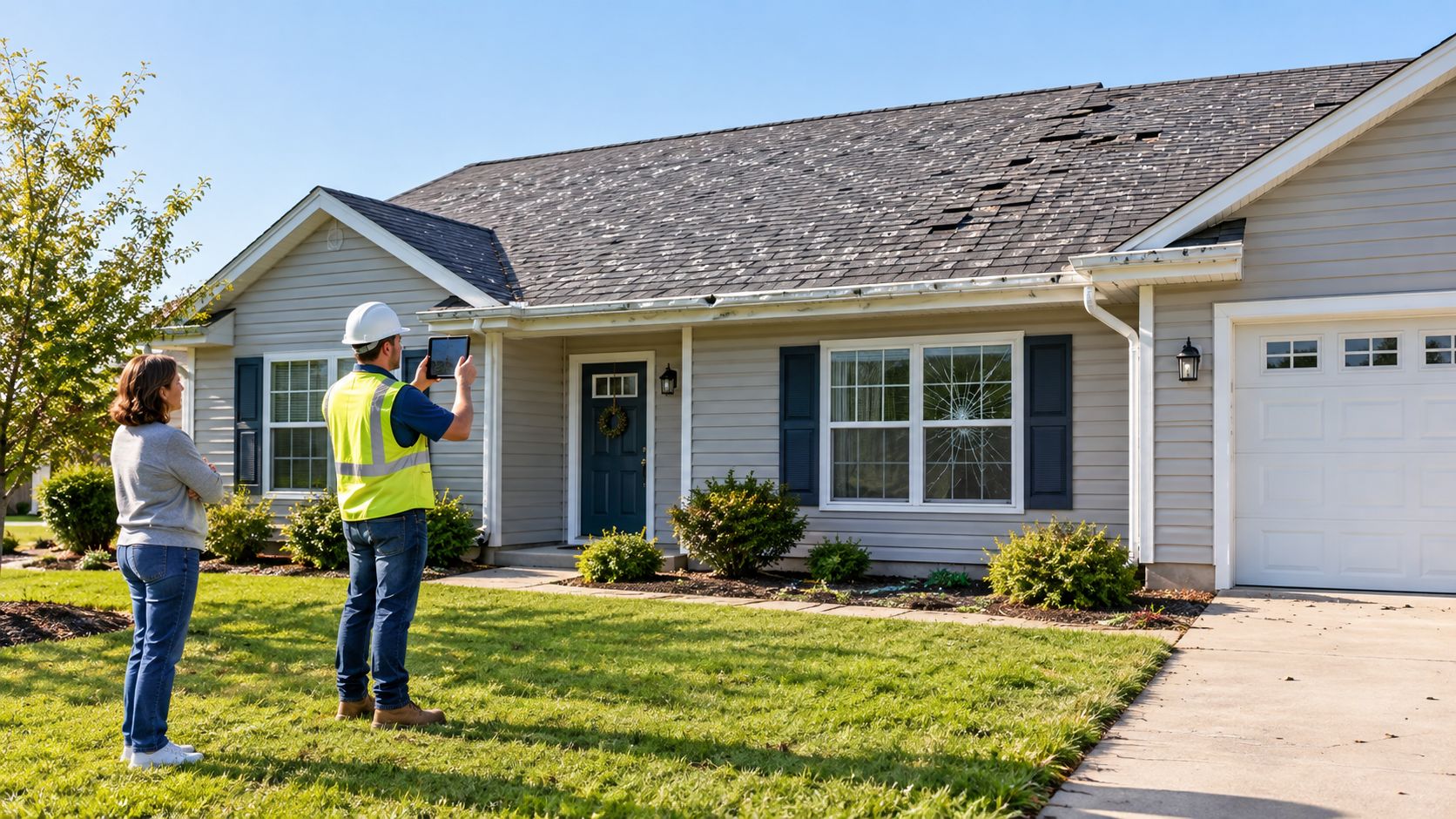
Start outside at ground level. Photograph every elevation, including the roofline, gutters, downspouts, siding, window frames, screens, doors, exterior lights, and visible trim. Take close-ups, then wider images showing where each item sits on the home. Label each file with the date, elevation, and location. A dent identified as the downspout on the northwest corner is useful evidence. An unlabeled close-up leaves the reviewer guessing.
Use a room-by-room and elevation-by-elevation log
On the roof, record the shingle type, roof planes, relevant slope, damaged accessories, exposed areas, lifted or missing shingles, and visible impact marks. Bruised asphalt may feel soft, similar to a grape underfoot, but do not walk an unsafe roof for evidence. A qualified inspector should use safe access and document representative damage with clear images and measurements.
On the exterior, record:
- Gutters and downspouts: Photograph dents, punctures, displaced sections, and the exact run or elevation.
- Siding and trim: Record cracked or chipped vinyl, impact marks, loose pieces, and matching or discontinuation concerns.
- Windows and doors: Photograph chipped frames, cracked glass, damaged screens, and distorted components.
- Roof accessories: Include vents, flashing, skylights, pipe collars, and other penetrations.
- Interior areas: Photograph stained ceilings, damp insulation, attic decking, walls, flooring, and affected contents.
Separate emergency mitigation from permanent replacement. Photograph conditions before temporary work whenever it is safe, keep receipts, and preserve removed materials for inspection when practical. Do not let a contractor discard damaged components without recording what was removed and where it came from.
Your contractor's report should identify physical evidence without claiming to decide coverage. Ask for photographs, dimensions, material descriptions, and a clear label for each item: temporary work, repair, or replacement. Review the report yourself before submission. If records arrive on paper, scan to PDF with PDFWix can help create an indexed file that is easier to search and submit.
Avoiding the Pitfalls That Quietly Shrink a Settlement
Fast signatures are not a substitute for a sound claim. Ohio's Department of Insurance warned in April 2025 that unsolicited contractors may be fraudulent, advised homeowners not to allow contractors to inspect property unsupervised, and cautioned against quickly signing documents or handing over insurance information for a contractor to submit a claim on the homeowner's behalf. Read the Ohio storm recovery warning before letting a stranger take control of the process.
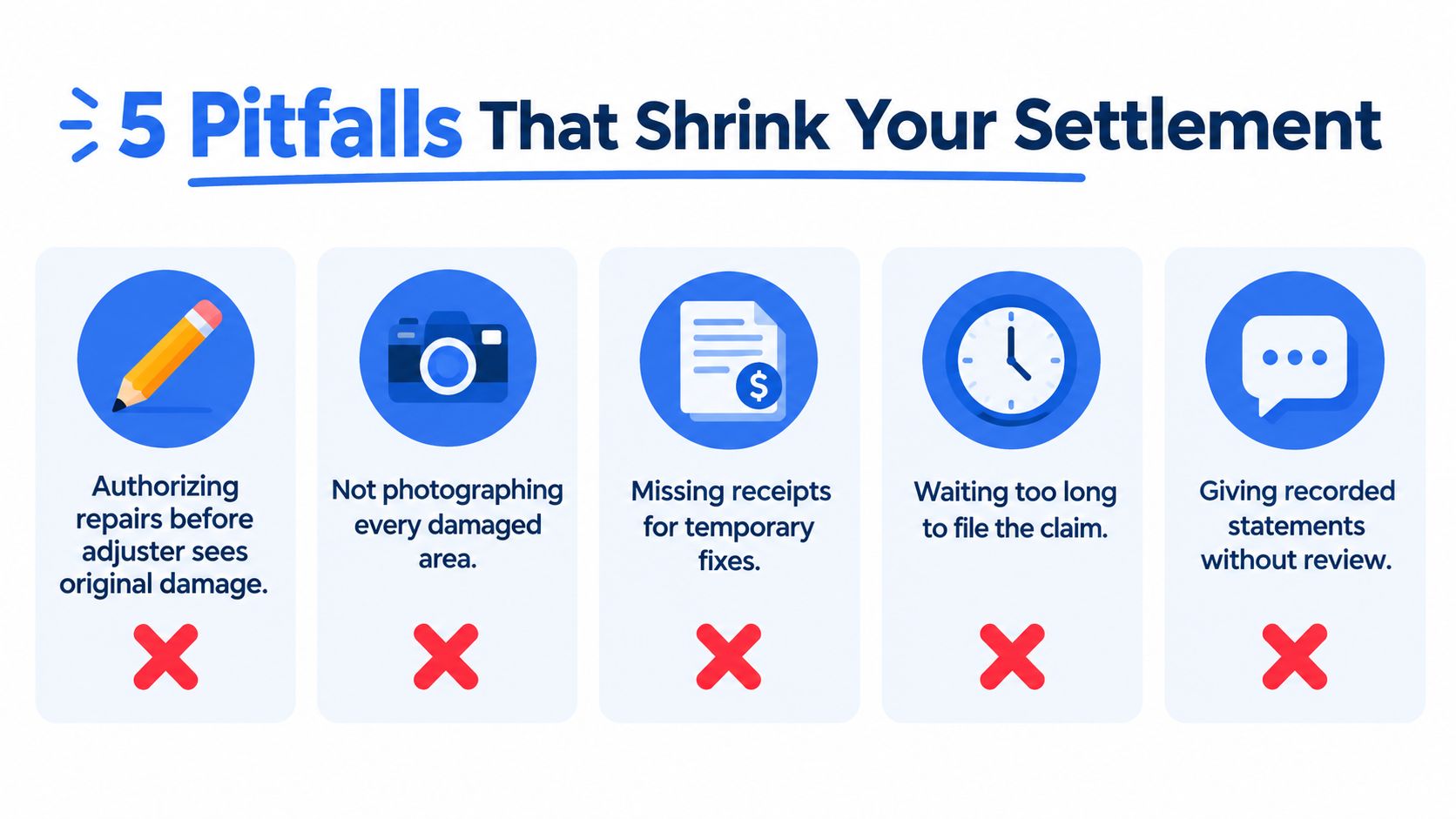
The five common traps are simple to identify:
- Permanent repairs before inspection: Once original materials disappear, the insurer may struggle to verify the condition.
- Incomplete photographs: A few roof pictures won't prove damage to gutters, siding, windows, attic areas, or interiors.
- Missing temporary-repair receipts: Emergency work without invoices makes reimbursement harder to evaluate.
- Delayed reporting: Waiting can conflict with policy notice provisions and gives the insurer an avoidable process argument.
- Unreviewed recorded statements: Answer accurately, but understand the question and don't guess about cause, timing, or coverage.
Run this checklist before signing
Verify the contractor's identity, insurance, and physical business information. Get a written scope before authorizing work. Ask the insurer what documentation it requires. Keep copies of every estimate, invoice, text message, photograph, and claim submission.
Then read the agreement for assignments of benefits, powers of attorney, releases, cancellation terms, payment conditions, and language that lets someone negotiate or submit information on your behalf. Don't sign a release until you've compared the settlement against the complete repair scope and understood what claims the release ends.
A contractor can help with construction facts, but policy interpretation belongs with the insurer, a licensed public adjuster, or an attorney. For another perspective on questions homeowners should ask before claiming a roof, you can check with Aastro Roofing, while still making your own decisions and retaining your own documents.
Escalating When the Insurer Stalls, Underpays, or Denies
Start with a written request, not an angry phone call. Ask the insurer to identify its coverage position, the policy provisions it relied on, the damage it accepted or rejected, the deductible calculation, and the reason for any partial payment or denial. Request the scope and payment explanation in writing, then compare them with your photographs, measurements, invoices, and policy pages.
Claims-handling problems are common enough that organized escalation matters. An analysis of 2024 national complaint data reported 39,680 claim-handling complaints, representing 65.2% of analyzed complaints. Delays accounted for 22.2%, and unsatisfactory settlements or offers accounted for 12.2%. The same analysis reported 15,161 homeowners-insurance complaints in 2024, compared with 13,104 in 2021, a difference of 15.7%. See the analysis of common insurance complaints for the cited complaint figures.
Use Ohio's regulatory path
If the insurer's handling remains unsatisfactory, contact the Ohio Department of Insurance Consumer Services Division. Submit a clear complaint with the policy, claim number, chronology, photographs, estimates, correspondence, denial or payment letters, and a concise statement of the problem.
The regulator can investigate whether the insurer or agent acted improperly. It doesn't replace the policy's appraisal, arbitration, or litigation procedures, and it doesn't automatically decide the amount of your loss. Kansas illustrates why this route deserves attention: its Department of Insurance closed 3,661 consumer complaints in 2024, reported that 67% involved claims-handling problems, and said its assistance helped recover more than $12.49 million for Kansas consumers. Homeowners and renters matters represented 21% of the complaints covered by that report. Those state-specific figures come from the Kansas Department of Insurance complaint report, while Ohio homeowners should use Ohio's regulator.
Federal disaster assistance is a separate track. FEMA generally requires an insured applicant to submit the insurance settlement, denial letter, a denial because damage didn't exceed the deductible, or proof that the peril is excluded or uninsured. Documents can generally be submitted within 12 months after applying, and a FEMA appeal is due within 60 days of the decision letter. The FEMA insurance-document guidance explains the required documentation and submission options.
Create one reconciliation page with these columns:
- Requested amount
- Insurer-approved amount
- Excluded amount
- Deductible
- Amount paid
- Unpaid amount
- Evidence supporting each disputed line
That table turns a vague complaint into a defined dispute. It also shows whether the disagreement concerns coverage, scope, pricing, deductible math, or missing documentation.
HIBCO ROOF LLC provides storm-damage inspections, photographs, measurements, written scopes, and communication support for Columbus and central Ohio homeowners, while leaving coverage decisions with the insurer. Visit HIBCO ROOF LLC to request a free written estimate and discuss the documentation you need before authorizing roof or exterior work.