
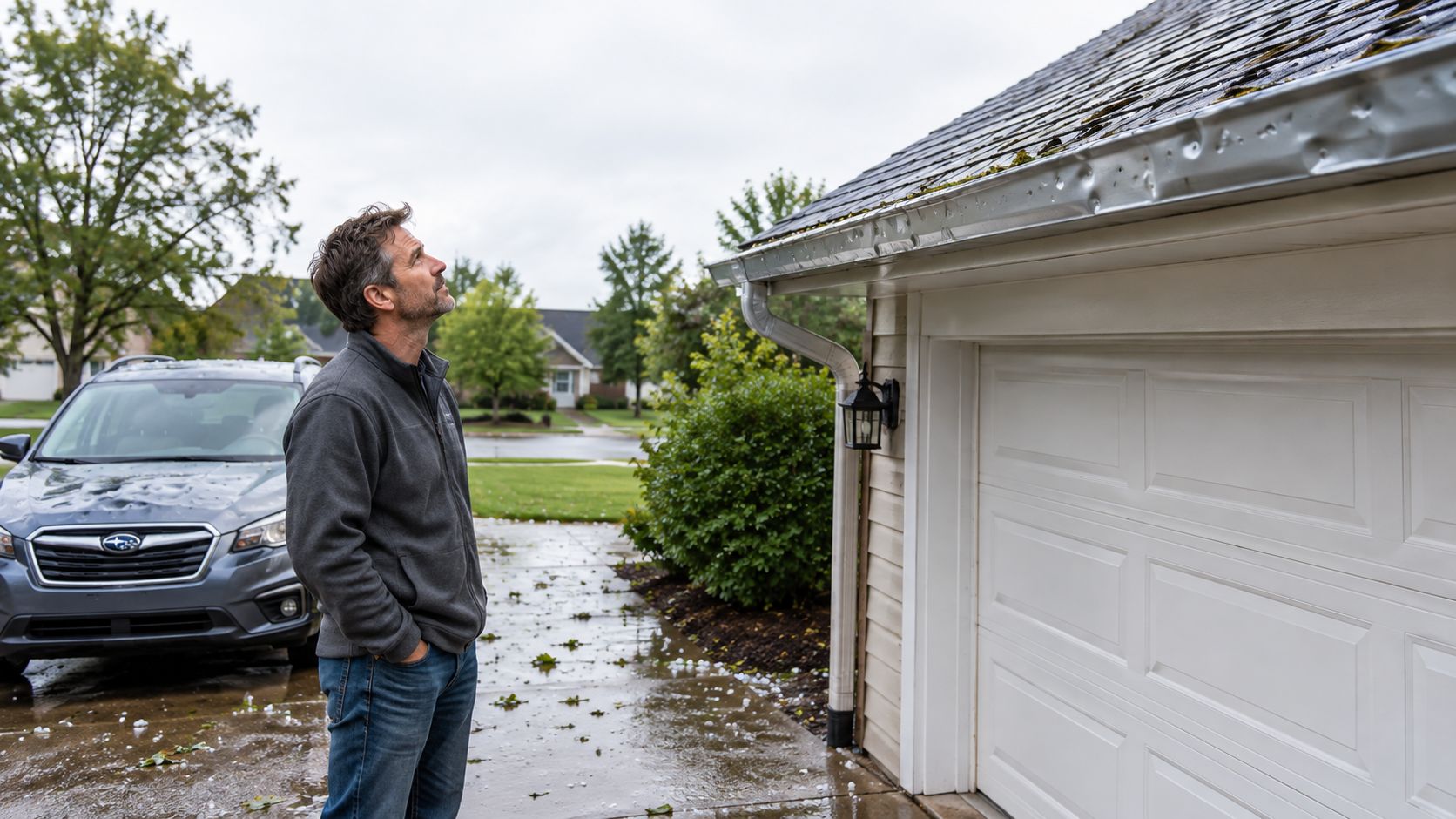
The morning after a Columbus-area hailstorm, a homeowner can stand in the driveway and see almost nothing conclusive. No shingles are missing. The roofline looks straight. Gutters are still attached. Yet water may have entered through damaged flashing, fractured shingles, or a skylight seal, and hail impacts can be difficult to judge from the ground.
That uncertainty creates the first important decision: should you call the insurer, a roofing contractor, or both? Calling a contractor first doesn't automatically hurt a claim. Starting permanent repairs before the damage is documented can. Insurance claim recovery support is the organized process that connects your policy, the physical evidence, the contractor's scope, the adjuster's findings, and the follow-through needed to reach a fair resolution.
Table of Contents
- The Morning After the Storm
- First 72 Hours After the Storm
- Building the Evidence Chain That Carries the Claim
- Insurance Proceeds Versus Disaster Assistance
- Working the Scope With the Adjuster
- Why Accepted Claims Still Leave Homeowners Short
- When the Insurer Stops Returning Calls
- Putting the Recovery Checklist to Work
The Morning After the Storm
A homeowner in central Ohio might report the loss, receive a claim number, and then wait for an adjuster while water staining spreads across a ceiling. The insurer may agree that a storm occurred but question whether the roof damage came from hail, wind, age, or earlier wear. Without dated photographs, a clear scope, and a record of every conversation, the homeowner is left trying to prove a complicated property condition from memory.
That's where recovery support matters. It isn't a promise that every requested item will be covered. It's a disciplined file that lets each participant do the right job.
- The insurer and adjuster evaluate the loss under the policy and document the basis for settlement.
- A public adjuster may represent the policyholder in claim preparation and negotiation.
- An attorney handles legal advice and coverage disputes that require legal representation.
- A roofing contractor documents roof and exterior conditions, prepares a repair-versus-replacement scope, links photographs to roof elevations, and records mitigation work.
The homeowner remains the decision-maker. A contractor can't promise coverage, declare a policy provision applicable, or force an insurer to accept a disputed scope. A contractor can provide objective evidence and explain what the building requires to become watertight again.
The need for organized help is easy to understand. The National Association of Insurance Commissioners catastrophe dashboard reports that U.S. economic losses from natural catastrophes reached $176 billion in 2024, the third-highest total since 1999. Insured losses reached $99 billion, the second-highest level on record.
The process has four practical phases:
- Notification, report the loss promptly and establish the claim file.
- Documentation, preserve evidence and build an itemized scope.
- Negotiation, compare the adjuster's findings with the documented repair requirements.
- Follow-through, track payment, supplemental documentation, code questions, and unresolved disputes.
A calm first response won't eliminate every disagreement. It does keep a routine repair from becoming a months-long argument over what happened, what was damaged, and what the policy supports.
First 72 Hours After the Storm
Start with safety. Stay away from downed lines, unstable structures, and areas you can't enter safely. Once conditions allow, report the damage to your agent or carrier. The NAIC homeowner claims guidance advises prompt notice because most policies impose a reporting deadline, and it recommends photographs, video, and an itemized inventory before cleanup.
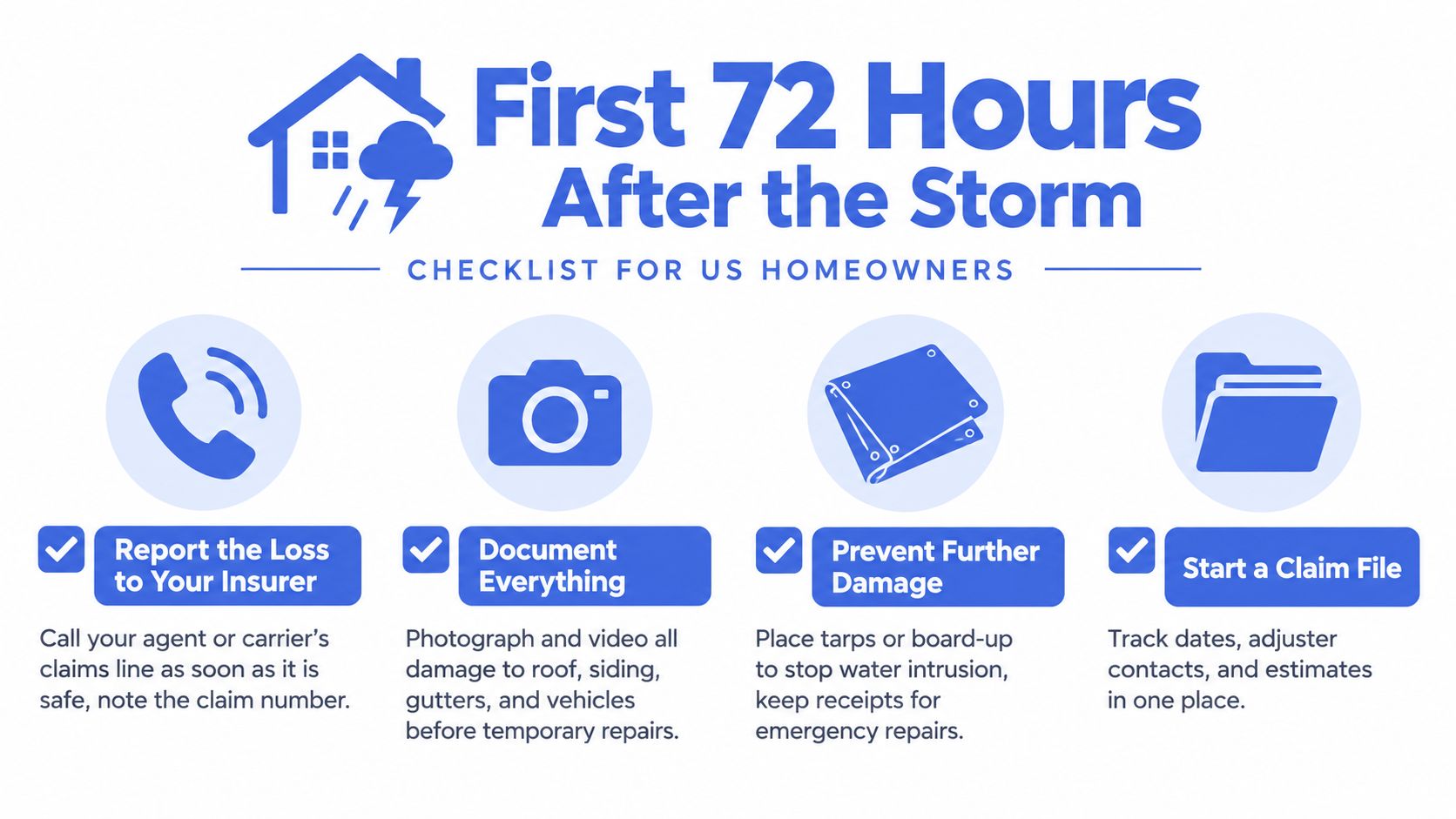
Use the first three days to create a clean record:
- Report the loss: Get the claim number, the representative's name, and the next scheduled action.
- Record conditions: Photograph and video roof slopes, siding, gutters, windows, skylights, vehicles, ceilings, and visible water intrusion before cleanup.
- Limit additional damage: Use reasonable temporary measures, such as a tarp or emergency board-up, when safe. Keep every receipt.
- Start a claim file: Save the policy, declarations page, correspondence, inspection dates, estimates, invoices, and call notes together.
The insurer generally assigns an adjuster to inspect the property and document the loss. That inspection can be harder to arrange if the roof has already been replaced or damaged materials have been discarded. Temporary mitigation is different from permanent repair. Stop progressive water intrusion, but preserve the condition and ask the carrier how it wants the evidence handled before removing damaged components whenever feasible.
Building the Evidence Chain That Carries the Claim
A strong claim is a traceable evidence chain, not a folder of random photographs. Each conclusion should connect the observed condition to its location, date, affected component, proposed quantity, and supporting cost. That connection gives the adjuster a file that can be checked rather than interpreted.
The NAIC post-disaster claims guide recommends prompt notification, detailed damage lists, photographs or video, adjuster contact notes, and contractor bids that show materials, prices, and labor line by line.
Build the file around five records:
- Date-stamped photographs and video: Capture wide views, close-ups, roof elevations, interior areas, and visible storm indicators.
- A structured inventory: Record damage room by room and structure by structure.
- Claim identifiers: Keep the policy number, claim number, date of loss, carrier contacts, and inspection dates together.
- Mitigation records: Save emergency invoices, receipts, and descriptions of temporary work.
- A detailed estimate: Separate materials, quantities, labor, taxes, permits, and code-required work.
For a Columbus-area roof, document displaced or fractured shingles, exposed underlayment, damaged flashing, gutters, siding, skylights, and interior staining before covering or removing debris, whenever safe. Identify every roof-slope photograph in the estimate. “Roof damage” gives the adjuster little to audit. “North slope, fractured laminated shingles across the field and damaged step flashing near the rear dormer” identifies the location, material, and scope.
Practical rule: If someone unfamiliar with the property cannot match a photograph to a line item, organize the file again.
A line-item estimate separates legitimate differences from speculation. It lets the adjuster compare quantities, pricing, depreciation, deductible treatment, and repair methods against a defined scope. Homeowners who need a broader filing reference can also consult this Mitchell-Joseph Insurance Agency claims guide.
For the roof-specific side of this work, our guide to a roof inspection for an insurance claim shows how to keep the inspection focused on evidence rather than assumptions. The goal is to make the actual condition difficult to misunderstand, not to inflate the claim.
Insurance Proceeds Versus Disaster Assistance
Insurance recovery and disaster assistance are separate funding paths. FEMA can't pay costs already covered by insurance, and an applicant with insurance may need to provide a settlement, denial letter, or proof of noncoverage. A denial because the damage falls below the deductible is still a relevant document. In applicable disaster-assistance processes, insurance documents may be submitted for review within 12 months after application, according to FEMA's insurance-document guidance.
| Funding Source | What Triggers It | Who Decides | Typical Payout | Documentation Required |
|---|---|---|---|---|
| Insurance recovery | Covered damage under the policy | The insurer under the policy terms | NFIP payments averaged $63,691 per claim, with a median of $20,272, between 2020 and 2024 | Claim notice, policy information, photos, inventory, adjuster records, estimates, receipts, and settlement documents |
| Disaster assistance | Eligibility under an applicable disaster-assistance program, after insurance is addressed | FEMA or the responsible assistance program | FEMA Individuals and Households Program grants averaged $2,704 per household between 2020 and 2024 | Application records, insurance settlement, denial letter, or proof of noncoverage |
| Below-deductible loss | Insurer determines covered damage doesn't exceed the deductible | The insurer, with possible review through available assistance channels | No insurer payment may be issued | Written claim decision, estimate, policy terms, and deductible information |
These averages come from the NFIP media toolkit, not a promise about an individual roof claim. The operational lesson is simple: maintain a claim-document register showing the date of loss, carrier notification, inspection, estimate version, settlement or denial status, uncovered items, and uploaded correspondence.
A contractor can document conditions, prepare a scope, photograph elevations, and invoice mitigation work. It shouldn't promise coverage or represent the insurer's decision. Homeowners comparing policy payment methods should also understand actual cash value versus replacement cost for a roof.
Working the Scope With the Adjuster
Treat the adjuster visit as a valuation meeting you prepare for. The NAIC consumer guidance explains that the insurer assigns an adjuster to inspect damaged items and document the loss for a settlement decision. Cooperate fully, then arrive with evidence that makes each disputed item easy to evaluate.
Bring the claim file, room-by-room inventory, dated photographs, receipts, mitigation invoices, and the contractor's line-item estimate. The estimate should identify roof elevations, materials, quantities, labor, permits, taxes, and code-required work. That detail keeps the meeting focused on measurable differences rather than general disagreement.
Ask the adjuster to identify:
- Which observed damage is included in the scope.
- Which items are excluded or considered unrelated.
- Whether the carrier needs more photographs, samples, or documentation.
- How depreciation and the deductible appear in the estimate.
- What written explanation supports any partial denial.
Challenge an incomplete scope with a specific elevation, photograph, flashing detail, or manufacturer requirement. The estimate should account for the work required to restore the affected roof and exterior system. Homeowners with interior moisture can apply similar documentation principles by reviewing this water damage claim process.
Keep inspection notes and record every follow-up. If the adjuster says an item will be reviewed later, write down who made that statement, the date, and the evidence requested. Send requested records through a traceable channel and retain the submission confirmation. For a roof-focused preparation checklist, consult this roof damage insurance adjuster guide. A contractor can document conditions and identify omitted work, but the insurer decides coverage.
Why Accepted Claims Still Leave Homeowners Short
An accepted claim doesn't automatically equal a complete recovery. The insurer may agree that hail damaged the roof while still disputing whether the payment should include recoverable depreciation, code-required work, matching exterior materials, ventilation, flashing, gutters, siding, or skylights.
United Policyholders reports survey findings that 69% of households were underinsured by an average of $247 per square foot, while 61% of respondents said the insurer's replacement-cost estimate was inadequate. Those figures appear in the organization's survey materials. They point to a problem homeowners often discover too late: the policy limit and settlement method may not match the cost of restoring the property to current requirements.
Start by separating the questions:
- What valuation method applies? Determine whether the policy uses actual cash value, replacement cost, or different methods for different property components.
- What depreciation can be recovered? Some policies require completed work and supporting invoices before withheld depreciation is considered.
- Are code upgrades covered? Ordinance-and-law coverage, exclusions, and limits control whether current building requirements are payable.
- Does matching matter? A damaged exterior may need to be evaluated alongside adjacent materials, but coverage depends on policy language and applicable rules.
- What is the complete envelope scope? Roofing, flashing, ventilation, gutters, siding, and skylights often function together, so a narrow shingle-only estimate may not describe the required repair.
A legitimate supplement adds evidence that was missing, concealed damage discovered during authorized work, or a policy-supported requirement that the original estimate omitted. An unsupported supplement adds work because the contractor wants a larger project. Those aren't the same.
A contractor's estimate can't fix an inadequate policy limit or create coverage for an excluded upgrade. It can show what the property needs and identify the policy questions that require an answer.
When the Insurer Stops Returning Calls
Silence is not a claims strategy. If calls go unanswered, an inspection remains unscheduled, or a partial payment arrives without a clear explanation, move from informal contact to written communication. State what was requested, when it was requested, what remains unresolved, and what documents support your position.
The escalation concern is real. A 2025 complaint report found that 69% of closed complaints involved claims handling, while homeowners and renters accounted for 25% of complaints. Consumer Reports also found that one in four homeowners who filed a claim waited more than 30 days for payment, and 6% waited more than 90 days. The figures are reported in this Kansas Insurance Department complaint report.
Use a written escalation ladder:
- Create a communication log: Record dates, names, phone numbers, promises, inspection status, and unanswered messages.
- Send a focused written request: Ask for the missing inspection date, written coverage position, itemized estimate, or explanation for each partial denial.
- Attach the evidence: Include photographs, mitigation invoices, adjuster notes, contractor estimates, and prior correspondence.
- Ask for deadlines in writing: Request the next action and identify any deadline that affects your repair or supplemental submission.
- Escalate outside the carrier when appropriate: Don't expect a roofing contractor to resolve a coverage interpretation or legal dispute.
For Columbus homeowners, the City of Columbus identifies the Ohio Department of Insurance as the state resource for help understanding a policy or addressing an insurer dispute. Its consumer assistance line is 1-800-686-1300, as listed in the city's property-damage guidance.
A contractor can help organize the physical evidence and clarify the repair scope. The homeowner, regulator, public adjuster, or attorney must decide which escalation path fits the dispute.
Putting the Recovery Checklist to Work
A workable recovery file should tell the story without requiring anyone to reconstruct it from scattered emails. On the first day, report the loss and open a claim register. Record the policy and claim identifiers, date of loss, carrier contact, and every promised next step.
Before cleanup, capture wide and close photographs of each roof elevation, exterior component, interior stain, and affected personal item. Preserve damaged materials when feasible. Use tarps or other reasonable temporary measures to prevent additional loss, and store the receipts with the claim file.
Before the adjuster arrives, prepare the written scope. It should identify materials, quantities, labor, taxes, permits, code-related work, mitigation, and the specific photographs supporting each area. During the inspection, compare the adjuster's observations with the file and request written explanations for exclusions or partial payment.
After the inspection, review the settlement for missing components and valuation treatment. Check whether the policy requires completed repairs or additional invoices for recoverable depreciation. If the carrier stops communicating, use the written escalation process and contact the Ohio Department of Insurance at 1-800-686-1300 when you need help understanding the policy or addressing an insurer dispute.
For Columbus and central Ohio homeowners, HIBCO ROOF LLC can contribute a free roof inspection, storm and hail damage documentation, a written repair or replacement scope, and communication support during the insurance process. The useful point is timing: obtain the defensible scope before the adjuster visit, not after a partial estimate has already shaped the claim.
HIBCO ROOF LLC provides free, no-pressure roof inspections, written estimates, storm damage documentation, and insurance claim assistance for Columbus-area homeowners. Visit HIBCO ROOF LLC to schedule an inspection and put an organized, evidence-based recovery file in place.