The storm came through a little after nine last night. This morning the downspout is lying in the mulch and the west wall of the house has a chalky scuff running along it at shoulder height. You're standing in the driveway holding a coffee, trying to work out whether this is a two hundred dollar problem or a twelve thousand dollar one before you call anybody.
Dents get checked first, because dents are what hail damage is supposed to look like. On a vinyl wall, the dents are usually the least important thing you'll find. What decides whether that wall keeps water out of your house is the lap joint, the fasteners, and the house wrap hiding behind the panel.
Here's how to walk the house, sort real hail damage to vinyl siding from ordinary wear, and build a record strong enough to survive an adjuster's second look.
Table of Contents
- Signs of Hail Damage on Vinyl Siding
- Telling Hail Marks Apart from Wear and Fading
- How Hail Size and Wind Change Siding Damage
- How to Document Hail Damage Before Any Repair
- Choosing Between Panel Repair and Re-siding
- Insurance Claims and Scheduling a Free Inspection
Signs of Hail Damage on Vinyl Siding
Ten minutes with a flashlight and a stick of chalk tells you most of what you need to know. Start on the elevation that faced the wind, not the front of the house. If the storm came out of the west, that's the west wall, and on most Columbus homes it will hold nearly every mark worth finding.
Work left to right at eye level, then drop down and read the bottom three courses, where each panel laps over the one below. Finish at the corners, the window trim, and the starter course just above the foundation. Trim stands proud of the wall, so it takes hits the flat panel face escapes, and impact marks cluster around it.
Rating what you find matters more than counting it.
| Sign | What it looks like | Severity |
|---|---|---|
| Round dents or dimples | Shallow circular marks, often grouped on storm-facing walls | Cosmetic unless paired with cracks |
| Cracks at the lower lap | Hairline or split cracks where panels interlock | Functional, water can enter |
| Punctures or holes | Small clean holes or shattered edges | Functional, exposes the barrier |
| Abrasion or sandblasted surface | Dull, rough patches with lost gloss | Cosmetic, but speeds UV wear |
| Loose or displaced panels | Panels that bulge, rattle or pull from nails | Functional |
| Torn or missing sections | Pieces gone and sheathing exposed | Urgent, repair now |
A dozen dimples on a shaded wall cost nothing to live with. One crack at a lap joint can funnel water behind the siding for months before a stain shows up on the ceiling of the room inside.
The pattern isn't theoretical. The National Weather Service's write-up of the May 10, 2016 severe weather event records wind-driven hail up to 1 inch that sandblasted west sides of homes, shredded vinyl siding and shattered windows. The same report logged quarter- to half-inch hail in one community and golf-ball- to egg-sized hail elsewhere, which is exactly why two neighbors on the same street can end up with very different repairs from one storm.
Practical rule: dimples are a cosmetic story. A split lap, a puncture, or a panel pulling off the wall is a water story, and water doesn't wait for an adjuster to agree with you.
Photograph every mark before you touch anything, chalk a circle around it, and write one word next to it: cosmetic or functional. That note is what turns a vague complaint about a hailstorm into a condition record someone can act on.
Telling Hail Marks Apart from Wear and Fading
Most of what looks like impact damage on a fifteen-year-old vinyl wall isn't impact damage. It's sun, cold, or the guy who installed it in 2008 with a nail gun set too high. Get that sorting wrong in either direction and you either file a claim you'll lose or you leave a real opening in the wall.
Run this test before you photograph anything
Stand back twenty feet and ask three questions. Are the marks grouped in a band on the wall that faced the wind, or are they scattered evenly across every elevation? Do they have sharp edges and a defined point of impact, or a soft, gradual change in color? Did they appear after a storm you can name and date?
Grouped, sharp-edged, and storm-dated means treat it as hail until a trained eye says otherwise. Even and soft means keep looking.
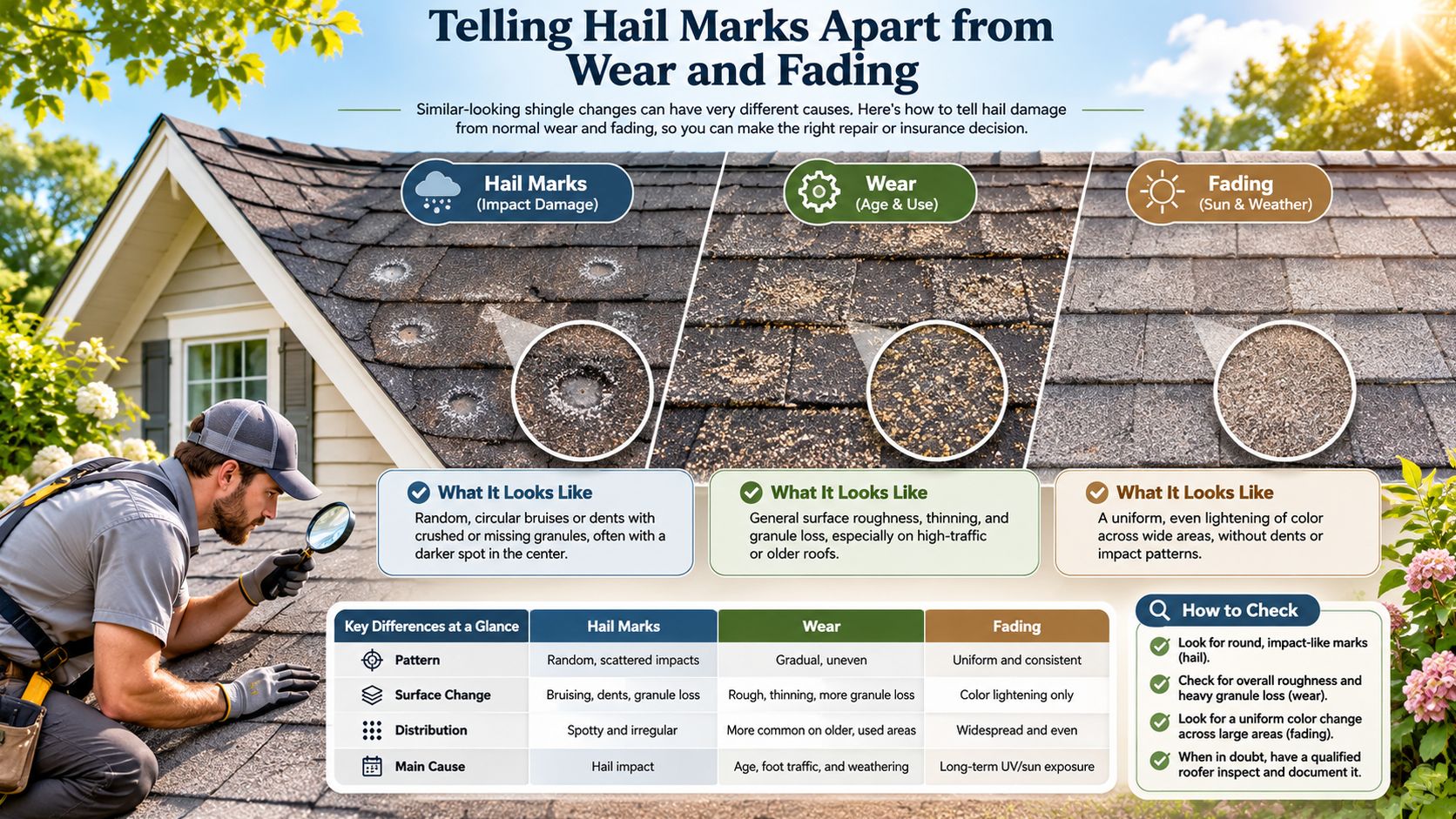
The same sorting logic runs on the roof above that wall, where granule loss and bruises have to be separated from age before anyone climbs a ladder.
| Look-alike cause | Pattern on the wall | Key clue |
|---|---|---|
| Sun fading | Even across the whole elevation, mostly south and west walls | Color change with no impact point |
| Thermal cracking | Cracks near fasteners, most visible in cold months | Brittle panels with no impact marks |
| Isolated impact | One mark, often at person height or near ground level | Single mark, no grouping |
| Mildew or dirt | Streaks or a uniform film | Washes off, no dent or crack |
| Installation faults | Buckling or gaps at seams | Nails driven too tight, no expansion gaps |
| Storm-timed impacts | Grouped marks on storm-facing walls | Matches a dated storm and wind direction |
Sun fading is the one homeowners misread most often. It runs the full height and width of a south or west wall, it's worst near the top where UV hits hardest, and there's no point you can put a fingernail into.
Thermal cracking is the winter version of the same confusion. Vinyl stiffens as it cools, and a panel nailed tight has nowhere to go when it contracts, so it splits near the nail hem. If you see a run of cracks lined up vertically along the studs, that's installation and temperature, not hail.
A single mark at knee height or shoulder height is a thrown ball, a mower, or a bicycle. Hail doesn't pick one spot.
Keeping the wall clean slows the fading and makes the next inspection honest, and the basics of vinyl siding care are worth an afternoon once a year.
How Hail Size and Wind Change Siding Damage
The common belief is that hail size alone decides the outcome. Size matters, but it's one input among several, and it's the one homeowners fixate on because it's the only one in the forecast.
The National Weather Service's hail impact and severity guidance sets out a straightforward progression that's useful when you're reading a storm report.
| Hail diameter | Expected siding effect | Severity |
|---|---|---|
| Under 1 inch (dime-sized) | Little or no property damage expected; prolonged accumulation can create other hazards | Low |
| 1.0 to 1.5 inches | Moderate damage to roofs and siding; can crack glass, especially with jagged edges | Moderate |
| 1.75 inches or larger | Major damage to homes, including dented siding and broken windows | High |
That table is a guide to probability, not a verdict on your wall. What tips a moderate storm into a siding claim is wind. Storm reports regularly describe neighborhoods where the houses on one stretch of a street took substantial vinyl damage while homes farther out were untouched, and where the worst-hit houses had siding stripped almost entirely off the walls that faced the wind. Same stones, same storm. The difference was which elevation caught the blast.
Diameter describes the energy in a single strike. Direction and angle decide how many strikes the wall absorbs and how square they land. A panel that shrugs off a straight-on hit can split open on an oblique, wind-driven strike in February, when the vinyl is cold and stiff and has less give. The IBHS 2025 research agenda calls out wind-driven hail measurement as an open research gap for precisely this reason, because hail moving sideways at speed doesn't behave like a stone dropped from directly above.
Impact angle, panel temperature and the thickness of the profile change the outcome as much as the number in the storm report.
Angle matters at the laps, too. A glancing strike that would leave a shallow scuff on flat metal can catch the bottom edge of a vinyl lap and crack it upward along the lock. One cracked lap interrupts the interlock for every course above it, which is why a handful of small impacts on the windward wall can mean more panel work than a dozen clean dents on the sheltered side. It also explains why two walls on the same house get scoped differently.
That's also why a rating on a product data sheet can't prove a specific storm did or didn't hurt your wall. An impact-resistant label describes a test condition. Your house faced a real one.
When you're reading a storm report, pull three things out of it: the reported stone size, the direction the wind came from, and which of your elevations faced it. The first two tell you what the storm was capable of, and the third tells you where to look. If the stones reported near you sat around the size that starts damaging roofs and the wind drove them into your west wall, that wall earns a slow, raking-light inspection even if the other three look clean from the driveway.
Write the three lines down before you pick up a ladder. They anchor everything that comes after.
How to Document Hail Damage Before Any Repair
You already own the tools for this. A phone, a ruler, a piece of chalk and twenty minutes will produce a better record than most inspection reports I've read.
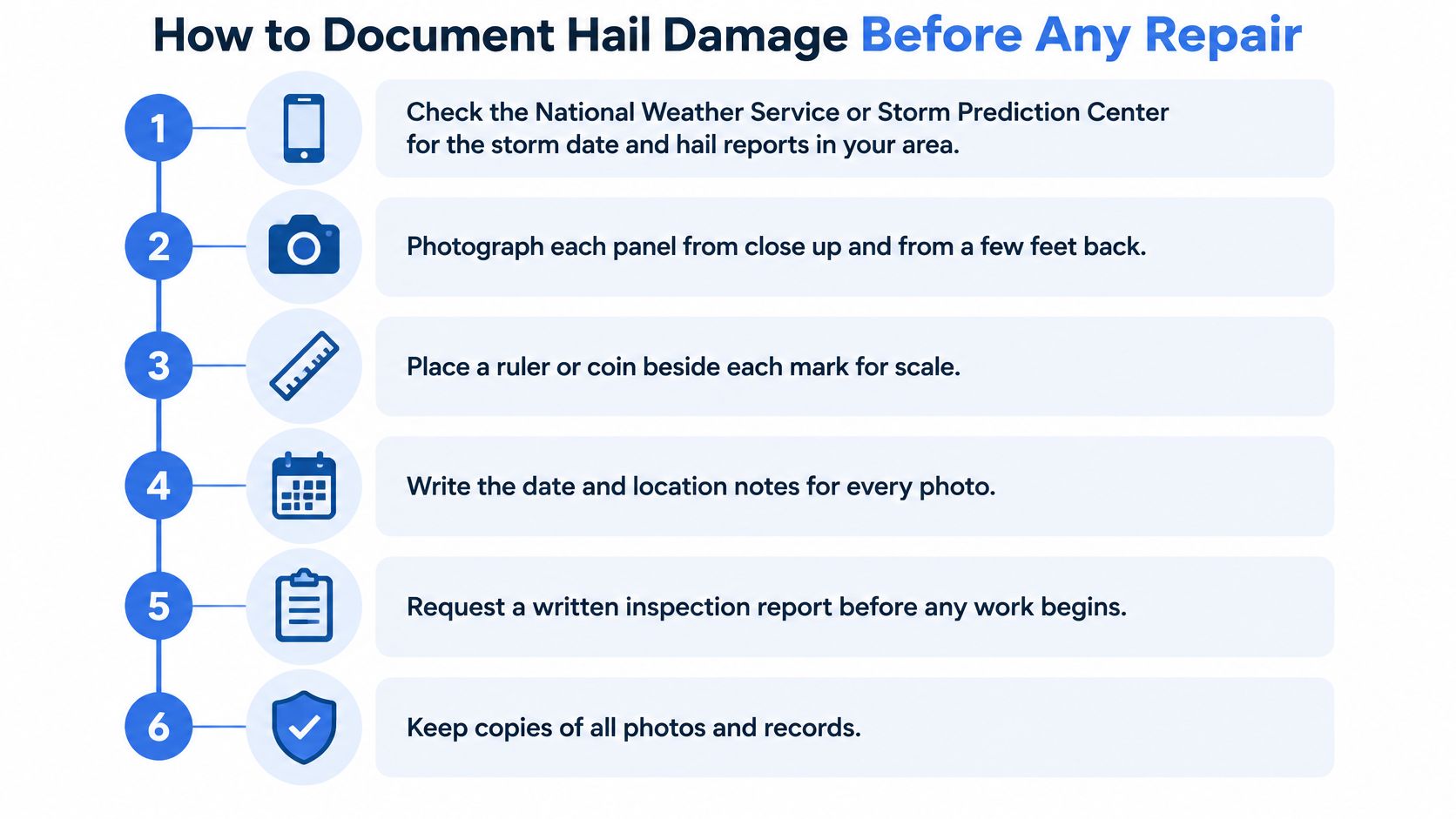
- Get the storm on the record. Look up the date and reported hail size for your area through the National Weather Service or the Storm Prediction Center's storm reports. This anchors everything that follows to a documented event instead of a memory of one.
- Shoot wide, then close. Photograph each elevation from about twenty feet back, then each damaged panel from a foot away with a coin or ruler against the surface for scale. An adjuster reviews dozens of files a week, and the ones with context and scale are the ones that get taken seriously.
- Draw the house on paper. Four rectangles for the four elevations, an X for the front door, and a numbered dot for each damaged panel. Write the count per wall so the total is a number, not an impression.
- Log every other surface on the same storm. Windows, screens, gutters, downspouts, trim, garage door. A dented downspout corroborates a cracked panel, and neighbors who file on the same day corroborate each other.
- Look behind the damage. Ease a cracked or punctured panel back and check the house wrap underneath. Torn, stretched or damp wrap turns a cosmetic panel swap into a wall repair, and you want to know that before the scope is set.
- Stop the water now. Tape a sheet of plastic over anything open, and keep the receipt for the materials. Emergency measures that protect the house read as reasonable to anyone reviewing the file.
- Save it all before a single panel comes off. Dated filenames in a cloud folder. Once the damaged panel is in the back of a truck, your evidence leaves with it.
The Storm Prediction Center's August 19, 2017 hail report shows why this level of detail is reasonable to expect. Observers recorded stones up to 2.5 inches alongside broken windows and holes punched through vinyl siding, which links a specific stone size to visible failure of the exterior envelope. Note the hail size, the affected elevations, how many panels and in what pattern, plus any related window or roof damage, and you've written the description an adjuster needs.
Here is the same sequence laid out as a process you can follow on your phone.
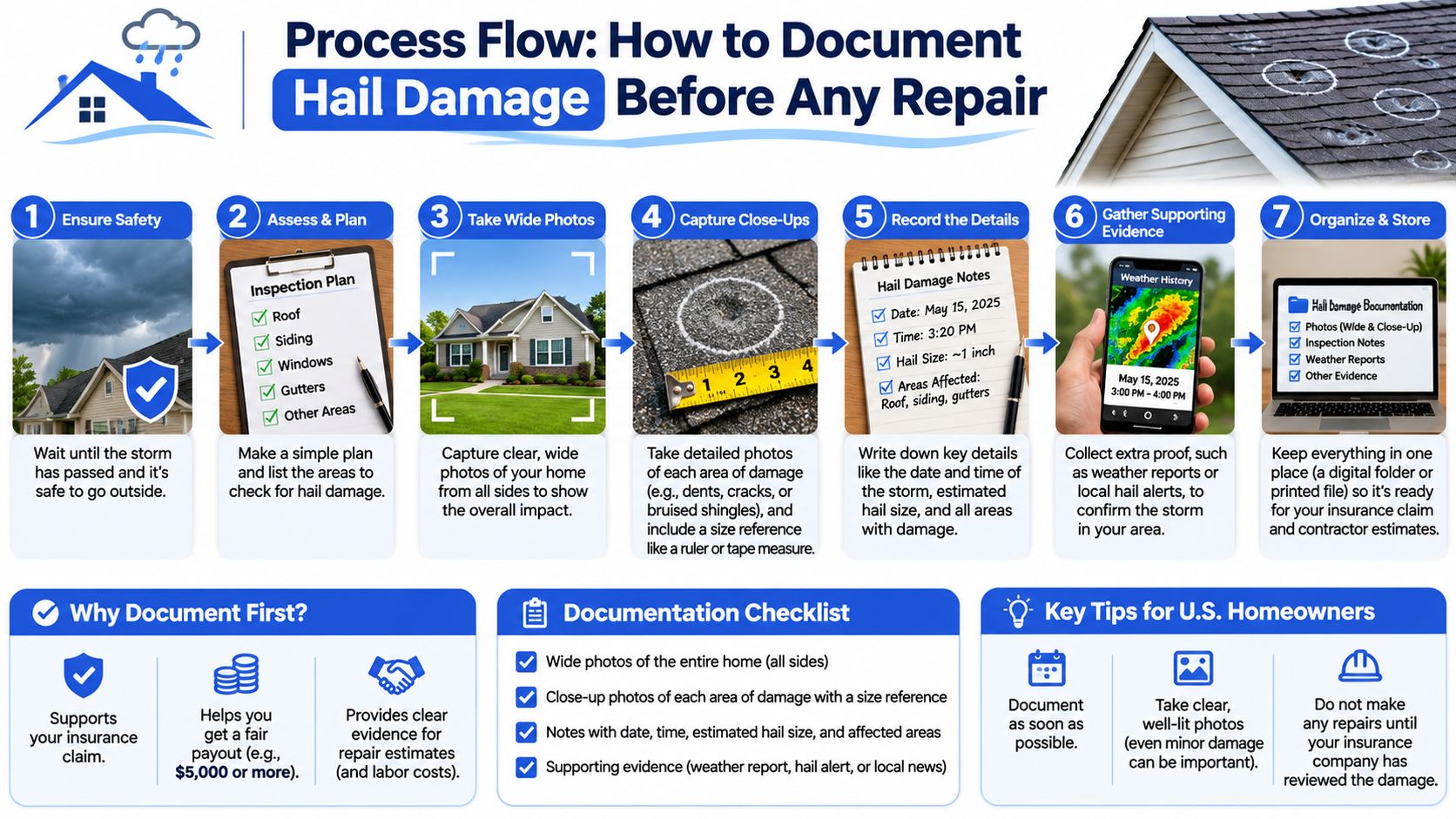
A written record separates storm damage from fading and age-related brittleness, and that separation is the whole argument in a claim.
Choosing Between Panel Repair and Re-siding
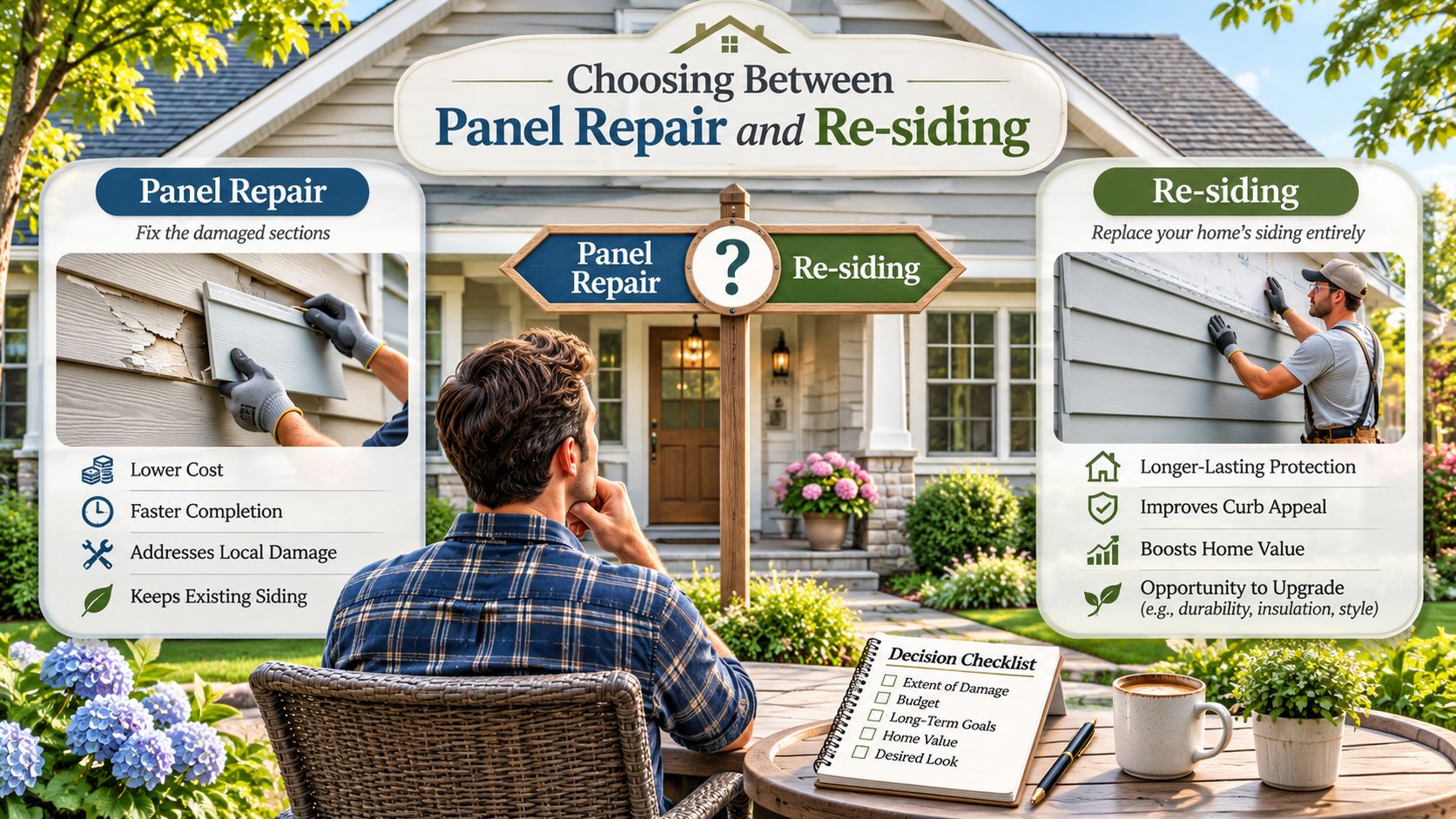
The question is the smallest repair that puts the whole wall back to keeping water out, and whether that repair will still match the rest of the house after a few seasons of sun.
On vinyl, the interlocking lap is the weak point. Panels are hung so they can move as the wall heats and cools, and the lap is the joint that takes the hit and sheds the load. A crack along that joint can look like a hairline on the face, then open on a warm afternoon and send water behind the panel instead of down it.
Wind direction decides how wide that problem spreads. The National Weather Service's Goodland large hail report records hail up to 2.75 inches that damaged west-facing windows and siding. One elevation can take the brunt while the next wall stays nearly clean, so count damaged panels by face before anyone calls it a spot job.
Before anyone promises you a patch, pull the exact profile, manufacturer, color and installation era off a scrap of the panel. If that stock is discontinued, or the wall has years of fade on it, a new panel in the same nominal color will read as a patch from the sidewalk.
| Repair option | Best fit | Watch for |
|---|---|---|
| Spot panel replacement | A few cracked panels with a matching profile in stock | Sun-faded neighbors that no longer match |
| Elevation replacement | Concentrated damage on one wall, scattered punctures | Trim and corner pieces that must match too |
| Full re-siding | Damage across several elevations or a discontinued profile | Highest cost and a broader insurance scope |
Corner posts, J-channel and starter strip are often the deciding factor. If the accessories are gone from the catalog, a small panel job turns into a bigger one whether you like it or not.
The installation itself is the other half of the equation, and it is not a homeowner project. Our siding work uses vinyl siding installed by experienced professionals. Common repair failures on vinyl come from nails driven too tight or panels cut short of an expansion gap, which leaves the wall unable to move and turns a clean patch into the next crack.
Ask for the scope in writing: how many panels, which elevation, whether wrap behind the damage gets replaced, and what happens if the match is off. A verbal "we'll patch it" is not a scope.
Insurance Claims and Scheduling a Free Inspection
Hail claims are routine in Ohio, not exotic. NOAA's National Centers for Environmental Information counts 105 weather and climate disasters exceeding one billion dollars in losses affecting Ohio from 1980 through 2024, and that list includes the Ohio Valley hail storms of June 17 and 18, 2021, which the agency prices at roughly 1.980 billion dollars in CPI-adjusted losses. Those figures are disaster-wide, not one wall, but they tell you the paperwork you're about to file is well-trodden ground.
Start with the money side. Look at your policy's hail or wind deductible, which is often written as a percentage of dwelling coverage rather than a flat number, and compare that figure to the repair estimate before you call. A repair that lands under the deductible usually comes out of your pocket, and there's no sense spending a claim on it.
Then move in this order: file promptly, hand over the photos and the sketch you already built, and be there when the adjuster walks the house. Presence matters. You can point at the split lap on the northwest corner and the matching dent in the downspout, and the conversation goes differently than it does with a stranger reading a form.
Where claims wobble isn't usually the obvious hole. It's the argument over what the storm caused and what age had already done. Ask three questions before you sign anything:
- What does the policy cover for siding? Get the specific language, not a summary from a salesperson.
- How is matching handled? Whether a repair has to match the faded wall next to it, and who decides if it doesn't.
- Does the scope include adjacent elevations? A repair that stops at the corner and leaves a visible seam is a problem you'll own later.
We help homeowners document storm damage, meet with insurance adjusters on site and work through the claim process, and we offer a free roof inspection and written estimate for Columbus-area homes so you know what you're dealing with before a claim goes in. If a repair is enough, we'll tell you so and put it in writing. When the roof is the bigger question, how a hail damage roof insurance claim works covers the part above the siding.
Confirm the damage before you file. Not after.
HIBCO ROOF LLC inspects and documents hail damage to vinyl siding, roofing and the trim in between for homeowners across Columbus and central Ohio, and we handle the paperwork side when a storm turns into a claim. Bring the dated photos, the sketch and your notes to a free inspection and we'll tell you plainly what's cosmetic, what's functional, and what the smallest correct repair looks like. Visit HIBCO ROOF LLC to schedule yours.