Most storm-chasing flyers hand homeowners the same blunt advice after a spring thunderstorm: step into the driveway, look for dents or missing shingles, and file a replacement claim before the week ends. That shortcut gets hail damage backward in two expensive ways. A shallow dimple on a shingle can look alarming up close yet never shorten the roof's life, while a hairline mat fracture you can't see from the yard lets rainwater slip behind the shingle layer months later.
Hailstorms aren't rare edge cases anymore. According to the LexisNexis U.S. Home Insurance Trends Report, the United States experienced 5,373 hail events in 2024, and hail loss costs sat 19% above the seven-year average. Separate Verisk figures reported by CLM Magazine show that non-catastrophic wind and hail roof claims climbed from 17% of residential claims in 2022 to 25% in 2024.
Understanding how hail damages a roof starts with separating scary-looking surface marks from structural fractures. Once you know what hail physically breaks inside a shingle, how stone size and roof age interact, and what a documented inspection should prove, you can decide between monitoring, targeted repairs, and replacement with a clear head.
Table of Contents
- How Hail Breaks Down an Asphalt Shingle
- Hail Size Thresholds and What They Mean
- Signs That Separate Cosmetic Marks From Real Damage
- How Hidden Damage Turns Into Leaks and Early Aging
- When a Storm Justifies a Roof Inspection
- Decide Whether to Book an Inspection After a Storm
How Hail Breaks Down an Asphalt Shingle
Every hailstone carries kinetic energy built from its mass and downward speed. When that frozen stone slams into a roof slope, the shingle absorbs that energy in a fraction of a second through compression, bending, and tearing. Because asphalt shingles cover approximately 80% of installed residential roofs in the United States according to the Insurance Institute for Business & Home Safety (IBHS), how a shingle reacts under impact explains most residential storm claims.
The visual below traces the progression from a shallow surface strike to a fractured shingle layer.
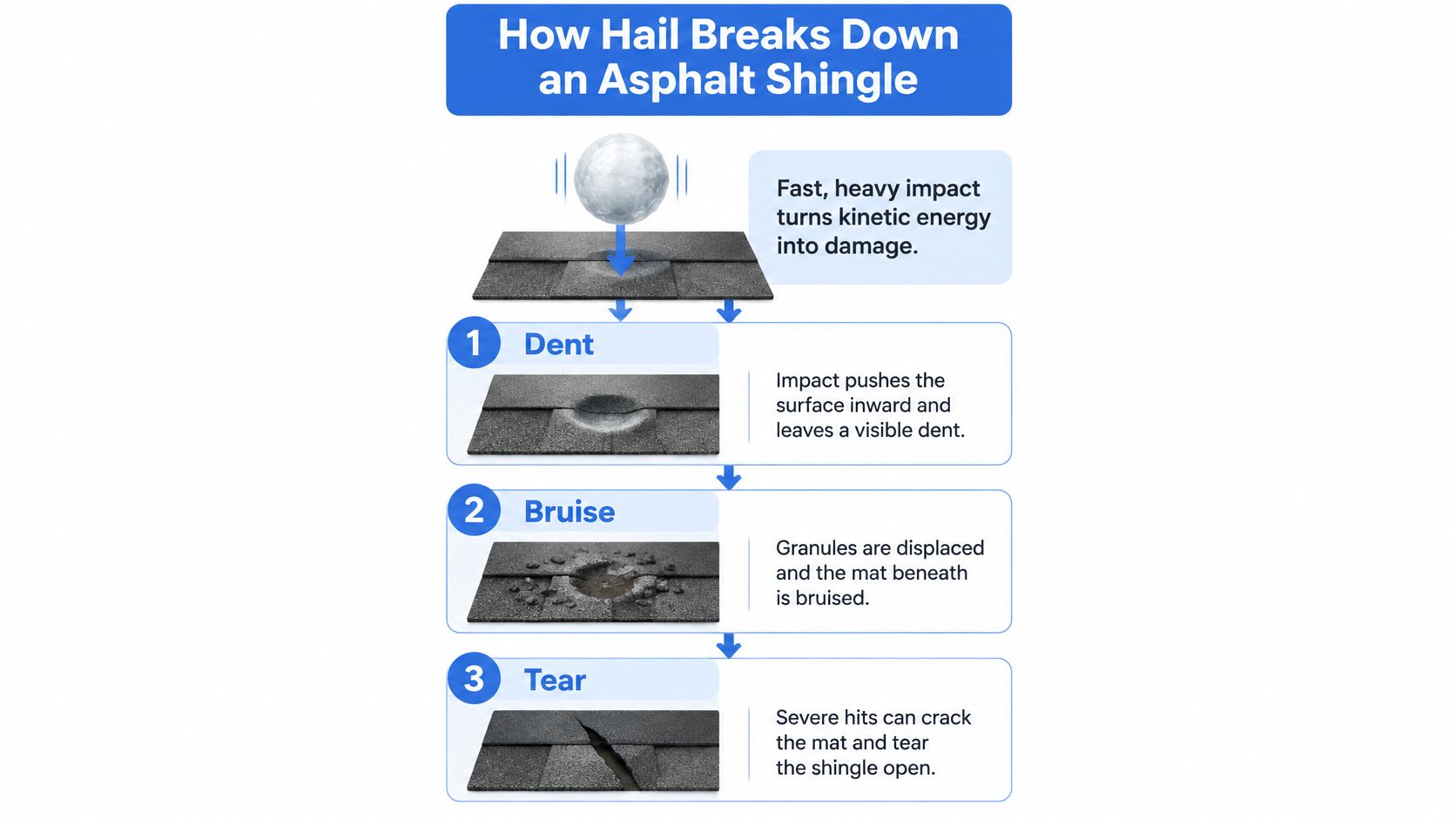
A single severe hailstorm rarely destroys a roof with one dramatic punch. Instead, impacts break down an asphalt shingle in four stages:
- Ceramic granules break loose. The impact scrapes or knocks away the crushed mineral coating embedded in the top asphalt layer, leaving a dark, exposed spot where the surface used to reflect sunlight.
- The asphalt coating and reinforcing mat compress. Beneath those granules sits a waterproof asphalt layer bonded to a fiberglass or organic reinforcing mat. A forceful strike crushes that underlying structure, creating a soft bruise even when the top surface doesn't split open.
- Surface cracks radiate along the strike zone. When the mat bends beyond its flex limit, hairline fractures open across the asphalt coating and break the fibers that hold the shingle together.
- Repeated strikes tear or puncture the material. High concentrations of stones hitting the same slope widen existing fractures, snap tabs loose, or punch cleanly through weakened spots.
Why Wind Angle and Granules Change the Outcome
Homeowners often assume missing granules are just an appearance issue. In reality, those ceramic pellets act like sunscreen for the asphalt beneath them. Once an impact strips them away, direct ultraviolet radiation dries out the exposed asphalt, making it brittle and faster to crack long before an active drip appears indoors. For a closer look at how granule shedding speeds up surface wear, advice from Ventura County Roof Cleaners breaks down why protecting that top mineral layer matters for long-term durability.
In laboratory testing, IBHS fires manufactured hailstones measuring 1.5 and 2.0 inches in diameter under controlled, vertical conditions to measure granule loss, dents, surface cracks, and tears, while also documenting that heavy volleys of smaller, sub-severe hail can accelerate aging and weaken shingles for later storms. Real thunderstorms add wind to that equation. The NOAA National Severe Storms Laboratory notes that hailstones can fall at speeds greater than 100 mph, reaching a maximum near 120 mph (193 km/h), and strong storm outflow can drive stones nearly sideways into steeper roof slopes, siding, window frames, and metal vents.
Think of a modern car bumper after a low-speed parking lot hit. The plastic cover can spring back and look mostly smooth from ten feet away while the foam absorber and support bar behind it are crushed.
A shingle doesn't need a visible hole to lose its weatherproofing. Concentrated impact energy, wind-driven angles, and repeated hits can compromise the reinforcing mat inside an otherwise intact-looking roof.
Hail Size Thresholds and What They Mean
Right after a storm clears, homeowners usually search local weather alerts for one number: how big was the hail? That instinct makes sense, because stone diameter drives mass rapidly, yet a single diameter reading never acts as an automatic pass-or-fail verdict for a roof.
On January 5, 2010, the National Weather Service raised its official severe-hail threshold from 0.75 inches (1.9 cm) to 1.00 inch (2.5 cm). As documented in NOAA's severe hail threshold technical report, that update reflected findings that common roofing materials generally didn't sustain damage until hailstones reached at least 1 inch across, roughly the diameter of a U.S. quarter.
Engineers also benchmark roofing materials using standardized ice-ball tests. Under the FM Approvals ANSI/FM 4473 test standard, laboratories fire controlled freezer ice balls measuring 1.25, 1.5, 1.75, and 2 inches in diameter at rigid roofing materials to assign Impact-Resistance Classes 1 through 4. Because that standard evaluates rigid coverings broadly, the same diameter scale serves as a reference point for asphalt shingles, metal panels, and tile roofs alike.
| Hail diameter | Familiar comparison | FM impact class | What it signals for a roof |
|---|---|---|---|
| 1.00 inch | U.S. quarter | Below Class 1 | Generally the lowest size at which common roofing is expected to be damaged |
| 1.25 inch | Half dollar | Class 1 | Lowest standardized test size; aged shingles can be damaged near this range |
| 1.50 inch | Ping-pong ball | Class 2 | Common IBHS laboratory size for assessing dents, tears and granule loss |
| 1.75 inch | Golf ball | Class 3 | Substantial impact energy; expect functional damage risk on weathered roofs |
| 2.00 inch | Hen egg | Class 4 | Largest standard test size; produces substantial damage risk in testing |
Why Stone Diameter Never Tells the Whole Story
A weather alert listing 1.75-inch hail two miles from your house tells you where to look, not what happened on your specific roof. Standardized freezer ice balls are uniform spheres dropped straight onto new samples in a lab. Outdoor storms drop irregular stones of varying density at shifting wind angles across roofs that have spent years baking under summer heat and winter freeze-thaw cycles.
Say two neighboring houses sit on the same street during a storm with quarter-sized hail. The home with a fresh, shaded roof facing away from the wind may come through with zero functional hits. Across the road, a sun-baked west-facing slope angled directly into the storm outflow can suffer bruised mats and cracked tabs from those exact same stones.
Use the size table as a triage tool rather than a diagnosis. A report of 1-inch or larger hail justifies checking your property, while smaller wind-driven stones still deserve attention on older, steeper, or heavily exposed slopes.
Signs That Separate Cosmetic Marks From Real Damage
Many homeowners assume every soft dimple on a shingle or every dark pinch of granules near a downspout means the roof has failed. Field engineering testing tells a more nuanced story, and knowing that distinction protects you from both unnecessary replacement claims and missed leaks.
Look closely at the cracking and displaced mineral surface shown in the inspection photo below.
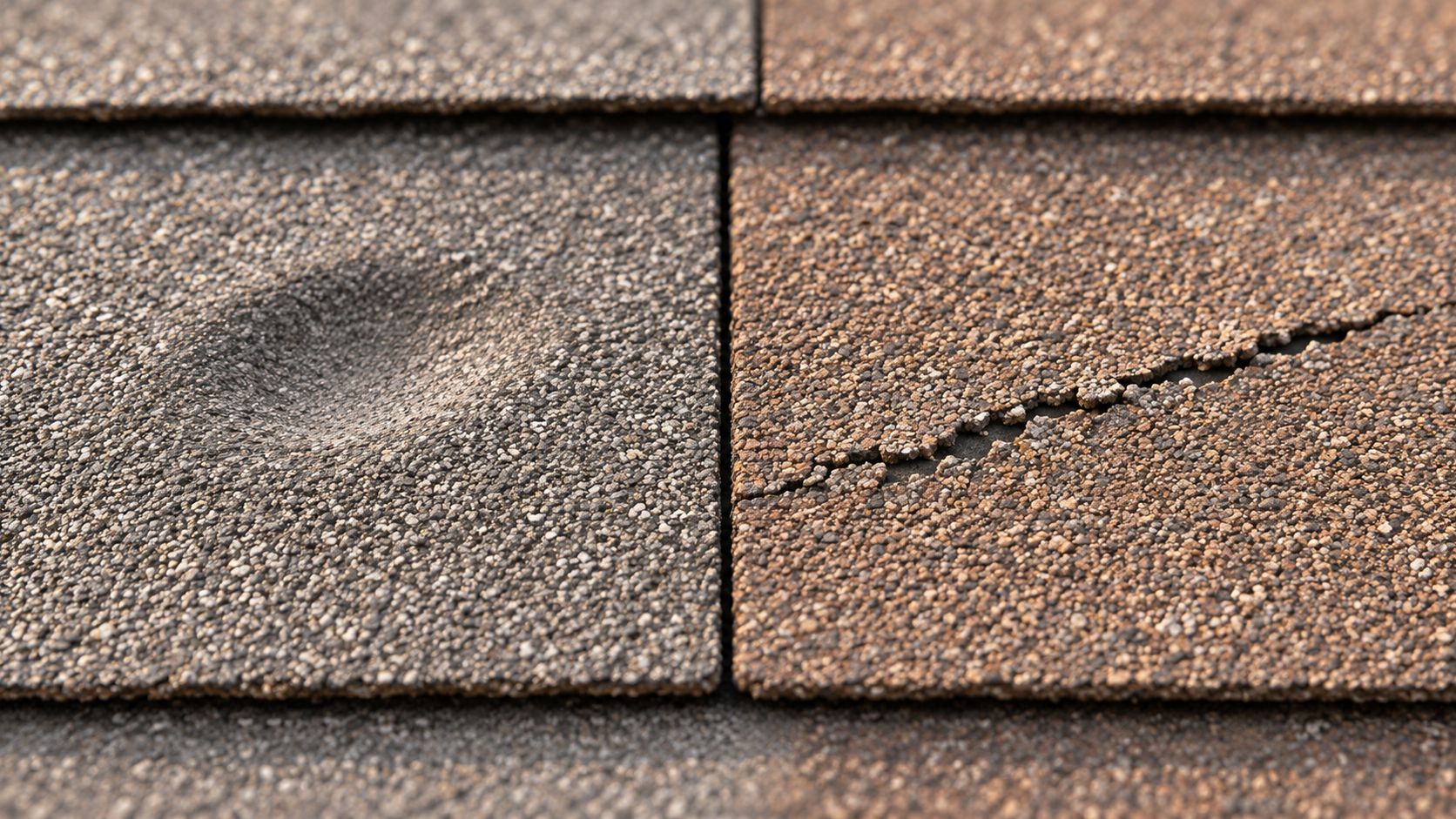
The reinforcing mat gives an asphalt shingle its tensile strength against wind uplift and water entry. In the Haag Engineering hail assessment protocol, long-term testing demonstrated that impact dents which didn't fracture the shingle failed to worsen measurably or turn into functional damage over time. By contrast, impacts that cracked the coating, ruptured the mat, or stripped enough granules to expose the underlying bitumen widened with weathering and reduced the roof's ability to shed water.
| Sign | What it may mean | Next step |
|---|---|---|
| Soft bruise that keeps the shingle surface intact | Cosmetic impact unless the mat is fractured | Note its location and check neighboring slopes |
| Exposed black asphalt in bare patches | Granules displaced and weathering protection reduced | Document it and arrange an evaluation |
| Torn, punctured or cracked shingle | Functional damage to the shingle | Schedule a repair promptly |
| Dented metal vent, gutter or flashing | Strong collateral evidence that hail struck the roof | Include it in the damage record |
| Granules collecting in gutters | Possible hail loss, but aging also sheds granules | Compare with roof age and storm date |
| Water stain on a ceiling | Water has entered, possibly from an earlier impact | Inspect the attic and roof urgently |
How to Read Patterns Instead of Isolated Marks
A single odd spot on a shingle proves very little on its own. Dropped tools, ladder rails, blistering from heat, and foot traffic leave marks that mimic hail at a glance. Real storm impacts scatter randomly across the windward slopes facing the storm path while leaving sheltered slopes relatively untouched.
Soft metal accessories give you a clear reality check from the ground or a ladder at the eaves. Aluminum gutters, downspouts, box vents, skylight flashings, and outdoor air-conditioning fins dent easily when heavy hail falls. When those metals show fresh dings on the same side of the house as suspect shingle spots, you're looking at a coherent storm pattern rather than isolated mechanical wear.
Don't treat loose grit at the bottom of a downspout as standalone proof either. Aging shingles shed mineral coating steadily through ordinary rainstorms, which is why comparing the buildup against your roof's history and reading up on spotting roof granules in your gutter helps you tell sudden storm loss apart from routine wear. If you photograph suspect marks from a safe vantage point, hold a quarter or small ruler next to each dent on a downspout or gutter so an assessor can gauge scale right away. Reviewing Superior Home Improvement roofing advice also reinforces why pairing close-up photos with collateral soft-metal evidence makes an inspection report far easier to evaluate.
Inspection rule: A minor dimple with intact granules can be monitored, while exposed black asphalt, cracked shingle edges, or any ceiling stain calls for a professional roof evaluation right away.
How Hidden Damage Turns Into Leaks and Early Aging
A dry living room ceiling the morning after a hailstorm doesn't mean the roof escaped unharmed. Hail damage frequently acts like a slow-motion leak, because water has to work its way through several layers before you ever spot a brown ring on drywall.
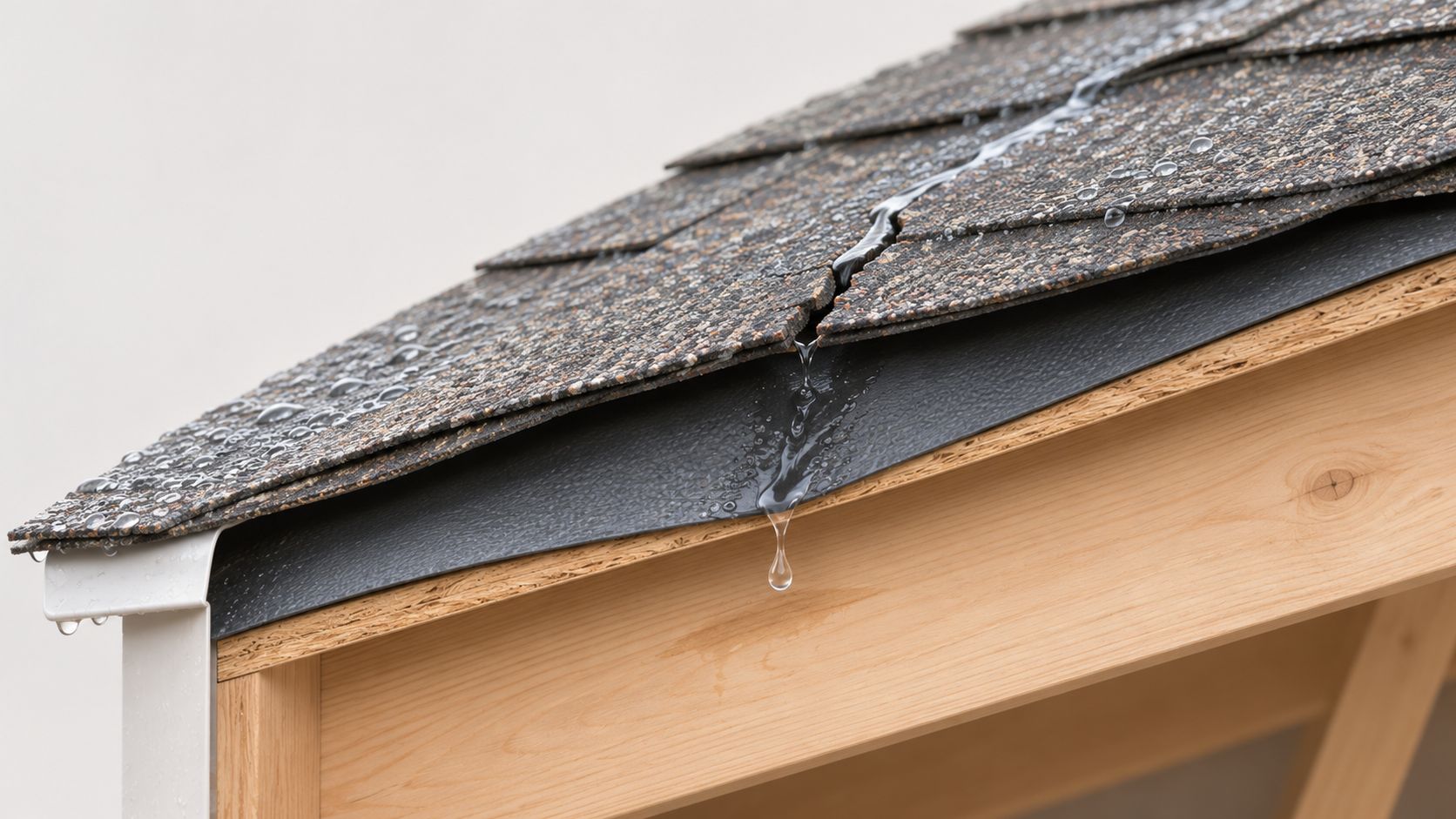
Here's the exact chain that turns an invisible shingle fracture into interior damage:
- An impact breaks the top weathering layer. A hailstone cracks the asphalt coating or weakens the adhesive seal between overlapping tabs, creating an entry point that stays hidden from the driveway.
- Rainwater reaches the underlayment. During subsequent rainstorms, wind-driven moisture slips through that fracture onto the felt or synthetic underlayment, leaving the roof's secondary barrier to handle water it wasn't meant to hold permanently.
- Moisture migrates into the wooden roof deck and insulation. Once water bypasses a nail hole or seam in the underlayment, it soaks the plywood or OSB sheathing, drips onto attic insulation, and travels along rafters before pooling on top of ceiling drywall.
- Visible indoor symptoms appear weeks or months later. By the time paint bubbles or a faint yellow halo shows up inside a bedroom, damp framing and wet insulation may already have been sitting out of sight for several storms, carrying interior deterioration similar to the risks of untreated plumbing leaks hidden behind walls.
Why Roof Age and Shingle Ratings Shift the Risk
Weathering steadily lowers an asphalt shingle's impact resistance, which changes how much damage a moderate storm can inflict. Federal building research published through GovInfo explains that hail damage starts once a stone exceeds a material's impact-energy threshold, and older shingles hit that threshold much sooner. In threshold testing of 11-year-old roofs, aged organic-mat shingles were damaged half the time by 1-inch ice stones, whereas aged fiberglass-mat shingles required stones near 1.25 inches. Knowing how weather shortens a roof's lifespan helps explain why a storm your neighbor's newer roof shrugged off can punch fractures into an older system.
Even an impact-resistant label doesn't make a roof hail-proof. In a 2019 test program reported by the IBHS shingle performance study, researchers evaluated eight commercially available impact-resistant shingles and recorded results spanning from Excellent to Poor. That same body of IBHS research notes that U.S. hail losses exceed $10 billion annually, and while new standard and impact-resistant shingles generally held up well against 1.5-inch or smaller laboratory hail, 2-inch and 2.5-inch strikes produced substantial damage.
After a hailstorm, a quick attic check with a bright flashlight can reveal concealed trouble before drywall stains form:
- Roof valleys and low junctions: Scan the underside of valley lines, chimney tie-ins, and plumbing vent boots where runoff concentrates heaviest.
- Dark staining on roof decking: Look for fresh damp rings, darkened plywood grain, or rusted nail tips poking through the wood sheathing beneath storm-facing slopes.
- Compressed or damp attic insulation: Gently check insulation directly below suspected impact areas for wet patches or flattened mats that signal dripping above.
- Ceiling edges near exterior walls: Walk upstairs rooms along the side of the house that faced the storm and check ceiling corners for faint discoloration.
When a Storm Justifies a Roof Inspection
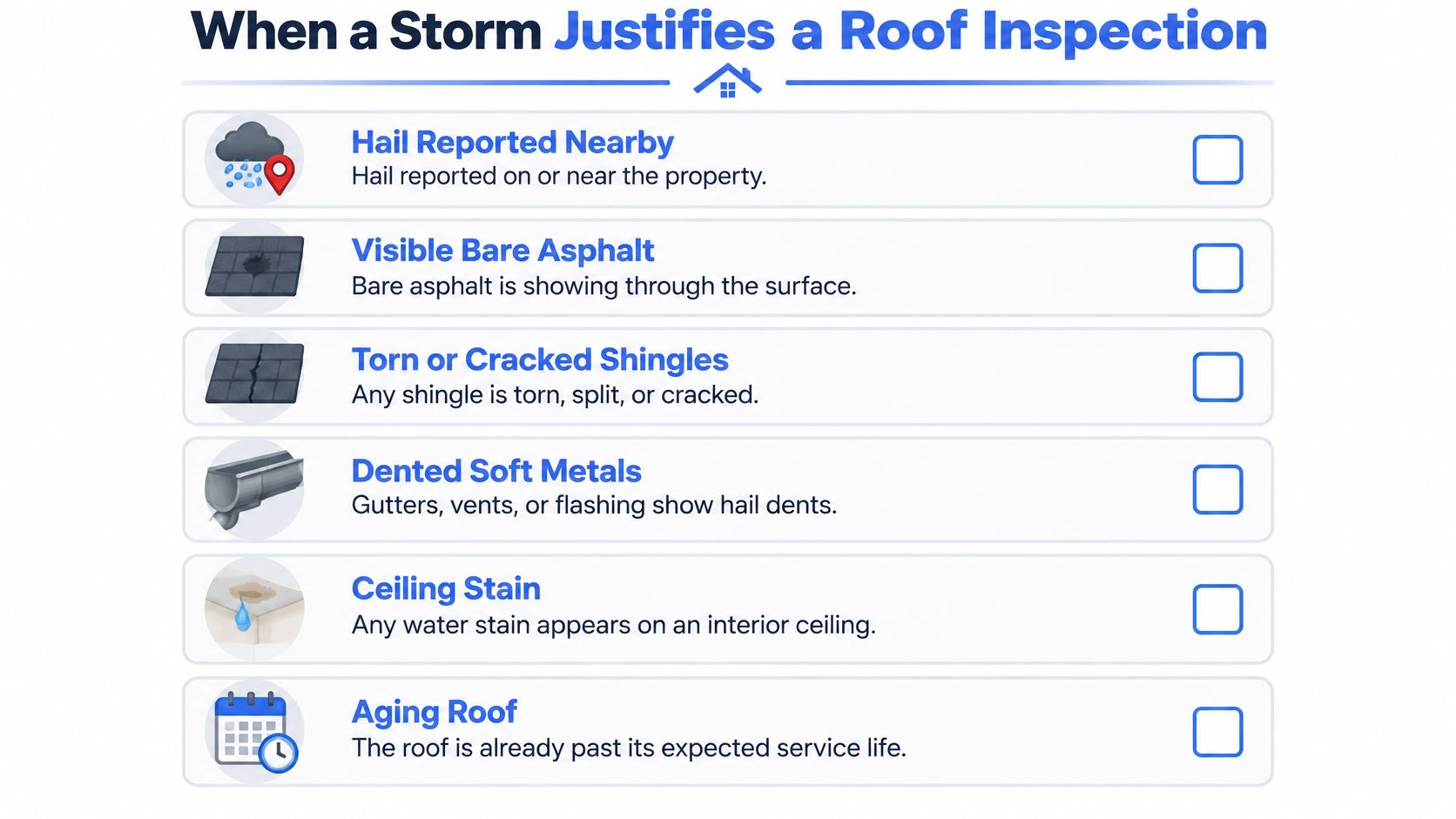
You don't need to hire a roofer every time pea-sized hail taps the windows, and you shouldn't wait for a bucket-filling leak either. Six concrete triggers tell you when a post-storm evaluation is worth scheduling:
- Hail reported on or near your property: Local storm reports placing hailstones in your immediate neighborhood justify at least a careful ground and attic check.
- Visible bare asphalt patches: Any dark circular spots showing exposed bitumen mean protective granules are gone and the shingle surface is vulnerable.
- Torn, split, or cracked shingles: Missing tabs, broken corners, or visible splits represent functional damage that lets wind and water underneath.
- Dented soft metals around the roofline: Fresh dimples on aluminum gutters, downspouts, roof vents, or flashing confirm stones hit with enough force to warrant a closer shingle check.
- Any new ceiling or attic stain: Moisture marks indoors signal that water has already breached the outer roof covering.
- An aging roof past its expected service life: Older, brittle shingles lose impact resistance quickly, so even modest hail can fracture worn mats.
Use the checklist below as a quick reference right after severe weather rolls through.
Verifying the Storm and Building a Clean Record
Weather radar fills an important gap when physical marks are hard to date. According to NOAA's National Centers for Environmental Information (NCEI), NEXRAD radar data can verify whether a hailstorm passed over a specific address, estimate the hail size, and pinpoint the storm location. That independent weather record frequently serves as supporting evidence in hail-related insurance and legal reviews.
Radar records also protect against bad assumptions in both directions. A nearby storm report alone doesn't prove your roof was damaged, and NCEI specifically cautions that some roofs have been intentionally damaged to imitate hail marks. Meanwhile, findings from Haag Engineering's long-term hail impact study show why careful documentation matters to homeowners: premature replacement claims built on cosmetic dents get challenged by adjusters, while overlooked mat fractures open the door to water intrusion later.
Before an inspector or adjuster arrives, build a clean, ground-level file without climbing onto wet or brittle shingles:
- Log the exact storm date and time. Pair local weather alerts or radar summaries with the date you noticed any debris or marks.
- Photograph collateral damage with scale. Take dated pictures of dented gutters, downspouts, window screens, siding chips, and AC fins with a coin or tape measure beside the marks.
- Note roof details and slope direction. Write down the roof's approximate age, shingle type, and which compass sides (such as west or southwest) faced the incoming wind.
If none of the six warning triggers show up after a mild storm, skip the panic and stick to your normal maintenance plan for how often a roof should be inspected.
Decide Whether to Book an Inspection After a Storm
Book a professional roof inspection after any storm that brought hail to your neighborhood, and treat visible bare asphalt, cracked shingles, dented soft metals, or indoor water stains as reasons to schedule immediately. Climbing up yourself risks injury on loose granules and can crease bruised shingles further under foot traffic.
A thorough evaluation should examine the full roof system rather than stopping at a few shingles. Expect the inspector to check granule loss, mat bruising, shingle tears, pipe boots and flashings, box and ridge vents, skylights, gutters, and signs of concealed attic leakage.
Three Steps to Take During Your Inspection Visit
- Request a written breakdown of cosmetic versus functional marks. Make sure photos clearly show whether dents left the reinforcing mat intact or fractured the asphalt coating and exposed bitumen.
- Tie the report to verified storm data. Check that the written record includes the storm date, slope orientations, and radar-confirmed hail size where available, so your file holds up if you speak with your insurer.
- Compare repair against replacement objectively. Weigh scattered, localized hits on a younger roof against widespread mat fractures across multiple slopes on an aging system before committing to work.
For homeowners in Columbus and central Ohio, HIBCO ROOF LLC offers a free roof inspection and written estimate, walks through whether a targeted repair or full replacement makes the most sense without sales pressure, and assists with storm documentation when an insurance claim is warranted. You can call or text 614-810-0050 to set up an evaluation.
Take one simple step this week: get the roof inspected while fresh granule tracks, clean metal dents, and storm radar dates are still easy to document.
If a recent hailstorm rolled over your neighborhood and you want clear answers instead of guesswork, our licensed and insured team at HIBCO ROOF LLC provides free roof inspections across Columbus and central Ohio. We document every shingle, flashing, vent, and gutter up close, explain whether a repair or replacement fits your roof's condition, and give you a straightforward written estimate with zero pressure.