The advice you hear most often about class 3 vs class 4 shingles is some version of "put Class 4 on the roof and the hail problem goes away, and the insurance discount pays for the upgrade anyway." Both halves of that sentence fail often enough to matter. A Class 4 label is a laboratory result from a steel ball dropped onto a test sample, and the discount is a line item your carrier either grants or doesn't, in writing, for the specific product on your specific house.
What the label does buy is real: a higher impact threshold than Class 3, and in many cases a better shot at a premium credit. What it doesn't buy is immunity from hail, and it doesn't settle the purchase. The decision comes down to three things you can verify before signing anything: the exact product's test evidence, your insurer's written rules, and the age and condition of the roof underneath.
Table of Contents
- What Class 3 and Class 4 Labels Actually Prove
- Class 3 and Class 4 Side by Side
- What Lab Ratings Miss in Real Hailstorms
- Cost and Insurance Credits Worth Checking
- Choosing by Your Ohio Roof Situation
- Confirm Your Shingle Class Before You Buy
What Class 3 and Class 4 Labels Actually Prove
Class 3 and Class 4 are impact-resistance classifications under UL 2218, and Class 4 is the higher laboratory threshold of the two. The difference between them is the size of the steel ball used in the standardized impact test. Class 3 shingles must remain functional after two impacts in the same location from a 1¾-inch ball. Class 4 shingles must withstand two impacts at the same location from a 2-inch ball.
That is the entire claim. It is a measured result on a sample under fixed conditions. Everything else people attach to the label, from hail-proof to claim-proof to longer-lived, is inference layered on top of a lab number.
The test, in the order it runs
Four steps, and each one narrows what the result really means.
- A steel ball drops from a set height. Under the UL 2218 specification summarized in GAF's 2025 publication on the two classes, Class 3 shingles are tested with a 1.75-inch steel ball dropped from 17 feet, while Class 4 shingles are tested with a 2-inch ball dropped from 20 feet.
- The impact lands twice in the same spot. Two hits at one location, not two hits spread across the panel. Concentrating the energy is what makes the test severe.
- The specimen is examined from behind. A Class 4 sample must take the 2-inch impact and then show no visible light through the impact site when viewed from the back.
- Results are judged at designated impact locations. The pass or fail applies to those tested points, not to every square foot of a finished roof.
What counts as damage, and what doesn't
The UL 2218 result is narrower than most homeowners assume. As Asphalt Magazine's closer look at shingle impact ratings explains, the test evaluates damage at designated impact locations and does not treat every visible mark as a failure. Dents and granule loss can occur without automatically disqualifying the material, while cracking or penetration that creates the defined failure condition can prevent a passing result.
That distinction matters when an adjuster walks your roof. Granule loss in the field, the kind that leaves dark patches in the valleys and on south-facing slopes, is a cosmetic finding. Cracking or a fracture through the mat is a functional finding. The class rating speaks to the second one only.
What the label means: the product met a specific laboratory damage criterion under specified conditions. It does not mean the roof is immune to wind, installation defects, aging, or every form of hail damage.
Why a pass isn't a promise for your roof
A 2-inch steel ball dropped from 20 feet is a stress test, not a description of the average storm that crosses Franklin or Delaware County. It is the top of the UL 2218 scale, and a shingle that survives it has cleared a hard threshold, which is worth something. It is not a forecast.
Read the class as one input in a longer list. Shingle design matters, since polymer-modified asphalt and different mat constructions absorb impact differently. Installation quality matters more than most homeowners expect, because a nailed-high or overdriven field never performs like the sample in the lab. Roof age, underlayment condition, flashing details, attic ventilation and your local storm exposure all shape how a roof comes through a hail season, and none of them appear on the wrapper.
I would treat the class number as the start of the conversation with a contractor, not the end of it. The product line, the installer and the deck underneath decide the rest.
What you should ask for is simple and specific: the UL 2218 test report for the exact product line quoted on your estimate, not a brochure line that says "Class 4 rated" somewhere in the footer. A manufacturer's technical data sheet and a current product listing will name the tested assembly. If the seller can't produce that for the model going on your roof, the class label is doing work it wasn't designed to do.
Class 3 and Class 4 Side by Side
A side-by-side view helps, as long as the ratings are read as test results. They are not field guarantees, and the exact shingle quoted still matters.
| Criteria | Class 3 | Class 4 |
|---|---|---|
| Impact test ball | 1.75-inch (1¾-inch) steel ball | 2-inch steel ball |
| Drop height | 17 feet | 20 feet |
| Pass condition | Roof assembly remains functional after two impacts at one location | Withstands two impacts at one location with no visible light through the impact site from behind |
| Price premium over basic shingles | Lower than Class 4 on most quotes; get the per-square number on yours | Higher than Class 3 on most quotes; get the per-square number on yours |
| Insurance treatment | Credit possible with some carriers; confirm the rules in writing | Credit possible with some carriers; not automatic |
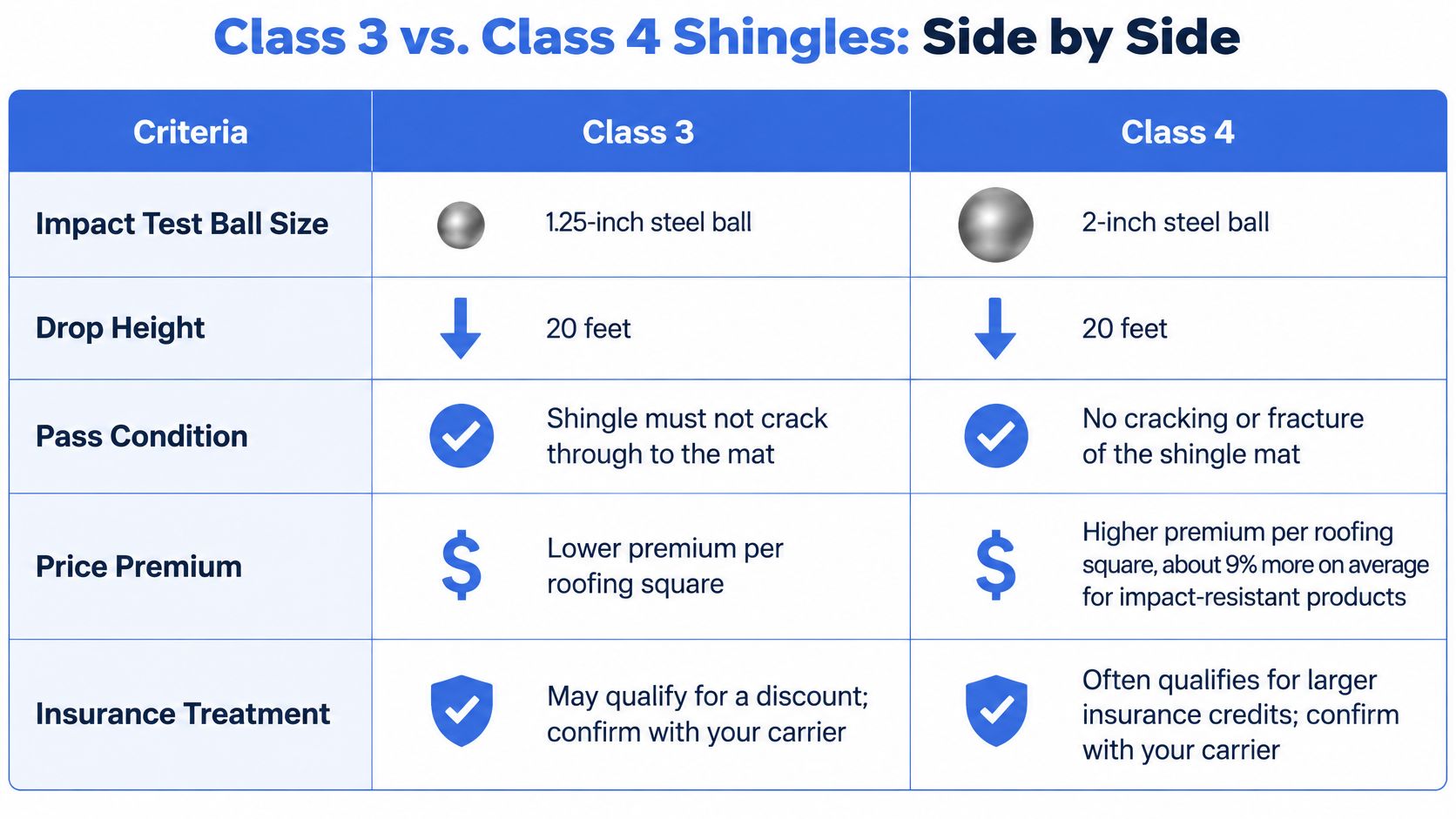
The first two rows show test severity. Ball size and drop height tell you how hard the sample was hit. They say nothing about whether your decking, underlayment, flashing or attic ventilation will hold up in a storm. The pass condition row is stricter for Class 4: no visible light through the impact site when viewed from behind. That distinction is useful, but it still describes a controlled impact at one location, not a whole roof through a hail season.
Price and insurance are usually where the decision gets made. IBHS testing of relative impact resistance in asphalt shingles reported an average cost premium of approximately 9% per roofing square across seven U.S. markets for impact-resistant products rated Good or Excellent. That is a benchmark for impact-resistant products broadly, not a Class 3 versus Class 4 spread. Quotes move with the product line, color, region and order size. A class-only rule of thumb cannot replace the line items on your written estimate.
Three things the table can't show
Pass rates by shingle type. Two products carrying the same class can have very different histories in independent testing, and the table flattens that out.
The effect of installation and roof age. A ten-year-old Class 4 roof with a failed pipe boot and matted attic insulation is a worse hail risk than a new Class 3 roof installed to spec.
Whether your carrier credits this product. Eligibility rules attach to the specific model, the documentation and the state, not to the class in the abstract.
The rule I'd apply: choose the class that matches your hail exposure and your budget, then verify the product rather than the label.
What Lab Ratings Miss in Real Hailstorms
The class number assumes a uniform steel ball arriving at a fixed speed, straight down, onto a new sample. Real hail is none of those things. IBHS guidance on commercial roof best practices makes the point directly: standardized ratings should not be read as a complete prediction of field performance, because actual hail varies in density, hardness, shape, velocity, temperature and impact angle.
The spread inside a single class is the part that surprises homeowners. In IBHS testing of 22 asphalt-shingle products from five manufacturers, the share of tested impact locations that passed looked like this.
| Shingle type | Class 3 pass rate | Class 4 pass rate |
|---|---|---|
| Basic three-tab | about 25% | about 25% |
| Basic architectural | about 35% | about 30% |
| Impact-resistant three-tab | Not reported in the IBHS summary | about 60% |
Those are test-location results, not probabilities that a particular roof survives a storm. Read them as a comparison of how products behave under the same protocol.
The finding that matters most
Impact-resistant three-tab shingles passed the Class 4 test at about 60% of tested locations, compared with about 25% for basic three-tab shingles, per IBHS's hail impact summary. Construction and formulation moved results further than the nominal class did. A basic architectural shingle, which carries no impact rating at all, cleared the Class 3 threshold at roughly 35% of locations, better than a basic three-tab managed on either test.
IBHS also reports that new asphalt shingles generally provide good protection from hail around 1.5 inches or smaller, regardless of impact rating. The 2-inch ball is a stress test above the size where most new roofs already cope.
Where the rating system gets shaky
A Haag study cited in the same IBHS summary found that only two of five tested impact-rated products passed the UL 2218 Class 4 test, while three, including a Class 3 product, failed even a Class 1 test under that study's protocol. Products marketed under the same family of labels behaved very differently when someone tested them independently.
That's the practical case for digging past the label. If hail size in your part of central Ohio runs large often enough to worry you, the breakdown of what size hail actually damages roofs is worth reading before you compare quotes.
A Class 4 shingle does not automatically outperform every Class 3 shingle in service. The exact product's independent test evidence, the warranty conditions, the roof's age and your area's hail history carry more weight than the number.
Cost and Insurance Credits Worth Checking
Class 4 products carry a real premium, and it shows up as a line item per roofing square on your written estimate. Put the two quotes side by side and read the actual numbers rather than working from a rule of thumb about percentages.
What you can't read off the estimate is what your carrier will do. An insurance discount is possible, not automatic. Guidance on Class 4 impact-resistant shingles and insurance treatment notes that premium credits depend on the insurer, the policy and the state, and that a Class 4 rating represents the highest impact-resistance category rather than a universally mandated discount.
The questions to put to your carrier in writing
- Dwelling only or whole policy. Ask whether the credit applies to the dwelling portion of the premium alone, since that changes the math considerably.
- Does Class 3 qualify. Some carriers credit both ratings at different levels. Others credit only Class 4.
- Listing and certification. Ask whether the product must appear on a specific list or carry a manufacturer certificate, and who supplies it.
- Installation documentation. Find out what proof is required at completion, whether that's a final invoice naming the model, photos, or an inspector's report.
- Renewal terms. Confirm whether the credit survives policy renewal and what happens if you switch carriers or the roof ages.
Running the math honestly
Multiply the yearly premium reduction by the number of years you expect to keep the roof, then compare that total with the added upgrade cost. Say the credit comes to a modest annual amount and you plan to stay 15 years. Multiply it out against the upgrade line, and if the Class 4 differential runs higher than that total, the credit doesn't close the gap on its own.
Then subtract the things that slowly erode the benefit: deductibles you'd still pay on a claim, cosmetic-damage exclusions that may limit what a hail claim covers, roof-age rules that reduce payouts on older roofs, and replacement terms that change if you sell. A credit that looks generous on a quote can shrink once those clauses apply.
One more wrinkle worth knowing. Some programs require more than an impact class. The same guidance notes that an impact rating alone may not qualify a roof for certain FORTIFIED hail provisions, which can require a separate hail rating. If a carrier or program mentions FORTIFIED, get the exact provision in writing before you assume the Class 4 label satisfies it.
If a storm has already pushed water inside, the order of operations changes. This guide to claims after a leak walks through documentation before you commit to a material class, which is the right sequence when there's active damage in the house.
For Columbus homeowners weighing the upgrade, the breakdown of how Class 4 shingles affect insurance discounts covers the documentation side in more detail. HIBCO ROOF also offers a 10% discount on any full roof replacement, which shifts the upgrade math in your favor and is worth factoring into the comparison before you decide the Class 4 differential is too steep.
A discount smaller than the upgrade cost makes Class 4 the weaker economic choice, even though it's the stronger lab rating. Both statements can be true at once.
Choosing by Your Ohio Roof Situation
Central Ohio doesn't hand you one hail problem. It hands you hail seasons that produce cosmetic granule loss on some roofs and functional cracking on others, wind events that test the same shingles, and freeze-thaw swings that punish weak flashing details. Wind resistance and installation quality matter as much as the impact rating, and the class label says nothing about either.
| Situation | Better fit | Why |
|---|---|---|
| Frequent hail area, long planned ownership | Class 4 | Higher laboratory threshold, and worth it if the insurer credit exceeds the upgrade cost |
| Roof at 15 to 25 years old | Decide on condition first | Roof age and condition affect field performance more than the class label |
| Low hail exposure, tight budget | Class 3 | Lower upfront premium while still rated impact-resistant |
| Insurer credit for Class 4 offsets the upgrade | Class 4 | The credit must cover the added cost over the years the roof stays in service |
| Hail damage already on the roof | Inspect first | A rating does not cover existing damage; document it before choosing a class |
Two situations that come up constantly
A 14-year-old architectural roof on a Columbus street took hail last spring. The shingles look intact from the driveway, and the homeowner wants to know whether to file a claim or upgrade. The decision starts with an inspection and claim documentation, not with a shingle class. Once the damage is on paper, compare Class 3 and Class 4 quotes against the carrier's written credit rules. If the roof has years left and the damage is cosmetic, the upgrade question becomes a budget question rather than a claim question.
A rental owner in a lower-hail part of the region wants the lowest upfront cost and a product with a sound warranty. Class 3 fits that brief. The roof still carries an impact rating, the tenant gets a sound assembly, and the owner isn't paying for a threshold the local storms rarely reach. Where the upgrade doesn't earn its keep through a credit, the cheaper class is the better business decision.
When the label shouldn't decide anything
Existing damage outranks the rating every time. A roof that has already lost granules across a slope or shows cracked mats needs assessment and documentation before anyone talks about Class 3 versus Class 4, because no rating retroactively covers a hit that already landed.
Poor attic ventilation is the other disqualifier. A hot, wet attic cooks shingles from underneath and shortens the life of a Class 4 roof as efficiently as a Class 3 one. If you're replacing a roof that failed early, the ventilation and flashing details on the quote deserve as much scrutiny as the shingle model. Ohio roofs live through enough thermal cycling that the assembly matters more than the badge, which is why roof lifespan in Ohio tracks condition and installation as closely as material grade.
Confirm Your Shingle Class Before You Buy
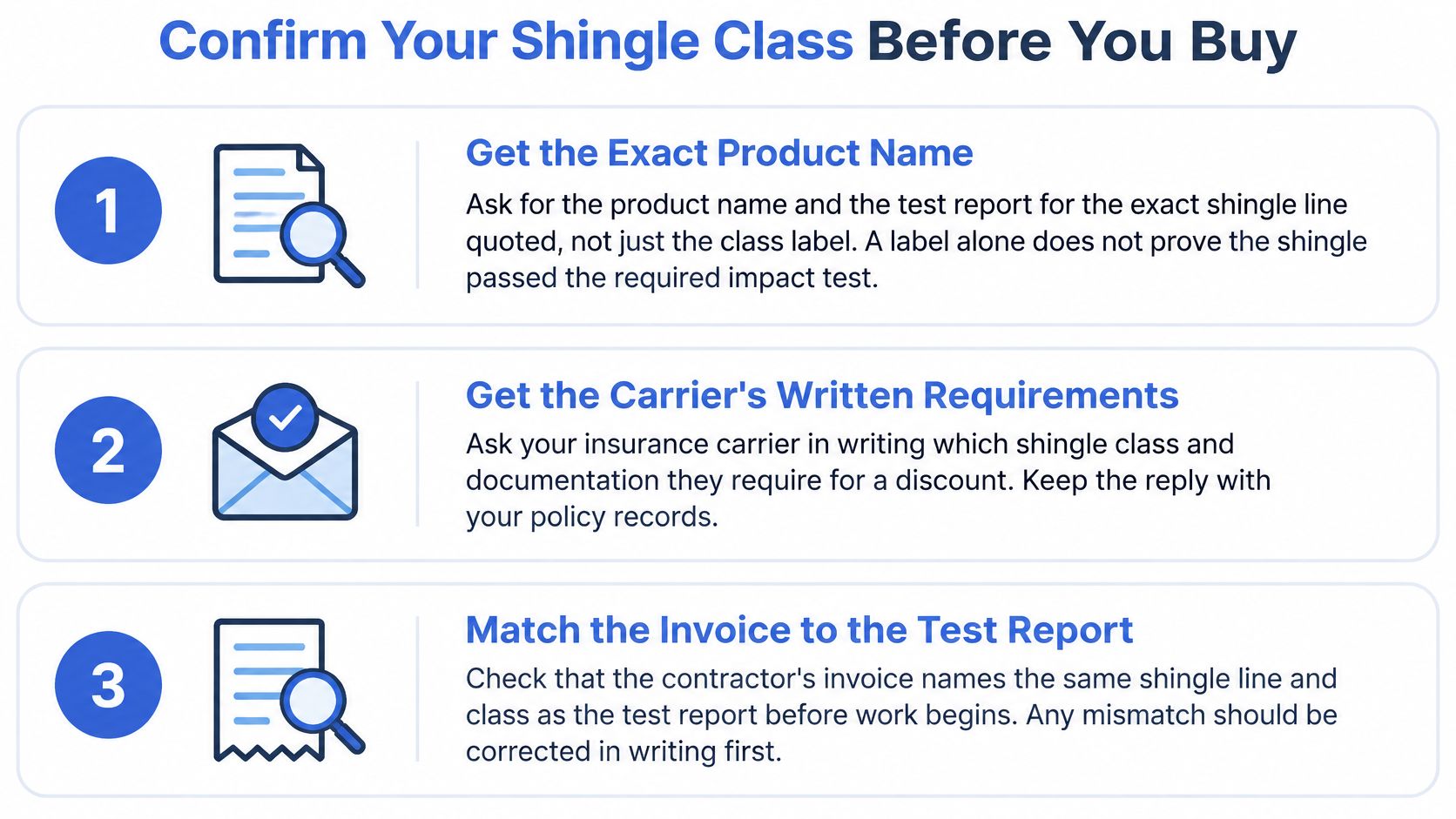
Six steps, in order, and each one exists because the label alone won't answer the question.
- Get the product name and the test report. Ask for the exact shingle line quoted, not the class label, and request the UL 2218 test documentation for that model. A label without a report doesn't prove the product on your roof passed the impact test.
- Get the carrier's rules in writing. Use the five questions from the cost section and keep the reply with your policy records. Verbal assurances from an agent don't survive a change of underwriter.
- Compare the premium against your ownership horizon. Divide the per-square upgrade cost by the annual credit to see the payback window. If you're selling in three years, the next owner collects the benefit.
- Check the assembly details on the quote. Roof age, underlayment, flashing and ventilation belong in writing alongside the shingle model, since each one affects how the roof performs in hail. A quote that lists only the shingle brand is incomplete.
- Document any existing hail damage first. Photograph it and get an independent inspection before choosing a class, because a rating applies to the product, not to damage already present.
- Get warranty terms for the installed system. Manufacturer coverage and installer workmanship coverage are different documents. Ask for both in writing with the estimate.
HIBCO Roofing provides free roof inspections and explains whether a repair or replacement is the best option, which is where most of these decisions begin. Customers can call or text HIBCO Roofing at 614-810-0050 to schedule a free inspection. If a roof can be repaired, HIBCO Roof says so; if replacement is the better long-term investment, it explains why, without pressure or sales tactics.
The decision rule: choose the class your insurer rewards and your hail exposure justifies, then verify the product itself. The label opens the door. The test report, the written credit rules and the condition of your roof decide whether you walk through it.
HIBCO ROOF LLC installs asphalt shingle roofing systems built for Ohio's hail, wind and temperature swings, using Owens Corning Total Protection Systems, and can walk you through the exact Class 3 or Class 4 product line quoted for your home. Inspections are free, and the conversation starts with your roof's condition and your insurer's written rules rather than a label. Visit HIBCO ROOF LLC to schedule an inspection or request an estimate.