Impact-resistant shingles typically cost $0.50 to $2.50 more per square foot than standard architectural shingles, and that usually works out to about $1,000 to $5,000 more on a typical roof replacement, depending on roof size and shingle class. If you're staring at a roofing estimate in Columbus and wondering whether the upgrade is worth it, the honest answer is yes in the right situation, but only if you focus on the incremental cost, not the full reroof bill.
Your roof doesn't care that it's a “premium” product. It either holds up in hail season or it doesn't, and central Ohio homeowners know how fast a routine storm can turn into a claim, a deductible, and a rushed replacement decision. The right question isn't whether Class 4 shingles are more expensive. It's how much more you pay, what you get for it, and whether your insurer helps cover the gap.
Table of Contents
- Why Columbus Homeowners Are Considering Impact Resistant Shingles
- Breaking Down the Impact Resistant Shingles Cost
- Class 4 Impact Resistant Shingles vs Standard Architectural Shingles
- Factors That Change Your Final Roof Replacement Price
- Insurance Discounts and the Real Return on Investment
- How to Get an Accurate Free Estimate for Your Roof
- Making the Right Decision for Your Home and Budget
Why Columbus Homeowners Are Considering Impact Resistant Shingles
A Columbus homeowner gets a storm-season estimate and sees two line items that matter: standard architectural shingles, or a Class 4 upgrade that costs more up front. The roof is already coming off, so the decision isn't theoretical anymore. It's a choice between paying the minimum now, or paying a bit more for a roof that's built to take a harder hit.
What Class 4 really means in plain English
Class 4 impact resistance comes from the UL 2218 test, which uses a 2-inch steel ball dropped from 20 feet without causing cracking or splitting. That matters because the label isn't marketing fluff, it's a performance standard built around simulated hail impact. Standard architectural shingles don't carry that rating, so they don't give you the same documented impact benchmark. See the testing context in GAF's explanation of Class 4 impact-resistant shingles.
The practical difference is simple. You're not buying a miracle roof that never gets damaged. You're buying more forgiveness when hail hits, and that extra margin can keep a storm from becoming a claim.
Practical rule: If you're already replacing a roof in a hail-prone market, price the upgrade as a small step up from the standard bid, not as a luxury add-on.
Columbus and the rest of central Ohio see enough storm activity that many homeowners now ask for impact resistance before they ask about color. That's the right order. A shingle can look good and still be the wrong product for the home. A tougher roof is worth serious consideration when the replacement is already unavoidable, especially if your insurance carrier rewards the upgrade.
Breaking Down the Impact Resistant Shingles Cost
The cleanest way to understand impact resistant shingles cost is to separate the installed upgrade premium from the total reroof price. Homeowners get tripped up when they compare a premium product's full installed cost to the cost of a bare-bones standard roof, then assume the upgrade is huge. It usually isn't. The better comparison is the extra you pay to move from standard architectural shingles to Class 3 or Class 4.
If you want the full Ohio context, start with our detailed breakdown of average roof replacement costs in Ohio. That gives you the baseline before you price the upgrade.
The numbers homeowners actually see
A 2025 market guide puts impact-resistant shingles at about $4.50 to $7.50 per square foot installed, compared with $3.50 to $5.50 for standard architectural shingles. That same guide says a 2,000 ft² roof often totals roughly $9,000 to $15,000 with Class 4 shingles versus $7,000 to $11,000 for standard materials. A separate 2026 guide notes that the premium has narrowed over time, with some affordable Class 4 options now only $0.50 to $0.95 more per square foot than standard shingles. See the pricing trend in the 2025 to 2026 impact-resistant shingle cost guide.
Another published comparison breaks the installed cost down this way, regular architectural shingles cost $350 to $500 per square, Class 3 impact-resistant shingles cost $450 to $700 per square, and Class 4 impact-resistant shingles cost $550 to $850 per square. Using a 2,500 square foot roof, that source estimates $8,750 to $12,500 for regular shingles and $11,250 to $21,250 for impact-resistant options, so the upgrade adds $2,500 to $8,750 depending on class and market conditions. See the detailed roofing example at Hulsey Roofing's Class 4 cost comparison.
Cost comparison by shingle type
| Shingle Type | Cost Per Square Foot (Installed) | Cost Per Square (100 sq ft) | Total Cost for 2,500 sq ft Roof |
|---|---|---|---|
| Standard architectural shingles | $3.50 to $5.50 | $350 to $550 | $8,750 to $13,750 |
| Class 3 impact-resistant shingles | $4.50 to $7.00 | $450 to $700 | $11,250 to $17,500 |
| Class 4 impact-resistant shingles | $4.50 to $7.50 | $450 to $750 | $11,250 to $18,750 |
The spread exists because quotes are not just material pricing. Labor assumptions, roof pitch, tear-off work, and regional availability all push the number around. That is why one contractor can sound cheap and another can sound expensive while both are quoting a real roof.
The premium usually lands in a manageable range. For a homeowner in central Ohio, the key question is whether the added cost buys enough storm resistance and insurance value to justify the step up from standard shingles.
Class 4 Impact Resistant Shingles vs Standard Architectural Shingles
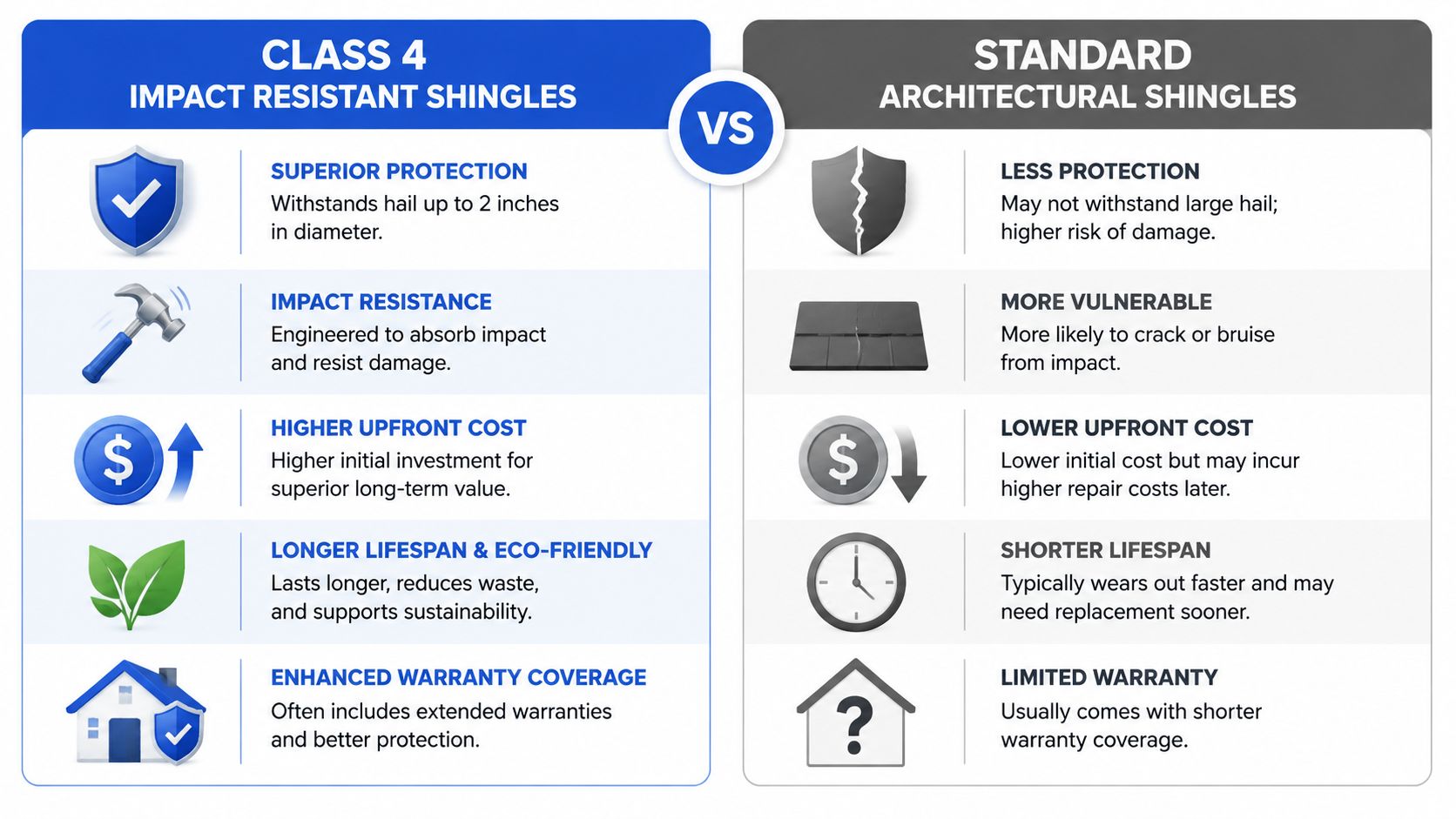
The cost gap only makes sense when you compare what each shingle delivers. Standard architectural shingles are the default on many homes because they're affordable and familiar. Class 4 shingles cost more because they're built to pass a harsher impact test and stand up better in hail-prone weather. For homeowners who want the simplest side-by-side, the comparison is straightforward.
Where the extra money goes
Class 4 shingles use UL 2218 Class 4 impact resistance, which means they've passed the highest available impact rating for this test category. Standard architectural shingles have no equivalent impact certification. That's not a minor label difference, it's the difference between a roof that's been tested for hail impact and one that hasn't.
Modern Class 4 products also don't force you into ugly or limited options. They're sold in the same general architectural styles and color families as standard shingles, so you're not trading curb appeal for durability. In practice, most homeowners can get the look they want without sacrificing protection. The style argument against impact-resistant roofing just doesn't hold up anymore. See this architectural shingle overview for a standard product reference.
Side-by-side trade-offs
- Impact rating: Class 4 has a documented rating, standard architectural shingles don't.
- Hail resistance: Class 4 is the better choice when storm damage is the main concern.
- Upfront cost: Standard shingles win on price, but only at the start.
- Insurance potential: Class 4 has a better shot at discounts in hail-prone markets.
- Appearance: Both can look sharp, and both can be matched to common home styles.
A contractor's roof estimate should spell out which product line is being used and whether the quote includes the upgraded impact-rated version. If it doesn't, ask for a revision. Too many homeowners accept a “good” shingle when they wanted the more durable one.
Straight answer: If you're already replacing the roof and you live in a storm market, Class 4 is the product I'd put on my own house before I'd spend the same money on cosmetic upgrades.
That's the trade-off. Standard architectural shingles are fine for a lot of homes. Class 4 shingles are the smarter buy when you care about damage resistance more than the lowest possible first price.
Factors That Change Your Final Roof Replacement Price
A roof quote is rarely just shingles multiplied by square footage. The final number shifts when the roof gets steeper, the tear-off gets messier, or the contractor finds damage under the old shingles. That's why two estimates for the same house can look nothing alike. The quote you trust is the one that explains the line items, not the one that hides them.
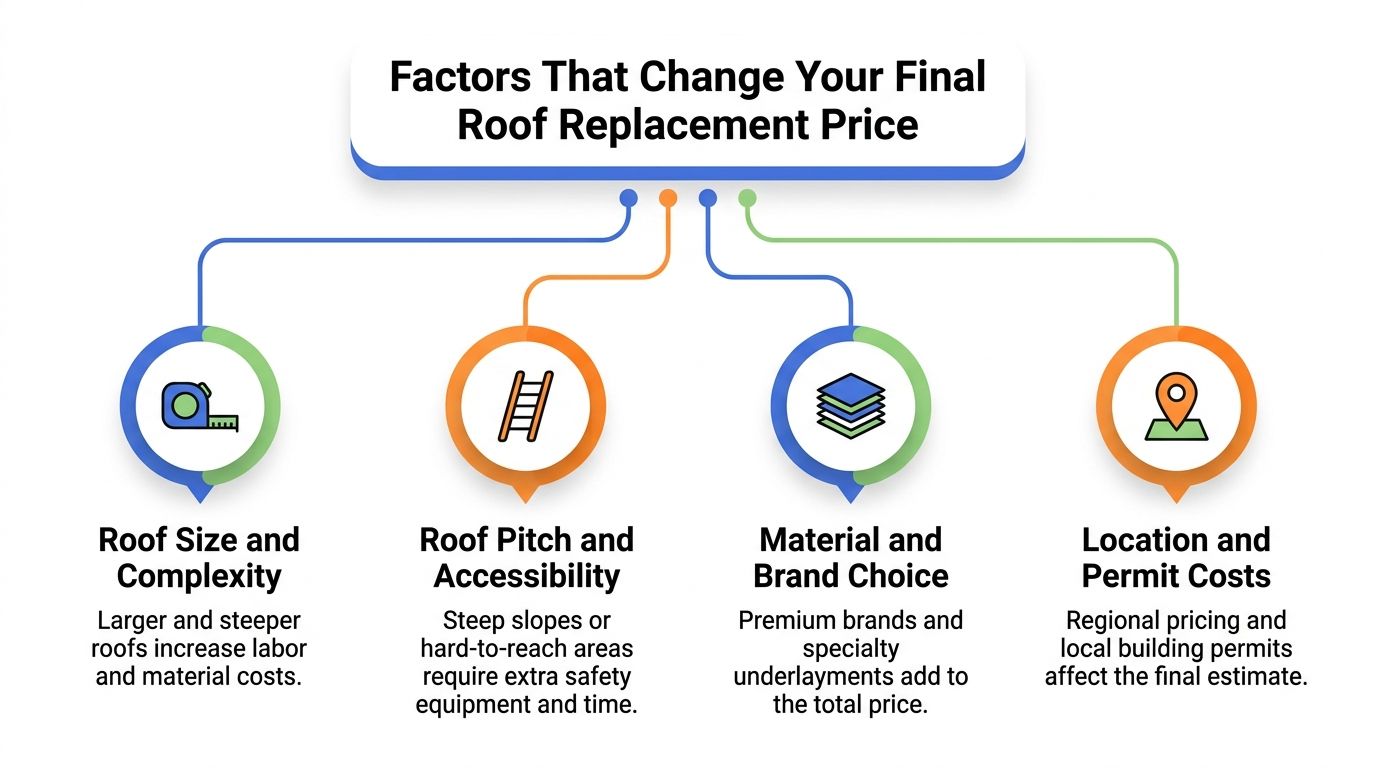
The biggest price drivers
Roof size is the first driver. Contractors measure in squares, and every additional section of roof adds material and labor. A simple ranch roof costs less to replace than a complex roof with multiple valleys, dormers, and penetrations.
Pitch and access come next. Steeper roofs require more time, more safety setup, and more labor. Hard-to-reach sections slow the crew down, and that affects the estimate quickly.
The hidden line items that change the bill
- Tear-off and disposal: Old shingles need to come off and go somewhere, and that work isn't free.
- Decking repair: Rotten plywood found under the shingles can raise the bill fast.
- Flashing replacement: Chimneys, vents, and valleys often need new metal to keep the roof watertight.
- Underlayment choice: Better underlayment costs more, but it also gives you a stronger backup layer.
- Ventilation work: Some roofs need updates to meet code and protect shingle life.
- Penetrations and roof complexity: Skylights, plumbing stacks, and other interruptions add labor.
A good analogy comes from storm-hardening other parts of the home. If you've ever looked into Cleveland hurricane door guidance from Danny's Garage Door Repair, you already know the lesson, protection upgrades are rarely just about the product itself. Installation details, openings, and structure matter just as much.
The result is that one contractor may quote a cleaner roof with fewer unknowns, while another prices in the likely repairs up front. That second bid can look higher, but it's often the more honest one. Ask what's included, ask what's excluded, and ask what happens if the crew finds bad decking once the tear-off starts. That's how you compare roofs instead of just comparing numbers.
Insurance Discounts and the Real Return on Investment
The financial question isn't whether Class 4 shingles are tougher. It's whether your insurance company rewards that toughness enough to justify the upgrade. In hail-prone markets, some insurers do offer wind and hail premium discounts that can make the math work. The catch is that the discount is never universal, and it depends on your insurer, your state, and your policy form.
What the discount can look like
Independent and industry-adjacent sources report roughly 15% to 35% wind and hail premium discounts for Class 4 impact-resistant roofs in some markets, with payback periods often cited around 6 to 10 years in those areas. That lines up with the basic homeowner logic, a bigger up-front investment can still make sense if it lowers the recurring cost of owning the roof. Read the broader insurance perspective in the 2026 roof replacement insurance guide.
Before you buy, call your agent and ask a direct question, not a vague one. Ask whether your current policy offers a discount for UL 2218 Class 4 roofing, whether the discount applies to wind, hail, or both, and whether the carrier requires specific documentation after installation. If they can't answer clearly, get the answer in writing before you sign a roofing contract.
Best move: Don't assume the discount exists just because the shingle is rated Class 4. Make the insurer say it plainly.
There's another layer homeowners ignore, fewer claims over time. A better roof can help you avoid deductibles and the headache of filing repeated storm damage claims. In storm markets, that matters almost as much as the premium discount itself. Resale is part of the picture too, because buyers in hail-prone neighborhoods pay attention to roofs that look newer and stronger.
The cleanest way to judge ROI is simple. If the premium is modest and the insurer gives you a real discount, Class 4 can pay back over time. If the insurer won't discount the roof and you're replacing a low-risk, low-exposure roof, the value case gets weaker fast. The roof should fit your risk, not your neighbor's.
How to Get an Accurate Free Estimate for Your Roof
A real estimate starts with a real inspection. A contractor should walk the roof, measure it, look at the flashing and ventilation, and explain what happens if hidden damage shows up after tear-off. If someone quotes a roof without seeing the roof, that number is just a guess with a logo on it.
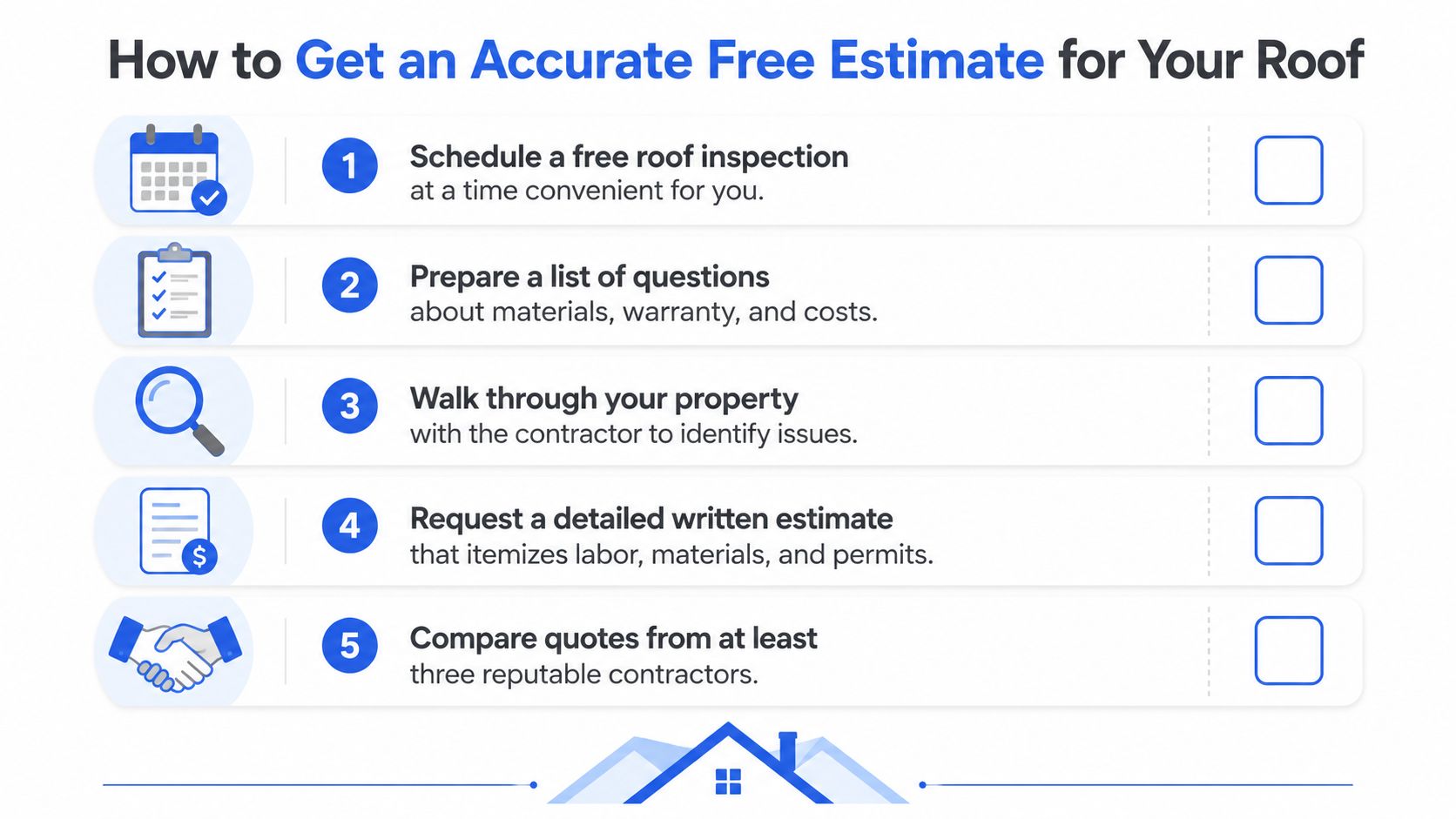
What a proper estimate should include
A good written estimate lists the shingle type, underlayment, tear-off scope, disposal, flashing work, ventilation changes, and any decking allowance. It should also identify the warranty terms and whether the contractor is licensed and insured. If the estimate is only one lump sum, ask for the line items before you compare it to anything else.
Use the appointment to ask pointed questions. Which shingle line are you quoting? Is it standard architectural, Class 3, or Class 4? Does the price include replacement of damaged plywood if the crew finds it? Those questions save money because they stop surprises before the job starts.
- Schedule the inspection: Pick a time when you can walk the property and discuss concerns.
- Request details in writing: Don't accept a verbal quote for a multi-thousand-dollar roof.
- Compare at least three bids: That's the fastest way to spot a lowball estimate.
- Review warranty language: Some products and installers offer stronger coverage than others.
- Watch for pressure tactics: A contractor who rushes you is often hiding something.
The right contractor should be comfortable with that process. If they aren't, keep looking. A professional estimate makes it easier to judge the actual impact resistant shingles cost on your home instead of guessing from internet averages.
For a deeper checklist on contractor selection, see how to choose a roofing contractor.
Making the Right Decision for Your Home and Budget
If your roof is aging, your neighborhood sees hail, and you already need replacement work, Class 4 makes strong financial sense. If you've just filed a storm claim and you're choosing a new roof anyway, I'd seriously consider the upgrade because the incremental cost is usually manageable and the protection is real. If you're selling soon, the durability story can help with buyer confidence and inspection readiness.
The key numbers stay the same. Impact-resistant shingles typically add a modest single-digit percentage to the total project cost, and the upgrade is usually much smaller than homeowners expect once it's priced as an increment instead of a whole roof. The best case for Class 4 is simple, higher storm exposure, a real insurance discount, and a homeowner who plans to stay put long enough to benefit.
If you live in Columbus or anywhere in central Ohio and you want a straight answer for your house, get a roof inspection and a written estimate before you make the call. A good contractor can tell you whether the upgrade is worth it on your exact roof, not just in theory.
HIBCO ROOF LLC helps Columbus and central Ohio homeowners compare roof replacement options the right way, with free inspections, clear written estimates, and no-pressure guidance on materials, storm damage, and insurance claims. If you want a local team that will look at your roof, explain the impact resistant shingles cost, and give you honest next steps, visit HIBCO ROOF LLC and schedule your free estimate.