Ohio roof replacement pricing usually lands between $4,950 and $13,500, with a statewide average around $6,831 to $8,100. If your house is standard asphalt-shingle and the layout is straightforward, that range gives you a realistic starting point before any surprises show up on the bid.
A lot of Ohio homeowners get the estimate call after a leak stains a ceiling, a home inspection flags aging shingles, or a sale is moving faster than expected. The problem is that roof pricing looks simple until the hidden items start stacking up, and that's where most budgets break.
Table of Contents
- Introduction to Ohio Roof Replacement Costs
- Key Cost Drivers for Roof Replacement in Ohio
- Ohio Roof Replacement Costs by Material and Size
- Insurance and Financing for Ohio Roof Replacement
- Checklist for Accurate Local Roof Replacement Estimates
- Reasons to Choose HIBCO ROOF LLC for Your Replacement
- Conclusion and Next Steps for Your Ohio Roof Project
Introduction to Ohio Roof Replacement Costs
The average roof replacement cost Ohio homeowners see is usually tied to the mid-thousands, not the bargain-bin low number some sales pitches imply. A statewide guide puts Ohio pricing at about $6,831 to $8,100, with typical project ranges from $4,950 to $13,500 depending on size and material (Ohio roof cost guide).
Why the average can mislead you
That average is useful only if your roof is average, and most roofs aren't. Pitch, complexity, shingle choice, and tear-off conditions all push the final price up or down, which is why a basic asphalt job and a premium replacement can live in completely different budget tiers.
Practical rule: treat the statewide average as a planning number, not a quote.
Ohio is also generally cheaper than many coastal markets, which is helpful but not a reason to relax. You still need a contractor who breaks out labor, materials, permit handling, and disposal instead of hiding them in one vague total.
What you should expect next
A good estimate should show where the money goes, not just what the roof costs. You should be able to tell whether you're paying for standard installation, upgraded materials, code-related corrections, or storm-related scope.
That's the difference between a usable number and a guess. If you're comparing bids right now, focus on whether each contractor is pricing the same system, not just the same square footage.
Key Cost Drivers for Roof Replacement in Ohio
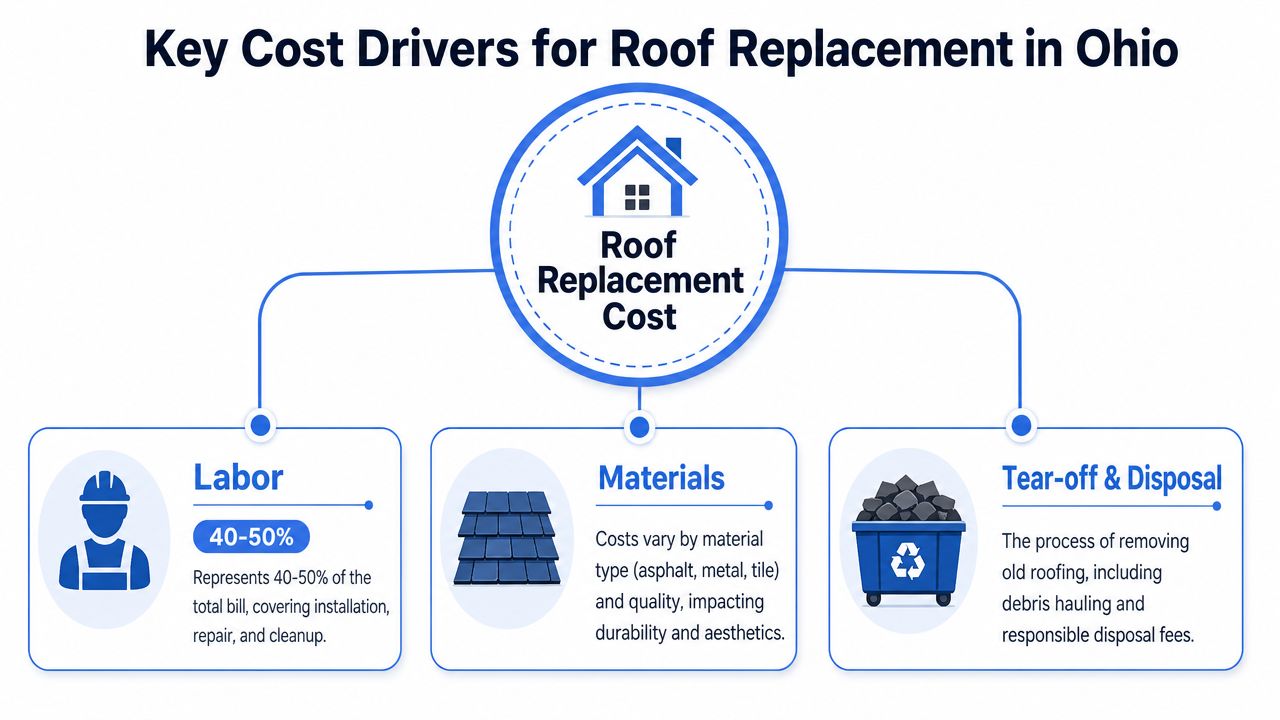
Labor is the first place to look because it often makes up 40% to 50% of the total bill, and Ohio permit fees average about $355.50 per project (Walker Roofing and Construction). That's why a low bid can look attractive and still leave out items you'll pay for later.
The labor line item
Labor covers tear-off, deck inspection, underlayment placement, shingle installation, flashing detail, and cleanup. On steeper or more complicated roofs, labor rises because the crew spends more time staging, cutting, sealing, and moving materials safely.
Materials and scope
Material choice is the biggest swing factor in the state, and Ohio pricing guides reflect that clearly. Architectural asphalt runs about $400 to $560 per square, standing-seam metal about $880 to $1,350 per square, and tile about $980 to $1,500 per square, all installed (Ohio material pricing guide).
Bottom line: compare the full roofing system, not just the shingle brand.
That means you need to ask whether a bid includes ice-and-water shield, ventilation correction, flashing replacement, and haul-away. The cheapest quote is often cheapest because it trims those details.
Tear-off, disposal, and local variation
Tear-off and disposal sound minor until they aren't. Old roofing has to come off, debris has to leave the property, and those steps add real labor and logistics to the job.
Location matters too. Columbus pricing tends to run differently from rural projects because labor density, access, and overhead aren't the same. If you want a broad comparison of roof budgeting factors, see this roof replacement cost overview.
Ohio Roof Replacement Costs by Material and Size
Material choice changes the math faster than almost anything else. A standard asphalt roof and a metal or tile roof are not interchangeable products, because labor method, fastening, underlayment, and detailing all change with the system.
The table below shows what that looks like in practical terms using the installed square pricing above. Since one square equals 100 square feet, the totals are simple conversions.
| Material Type | Cost per Square | Cost for 1,500 sq ft | Cost for 2,000 sq ft | Cost for 2,500 sq ft |
|---|---|---|---|---|
| Architectural asphalt shingles | $400–$560 | $6,000–$8,400 | $8,000–$11,200 | $10,000–$14,000 |
| Standing-seam metal | $880–$1,350 | $13,200–$20,250 | $17,600–$27,000 | $22,000–$33,750 |
| Tile | $980–$1,500 | $14,700–$22,500 | $19,600–$30,000 | $24,500–$37,500 |
What the table means in real life
Asphalt is the budget benchmark because it stays near the lower end of the installed spectrum. Metal and tile push the project into a different tier fast, which is why a homeowner can hear two quotes that seem wildly apart even when the roof size is similar.
The size effect is just as direct. A larger roof needs more squares of material, more labor time, and more disposal volume, so the total rises in a straight line even before complexity is added.
Why system scope matters more than the cheapest bid
A low per-square quote is not a win if it excludes important parts of the job. Ask whether the proposal includes flashing, ventilation correction, tear-off, permit handling, and cleanup, because those omissions are where some bids are artificially low.
For homeowners comparing asphalt to metal, this metal roofing vs asphalt comparison is a useful next read. It helps you judge whether the higher upfront spend matches your goals for durability, appearance, and long-term upkeep.
Insurance and Financing for Ohio Roof Replacement
A storm claim changes the economics, but it doesn't magically make every roofing expense disappear. Independent cost guidance notes that insured claims often cover material-related loss while excluding permit work, structural upgrades, and disposal fees (Parkhill Roofing).
Standard replacement versus storm claim
A routine replacement is simple. You own the bill, you choose the contractor, and the whole system is priced as a normal home improvement.
A storm-damage claim is different because the insurer looks at sudden, accidental damage, not ordinary wear. That means documentation matters, and so does the scope the adjuster accepts.
Financing the part insurance doesn't cover
If you're paying out of pocket, financing can protect your cash flow. Homeowners commonly use personal loans, home-equity lines, or roofing-specific credit when they need to spread the cost out instead of taking the full hit at once.
If you want help lining up project financing while you sort out the replacement scope, secure investor capital with LendingXpress can be worth reviewing as a resource, especially when the project is tied to property improvement rather than a quick patch.
Use financing for timing, not denial. If the roof is failing, don't delay the work just because the bill feels inconvenient.
The right move is to separate the claimable damage from the items that stay on you. That keeps the budget honest and prevents the false comfort of thinking the insurer will cover every line on the invoice.
Checklist for Accurate Local Roof Replacement Estimates
Good quotes start with good information. If you give three contractors the same roof details and the same scope expectations, you'll get bids that are comparable instead of three different guesses.
What to do before you sign anything
- Verify contractor licensing. Ask for proof that the company is licensed and insured, and don't accept a vague verbal promise.
- Schedule an in-person inspection. A roof estimate based on satellite images alone can miss flashing damage, ventilation issues, or hidden deck problems.
- Request itemized bids. The proposal should separate labor, materials, tear-off, disposal, and permits so you can see what's included.
- Check scope details. Confirm whether ice-and-water shield, ventilation corrections, and cleanup are part of the quote, not optional add-ons.
A written estimate should also state who handles permits and what happens if the crew finds rotted decking or other hidden damage. If you're trying to understand project sequencing and timing, this roof replacement timeline is a useful companion.
How to compare bids the right way
Don't compare only the final number. Compare the same roofing system, the same tear-off plan, the same warranty terms, and the same cleanup expectations.
If one bid is much lower, assume something is missing until the contractor proves otherwise.
That mindset saves money. It also keeps you from discovering mid-project that the “cheap” estimate left out the exact work your roof needs.
Reasons to Choose HIBCO ROOF LLC for Your Replacement
HIBCO ROOF LLC serves Columbus and central Ohio homeowners with inspections, repairs, and full replacements, and it works as a licensed and insured contractor. It also offers free, no-pressure written estimates, manufacturer-backed materials, and support for insurance claims and financing pre-qualification.
That matters because roof replacement isn't just a labor purchase, it's a coordination job. You want a contractor who can inspect the roof, explain the scope, document storm damage if needed, and keep the project moving without forcing a hard sell.
The company also holds Owens Corning Preferred Contractor status, and it reports that many replacements are completed in a single day with post-job cleanup included. For homeowners trying to get from leak to finished roof without chaos, that combination of speed, documentation, and cleanup is hard to ignore.
Conclusion and Next Steps for Your Ohio Roof Project
The average roof replacement cost Ohio homeowners should plan for depends on more than shingles. Statewide pricing often sits around $6,831 to $8,100, with typical projects ranging from $4,950 to $13,500, but labor, permits, disposal, and ventilation corrections can move your total quickly.
Get a written estimate that breaks out the full scope. A real quote should show the tear-off, underlayment, flashing, permit handling, disposal, ventilation fixes, cleanup, and the material line by line. If a contractor gives you one lump number and calls it “all-in,” keep shopping.
Compare the same work from each bidder, not just the same roof size. Ask whether the price changes if the deck is soft, if extra layers must come off, or if the attic needs ventilation corrections. Those details are where Ohio homeowners get surprised.
Material choice still drives the final bill. Asphalt usually gives you the lowest installed price, while metal and tile push the project higher because the material, labor, and installation requirements are all greater.
Do not let a vague bid decide the project for you. Ask straight questions, get everything in writing, and make sure the contractor explains permits, disposal, ventilation correction, and cleanup before you sign. That is how you protect your budget and avoid a mess on your property.
A CTA for HIBCO ROOF LLC.