A Class 4 shingles insurance discount can range from 5% to 30%, usually applies only to the wind-and-hail premium, and is set independently by each insurer. Installing impact-resistant shingles doesn't automatically qualify your roof or reduce your bill.
The popular advice to install Class 4 shingles and collect the savings skips the most important work: getting the carrier's approval before you buy and submitting the right records afterward. For Columbus and central Ohio homeowners, the useful comparison isn't a headline discount. It's the confirmed annual savings against the added installation cost, with coverage restrictions included.
Table of Contents
- Typical Class 4 Credits and What They Save
- What a Class 4 Rating Actually Tests
- Carrier Rules That Decide Whether You Get the Credit
- Paperwork and Steps to Confirm Eligibility Before Installing
- When Class 4 Shingles Do Not Pay for Themselves
- Decide Once the Credit Is Confirmed in Writing
Typical Class 4 Credits and What They Save
Available market guidance puts potential Class 4 credits at roughly 5% to 30%, with Ohio-oriented programs citing approximately 5% to 15% and broader hail-prone-market estimates reaching 10% to 30%, according to Ohio roofing insurance guidance. These are potential ranges, not a nationwide rate schedule or a promise that your carrier participates.
The premium component matters as much as the percentage. A credit applied only to wind and hail won't reduce the portions of your bill associated with other coverages. Don't multiply a quoted credit by your total homeowners premium unless the agent confirms that's the correct calculation.
Annual savings at each Class 4 credit level
The following arithmetic uses hypothetical wind-and-hail premiums and the credit levels within those published ranges.
| Credit level | Saving on $600 wind-and-hail premium | Saving on $1,000 wind-and-hail premium | Where the range is cited |
|---|---|---|---|
| 5% credit | $30 per year | $50 per year | Low end of Ohio-oriented carrier programs |
| 10% credit | $60 per year | $100 per year | Inside both the Ohio and broader ranges |
| 15% credit | $90 per year | $150 per year | Top of Ohio-oriented carrier programs |
| 30% credit | $180 per year | $300 per year | Top of broader hail-prone-market estimates |
| Deductible reduction | No recurring premium saving from the reduction itself | No recurring premium saving from the reduction itself | Value appears only after a covered hail or wind claim |
A deductible reduction is a different benefit. It lowers your out-of-pocket responsibility when an eligible covered claim occurs rather than automatically reducing your monthly premium. Ask the agent to identify which benefit is being offered.
Calculate dollars, not headlines: Confirm both the credit percentage and the premium component it applies to before treating an insurance incentive as part of your roofing budget.
Use the wind-and-hail premium shown on your declarations page if it's separately listed. If it isn't, ask the agent for the eligible premium amount and a written calculation. Also request the effective date, so you don't count savings before the carrier will apply them.
What a Class 4 Rating Actually Tests
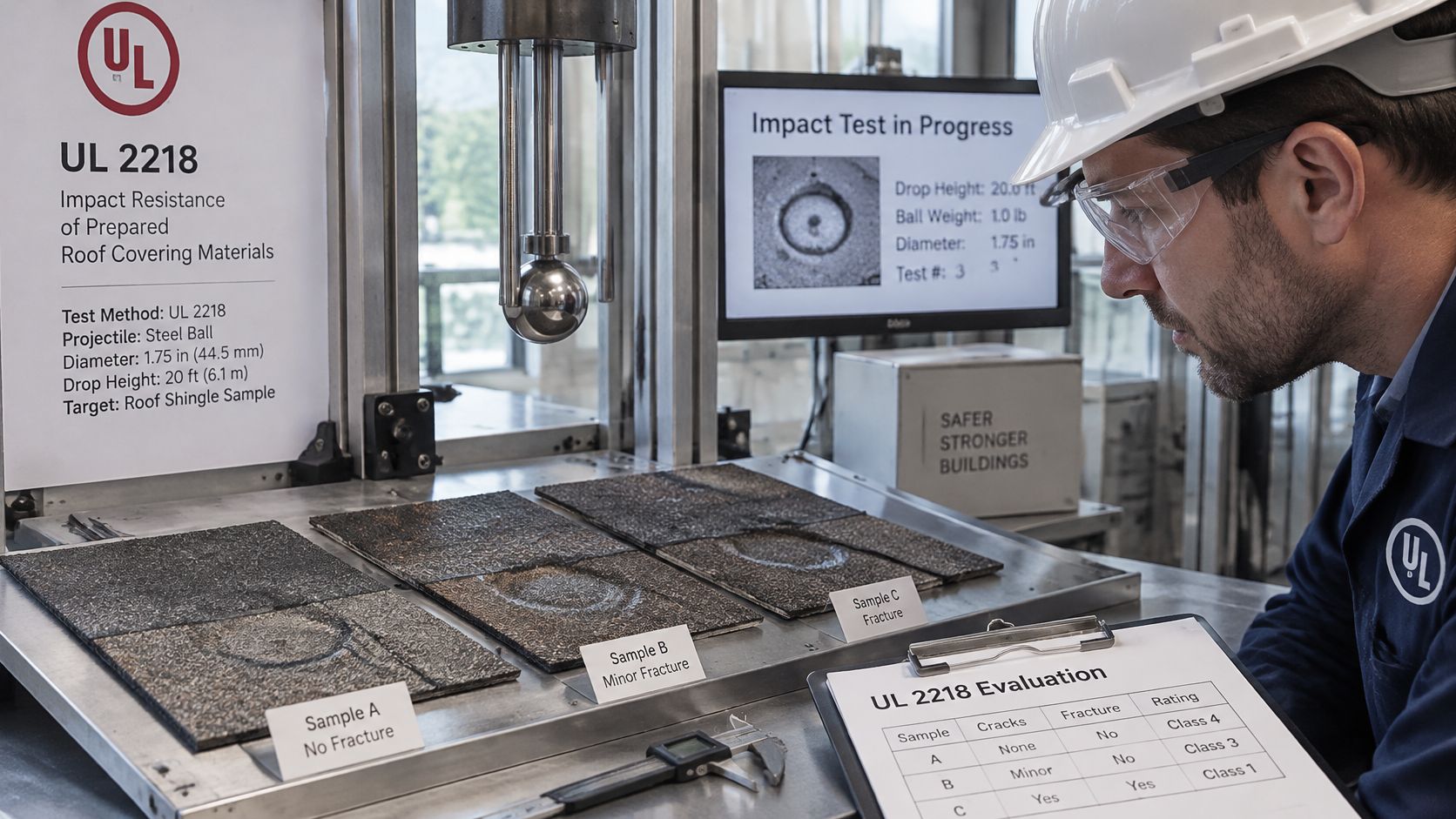
Class 4 is the highest impact-resistance classification under UL 2218, a standard used to evaluate roofing materials against simulated hail impacts. The Texas Department of Insurance roofing guide describes testing with a 2-inch steel ball dropped from 20 feet, with two impacts in the same location and no cracking, splitting, or rupturing through the back of the material.
That's a controlled material test, not a prediction of everything a storm can do to an installed roof. It gives manufacturers, contractors, and insurers a common way to identify tested impact resistance.
A test result isn't a damage guarantee
Think of a vehicle's crash-test rating. It tells you how the vehicle performed under defined conditions, not that it can't be damaged in an accident. The roofing classification works similarly: it demonstrates performance against a specified impact without promising immunity from every hailstorm.
Don't confuse impact resistance with other roof ratings. A Class A roof fire rating addresses a separate performance question. Check each relevant rating on its own documentation rather than assuming that a strong result in one category establishes performance in another.
The connection between impact ratings and insurance incentives isn't new. As documented by Professional Roofing, the Texas Department of Insurance established a hail-resistant-roofing program in 1998 that allowed discounted insurance rates after installation of qualifying materials.
That history explains why insurers recognize documented impact resistance, but it doesn't establish eligibility for an Ohio property. Your carrier still has to accept the product and installation for your policy.
Practical rule: Treat the Class 4 label as eligibility evidence, not as an insurance discount.
Before selecting a color or signing the estimate, obtain documentation for the exact shingle model. A brand name, a broad product-family description, or an estimate that says only impact-resistant shingles leaves too much unresolved. Match the manufacturer's designation to the product named in the contract.
Carrier Rules That Decide Whether You Get the Credit
The same roof can qualify with one insurer and receive no credit from another. GAF's impact-resistant roofing guidance explains that insurance incentives depend on the carrier and jurisdiction, with insurers controlling the credit amount and applicable requirements.
For a Columbus-area homeowner, a useful agent conversation starts with eligibility, moves to coverage, and ends with the actual price. Asking only whether the company offers a roof discount can produce an answer that's technically correct but financially incomplete.
Questions to take to your agent
- Does this policy offer the credit at this address? Confirm that the carrier's program applies to your ZIP code and policy form.
- What product evidence is acceptable? Ask whether UL 2218 documentation is sufficient or whether the insurer requires a particular label, approval, or additional test.
- Must the entire roof system qualify? Identify any installation or component requirements beyond the field shingles.
- Which premium receives the credit? Have the agent distinguish the dwelling premium, wind-and-hail component, and total policy premium.
- Does a partial repair count? Confirm whether eligibility requires full replacement rather than replacement of a damaged slope.
- Are there roof-age restrictions? Ask how age affects initial eligibility and whether the benefit changes at renewal.
- Does local loss history affect the offer? Request a property-specific answer rather than relying on a general advertisement.
- Is a cosmetic-damage exclusion required? Ask for the actual endorsement before accepting the credit.
A cosmetic-damage exclusion can remove coverage for dents or appearance changes that don't impair the roof's function. Don't rely on a verbal description of that trade-off. Read the proposed wording and ask how the carrier distinguishes appearance damage from covered functional damage.
Compare the complete policies
Consider a hypothetical comparison using the upper end of the Ohio-oriented range: one carrier offers a 15% wind-and-hail credit, while another offers none. That doesn't automatically make the first policy cheaper or better. Its base premium, deductible, exclusions, and roof settlement provisions may produce a less favorable overall result.
Compare the final annual premium with equivalent coverage, then compare what you would owe after a covered loss. A smaller bill isn't necessarily better value if you're accepting a coverage restriction you wouldn't otherwise choose.
Ask the questions in that order: eligible product, eligible installation, coverage changes, premium calculation, effective date. Get the answers in writing before authorizing the upgrade.
Paperwork and Steps to Confirm Eligibility Before Installing
Turn the agent's answers into a project file before signing the roofing contract. The Colorado Roofing Association's comparison of impact-resistant shingles identifies product approval and documentation as practical obstacles: homeowners can pay for qualifying-looking materials yet receive no credit when the carrier doesn't recognize the product or the necessary records weren't preserved.
The objective isn't to collect paperwork indiscriminately. It's to build a file that connects the approved product, your property, the completed installation, and the policy adjustment.
Before signing the contract
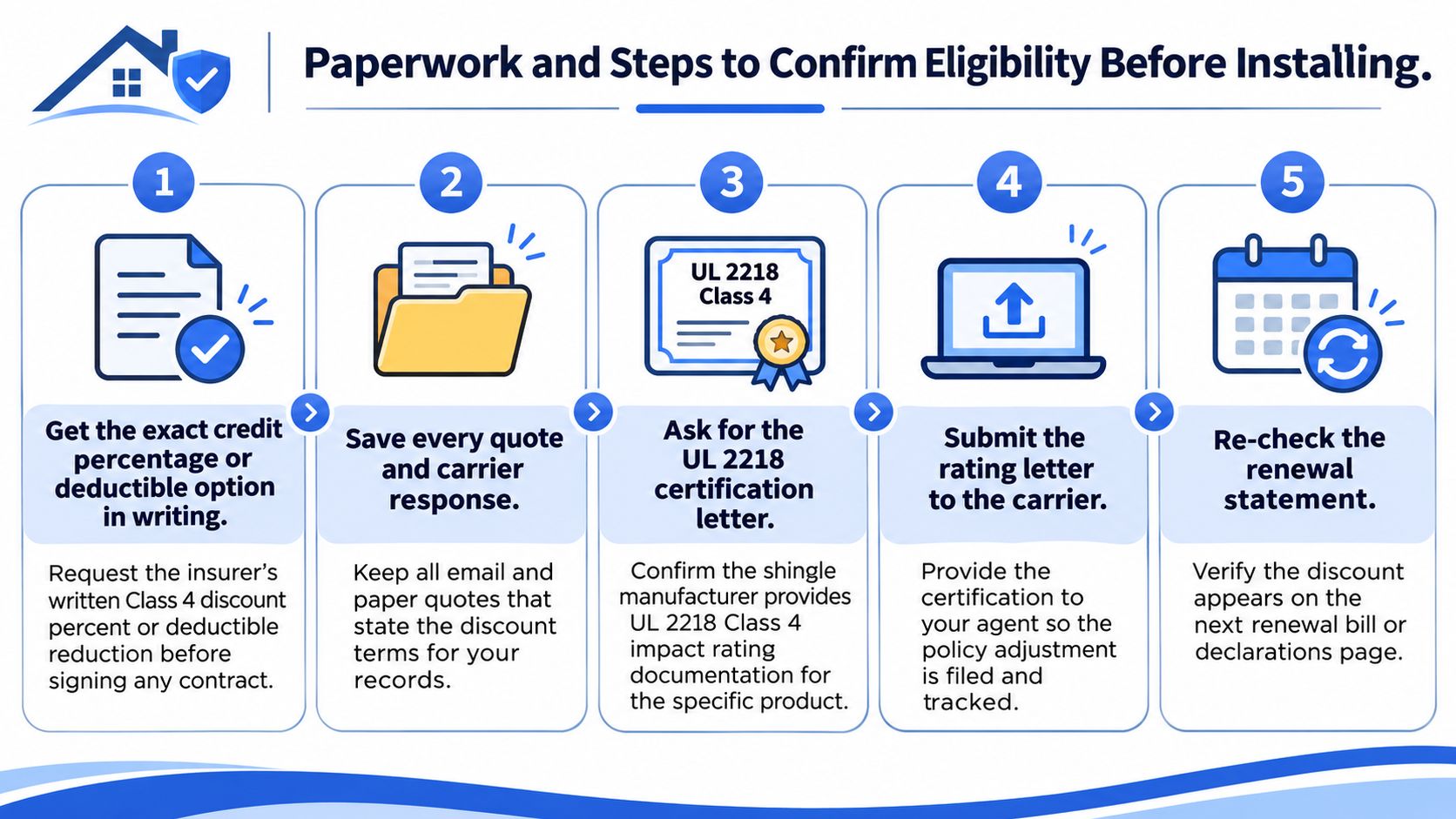
Get the benefit in writing. Save the carrier's exact credit offer or deductible alternative, including conditions and the proposed effective date. Keep the email with the quote it refers to, so an estimate doesn't get mistaken for final approval.
Record the calculation base. Ask the agent to identify the eligible premium component and show the resulting annual savings. This gives you a figure you can compare with the roofing estimate rather than an unsupported percentage.
Name the exact shingle. Request the manufacturer's product data sheet showing the impact classification for the model being ordered. Make sure the roofing contract uses the same manufacturer and model designation, not simply architectural or impact-resistant shingles.
Resolve installation scope. Confirm whether the insurer requires complete replacement and whether other roof-system requirements apply. Put the agreed scope in the contract before materials are ordered.
Obtain the carrier's document checklist. Ask for any required contractor form early. It's easier to arrange photographs, labels, and certifications during the project than to reconstruct them after cleanup.
Documents to collect for a Class 4 credit
Use this as a working checklist. The carrier's requirements control, and not every insurer will request every item.
| Document | Why the insurer asks | When to collect it |
|---|---|---|
| Product data sheet showing UL 2218 Class 4 | Confirms the exact shingle model qualifies | Before ordering the shingles |
| Carrier written confirmation of eligibility | Records the terms accepted before purchase | Before installation |
| Installation invoice | Identifies the property, completed work, and listed product | Right after installation |
| Installation certification or contractor form | Documents installation details required by the carrier | At project completion |
| Photographs of the finished roof | Documents condition and installation, alongside pre-work images | Before and after the job |
| Packaging labels or bundle tags | Matches delivered materials to the approved product | During delivery and installation, keep until final inspection |
| Permit and inspection records | Documents local review where applicable | After final inspection |
Completion day and policy follow-through
Collect the records before closing out the job. Check that the final invoice names the installed product and property address. Save bundle-tag photographs and any required installation certification while the materials and project details are still easy to verify.
Submit the file and confirm acceptance. Send the complete package to your agent, request acknowledgment, and ask for written confirmation of the applied credit or endorsement. Re-check the renewal documents rather than assuming submission completed the process.
A common paperwork gap is easy to prevent. Say a homeowner discards the bundle tags, keeps an invoice that says only new shingles, and can't identify the exact installed model. The finished roof's appearance may not establish product eligibility, leaving the homeowner trying to prove a purchase that should have been documented at delivery.
Keep digital copies together, including carrier responses and the submitted attachments. Photograph the roof before and after work, and retain original records if the insurer requests them again at renewal.
Don't close the file when the roof is finished. Close it when the insurer confirms the policy adjustment.
Storm-damage records serve a related but different purpose. A roof inspection for an insurance claim documents the condition and damage being evaluated; product certification supports eligibility for a roofing credit. We help document storm damage, meet with insurance adjusters, and guide homeowners through the claim process, while the insurer decides coverage and credit eligibility.
Your completed folder should hold the written offer, product data sheet, invoice, certification, photographs, and applicable permit or inspection records.
When Class 4 Shingles Do Not Pay for Themselves
Better impact resistance can justify an upgrade without making it a profitable insurance purchase. Class 4 shingles don't eliminate hail losses, and premium savings alone may take longer to recover the additional cost than you expect to own the home.
Use incremental cost, not the entire replacement price, when comparing an upgrade on a roof already due for replacement. If you're replacing an otherwise serviceable roof mainly to obtain a credit, the amount you're spending to pursue that benefit is much larger.
Run a simple break-even test
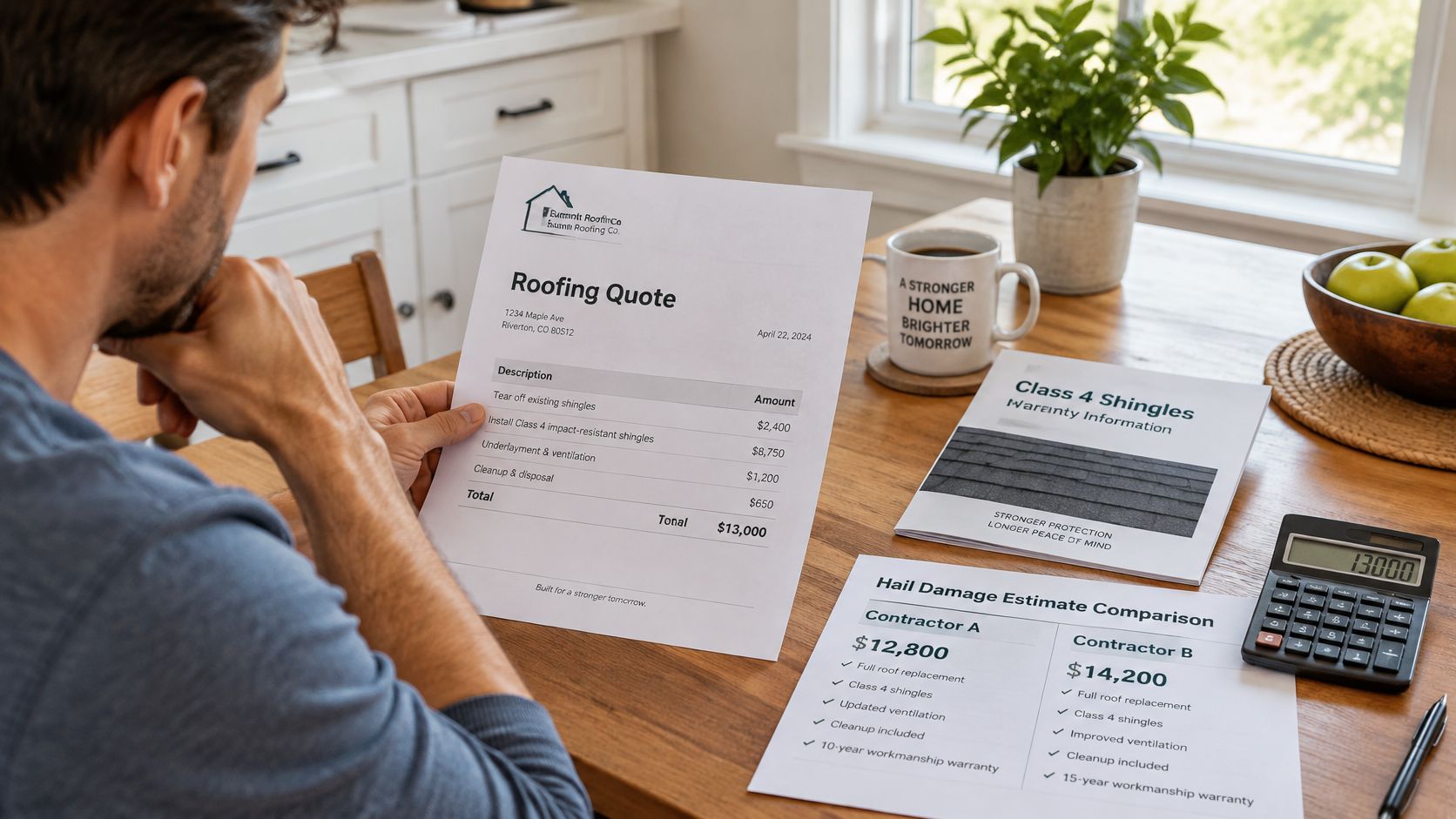
Consider a hypothetical upgrade that adds $2,000, with a 15% credit on a $600 annual wind-and-hail premium. The credit saves $90 annually, so premium savings alone would take about 22 years to recover the upgrade cost, before deductible effects, financing costs, or changes to the policy.
Added upgrade cost ÷ confirmed annual credit = simple payback period.
Ask for comparable replacement options with the same scope, so the price difference reflects the material upgrade rather than unrelated repairs. The factors affecting Ohio roof replacement costs also matter when evaluating the total project budget.
Check what the premium calculation leaves out
Roof age, the wind-and-hail deductible, underwriting rules, and the policy's settlement method can change the result. A replacement-cost provision and an actual-cash-value provision don't produce the same claim payment, and a cosmetic exclusion may leave appearance damage uninsured.
The broader insurance context also deserves attention. Claims Journal's reporting on Verisk findings states that 16 U.S. states had at least 20% of roofs affected by severe hail in 2025, compared with 12 states in 2024. The same report notes that Texas's 2026 bulletin encouraged actuarially supported impact-resistant roofing credits without mandating a specific discount amount.
Those findings support taking hail exposure seriously, not assuming a particular Ohio savings figure. Choose the upgrade based on your property, expected ownership period, and written policy terms.
Buying rule: Compare the annual credit with the added cost, then check the deductible, settlement method, and exclusions before deciding.
Decide Once the Credit Is Confirmed in Writing
Proceed with the insurance-savings comparison when the carrier has confirmed eligibility and the exact shingle model has the required documentation. Match the written annual benefit against the added installation cost, then decide whether the payback and coverage terms fit your plans.
If the carrier can't confirm a credit, you can still choose impact-resistant shingles for durability. Just don't describe an unapproved insurance incentive as money the upgrade will return. That distinction keeps a reasonable material choice from becoming a misleading financial promise.
Make the inspection request useful
When contacting our team, explain whether you're evaluating an aging roof, investigating storm damage, or comparing replacement materials. Include the carrier's requirements and request that the proposed product data sheet and completion paperwork be addressed from the start.
We help document hail and storm damage, meet with insurance adjusters, and guide homeowners through the insurance claim process. The insurer remains responsible for deciding whether damage is covered and whether the proposed roof qualifies for a policy credit.
Before the crew arrives, keep the carrier's written answer and approved product data sheet in hand. Have the required installation forms ready and establish who will provide the invoice, photographs, and certification at completion. The finished installation records belong in that same folder before you submit the credit request.
Every homeowner receives a free roof inspection and a no-obligation estimate from HIBCO ROOF LLC. Call or text 614-810-0050 to schedule, and bring your insurer's Class 4 requirements so we can discuss the roofing scope and documentation alongside your estimate. If storm damage is involved, we also help document conditions, meet with adjusters, and guide you through the claim process.