
You heard the wind Saturday night. Sunday morning you're in the driveway in slippers with cold coffee, looking at seven shingles peeled back over the garage and a gutter hanging off its hanger. Half the neighborhood is doing the same thing. You take a few phone photos and think the obvious thought: this is what insurance is for.
Maybe. That's the honest answer, and it's the one most homeowners don't hear until they're three weeks into a claim. Roof repair insurance is real coverage, and it pays claims across central Ohio every year. How much it pays on your roof depends on details buried in your own policy: what caused the damage, whether the roof line settles at replacement cost or actual cash value, your wind and hail deductible, and how well anyone documented the damage before the torn shingles hit the ground.
What follows is a plain-language walk through all of it. You'll learn how to separate storm damage from ordinary wear, why two neighbors with identical damage can get very different checks, how to build an inspection file an adjuster can work with, and what to do when the letter in your mailbox is about underwriting rather than a claim.
Table of Contents
- What Roof Repair Insurance Actually Pays For
- Covered Storm Damage Versus Everyday Wear
- Replacement Cost and Actual Cash Value Payouts
- Photos Measurements and the Inspection File
- From Filing to Final Check
- Storm Repair Stories With Different Outcomes
- Repair Claim or Replace Decision
What Roof Repair Insurance Actually Pays For
Roof repair insurance is the portion of a homeowners policy that responds when something sudden and accidental damages the roof. Wind peels shingles back. Hail bruises the mat under the granules. A limb punches through the deck. Those are insurable events. A roof that has aged out, lost granules evenly across every slope, or leaked for two winters because a pipe boot was never replaced is a maintenance item, and the policy treats it that way.
The frequency numbers explain why this matters so much here. Insurance industry data summarized by the Insurance Information Institute for 2020 through 2024 shows about 1 in 18 insured homes files a homeowners claim in a typical year, roughly 5.6%. About 1 in 36, or 2.8%, files a property-damage claim tied specifically to wind or hail. A roof claim isn't a rare event confined to a few unlucky blocks. It's a recurring category of residential loss.
It also isn't a one-shingle problem. Storm claims routinely involve shingles, flashing, vents, gutters, and the exterior components around them. That's why a walk around the driveway misses so much. The damage that decides your claim is usually at a ridge, on a north slope, around a chimney, or in soft metal you never think to look at.
Plain rule: the policy responds to what happened to your roof, not to how old your roof is.
Ahead is the full picture. You'll see how to sort storm damage from wear, why replacement cost and actual cash value produce different checks on the same loss, how to build a photo and measurement file, how a replacement-cost claim pays out in stages, and four common outcomes that end very differently.
Before anyone climbs a ladder, pull your declarations page and mark three things with a pen: the wind and hail deductible, the settlement basis for the roof, and any separate roof limit or endorsement. Those three lines decide more about your payout than the storm does. If you want to see how the claim itself gets assembled, filing a storm damage roof claim is worth reading before you authorize anything.
Covered Storm Damage Versus Everyday Wear
Your car insurance pays to tow the car after a crash. It doesn't buy new tires because yours went smooth over 50,000 miles of highway. Homeowners coverage works the same way, and that distinction settles most roof claims.
Policies cover sudden, accidental damage from an insured peril such as wind, hail, lightning, or a tornado. They don't cover the progressive loss of serviceability that comes from aging, rot, deferred maintenance, or gradual deterioration, as a state consumer guide to homeowners policies explains. Same roof, same leak, two different answers depending on which bucket the cause falls into.
That creates a causation problem. You have to show the storm produced the damage you're claiming, and your insurer can take everything that predates the storm and assign it to an exclusion. Neither side is being unreasonable. You're both reading the same roof through different questions.
How one roof becomes two files
An adjuster standing on a 19-year-old roof is doing two jobs at once. One is dating and describing what the storm did. The other is deciding how much of what's visible was already there. The first job can produce a payment. The second usually can't.
| Condition | Typical treatment | What supports the finding |
|---|---|---|
| Hail impact | Often covered if sudden and accidental | Bruised or fractured shingles, split tabs, dents in vents or soft metal |
| Wind | Often covered as a sudden insured peril | Missing shingles, creased tabs, exposed fasteners, displaced flashing |
| Lightning or tornado | Generally covered as a sudden peril | Punctures, displaced components, or storm-dated structural hits |
| Uniform granule loss | Generally excluded as wear | Balding across slopes without a discrete impact pattern |
| Rot or deferred maintenance | Generally excluded | Soft decking or a long-term leak with no covered event |
| End of useful life | Homeowner cost, not a claim | Age-related failure without storm-created damage |
Use the table as a filter, not a verdict. Walk your own roof from the ground with binoculars, look at each slope, and ask which row the condition belongs in.
A leak by itself proves nothing. Water on the ceiling tells you the roof failed. It doesn't tell you why. If a wind-torn shingle opened a path for that water, you have a covered chain of events. If a brittle, granule-bare field cracked under ordinary thermal movement, that's your bill even though the stain on the drywall looks identical.
Cosmetic marks that don't affect how the roof sheds water may be handled differently from functional damage, depending on policy language. A dented gutter that still carries water is a different conversation from displaced valley flashing that's dumping water behind the siding.
The test worth applying: if you can't name the storm and point to the mark it left, you're probably looking at maintenance, not a claim.
Match each condition you find to one row before you estimate what a claim could cover. If most of your list lands in the bottom three rows, the honest plan is a repair or replacement on your own budget, and no amount of paperwork changes that.
Replacement Cost and Actual Cash Value Payouts
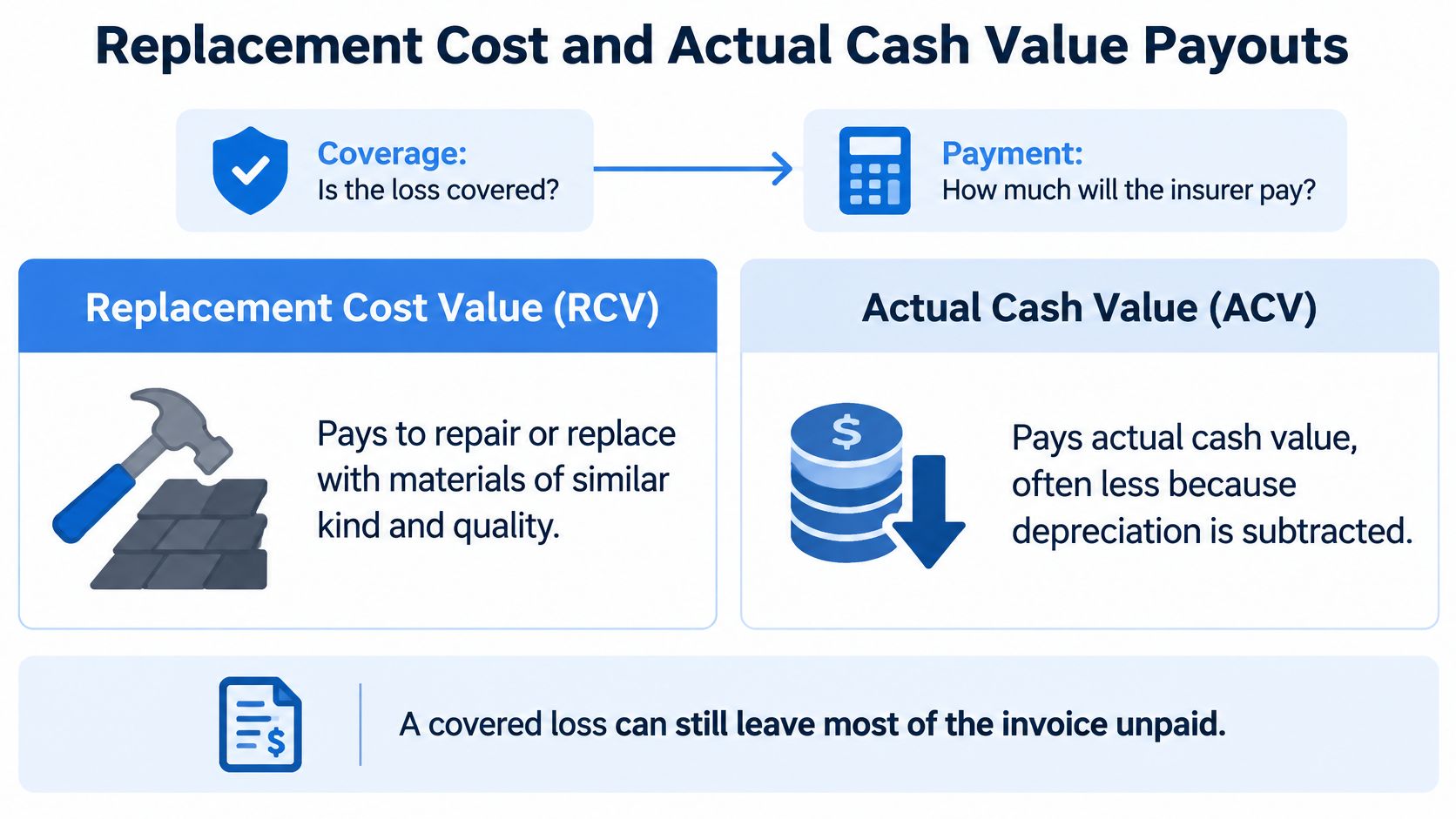
Coverage and payment are separate questions, and confusing them is where homeowners get hurt. A loss can be fully covered and still leave you funding most of the invoice.
The National Association of Insurance Commissioners runs the math on a $15,000 roof loss. With replacement cost coverage and a $1,000 deductible, the insurer pays $14,000. On the same loss settled at actual cash value, with $10,000 of depreciation and the same $1,000 deductible, the check is $4,000, according to the NAIC's guide to replacement cost and actual cash value. Nothing about the damage changed. Only the settlement basis did.
Replacement cost value pays to repair or replace with materials of similar kind and quality, without subtracting depreciation, up to the policy limit and less the deductible. Actual cash value subtracts depreciation for the roof's age, condition, expected useful life, and replacement cost, then subtracts the deductible on top.
Here's how the two paths compare on that same invoice.
| Settlement basis | What is subtracted | Example payment |
|---|---|---|
| Replacement cost value | Deductible only, no depreciation, up to the limit | $14,000 ($15,000 minus $1,000) |
| Actual cash value | Depreciation and the deductible | $4,000 ($15,000 minus $10,000 minus $1,000) |
| Dwelling RCV with a roof exception | Roof may be ACV or specially limited | Check the declarations; the roof line controls |
The roof line can override the rest of the policy
Plenty of policies give the dwelling replacement cost and then apply actual cash value or a special limit to the roof surfaces only. Look on your declarations page for a roof payment schedule, a roof surfaces endorsement, or a windstorm roof endorsement, and read the table attached to it. That language controls your payout no matter what the rest of the policy promises.
Carriers have reasons to sharpen those terms. Verisk data reported by Insurance Business put U.S. roof repair and replacement claim value at nearly $31 billion in 2024, up nearly 30% from 2022. That's context for why roof language keeps tightening, not a forecast of your settlement.
The deductible decides just as much. A separate wind and hail deductible can be a flat amount or a percentage of the dwelling limit. Say your policy carries a 2% wind and hail deductible on a $400,000 dwelling limit. That's $8,000 before the policy pays a dollar, enough to swallow a small repair whole.
Three numbers to write on one sheet
Start by gathering your own figures: the written repair estimate, the wind and hail deductible, and the roof's settlement basis. Every decision for the rest of this process runs through those three figures.
A contractor estimate is not an insurer promise, and a friendly adjuster's nod isn't either. The written settlement is the only thing that pays. If you're weighing a full replacement against a repair, claiming a new roof on insurance explains how carriers evaluate that request, and our own comparison of actual cash value versus replacement cost goes deeper into how depreciation is calculated on an aging roof.
Photos Measurements and the Inspection File
Storm damage is time-sensitive in a way that surprises people. The National Centers for Environmental Information counted 403 U.S. weather and climate disasters costing at least $1 billion each between 1980 and 2024, and severe storms were the largest category at 203 events, with more than $510 billion in damage, according to NOAA's billion-dollar disaster summary. Those totals cover homes, businesses, infrastructure, and crops, not roof payouts. They still tell you how often the weather does this to a neighborhood.
The file you build in the first 48 hours does most of the work in a claim, because it ties a physical condition to a dated event. Here's the sequence at a glance, then the reasoning behind each step.
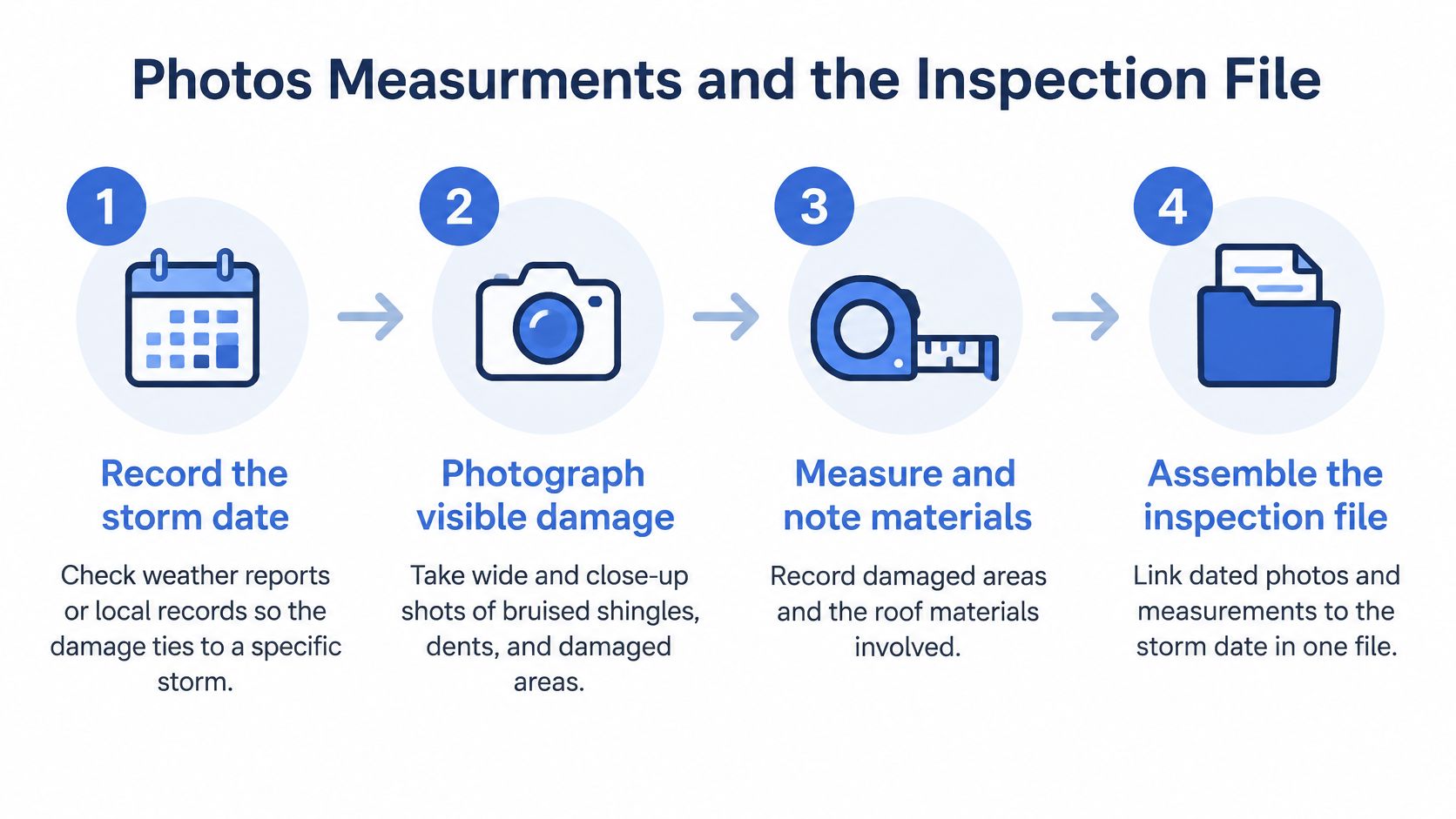
- Fix the storm date first. Pull the weather report or local record for the day the damage happened, so the damage attaches to a specific event instead of a vague season. An adjuster can work with a date. He can't do much with "sometime in April."
- Photograph every slope before anything gets removed. Wide shots of each plane, then close-ups of shingles, flashing, pipe boots, vents, gutters, and any dents in soft metal. Once a crew starts tearing off, the evidence is in a dumpster.
- Measure what's damaged. Record the affected area and the materials involved, and note interior stains with room names and dates, but only where water appeared.
- Make temporary repairs and keep every receipt. Tarping or re-nailing to stop water entry counts as limiting further damage, and most policies expect it. A failure to limit additional damage can complicate the claim.
- Keep the damaged parts. Samples of fractured shingles, bent flashing, and vent pieces stay in the garage until the adjuster has seen them.
- Get a written estimate that separates causes. The scope should list storm-created items apart from pre-existing wear such as granule loss or brittleness, so the two conversations don't get blended into one number.
Hidden damage is the reason to look past the visible shingles. Underlayment, decking, and ventilation components can all be compromised while the roof still looks intact from the street. Ask the inspector to check beneath the surface and at every penetration, rather than photographing one leak and calling it done.
A dated inspection earns its keep even if you never file, because it records the roof's condition at a known moment. For a closer look at what a claim-grade inspection includes, see roof inspection for an insurance claim. Assemble everything in one folder: storm date, photos, measurements, temporary-repair receipts, written estimate. When your agent asks, you send a single email.
From Filing to Final Check
Replacement-cost claims rarely arrive as one check, and the split catches people mid-project. The initial payment usually reflects the roof's actual cash value, meaning replacement cost minus depreciation and the deductible, while the withheld depreciation becomes recoverable after the work is finished and you've provided evidence of it, per the NAIC's disaster claims guide. Maryland's insurance regulator describes it the same way: most homeowners policies require completion of the repair or replacement before the remaining depreciation is released.
That means you may need cash on hand to cover the gap between the first check and the last one. Here's the order that keeps a claim moving.
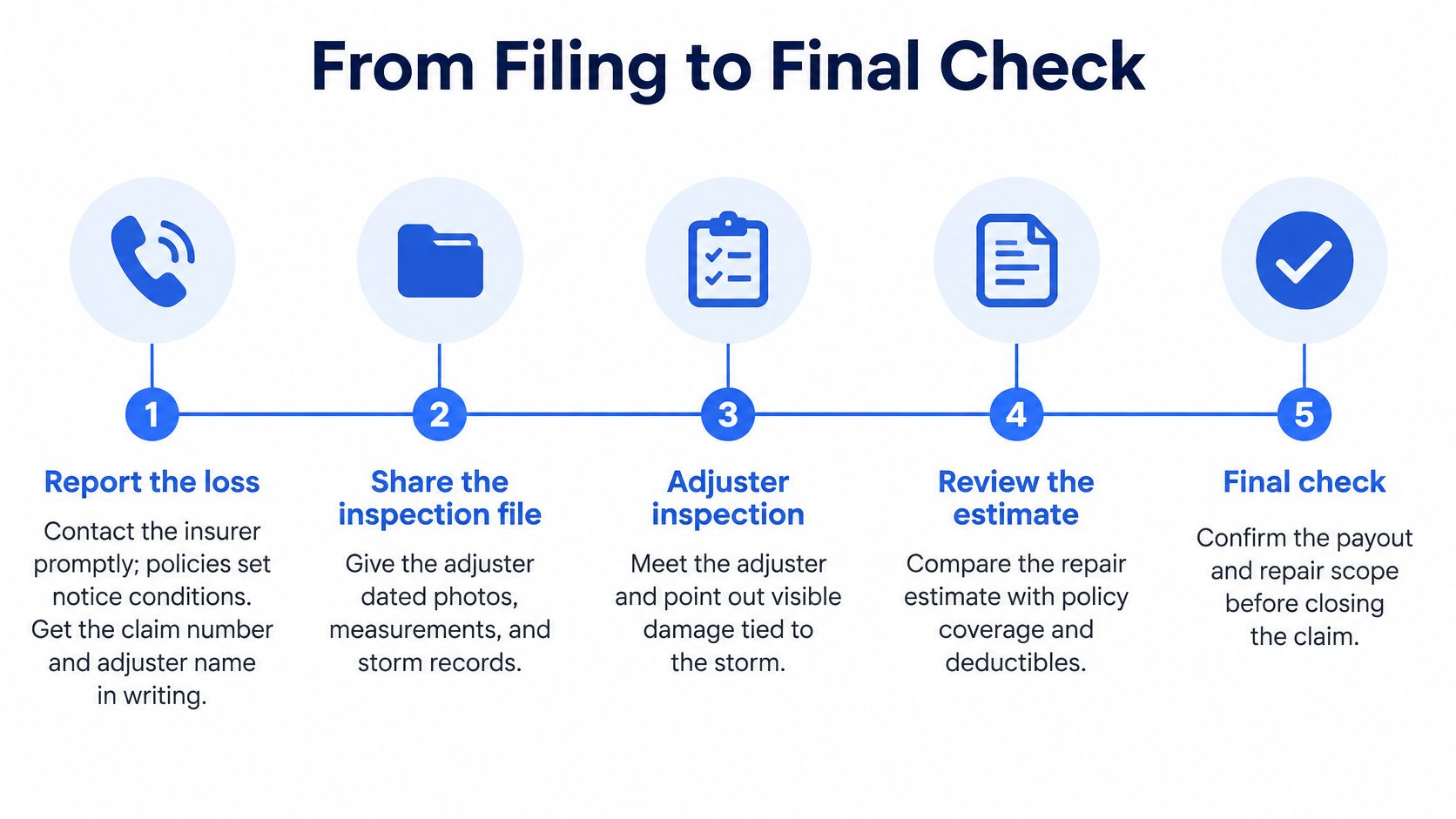
- Report the loss promptly. Policies set notice conditions, and a late report gives an insurer room to reduce a payment. Get the claim number and the adjuster's name in writing the same day.
- Send the inspection file. Dated photos and measurements let the adjuster separate covered storm damage from items that belong to wear.
- Meet the adjuster on the roof. Walk the slopes together and point out each mark you documented. Agreement in real time is easier than a dispute by email three weeks later.
- Read the estimate line by line. You'll see replacement cost, depreciation, the deductible, and the itemized scope. Ask about any line you don't recognize.
- Take the first payment and plan the gap. On a replacement-cost policy that check is typically the depreciated value, not the full scope.
- Finish the work, then submit proof. Invoices and final photos trigger release of the withheld amount.
- Confirm the roof limit or endorsement before work starts, so the scope matches what the policy pays.
Two questions belong in the conversation before you sign a contract. First, whether a partial-slope loss will be matched, meaning whether the insurer pays for a uniform appearance across slopes or only the damaged area. Second, the proof-of-loss deadline in your policy, since a late filing can reduce what's paid.
If you want the claim mechanics from the contractor's side, storm claim help for Ocala homeowners walks the same sequence, and how insurance claims work covers the documents insurers ask for and when they want them.
Ask your agent before work starts: which document releases the remaining depreciation, and by what date does it need to be submitted?
Storm Repair Stories With Different Outcomes
Four homeowners, four storms, four endings. None of these is unusual in central Ohio, and what separates them is mostly policy terms and paperwork rather than luck.
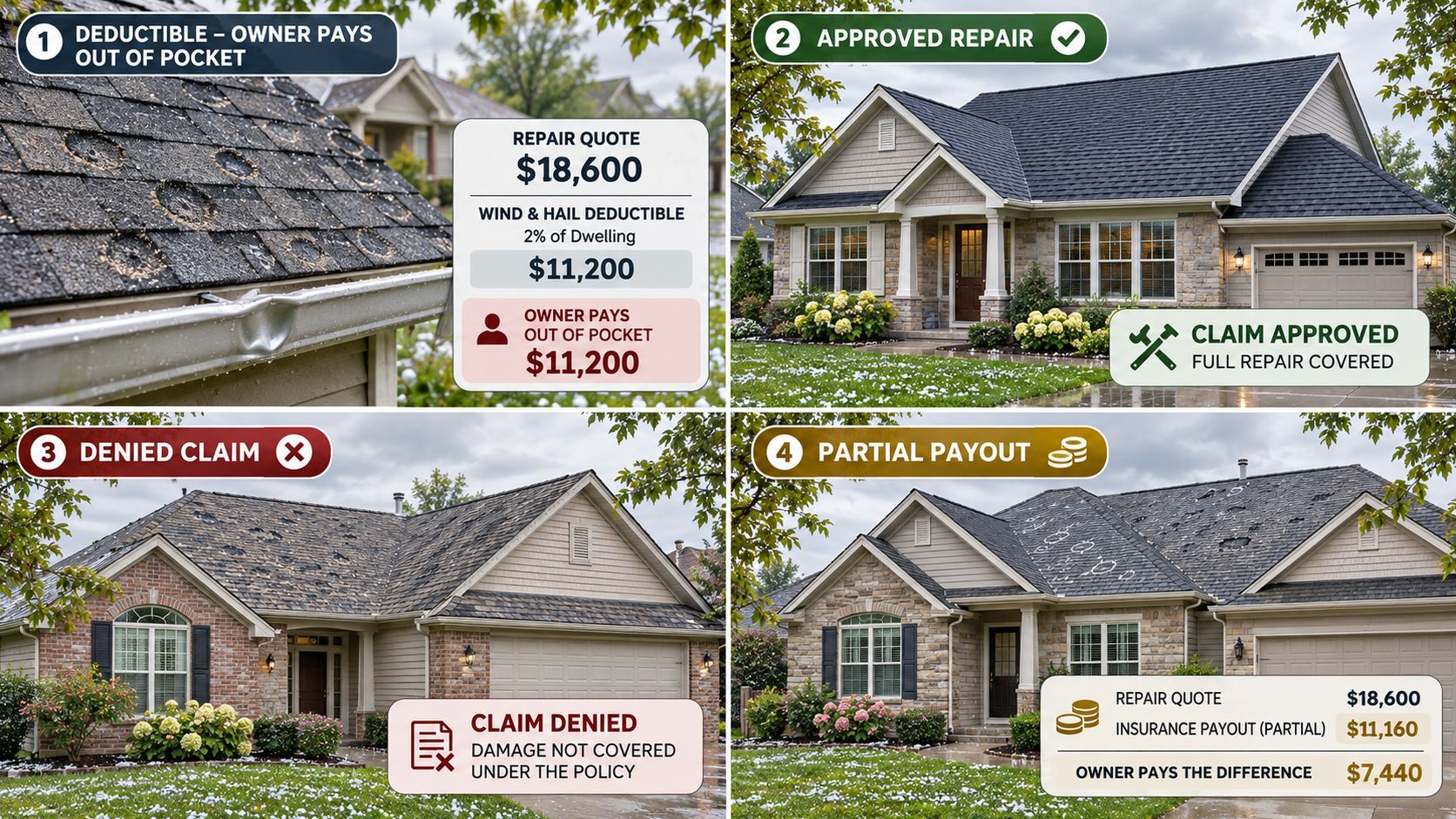
The deductible swallows the repair. Hail bruises six shingles and dents a downspout. The quote comes back under the wind and hail deductible, which is a percentage of the dwelling limit rather than a flat amount. The owner pays for a targeted repair, keeps a clean claim record, and preserves the option to file if a bigger storm comes through next spring.
Covered, and still short at the start. Wind strips shingles from one slope of a 6-year-old roof carrying replacement-cost terms. The claim is approved. The first check holds back depreciation until the work is done and invoiced, so the owner has to float materials and labor before the balance arrives.
Covered, and mostly out of pocket. An older roof shows scattered hail marks plus widespread brittleness. The adjuster accepts the hail marks and declines the aging. Actual cash value trims the payment down hard, and the full replacement the owner wanted is far more than the policy will fund. Filing for a replacement the policy won't reimburse is a poor reason to start a project.
The notice that is not a claim
A renewal letter saying your roof is aging, or a note that an insurer reviewed aerial imagery of the property, is an underwriting question rather than a denied claim. Massachusetts regulators addressed this directly: insurers using aerial imagery are expected to make sure the images are accurate, and state guidance says insurers generally must give at least 45 days' advance notice of nonrenewal and explain the reason, per the Massachusetts consumer advisory on roof-related insurance notices. Age and condition are not interchangeable words.
If a notice arrives, do four things in order. Contact your agent. Ask for the exact underwriting reason in writing. Decline the unsolicited door-to-door crew that appears the week after the letters go out. Get an independent inspection that documents each slope and flashing area before authorizing a replacement.
A roof can be excluded from payment for ordinary wear and still matter to whether an insurer renews the policy. Those are two different letters, and only one of them is about money you're owed.
Find your own case before you file anything. If your quote clears the deductible and a dated storm left functional damage, a claim makes sense. If the roof is at the end of its life, or a notice is asking about condition, the next step is documentation, not a claim number.
Repair Claim or Replace Decision
Most homeowners end up choosing one of three paths. Match your situation to a row, then confirm the terms in writing before anyone touches the roof.
| Situation | Next step | Reason |
|---|---|---|
| Quote at or below the wind and hail deductible | Pay for a direct repair | A claim would pay nothing after the deductible |
| Dated storm caused functional damage and the likely net payment beats paying alone | Open a claim | Deductible and depreciation are already subtracted from the estimate |
| Roof is at the end of its life or the unpaid gap is large | Plan a homeowner-funded replacement unless the roof line clearly pays replacement cost | Age-related wear is generally excluded |
Do these three things first
- Pull the declarations page and read the roof language. Find the wind and hail deductible, the settlement basis for the roof, and any separate roof limit or endorsement. Those three lines answer more than a phone call will.
- Compare the written repair scope with the deductible. If the likely net payment after depreciation is small, a direct repair can cost less than filing, counting the premium consequences nobody quotes at the kitchen table.
- Get the terms confirmed and inspect independently. Ask your agent to confirm the settlement basis and roof limit in writing, treat a contractor estimate as a scope rather than an approval, and decline any offer that requires a same-day signature.
For a neutral second look, HIBCO ROOF LLC inspects roofs across Columbus and central Ohio, documents storm damage, and meets with adjusters while a claim is open so the scope and the damage agree. Every homeowner gets a free roof inspection and a no-obligation estimate, and you can call or text 614-810-0050 to schedule one.
Bring the declarations page and the dated photo file to that inspection. The decision should rest on the written scope and the settlement terms, not on how big the storm felt from the driveway.
HIBCO ROOF LLC does the part most homeowners can't do alone: reading storm damage against your policy terms, photographing and measuring what the storm did, and putting the repair or replacement scope in writing before a claim or a contract gets signed. If shingles are in the yard and you're unsure whether the policy will respond, start with a free inspection rather than a phone call to your insurer. Visit HIBCO ROOF LLC to schedule that inspection and get the numbers in front of you first.