
Most Columbus-area homeowners should budget from the national 2025 range of $5,900 to $13,400 for a residential roof replacement, with a standard 2,000-square-foot home averaging roughly $9,500. Columbus projects commonly land in the middle or slightly above that range, depending on roof complexity, layer count, and decking condition.
That range is a starting point, not a promise. A roof that looks simple from the driveway can involve steep pitches, multiple valleys, difficult access, damaged decking, inadequate ventilation, or flashing that must be rebuilt to code. Those details decide the final roofing replacement cost, and they're exactly where vague estimates fail homeowners.
Table of Contents
- What Roofing Replacement Cost Actually Looks Like in Central Ohio
- Key Factors That Drive Roofing Replacement Cost Up or Down
- Tear Off vs Overlay and Why It Changes Your Final Price
- Realistic Roofing Replacement Cost Ranges for Columbus Homes
- How Insurance Coverage and Replacement Cost Value Affect Your Out-of-Pocket
- How to Get an Accurate Free Estimate from a Licensed Columbus Contractor
- Frequently Asked Questions About Roofing Replacement Cost
- Does an old roof automatically qualify for replacement?
- When is repair financially reasonable?
- Should I finance the project?
- What should I receive before work begins?
- What happens if decking damage appears after tear-off?
- Does storm documentation matter?
- Can a warranty cover a bad installation?
- What should I do with competing estimates?
What Roofing Replacement Cost Actually Looks Like in Central Ohio
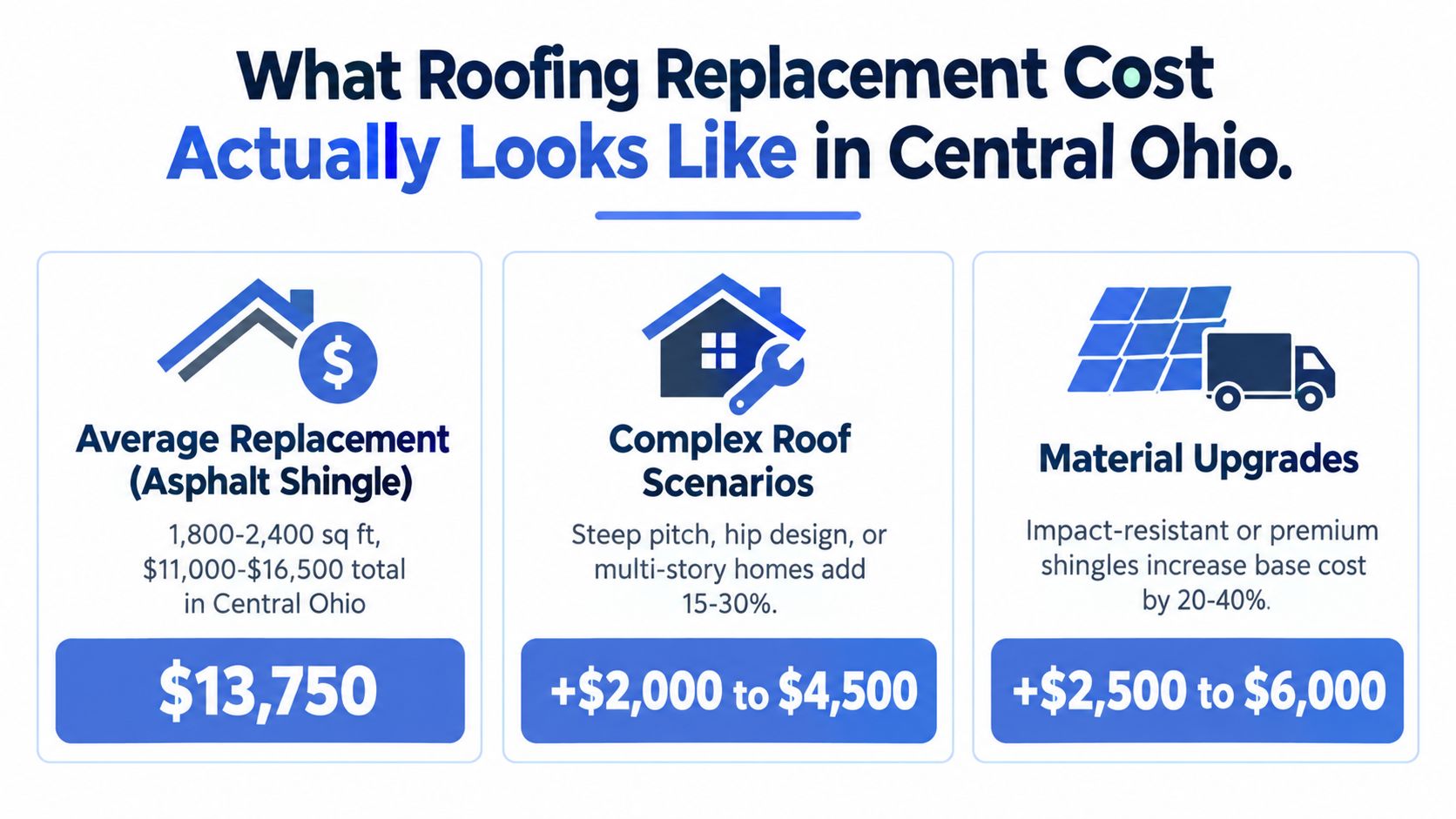
National averages tell only half the story. In 2025, reported residential replacement pricing placed most projects between $5,900 and $13,400, while another estimate put a standard 2,000-square-foot home near $9,500. The sources also report an approximate national average of $9,600, with labor commonly representing 50% to 60% of the overall expense. See the 2025 national roofing affordability analysis for the underlying benchmarks.
Those figures are useful for budgeting, but they don't describe a Columbus roof accurately enough to approve a contract. A local estimate can move higher when the home has a steep roof, several existing shingle layers, limited staging space, many penetrations, damaged eaves, or decking that can't be inspected until tear-off begins.
Practical rule: Use national averages to decide whether a quote deserves investigation, not to decide whether the quote is correct.
Why Columbus estimates vary
Roofing labor isn't priced like painting a room. Crews must move materials, protect landscaping, remove old coverings, work safely at height, install flashing and ventilation, and clean up every load of debris. A two-story house with a complicated hip roof can require substantially more labor than a single-story home with a straightforward gable roof, even when the floor areas look similar.
The national numbers also show why material choice doesn't automatically equal better resale economics. A 2025 cost-versus-value analysis reported $31,871 as the national average asphalt-shingle replacement cost and $21,501 in added resale value, or 67.5% cost recoupment. Metal roofing averaged $51,865 and added $25,972 in resale value, or 50.1% recoupment. The roof replacement resale-value analysis makes the central point clearly: replacement is primarily a protection and condition-restoration project, not a guaranteed dollar-for-dollar remodeling investment.
Those are national averages, not Columbus bids. Your estimate must account for actual roof surface, pitch, tear-off, access, ventilation, flashing, permits, and concealed repairs.
Key Factors That Drive Roofing Replacement Cost Up or Down
The first mistake homeowners make is comparing floor area instead of roof area. Contractors price the roof in squares, and one roofing square equals 100 square feet of actual roof surface. Roof pitch, overhangs, valleys, dormers, and additions can make the roof surface much larger than the conditioned space below.
The RSMeans residential cost data lists benchmark installed costs of approximately $175 to $214 per square for standard asphalt shingles and $230 to $288 per square for laminated shingles, excluding removal of existing roofing and replacement of eave materials. On a 25-square roof, that means approximately $4,375 to $7,200 for the shingle installation component alone, before tear-off and project-specific allowances.
The variables that matter on the estimate
| Variable | Typical Cost Impact | Why It Matters |
|---|---|---|
| Roof squares | More roof surface increases material and labor quantities | Floor area doesn't reveal the actual area crews must cover |
| Steep pitch | Increases safety, staging, and installation time | Crews work more slowly and need additional fall-protection measures |
| Valleys and hips | Adds cutting, flashing, and waste | Complex geometry creates more joints where water must be managed |
| Existing layers | Adds tear-off, disposal, and inspection work | Each layer increases labor and may reveal concealed damage |
| Deck condition | Can add plywood or structural repairs | Damaged substrate can't safely support new roofing |
| Flashing | Increases accessory and detail work | Chimneys, walls, skylights, and penetrations need watertight transitions |
| Ventilation | May require new ridge or intake components | Poor airflow can shorten system performance and affect warranty eligibility |
| Access | Can increase staging and handling time | Tight lots, fences, landscaping, and multi-story elevations slow material movement |
Read the accessories, not just the shingles
A low shingle price can hide an incomplete roof system. The estimate should identify synthetic underlayment, ice-barrier membrane where required, drip edge, pipe boots, step flashing, counterflashing, ridge ventilation, waste, disposal, and permits.
The RSMeans construction project guide supports pricing roofing as separate assemblies rather than one blended square-foot figure. That's the right approach in Columbus. If a contractor lists only “remove and replace shingles,” ask what protects the edges, valleys, penetrations, and roof-to-wall transitions.
Tear Off vs Overlay and Why It Changes Your Final Price
An overlay can look cheaper because the contractor installs new shingles over the existing roof. The problem is that the crew can't properly inspect the deck, correct hidden moisture damage, or rebuild every underlying component. You may save on removal while keeping the very defects that caused the roof to fail.
Residential roofing guidance based on the International Residential Code generally requires removal of existing coverings down to the deck, although limited re-covering may be allowed. A code-based roofing guide also identifies situations where re-covering isn't permitted, including water-soaked or badly deteriorated roofing, slate, clay, cement, or asbestos-cement tile, and roofs with two or more existing applications. Review the 2025 residential roofing and re-roofing guide when discussing an overlay with a contractor.
How to inspect the tear-off line
A professional estimate should answer these questions before you sign:
- How many layers are present? The contractor should document the visible layers and explain whether removal is included by layer.
- What happens at the deck? Ask for a per-sheet or per-square-foot allowance for damaged plywood and a process for photographing concealed repairs.
- Which components are replaced? Look for underlayment, ice barrier, drip edge, flashing, pipe boots, ventilation, and disposal.
- Is the installation method permitted? The bid should state whether the work is a tear-off or a permitted re-cover, not leave that decision vague.
- What changes if hidden damage appears? The contract should explain approval procedures before additional work begins.
A low overlay bid isn't a bargain if it prevents inspection of the deck or leaves code-required flashing untouched.
The guide to overlaying a roof can help you understand the trade-offs before accepting a re-cover proposal. In my view, a full tear-off is usually the more defensible choice when the existing roof is aging, has multiple layers, or shows signs of leakage. It exposes the substrate and gives the installer a chance to build the system correctly instead of covering uncertainty.
Realistic Roofing Replacement Cost Ranges for Columbus Homes
A realistic Columbus estimate starts with the roof itself, not the home's listing square footage. For a straightforward asphalt-shingle replacement, national 2025 benchmarks place many projects between $5,900 and $13,400, while a standard 2,000-square-foot home has been estimated near $9,500. Those figures are useful context, but a central Ohio bid may sit above the midpoint when the roof has difficult geometry, extensive tear-off, or concealed repairs.
Three Columbus scenarios
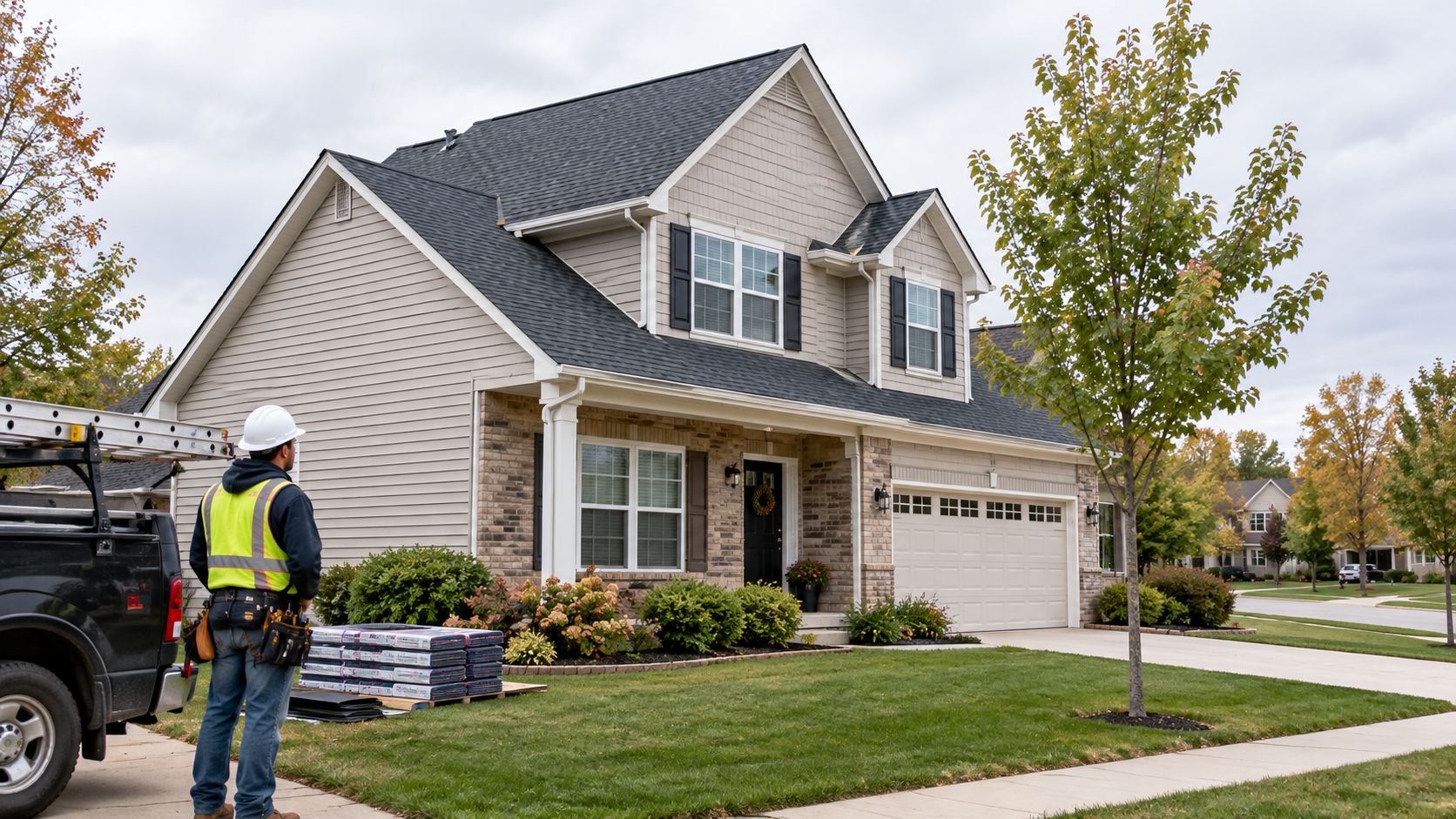
Aging asphalt roof with simple access. A one-story home with a basic roof shape, limited penetrations, one existing layer, sound decking, and ordinary asphalt shingles should be compared against the middle of the national range. The bid still needs to identify tear-off, disposal, underlayment, flashing, ventilation, and cleanup.
Steep or complex roof. A house with multiple hips, valleys, dormers, chimneys, skylights, or upper-story elevations requires more cutting, staging, fall protection, and detail work. The contractor may need more accessory material and more crew time even when the roof surface isn't dramatically larger.
Tear-off with decking repairs or upgraded materials. Removing several layers can reveal wet or deteriorated decking. The final price may also rise when the homeowner selects laminated shingles, impact-resistant products, upgraded ventilation, or additional flashing. Those are separate scope decisions, not unexplained “market adjustments.”
The Columbus roof replacement cost-per-square guide is useful for understanding how a contractor converts measured roof area into an installed proposal. Use that framework to compare quantities and inclusions, not to demand a fixed price before inspection.
What a comparable bid looks like
Two estimates are comparable only when they include the same tear-off scope, number of layers, underlayment, ice barrier, flashing, ventilation, decking allowance, disposal, permits, warranty terms, and cleanup. A quote with a lower headline price may omit items another contractor included.
FEMA's guidance on wind resistance adds another reason to look beyond visible shingles. Strong winds create uplift where the roof connects to the walls, and FEMA's storm-resistance guidance recommends properly tying rafters or trusses to exterior walls with metal connectors or straps. After a storm, an inspection should document roof-to-wall connections, decking, framing, underlayment, and water intrusion, not just count missing shingles.
How Insurance Coverage and Replacement Cost Value Affect Your Out-of-Pocket
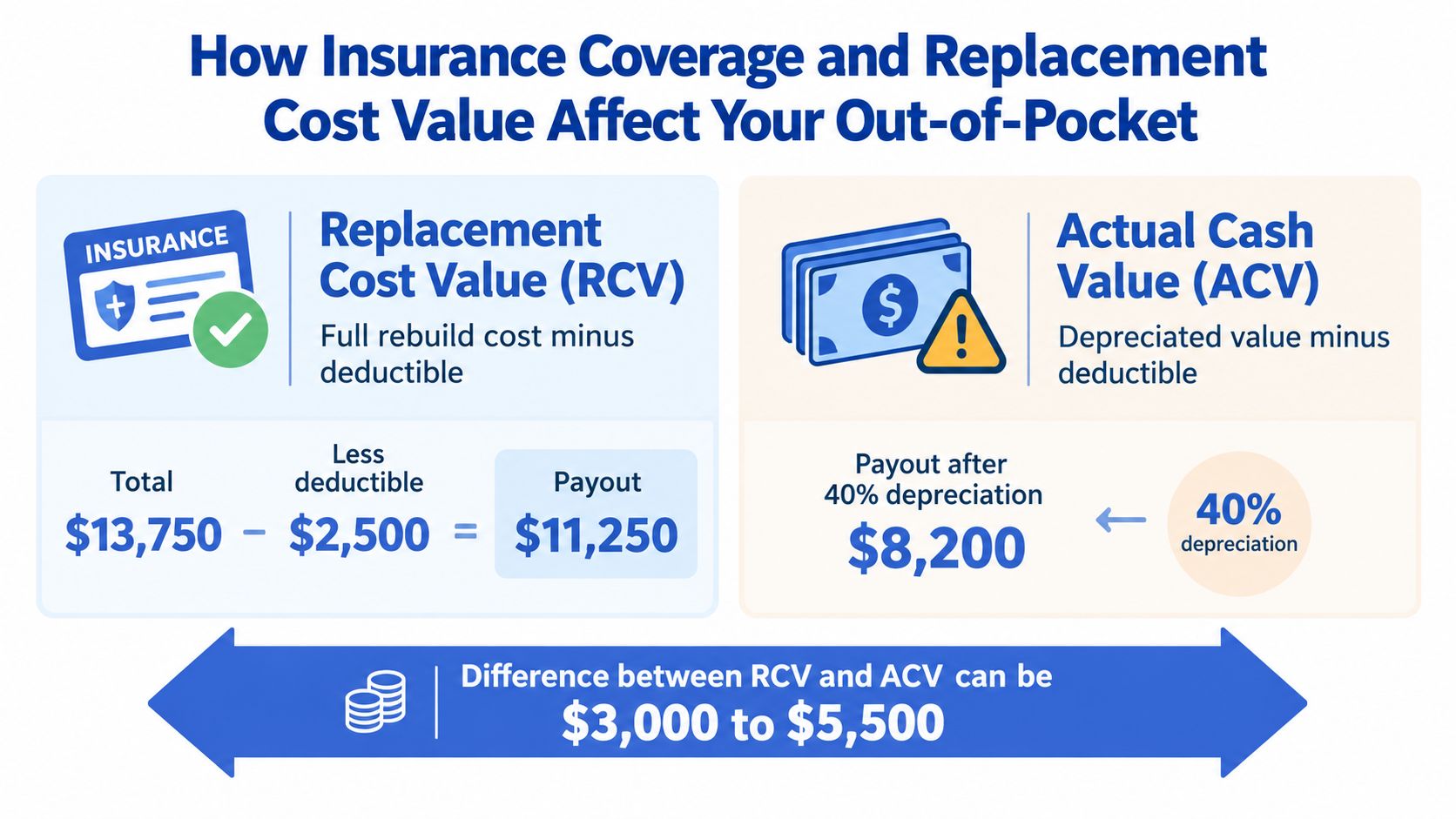
Insurance terminology can make a normal replacement estimate look more confusing than it is. Replacement-cost value, or RCV, generally refers to the cost to rebuild with covered materials, subject to the policy and deductible. Actual-cash value, or ACV, applies depreciation for age and condition before the deductible, so the initial payment may be lower.
A deductible is still the homeowner's responsibility. Your policy may also limit or exclude matching materials, code upgrades, maintenance-related deterioration, or certain roof-age conditions. Don't sign a roofing contract based on an assumption that the insurer will pay the full replacement amount.
What the 2025 claims data means
Verisk reported an average residential replacement cost of $17,631 in 2025, up 33% from the 2021 to 2024 average. The same report placed average repair cost at $4,699, up 25%, while total residential roof replacement-cost value fell to $23 billion and claim counts declined. See the Verisk State of America's Roofs report for that analysis.
The lesson is practical. Fewer claims don't mean individual replacement projects are cheaper. A homeowner may face a larger contractor invoice even while insurers process fewer claims overall.
Three claim situations
Sudden storm damage with RCV coverage may support replacement when inspection and documentation establish a covered event. The insurer may release funds according to policy conditions, with the deductible remaining your responsibility.
Storm damage with ACV settlement can leave a larger cash gap because depreciation reduces the initial payment. Ask the adjuster how age, condition, deductible, recoverable depreciation, and code provisions affect the settlement.
An aging roof without a covered peril usually isn't transformed into an insurance claim by the presence of a leak. Age-related deterioration and deferred maintenance are different from sudden wind, hail, or fallen-tree damage.
The ACV versus RCV roof insurance guide is a useful reference before filing. Document the roof condition, storm date if known, interior water damage, temporary protection, and contractor findings. A credible contractor can assist with documentation, but the policy and insurer determine coverage.
How to Get an Accurate Free Estimate from a Licensed Columbus Contractor
A useful free estimate begins with an inspection, not a round number over the phone. Give the contractor a clear history of leaks, repairs, storm exposure, attic moisture, missing shingles, and prior roofing work. Those details help the inspector focus on likely failure points.
The contractor should walk the roof when safe, inspect accessible attic areas, document existing layers, examine valleys and penetrations, assess flashing, and review ventilation. If the roof can't be walked safely, the contractor should explain how the inspection was performed and what remains uncertain.
Demand an itemized scope
Your written estimate should identify:
- Roof measurement: The number of roofing squares and the method used to measure them.
- Removal: Tear-off by layer, disposal, hauling, and protection of landscaping and exterior surfaces.
- Water protection: Underlayment, ice-barrier membrane, drip edge, and valley treatment.
- Metalwork: Step flashing, counterflashing, pipe boots, chimney details, and skylight integration.
- Ventilation: Existing conditions, proposed ridge ventilation, intake ventilation, and any limitations.
- Decking: Unit pricing or an allowance for concealed repairs, plus the approval process.
- Warranty: Manufacturer requirements, installation conditions, exclusions, and who handles warranty service.
A contractor who refuses to separate labor, materials, disposal, flashing, ventilation, and potential deck repairs makes bid comparison unnecessarily difficult. For teams that need structured takeoffs and clearer proposal preparation, Exayard roofing estimating software is one resource worth reviewing.
Ask whether the contractor is licensed and insured, who will perform the work, whether permits are included, and how change orders are approved. HIBCO ROOF LLC is one Columbus-area option that provides inspections, repairs, full replacements, storm documentation, insurance claim assistance, and free written estimates.
Frequently Asked Questions About Roofing Replacement Cost
Does an old roof automatically qualify for replacement?
No. Age alone doesn't establish a covered insurance loss or prove that replacement is necessary. A contractor should assess shingle condition, active leaks, flashing, ventilation, decking, and storm-related damage. An insurer separately determines whether a covered peril caused the loss.
When is repair financially reasonable?
Repair makes sense when the problem is localized, the surrounding roof system remains serviceable, and the contractor can identify the failure source. Replacement deserves serious consideration when leaks recur, damage is widespread, multiple layers prevent proper inspection, or the roof can't provide reliable protection after targeted work.
Should I finance the project?
Financing can spread the cash burden, but compare the total repayment amount, interest, fees, prepayment terms, and whether the payment begins before the work is complete. Financing doesn't make an incomplete scope acceptable. Approve the roofing system first, then evaluate the payment option.
What should I receive before work begins?
Get a signed contract describing materials, quantities, tear-off, disposal, flashing, ventilation, decking allowances, permits, warranties, payment schedule, change-order rules, cleanup, and start conditions. Keep the inspection report, photographs, insurance correspondence, and any manufacturer documents together.
What happens if decking damage appears after tear-off?
The contractor should photograph the affected areas, identify the quantity and unit price, and obtain your approval under the contract's change-order procedure. Don't accept an unexplained final invoice. Decking replacement must restore a suitable substrate before new roofing is installed.
Does storm documentation matter?
Yes. Photographs, inspection notes, temporary repairs, dates, and descriptions of interior water intrusion help establish what happened and when. Documentation doesn't guarantee coverage, but it gives the homeowner and insurer a clearer record.
Can a warranty cover a bad installation?
A manufacturer warranty may depend on specified components and documented installation practices. It generally doesn't turn omitted flashing, inadequate ventilation, concealed deck damage, or unauthorized substitutions into covered work. Read both the contractor warranty and the manufacturer warranty before signing.
What should I do with competing estimates?
Compare scope, not totals. Put the bids side by side and mark whether each includes the same number of layers, underlayment, ice barrier, flashing, ventilation, decking allowance, disposal, permits, warranty, and cleanup. The lowest number is only useful when the work description is equivalent.
HIBCO ROOF LLC provides Columbus-area homeowners with free roof inspections, written replacement estimates, storm and hail documentation, insurance claim assistance, repairs, and full roof replacements. Visit HIBCO ROOF LLC to request an inspection and compare your current roofing replacement cost against an itemized local scope.