
You're sitting at the kitchen table with a roof proposal, and the word “lifetime” sounds reassuring. After paying for a replacement, you'd like to believe that any future leak will be someone else's bill.
But the advertised year count tells you less than the paperwork does. For a central Ohio homeowner, the important questions are who must respond, how long the full remedy lasts, and whether that remedy includes labor, tear-off, and disposal.
Table of Contents
- Two Promises Inside Every Roof Replacement Warranty
- Why a Lifetime Label Rarely Means Full Payment
- What the Written Warranty Must Say and How to Check It Before Hiring
- How to File a Roof Warranty Claim
- How a Warranty Transfer Affects a Home Sale
- Get Both Warranties in Writing Before You Sign
Two Promises Inside Every Roof Replacement Warranty
A roof replacement warranty usually separates responsibility for the product from responsibility for installing it. Sometimes an enhanced manufacturer warranty adds another layer, but none of these promises is homeowners insurance.
The manufacturer addresses defects in listed shingles or components. The installing contractor addresses mistakes such as poorly integrated flashing, incorrect fastening, or detailing that doesn't follow the required installation method.
The National Roofing Contractors Association consumer advisory distinguishes those responsibilities and reports that, although there's no industry-standard workmanship term, an informal contractor survey found one to two years is common.
Who pays under a roof replacement warranty
| Promise | Who stands behind it | Typical term | What it covers | Common exclusions |
|---|---|---|---|---|
| Manufacturer material warranty | Shingle or component maker | Often 25 years, 30 years, or lifetime, with full remedy commonly about 10 years | Defects in the listed product | Hail, wind, installation errors, poor ventilation, ordinary aging |
| Contractor workmanship warranty | Installing contractor | No standard length; 1 to 2 years is common | Flashing, fastening, and detailing errors | Storms and unrelated gutters, skylights, siding, or pre-existing deck defects |
| Enhanced system warranty | Manufacturer when a qualifying contractor installs a specified system | Full material and labor for an initial period, then reduced coverage | Defined system defects and qualifying installation failures | Owner alterations, building movement, poor maintenance, storm damage |
| Homeowners insurance | The insurer, subject to the policy | Policy term and deductible | Sudden covered hail or wind damage | Wear, maintenance failures, and manufacturing defects |
Read across the table, not just down the term column. A manufacturer might supply replacement shingles while leaving you responsible for removing the defective roof and installing the new material.
An enhanced system warranty can improve that arrangement, but “system” doesn't mean every roof-related problem qualifies. Our GAF System Plus warranty guide gives you another document-specific comparison to use when evaluating proposals.
Match the promise to the problem
Say water enters beside a chimney. If the installer mishandled the step flashing, that points toward workmanship coverage; if wind displaced otherwise sound roofing, the insurance policy deserves attention instead.
Likewise, a roof warranty doesn't automatically cover an aging skylight, loose gutter, damaged siding, or roof decking that was already deteriorating. Ask the person diagnosing the leak to identify its cause, not merely its location.
Construction insurance terminology can also cause confusion. The builders warranty options from ABS Insurance Brokers, offered by ABS Insurance Brokers Pty Ltd, provide an Australian example of a separate insurance category, not a substitute for an Ohio roofing product or workmanship warranty.
Practical rule: If a repair isn't written into the coverage, budget as though it isn't covered until the responsible party confirms otherwise in writing.
Collect the manufacturer certificate and the contractor's workmanship terms before paying a deposit. Keep the final versions with installation photographs, invoices, and the signed scope of work.
Why a Lifetime Label Rarely Means Full Payment
The full-payment window matters more than the lifetime label. Once that window closes, the manufacturer may contribute less toward materials while leaving you to pay the labor.
A roof-life guide summarizing the 2007 National Association of Home Builders and Bank of America study puts average asphalt-shingle life at approximately 20 years, contrasts that with 25-year, 30-year, and lifetime marketing terms, and describes a common example offering full material-and-labor protection for qualifying manufacturing defects during the first 10 years.
The timeline separates those different clocks.
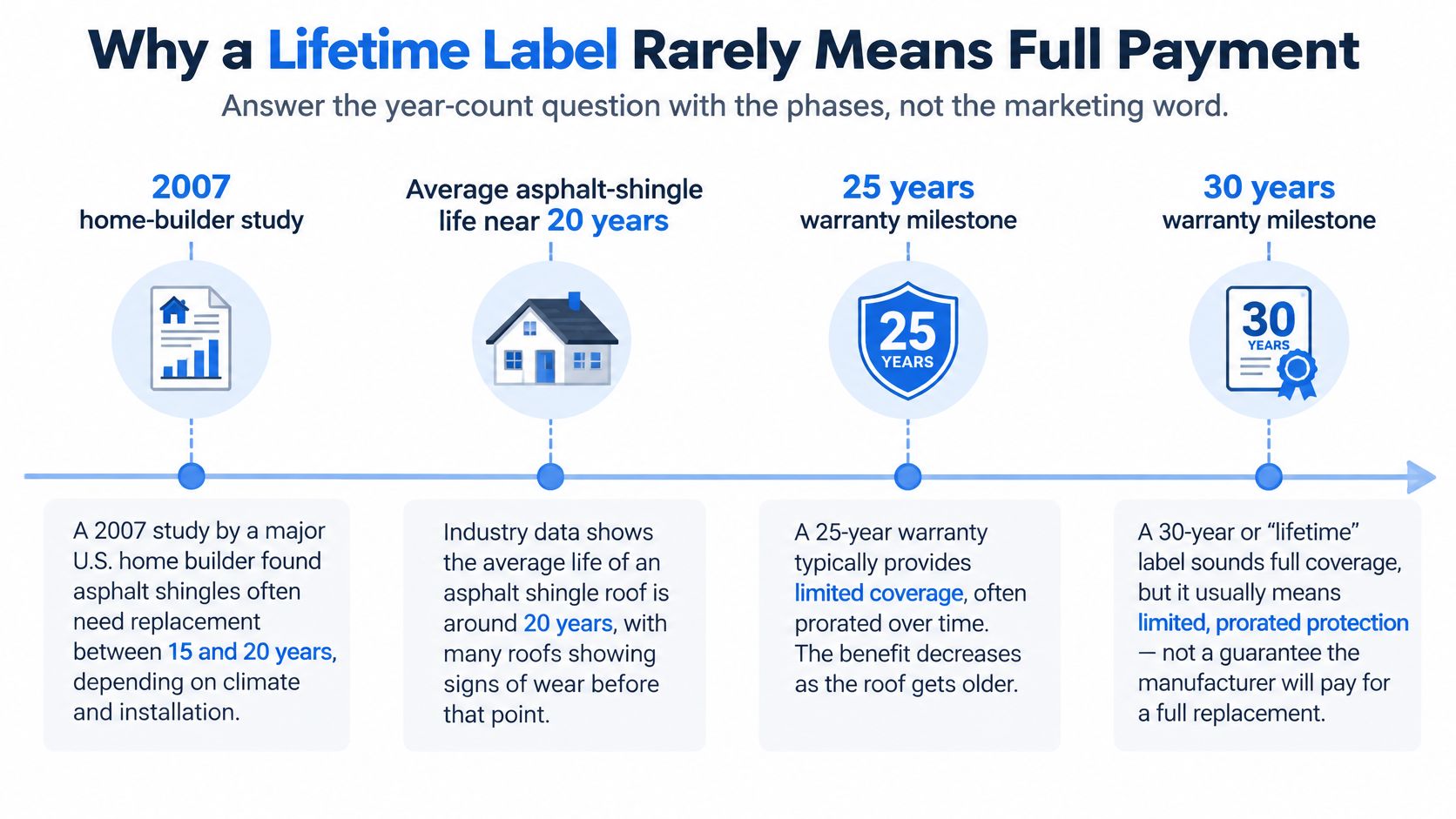
How roof warranty value changes over time
| Phase | When it usually applies | What you can expect |
|---|---|---|
| Non-prorated | Often the first 10 years on an enhanced warranty | The full remedy named in the warranty, sometimes materials and labor |
| Prorated | After that window through the advertised term | A shrinking material contribution; labor often ends |
| Workmanship | Commonly the first 1 to 2 years | Labor for qualifying installation defects, not product aging |
| Expected shingle life | About 20 years on average for asphalt | A service-life estimate, not a promise of full replacement cost |
Non-prorated means the manufacturer hasn't reduced its specified contribution because of the roof's age. It doesn't mean every expense or cause of damage qualifies.
The manufacturer warranty explanation from Hyre Roofing describes how coverage can shift from the full specified remedy to an age-reduced contribution, with labor potentially ending. Tear-off, disposal, delivery, and leak diagnosis still need their own answers in the document.
For central Ohio homeowners, that distinction matters when comparing bids. A lower-priced proposal with a clearly defined remedy may be easier to evaluate than a more expensive proposal that advertises longevity without naming who pays the installation bill.
Run the same defect through different dates
Consumer Reports' roofing buying guide reports an average U.S. roof replacement cost of $9,513 in 2025 and says most manufacturers' baseline full-replacement warranty period is about 10 years. Treat the national cost as a rough budgeting reference, not an estimate for your Columbus home.
For a hypothetical shingle line that pays full material and labor through year ten, compare a qualifying defect discovered in year eight with the same defect discovered in year fourteen. The earlier claim would be evaluated under the full remedy; the later claim would use the prorated schedule, potentially leaving labor and part of the material cost unpaid.
Pull the actual schedule and test both dates before deciding whether the claim offers meaningful help. Don't invent a straight-line depreciation formula if the certificate uses something else.
Our architectural shingle warranty guide can help you separate a product's advertised term from its expected performance. For the selected shingle line, identify the non-prorated period, proration formula, labor duration, disposal coverage, and installer eligibility requirements.
A longer label isn't automatically a better deal. What matters is the unpaid balance you'd face after the manufacturer applies its remedy.
What the Written Warranty Must Say and How to Check It Before Hiring
A full warranty has a specific meaning, not just a reassuring tone. The Federal Trade Commission's consumer warranty guide explains that a full warranty must satisfy conditions including a free remedy, coverage for later owners during the term, and replacement or refund when repair can't reasonably resolve the problem; warranties that don't meet those conditions must be identified as limited.
The FTC also says consumers must be able to read warranty terms before purchase. Look for the coverage period, covered repairs, available remedy, exclusions, maintenance duties, and claim procedure.
That doesn't mean every roofing promise falls under the same federal rules. The FTC's business guide to federal warranty law explains that a warranty solely covering a repairer's workmanship is generally outside the Magnuson-Moss Warranty Act, while a written warranty covering replacement parts and their installation can fall within it.
Check the estimate against the certificates
Confirm credentials and insurance. Verify the contractor's legal business name, applicable local licensing or registration, and current insurance. Make sure the entity signing the contract is the entity responsible for the work.
Get the separate writings. Request the manufacturer certificate for the exact shingle line and the contractor's written workmanship terms. A brochure describing available upgrades isn't proof that your project includes them.
Match every significant component. Compare the estimate with the warranty's covered products. Mark tear-off, disposal, step and counterflashing, pipe boots, underlayment, ventilation, ridge components, and labor duration. If flashing will be reused, get that decision and its coverage consequences in writing.
Document enhanced-system eligibility. If the proposal includes enhanced protection, identify the required components, installer qualification, registration procedure, and party responsible for submitting it. Contractor recognition alone doesn't establish which warranty you're buying.
Our guide to choosing a roofing contractor offers additional questions for comparing the estimate with the promised work. Keep the comparison focused on obligations you can verify rather than sales language.
Separate legitimate requirements from blanket restrictions
Read restrictions carefully. The FTC's guidance on warranty tie-in restrictions explains that a consumer-product warrantor generally can't void coverage merely because you use an independent service provider or another company's part, unless it supplies the required part or service free or obtains a narrow waiver. It can deny coverage for damage caused by outside parts or services, so installation quality and compatibility still matter.
Make maintenance duties practical. Ask what you're expected to inspect, clear, or preserve. Keep debris out of drainage paths, don't block soffit intake vents with insulation, and retain invoices for professional maintenance or alterations. Don't climb onto a wet, icy, or steep roof to satisfy a vague maintenance clause.
Leave with registration and claim contacts. Identify who registers the system, what confirmation you'll receive, where notice goes, and what evidence a claim requires. Put the manufacturer and contractor contact details in the project folder.
Later accessories deserve the same care. For a standing-seam metal roof, Contractor's Den's 6500 snow retention system for metal roofs is an example of an accessory whose attachment method and compatibility should be reviewed before installation, rather than assumed harmless to existing coverage.
Circle the covered components, remedy, wind and impact limitations, and notice deadline. If the proposal can't identify those provisions, you don't yet have enough information to value the warranty.
Ask who pays for an inspection if no covered defect is found. Also distinguish roof repairs from interior restoration: replacing shingles doesn't automatically include ceiling paint, insulation, or damaged belongings.
How to File a Roof Warranty Claim
A new ceiling stain calls for damage control and documentation, not an immediate guess about who owes you a roof. Follow a sequence that protects the house without destroying evidence of the cause.
Preserve evidence and notify the right party
Limit water entry safely. Move belongings, contain indoor drips, and arrange professional temporary protection when needed. Photograph visible shingles, flashing, attic conditions, and ceiling damage before removal. Don't enter an unsafe attic or climb onto storm-damaged roofing.
Identify the likely payer. A suspected product or installation defect belongs with the relevant warranty documents. Fresh hail or wind damage calls for reviewing the insurance policy and deductible. If the cause is uncertain, obtain a written diagnosis rather than choosing a claim path by appearance alone.
Read the notice requirements. Find the deadline, required evidence, and any inspection or sample-submission procedure. Waiting for a convenient repair date can undermine an otherwise eligible claim.
Send written notice. Contact the party named in the document. Include the installation date, product line if known, symptoms, photographs, and your contact details. Save the submission and delivery confirmation.
Allow inspection before destructive work. Give the contractor or manufacturer an opportunity to examine the suspect area before another crew removes it. If water damage is spreading, arrange necessary mitigation, document why it couldn't wait, and preserve removed materials when practical.
Request the remedy in writing. Ask whether the decision is repair, replacement materials, a prorated payment, or denial. Get a breakdown of excluded labor, tear-off, disposal, and other charges before authorizing corrective work.
Compare a denial with the contract. If the reason is maintenance, ventilation, or an owner alteration, ask which provision applies and what evidence connects it to the failure. Keep communications factual and retain every response.
Use the visual as a quick reminder while assembling the claim file.

Which claim path fits the damage
| Damage cause | Payer | First notice |
|---|---|---|
| Manufacturing defect in shingles | Manufacturer warranty, if eligible | Maker, within the certificate deadline |
| Installation error such as flashing, fastening, or detailing | Contractor workmanship warranty, if active | Installing contractor, in writing |
| Sudden hail or wind damage | Homeowners insurance, subject to coverage | Insurer, watching the deductible and notice window |
| Wear, skipped maintenance, or ventilation fault | Usually none; check exclusions and cause | Ask for the denial reason in writing |
Consider a hypothetical workmanship claim made in the third year after a shorter contractor warranty has expired. The continued existence of a shingle warranty wouldn't extend that contractor's obligation.
A different mistake is sending hail damage only to the manufacturer while the insurance notice window passes. Keep both sets of documents accessible so uncertainty about the cause doesn't become unnecessary delay.
Store photographs, invoices, both warranties, inspection findings, and every letter in a single digital folder with a backup.
How a Warranty Transfer Affects a Home Sale
A Columbus seller hands over a roofing brochure at closing. The buyer sees “lifetime” and assumes coverage follows the deed, but neither person checks whether the warranty was registered or whether a transfer application is required.
That assumption can leave the buyer with reduced protection or no eligible transfer. Manufacturer policies may restrict the handoff, require documentation or a fee, and change the remedy available to the new owner.
The closing date can start a deadline
The Roof Shepherd's warranty-transfer summary reports that Owens Corning requires the second owner to contact the manufacturer within 60 days of the property transfer, while another major manufacturer allows one year; it also describes certain enhanced arrangements where transfer after the non-prorated period can reduce coverage to two years. These are product-specific examples, not a universal transfer rule.
Read the certificate applicable to the installed product and warranty level. Don't substitute a current sales brochure for the terms issued with the roof.
A typical limited warranty can impose transfer conditions that matter at resale. The distinction between full and limited coverage therefore deserves attention in the sale packet, not just during the original installation.
A listing that mentions a roof warranty should also identify the document that supports the claim and the action the buyer must take.
Give each side a defined job
- Seller hands over the record. Include the installation date, product names, proof of purchase, registration confirmation, manufacturer certificate, workmanship terms, and any prior claim correspondence.
- Buyer confirms eligibility. Check whether a transfer is still available, who must submit it, the filing deadline, any fee, and what coverage remains after approval.
- Both preserve confirmation. Keep the completed transfer form and the manufacturer's acceptance with the closing documents. A submitted application isn't necessarily an approved transfer.
If you're also buying outside Ohio, coordinate that property's documents with its local transaction team. For a Florida purchase, the Destin Real Estate Agents at Dream Destin Realty provide a relevant local contact, while the manufacturer remains the authority on roof-warranty eligibility.
Start the review before closing when possible, then complete the buyer's requirements promptly afterward. Waiting until a leak appears can turn a straightforward administrative task into a coverage dispute.
Get Both Warranties in Writing Before You Sign
Don't authorize a replacement because a flyer says “lifetime.” Sign when the manufacturer certificate, any separate workmanship terms, and the written estimate identify the protection attached to your actual project.
The bid should agree with the warranty on the selected system, full-remedy window, labor responsibility, and registration duties. Keep storm coverage separate, and don't assume a contractor's name or manufacturer relationship substitutes for the certificate.
Make the signing decision concrete
- Resolve missing terms. Get unclear responsibilities answered in writing before work begins, especially inspection charges, removal costs, and claim contacts.
- Keep one project packet. Save the signed estimate, applicable certificates, registration evidence, photographs, and invoices together.
- Choose based on the roof's condition. A repair may make more sense than replacement when the defect is localized and the remaining roof is serviceable.
We explain when repair is possible and when replacement is the better long-term investment, without pressure. Ask us for the written estimate and claim contacts so you can compare the proposed work with the applicable manufacturer paperwork.
HIBCO ROOF does not provide warranties or guarantees. Read the manufacturer document and any separate workmanship terms for the party named as responsible.
The file you retain is what a future buyer, adjuster, or claim reviewer can evaluate. The headline year count can't replace it.
HIBCO ROOF LLC offers free roof inspections, no-obligation estimates, roof repairs, and full roof replacements for Columbus and central Ohio homeowners. Visit HIBCO ROOF LLC to arrange an inspection and request a written estimate, then review the applicable product warranty and claim contacts before authorizing work.