The wind has stopped, and your roof still looks mostly intact. Then you notice a dark line across a shingle tab, or a folded edge that wasn't obvious before the storm. Does that mean you need a repair, a new roof, or an insurance claim?
Wind creased shingles can be functional damage even when nothing has blown away. But a crease doesn't establish its own cause. For Columbus and central Ohio homeowners, the useful questions are what bent the shingle, whether its protective layers still work, and what the surrounding roof can tell you.
Table of Contents
- Telling a Wind Crease From Look-Alike Wear
- How Wind Creases an Asphalt Shingle
- How to Inspect the Roof After a Windstorm
- Wind Ratings That Set the Damage Threshold
- Repair or Replace Based on the Damage Pattern
- Insurance Claims After Wind Damage
- Schedule an Inspection Before the Next Storm
Telling a Wind Crease From Look-Alike Wear
A crease alone doesn't prove the wind made it. A convincing diagnosis combines the shape of the damage, the condition of the adhesive, its location, and evidence connecting it to a storm.
The engineering paper on asphalt-shingle wind performance identifies weathering, manufacturing quality, fastener installation, sealant strength, and shingle stiffness as contributors to failure. That means an inspector shouldn't diagnose storm damage from a close-up photograph alone.
Signs that point to wind versus other causes
| Sign | Points to wind | Points to other causes |
|---|---|---|
| Fold or crease | Fresh fold with a clean edge, often on windward eaves or ridges | Curl or ripple across the whole roof, not tied to a storm |
| Seal strip | Cleanly separated, with a torn fresh bond surface | Dusty or dirty strip, or a strip that was never bonded at installation |
| Loose tab with no fold | Weak evidence alone; look for a crease, tear, or other corroboration | Cold-weather installation, adhesive contamination, or thermal movement |
| Where damage sits | Windward slopes, eaves, ridges, and valley tops | Damage across all slopes that matches general age wear |
| Granules at the fold | Fresh exposed mat at the crease | Gradual bald spots and granules collecting in the gutters |
| Nearby shingles | Related creases or missing tabs close by | No related damage around the spot |
A fresh-looking fold supports recent bending, but it doesn't identify what did the bending. A torn adhesive surface provides another clue, while a dusty seal strip suggests the tab may never have bonded properly.
Likewise, looseness isn't the same as wind damage. Cold application conditions can prevent bonding, dirt can interfere with adhesion, and heating and cooling can move roofing materials. Weathered shingles can also become stiff and less able to flex without cracking.
Practical rule: Treat each visible sign as a clue, not a verdict.
Compare the slopes before naming the cause
Windward slopes face the approaching wind. A cluster there, especially near eaves, ridges, or valley tops, supports a wind-related explanation more strongly than an isolated mark with no neighboring damage.
Age-related wear is often more broadly distributed, although sunlight, shade, and exposure can make slopes age differently. Uniform wear supports deterioration; a directional pattern deserves closer investigation.
Write down the storm date and wind direction, then compare each roof slope. Our guide to roof shingle damage can help you distinguish the visible conditions before you label them.
How Wind Creases an Asphalt Shingle
Think of a plastic ruler flexed back and forth until it holds a permanent bend. An asphalt-shingle tab can undergo a similar motion when gusts repeatedly lift its exposed edge.
The technical bulletin on wind damage to self-sealing asphalt shingles describes lasting evidence such as creasing, folding, tearing, or missing material. A broken seal bond together with permanent deformation is more persuasive than a tab that merely looks raised.
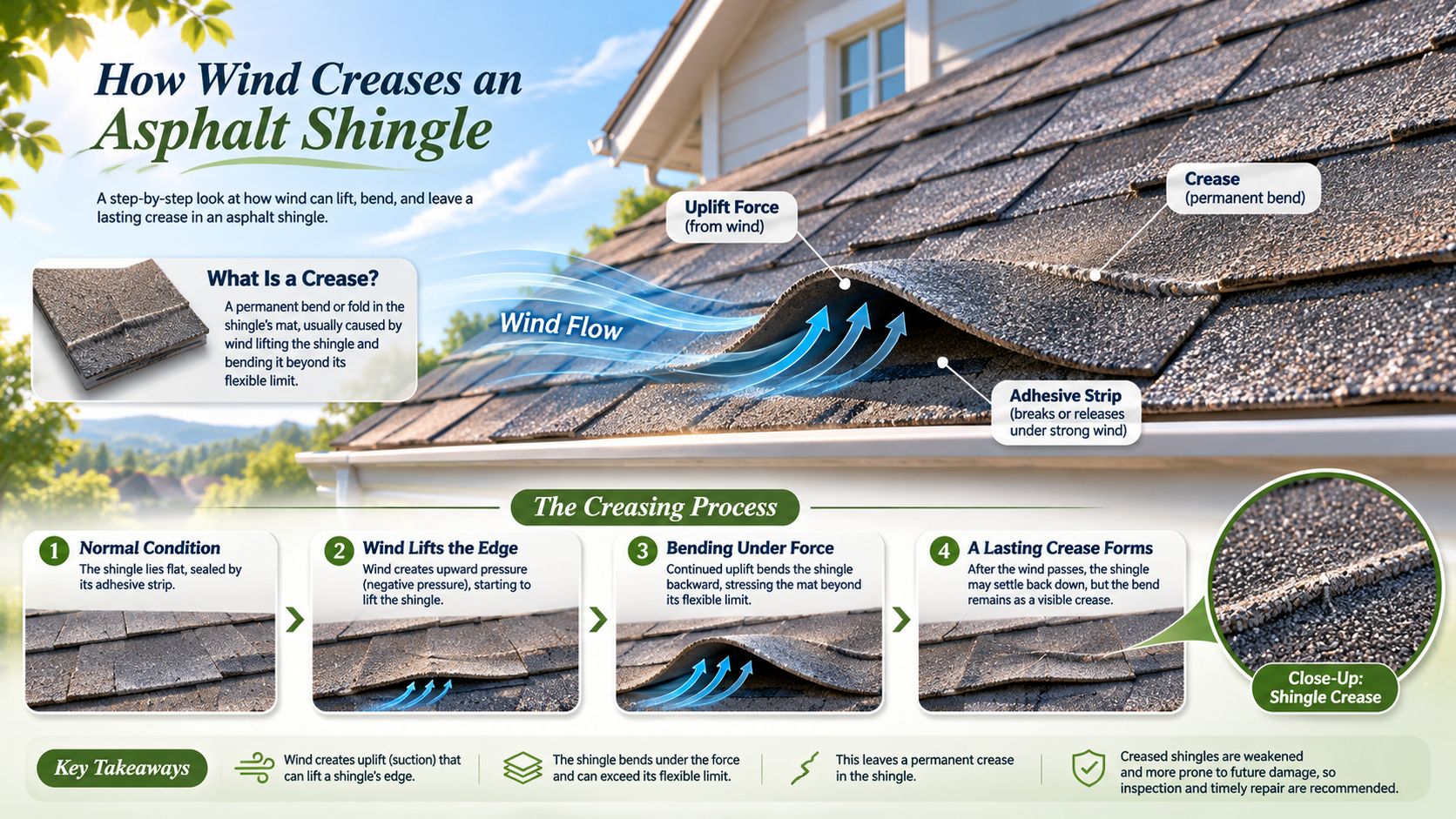
Say a sealed tab at a windward eave bends near its lower edge while the neighboring tab stays flat. Repeated uplift can damage the mat, the reinforcing body inside the shingle, while the adhesive releases at a different moment. The tab can remain nailed down yet provide a pathway for wind-driven rain.
A historical review of asphalt-shingle wind resistance reported that 67% of surveyed respondents had observed wind damage to shingles and noted field-performance assessments by FEMA and the Roofing Industry Committee on Weather Issues since 1989.
A confirmed wind crease is therefore more than a surface blemish. Photograph it before weathering makes the fold's original condition harder to distinguish.
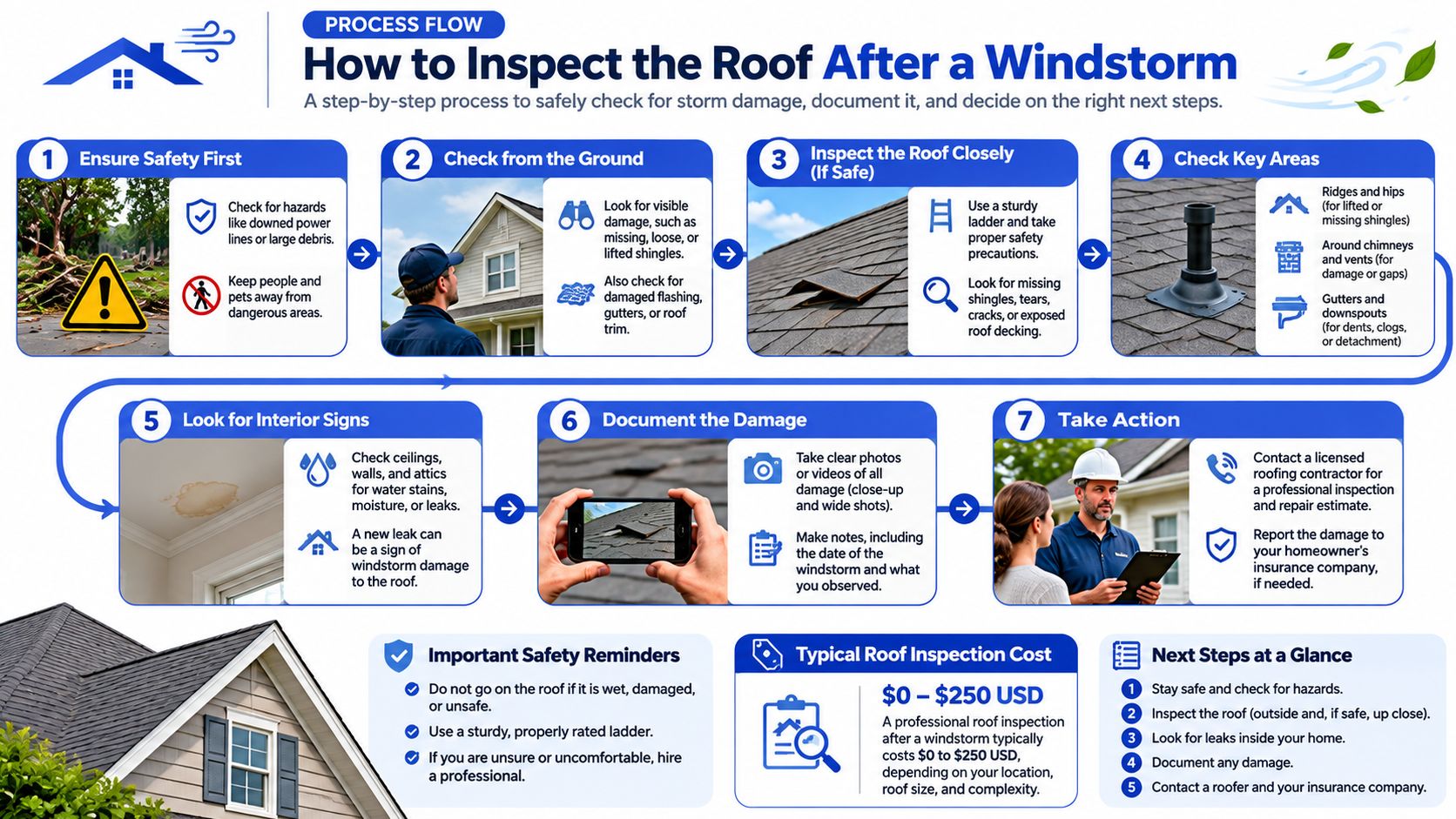
How to Inspect the Roof After a Windstorm
Start from the ground, not a ladder. Binoculars, a phone camera with zoom, a notebook, and a simple roof sketch let you collect useful information without walking on a potentially damaged surface.
The asphalt-shingle wind-damage evaluation guide identifies improper installation and poor seal condition as major contributors to high-wind damage. A useful inspection therefore examines the roof system, not just the most obvious fold.
Collect the evidence safely
Record the storm conditions. Note the date, wind direction, and approximate gust speed from local weather records. Record the reporting station too, since a nearby measurement isn't an exact measurement at your roof.
Walk the property with binoculars. Begin with slopes facing the wind, then scan eaves and ridges for folded edges or displaced material. Keep clear of fallen wires, hanging branches, and loose debris.
Map each suspect area. Sketch the roof and mark the location of every visible crease. Label slopes by compass direction or a clear landmark so the inspector can connect photographs to the correct area.
Have the inspector examine fastening and sealing. Nail placement and adhesive engagement affect how the roof resists uplift. This hands-on work belongs to someone who can access the roof safely without creating new damage.
Look beyond the fold. Missing or displaced tabs, exposed fasteners, and tears help establish the extent of failure. A shingle lying flat again may still have a damaged mat that no longer sheds water reliably.
Check connected components. The inspector should examine neighboring tabs, flashing, and any exposed underlayment, the protective layer beneath the shingles. Related damage can expand the repair beyond the initially visible spot.
Pair detailed and location photographs. Have the inspector photograph each crease close up with a ruler or other scale reference, then take a wider image showing its roof position. Preserve the original files rather than keeping only marked-up screenshots.
Check the attic from a safe access point. Look for water stains, damp insulation, or wet roof sheathing beneath the suspect area. Don't step between framing members or approach wet electrical equipment.
Keep observation separate from testing
For a claims-focused explanation of what to preserve, For The Public Adjusters wind guidance from For The Public Adjusters, Inc. offers additional documentation context. Our roof inspection and repair guide explains how inspection findings connect to repair decisions.
Don't pull tabs upward to see whether they'll break. You can alter the evidence and damage a shingle that was still serviceable.
Standardized mechanical uplift testing is a laboratory procedure. A professional field assessment is not a reason for homeowners to imitate it by tugging on installed shingles.
Wind Ratings That Set the Damage Threshold
A wind rating describes performance under defined test conditions, not a guaranteed damage threshold for your house. Roof exposure, installation, sealing, and material condition all affect what happens during an actual storm.
ASTM D3161 uses fan-generated wind over a prepared deck. ASTM D7158 compares calculated wind uplift with measured resistance, while ASTM D6381 measures the force required to break the adhesive seal.
Wind standards and what each one measures
The roofing-industry bulletin on shingle test standards describes the ASTM D3161 fan test, its two-hour exposure, and the distinction between test speeds and code wind values.
| Standard | Test method | Ratings or speeds | What it tells you |
|---|---|---|---|
| ASTM D3161 | Fan test over a prepared deck, two hours | Class A 60 mph, Class D 90 mph, Class F 110 mph | Highest test speed reached without tab lifting |
| ASTM D7158 | Calculated uplift force compared with measured resistance | Class D 90 mph, Class G 120 mph, Class H 150 mph | Resistance must exceed the calculated force at the rated speed |
| ASTM D6381 | Measured force needed to break the seal | No wind class; Procedure A clamp, Procedure B T-section | Seal strength, not wind speed |
| FEMA guidance | Replacement recommendation after wind damage | Products designed for wind up to 116 mph | Verify D7158 compliance before choosing a replacement |
The ASTM D7158 standard defines the uplift-resistance comparison underlying Class D, G, and H ratings. Its method assumes shingles installed according to manufacturer instructions and sealed under prescribed conditions.
The ASTM D6381 standard distinguishes Procedure A, which uses a clamp, from Procedure B, which uses an adhered metal T-section. Neither procedure assigns a wind-speed class.
FEMA's hazard-mitigation guidance recommends replacement shingles designed for wind velocities up to 116 mph and advises verifying ASTM D7158 compliance.
Why the label can't settle the diagnosis
A high-rated shingle can still crease if nails miss the required fastening zone or its seal never develops properly. Conversely, a reported storm gust doesn't establish that every shingle experienced the same uplift.
Code wind values use three-second gusts, whereas the fan test uses sustained laboratory exposure. Those measurements aren't interchangeable, even when their speed numbers look similar.
Look for the product class on a saved wrapper, installation paperwork, or the manufacturer's data sheet. Bring that information to the inspection so the contractor can compare the identified product with its installation requirements, rather than guessing from appearance.
Repair or Replace Based on the Damage Pattern
Keep the scope local when the damage is local. Isolated creases with sealed tabs and an intact mat call for a targeted repair assessment, not an automatic whole-roof replacement. Fractured mats, compromised seals, and torn tabs generally require replacement of the affected shingles.
The important distinction is between replacing damaged shingles and replacing the entire roof. Those are very different decisions.
Repair or replacement by damage pattern
| Damage pattern | Usual fix | What changes the fix |
|---|---|---|
| Isolated creases, sealed tabs, intact mat | Repair the affected shingles | Matching product is no longer available |
| Creases clustered on one windward slope | Repair across that slope or replace the section | Seal failure spreads along the slope |
| Fractured mat or torn tabs | Replace the damaged shingles | Matching product unavailable or neighboring seals compromised |
| Compromised underlayment or decking | Replace the roof section or the full roof | Exposed underlayment or soft decking expands the assessment |
| Damage across several slopes on aging shingles | Full roof replacement may be appropriate | Multiple affected slopes plus widespread granule loss |
Exposed underlayment doesn't automatically require a full roof replacement. The inspector must establish whether it remains sound and whether water has damaged the decking, the structural surface supporting the roof.
Compare an isolated repair with a section repair
Say an inspector finds a creased eave tab and confirms that compatible replacement shingles are available. If surrounding materials remain sound, that could be a small repair completed during an afternoon, rather than a roof replacement.
Now suppose the same crease sits beside several lifted tabs, with repeated seal failures along the slope. The better scope may be a section repair because replacing the visible tab alone would leave adjacent failures unresolved.
Product compatibility matters as much as color. A discontinued shingle can make a patch conspicuous, but appearance alone doesn't establish whether the repair will perform. Dimensions, exposure, fastening, and the ability to integrate replacement shingles all need checking.
Repair boundary: Don't press a fractured shingle flat and call it restored. Flattening the fold doesn't rebuild its reinforcing mat.
Missing shingles, damaged flashing, and failed pipe boots are often repairable conditions. Weigh the proposed repair against the roof's remaining serviceability, the number of affected slopes, and whether the surrounding shingles can tolerate repair work.
For high-wind replacement work, FEMA's installation approach calls for Class F under ASTM D3161 or Class H under ASTM D7158, manufacturer-compliant starter strips, and six nails rather than a four-nail pattern where that guidance applies. The written scope should identify the applicable installation requirements, not merely promise a wind-resistant shingle.
Insurance Claims After Wind Damage
Non-catastrophic wind and hail claims increased from 17% of U.S. residential roof claims in 2022 to 25% in 2024, according to Verisk's roofing findings. Those figures describe national claim activity, not the likelihood that a particular crease will be covered.
Coverage depends on cause and policy language. An adjuster may need to distinguish storm-created damage from aging, installation problems, or other causes. Calling a mark a wind crease doesn't resolve that question.
Build a useful claim file
- Read the deductible first. Check for a separate wind or hail deductible and compare it with the written repair estimate. A small repair may fall below your out-of-pocket responsibility.
- Keep the evidence together. Save the storm date, weather records, original photographs, slope sketch, and inspection notes in a single folder.
- Request a written diagnosis. The report should explain the physical evidence supporting the cause and identify the affected components.
- Review the proposed scope. Confirm that the adjuster's estimate addresses every documented affected slope and related repair item.
- Preserve mitigation receipts. Follow your policy's requirements for preventing further loss, and retain invoices for temporary protection.
Document promptly because weathering can make an isolated fold harder to date. Our wind-damage roof insurance coverage guide provides additional context for reviewing policy terms.
Put the national figures in perspective
In 2024, U.S. roof repair and replacement claim costs totaled nearly $31 billion, up nearly 30% from 2022, according to Verisk's report discussed in Carrier Management. Verisk also reported that roof-related line items represented more than one-quarter of total U.S. residential insurance claim value, while wind and hail accounted for more than half of residential claims.
Approximately 80% of U.S. roofs use asphalt shingles, according to Verisk's findings reported by Independent Agent. That scale explains the attention to shingle damage, but your strongest preparation remains specific: know your deductible and document your roof before the adjuster arrives.
Schedule an Inspection Before the Next Storm
Choose a licensed, insured roofing contractor rather than climbing onto the roof yourself. The inspection should produce close and wide photographs, a location map, and a written explanation of whether isolated shingles can be replaced or a larger section needs attention.
At HIBCO ROOF LLC, we serve Columbus and central Ohio as a licensed and insured contractor. We help document storm damage, meet with insurance adjusters, and guide homeowners through the claim process, including when repair is the appropriate scope.
Bring evidence and request a clear scope
- Bring your storm notes. Include the date, wind direction, ground-level photographs, and slope sketch.
- Identify the visible change. Point out a new fold, torn tab, or freshly exposed mat without manipulating it.
- Request installation details. Ask which ASTM D7158 class the replacement carries and how fastening will meet manufacturer and applicable high-wind requirements.
We explain whether repair or replacement is the better option without pressure. The goal is a defensible diagnosis and a suitable repair scope, not a replacement recommendation based on a single photograph.
HIBCO ROOF LLC offers a free roof inspection and estimate to help determine what wind creased shingles mean for your roof. Visit HIBCO ROOF LLC to schedule your inspection before the next storm.