If a roof has circular marks after a storm, what proves those marks are hail damage rather than old blisters? Counting spots doesn't answer that question. The important evidence is what happened to the reinforcing mat beneath the shingle surface, supported by the storm record and the pattern across the roof.
For Columbus and central Ohio homeowners, the difference between hail damage vs blistering affects more than terminology. It determines whether you need storm-damage documentation, a targeted repair, a material-condition assessment, or continued monitoring.
Table of Contents
- Hail Damage vs Blistering at a Glance
- What Hail Leaves Behind on Shingles
- What Causes Shingles to Blister
- Hail Size and Shingle Age in Your Area
- How to Test a Roof Slope for Hail or Blisters
- Choosing Between a Claim, Repair or Maintenance
- Confirm the Cause Before You Pay for a Replacement
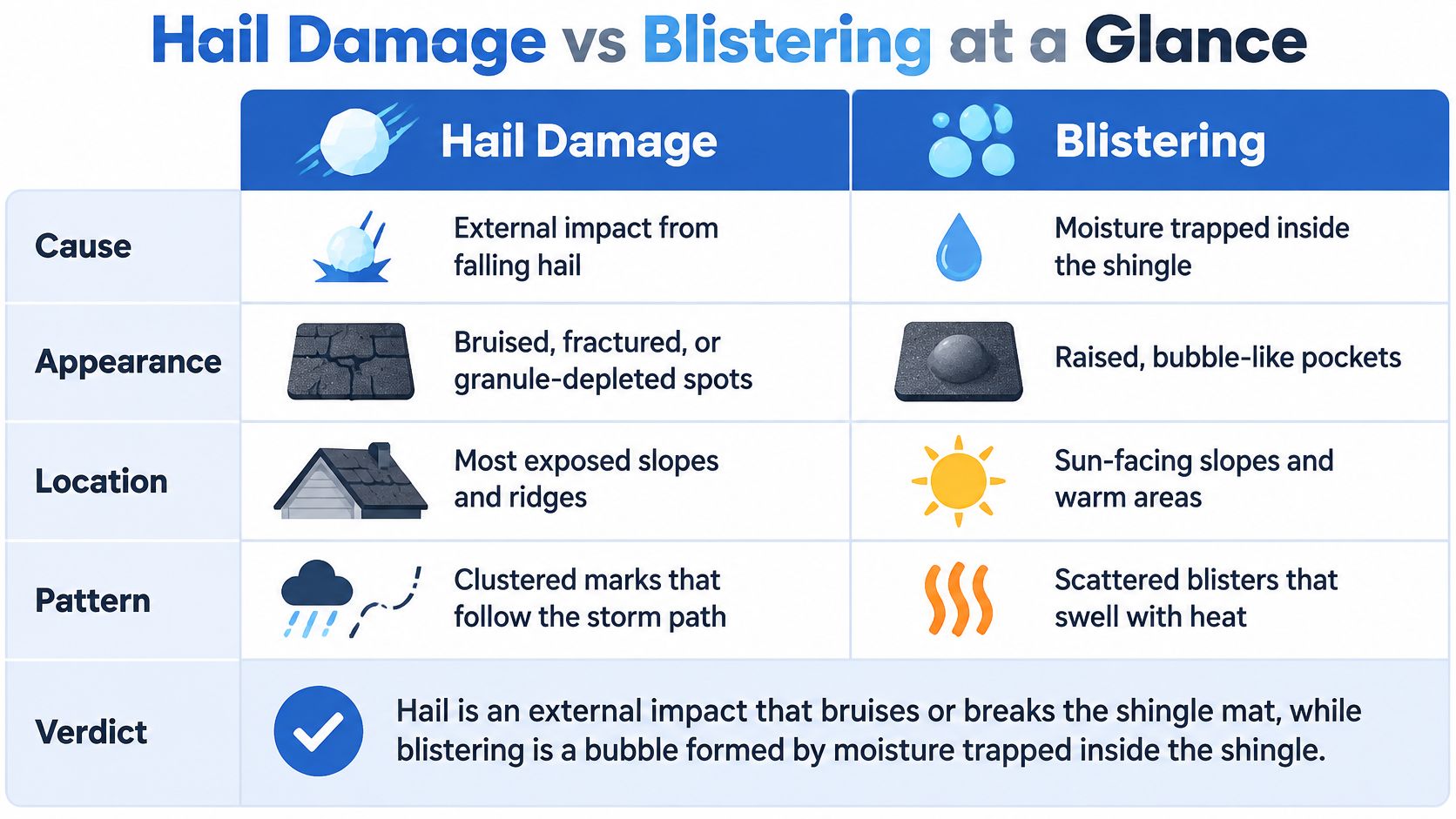
Hail Damage vs Blistering at a Glance
| Criterion | Hail damage | Blistering |
|---|---|---|
| Cause | External impact from falling hail | Moisture vapor, volatile gases or heat trapped in the shingle |
| Shape | Sharp-edged dent with a soft bruise under the surface | Raised bubble, dome or ruptured surface area |
| Mat condition | Fracture, tear or puncture of the reinforcing mat | Mat intact beneath the bubble |
| Pattern | Concentrated on slopes facing the storm direction | Scattered across sun-exposed areas with no storm alignment |
| Collateral marks | Dents on gutters, downspouts, vents, screens or HVAC fins | None on soft metals |
| Granule loss | Missing where the impact landed | Missing from the tops of ruptured bubbles |
Hail is an external impact that bruises or breaks the shingle mat, while blistering is a bubble formed by moisture, trapped volatiles or heat within the shingle. The table describes typical findings, not a substitute for examining the actual roof.
Falling ice strikes from outside; blistering develops from conditions within the material. An impact may leave a depression and underlying softness, while an unopened blister projects above the surrounding surface. A functional impact injures the reinforcement, whereas an intact blister may leave that reinforcement unaffected.
Read the whole pattern
Storm-facing slopes can show a stronger impact pattern, while blistering often follows heat exposure without matching a storm direction. Dented accessories support an impact diagnosis, but blistering itself doesn't dent metal. Missing granules must also be interpreted by location, whether they surround an impact or sit where a raised bubble wore away.
Hail deserves serious attention: NOAA's billion-dollar disaster climatology identifies severe convective storms, including hail, tornadoes and damaging winds, as the most frequent category of billion-dollar weather and climate disasters in the United States. That classification establishes the scale of storm exposure, but it doesn't establish the cause of an individual shingle mark.
Inspection rule: Treat appearance as a clue and mat condition as evidence.
A roof can blister without a hailstorm, and hail can damage a roof that has no blisters. Both conditions can also exist on the same roof, so an inspector shouldn't assign every mark the same cause.
What Hail Leaves Behind on Shingles
Functional hail damage compromises the shingle's ability to shed water, rather than changing its appearance. Look for a fracture, tear or rupture in the reinforcing mat, sometimes accompanied by a soft bruise and granule displacement deep enough to expose the underlying bitumen.
An inspector can compare a suspected bruise with nearby sound material using careful finger pressure. The purpose isn't to force a dent into the shingle. It's to determine whether the existing mark has localized softness or a break that distinguishes it from the surrounding surface.
The technical hail-damage paper hosted by InspectApedia reports no measurable change in non-fracturing impact dents after approximately 11 years of natural weathering, while fractures widened without visibly propagating. That distinction matters: a dent with an intact mat doesn't automatically support the same repair scope as a fractured shingle.
Separate the injury from the surface mark
Hail assessment distinguishes breach, deformation and granule loss. These findings aren't interchangeable: a broad bare spot can be less informative than a smaller mark with confirmed reinforcement damage.
An inspector should record what is present:
- Breach: A tear, puncture or fracture through the shingle's reinforcing material.
- Deformation: A depression or displaced area, with a note about whether the material underneath remains sound.
- Granule loss: The extent of missing surfacing and whether asphalt or reinforcement is exposed.
Softer hail can produce broad granule displacement without an equally obvious dent. Conversely, a shingle can have underlying damage that doesn't photograph clearly from directly overhead. Side lighting, close inspection and comparison with undamaged material help avoid judging by the darkest spot alone.
Rule out contact damage and weathering
Foot traffic, installation scuffs, adhesive spots and ordinary aging can resemble storm marks. A scuff near a service route or a repeated mark beside equipment deserves a different explanation from a distributed impact pattern.
Likewise, roof granules in the gutter are a reason to investigate the roof's condition, not proof of hail by themselves. Photograph the suspected mark, its immediate surroundings and its position on the slope.
The useful conclusion is specific: bruised, fractured, punctured, or only missing granules. A report that uses those descriptions gives the homeowner and adjuster something more meaningful than a total count of circles.
What Causes Shingles to Blister
Blisters form when moisture vapor or volatile compounds expand under heat and push part of the shingle surface upward. Localized loss of adhesion allows the surface to separate into a bubble instead of remaining bonded flat.
Manufacturing conditions can leave moisture or gases within the shingle. Technical discussions identify damp felt or fiberglass mat and inadequately cured resins as possible sources. Sun exposure then supplies heat that expands the trapped material; the presence of bubbles doesn't establish that a recent storm caused them.
InspectApedia's asphalt-shingle blistering guide specifically distinguishes blistering from hail and explains that raised blisters can erode into small, round areas of missing granules. Those worn spots are where a quick visual diagnosis often goes wrong.
Follow the bubble through its wear stages
An unopened blister stands above the surrounding shingle. It may feel soft, but softness alone isn't enough to call it an impact bruise because its shape and underlying condition differ.
After the raised surface ruptures or wears away, the remaining pit can look like a hail mark. Steep-sided pits beside intact bubbles support a blistering diagnosis, especially when the distribution doesn't correspond to storm exposure.
A popped blister is evidence of a failed bubble, not automatically evidence of falling ice.
The ASCE hail-testing paperNH.1527-6996.0000509) distinguishes breach, deformation and granule loss, and notes that softer manufactured hail can produce broader granule-loss areas with less obvious deformation. That finding is another reason not to diagnose either condition from the size of a bare patch.
Investigate the roof conditions without assuming a cause
A blister assessment should include more than photographing the most obvious bubbles:
- Roof orientation: Map concentrations on sun-exposed slopes and compare them with shaded areas.
- Material condition: Record intact bubbles, open pits and the condition of nearby shingles.
- Roof history: Review shingle age, installation records and any earlier photographs.
- Attic conditions: Evaluate ventilation rather than assuming every blister proves a ventilation defect.
Photograph blisters before touching them. Don't puncture them or press aggressively to discover what's underneath, because that changes the condition being evaluated. An accessible shingle edge or underside may offer useful information without destroying the surface.
Hail Size and Shingle Age in Your Area
Regional hail frequency explains why storm evidence deserves attention, but it cannot diagnose a particular roof. A weather report establishes context; the shingles still need to show compatible damage.
Using observations from 1955 through 2024, the National Weather Service's Ohio Valley hazard assessment estimates an annual probability of roughly 50% to 60% for one-inch-or-larger hail within 25 miles in the southern and western portions of its Cleveland forecast area, with two-inch-or-larger hail peaking around 10% to 15% there. Those are regional estimates for that forecast area, not property-specific probabilities for Columbus.
Hail size thresholds by shingle condition
| Shingle condition | Hail size that can cause damage | What to check |
|---|---|---|
| Lightweight composite shingle | About 1 inch | Mat bruise or fracture on each slope |
| Heavier laminated shingle | Larger hail generally required | Mat bruise or fracture on each slope, not granule loss alone |
| Deteriorated or brittle shingle | Smaller stones can cause damage | Granule loss and age alongside the storm record |
| Blistered shingle | Blisters are not an impact threshold | Whether the surface is bruised beneath the bubble |
These are screening guidelines rather than pass-or-fail limits. The Nebraska Department of Insurance describes the product and condition differences underlying these thresholds; the actual inspection must account for the roof in front of you.
Wind speed, impact angle, shingle temperature, exposure and existing deterioration all affect how a roof responds. A weather report that sounds severe doesn't prove every shingle failed, and an older roof may respond differently from a newer roof made with a heavier product.
Match the event to the roof
Start with the suspected storm date, reported hail size and property location. Then compare that information with when the marks were first noticed, any earlier inspection photographs and the directions in which the roof was exposed.
For a practical explanation of what size hail damages roofs, use stone size as a reason to inspect, not as a replacement recommendation. A documented event and compatible marks justify closer examination.
An uncertain or missing storm window makes blistering and ordinary deterioration more plausible, but it doesn't conclusively rule out an unrecorded impact. Record the uncertainty rather than inventing a date.
Timing matters: Discovering a mark after a storm doesn't establish that the storm created it.
The strongest assessment aligns the event, product condition and physical evidence. A mismatch calls for further investigation before assigning storm damage or recommending a claim.
How to Test a Roof Slope for Hail or Blisters
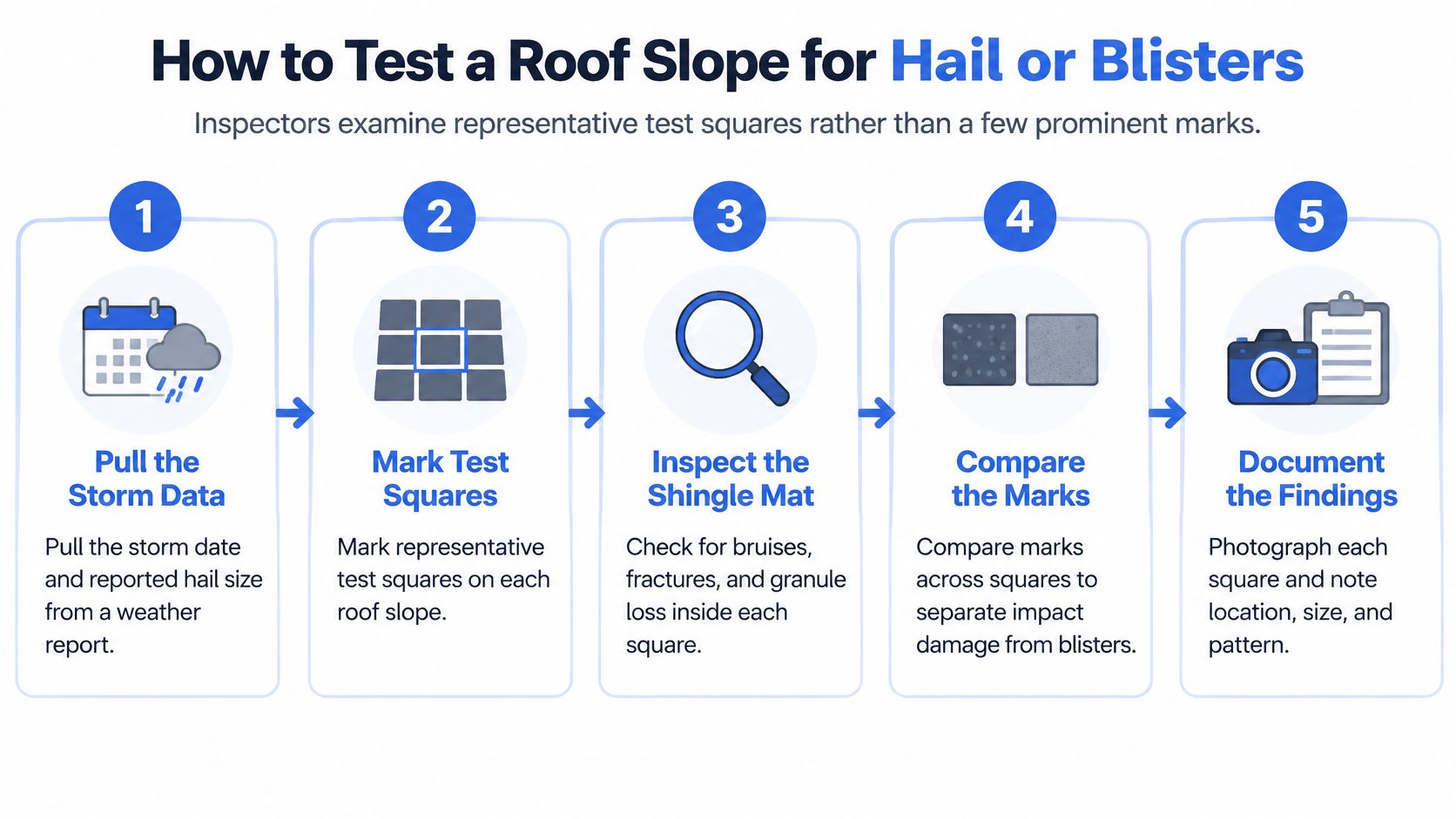
Inspectors use representative sampling rather than selecting only the most dramatic marks. A consistent method makes it easier to compare roof directions and distinguish actual impacts from pre-existing surface conditions.
Optima's hail-inspection guidance describes a standard 100-square-foot test area, often a 10-by-10-foot square, examined on representative roof slopes or directions. The dimensions standardize observations; they aren't an automatic insurance approval threshold.
Homeowners shouldn't climb a roof to reproduce this procedure. Loose granules, brittle shingles, steep pitches and unprotected edges create hazards, so leave roof access and tactile testing to an equipped professional.
Use a repeatable inspection routine
Collect the storm record before roof access. Record the suspected date, reported hail size and report location, keeping observations at the property separate from reports nearby.
Select representative areas on each slope. Record the roof direction and test-area boundaries so another inspector can locate the same shingles rather than evaluate an unrelated patch.
Identify qualifying impacts carefully. Use gentle finger pressure only where appropriate to assess suspected bruising, and note fractures, punctures and exposed bitumen without creating new damage.
Photograph detail and context. Place a ruler beside each suspected mark, take a close-up and then step back for a wider slope photograph that establishes its location.
Check exposed accessories. Record dents or impact marks on gutters, downspouts, vents, flashings, screens and HVAC fins, noting whether their exposure corresponds to the shingle findings.
Compare roof directions. Look for a coherent impact distribution rather than assuming every slope must have an identical count, and account for differences in shade and material condition.
Map blisters separately. Photograph raised bubbles and ruptured pits before touching them, and don't puncture or press suspected blisters to make them easier to classify.
Write a conclusion for each area. Record the count, mark type, slope direction and whether accessory evidence supports an impact explanation.
Make the inspection sheet useful
Audit Genius's guide to inspecting roofs for hail damage is a useful companion when organizing the inspection questions and documentation. The final record should still describe the actual property, not reproduce a checklist.
A practical worksheet has separate fields for confirmed functional impacts, suspected impacts, blisters and other wear. Keep uncertainty visible instead of combining all marks into a single damage total.
Attach the photographs to the corresponding slope entry. The result should be understandable without another roof visit: functional impacts, blisters, neither, or unresolved findings that need further evaluation.
Choosing Between a Claim, Repair or Maintenance
The decision should follow the cause and extent of damage, not the number of visible spots. The Nebraska Department of Insurance's roof-repair guidance distinguishes a hail bruise in the mat from blister pockmarks and notes that lightweight composite shingles may be damaged by hail around 1 inch, while heavier shingles generally require larger hail and deteriorated shingles may sustain damage from smaller stones.
When storm evidence supports a claim
Confirmed functional impacts across multiple slopes, compatible accessory damage and a documented storm window support submitting a well-documented claim. Keep close-ups, wider photographs and the slope worksheet together, and review your policy's applicable terms and reporting requirements.
Our hail-damage roof insurance claim guide can help you organize that process. At HIBCO ROOF LLC, we document storm damage, meet with insurance adjusters and guide homeowners through the claim process. The insurer determines coverage under the policy.
When maintenance or repair makes more sense
Blistering without a confirmed breach, leakage or compatible storm evidence is a material-condition and maintenance question. Record its condition and monitor it rather than presenting it as hail.
A few confirmed functional impacts on an otherwise serviceable roof may justify targeted repair. Missing shingles, damaged flashing, pipe boot failures and storm-related damage can often be repaired, while widespread failure or a roof already near the end of its service life may justify broader work.
Average 2025 roof costs and hail claims
| Measure | Value |
|---|---|
| Average roof repair cost | $4,699 |
| Average roof replacement cost | $17,631 |
| U.S. homeowner hail claims filed | 835,058 |
Verisk's 2025 U.S. Roofing Realities report reports average U.S. costs of $4,699 for roof repair and $17,631 for roof replacement. These national averages aren't estimates for your property.
Leaders Edge, reporting Verisk data, states that 835,058 U.S. homeowner hail claims were filed in 2025. Claim volume doesn't determine whether an individual roof qualifies.
Replacement carries a substantially larger cost than repair, so a recommendation needs more support than appearance alone. Misclassifying blisters can weaken a claim and encourage unnecessary work; overlooking genuine mat damage can leave a repairable problem unresolved.
Confirm the Cause Before You Pay for a Replacement
Start with a professional inspection from HIBCO ROOF LLC before committing to replacement. We provide free roof inspections and explain whether repair or replacement is the better option. If the roof can be repaired, we say so; if replacement is the better long-term investment, we explain why without pressure.
Bring the suspected storm date, any photographs taken before and after the event, and any inspection worksheet already prepared. Ground-level pictures of accessories and interior leak evidence are useful too. You don't need to climb the roof to prepare for the appointment.

Ask for a diagnosis you can verify
The inspection should give you an explanation for the recommendation, not just a proposed scope of work. Ask the inspector to connect each finding to a photograph and distinguish confirmed damage from uncertainty.
- Mark classification: Identify functional impacts, intact blisters, ruptured blisters and unrelated wear separately.
- Leak evidence: Explain whether water intrusion is present and which component appears responsible.
- Remaining service life: Evaluate surrounding shingles and repair feasibility, not only the worst-looking patch.
- Scope justification: Explain why targeted work is sufficient or why broader replacement makes more sense.
Don't pop or puncture blisters before the inspection. Preserving the original condition helps the inspector distinguish a material issue from subsequent handling damage.
Confirmed breaches, active leakage or widespread material failure deserve a repair or replacement plan. Isolated blistering without a breach may instead call for documented monitoring. Neither conclusion should depend solely on whether the roof looks spotted from the ground.
To arrange a free inspection, contact us through our website or call or text 614-810-0050. Have your property address and suspected storm date ready so you can explain what prompted the concern.
HIBCO ROOF LLC offers free roof inspections, storm-damage documentation and clear explanations of repair versus replacement. Visit HIBCO ROOF LLC to request an inspection and find out whether the marks on your roof are functional hail impacts, blistering or other wear before you authorize work.