A lot of Columbus homeowners don't notice a roof problem until the first ceiling stain shows up after a hard rain. By then, the damage has usually been working for a while, hidden behind shingles, flashing, gutters, and attic insulation that looked fine from the driveway. Preventive roof maintenance keeps that quiet failure from becoming an expensive surprise, and in central Ohio that matters because freeze-thaw swings, spring storms, summer hail, and a heavy load of oak and maple debris all put roofs through repeated stress.
The good news is that this doesn't need to be complicated. A roof you check on purpose, clean on time, and document well is far easier to keep in service than one you only look at when water starts coming inside. That's true whether you own a newer subdivision home in Franklin County or an older house with original trim and aging gutters. If you're already comparing home maintenance priorities, even a plumber's seasonal advice, like what a San Antonio plumbing company might tell a homeowner about stopping small leaks early, points in the same direction, small problems are cheaper when you catch them before they spread.
One practical warning matters before anything else. If you're seeing moisture inside, use the signs on this roof leak guide as a reminder that interior stains are usually the end of the story, not the beginning.
Table of Contents
- Why Central Ohio Roofs Fail Before Anyone Notices
- What Preventive Maintenance Saves You
- Your Twice-a-Year Roof Inspection Checklist
- A Columbus-Season Maintenance Calendar
- DIY Tasks Versus Professional-Only Work
- Documentation and Insurance Prep That Pays Off Later
- When and How to Bring in HIBCO ROOF LLC
Why Central Ohio Roofs Fail Before Anyone Notices
A Columbus roof often fails in stages, not all at once. From the driveway, everything can look normal while small problems build at the seams, around vent boots, behind chimneys, and inside gutters packed with last fall's leaves. Then one day the homeowner finds a stain on a bedroom ceiling, a rotted fascia board after a gutter overflow, or a warranty letter that does not go the way they hoped because upkeep was never documented.
The weather here works against shortcuts
Central Ohio does not usually punish a roof with one giant event. It keeps hitting the same weak spots with freeze-thaw cycles, spring wind, summer hail, and long stretches of wet debris sitting in valleys and gutters. That means the roof edge, the flashing, and the drainage path matter as much as the shingles themselves.
A well-timed maintenance routine is a low-cost way to slow that wear. Building industry data in the brief shows proactive maintenance averaging 14 cents per square foot per year versus 25 cents for reactive maintenance, with roof life averaging 21 years instead of 13 when care is proactive, a difference that can push replacement back by roughly 8 years Firestone and ProLogis study summary. That is the economics behind the habit. Small annual attention buys time, and time is what keeps a roof from becoming a capital project.
Practical rule: if the roof looks fine from the street, that does not mean the drainage system, flashing, or attic side is fine.
What homeowners can see, and what they can't
Homeowners can safely spot obvious trouble from the ground. Missing shingles, sagging gutters, granular buildup at downspouts, and debris caught around penetrations are all visible clues. What they usually cannot see is the hidden moisture trapped below the surface, and that is where a lot of central Ohio roof damage gets missed until it spreads.
That is why preventive roof maintenance is more than looking up once a year. It is a repeatable habit with a clear line between observation and repair. Clean what is safe, document what you find, and call a contractor when the problem goes beyond light maintenance or anything starts to suggest structural damage.
A few warning signs deserve faster attention than a casual walkthrough can provide. A dark ceiling spot, a soft roof deck, or repeated shingle loss after a storm should be treated as more than surface wear. If you want a plain-English way to spot those early leak clues, our guide on signs of a roof leak covers the common ones we see in the field.
For homeowners trying to decide what belongs in DIY territory, the answer is narrow. Clearing loose debris from a low-slope edge, checking downspouts from the ground, and keeping gutters from backing up are reasonable tasks. Steeper slopes, flashing repairs, and anything near brittle penetrations are not. That is where a roof turns from a weekend chore into a fall risk, and where a small mistake can become a bigger repair.
Central Ohio weather does not give roofs many clean breaks, and oak and maple debris makes the job worse every spring and fall. A roof that gets checked, cleaned, and documented on schedule stands a better chance of making it through the next storm cycle without a surprise. The same practical rule applies if you are comparing trade work in other markets, including a San Antonio plumbing company that would probably say the same thing about catching small leaks before they spread.
What Preventive Maintenance Saves You
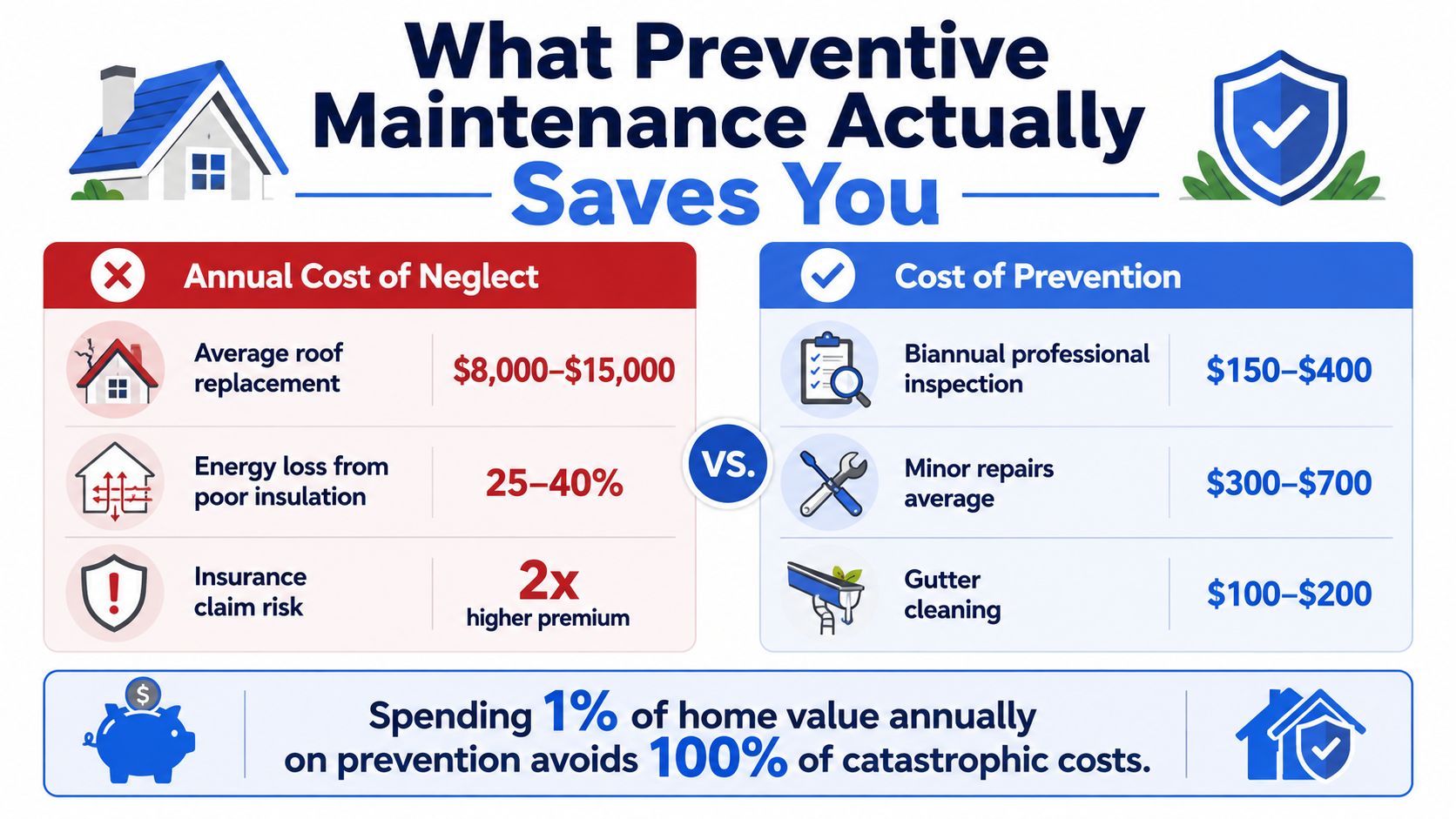
The cost case for preventive roof maintenance is straightforward because roofs are expensive to replace and relatively cheap to inspect. Industry guidance says maintenance programs usually run 1% to 3% of a roof's estimated replacement cost per year, and another protocol sets a minimum $0.05 per square foot per year for preventive maintenance industry guidance summary. That is a small planned spend compared with leak damage, interior repairs, insulation replacement, and the disruption that comes with fixing a lived-in house.
In central Ohio, that trade-off matters because freeze-thaw cycles, summer storms, and leaf-heavy valleys do not give a roof much slack. A roof that gets cleaned, checked, and documented on schedule has a better chance of making it through the next weather swing without a surprise.
The math works because small defects do not stay small
The strongest numbers in the research are plain. Analysts tied to a roofing alliance found proactive systems cost 14 cents per square foot per year on average, while reactive maintenance cost 25 cents per square foot study summary. The same summary says proactive systems lasted 21 years versus 13 years for reactive ones. Neglect does not save money, it just pushes a larger bill into the future.
That is why the homeowner habit of waiting for a leak is the expensive choice. A roof often pays for itself in the background, and maintenance is what keeps that system from failing early. It also explains why maintenance language in warranties matters. A roofing-industry presentation cited by FEFPA says approximately 80% of all roof leaks could be prevented by timely repairs, and it ties preventive maintenance to warranty protection FEFPA presentation.
For Columbus homeowners, the practical benchmark is easier to use than the lifecycle math. A routine inspection and light upkeep usually cost a fraction of what a full replacement does, often only pennies per square foot on the maintenance side. Compare that with the cost of drywall, insulation, and finish work after water gets in, and the value shows up fast.
Compare prevention to reaction before you spend
| Metric | Preventive Maintenance | Reactive Maintenance |
|---|---|---|
| Annual spending pattern | Planned, small, routine | Unplanned, larger, urgent |
| Roof life | 21 years on average study summary | 13 years on average study summary |
| Life-cycle cost | Lower when upkeep stays on schedule | Higher when repairs wait for leaks |
| Damage timing | Catch defects early | Fix after water has already entered |
| Warranty position | Better chance of staying compliant | Risk of losing coverage if upkeep was skipped |
For a Columbus homeowner, the point is not abstract efficiency. It is avoiding the moment when a small repair turns into a ceiling patch, drywall work, and a roof replacement discussion that could have been delayed with ordinary maintenance. The same lesson shows up in preventing water damage in Marion County, water moves fast once it gets past the roof line.
Your Twice-a-Year Roof Inspection Checklist
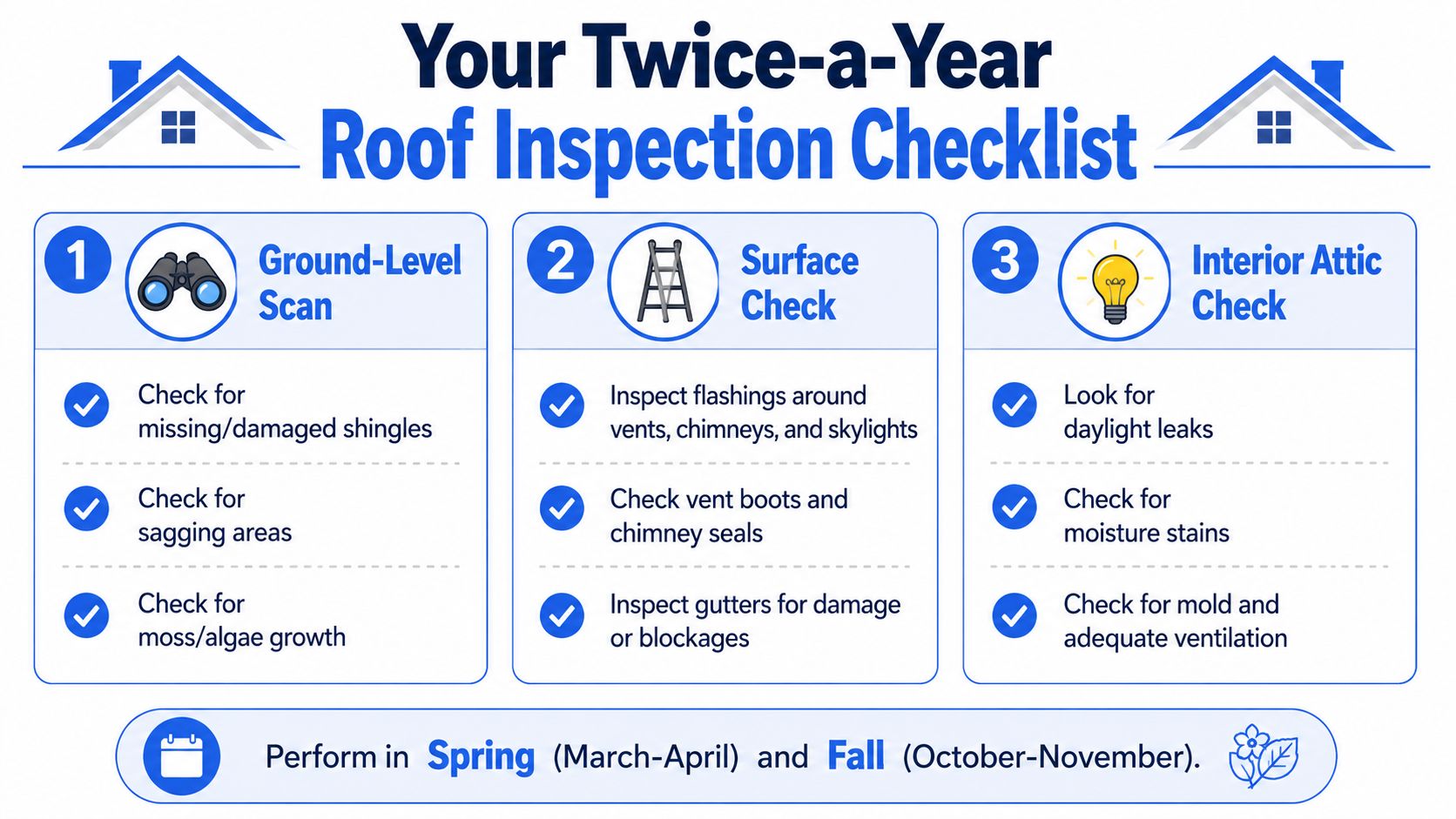
A roof inspection doesn't need to be complicated, but it does need to be consistent. The most useful rhythm is semiannual, one pass in spring and one in fall, with extra checks after hail, high winds, or heavy rain maintenance guide. Newer roofs can usually be checked annually if conditions are mild, but around Columbus, the better habit is to look more often and write down what changed.
Start from the ground, then move inward
Begin with binoculars and a slow walk around the house. Look for missing shingles, lifted edges, sagging roof lines, debris in the valleys, and any visible flashing damage around chimneys, vents, or dormers. If the roof surface is safe and low-slope enough for a homeowner to access carefully, take a closer look, but don't force that step just because you want a better view.
Then go inside. The attic and the top floor tell you things the exterior can't, especially when moisture has already entered the assembly. A roof deck that looks dry outside can still show staining, musty odor, or daylight at penetrations from the attic side.
If the attic smells damp, that's not a cosmetic issue. It means the roof system has already started losing the moisture battle.
Use the same checklist every time
- Shingles: Look for curling, missing tabs, or heavy granule loss. Action, note the location and watch for spread, because repeated loss usually points to age or storm wear.
- Flashing: Check chimneys, vent boots, valleys, and wall intersections. Action, call a roofer if flashing is lifted, split, or rusted through.
- Gutters and downspouts: Make sure water can move freely. Action, clear debris and confirm discharge away from the foundation.
- Soffit and fascia: Look for staining, peeling paint, or soft wood. Action, treat that as a moisture clue, not just a trim problem.
- Attic deck: Scan for stains, damp insulation, and daylight at seams or penetrations. Action, document it and schedule an inspection.
A useful internal reference if you're planning ladder work is how to clean gutters without a ladder, because a lot of homeowners can handle roof-adjacent cleanup without ever stepping onto the roof itself.
A Columbus-Season Maintenance Calendar
Central Ohio roofs age in step with the weather, so the calendar should match the weather. Spring exposes what winter did, summer tests the roof with UV and storms, fall loads the system with leaves, and winter rewards good prep by showing which drainage paths are still open. That rhythm matters more here than in a milder market, especially around mature neighborhoods where oak and maple debris keep landing on the roof and in the gutters.
Spring, summer, fall, and winter each have a different job
Spring is cleanup and assessment season. Clear winter debris, inspect for loose or missing shingles, and check gutters and downspouts for fallout from ice and freeze-thaw movement. If the attic tells a different story than the exterior, document it right away.
Summer is storm-readiness and recovery. Before a storm season gets going, take photos of the roof, flashing, and gutters so you know what “normal” looked like. After hail or heavy wind, walk the perimeter and look for fresh debris, displaced pieces, and soft-metal dents around gutters and vents.
Fall is the heaviest maintenance window. Clean gutters before the leaves clog them, seal exposed fasteners where needed, and trim branches that hang over the roof so the next wind event doesn't scrape the shingles. In a Columbus yard, that often means paying special attention to oak and maple limbs that shed both leaves and small debris.
Winter is mostly monitoring. Watch for ice patterns along eaves and pay attention to any interior signs that meltwater isn't draining the way it should. If the roof is quiet and the attic is accessible, use that time to plan spring work rather than waiting for the next storm.
Event-triggered checks beat the calendar
The calendar doesn't replace common sense. If a storm drops hail, if strong winds move visible debris, or if heavy rain reveals overflow at the gutters, inspect right away instead of waiting for the next scheduled check. That's where the maintenance habit earns its keep, because the faster you document and correct a problem, the less it has time to spread.
A useful winter reminder from ice dam fixes is that ice problems usually start at the edge of the roof, not in the middle of the field. The edge is where drainage either works or fails.
DIY Tasks Versus Professional-Only Work
The safest roof homeowners are the ones who know where to stop. A ten-minute task can turn dangerous fast if the slope is steep, the roof is wet, or the problem is larger than it first looked from the driveway. That line matters because the right fix at the right time is helpful, but a bad fall or an accidental tear in the shingles costs a lot more than a service visit.
What you can usually handle
A homeowner can safely do ground-level checks, clean accessible gutters from a stable ladder, and trim small branches with a pole saw if the work stays away from the roof surface. Applying sealant to a known, reachable flashing gap can also be reasonable if the leak path is obvious and the location is safe to access.
A Worthington homeowner clearing a clogged downspout before a storm is doing the right kind of work. The task is simple, the risk is low, and the payoff is immediate because water can get off the roof again.
What needs caution, and what needs a roofer
Walking a low-slope roof in soft-soled shoes can be acceptable in dry conditions if the homeowner is steady and the surface is safe. Pressure washing asphalt shingles is a different story, because it can strip granules and shorten roof life. That's one of the few maintenance moves that looks productive but often causes damage.
A Dublin homeowner who finds granules piling up in the gutter should stop there and call for help. That clue may be normal aging, storm damage, or something worse, but it's not a sign to start poking around on the shingles.
Practical rule: if you can already see sagging, soft spots, hail bruising, or a leak path that involves the attic or chimney, it's pro-only work.
Steep slopes, multi-story roofs, chimney flashing rebuilds, soft decking, structural sagging, and full tear-offs belong in a roofer's hands. That's also the point where a company like HIBCO ROOF LLC fits naturally into the conversation, because inspection and repair are part of the same maintenance chain.
Documentation and Insurance Prep That Pays Off Later
Maintenance only protects you if you can prove it happened. A roof file doesn't need to be fancy, just consistent. Keep dated photos, a short written log, receipts for any materials or labor, warranty paperwork, and notes on storms that hit the property. That habit matters whether you're trying to track gradual wear or prepare for an insurance conversation after wind or hail.
Build one roof folder and keep it current
A simple structure is enough. Put one folder in your phone or computer for roof photos, and label the files by date and season. Keep a one-page log that lists what you inspected, what you cleaned, and what you repaired, then save every invoice with it.
That kind of record helps after a claim because an adjuster usually wants to know what changed, when it changed, and whether the roof had been maintained. It also helps you decide whether to pay out of pocket for a small repair or file a claim for a larger storm event. The cleaner the paper trail, the easier that decision gets.
For homeowners coordinating coverage questions, Mai & Associates home insurance is a useful example of the kind of insurance resource that can help you understand policy language, while your roof file gives the facts on the ground.
What to gather before anyone files a claim
- Pre-storm photos: Save a few clear shots of the roof, gutters, and visible flashing.
- Post-storm photos: Capture the exact areas that changed, plus any debris on the ground.
- Repair receipts: Keep invoices for patchwork, cleaning, and inspections.
- Warranty papers: Store manufacturer and installer documents together.
- Inspection notes: Write down dates, weather, and anything unusual you observed.
That folder becomes especially useful if a claim question turns into a maintenance question. If you can show regular care, you've got a much stronger position than a homeowner who has nothing but a ceiling stain and a memory of “checking it sometimes.”
When and How to Bring in HIBCO ROOF LLC
Some roof situations are still worth watching, but others are past the homeowner stage. After hail, after obvious wind damage, when shingles are curling or shedding granules, when an insurance claim is under consideration, when the roof is getting close to the 15-year point, or when a house is being prepared for sale, it makes sense to bring in a contractor who can inspect the system as a whole.
What a roof inspection should include
A proper visit should cover the shingles, flashing, gutters, downspouts, and attic side of the roof deck. It should also include photo documentation and a written estimate with no pressure to move forward until the homeowner is ready. That's the kind of inspection that helps a homeowner decide whether the roof needs a small repair, a larger fix, or a replacement plan.
HIBCO ROOF LLC fits that role in Columbus and central Ohio as a licensed and insured contractor that offers free roof inspections and written estimates. The company also holds Owens Corning Preferred Roofing Contractor status, which matters because homeowners want a contractor who works within manufacturer-backed systems and documents the condition clearly.
Bring a short list to make the visit efficient
Before the appointment, gather any storm photos, warranty paperwork, insurance letters, and a quick list of the spots you've noticed from inside the house. If there's a leak stain, note when it appeared and whether it changes after rain. That gives the inspector a head start and keeps the visit focused on the actual problem, not guesswork.
If your roof is due for a careful look, HIBCO ROOF LLC can inspect the shingles, flashing, gutters, and attic, then give you a straightforward written estimate with no pressure. Visit HIBCO ROOF LLC to schedule a free inspection and get ahead of the next Columbus storm before it turns a small defect into a bigger repair.