

More than 500,000 people receive medical treatment every year from ladder-related injuries in the United States, and over 300 die. Even worse, more than 97% of those injuries happen in non-occupational settings like residential homes according to ladder fall statistics compiled here. That changes the whole conversation around gutter cleaning. This isn't about convenience. It's about keeping your feet on the ground while still protecting your house.
Around Columbus, clogged gutters don't just make a mess. They dump water against foundations, stain siding, soak fascia, and create the kind of overflow that shows up after a hard rain or a winter thaw. The good news is that for a lot of single-story homes, you can handle routine gutter cleaning from the ground if you use the right tool and know what to check after the debris is gone.
Table of Contents
- Ditch the Ladder and Clean Your Gutters Safely
- Choosing Your Ground-Based Gutter Cleaning Tools
- The Ground-Level Gutter Cleaning Process
- Clearing the Most Overlooked Problem Your Downspouts
- When to Call a Gutter Professional in Columbus
- Protect Your Home with Consistent Gutter Maintenance
Ditch the Ladder and Clean Your Gutters Safely
If you're searching for how to clean gutters without a ladder, your instinct is already pointing in the right direction. Ladder work during gutter cleaning goes wrong fast. You're reaching sideways, handling awkward tools, and trying to work above eye level while standing on uneven ground near landscaping, mulch beds, or wet concrete.
That's why I tell homeowners to stop treating ladder-free cleaning like a shortcut. For many houses, it's the safer method and the smarter one. On a typical single-story home, you can often remove debris, flush the channel, and test drainage from the ground without ever climbing.
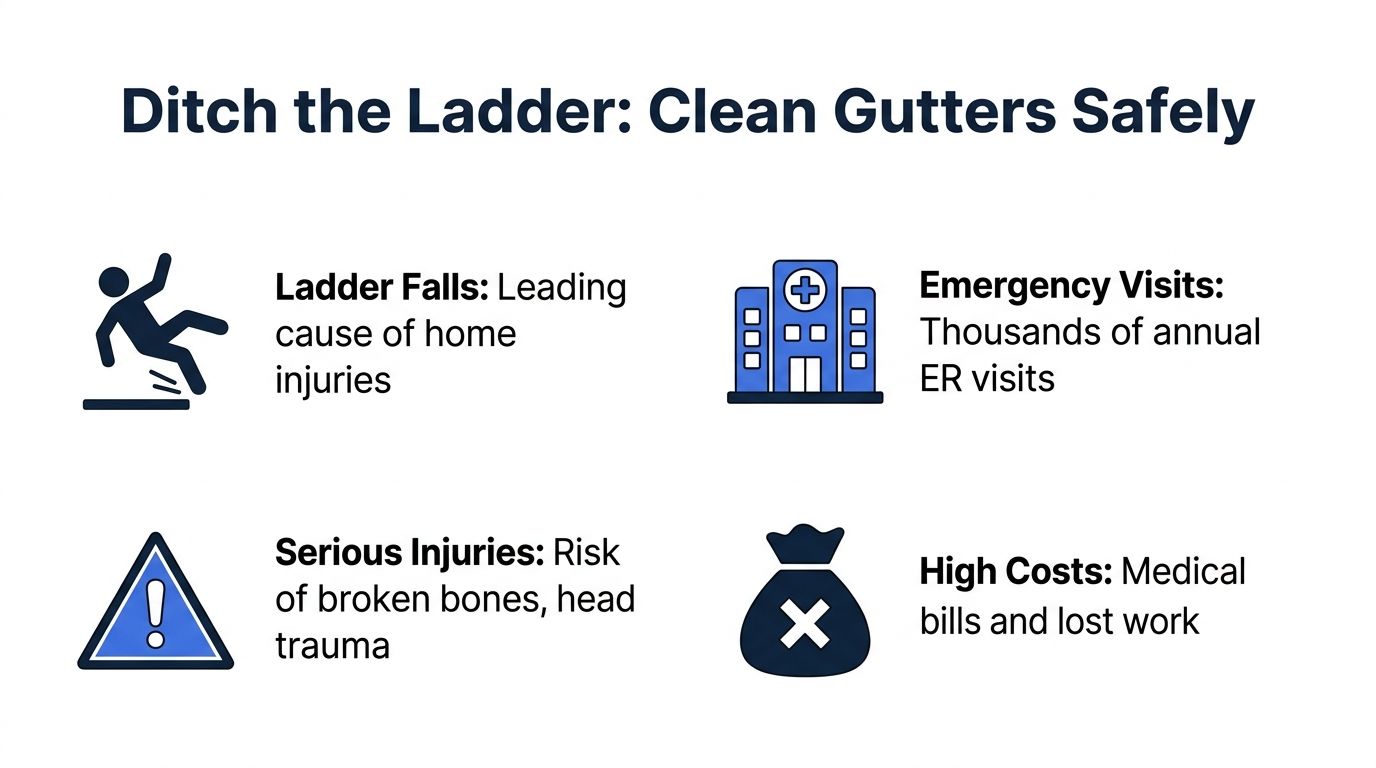
Safety matters more than speed
Most homeowners think the risky part is getting up the ladder. It isn't. The risky part is everything after that. Twisting to scoop wet leaf sludge, dragging a hose, shifting the ladder every few feet, and trying not to dent the gutter while you work. That's where people make bad decisions.
Practical rule: If the job requires leaning out past your belt buckle or moving a ladder repeatedly around shrubs, it's already a bad DIY setup.
Ground-based methods also reduce accidental damage. I've seen gutters bent by ladder tops, seams loosened by pressure in the wrong spot, and fascia stained because a small clog got missed. Working from the ground lets you focus on control instead of balance.
If you still plan to use a ladder for any exterior work, learn the basics of choosing an extension ladder before you do. Even then, gutter cleaning is one of the first jobs I'd move off a ladder whenever possible.
Clean gutters protect more than the gutter
A clear gutter system moves water away from the house. That protects siding, soffits, landscaping beds, basement walls, and the soil around the foundation. In Central Ohio, you get leaf drop, freeze-thaw cycles, heavy rain, and spring debris all packed into the same system.
When people put this job off, they usually don't notice until water starts spilling over the front edge. By then, the gutter may not be the only problem. The clog often moved downstream.
Choosing Your Ground-Based Gutter Cleaning Tools
The right no-ladder method depends on two things. How high the gutter is, and what kind of debris is inside it. According to this guide on safe home maintenance for seniors, ground-based methods are most effective for single-story homes with gutters at or below 10 feet. It also notes that leaf blower attachments work well for dry debris, wet/dry vacuums are necessary for wet, packed leaves, and water flushers are great for sludge but not heavy debris.
That lines up with what works in the field. A tool that feels great in October can be almost useless after a rainy spring stretch.
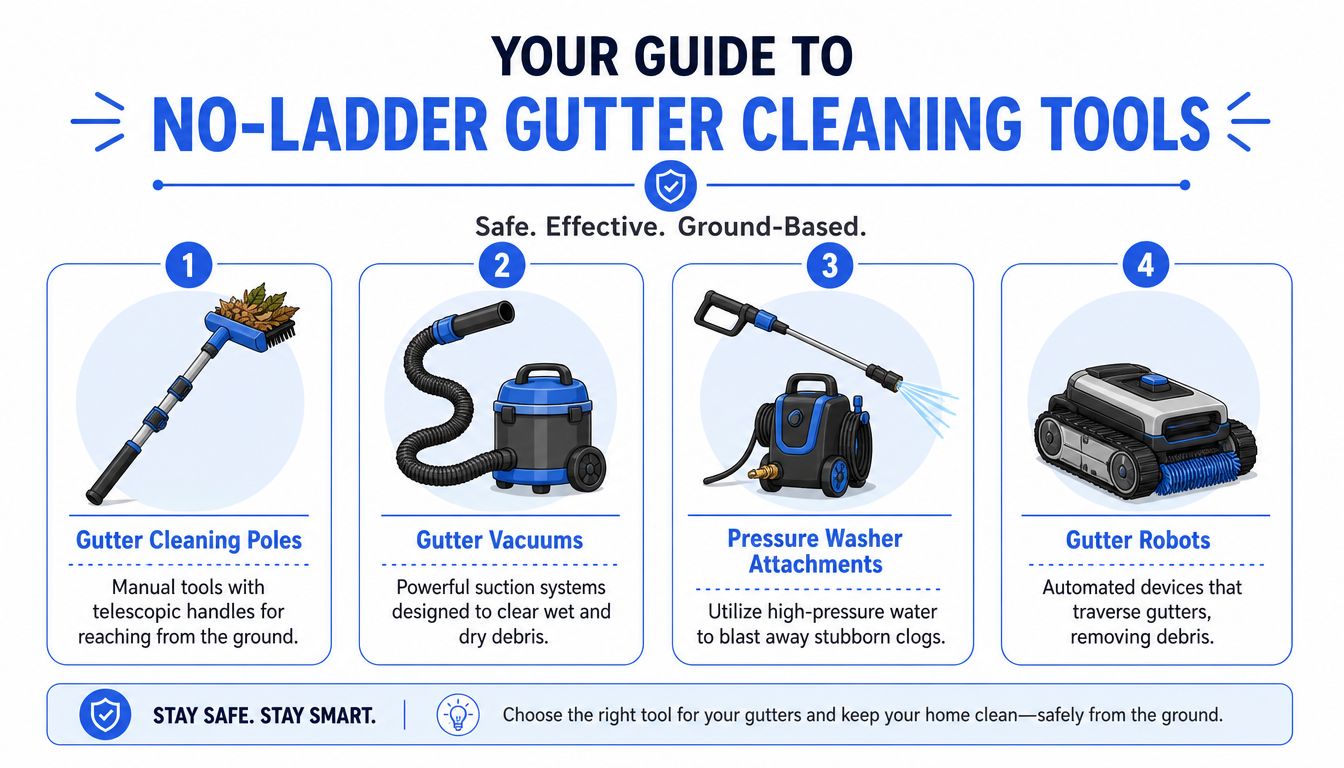
Match the tool to the debris
Here's the quick decision guide I'd give a neighbor:
| Tool type | Best use | Main drawback |
|---|---|---|
| Telescoping pole with scoop or brush | Light to moderate debris you can pull toward you | You're working blind |
| Leaf blower attachment | Dry leaves and loose material | Messy, loud, weak on wet debris |
| Wet/dry vacuum with gutter kit | Wet, packed leaves and heavy buildup | Bulkier equipment |
| Water wand or flusher | Sludge, final rinse, downspout testing | Won't remove heavy packed debris by itself |
| Gutter robot | Routine maintenance on standard gutter runs | Less useful when debris is dense or drainage is blocked |
What each tool does well
Telescoping poles, tongs, and scoops are the simplest place to start. They're mechanical, direct, and don't depend on airflow or water pressure. A telescopic gutter cleaner extends from the ground so you can reach the channel without climbing, and this tool overview from Lednor Home also notes that gutter cleaning robots operate as remote-controlled devices that travel through the gutter itself.
Manual pole tools are best when you want control. If a gutter has a layer of maple leaves with some grit mixed in, a scoop or tong gives you a decent shot at removing the bulk of it without spraying mud everywhere.
Leaf blower attachments are fast when the debris is dry. Fresh leaf drop, seed pods, light twigs, and dusty material can move quickly with a curved blower tube. But if the gutter has wet leaf mat, they don't solve the underlying issue. They just skim the top and leave the heavy material behind.
Dry debris is a blower job. Wet debris is a vacuum job. Mixing those up wastes time.
Wet/dry vacuums with gutter kits are the most effective DIY option for packed, damp debris. If the gutter feels like compost, suction beats air every time. A good shop vacuum setup can pull out the heavy stuff that sits flat on the bottom and blocks the outlet opening.
Water wands and flushers have a place, but they're often misunderstood. They're useful after the bulk debris is gone. They rinse sediment, move sludge, and help you see whether water is traveling to the outlet. They aren't the first tool I'd choose for a gutter full of compacted leaves.
Gutter robots appeal to homeowners who want less manual work. They can make sense on straight, standard gutter runs when you're staying ahead of light buildup. They're less convincing when you've already got packed debris at the outlet or a hidden clog farther down the line.
One other point that gets missed. Prevention is often a better investment than fighting the same clog over and over. If leaves are the recurring issue, it's worth looking at leaf guard protection options before the problem turns into repeated overflow and fascia damage.
The Ground-Level Gutter Cleaning Process
A good no-ladder gutter cleaning job isn't complicated, but it does need order. Most problems come from skipping setup, rushing the passes, or assuming the gutter is clear because the top edge looks cleaner from the yard.

Set up the area first
Before you touch the gutter, move vehicles away from splash zones and protect anything delicate below. Tarps help. So does pulling lightweight planters back from the wall. If you're using a blower or flusher, expect debris to come down where you don't want it.
Keep your workflow simple:
- Start near one end: Don't bounce around the house.
- Clear the bulk first: Remove leaves, twigs, and clumps before you rinse.
- Work in short sections: Small sections are easier to control when you can't see the gutter bottom directly.
- Check the outlet area: That's where small misses turn into big overflows.
Work in short sections and verify as you go
If you're using a wand or tongs, follow the basic operation instructions exactly. Window Genie's guide to no-ladder gutter cleaning specifies attaching a gutter cleaning wand to a standard garden hose and spraying debris out of the gutter. The same guide explains that gutter tongs work by extending the pole, opening the tongs with a trigger, inserting them into the gutter, gripping debris, and repeating until the section is clear.
That sounds basic, but technique matters. Don't try to clean a full run in one sweep. Work a manageable section, then listen and watch. Water should move cleanly toward the outlet. If it stalls, swirls, or backs up, the problem is still there.
A few field tips help when you're working blind:
- Use the sound: A clear section sounds different from a blocked one during flushing.
- Watch the ground: Debris pattern tells you whether you're moving material or just splashing it.
- Spot-check angles: A small mirror on a pole can confirm whether the bottom of the gutter is clean.
- Don't trust the front edge: A gutter can look fine from below and still have a packed strip sitting at the back.
If you only remove what you can see falling out, you often leave the clog that matters most.
Clearing the Most Overlooked Problem Your Downspouts
A lot of homeowners stop once the horizontal gutter looks clear. That's the part most guides get wrong. Clearing gutters is only half the job, because 70% of gutter-related water damage originates from downpipe obstructions, according to this downpipe-focused explanation from Edwards & Hardy. It also points out that most no-ladder guides don't explain how to diagnose or clear those hidden blockages from the ground.
That's exactly why people still get overflow after a “successful” cleaning. The water has nowhere to go.
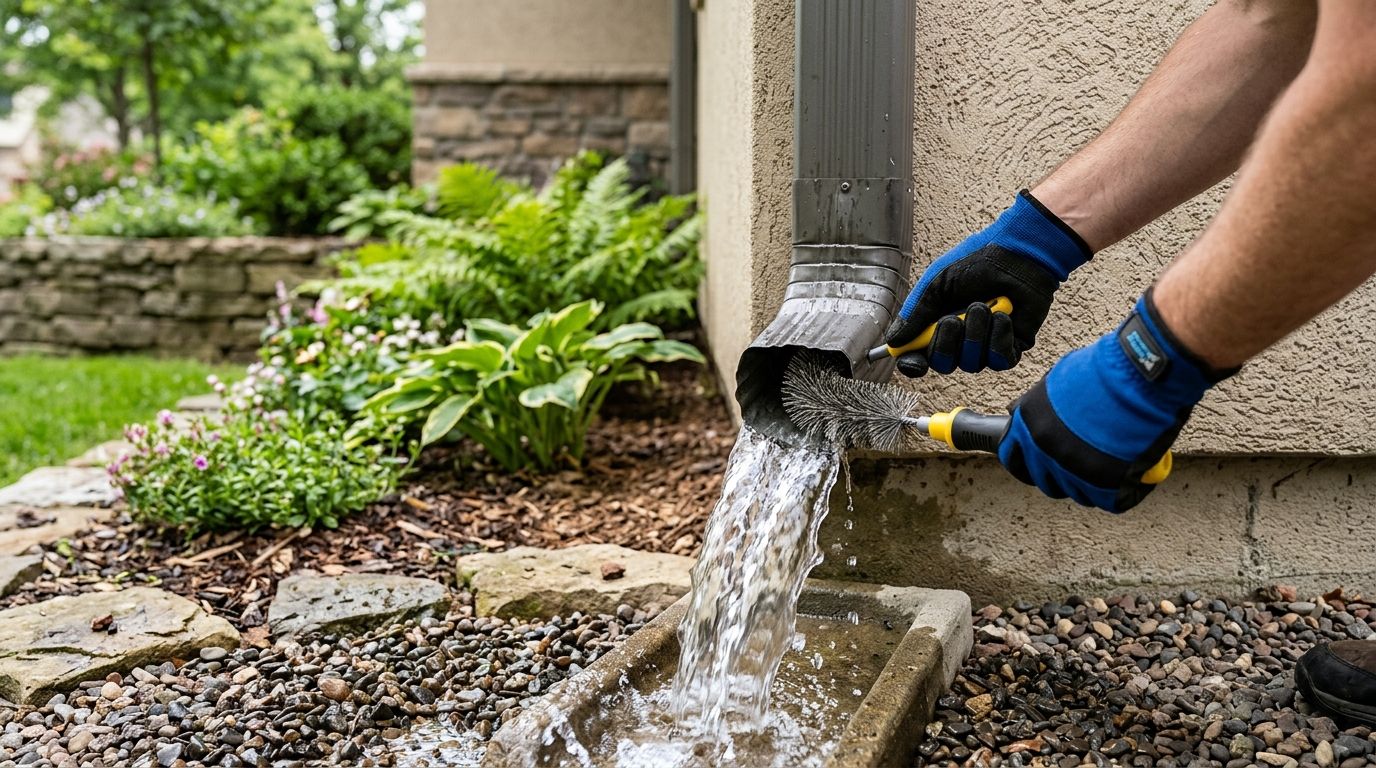
How to tell the downspout is still blocked
The most common trouble spot is the elbow. Sometimes it's the upper elbow at the gutter connection. Other times it's lower near the discharge point where leaf mush settles and hardens.
Watch for these signs:
- Overflow during rain: Water pours over the gutter edge even though the channel itself isn't packed.
- Weak or no discharge: You flush from above or through the gutter, but little water comes out at the bottom.
- Repeated backup at one outlet: The same corner keeps failing after every cleaning.
- Staining near seams or corners: Water is hanging up instead of moving down and out.
Two ways to clear it from the ground
The first method is bottom-up flushing. Remove the lower extension if there is one, place a hose or spray nozzle into the bottom opening, and push water upward through the downspout. This can break soft clogs loose and force debris back into the gutter where you can flush it out properly.
The second method is a plumber's snake. Feed it from the bottom opening and work slowly through the elbow. Don't jam it. Rotate, back off, and advance again. If the clog breaks, flush with water and confirm you've got full flow at the discharge.
Use a simple verification routine after either method:
| Check | What you want to see |
|---|---|
| Water into gutter or top outlet | Immediate movement toward downspout |
| Water exiting bottom | Steady, unrestricted flow |
| No backing up at elbow area | No bubbling or spillback |
| Final rinse | Clear discharge without chunks |
If you can't restore flow from the ground, don't keep forcing it. At that point the issue may be deep in the run, packed at an elbow, or tied to a damaged section.
When to Call a Gutter Professional in Columbus
Some gutter jobs are fine for a careful homeowner on the ground. Some aren't. Around Columbus, the line usually gets crossed when height, access, or damage enters the picture.
Two-story homes are the obvious example. Even if you can reach part of the system with a long tool, you usually can't verify the whole run well enough from the yard. Add mature trees, steep grades, rear decks, sunrooms, or buried drain connections, and the job stops being routine.
Red flags that change the job
Call a professional if you see any of the following:
- Sagging sections: That often means the debris load got heavy or the fasteners are failing.
- Detached or leaking joints: Cleaning won't fix alignment or separation.
- Animal nesting material: Rodents and birds turn a cleaning job into a sanitation issue.
- Solidified buildup: If the gutter contains old composted material, tools from the ground may not be enough.
- Two-story or hard-access runs: Safety and verification both get harder.
- Signs of broader drainage trouble: If water is pooling around the house after discharge, the gutter may not be the only problem.
When runoff keeps causing soggy areas or washout near the foundation, it helps to understand the yard side too. A practical companion read is R.E. and Sons' drainage expertise, which explains how surface drainage problems can keep causing issues even after the gutter system is cleaned.
What professional service usually costs
If you're weighing DIY against hiring it out, use real numbers. Family Handyman's pricing overview for no-ladder gutter cleaning puts single-story gutter cleaning at $0.80 to $1.20 per linear foot and two-story cleaning at $1.50 to $2.00 per linear foot.
That price starts to make sense when the alternative is guessing from the ground on a tall home or missing damage while you focus only on debris. If you're comparing options locally, it also helps to review what's typically included in roof and gutter cleaning services so you can tell whether the scope covers flushing, inspection, and blockage verification.
Protect Your Home with Consistent Gutter Maintenance
The safest approach is simple. Stay off the ladder when you can, use the tool that matches the debris, and don't stop at the gutter channel. If the downspout still can't carry water away, the job isn't finished.
For single-story homes, ground-based cleaning can work well when the buildup is manageable and access is straightforward. For higher homes, damaged systems, or repeated overflow, professional service is usually the better call. The goal isn't just getting leaves out. The goal is keeping water moving away from the house every time it rains.
If your home has guards installed, maintenance changes a bit. Some systems still collect fine debris on top or at openings, so it's worth reviewing tips for cleaning gutter guards before you assume they're maintenance-free. And if you're evaluating the bigger picture, it helps to understand the full range of gutter system options that affect long-term performance.
A clean gutter that won't drain is still a problem. A gutter that drains well protects the roof edge, siding, foundation, and the soil around the house. That's the standard to aim for.
If you'd rather have an experienced local contractor inspect the system, HIBCO ROOF LLC serves Columbus and central Ohio with roofing and exterior expertise, including gutters. If you're dealing with overflow, repeated clogs, or signs of water damage, reach out for a free, no-pressure inspection and written estimate.