
A sagging roof repair cost is usually $2,000 to $7,000, because this is a structural problem, not a cosmetic one. In lighter cases it may land lower, and in severe cases involving major framing failure or rebuilding, the price can climb well beyond that range.
If you're looking up at a dip in your roofline from the driveway, or you've noticed a bow in the ceiling line from inside the attic, you're right to be concerned. A sagging roof usually means something underneath the shingles has weakened, shifted, rotted, or been overloaded. The shingles might be the visible surface, but they aren't the actual issue.
In Columbus, I see homeowners make the same mistake over and over. They assume the fix is just replacing a few shingles or patching one soft area. That approach often misses the true cause, and when the cause is missed, the repair doesn't hold. The safest path is a structural diagnosis first, then a repair plan that matches what the framing is doing.
Table of Contents
- Why Your Roof Is Sagging Common Causes Explained
- The Real Sagging Roof Repair Cost An Itemized Breakdown
- Repairing vs Replacing Which Is Right for Your Sagging Roof
- The Critical First Step A Professional Structural Inspection
- Will Insurance Cover a Sagging Roof Repair
- Real-World Examples of Sagging Roof Repairs in Ohio
- Your Next Steps To Protect Your Columbus Home
Why Your Roof Is Sagging Common Causes Explained
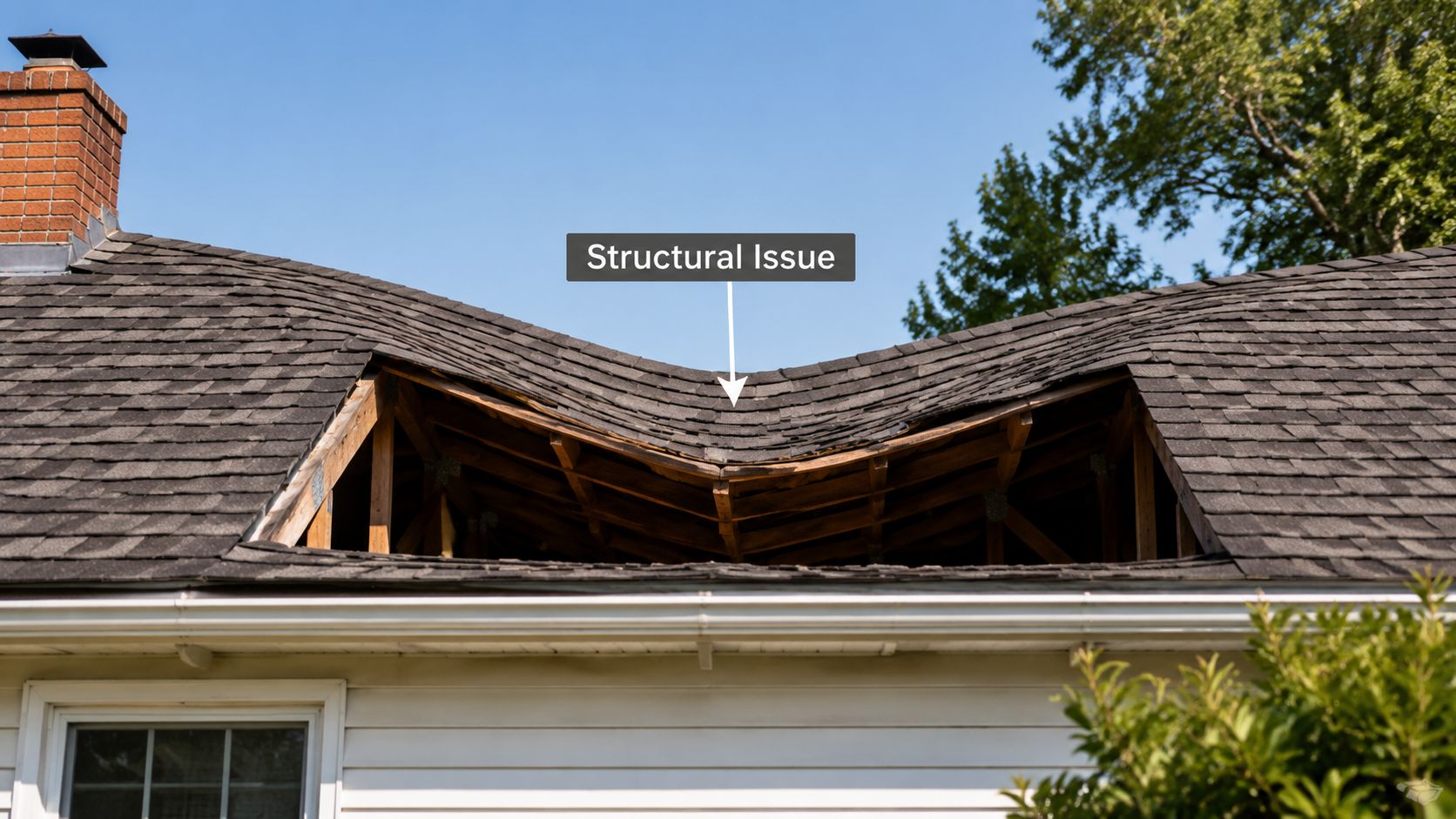
A sagging roof isn't just an ugly line in the wrong place. It's your house telling you that part of the roof structure isn't carrying weight the way it should.
Think of the roof like a skeleton. The decking is the flat wood surface under the shingles. The rafters or trusses are the bones that hold the shape. When one of those parts weakens, the roofline can dip, bow, or roll.
What usually fails first
Water damage is one of the most common starting points. A leak around flashing, a vent, a valley, or a damaged roof section can soak the decking and framing over time. Wood doesn't need a dramatic hole to fail. It just needs repeated moisture and enough time.
When that happens, a few things can show up:
- Soft roof decking: The plywood or OSB under the shingles loses stiffness and starts to deflect.
- Weakened rafters: Wood members can split, rot, or slowly bow under load.
- Fastener failure: Nails and connectors don't hold properly when surrounding wood deteriorates.
- Interior clues: Ceiling cracks, sticking doors near load paths, and attic staining often show up before homeowners realize the roofline has changed.
If you want a better sense of how the roof surface and deck work together, this explanation of roof deck protection and moisture control helps connect what happens under the shingles to the structural problems above the attic.
Practical rule: If the roofline changed shape, don't assume the problem is limited to the spot you can see from outside.
Loads and past work matter too
Not every sag starts with active rot. Some roofs sag because the framing was marginal from day one, or because the structure was asked to carry more than it was designed for.
A few common examples:
- Undersized framing: Older rafters or ridge members may not have been sized properly for the span.
- Too much roofing weight: Multiple old shingle layers can add unnecessary load.
- Previous contractor shortcuts: A repair that patched surface materials without correcting the framing can leave the structure vulnerable.
- Storm and seasonal stress: In central Ohio, repeated weather exposure can turn a small weakness into visible movement.
What doesn't work is treating a sag like a simple shingle repair. New shingles over weak framing only hide the issue for a while. The roof may look straighter for a short period, but the structure beneath is still doing the same failing work.
A good diagnosis starts with where the sag is, how wide it is, whether it's at the ridge or in the field of the roof, and what the attic framing looks like directly beneath it. That tells you whether you're dealing with deck failure, rafter deflection, truss damage, ridge problems, or a combination.
The Real Sagging Roof Repair Cost An Itemized Breakdown
Homeowners don't just want a range. They want to know what drives the bill. That's the right question, because sagging roof repair cost isn't one line item. It's a stack of decisions and required work.
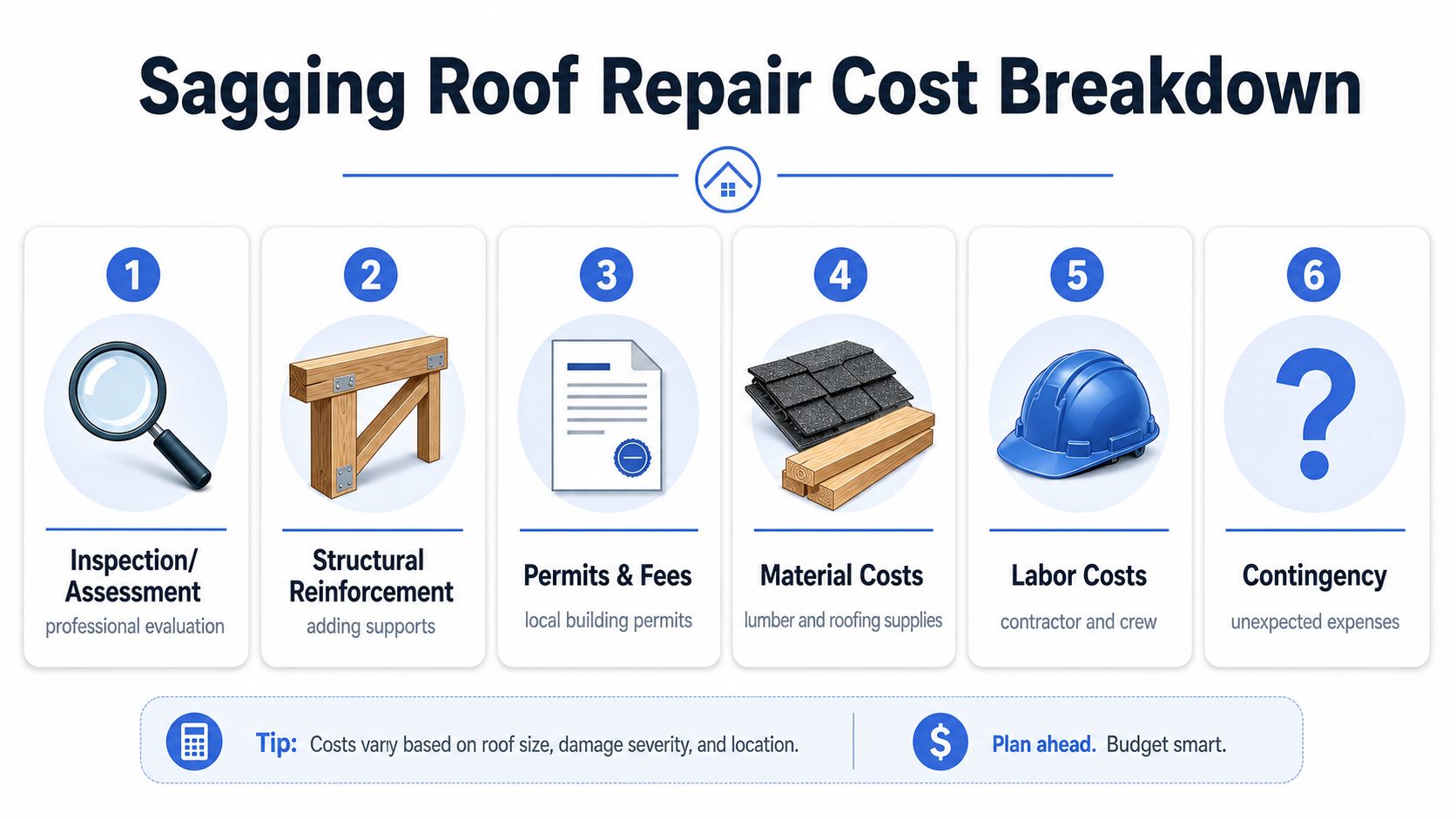
The broad ranges vary by severity. According to Econo Roofing's breakdown of structural roof repair pricing, sagging roof repair is structural work that can cost $2,000 to $7,000 or more, localized sagging from decking water damage runs $2,000 to $3,500, rafter sistering typically costs $2,500 to $5,000, and serious truss repair can reach $5,000 to $15,000 or more.
What you're paying for
The total usually includes several layers of work, not just one repair crew nailing in a board.
| Cost Area | What it usually covers |
|---|---|
| Inspection and assessment | Exterior review, attic inspection, leak tracing, scope definition |
| Structural reinforcement | Sistered rafters, bracing, truss correction, framing repair |
| Decking repair | Removal of damaged sheathing and installation of new deck panels |
| Roofing restoration | Underlayment, flashing, shingles, ridge materials over repaired areas |
| Permits and compliance | Required approvals for structural work where applicable |
| Labor and cleanup | Tear-off, staging, site protection, debris removal |
A quote gets more expensive when a contractor has to open the roof, shore an area safely, repair the framing, replace bad decking, and then restore the weatherproofing system above it. That's normal. It's also why a low quote without a clear structural scope is risky.
Here are the trade-offs that matter most:
- A surface-only repair costs less up front, but it often leaves the weak framing in place.
- Structural reinforcement costs more, but it addresses the reason the roof moved.
- Permit and engineering requirements add cost, but they reduce the chance of a failed repair and future sale or insurance complications.
If your repair includes flashing transitions or moisture-sensitive seams, quality sealing products matter too. For homeowners and contractors comparing materials, you can find butyl tape at Contractor's Den, which is the kind of component often used where durable sealing is needed around roof details and adjacent assemblies.
Estimated Sagging Roof Repair Costs in Columbus OH
The numbers below are best used as a practical planning table, not a phone-quote shortcut.
| Repair Level | Common Fixes | Estimated Cost Range |
|---|---|---|
| Minor structural issue | Limited reinforcement where no structural member replacement is needed | $800 to $5,000 |
| Light to moderate sagging | Decking repair, localized framing correction, roofing restoration | $2,000 to $7,000 |
| Rafter sistering | Adding support boards to weakened rafters | $2,500 to $5,000 |
| Serious truss failure | Truss repair and related structural correction | $5,000 to $15,000 or more |
The lower end only applies when the problem is caught early and the repair stays localized. Once crews uncover widespread rot, broken truss members, or large areas of failed decking, pricing shifts fast because the work becomes reconstruction, not repair.
A detailed quote should tell you what is being removed, what framing is being reinforced, whether decking is included, and how the roof covering will be restored afterward.
Repairing vs Replacing Which Is Right for Your Sagging Roof
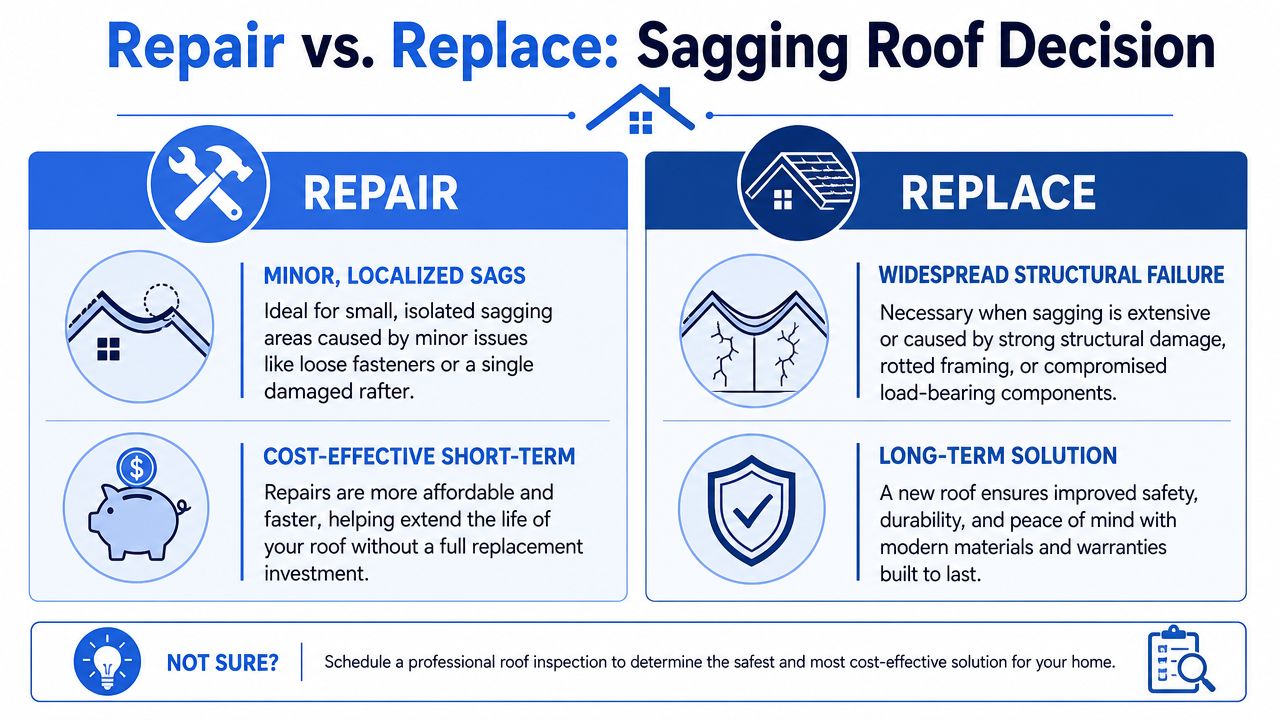
Some sagging roofs should be repaired. Others are telling you the entire assembly has reached the point where replacement is the more sensible move.
The decision isn't emotional. It's mostly about extent, age, and whether the existing roof system is worth preserving.
According to The Roofing Brief's cost analysis for sagging roof repairs, the median residential cost to repair a sagging roof falls between $4,000 and $9,000 because it often requires sister-rafter reinforcement or truss replacement. When damage is severe enough to require a full structural rebuild with new decking and re-roofing, costs typically range from $5,000 to $15,000 or more.
When repair makes sense
Repair is usually the better path when the sag is isolated and the surrounding roof still has useful life left.
That often looks like this:
- One limited problem area: A section near a chimney, valley, or vent took on water and damaged only a small portion of framing or decking.
- The shingles are still serviceable: The roof covering doesn't need replacement across the whole home.
- The structure around the sag is sound: Once the damaged members are corrected, the rest of the roof system remains dependable.
- You're solving the root cause: The leak source, ventilation issue, or framing defect is being corrected.
In those cases, repair avoids tearing off a roof that still has value.
When replacement is the smarter move
Replacement becomes the better financial decision when repair starts turning into repeated patchwork. If the roof covering is already near the end of its life, or if multiple structural areas have been compromised, piecemeal work can cost you twice.
A full replacement often makes more sense when:
| Sign | Why it points toward replacement |
|---|---|
| Widespread sagging | The problem isn't isolated to one member or one section |
| Large areas of damaged decking | You already have broad removal and rebuild scope |
| Older shingles | Reinstalling around a major repair can waste money on an aging roof |
| Multiple previous repairs | The system has a history of recurring trouble |
If you're comparing those two paths, this guide on how much roof replacement costs gives a useful broader framework for the replacement side of the decision.
If the framing repair is substantial and the shingles above it are already tired, replacement usually gives the cleaner, longer-lasting result.
The mistake I see most often is trying to preserve old roofing material at all costs. That can be sensible on a newer roof. On an aging roof with structural trouble, it usually isn't.
The Critical First Step A Professional Structural Inspection
Before anyone talks about final pricing, materials, or timelines, the first question is simple. What, specifically, is failing?
A proper sagging roof inspection goes beyond what you can see from the yard. The roofline may suggest one issue, but the attic often tells a different story. A dip at the ridge could point to beam problems. A low area in the field could trace back to rotted decking, undersized rafters, or prior modifications that weakened the load path.
Why attic access matters
A real structural inspection should include interior access wherever it's safe and feasible. That's where a contractor can look for:
- Bowed or cracked rafters
- Split truss members or altered webbing
- Dark staining and damp sheathing
- Compressed insulation below chronic moisture
- Improper bracing or older repair attempts
Skipping that step is where bad repair plans begin. Homeowners in Columbus often get told a sag is just a localized issue, only to learn later that the visible dip was the symptom, not the whole problem.
When an engineer should be involved
This is the part too many contractors downplay. According to HomeFixx on roof sagging and structural evaluation, skipping a $300 to $800 structural engineer evaluation before repair risks under-engineering the solution. The same source states that 60% of sagging roof repairs that fail within two years stem from unassessed underlying causes such as ridge beam failure or undersized rafters.
That matters for two reasons. First, a failed repair means you pay again. Second, if a claim is involved, an incomplete diagnosis can create insurance trouble because the scope may not match the actual damage.
A contractor should be comfortable telling you when the project needs engineering input and when it doesn't. If someone wants to sell a fix before they inspect the framing thoroughly, that's a warning sign. This guide on how to choose a roofing contractor can help you vet who is diagnosing versus who is just estimating.
The cheapest inspection is often the most expensive choice if it misses the structural cause.
Will Insurance Cover a Sagging Roof Repair
Insurance coverage depends less on the shape of the roof and more on why it sagged. That's the distinction homeowners need to understand before they assume a claim will pay for everything.
Covered cause versus uncovered condition
In general, insurance is more likely to respond when the sag ties back to a sudden covered event, such as storm damage or a tree impact. Insurance is far less likely to help when the roof sagged because of long-term deterioration, neglected leaks, aging materials, or construction defects that developed over time.
That means two roofs can look similar from the street and be treated very differently by the carrier.
A practical consideration to keep in mind:
- Sudden event: Better chance of coverage if the damage can be documented clearly.
- Long-term wear: More likely to be viewed as maintenance, deterioration, or pre-existing failure.
- Mixed causes: Often the hardest claims, because storm exposure may reveal an older weakness that was already there.
If you want a plain-language overview of how claims are usually handled from first notice through documentation and adjustment, this resource on understanding roofing insurance claims is a useful starting point.
How to document the problem well
If you suspect an insurable cause, don't wait too long to document what you see.
Use a simple checklist:
- Photograph the roofline from multiple angles. Get wide shots and detail shots.
- Take attic photos if it's safe. Capture staining, cracked members, wet decking, or daylight penetration.
- Save weather-related context. Note when the issue was first noticed after a storm or impact event.
- Get a written inspection summary. Verbal opinions don't help much in a claim file.
- Avoid cosmetic-only repairs first. Temporary patching can muddy the record if the structural cause isn't documented.
Don't present assumptions as facts when talking to the insurer. Report what you observed, when you noticed it, and what the inspection found. Clear records help far more than dramatic language.
Real-World Examples of Sagging Roof Repairs in Ohio
Sagging roof repair cost makes more sense when you picture real homes, real roof layouts, and the kinds of defects crews uncover.
According to HomeAdvisor's national roof repair cost guide, the average national roof repair cost is $1,171, but sagging roofs often exceed that median because they involve the framing system. The same source places average sagging roof repair costs between $750 and $3,000 depending on severity.
Example one localized rafter rot
A common Columbus ranch house develops a visible dip over one back bedroom. From outside, it looks small. In the attic, the issue turns out to be chronic moisture near a vent flashing that slowly damaged part of the decking and one rafter bay.
This is usually the kind of job where a repair makes sense. The framing issue is limited, the damaged wood can be removed and reinforced, and the roofing materials above that section can be restored without rebuilding the whole roof.
Example two overloaded aging roof
Another common scenario is an older two-story home with multiple old roofing layers and a long shallow bow across one slope. The sag isn't dramatic, but it's broad. Once opened, the structure may show long-term deflection rather than one isolated break.
Homeowners often get into trouble if they chase the lowest quote. A small patch won't reverse a roof plane that's been overloaded for years. An effective solution may involve removing excess roofing weight, correcting the framing, and deciding whether preserving the old roof covering still makes financial sense.
Broad sagging usually points to a system problem, not a one-board problem.
Example three storm exposure revealed hidden weakness
Sometimes a storm doesn't create the entire problem. It exposes one that was already underway.
A homeowner notices fresh interior staining after wind-driven rain. During inspection, the roof shows a low area near the ridge. The storm may have opened the path for water entry, but the framing weakness likely predates the event. These are the jobs that require careful documentation, because the repair plan has to separate what is newly damaged from what had already deteriorated.
The lesson from all three examples is the same. Two roofs with similar visual sags can need very different scopes of work. That difference is why serious contractors inspect first, price second.
Your Next Steps To Protect Your Columbus Home
A sagging roof won't hold steady on its own. If the framing has started to move, water and weather usually make the next season more expensive than this one.
The good news is that early action can keep a problem contained. According to Fixr's roof repair cost guide, minor structural issues that don't require replacing structural components can be fixed for as little as $800, while repairs involving structural reinforcement can cost up to $5,000. That's one of the clearest reasons to act before the damage spreads.
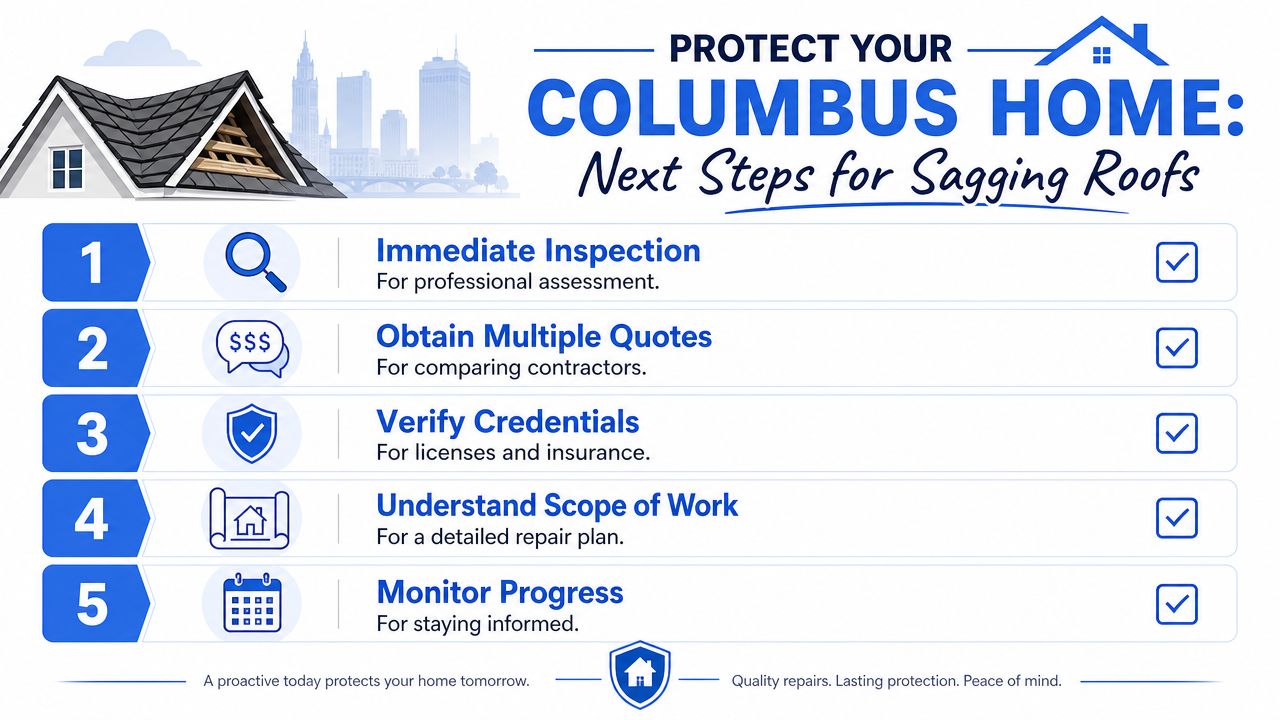
Use this checklist:
- Schedule an inspection quickly: Don't wait for the next hard rain or winter load to tell you more.
- Compare scopes, not just prices: A detailed quote should explain framing work, decking, roofing restoration, and whether permits or engineering are needed.
- Verify credentials carefully: Licensing and insurance matter, and if you want a broader read on how contractor requirements are discussed in other markets, this guide to UK contractor licenses is an interesting reference point for how oversight and qualifications affect homeowner protection.
- Ask what caused the sag: If the answer is vague, the repair plan probably is too.
- Get everything in writing: Especially if insurance may be involved.
The best next step is simple. Get the roof looked at before someone sells you a fix for the symptom instead of the structure.
If you've noticed a dip, bow, or uneven roofline in Columbus or central Ohio, HIBCO ROOF LLC can provide a no-pressure inspection and written estimate. Their team handles roof inspections, structural repair planning, storm and hail assessments, insurance claim support, and full roof replacement when repair no longer makes sense.