
$4.50 to $12 per square foot is the most useful starting range for a new roof in 2026, with the broader installed market stretching from $3 to $25 per square foot depending on material, pitch, labor, and tear-off conditions. On a typical roof, that's the number that gets you in the right neighborhood before anyone walks the deck.
That's the answer most homeowners in Columbus want when they've got a leak stain, a storm-damaged ridge, or a realtor asking whether the roof will hold up through inspection. The catch is that the quote on paper rarely matches the number in your head, because the roof itself decides a lot of the final price.
Table of Contents
- Why Homeowners Get Three Different Numbers for the Same Roof
- What Per Square Foot Actually Means in Roofing
- The Cost Drivers That Move Per Square Foot Pricing
- Material Choices and Their Per Square Foot Ranges
- Step-by-Step Example Calculations for Common Roof Sizes
- When Per Square Foot Pricing Meets Insurance and Financing
- How to Get an Accurate Estimate You Can Actually Compare
- Turning the Number Into a Real Project in Central Ohio
Why Homeowners Get Three Different Numbers for the Same Roof
A Columbus homeowner calls three roofers after a spring storm, and the quotes land miles apart. One comes in low, one sits in the middle, and one looks almost high enough to feel insulting. Same house, same shingles on the surface, same request for a roof replacement.
That gap usually isn't because one contractor can't read a tape measure. It's because each estimator decided how much to include in the number, how much to spell out, and how much to leave for later as a change order or “unexpected condition.” In roofing, the installed price per square foot became the common language because it forces everyone to talk about the same unit of work.
The number is a comparison tool, not the invoice
Per-square-foot pricing helps strip the job down to something comparable. It lets you compare labor, materials, and overhead without getting lost in a flat lump sum that hides the scope. A quote that looks cheap can be missing tear-off, decking repairs, flashing work, or disposal, while a pricier quote may be more complete.
Practical rule: if two bids don't list the same scope, they're not really the same price.
That's why the range matters more than a single headline number. Recent 2026 guides place most residential installed jobs around $4.50 to $12 per square foot, with broader installed pricing from $3 to $25 per square foot depending on the roof system and site conditions (RoofVista pricing guide). Another 2026 guide puts most replacements at $4,000 to $11,000 per 1,000 square feet, which is the same as $4 to $11 per square foot when you divide by 1,000 (NerdWallet roof replacement cost guide).
The hidden line items are where the spread comes from
The homeowner sees “new roof.” The contractor sees a bundle of decisions. Material tier, pitch, access, tear-off layers, ventilation, and flashing all push the number around. A quote can be wrong on paper and still be honest if it's based on a different scope.
That's why experienced roofers read bids like a checklist, not a promise. The job is to find out what's included, what's assumed, and what gets added once the old roof comes off.
What Per Square Foot Actually Means in Roofing
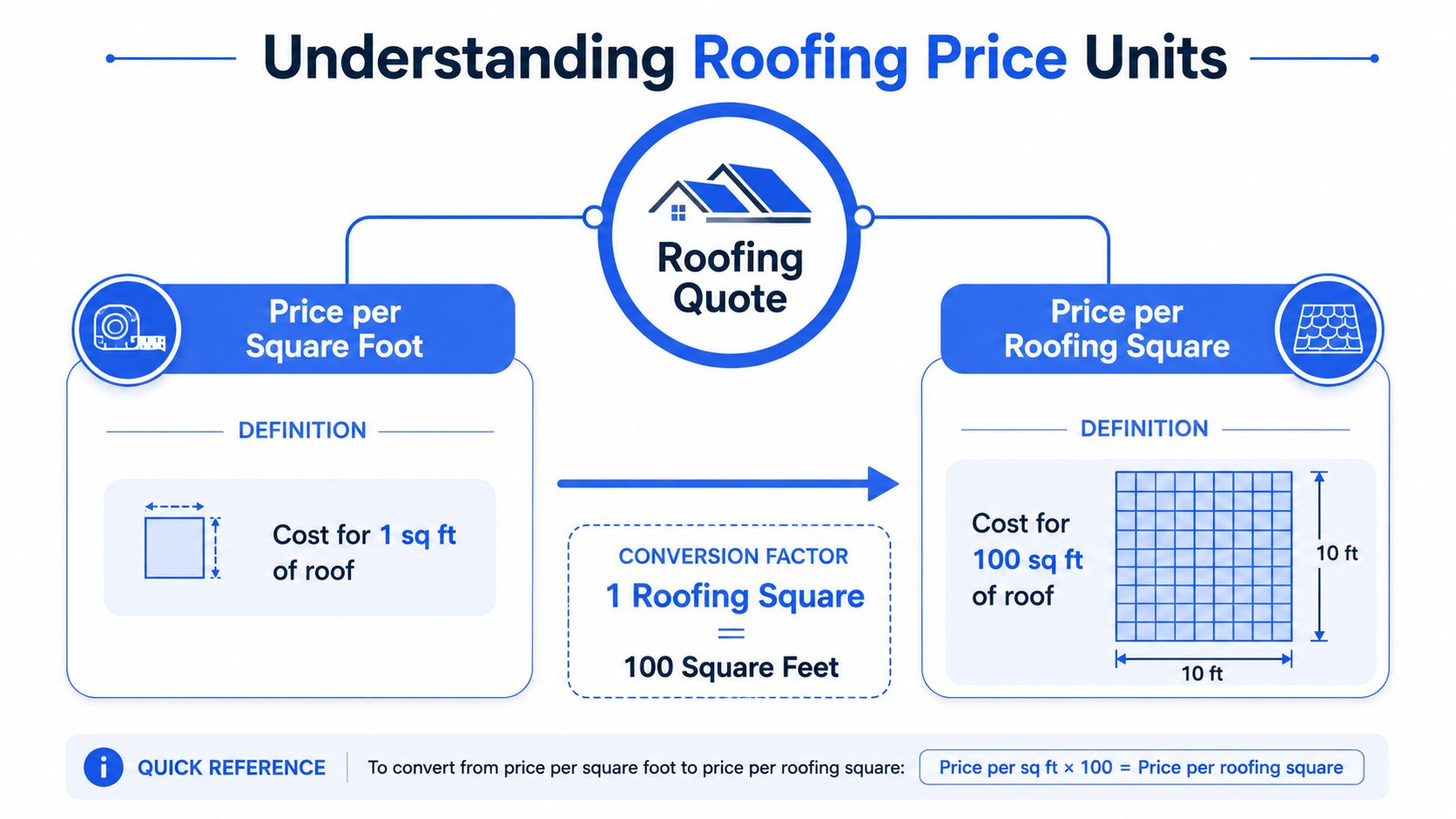
Roofing quotes usually use two units, price per square foot and price per roofing square. They describe the same thing in different ways, and one roofing square equals 100 square feet of roof surface (RoofVista pricing guide). That's why contractors like the square, materials are counted that way, and labor is easier to estimate that way.
Converting the numbers without doing mental math
If a contractor says $450 per square, that equals $4.50 per square foot. If another says $1,200 per square, that equals $12 per square foot. The math is simple, divide or multiply by 100.
That conversion matters because homeowners often hear both formats in the same week. One salesperson may quote the roof in squares because that's how bundles, underlayment, and labor are planned. Another may talk in per-square-foot terms because it feels closer to the size of a whole house.
Waste factor is already part of an installed price
Installed roofing prices already assume material waste, overlaps, cuts, and layout losses. You're not buying a perfect sheet of roofing material that covers every inch with no trim loss. Valleys, hips, ridges, and starter rows all consume extra material, and that's baked into real-world pricing.
A quote that sounds neat on paper still needs to explain the roof surface, not just the home's floor plan.
That's where many homeowners get tripped up. A 2,000-square-foot home doesn't necessarily mean 2,000 square feet of roof, because the roof surface is shaped by pitch and design. Contractors measure the roof, not the living room, then price the installed system from there.
The Cost Drivers That Move Per Square Foot Pricing
The big reason two roofs of the same size can land in different price bands is simple, the houses aren't the same job. Material, pitch, tear-off layers, structure, and roof details change both the labor time and the risk. On a Columbus replacement, those differences are usually more important than the raw square footage.
What pushes the number up
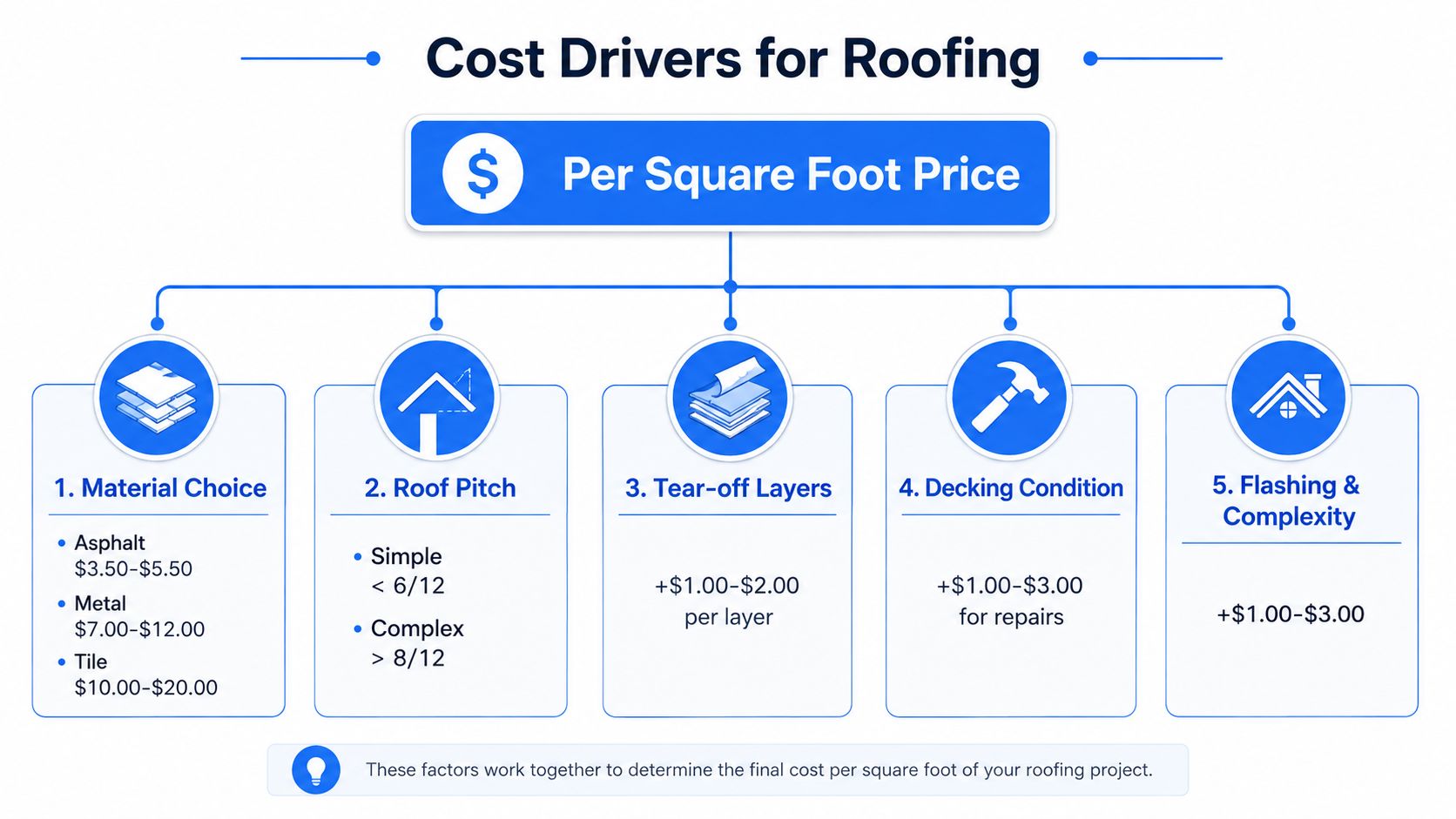
Material choice is the biggest lever. Asphalt sits as the baseline, while standing seam metal, tile, and slate rise because they need more specialized labor, heavier handling, and tighter installation detail. Recent pricing guides show the spread clearly, from standard asphalt into premium systems (RoofingCalculator material benchmarks).
Roof pitch and complexity change how safely and slowly the crew can work. A steeper roof takes more setup and more caution, and roof features like chimneys, valleys, skylights, and cut-up lines all require custom flashing and more cuts.
Tear-off layers matter too. Taking off one old layer is one thing. Removing a second layer adds disposal and labor, and the price rises because every square has to be stripped twice before the new system goes on.
Decking condition can turn a normal replacement into a repair job. Once the old shingles come off, rotten or soft wood has to be replaced before new underlayment and shingles can be installed. That's not optional if the roof deck can't hold fasteners.
What homeowners can control, and what they can't
Some costs are tied to the house itself. Pitch, existing layers, skylights, and the shape of the roofline are already there. Others are choices, like material tier, flashing upgrades, gutter scope, and whether you replace worn accessories while the crew is on site.
Good estimate habit: separate the roof you have from the roof you want.
Disposal fees, permits, ventilation changes, and insurance scope can also move the number, but the cost driver is usually the amount of labor the job demands. That's why a small, simple roof can be easier to price than a larger roof that's chopped up with hips, valleys, and penetrations.
Material Choices and Their Per Square Foot Ranges
Material choice is where the price bands stop looking abstract and start feeling real. Asphalt is still the baseline on most Columbus homes, while metal, tile, and slate climb fast because the install is more demanding and the system lasts longer. That trade-off is what makes the conversation about value, not just sticker price.
Installed cost by material
| Material | Installed Price per Sq Ft | Approx Total for 2,000 Sq Ft Home |
|---|---|---|
| 3-tab asphalt shingles | $3.43 to $4.65 | $6,860 to $9,300 |
| Architectural asphalt shingles | $4.11 to $5.57 | $8,220 to $11,140 |
| Standing seam metal | $12 to $30 | $24,000 to $60,000 |
| Tile or clay | $10 to $25 | $20,000 to $50,000 |
| Slate | $18 to $35 | $36,000 to $70,000 |
Those asphalt ranges come from installed U.S. pricing guides, while the premium-system ranges reflect the broader market spread in 2026 guides (RoofingCalculator, RoofVista pricing guide, Costorie roofing calculator). For a Columbus homeowner, that means a normal asphalt roof and a premium roof can sit in completely different budget tiers even if the house size is the same.
Why the premium systems cost multiples more
Metal, tile, and slate aren't just pricier material purchases. They take more precise fastening, more flashing integration, and more time on the roof. They also tend to be chosen for service-life reasons, which is why the upfront number is only part of the decision.
Asphalt is still the practical baseline for many local homes because it balances cost, availability, and installation speed. If you want a deeper look at how that plays out on a basic shingle replacement, this asphalt shingle roof replacement cost guide gives a useful local frame.
For homeowners comparing exterior projects, the logic isn't unique to roofing. If you've ever had to estimate window cleaning costs, you already know the problem, a surface-area number only makes sense once the scope is clear.
Step-by-Step Example Calculations for Common Roof Sizes
The cleanest way to use per-square-foot pricing is to walk the roof the way a contractor does, from size to material to scope. The examples below use the ranges already covered, then nudge them for pitch, tear-off, and complexity. They're not promises, they're defensible estimates that help you spot a bad bid fast.
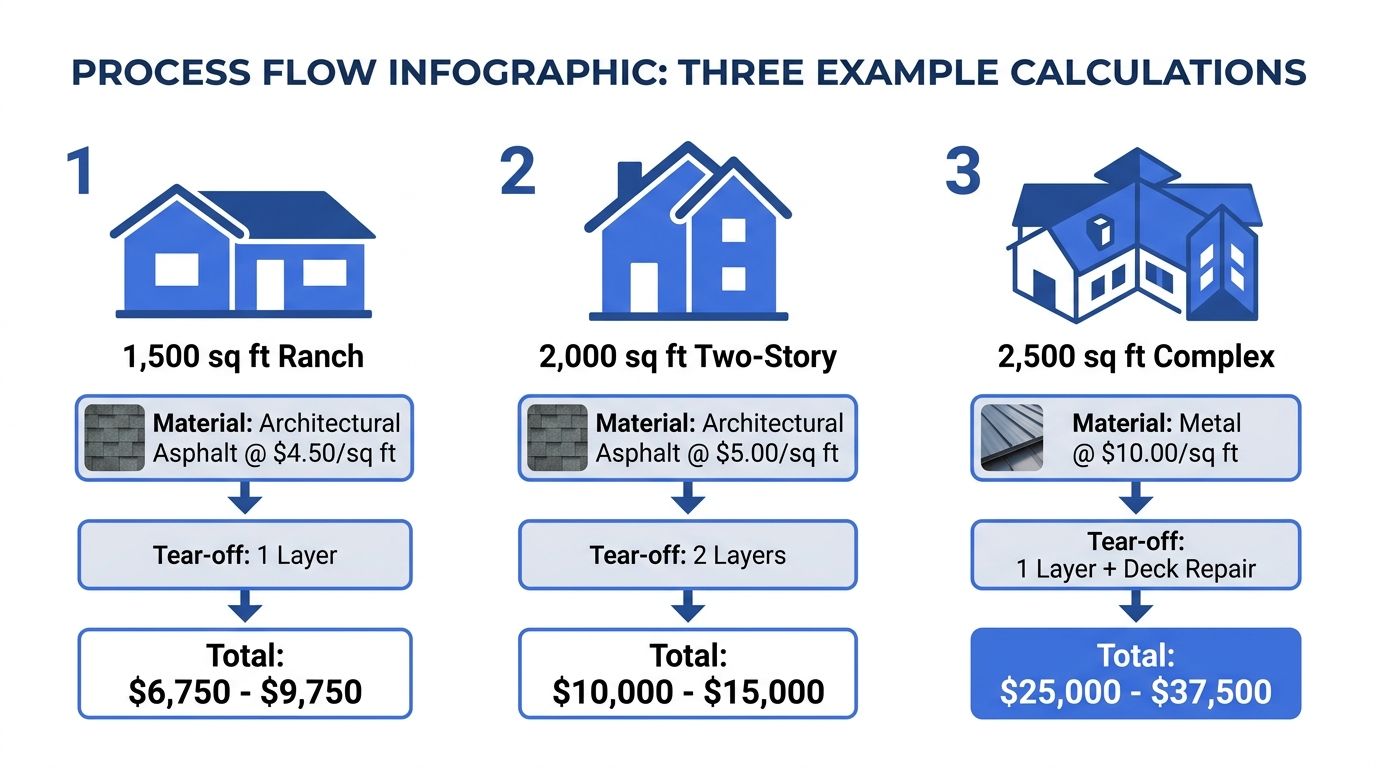
Example one, a 1,500-square-foot ranch
A single-story ranch with a moderate pitch and one layer to remove usually sits in the easier part of the market. If the homeowner chooses architectural asphalt, the installed range of $4.11 to $5.57 per square foot gives a base total of $6,165 to $8,355 before any roof-specific complications (RoofingCalculator).
A simple roof with straightforward access can stay near that band if the decking is sound and the flashing is routine. If the crew needs to replace a few weak areas or work around extra penetrations, the total drifts upward. That's still consistent with the market because the square-foot number already reflects installed labor, not just loose shingles.
Example two, a 2,000-square-foot two-story with steeper pitch
This job starts closer to the middle of the residential market, because the roof is larger and harder to work. A steeper pitch pushes labor up, and a second layer of tear-off adds more removal and disposal burden. If the roof also needs new flashing and ventilation, the installed number can sit comfortably above a basic shingle replacement.
Using the broad residential band of $4.50 to $12 per square foot, the projected installed total lands around $9,000 to $24,000 (RoofVista pricing guide). That spread looks wide because the scope is wide. A bid near the low end needs to show exactly what's included, or it isn't really comparable.
Example three, a 3,000-square-foot home with premium metal
Premium standing seam metal lives in a different pricing category. With installed ranges commonly quoted at $12 to $30 per square foot, a 3,000-square-foot roof can run from $36,000 to $90,000 (Costorie roofing calculator). If the roof is also complex and chopped up with valleys, hips, or dormers, the price usually sits toward the higher end of that band.
If your back-of-the-envelope total falls way outside the published range for the material, the bid deserves a second look.
That sanity check is the point. Use the material range first, then ask whether the roof shape, tear-off, and repairs explain why your number moved up or down.
When Per Square Foot Pricing Meets Insurance and Financing
The same roof can feel much cheaper or much more expensive depending on how it's paid for. On an insurance claim, the carrier's pricing scope and the documented damage usually drive the repair value, while the homeowner's real out-of-pocket cost is often the deductible plus any upgrades beyond the covered scope. For claim-specific context, advice from For The Public Adjusters is useful when you're trying to understand how coverage questions affect replacement timing.
Insurance claims change what the number means
Insurance work isn't a retail shopping trip. The claim process tends to anchor the project to damage, matching, and approved line items, not to the highest-end quote on the street. That means two identical roofs can produce different effective costs if one is a covered loss and the other is a straight cash replacement.
Upgrades are where homeowners often get surprised. If you choose a better system than what the policy scope covers, the delta comes out of pocket. That's not a bad decision by itself, but it needs to be understood before the job starts.
Financing turns the roof into a cash-flow decision
When a roof is financed, the per-square-foot price becomes a payment problem as much as a project cost. A slightly higher installed price for a longer-lasting system can still make sense if it reduces the chance of another replacement before you've finished paying for the first one.
The cheapest roof per square foot isn't always the cheapest roof over ownership.
That's especially true in storm-prone neighborhoods, where repeated damage or repeated repairs can erase the benefit of a low initial bid. The better question is whether the installed system fits the house, the weather, and the years you plan to stay there.
How to Get an Accurate Estimate You Can Actually Compare
A useful estimate names the roof area, the material, and every scope item that changes the price. If those details aren't in writing, the per-square-foot number can be misleading. A low bid often just means something valuable got left out.
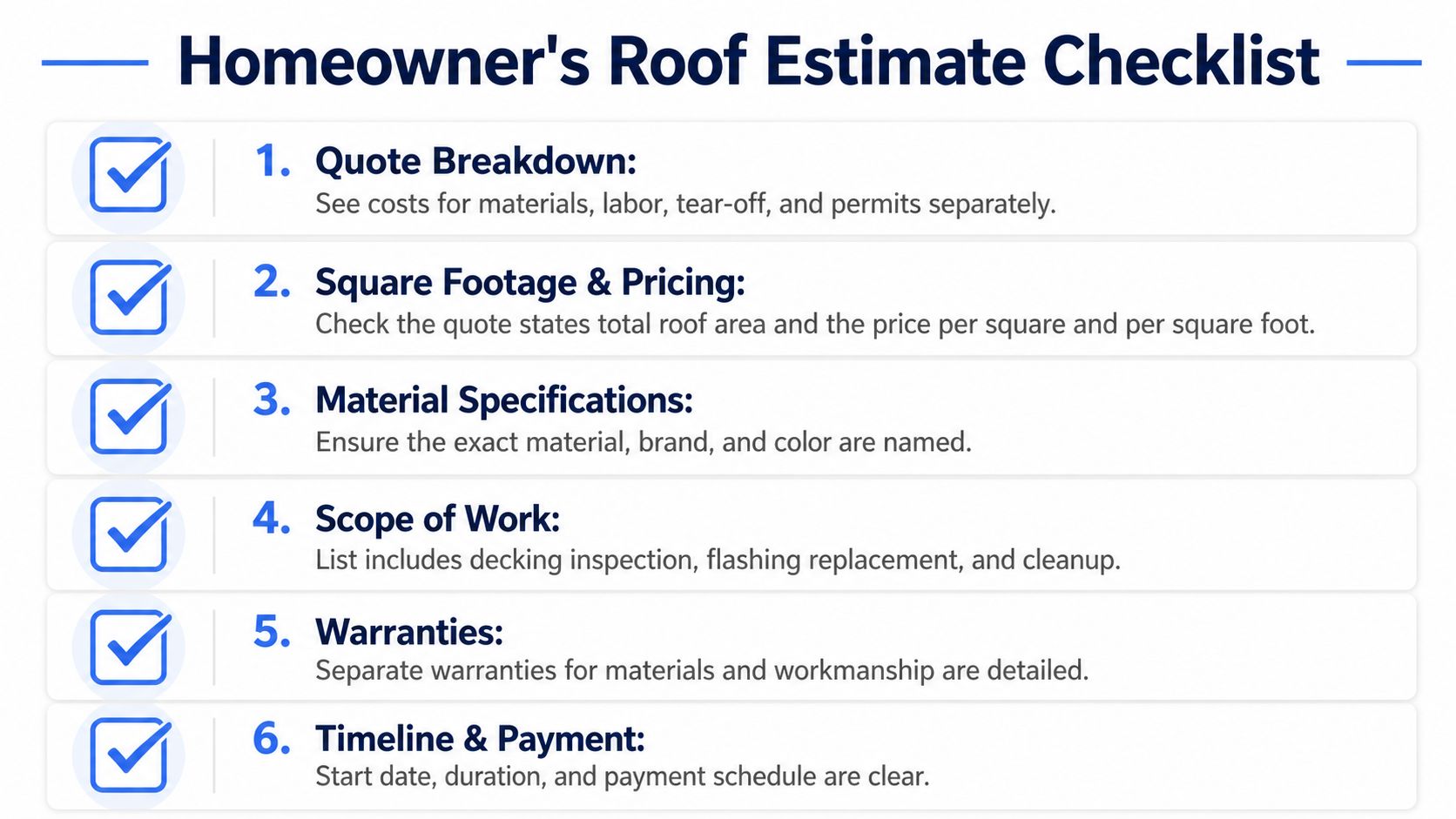
What every quote should spell out
- Roof area and unit basis: Make sure the quote states whether it's per square foot of roof or per square foot of home.
- Material specifics: Brand, style, and color should be named, not implied.
- Scope of work: Tear-off layers, flashing, underlayment, ventilation, decking allowance, cleanup, disposal, and permits belong on the page.
- Warranty terms: Separate material and workmanship coverage should be listed clearly.
- Timeline and payment schedule: You should know when the work starts, how long it's expected to take, and when money changes hands.
For contractor selection, this local roofing contractor guide is worth reading before you sign anything.
Ask each contractor if the price is locked or only an estimate, whether they're licensed and insured, and whether they install the manufacturer's system as specified. The most useful estimate is the one someone can walk you through line by line without dodging the hard questions.
Turning the Number Into a Real Project in Central Ohio
For Columbus and central Ohio homeowners, the per-square-foot number is just the starting point. A real roof project usually begins with a free inspection, a written estimate, and a scope that covers materials, labor, cleanup, and the details that keep the roof system watertight. On larger jobs, financing pre-qualification can help if you want to line up the payment before the crew arrives.
HIBCO ROOF LLC handles roof inspections, replacements, storm and hail assessments, insurance claim assistance, gutters, skylights, and related exterior work for local homeowners. If you're comparing a quote now, use the ranges in this article against a written estimate and see whether the number sits inside the normal band for your material and roof complexity. For a local benchmark on replacement pricing in the state, this Ohio roof replacement cost overview is a practical next read.
If you want a straight answer on your own roof, schedule a free inspection with HIBCO ROOF LLC. We'll look at the roof, explain the scope, and give you a written estimate you can compare against the per-square-foot ranges in this article.