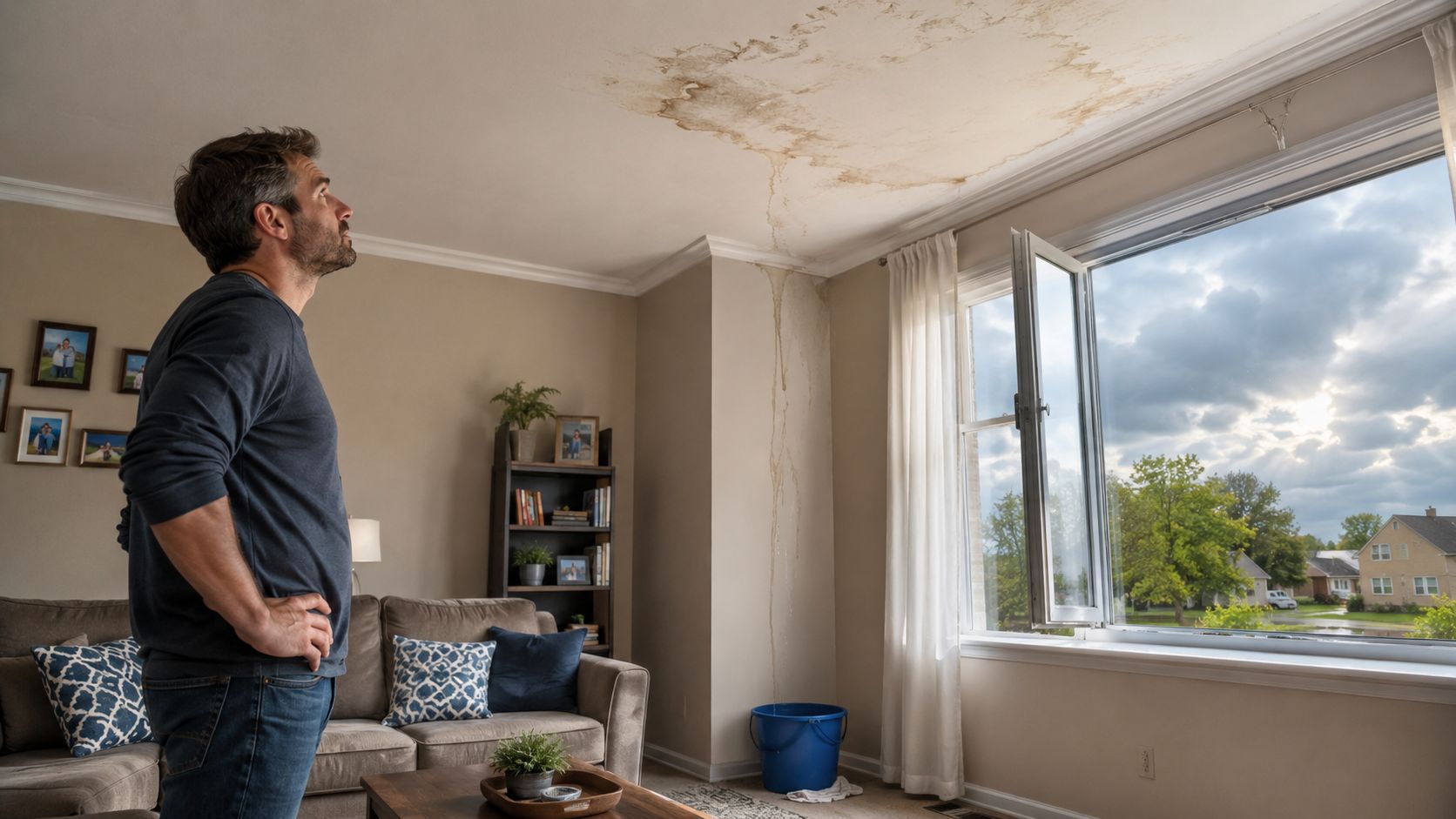
After a hard Columbus spring storm, a homeowner walks into the living room and spots a brown stain spreading across the ceiling. The shingles looked fine from the driveway, the gutters weren't overflowing, and nothing about the roof edge seemed urgent until the leak showed up inside. That's how roof edge problems usually work, they stay hidden until water has already found the weakest point.
Roof edge protection is the part of the roofing system that manages the perimeter of the roof, where wind, water, and worker safety all meet at once. It includes the drip edge tucked under the shingles, the membrane and metal details that move water away from the fascia, and the guardrails or fall-protection systems that keep roofers safe when the roof is open. Those two jobs, water control and fall prevention, are tied to the same edge.
Federal NIOSH and CDC materials note that falls to a lower level are the primary cause of fatal injuries in construction, with an average of 353 construction workers dying each year from falls to a lower level during 2006 to 2010, and 126 of those deaths per year, or 36 percent, involving unguarded roof edges, roof and floor holes, or skylights (CDC/NIOSH data). That's why the edge matters so much, even on a house that looks fine from the street.
For homeowners who want a plain-English breakdown while they compare roof work options, the 24/7 AI assistant for service businesses from Expressify AI can help organize questions before an inspection. And if you want a deeper look at the deck side of the roof system, see roof deck protection details.
Table of Contents
- What Roof Edge Protection Actually Does
- Types of Roof Edge Protection Systems
- Warning Signs Your Roof Edge Protection Is Failing
- Building Codes and Insurance Requirements for Roof Edges
- Costs, Lifespans, and Replacement Windows
- Questions to Ask Your Roofer About Edge Protection
- Protecting Your Home Starts at the Edge
What Roof Edge Protection Actually Does
A Columbus homeowner can have a roof that looks clean from the curb and still have a weak edge detail. I've seen ceilings stain after a heavy storm while the problem was not the middle of the roof at all, it was the perimeter, where runoff, flashing, and fasteners all have to work together. The edge is the place where a small installation miss becomes a water path.
Water management at the edge
The first job of roof edge protection is to guide water where it belongs. Drip edge and related edge metal keep runoff from curling back under the shingles and toward the fascia, and that matters in central Ohio because repeated wetting, freezing, and thawing can work water into wood that should've stayed dry. Once that starts, you don't just get a cosmetic stain, you get rot, soft trim, and future leak paths.
That's why edge work belongs in the same conversation as shingles and flashing. If the edge detail is wrong, a roof can shed water poorly even when the field shingles are still in decent shape. Homeowners often think in terms of “roof leak” or “gutter problem,” but edge failures usually sit between those two.
Worker protection during reroofing
Roof edge protection also means fall protection when a crew is working on your home. OSHA's general-industry walking-working-surface rule requires fall protection whenever an unprotected side or edge is four feet or more above a lower level, and the allowed protections include guardrail systems, safety net systems, and personal fall protection systems (OSHA interpretation). On a reroof, that's not a nice-to-have, it's the physical barrier that keeps a job from becoming a tragedy.
Practical rule: if the edge detail looks “close enough,” that's not enough. Water and fall hazards both concentrate at the perimeter, where tolerances matter more than appearance.
A useful way to think about it is this. The roof edge is like the hem of a coat, the part that gets hit first, wears fastest, and has to hold the whole piece together. If the hem fails, the rest of the coat doesn't matter much.
For more on how edge layers are sequenced during roof work, drip edge and gutter spacing is worth reading alongside this.
Why it matters on a real house
On a typical Columbus home, the edge is doing more work than many realize. It has to handle runoff, support proper shingle termination, and tolerate weather that swings from wet to frozen and back again. When that perimeter is built right, nobody notices it. When it's built wrong, the damage shows up in the fascia, the attic, or the drywall below.
Types of Roof Edge Protection Systems
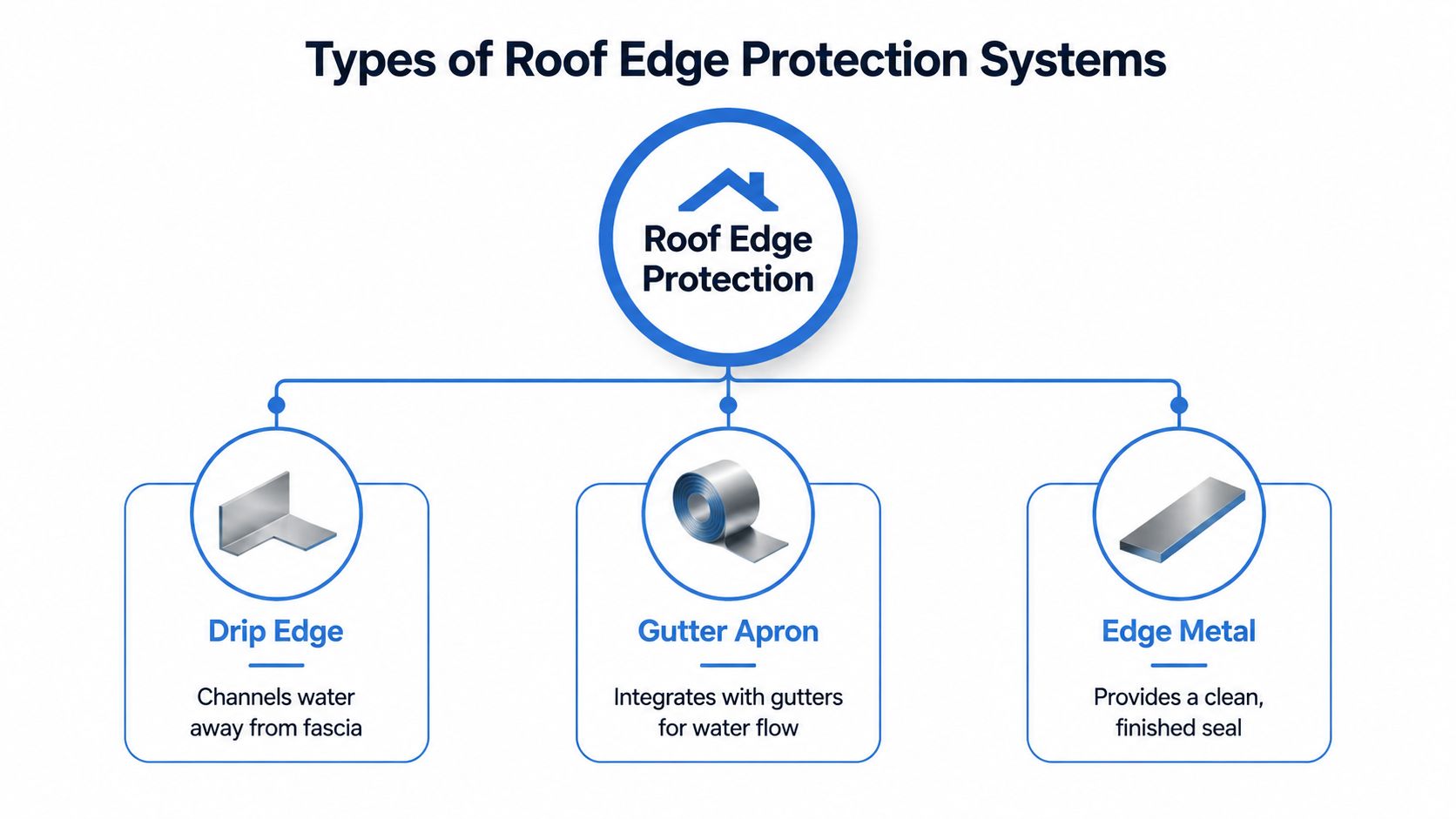
Roof edge protection isn't one product. It's a family of parts that do different jobs at the same perimeter line. The easiest way to sort them is to think about what each piece protects, water, structure, or people.
The water-control pieces
Drip edge is the thin metal flashing that sits at the roof perimeter and pushes water away from the fascia. It's one of those details you barely notice when it's right, but you'll notice fast when it isn't. In a healthy system, it helps runoff move cleanly into the gutter instead of sneaking back under the roofing layers.
Gutter apron is closely related, and on some roofs it's the better description for the metal that bridges the roof edge into the gutter line. If you're dealing with gutter replacement or roof replacement together, that transition matters because water doesn't care which trade owns the line. It only follows the weakest overlap.
Edge metal is the broader term for the finished metal termination at the perimeter. On some homes, especially where the roof is being reworked with upgraded materials, the edge metal is part of a cleaner, more durable assembly that helps define how the roof sheds water.
The membrane and fascia interface
In Ohio, the membrane at the eave matters because freeze-thaw weather punishes weak spots. A self-adhering membrane helps seal the vulnerable edge zone, especially where water can back up under shingles during storms or ice events. The fascia and gutter interface is where older central Ohio homes often show trouble first, because that's where the roof edge meets the vertical trim and the drainage path.
A roof edge can look finished and still be wrong underneath. The visible metal is only part of the system.
Temporary and permanent fall protection
When a crew is on the roof, guardrails may be temporary or permanent depending on the job. Safety guidance specifies that temporary edge protection should have no gap between the roof edge and guardrail exceeding 100 millimeters, a clear distance from roof cladding to the bottom rail of 150 to 275 millimeters, and a top rail at least 900 millimeters high (SafeWork NSW guidance). Those dimensions matter because a guardrail that looks present can still leave dangerous openings.
For homeowners who want to compare installation logic with training expectations, Australian working at heights training is a useful reference point for how seriously the industry treats perimeter safety. The practical takeaway is simple, the edge has to fit the roof, not just sit near it.
For a local look at membrane sequencing at the perimeter, ice and water shield installation details connects the edge pieces to the rest of the roof system.
Warning Signs Your Roof Edge Protection Is Failing
Most homeowners don't discover edge problems by climbing a ladder. They see them from the driveway, or they notice the inside damage after the outside clues were already there. That's why the first inspection should be visual and simple, not risky.
Clues you can spot from the ground
Granules collecting in gutters are a warning sign, especially when the roof is older and the edge is the first place to lose its protective surface. If the edge metal is doing its job, the shingles at the perimeter hold up longer and the runoff path stays cleaner. When the edge starts failing, the gutter often becomes the evidence tray.
Rust-colored streaks on fascia boards are another clue. So are gutters that look like they've pulled away from the roofline or developed a sag near the eaves after seasons of expansion and contraction. In central Ohio, that movement matters because repeated freezing and thawing puts stress on metal fasteners and small overlaps.
What the warning signs usually mean
A visible gap at the drip edge or along the fascia line often means water can move behind the surface instead of into the gutter. That hidden movement is what leads to soft wood, peeling paint, and eventually interior leaks. The problem is rarely one dramatic failure, it's a sequence of small openings.
Ground-level inspection is a starting point, not a diagnosis. If you can see staining, separation, or pulled fasteners from the yard, the edge deserves a closer look.
The contrarian point is important here. A system can be installed to code and still fail to protect the home if the actual roof geometry doesn't match the details on site. Gutters, gables, and uneven edge lines can turn a seemingly correct installation into a leaky one when the clearances and overlaps aren't right.
That's why a homeowner should treat the driveway view as the first clue, not the last word. If the perimeter looks tired, don't wait for ceiling damage to confirm it.
Building Codes and Insurance Requirements for Roof Edges
A roof edge can look fine from the driveway and still fail the rules that govern how the work gets done. OSHA's walking-working-surface rule sets the broad threshold at four feet or more above a lower level for fall protection in general industry, and the accepted options include guardrails, safety nets, and personal fall protection systems (OSHA interpretation). That standard shapes how contractors set up the job before the first piece of metal or shingle comes off.
How the roof-work zones change the controls
Roof work is often divided by distance from the edge because the exposure changes fast. The nearest zone, less than 6 feet, calls for the strongest controls, such as guardrails, safety nets, travel restraint, or personal fall arrest systems. The middle zone, 6 to 15 feet, still needs controlled access and task-specific fall protection. The outer zone, 15 feet or more, carries less exposure, but it still depends on a planned setup.
| Distance from Edge | Zone Classification | Required Protection Measures |
|---|---|---|
| Less than 6 feet | Highest exposure zone | Guardrails, safety nets, travel restraint, or personal fall arrest systems |
| 6 to 15 feet | Intermediate exposure zone | Controlled access and fall protection suited to the task |
| 15 feet or more | Lower exposure zone | Reduced exposure, but still governed by site safety planning |
That matters for a homeowner because the safety plan usually reveals how the rest of the job will be handled. A crew that is careful at the perimeter is more likely to be careful with sequencing, flashing, and cleanup. A crew that is casual near the edge can leave behind a sloppy gutter transition or a weak spot where water starts to work behind the fascia.
What insurance and inspection people care about
Insurance adjusters and home inspectors look for documentation, clear scope, and perimeter details that were treated as part of the job instead of an afterthought. A contractor who can explain the edge protection plan clearly is usually easier to trust on claim paperwork too. That does not guarantee approval, but it can reduce friction when storm damage is part of the file.
For homeowners comparing safety-minded contractors, temporary stair railing options show the same basic principle in another setting. A barrier only works when the geometry is right.
If you are comparing sequencing on the roof deck side as well, roof deck protection guidance is a useful companion reference.
Costs, Lifespans, and Replacement Windows
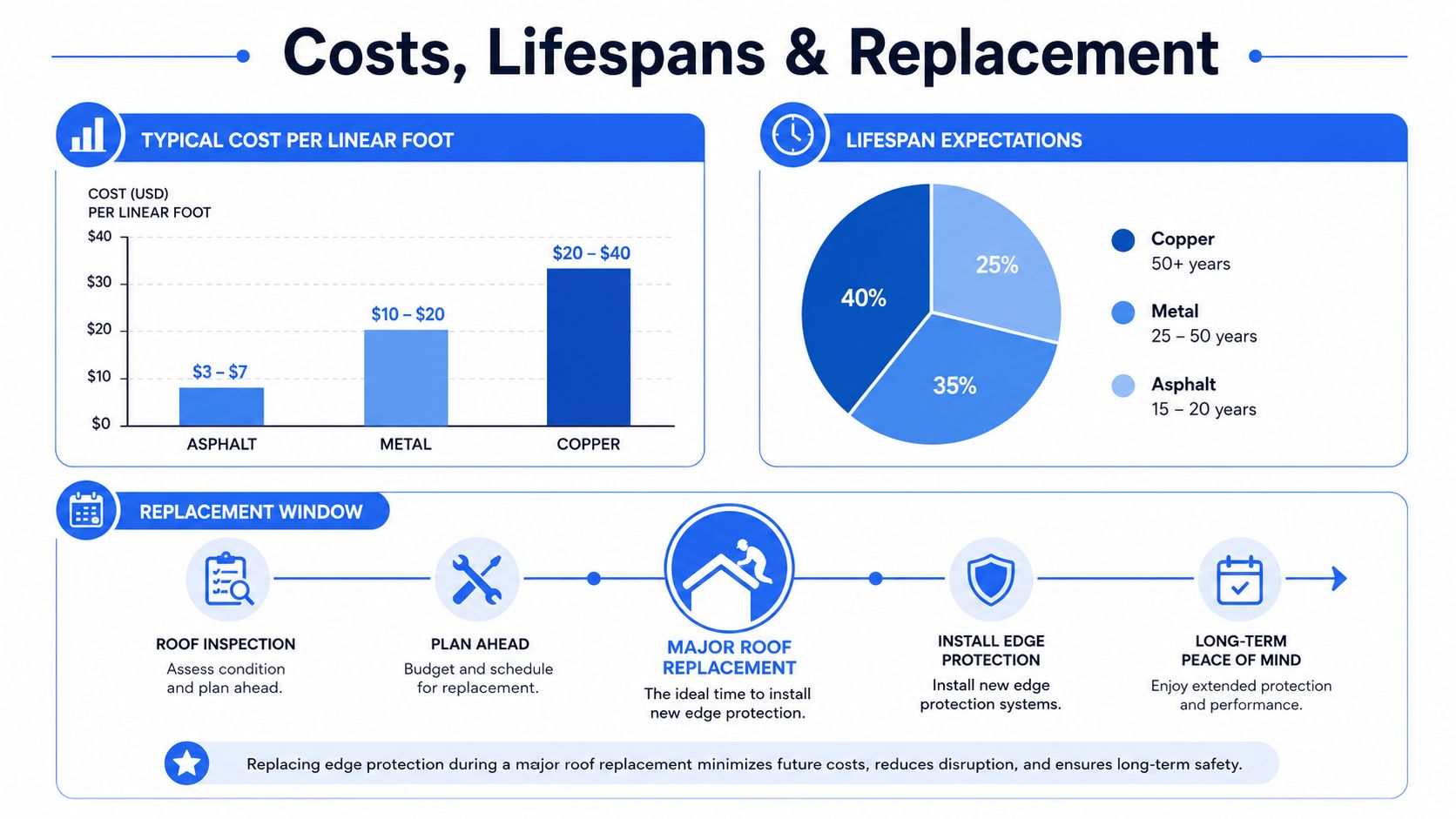
The money question is usually simpler than people expect. Most edge protection is cheap compared with the damage it prevents, but the details matter because some parts are long-lived and others age out faster. In central Ohio, you want to think in terms of the whole roof cycle, not just the current leak.
What lasts and what doesn't
Drip edge and edge metal usually last as long as the roof unless they're bent, installed poorly, or damaged by storm debris. They're the perimeter hardware that should go in with the reroof and stay put through the roof's service life.
The membrane at the eave is different. Independent guidance emphasizes fully adhered membranes, code-compliant drip edges, mechanically fastened edge details, and secure cladding at eaves and gables, while market reports describe a shift toward modular, lightweight, tool-free systems, non-penetrating designs that preserve roof warranties, and inspection tracking improvements (PNNL guidance). In practice, that means the industry is moving toward cleaner installs that are easier to maintain and less likely to compromise finished roofing.
The replacement decision
The best time to upgrade edge protection is usually during a major roof replacement, when the old layers are already coming off. That's when the crew can rework the perimeter cleanly instead of trying to patch around old metal or rotted fascia. It's also when homeowners get the most value from upgrades that preserve warranty conditions and avoid rework later.
| Component | Typical Replacement Window |
|---|---|
| Drip edge and edge metal | Usually with the roof, unless damaged |
| Membrane at the eave | Earlier than metal if weather exposure is heavy |
| Gutter and fascia interface | Often first to show failure and most involved to replace |
One practical way to look at it is this, a modest edge-protection investment during a reroof can prevent much bigger repair bills later if water gets behind the fascia and into the structure. That's not a theory, it's how small perimeter failures turn into bigger envelope problems.
Questions to Ask Your Roofer About Edge Protection
The right contractor should be able to talk about the roof edge without sounding vague. If they can't explain how the drip edge ties into the gutter line, they probably don't have a clean plan for the rest of the assembly either. Good questions filter out rushed crews fast.
Questions that separate careful roofers from shortcut takers
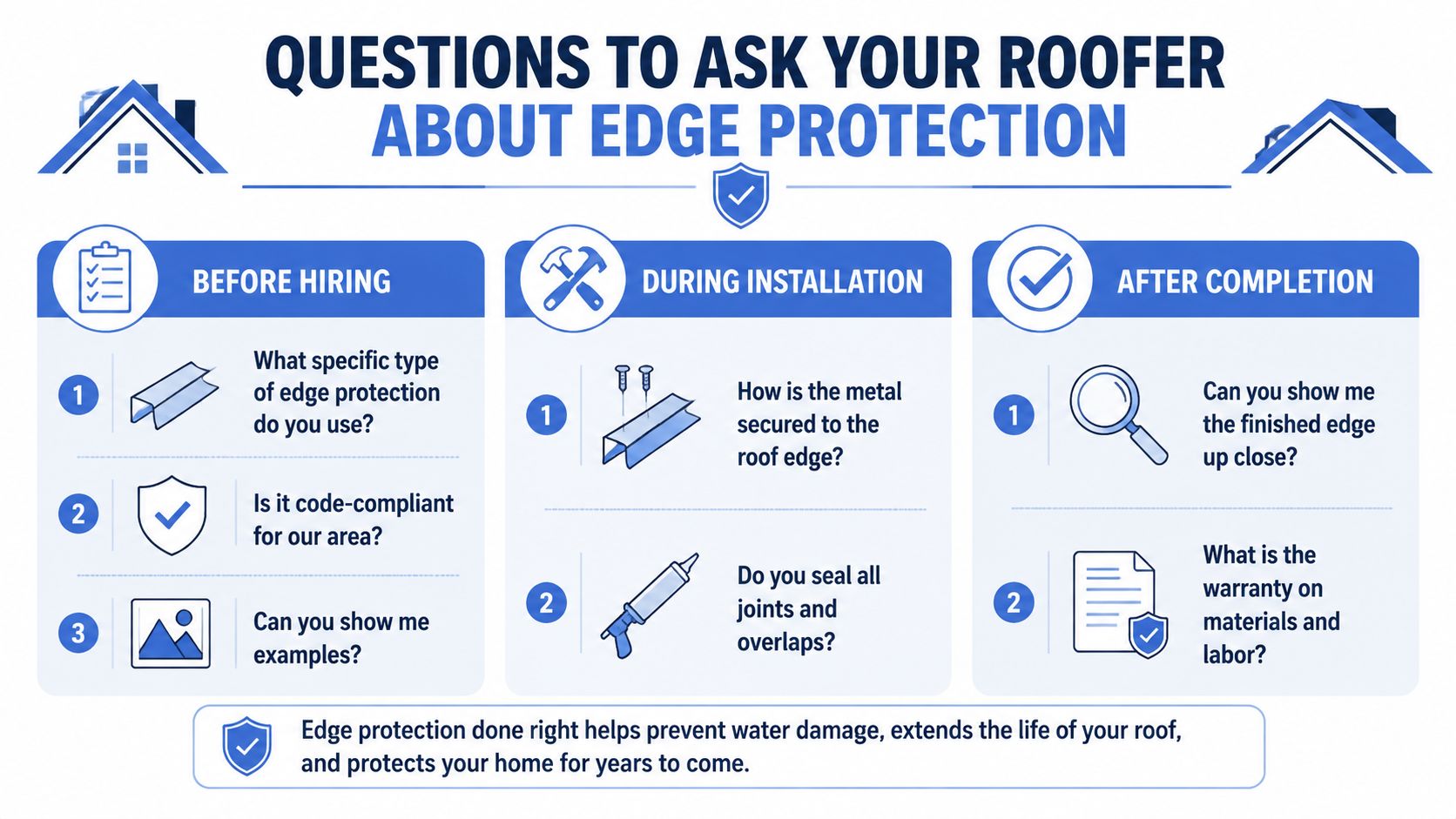
Before you sign anything, ask what specific type of edge protection they use and whether it matches the roof's layout. Ask how they handle the drip edge placement, how they secure the metal, and whether the membrane runs fully to the eave where it should. If a contractor can't explain that in plain language, that's a problem.
During the job, ask how they handle overlaps, joints, and the fascia-to-gutter transition. If the edge is tight, uneven, or full of patched gaps, the finished roof can still shed water poorly even if the shingles look sharp. That's especially true on older Columbus homes where the trim line isn't perfectly straight anymore.
After the job, ask to see the finished edge up close and ask for a written warranty on materials and labor. The contractor who is comfortable showing the perimeter finish usually did the perimeter right. The one who avoids the question may have something to hide.
Red flags that should make you pause
- No drip edge at all: If they want to skip it, walk away.
- Nailed-through membrane without explanation: Membranes should be handled according to the assembly, not punctured carelessly.
- Vague answers about edge safety: A crew should be able to explain its fall protection plan clearly.
- Pressure to sign immediately: A detailed written estimate should come first.
For a homeowner, the edge conversation is also a safety conversation. A roofer who treats the perimeter carefully is usually more disciplined with the rest of the project too. That's why the questions matter before any ladder goes up.
Protecting Your Home Starts at the Edge
A roof edge can look finished and still be one bad storm away from failure. That's the part homeowners miss from the driveway, because the edge is where water control, trim protection, and worker safety all overlap. When that line is built right, the whole house benefits.
For Columbus homes, that matters more than ever because the weather keeps testing every seam, every fastener, and every bit of wood at the perimeter. The difference between a durable roof and a problem roof often starts with the edge detail nobody notices until it's too late. If the fascia is already stained, the gutters are separating, or the edge metal doesn't look right, don't shrug it off.
A free, no-pressure inspection is the easiest way to find out whether the roof edge is still doing its job. Once you know what to look for, you can make a smarter call on repair, replacement, or gutter work before the damage spreads.
HIBCO ROOF LLC helps Columbus and central Ohio homeowners inspect roof edges, spot leak sources, and plan repairs or full replacements when the perimeter details aren't holding up. If you want a clear, practical look at your roof edge protection, visit HIBCO ROOF LLC to request a free estimate and get a no-pressure inspection scheduled.