

Aluminum gutters usually cost about $6 to $12 per linear foot installed, and a 200-foot system often lands around $1,200 to $2,400. A change of just $2 per foot can move that total by about $400, which is why two quotes for what sounds like the same job can come back surprisingly far apart.
If you're sitting at the kitchen table with two estimates and wondering why one contractor is higher, you're asking the right question. The cost of aluminum gutters isn't just about aluminum. It's about how many feet your home needs, how the roof is shaped, whether the installer is making long clean runs or working around corners and height, and whether your quote includes the pieces homeowners often miss on the first read.
Table of Contents
- What Seamless Aluminum Gutters Are and Why They Cost More
- How Much Seamless Aluminum Gutters Cost Per Foot Today
- Seamless Versus Sectional and Choosing the Right Gutter Size
- What Drives Your Final Quote Beyond the Per Foot Price
- Material Grades Profiles and Labor Factors That Change Cost
- Financing Options and Long Term Return on Your Gutter Investment
- Planning Your Seamless Gutter Project With Confidence
What Seamless Aluminum Gutters Are and Why They Cost More
You get two quotes at the kitchen table. Both say aluminum. One is higher, and the difference does not make sense at first glance.
The missing piece is how the gutter is made and installed.
Aluminum gutters can be formed on site in one continuous run, instead of pieced together from shorter factory sections. That changes the job in two ways. First, there are fewer joints along the straight runs, which means fewer places for water to work its way out over time. Second, the installer is not just hanging parts from a box. The installer is measuring your house, shaping the metal at the property, and fitting each run to the roofline.
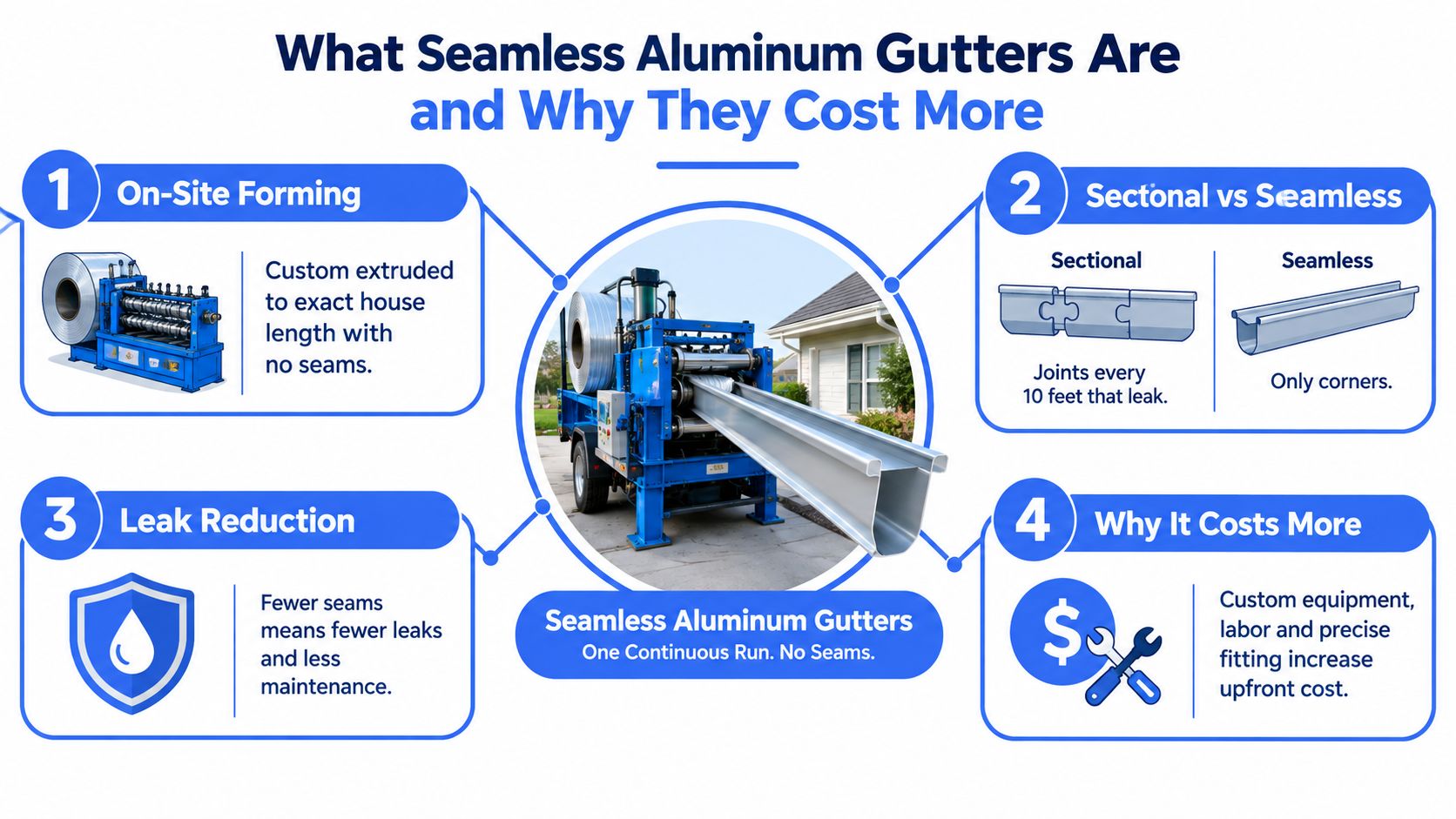
Think custom trim, not off-the-shelf pieces
Custom trim is a good comparison. If you build a long trim line from several short pieces, every connection is a spot that can separate, swell, or show movement later. A gutter works the same way. More joints usually mean more places to seal, more places to watch, and more places that can fail first.
That helps explain why the price is often higher. Part of the quote is unavoidable. The crew needs a forming machine, coil stock, careful measurements, and time to produce each long run on site. Part of the quote can still move up or down. Longer runs are usually simpler than a roofline with many corners, tie-ins, height changes, and tricky downspout locations.
That is the part many homeowners miss. The material matters, but the total often moves more because of house-specific complexity than because one aluminum coil is radically different from another.
Why the higher quote can still make sense
Cost guides commonly note that custom-formed systems run higher than sectional aluminum because you are paying for fabrication and fitting, not just the metal itself.
A practical way to read the estimate is this: one part covers the gutter itself, and another part covers the work required to make it fit your home cleanly. If two quotes use similar aluminum, the higher price often reflects labor, setup, and reduced joint count more than a dramatic jump in raw material cost.
For homeowners who have dealt with drips at seams or repeated resealing, that added cost can solve a recurring problem instead of changing the look.
How Much Seamless Aluminum Gutters Cost Per Foot Today
A homeowner in Columbus might hear two numbers for the same house and wonder why one quote is a few hundred dollars higher. The answer usually starts with the footage, then shifts to the parts of the quote that are required versus the parts that can change.
Current pricing guides commonly place installed aluminum gutters at about $6 to $12 per linear foot, while some contractor-market and 2026 pricing summaries put the range closer to $9 to $13 per foot depending on gauge and local labor. On a typical home, 150 to 200 linear feet often puts the project around $900 to $2,400 according to this seamless gutter cost guide from HomeGuide and this aluminum gutter pricing summary.
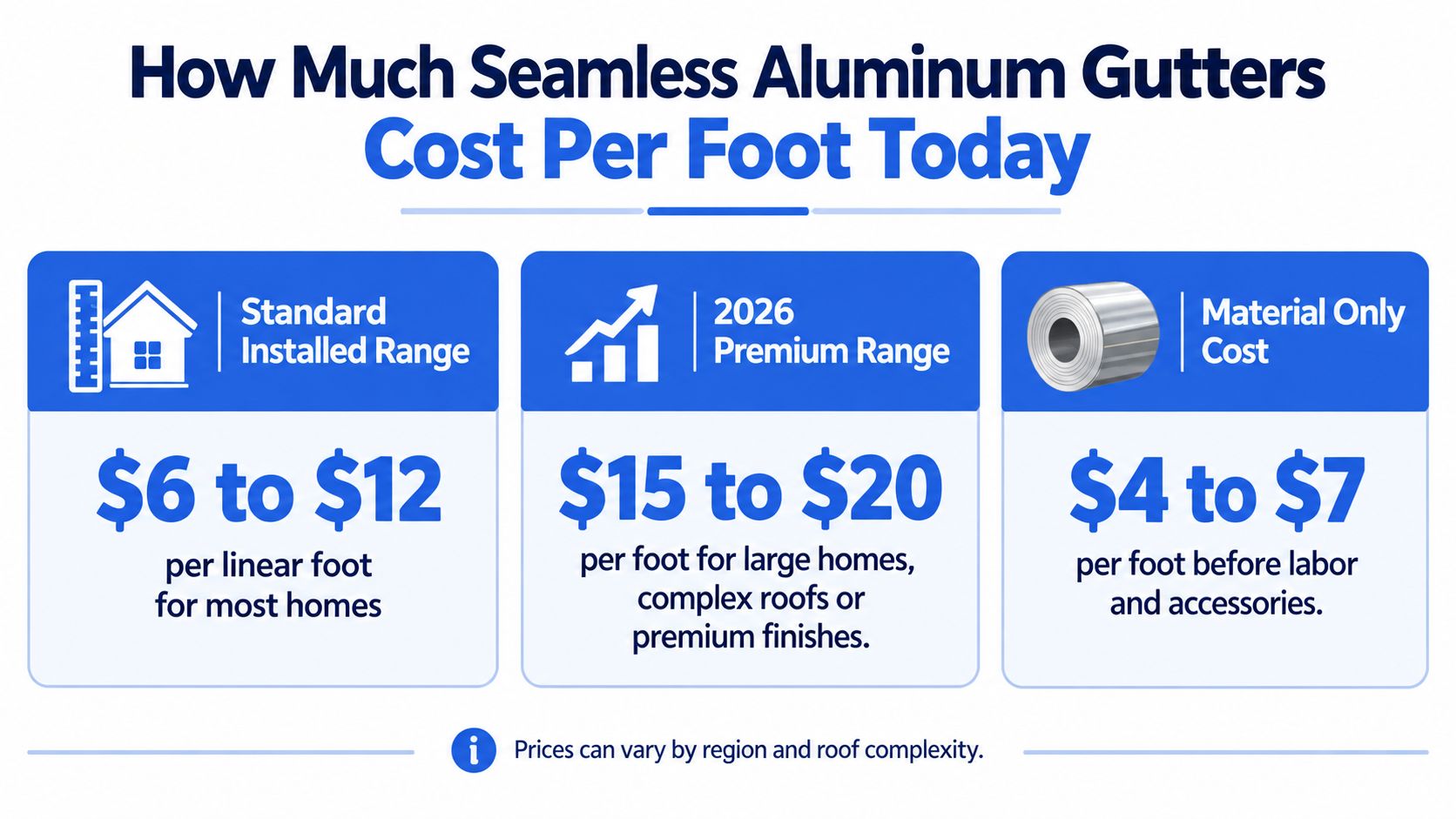
How to read the per-foot number
Gutters are priced a lot like fencing or baseboard trim. The contractor measures the total roof edge that needs protection, then applies a per-foot rate.
That makes the footage the required part of the quote. If your house needs 180 feet, nobody can price 140 feet and still do the job correctly.
A simple example shows how the math works:
- A 150-foot home at $6 per foot comes out to about $900.
- That same 150-foot home at $12 per foot comes out to about $1,800.
- A 200-foot home at $6 per foot comes out to about $1,200.
- A 200-foot home at $12 per foot comes out to about $2,400.
That is why measurement matters so much. A quote is really length multiplied by a rate, plus the house-specific details wrapped into that rate.
Where the total is fixed, and where it can move
Homeowners often focus on the metal itself, but material is only one piece of the bill. Some quote drivers are hard to avoid. The crew still has to measure accurately, bring the equipment, form each run, hang it correctly, and make sure water has a clear path to the downspouts.
Other drivers are more flexible. A larger profile, tougher access, more corners, extra downspouts, thicker aluminum, or old gutter removal can all push the per-foot number up. On a simple ranch, the rate may stay near the lower end. On a taller home with bump-outs and tricky roof lines, the same aluminum can cost more to install because the labor takes longer and the setup is harder.
That is the part many homeowners miss.
A small change in the per-foot rate spreads across the whole house. As noted in The Roofing Brief's cost breakdown for aluminum gutters, a $2 per-foot difference changes a 200-foot project by about $400.
What a clear quote should show
A useful estimate should break out the drivers behind the total so you can see what is required and what is optional. If a contractor only gives one lump sum, ask how much of that price comes from footage, profile size, downspouts, removal, and labor conditions.
If you want a plain-language example of how service scope should be explained, this professional gutter service contractor page is a good reminder that clear descriptions help homeowners compare quotes fairly.
The goal is not just finding the lowest number. It is understanding which parts of the quote are tied to your home's measurements and which parts reflect choices or added complexity.
Seamless Versus Sectional and Choosing the Right Gutter Size
Two neighbors can have houses that look almost the same from the street and still get very different gutter quotes. One difference may be the gutter type. Another may be the size. Those two choices often change the total more than homeowners expect, because they affect both material use and install time.
Continuous-run versus sectional on cost and upkeep
Sectional aluminum gutters are put together from shorter pieces joined along the run. Continuous-run aluminum gutters are formed to longer lengths for each section of roofline, which cuts down on the number of joints between corners and ends. If you want a field-level picture of how those systems differ, this guide to seamless vs. sectional gutters shows the side-by-side layout clearly.
That joint count matters.
More joints usually means more connection points to seal, more spots to maintain, and more labor decisions during installation. Fewer joints usually means a higher starting price, but less fuss along the straight runs later. As a broad cost comparison, HomeGuide's gutter pricing overview notes that sectional gutters are generally cheaper upfront, while custom-formed gutter systems cost more because they are measured and made for the house.
| Feature | Continuous-Run Aluminum | Sectional Aluminum |
|---|---|---|
| Installation style | Formed to longer lengths for each run | Assembled from shorter pieces |
| Upfront cost | Usually higher | Usually lower |
| Joint count | Fewer joints along straight runs | More joints throughout |
| Leak risk | Lower along long runs because there are fewer seams | Higher because more seams can loosen or fail |
| Maintenance feel | Often less attention at mid-run joints | Often more resealing and seam checks |
| Long-term value | Often chosen for lower leak potential | Often chosen for lower initial spend |
A simple way to look at it is this: sectional systems are a bit like snapping together shorter fence panels, while continuous-run gutters are closer to using one long board cut to fit. Both can work. The longer custom-fit piece usually costs more to install, but it creates fewer break points.
Why gutter size changes the quote
Size is where a lot of quote confusion starts. Homeowners may compare a lower bid for a 5-inch system against a higher bid for a 6-inch system and assume the contractor with the lower number is cheaper. In many cases, the quotes are not equal to begin with.
The common choice is 5-inch or 6-inch K-style. The larger profile uses more metal, often needs larger accessories, and may call for a different downspout plan. That makes size one of the quote drivers you can usually see on paper, even before labor conditions are discussed.
When 6-inch gutters make sense
A larger gutter often fits homes with:
- Steep roof planes: Water reaches the edge faster and with more force.
- Large roof areas feeding one run: More water enters the same gutter section during a storm.
- Past overflow problems: Capacity may be too tight for the house's runoff pattern.
- Heavy tree debris or higher-volume downspout needs: A bigger system can pair better with a stronger drainage setup.
A 5-inch system is often enough on a simple home with moderate runoff. A 6-inch system makes more sense when the roof collects and dumps water fast. The difference is a little like choosing between a standard driveway drain and a wider trench drain. If more water has to move through the opening, the larger path can prevent backup.
That is why size is partly a performance decision and partly a cost decision. Material price matters, but the bigger question is whether the house needs the added capacity. A low quote on an undersized gutter can look good on paper and still be the more expensive choice if overflow, clogs, or premature replacement show up later.
What Drives Your Final Quote Beyond the Per Foot Price
Most online pricing articles stop too soon. They give you a range, but they don't help you sort the quote into unavoidable drivers and variable choices.
Broader pricing summaries place gutters around $6 to $20 per linear foot installed, with some sources narrowing typical aluminum installs to $6 to $12 or $7 to $13 per foot, while broader gutter estimates can run as high as $8 to $28 per foot depending on home complexity and add-ons; that means a 150-foot job can range from roughly $900 to $3,000+ before extras like downspouts, tear-off, fascia repair, or steep-roof labor are counted, as explained in Big River Roofs' discussion of seamless gutter pricing spread.

The unavoidable parts of a quote
Some line items aren't sales fluff. They're built into the house itself.
- Linear footage: More roof edge means more gutter. This is the biggest baseline driver.
- Corners and layout: A straight ranch is simpler than a house with multiple turns and roof sections.
- Height and access: Working on a taller or harder-to-reach roof takes more labor and setup.
- Old system removal: If existing gutters need to come off and be hauled away, the quote rises.
These items are hard to argue with if they're documented correctly. They reflect the physical job.
The negotiable or adjustable parts
Other choices depend on performance goals, appearance, or how complete you want the project to be on day one.
| Quote driver | Usually unavoidable or variable | Why it changes cost |
|---|---|---|
| Gutter length | Unavoidable | It's based on actual measurement |
| Roof height | Unavoidable | Safety and labor time increase |
| 5-inch or 6-inch profile | Variable | Larger systems use more material and accessories |
| Downspout count and layout | Variable within reason | Drainage design changes parts and labor |
| Color and finish | Variable | Some options may price differently |
| Gutter guards | Variable | Added product and installation work |
| Fascia repair | Unavoidable if damage exists | Gutters need sound attachment points |
If you want another homeowner-focused example of how replacement quotes can be broken down, this page on gutter replacement cost follows the same logic: total cost comes from scope, not just a single advertised rate.
How to read a quote without getting lost
Start with the foot count. Then ask three plain questions:
- What part of this total is tied to the house and can't really change?
- What part changes if I stay with a 5-inch profile, standard color, and basic downspout layout?
- What extras are being included now so I don't get surprised later?
Kitchen-table test: If a contractor can't explain why the total changed in plain language, the estimate still isn't clear enough.
That approach keeps you from focusing only on the per-foot number while missing the items that swing the final bill.
Material Grades Profiles and Labor Factors That Change Cost
Two homes can both need aluminum gutters and still get very different quotes. The reason is simple. "Aluminum" names the metal, but it does not describe the full job.
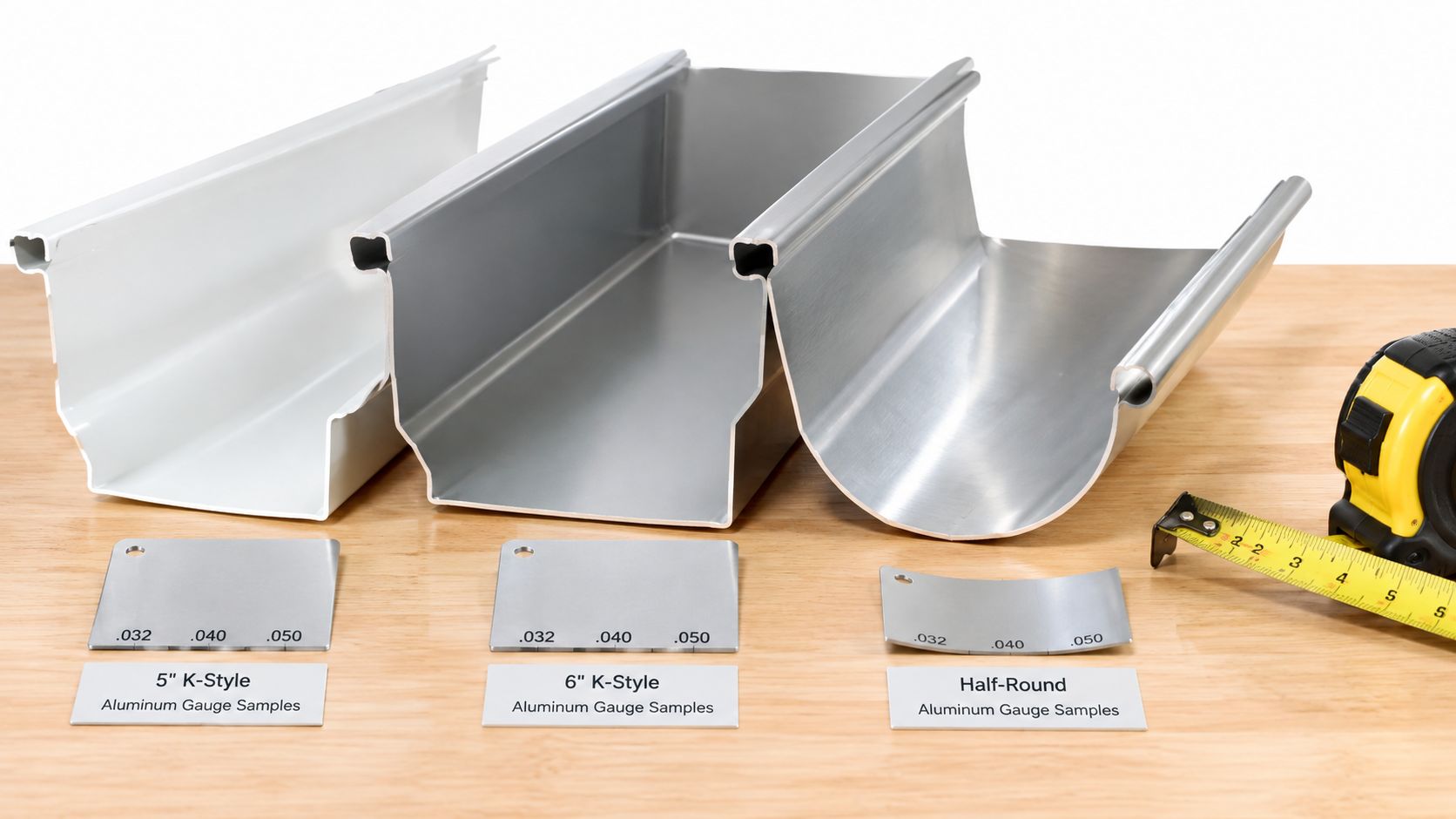
A better way to read this part of the estimate is to separate what is built into the system from what changes by house. Built into the system are the gutter profile, the coil quality, and the matching parts that make everything fit together. What changes by house is the labor. Height, corners, long runs, deck obstacles, and tight access can add more to the total than homeowners expect.
What changes inside an aluminum quote
Start with the profile. A 6-inch gutter usually costs more than a 5-inch gutter because it uses a larger coil and larger companion parts, including outlets, end caps, and downspouts. The difference is not just extra metal. It is a bigger drainage system from end to end.
Material grade matters too. Aluminum coil comes in different thicknesses and finish qualities, and contractors may price those options differently based on dent resistance, color availability, and how cleanly the product holds up over time. LeafFilter's guide to gutter materials gives a useful overview of how material quality and performance options can vary even within the same general category.
Then there are the parts homeowners do not always notice on a quote at first glance:
- corners and miters
- hidden hangers
- outlets
- end caps
- downspout elbows
- splash blocks or drainage extensions
A house with several roof turns can need far more fitting and fastening than a straight ranch run, even if the measured gutter length is similar.
Why labor often creates the bigger spread
Labor is where two similar-looking quotes can separate fast.
A one-story home with open ground access is usually straightforward. A two-story home with a steep grade, a sunroom below the eave, or landscaping that limits ladder setup takes more time and more care. Crews may need extra repositioning, more safety setup, and slower installation around problem spots. That added effort shows up in the price even if the gutter coil itself is the same.
The same thing happens with downspouts. One clean drop at each corner is simpler than routing around windows, porches, walkways, or air conditioning equipment. None of that is flashy, but it is real labor.
If you're budgeting exterior work more broadly, it helps to understand how labor and specification choices affect home projects in general. A resource like new home construction costs explained gives useful context for how scope, materials, and site conditions shape pricing across residential work.
Choosing the right setup for the house you actually have
For a simple roofline, a standard profile and basic layout may be all you need. For a house with heavy runoff, long roof sections, or awkward drainage paths, paying for the right profile and installation details can prevent overflow and callbacks later.
That is why it helps to ask one practical question at estimate time: which part of this quote is tied to better performance, and which part is tied to job difficulty? A clear answer helps you see what is required, what is optional, and where comparison shopping is fair.
In Columbus, HIBCO ROOF LLC provides gutter installation and replacement as part of residential exterior work, along with written estimates that help homeowners compare scope rather than guessing from a single total.
Financing Options and Long Term Return on Your Gutter Investment
A Columbus homeowner gets a gutter quote for $1,800 at the same time the house needs a few other exterior fixes. The first question usually is not whether gutters matter. It is whether this job needs to happen now, and what that total looks like in real monthly terms.
If that $1,800 project is financed over time, the payment can feel a lot more manageable than the full invoice at once. The exact amount depends on the lender, rate, and term, but the useful budgeting exercise is simple. Compare one monthly payment against the cost of putting off drainage work and risking fascia repairs, washout near the foundation, or repeat service calls during heavy rain.
As noted earlier, aluminum systems usually cost more upfront than sectional gutters and are often chosen because they reduce joints and maintenance points. The better question here is what part of your quote protects the house, and what part is flexible for timing or scope.
That distinction matters.
Some costs are hard to avoid if the system is going to work properly. You still need enough gutter for the measured roof edges, enough downspout capacity to move water away, and labor to remove the old system and secure the new one correctly. Those are the foundation of the job.
Other parts of the quote may give you room to adjust. Homeowners can sometimes phase related fascia repairs, choose a standard color instead of a special-order finish, or separate gutter guards into a later project if leaf buildup is not the immediate problem. In other words, the total is not just a material price. It is a mix of required drainage pieces and optional add-ons.
A simple kitchen-table way to judge return is to ask whether the money is solving an active water-control problem or only improving appearance. If gutters are overflowing at corners, leaking at seams, or dropping water next to the foundation, the return is easier to see because the replacement is preventing a known problem. If the current system still works and you are upgrading mainly for appearance, timing becomes a bigger part of the decision.
Bundling can also change the math. If gutters are replaced during roofing, fascia, or siding work, some setup and access costs may already be part of the larger project. That does not make the gutters free, but it can make the labor portion more efficient than doing the work as a completely separate visit.
One practical rule helps here. Do not trim the drainage layout just to force the quote under a target number.
Cutting a downspout run or undersizing part of the system is a little like buying cheaper brakes for a truck that still carries the same load. The upfront number drops, but the job the system has to do does not. A better approach is to ask the contractor which items are required for performance and which are optional for budget timing.
The strongest return usually comes from a quote that matches the house, keeps water away from trouble spots, and fits comfortably into the homeowner's cash flow.
Planning Your Seamless Gutter Project With Confidence
By the time you're comparing estimates, the headline number shouldn't be the only thing you look at. The smarter move is to confirm the scope.
A reliable quote for the cost of aluminum gutters should show the actual linear footage, note whether you're getting a 5-inch or 6-inch profile, and spell out what happens with downspouts, old gutter removal, and any fascia concerns. If you want a useful reference point for what a local installation page should cover, this overview of seamless gutter installation is the kind of detail homeowners should expect.
A short checklist before you sign
- Verify the measurements: Ask how many linear feet are being quoted and how that was measured.
- Confirm the profile: Make sure the estimate states whether the system is 5-inch or 6-inch.
- Check the downspouts: Don't assume they're included. Ask how many, where they'll discharge, and whether changes are planned.
- Ask about the substrate: If fascia is damaged, find out whether repair is included or excluded.
- Read the exclusions: A lower quote may leave out tear-off, disposal, or accessories.
- Review appearance items: Color, finish, and visible hardware should be written down.
Homeowners also sometimes think about gutters as part of the home's curb appeal after dark, not just drainage. If that matters to you, examples like Austin gutter lighting by Modern Yard Landscapes show how gutter lines can also play into exterior design planning.
A calm, written estimate is worth more than a fast verbal number. When the measurements are clear and the scope is itemized, you can compare contractors fairly and choose the setup that fits your house instead of guessing from a lump sum.
If you're comparing gutter quotes in Columbus or central Ohio, HIBCO ROOF LLC offers free written estimates for gutter installation and replacement, along with related exterior work like roofing, siding, and leaf protection. If you'd like a quote that breaks down measurements, profile size, and scope in plain language, visit HIBCO ROOF LLC.