
You walk outside the morning after a hard June storm in central Ohio and the clues are everywhere. The mailbox post has fresh divots. The downspouts are nicked up. Maple leaves are shredded across the driveway. Your car might even have new little dents. Then you look up at the roof and think, “It looks fine from down here.”
That's where a lot of homeowners lose money.
Roofing hail damage insurance isn't mostly about shingles. It's about what you can prove, when you prove it, and whether the damage crosses the carrier's line from cosmetic to functional. I've seen homeowners with obvious storm collateral get weak settlements because they filed fast and documented poorly. I've also seen homeowners push a denied claim back into payment because they had the right photos, the right test squares, and a contractor who knew how to read an estimate instead of just swinging a hammer.
If you treat a hail claim like a roofing job, you'll probably take whatever number the carrier gives you. If you treat it like a paperwork fight with deadlines, evidence rules, and deductible math, you give yourself a real shot at the right outcome.
Table of Contents
- The Morning After the Storm
- Why Hail Is the Claim That Keeps Coming
- How Adjusters Actually Measure Hail Damage
- RCV, ACV, and the Deductible Math
- Why Hail Claims Get Denied and How to Push Back
- Where Your Contractor Changes the Outcome
- Moves That Consistently Maximize a Hail Claim
- Bringing It All Together Before You Call
The Morning After the Storm
The driveway tells the story before the roof does.
A homeowner in central Ohio steps outside after an evening hailstorm and sees dents in the gutter apron, marks on the A.C. fins, and leaf litter torn to pieces under the maple tree. The shingles still look flat from the ground. No chunks missing. No dramatic hole. That calm-looking roof is exactly what fools people into waiting.
What to document before anything changes
The first day matters more than you might realize. Photos taken before anyone touches the roof carry weight because they lock in the condition of the property right after the loss. Once a tarp goes up, debris gets cleaned, or a gutter gets replaced, you've erased part of your evidence.
Start at ground level and work the whole exterior.
- Photograph collateral hits: Get clear shots of downspouts, gutters, window screens, metal vents, mailbox posts, patio furniture, and vehicles if they took impact.
- Capture the storm footprint: Wide photos help show the damage wasn't isolated to one random spot.
- Check the gutter bases: If you see fresh granules collecting near downspout exits, pay attention.
- Use a ladder carefully, not the roof itself: You may be able to spot bruised shingle surfaces or ridge cap issues from the eave without climbing onto a slick slope.
Practical rule: The claim file starts the morning after the storm, not when the adjuster shows up.
What usually gets missed
Most hail damage that matters to a claim isn't dramatic from the lawn. It shows up in soft metals first, then in shingle bruising, granule displacement, and mat damage that needs close inspection. Ridge caps and hips often tell the story early because they're more exposed and easier to read.
Resist the urge to “just go up and check.” A wet roof and a rushed homeowner are a bad mix. Get the perimeter photos, save any obvious storm debris patterns, and keep notes on the date and time.
That first set of photos often decides whether the carrier sees a storm event or sees a worn roof with a convenient story attached to it.
Why Hail Is the Claim That Keeps Coming
Hail isn't some oddball coverage issue. It's one of the main drivers behind homeowner property losses, and insurers price, inspect, and dispute roofs accordingly.
The Insurance Information Institute reported that wind and hail accounted for 42.5% of insured homeowner property-damage losses in 2023, compared with 22.6% for water damage and freezing and 21.6% for fire and lightning. The same source said roughly one insured home in 36 files a wind-or-hail claim in a given year, with an average paid claim of about $14,747 across 2019 to 2023. Those figures are summarized in this hail damage claim overview. That's why carriers don't treat hail as a niche event. They treat it as a recurring cost center.
Why insurers stay skeptical
Hail claims keep coming because roof damage often doesn't fail all at once. Wind can rip a tab loose and make the loss obvious. Hail is trickier. It can bruise a mat, displace protective granules, and shorten roof life without creating a leak the same week.
That delayed pattern is exactly why these claims get argued so hard.
For longer-range loss context, an American Meteorological Society study found that hail produces insured losses that average more than $850 million annually, and those losses were higher than every other country cited in that study. The same body of reporting highlighted that non-catastrophic wind-and-hail roof claims rose from 17% to 25% of all residential claims between 2022 and 2024, and Verisk data showed 16 states recorded severe hail impacts on more than 20% of roofs. Kansas had 51.8% of roofs impacted and a long-term average annual hail loss of $2.2 billion, as discussed in this hail loss research and industry summary.
Hail claim frequency at a glance
| Year | Avg Hail Claims (US) | Avg Severity per Claim | Central Ohio Activity |
|---|---|---|---|
| 2019 to 2023 | Roughly one insured home in 36 files a wind-or-hail claim in a given year | About $14,747 | Spring and early-summer storm activity regularly puts homeowners into the hail-claim cycle |
| 2023 | Wind and hail made up 42.5% of insured homeowner property-damage losses | Qualitatively high because roof systems absorb visible damage | Central Ohio homeowners often see collateral metal damage before they see obvious shingle failure |
| 2022 to 2024 | Non-catastrophic wind-and-hail roof claims rose from 17% to 25% of all residential claims | Not separately stated in the verified data | Carriers treat hail reviews as routine, not rare |
In central Ohio, that means you shouldn't think of hail as a fluke. You should think of it as a familiar insurance event with very familiar pushback.
How Adjusters Actually Measure Hail Damage
Adjusters don't get paid to stare at your roof and go with a gut feeling. They build the scope from repeatable field documentation. If your side of the claim doesn't follow that same logic, you're talking past the process.
The test square is the language of the claim
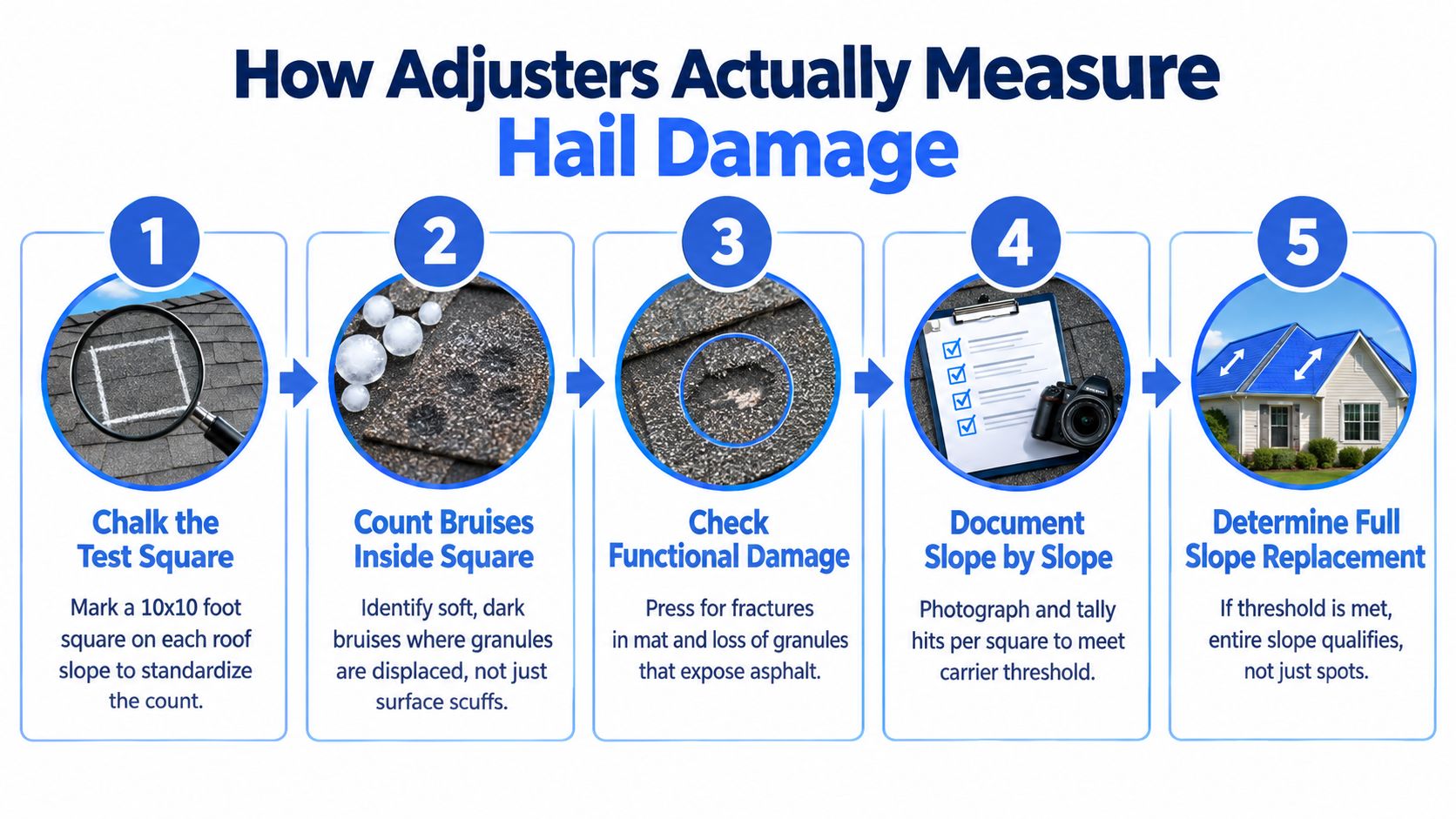
On asphalt shingle roofs, insurance-grade hail assessments typically use 10 foot by 10 foot test squares, or 100 square feet, placed on each roof slope. That method is outlined in this InterNACHI explanation of hail damage test squares. The point is simple. The adjuster needs a representative sample on every exposure, not one dramatic photo from the worst spot on the roof.
Inside each square, they're looking for specific markers:
- Bruised shingles: Soft impact points where the mat underneath may be fractured
- Displaced granules: Not casual scuffing, but impact areas where protection has been knocked away
- Exposed asphalt or fractured matting: That's where the cosmetic argument starts to weaken
- Pattern consistency: Random wear doesn't usually spread in a storm pattern across multiple slopes
Ridge and hip shingles usually get checked early because they take direct hits and can reveal damage faster than flatter field shingles.
What a real inspection packet should include
A serious hail file is boring in the best possible way. It's organized, repetitive, and tied to each slope.
That means:
- Slope-by-slope photos with enough distance to orient the shot
- Close-ups of hits with a coin, finger, or chalk circle for scale
- Notes on brittleness and age because old shingles break differently than newer ones
- Collateral metal evidence that supports storm intensity
- Consistent square placement so counts can be challenged if the carrier's sample is weak
If the adjuster built the estimate from test squares, your rebuttal has to come back in test-square language too.
That's why a roof inspection for claims needs to be technical, not casual. If you want a better sense of what carriers and contractors are debating on site, this breakdown of a roof damage insurance adjuster visit is worth reading.
RCV, ACV, and the Deductible Math
Most homeowners don't get burned on a hail claim because coverage was impossible. They get burned because they didn't understand the payment formula until the first check landed.
The two terms you need to know are replacement cost value, or RCV, and actual cash value, or ACV. The National Association of Insurance Commissioners explains the difference clearly in this guide to replacement cost vs actual cash value. RCV pays the cost to repair or replace damaged property without deducting depreciation. ACV pays the depreciated amount, with age, condition, and wear taken into account.
What that means in plain English
If you have an RCV policy, the insurer may still hold back depreciation until the work is completed and documented. If you have ACV coverage on the roof, the lower number isn't temporary. It may be the whole game.
That's where older roofs get ugly fast. A Montana insurance bulletin states that once a roof reaches about 10 to 15 years old, hail damage may be paid at ACV rather than replacement cost, meaning the insurer may not fully fund a new roof even when the loss is covered. That guidance appears in this state bulletin on hail-damaged roof coverage.
RCV vs ACV payout on a sample hail claim
| Line Item | RCV Policy | ACV Policy |
|---|---|---|
| Covered roof loss | Pays to repair or replace without deducting depreciation | Starts from a depreciated value based on age and condition |
| Depreciation | Typically recoverable after completed work is documented | Deducted and usually not recoverable |
| Deductible impact | Deductible still applies | Deductible still applies after depreciation reduces the claim value |
| Final homeowner out-of-pocket | Usually lower than ACV if the roof qualifies and paperwork is completed | Often higher because the roof value is reduced before payment |
Texas gives a clean example. The Texas Department of Insurance shows how a $10,000 roof loss with a $4,000 deductible can result in a $6,000 insurer payment under replacement cost coverage, while ACV pays less because depreciation is subtracted before the deductible is applied. You can see that example in this Texas roof-loss settlement explainer.
Where homeowners miss money
The estimate itself is where underpayment often starts. Check for missing line items like starter, ridge, underlayment, flashing, drip edge, ventilation components, and other related scope items that belong with a proper roof replacement. If your carrier pays RCV, make sure your contractor submits the final invoice and completion documents needed to release recoverable depreciation.
A lot of people cash the first check and assume that's the settlement. It often isn't.
If you want the policy language translated into normal speech before you sign anything, this guide on actual cash value vs replacement cost roof coverage is a useful companion.
Why Hail Claims Get Denied and How to Push Back
Most denials follow a handful of patterns. They're predictable, and that's good news, because predictable pushback can be answered with the right file.
The four arguments carriers lean on
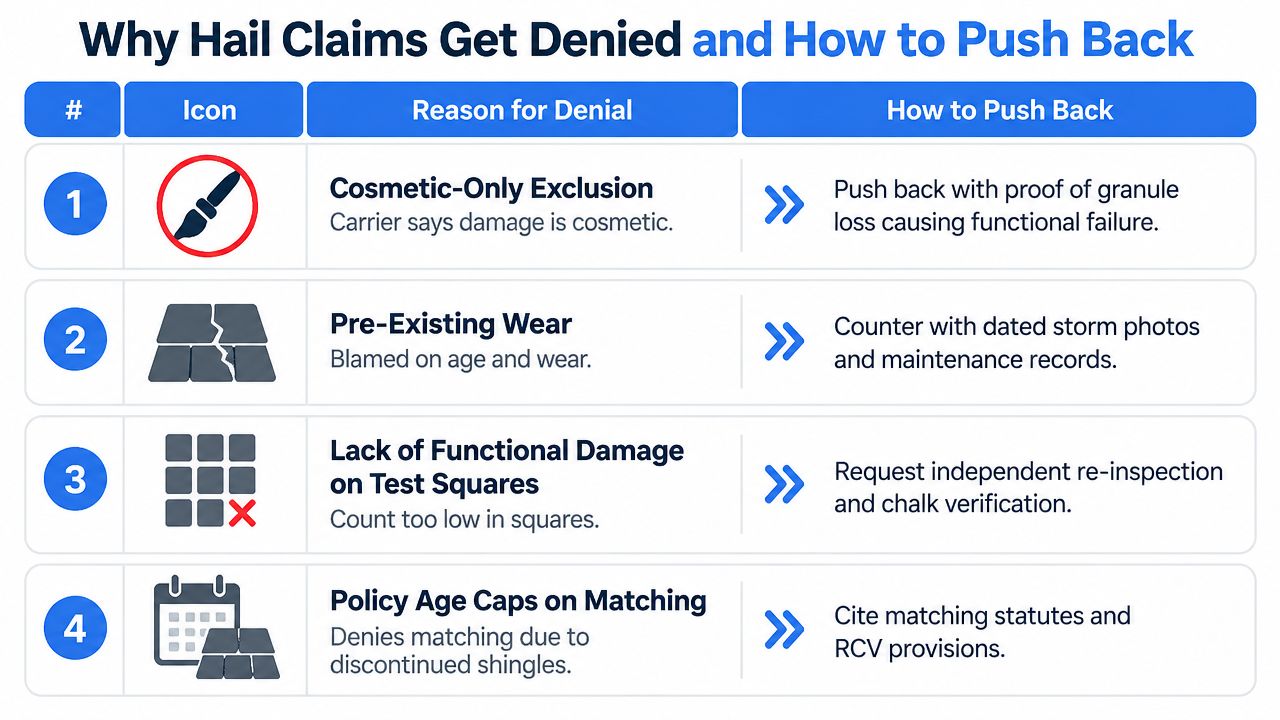
The first is cosmetic-only damage. The carrier says the roof is marked up but still functional. That's where granule loss matters. Expert guidance notes that the mineral granule surface protects asphalt from UV exposure, and when repeated hail removes that protective layer, the asphalt can become brittle and deteriorate faster. That issue is discussed in this technical note on hail-driven granule loss.
The second is pre-existing wear. The adjuster points to aging, foot traffic, blistering, or old repairs and says the storm didn't create the condition.
The third is insufficient hits inside the test squares. The carrier doesn't dispute the storm happened. It disputes that your roof met its threshold.
The fourth is matching and age restrictions. On older roofs, carriers may resist paying to blend or replace adjacent areas when shingles can't be matched cleanly.
What moves a denial
You don't beat these arguments with outrage. You beat them with cleaner evidence.
- For cosmetic denials: Bring close-up photos that show granule displacement tied to functional exposure, not just visible marks.
- For wear-and-tear denials: Use dated storm photos, prior maintenance records, and collateral metal damage from the same event.
- For weak test-square counts: Request a reinspection and make sure the competing square locations are marked and photographed.
- For matching disputes: Get manufacturer documentation on discontinued shingles or incompatible replacement options.
A denial letter is usually a position statement, not the final truth about the roof.
A formal supplement packet should answer the carrier line by line. If that stalls, a public adjuster or coverage attorney may become necessary, especially when the dispute turns from damage to policy interpretation. The same paperwork principles show up in other exterior losses too. If you want a parallel example outside roofing, this guide on navigating tree damage insurance claims is useful because it shows how documentation, causation, and scope drive payment in another storm-damage category.
One more reality check matters here. Verisk reported average U.S. residential roof replacement costs at $17,631 in 2025, up 33% from the 2021 to 2024 average, while repair costs rose 25% to $4,699. That projected severity pressure for 2025 was highlighted in this Verisk roof risk outlook. When replacement numbers rise, scrutiny rises with them.
Where Your Contractor Changes the Outcome
A good contractor doesn't “fight the insurance company” in the dramatic sense. That phrase gets abused. What a good contractor does is much more useful. They review scope, document missed items, support code requirements, and keep the adjuster focused on the roof that exists instead of the simplified version on a spreadsheet.
The contractor who helps versus the one who disappears
The useful contractor shows up with measurements, slope photos, collateral documentation, and a written supplement if needed. They understand how to compare the roof in front of them to the line items in the insurer estimate. They can explain why ridge, starter, flashing, ventilation, or accessory components are missing.
The useless contractor says, “Insurance will buy it,” then vanishes until a check clears.
That difference is enormous.
What to expect from a serious inspection
A thorough contractor should bring more than a sales pitch. The file should include:
- Chalk-marked test areas: So their findings can be compared to the carrier's square counts
- Complete roof imagery: Drone photos can help capture every slope cleanly when site conditions make ladder shots messy
- Interior and attic observations: Moisture staining and ventilation conditions matter when scope gets debated
- A written supplement packet: Not just verbal complaints about the estimate
HIBCO ROOF LLC is one example of a central Ohio contractor that provides storm and hail damage assessment, documentation, and insurance-claim support as part of its residential roofing work. That's the kind of role you want from any contractor you consider. Not “trust us.” Actual documentation.
Before you sign anything
Be careful with assignments, contingency language, and who controls the claim paperwork.
Ask these questions in plain terms:
- Who gets the insurance check if my claim is approved?
- Who writes and submits supplements?
- Who meets the adjuster on site?
- What happens if the carrier approves less than your proposed scope?
- Are you local enough to come back if the claim drags out?
A contractor should make the file clearer, not more confusing.
Moves That Consistently Maximize a Hail Claim
The best claim outcomes usually come from a sequence, not one magic trick. Homeowners who stay organized and slow down just enough to build a clean file usually do better than homeowners who panic-call the carrier and hope the adjuster catches everything.
The sequence that works
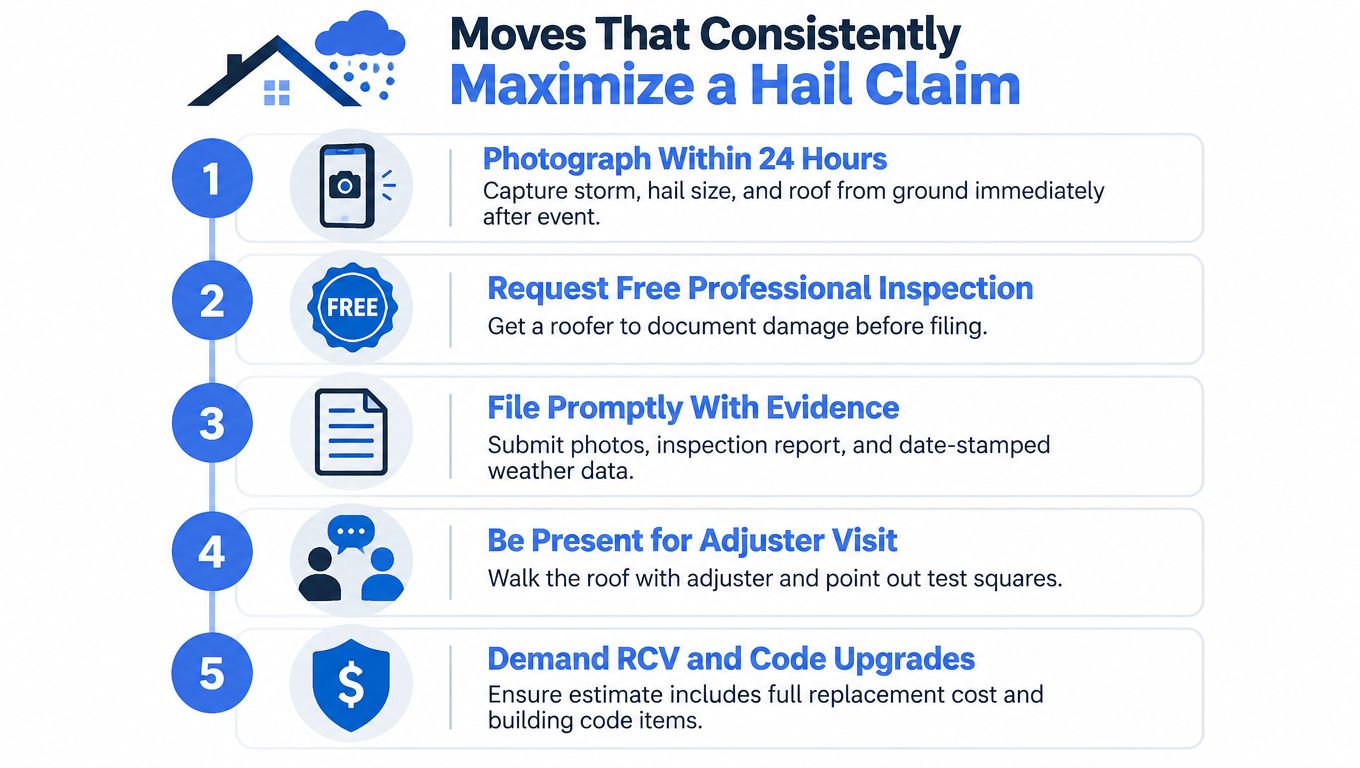
First, document the property within 24 hours if it's safe. Take date-stamped photos of the roof from the ground, all elevations, gutter lines, downspouts, metal vents, screens, mailbox damage, siding marks, and vehicles.
Second, get a contractor inspection that same week. Not after a repair. Not after your cousin climbs up there. Before anything changes.
Third, file the claim before anyone starts roof work. Emergency protection is one thing. Changing the evidence is another.
What to do at the adjuster appointment
Don't let this turn into a driveway conversation.
- Be present: If you can't attend, have someone there who understands the file.
- Insist on slope-by-slope review: A serious hail claim should not end with a glance from the lawn.
- Bring matching test squares: If your contractor found functional hits, those areas should be available for comparison.
- Ask for line-item scope: Never accept a vague verbal statement that “they bought the roof” or “they only bought a repair.”
The settlement usually improves when the homeowner stops acting like a spectator and starts acting like the keeper of the file.
The mistakes that cost people money
Some mistakes show up over and over:
- Waiving the deductible: If a contractor offers to “take care of it,” walk away.
- Using out-of-state storm crews: If a supplement is needed later, you want someone who still answers the phone.
- Accepting the first ACV check without questions: Especially if the policy may owe recoverable depreciation or a broader scope
- Signing a partial repair scope too fast: Once you bless a weak estimate, it gets harder to reopen missing items
A hail claim isn't won by being aggressive. It's won by being prepared.
Bringing It All Together Before You Call
Before you file, stop and pressure-test your position. Most bad claim outcomes can be traced back to one of five gaps. The homeowner didn't know the policy form. Didn't know the deductible. Didn't have slope-specific evidence. Didn't verify the storm date tightly enough. Or didn't bring a contractor who could speak the adjuster's language.
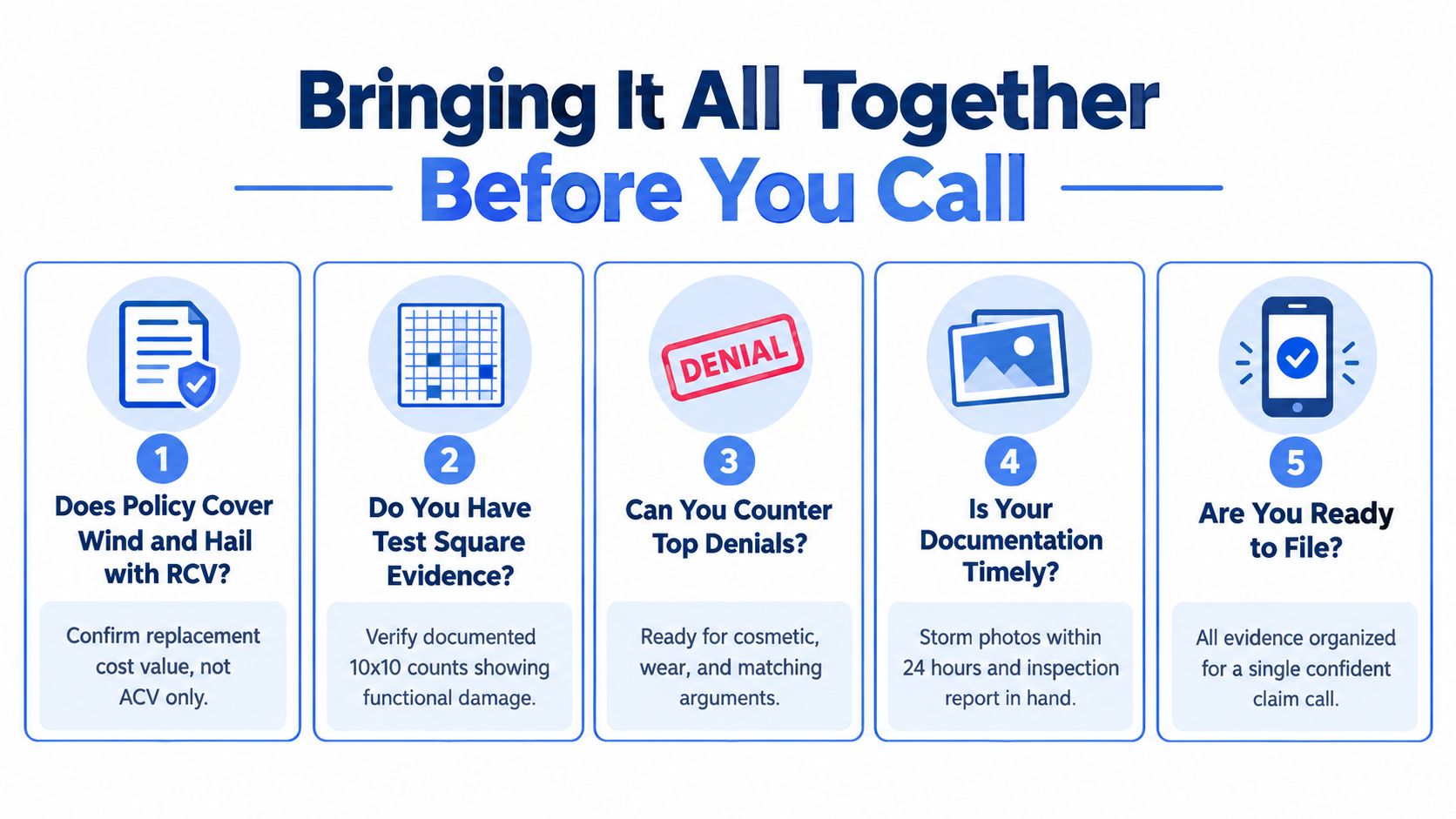
The five-question readiness check
Ask yourself these questions before you make the call:
- Do I know whether my roof is covered on RCV or ACV? If you don't know, pull the declarations page before the claim starts.
- Do I know my wind or hail deductible in dollars? If that number shocks you later, the claim can fall apart financially even if coverage exists.
- Do I have slope-specific photo evidence? Not just “roof looks bad,” but actual documented findings.
- Do I have storm-date support tied to my property? Use a local report that fits your address and date, not loose chatter from another part of town.
- Do I have a written inspection report? Verbal opinions don't help much once the claim turns adversarial.
The one move that changes most settlements
If you do only one thing right, do this. Bring a contractor to the adjuster meeting with matching test squares and a written rebuttal ready if the carrier leans on cosmetic damage. That single move changes the conversation from opinion to comparison.
For homeowners who want to tighten up their file before that visit, this guide to a roof inspection for insurance claim preparation lays out what your documentation should look like.
The roof work itself usually isn't the hard part. The hard part is proving enough functional damage, on the right slopes, in the right time window, under the right policy language, with enough discipline to challenge a weak scope. That's why roofing hail damage insurance is really a documentation problem wearing a shingle problem's clothes.
HIBCO ROOF LLC helps Columbus and central Ohio homeowners inspect storm damage, document slope-by-slope hail evidence, review insurance scopes, and handle the roof replacement or repair once the claim is settled. If you want a local contractor who understands both the roof and the paperwork, visit HIBCO ROOF LLC and schedule an inspection before your claim file goes sideways.